
Securing a single successful lab-grown diamond order is a good start, but it does not guarantee you can repeat that result. A clear review of supplier red flags before scaling helps jewelry brands assess whether quality control, certifications, export experience, and custom design support can remain consistent beyond the first shipment. First orders often receive better treatment, and without a structured system, subsequent shipments can drift in quality, color, or cut. For jewelry brands building a line around lab-grown stones, inconsistency is a direct threat to product reputation and customer trust.
For the full framework, read China Lab-Grown Diamond Supply Chain Guide.
This article moves past general sourcing advice to address the specific operational challenge of repeatability. It provides a clear framework for locking specifications, tracking grade distributions to catch drift, and managing price fluctuations between orders. You will learn how to build a sourcing system that treats each order as a data point, uses simple scorecards to evaluate suppliers, and shifts from single-source reliance to a balanced portfolio that protects your supply chain and your margins.
For brands new to this process, it is worth acknowledging that the system described here requires upfront effort. The first few orders will demand more documentation and verification than most brands initially expect. However, the investment in structure pays off when reorders become predictable and inventory quality remains consistent across product runs. The alternative — relying on informal notes and supplier goodwill — often leads to costly mismatches that erode both margins and customer confidence.
| Area of Focus | Common Mistake | Repeatable System |
|---|---|---|
| Specifications | Using fixed single grades (e.g., G color) | Using range-based specs (e.g., G-H) with confirmed distribution |
| Shape Reliability | Treating all shapes as equally reorderable | Relying on rounds, cushions; requiring visual inspection for ovals, pears |
| Quality Tracking | Checking only the range passed or failed | Tracking full grade distribution per order to detect drift |
| Supplier Relationship | Relying on a single source for all orders | Maintaining a balanced portfolio of 2–4 vetted suppliers |
| Price Management | Accepting any price change at reorder | Flagging deviations over 10% and comparing grading reports |
| Documentation | Keeping informal records | Maintaining per-order performance sheets with standard reorder tables |
Quick Questions Before You Read
Q: Is one successful sample order enough to trust a supplier?
No. First orders often get priority treatment. A repeatable system requires locking specs in writing and tracking multiple orders to verify consistency.
Q: How do I know if my diamond quality is drifting between orders?
Tracking the full grade distribution—not just the pass/fail range—across each order reveals gradual shifts that a simple range check would miss.
Q: Should I buy all my lab-grown diamonds from one supplier?
No. A portfolio of 2–4 vetted sources reduces risk, maintains leverage, and gives you a fallback if one supplier’s quality or pricing becomes unreliable.
Q: How do I handle price changes between repeat orders?
Build a pricing baseline from your first order and question any deviation over 10%. Compare grading reports to verify if the price change reflects a real quality difference.
Why a Single Successful Order Does Not Prove a Reliable Supplier Fit
One good order is not a system. Many jewelry brands discover this only after placing a second order that looks noticeably different from the first — different color, different clarity distribution, different proportions. The gap between a successful transaction and a reliable sourcing relationship is wider than most buyers assume, and crossing it requires more than a positive first impression.
The Common Mistake Brands Make After a Good First Order
The pattern is predictable. A brand orders a mixed parcel, receives acceptable quality at a competitive price, and assumes the supplier can replicate that result indefinitely. This assumption ignores how first orders are often handled inside the supplier’s operation. First orders frequently receive preferential sorting, better rough allocation, and more attention from senior production leads. The supplier wants to win the account, so they put their best inventory and their most experienced people on the job. The second order does not get the same treatment unless the buyer has locked down specifications in writing.
Without documented requirements, the second order can drift significantly. Color may shift toward the lower end of the stated range. Clarity may include more stones near the bottom of the grade boundary. Proportion distributions may widen. The supplier is not necessarily acting in bad faith — they are simply working with a different inventory pool and a different level of internal priority. The brand, having assumed consistency, now holds stones that do not match their existing stock or their customer expectations.
How Supplier Attention Levels Shift Between First and Repeat Orders
Many China-based suppliers operate a tiered service model that most first-time buyers never see. A new order is often routed through a senior production manager who personally selects rough, monitors cutting, and reviews final grading. That same order, when repeated, may be handed to a junior coordinator pulling from a different rough bin and working under looser supervision.
This shift introduces variance at multiple points. Stone selection changes because the coordinator does not have the same familiarity with the buyer’s preferences. Cutting consistency drifts because the junior contact may accept wider tolerance in proportions. Final grading shifts because a different person is reviewing the output. The supplier’s quality control process may be structurally sound, but the human factors — who picks the stones, who oversees the cutting, who signs off on the parcel — change between orders.
Brands that do not lock specifications in writing lose control of this transition. Verbal instructions or email summaries are not enough. The supplier’s internal handoff depends on documentation, and if the buyer did not provide it, the junior coordinator works from whatever notes are available, which is often less than what the senior manager knew from the first conversation.
What to Verify Before Scaling to Repeat Orders
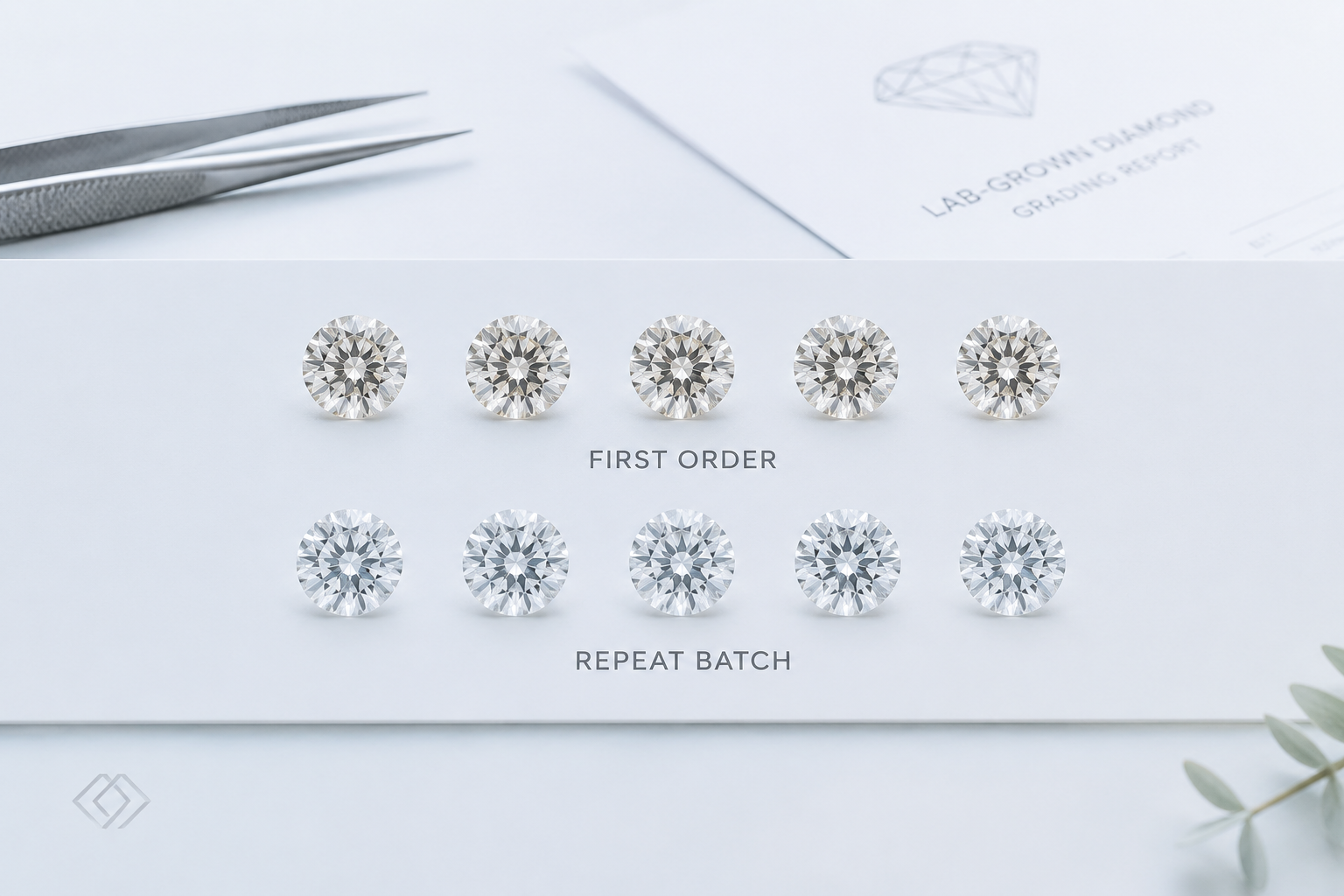
Before committing to volume, request side-by-side comparison photos of stones from the first order alongside the proposed second batch. The visual comparison reveals differences that grade reports cannot capture — slight shifts in brightness, pattern symmetry, or face-up color that change how the stone looks in a setting.
Ask the supplier to confirm in writing whether the rough source, the cutting line, and the final grader remain the same. If any of these have changed, you need to evaluate whether the new configuration can deliver the same result. Document the response in your order notes and reference it when reviewing the next shipment. Do not assume continuity without written confirmation. A supplier who cannot or will not provide this documentation is signaling that their internal process is not structured for repeatable quality, regardless of how good the first order looked.
A further point worth noting is that the distinction between laboratory-grown diamonds and natural diamonds is critical here. When a supplier describes a stone simply as a “diamond,” a buyer should confirm whether the reference is to a laboratory-grown diamond or a mined diamond. For brands sourcing lab-grown stones, documenting this origin in every order and specification sheet is a practical step that prevents confusion and aligns with the Federal Trade Commission’s guidance on clear disclosure. It is not necessary to over-explain the distinction in every conversation, but because the sourcing system relies on precise documentation, specifying “laboratory-grown diamond” rather than just “diamond” in written records eliminates any ambiguity about the product’s origin at the specification and reorder stage.
Defining Your Specification Ranges for Repeatable Quality Bands
General quality targets like “G-H color, VS clarity, good make” sound clear but are functionally vague. They leave room for interpretation on every variable that matters for visual consistency. To build a repeatable sourcing system, brands must translate these loose descriptions into defined specification bands that can be communicated, verified, and enforced across multiple orders. This shift — from fixed grades to range-based specs — is the difference between hoping for consistency and designing for it.
Why Fixed Color and Clarity Grades Cause Reorder Problems
A fixed target such as “G color, VS1 clarity” assumes every stone in the parcel falls exactly on those lines. In reality, parcels contain stones that grade near the boundary of adjacent categories. A G can be near GH or near F. VS1 can be near VS2 or near SI1. When a supplier fills a fixed target, they are incentivized to push boundary stones into the parcel — stones that technically meet the grade but sit at the edge of the range rather than the center.
The result is visual inconsistency between orders. The first parcel may have contained stones averaging toward the middle of G color and VS1 clarity. The second parcel, filled from a different inventory pool, may contain stones that barely qualify. On paper, both orders satisfy the same grade target. In a jewelry setting, they look different. The buyer discovers the mismatch only after setting stones into finished pieces, at which point the cost of replacement is significant.
Range-based specifications solve this problem. A spec of “G-H color, VS1-VS2 clarity” gives the supplier clear upper and lower limits. It tells them exactly which stones are acceptable and which are not. More importantly, it matches the real distribution of a natural production run. Parcels of lab-grown diamonds naturally contain stones that fall across a range. By setting a range, you align your specification with how stones actually come out of production, reducing the supplier’s incentive to push boundary stones into your order.
A further compliance consideration arises here. When a brand specifies a grade range for laboratory-grown diamonds, the grading report documenting that range should clearly identify the stones as laboratory-grown. If a supplier provides a grading report that does not state “laboratory-grown,” the buyer should verify the report’s classification and, if necessary, request a corrected or confirming document. This practice is not about distrusting the supplier; it is about ensuring that the documentation trail from order to order consistently and accurately reflects the origin of the stones, which supports both internal quality tracking and any future customer-facing disclosure requirements.
Setting Proportion and Measurement Guardrails for Matching Stones
Color and clarity grades capture only part of what makes a diamond look consistent. Proportion and measurement guardrails prevent the supplier from sending stones that grade the same but look visibly different when set next to existing inventory.
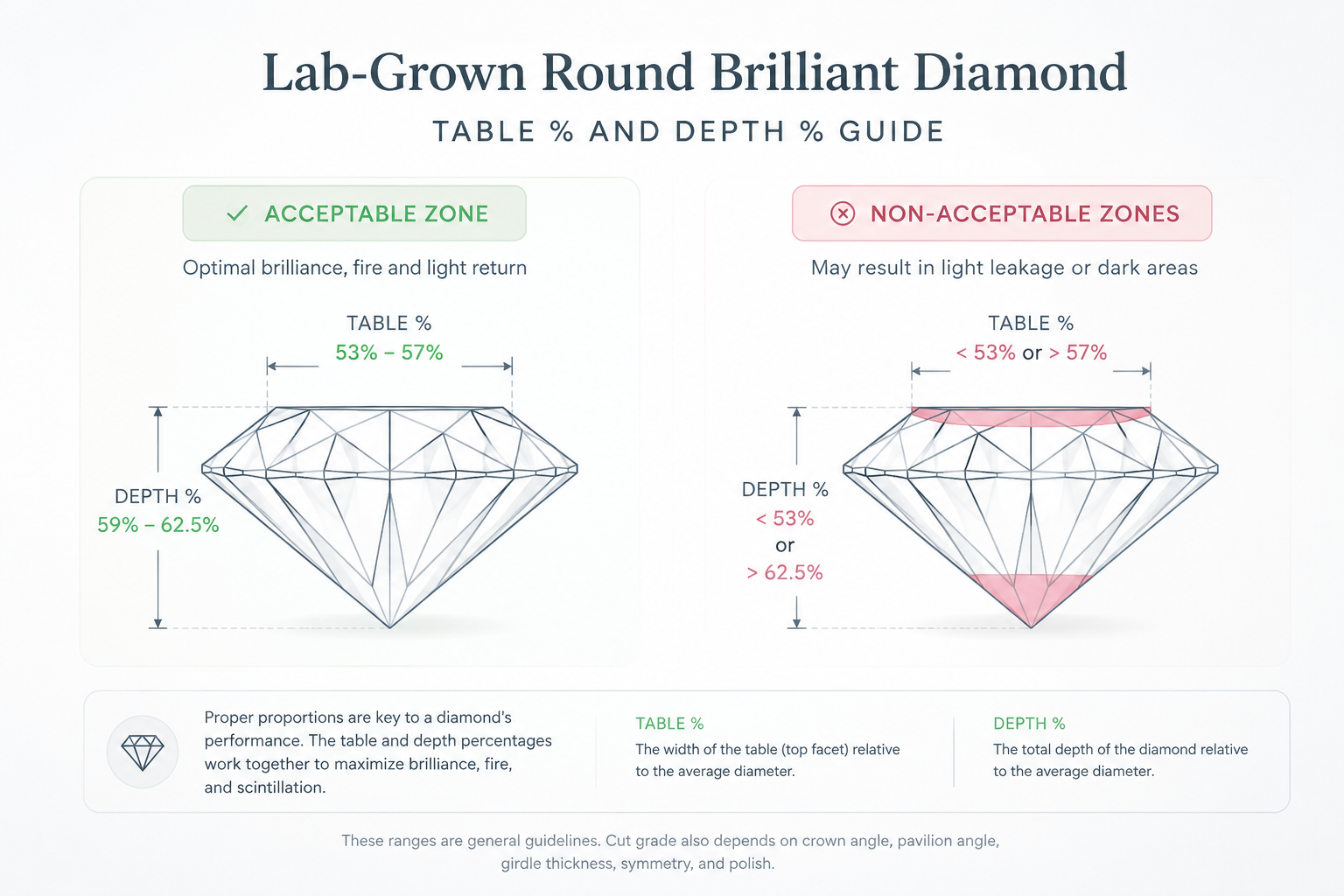
For shapes with defined cut parameters — round brilliants, princess cuts, and some cushion cuts — set acceptable ranges for table percentage, depth percentage, crown angle, and pavilion angle. A round brilliant with a 58 percent table and 34.5 crown angle looks different from one with a 62 percent table and 32 crown angle, even if both carry the same cut grade. The difference matters most when stones are set together in multi-stone rings, earrings, or matched pairs.
For fancies like oval, pear, and marquise, the critical guardrail is the length-to-width ratio. A 1.40 ratio oval looks visibly longer than a 1.30 ratio oval. If your first order contained ovals averaging a 1.35 ratio, your second order should specify a range tight enough to match — 1.33 to 1.37, for example, rather than the industry-wide 1.30 to 1.50 that suppliers commonly accept. Without this guardrail, the second delivery may contain stones with a different visual silhouette, making them unusable for the designs you planned.
What This Means in a Real Purchase
Before placing a repeat order, confirm that your specification range matches the actual distribution of stones you approved from the first order. Review the grading reports from the first parcel and note where most stones actually fell. If the average was H color and VS2 clarity, do not set a G-VS1 range unless you are willing to pay more for a higher-grade parcel. A tighter specification may sound better, but if it does not match what you already hold, the reorder will not match your existing inventory.
Match the range to what you already have, not what you hope to receive. This is the practical difference between a specification system that works and one that creates unnecessary friction with your supplier.
For buyers, it is also worth noting that proportion guardrails are not a substitute for visual review. A stone can meet all proportion targets and still show poor brightness or symmetry due to facet alignment or rough quality. The guardrails help narrow the field, but the final judgment should involve viewing representative stones, especially for shapes where cut quality is not captured by a single grade.
Shape Performance Tiers: Standard, Preferred, and Custom-Cut Channels
Not all diamond shapes behave the same way in a sourcing system. Some shapes can be reordered reliably with minimal variation across batches. Others require tighter specifications, more visual inspection, validated lab grown diamond certificates, or entirely different lead-time expectations. Organizing shapes into performance tiers helps brands decide which shapes to stock broadly, which to treat as premium controlled items, and which to handle through custom cutting rather than inventory replenishment.
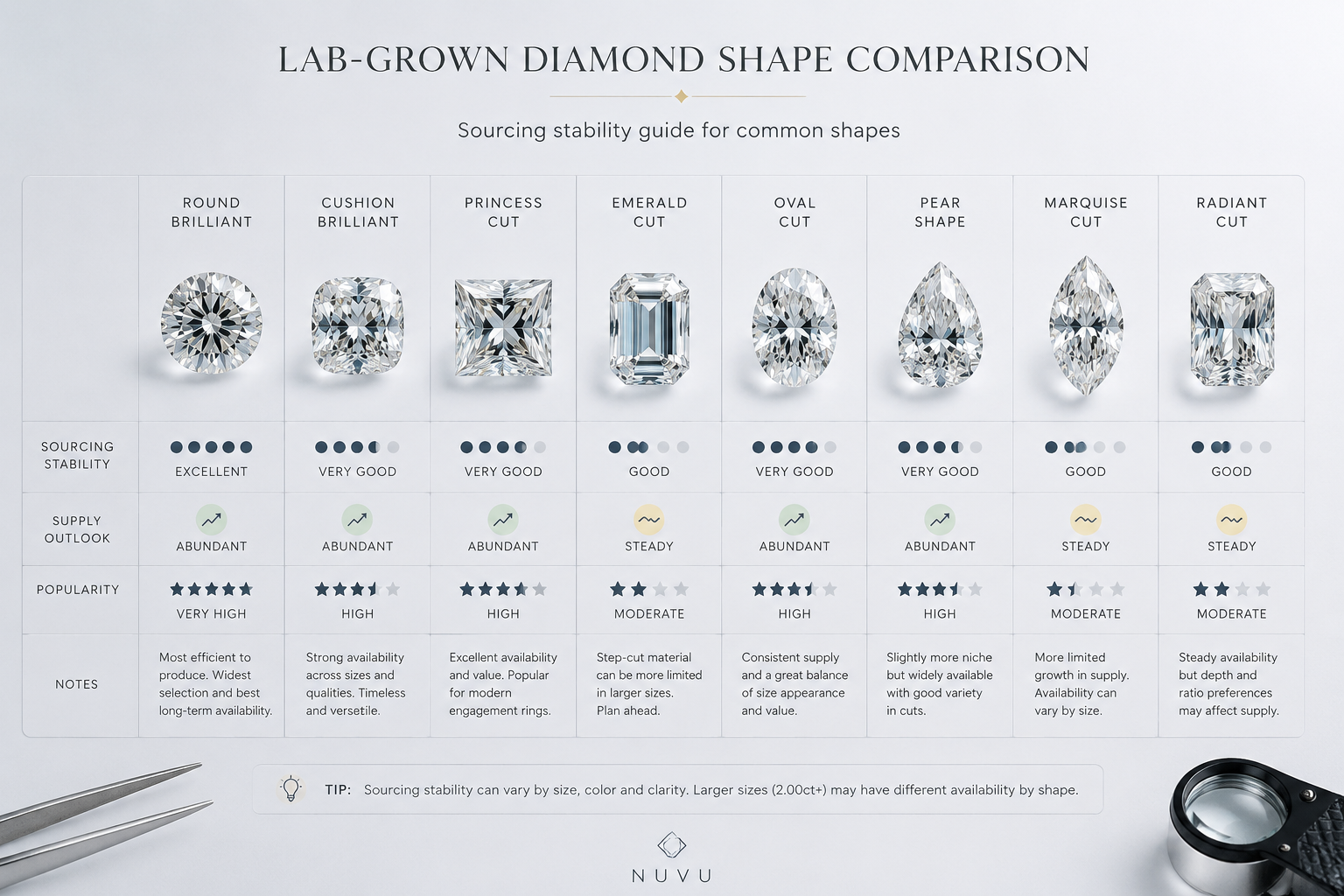
Standard Channels: Round, Cushion, Princess, Emerald
Round, cushion, princess, and emerald cuts benefit from the highest cutting volumes in the lab-grown diamond market. Suppliers produce these shapes continuously, which means consistent rough availability, standardized proportion ranges, and repeatable cutting outcomes. A supplier can reliably produce multiple stones within the same specification band for these shapes because the production process is well-practiced and the rough input is stable.
For brands building a repeatable sourcing system, these shapes should form the foundation of inventory. They are the most predictable to reorder, the least likely to suffer from variance between batches, and the easiest to match across orders. If a brand needs to maintain consistent product lines across multiple reorder cycles, the standard channel shapes are where that reliability is most achievable.
Preferred Channels: Oval, Pear, Marquise
Oval, pear, and marquise cuts have higher variance than standard shapes, primarily because their length-to-width ratios, shoulder shapes, and faceting patterns vary more across individual stones. A single order of ovals may yield stones that look noticeably different when laid out side by side — some more elongated, some wider, some with different shoulder curvature.
Preferred channels require tighter ratio-range definitions and more visual inspection before acceptance. Brands should order slightly more inventory than needed to allow for selection, rejecting the stones that fall outside the desired visual profile. This is not a sourcing failure but a structural reality of shapes that are cut from rough with less standardized geometry. If a brand plans to set ovals or pears in multi-stone designs, the selection process becomes even more important, because mismatched stones will be set next to each other.
Custom-Cut Channels: Radiant, Asscher, Non-Standard Fancies
Radiant, asscher, and non-standard fancy shapes have lower cutting volumes and wider variation in cut quality. These shapes may require dedicated rough sourcing, longer lead times, and more coordination between the brand and the supplier’s cutting team. The supplier is not producing these shapes continuously; they are cutting them in smaller batches or to order, which means less predictability in proportion, clarity placement, and overall consistency.
Brands should treat custom-cut channels as made-to-order items rather than stock replenishment items. Do not rely on these shapes for rapid reorder cycles or for maintaining consistent inventory levels across product lines. Instead, plan for longer lead times, accept that each batch may require more careful inspection, and consider whether the visual variation is acceptable for the intended design. For single-stone pieces with a specific design brief, custom-cut channels offer flexibility. For repeatable product lines, they introduce friction that most brands should avoid until their sourcing system is mature enough to absorb it.
Certificate Standards: Building a Verification Workflow for Reorders
Certificates create the illusion of perfect consistency. Two stones with the same grade from the same lab can still differ visually, because grading involves human judgment within accepted tolerances. When you scale from one order to repeat orders, that tolerance band becomes the main source of drift. The goal is not to eliminate all variation—that is not possible—but to catch meaningful shifts before stones reach your inventory.
A key compliance consideration here is that a grading report documents key characteristics — color, clarity, cut, carat weight — but it should not be treated as a guarantee of beauty, value, or sourcing ethics. For a sourcing system, this means the grading report is a verification tool, not a quality assurance endpoint. The report tells you that a stone falls within a certain grade window; it does not tell you how the stone will look in a specific setting or how it compares visually to stones from other orders that may have been graded at the edge of that window. Building a verification workflow that treats the report as one data point among several — alongside visual inspection, proportion measurement, and supplier documentation — creates a more realistic and defensible basis for comparing stones across orders.
Which Grading Protocols Are Most Repeatable for Supplier Comparison
GIA, IGI, GCAL, and AGS all produce reliable reports, but they do not grade identically. Color tolerance ranges differ. Clarity plotting conventions vary. Cut classification parameters are not perfectly aligned. For a repeatable sourcing system, the critical question is not which lab is theoretically stricter. The question is which lab your supplier uses consistently. Changing labs between orders introduces a new variable that makes it nearly impossible to tell whether a grade shift came from the stone quality or the grading standard. If your first order was certified by IGI, request IGI for the second order unless you have a specific, documented reason to switch. Consistency of the grading source removes one layer of ambiguity.
For buyers, the practical implication is that comparing stones from different grading labs requires extra caution. A stone graded G by one lab may be graded H or F by another, not because the stone changed, but because the labs apply different tolerance windows. When building a repeatable sourcing system, it is more useful to treat the grading lab as a fixed parameter — like shape or carat weight — rather than a variable to switch between orders.
How to Spot Possible Grade Shifts Between Orders Using Your Own Records
Most brands track the stated grade range of an order—G-H color, VS1-VS2 clarity—and stop there. That is not enough. Within that range, the actual distribution matters. A first order might have delivered mostly G stones with a few H stones at the low end. If the second order delivers mostly H stones with a few G stones at the high end, the visual batch quality has shifted even though the stated range is identical. The fix is simple: capture the full grade distribution for every order. Count how many stones fell at each color and clarity level. On the next order, compare the proportions. A measurable downward shift—more H stones, fewer G stones—signals that the supplier may be selecting from a different inventory pool or applying a looser interpretation of the specification.
Additionally, it is important to verify that the grading report itself clearly identifies the stone as a laboratory-grown diamond. Some grading reports may include this designation in the header or comments section, while others may require the buyer to check the identification line. For a repeatable sourcing system, making this verification a standard step in the ordering process adds a layer of documentation that supports both quality tracking and any customer-facing claims. A stone whose grading report does not state “laboratory-grown” or “laboratory-created” may be documented in a way that could cause confusion later, especially if the brand sells to buyers who value clear origin disclosure.
Certificate and Visual Review Check
Before approving a repeat order, ask the supplier to send the grading report PDFs for the proposed stones. Compare the proportion measurements and clarity plots against your records from the previous order. If table or depth percentages have shifted more than one percent, or if the clarity plots show inclusion positions that are noticeably different from the previous batch, request photos or video of representative stones before giving final approval. Proportion drift and inclusion pattern changes are often early indicators of a supplier sourcing from a different rough batch or cutting line. Catching them before shipment prevents mismatched inventory and reduces return rates.
Supplier Record-Keeping: What to Track So Reordering Gets Easier
Most brands operate from memory or scattered email threads when placing a repeat order. That approach works for the first two or three orders. After that, the details blur. The supplier changes a contact person. A cutting line shifts. A rough source changes. Without records, you cannot distinguish between a real quality change and a vague feeling that something is different. A simple tracking system removes the guesswork.
The Core Fields Every Brand Should Capture Per Order
For every order, record the following: total carat weight ordered and total carat weight received, stone count per shape, grade distribution per color and clarity level, proportion ranges measured from a sample of the batch, the supplier contact person who handled the order, the rough source if the supplier disclosed it, the cutting line or factory location, the grading lab and report dates, the lead time from order placement to delivery, and any stones rejected or returned with the specific reason codes. This data set becomes the baseline for every future order. Without it, you cannot measure whether a repeat order matches the first one or has drifted.
How to Create a Supplier Performance Summary Sheet
At the end of each order, update a one-page summary that compares what you actually received against what you specified. Include the grade distribution variance, any proportion drift, and any visual appearance notes from your inspection. This sheet does not need to be polished. It needs to be accurate and comparable across orders. Before placing the next order, share a redacted version of this summary with the supplier. The act of sharing signals that you are tracking performance. It also gives the supplier a concrete reference for what you expect, which reduces the chance that a new coordinator or different production line will interpret your specifications differently.
One practical limitation worth noting: the performance summary is only as useful as the data you record. If the inspection notes are vague — for example, “looks okay” rather than specific observations about color, brightness, or inclusion visibility — the summary loses its value for comparison. Taking a few minutes after each order to write precise, comparable notes will make the tracking system far more effective when comparing multiple orders side by side.
Another field worth adding to the performance sheet is the growth method of the stones — HPHT or CVD. Different growth methods can produce different color profiles, inclusion patterns, and overall visual characteristics, and a shift in growth method between orders may be one of the first signs of a change in the supplier’s rough source or production line. By logging the growth method for each order and flagging any change, the brand creates a data point that can help explain or predict quality drift before it becomes a problem in finished inventory.
Building a Reorder Workflow With Order Templates and Communication Standards
Specifications and records only help if they translate into clear communication. Every time a brand places a reorder without a structured request, they introduce room for interpretation. A repeatable sourcing system depends on the buyer and supplier working from the same document, asking the same questions, and comparing answers on the same basis. Templates and response standards make that possible.
What Every Reorder Request Must Include to Get Accurate Pricing
A reorder request should specify the following: shape, carat weight range, color and clarity range, proportion guardrails (table, depth, crown angle, pavilion angle), certificate requirement and lab, acceptable length-to-width ratio for fancy shapes, preferred cut grade or minimum proportion tolerance, acceptable fluorescence range if relevant, delivery timeline, and a reference to the previous order number. Suppliers manage multiple inquiries simultaneously. When your request lacks specificity, they either ignore it, quote a generic price that does not reflect your actual needs, or allocate inventory that does not match. Listing every parameter upfront saves time on both sides and reduces the chance of receiving a quote based on assumptions.
How to Standardize Supplier Responses for Easy Comparison
Suppliers respond in different formats. Some send a table. Others write a paragraph. A few send a PDF with multiple pages. Asking every supplier to respond in the same format is not unreasonable—it is efficient. Request a table with columns for stone ID, carat weight, color, clarity, cut grade, certificate number, and per-carat price. If a supplier sends a paragraph response, ask them to convert it to a table before you review it. This standardization lets you compare quotes from multiple suppliers on the same basis and spot pricing outliers immediately. A supplier who resists a simple table format may also resist other forms of documentation and consistency down the line.
One compliance nuance here: when requesting per-carat prices from suppliers, it is useful to ask whether the quoted price includes the grading report cost and any applicable shipping or insurance fees. A price that excludes certificate costs may appear lower but ultimately cost more when the report fees are added. Documenting the full cost per stone, including certificate and shipping, in the reorder request template ensures that the pricing comparison across suppliers is based on the same set of assumptions. This also supports the pricing baseline tracking described in the next section, because the baseline should reflect the total cost per stone, not just the per-carat cost of the diamond itself.
Managing Pricing Volatility Across Reorder Cycles
Lab-grown diamond prices are not stable, and treating them as such is one of the fastest ways to get caught off guard between orders. Prices shift based on production volume, the cost of rough, certificate demand, and overall market inventory levels. A shape that was priced favorably in one quarter may rise when manufacturers shift resources to a more popular shape. The key is not to predict every move but to build a pricing logic into your sourcing system that flags deviations and helps you interpret them.
What Causes Price Movement Between Orders and How to Anticipate It
Tracking price trends for your core shapes across three to six months gives you a working baseline. This does not require a spreadsheet of every transaction—just a record of the per-carat price you paid for each shape and grade band in your last few orders. When a supplier quotes a reorder price that moves more than 10 percent from that baseline, you have a reason to pause and ask for specifics before negotiating. The increase may be driven by real market conditions, but it may also reflect a shift in how the supplier is selecting stones for your batch. Asking for the specific reason behind the change keeps the conversation grounded in data rather than assumption.
Using Price Anchoring From Your First Order to Set Reorder Expectations
Your first order price is not a permanent guarantee, but it serves as a reference point. When requesting a reorder price, restate the previous per-carat price and ask the supplier to explain any deviation. This anchors the negotiation on historical data rather than market chatter. It also signals that you are tracking pricing, which discourages arbitrary increases. Suppliers who know you compare quotes against past orders tend to offer more consistent pricing upfront, because they understand that a large unexplained jump will trigger a conversation rather than an automatic acceptance.
What to Verify Before Accepting a Price Change
When a supplier quotes a higher per-carat price for a reorder, request the grading reports for the proposed stones and compare them against the previous order’s grade distribution. The price increase may be justified by a better color or clarity profile, or it may be a market adjustment disguised as a quality shift. Compare the full distribution, not just the headline grade. A parcel that moved from mostly H-VS2 to mostly G-VS1 may legitimately cost more. A parcel with the same grade range but a higher price deserves a clearer explanation.
It is also worth recognizing that price increases can sometimes be linked to grading lab fees or certificate demand, not just rough or production costs. A supplier who uses a higher-cost grading lab or who faces longer certification turnaround times may pass those costs along. Asking for a breakdown of the price movement — how much comes from the stone cost versus the certificate cost — gives you a more precise negotiation point and helps you decide whether the increase is reasonable or negotiable.
A further consideration for brands comparing prices across multiple suppliers: prices can vary because of cut precision, report type, seller channel, size, shape, availability, and documentation. Two stones that share the same color and clarity grade may have very different prices depending on the quality of the cut, the specific grading lab used, and the supplier’s inventory position. When building a reorder pricing baseline, it is useful to track not just the per-carat price but also the full cost per stone, including any grading report fees. This gives the brand a more complete picture of what a specific specification range should cost, which makes it easier to identify when a price change is unusual and worth questioning.
Setting Up a Supplier Scorecard for Long-Term Sourcing Consistency
A supplier scorecard turns subjective impressions into structured data. Without one, decisions about which supplier to grow with or replace tend to be driven by the most recent order, which may not reflect the overall pattern. A simple scoring system gives you a repeatable way to evaluate performance across multiple orders and make decisions based on accumulated evidence rather than memory.
What Metrics Matter Most for Repeatability and Reliability
The scorecard should weight the following factors: on-time delivery percentage, grade consistency (actual received versus ordered specification), rejection rate (stones returned or replaced), communication speed (time to respond to quotes and requests), certificate accuracy (whether the grades in the report match the stones), and pricing stability across orders. Each metric should be scored on a simple 1–5 scale. Do not overcomplicate the system. The goal is to surface patterns, not to produce a perfect evaluation. A supplier who scores high on grade consistency but low on communication speed may still be workable if you adjust your lead time expectations. A supplier who scores low on both consistency and rejection rate is a clear risk.
When to Increase, Maintain, or Exit a Supplier Relationship
A supplier with a score of 4–5 across all categories is a candidate for increased order volume or preferred partner status. A supplier with a score of 3–4 is worth maintaining but should be monitored for drift, especially when cross-checking performance against a lab grown diamond supplier guide before changing purchasing allocations. A supplier scoring below 3 on grade consistency or rejection rate should be placed on warning status. If a supplier fails to improve after one documented notification, begin sourcing an alternative. The scorecard also helps you have that conversation with confidence. When you can point to specific metrics from multiple orders, the discussion becomes about data rather than frustration.
Note that the scorecard is a decision-support tool, not a decision-maker. A supplier with a borderline score may still be worth retaining if they offer unique shapes, fast lead times, or pricing that compensates for minor consistency shortcomings. The scorecard helps you see the tradeoff clearly and decide whether the compromise is acceptable for your product line, rather than keeping a supplier out of inertia or avoiding the work of qualification.
An additional metric that aligns with best practices for lab-grown diamond sourcing is the supplier’s willingness to confirm the growth method (HPHT or CVD) and rough source on each order. Some suppliers can provide this information as part of their standard documentation, while others may not track it. A supplier who can document the growth method and rough source across multiple orders is demonstrating a higher level of internal tracking and transparency. For the scorecard, this can be captured as a “documentation transparency” metric, scored based on whether the supplier provides growth method information, rough source details, and grading report PDFs without being asked. This metric helps identify suppliers whose internal processes are aligned with the repeatable system the brand is building.
Scaling the Sourcing System: From Single Supplier to Balanced Portfolio
Most brands start with one supplier. That makes sense for early testing, but it creates concentration risk. If that supplier’s rough allocation shifts, their cutting line changes, or their business priorities change, your entire supply chain is affected. Moving from a single-supplier model to a balanced portfolio does not mean managing ten relationships at once. It means having two to four vetted suppliers, each serving a specific shape or quality tier, so you can spread risk and maintain leverage without overcomplicating your workflow.
Why a Balanced Supplier Portfolio Protects Your Product Line
A single supplier may perform well for six months and then drift. The reason is often unrelated to your relationship: their rough source may change, their production team may turn over, or they may shift focus to higher-margin shapes. When that happens, you have no fallback and no basis for comparison. A balanced portfolio gives you a reference point. If one supplier’s pricing moves sharply or their consistency drops, you can compare against your other vetted sources and decide whether to reallocate volume. This protects your product line from disruptions that have nothing to do with your own buying decisions.
Portfolio diversification also helps with capacity planning. A supplier specializing in rounds may not be the best source for fancy shapes, and a supplier with strong performance in one grade band may not perform as well in another. By assigning specific shape or quality tiers to different suppliers, you build a system where each supplier works within their strongest production area, which tends to produce better consistency than asking one supplier to cover every category.
How to Qualify a New Supplier Against Your Existing Standards
Before adding a new supplier, run a trial order that matches your existing specification range and certificate standard. Compare the actual stones received against your internal scorecard criteria. Do not place a large order until the supplier has demonstrated consistency over at least two small trial orders. Document the trial results in your supplier records so you can reference them later. This disciplined qualification process prevents the common mistake of adding a new supplier based on a single impressive quote or a personal introduction. A supplier who cannot meet your standards in a small order will not improve with volume.
For brands managing multiple suppliers, it is useful to set a review cadence — for example, updating each scorecard quarterly and reviewing the portfolio mix every six months. This keeps the relationship decisions active rather than reactive, so you are not caught off guard when a supplier’s performance shifts. The portfolio is not a static choice; it should evolve as your product line and market conditions change.
When qualifying a new supplier, it is also good practice to confirm that their grading reports for laboratory-grown diamonds clearly state the origin of the stones. Some suppliers may provide stones with reports from labs that do not distinguish between natural and laboratory-grown diamonds in the report header. For a brand building a repeatable sourcing system, requiring that all grading reports include a clear “laboratory-grown” designation is a simple specification that prevents documentation inconsistencies and supports both internal tracking and future customer-facing claims. This specification should be included in the trial order documentation and treated as a standard requirement for any new supplier entering the portfolio.
Industry Standards and Terminology: What the FTC and GIA Say About Lab-Grown Diamond Description
For jewelry brands building a repeatable sourcing system, understanding how regulators and gemological authorities define and classify lab-grown diamonds is not just a compliance exercise — it is a practical tool for specification accuracy and buyer communication. When your product descriptions, grading expectations, and advertising claims are aligned with official terminology, you reduce the risk of miscommunication with suppliers and the risk of misleading your own customers.
FTC Guidance on Lab-Grown Diamond Terminology and Disclosure
The Federal Trade Commission (FTC) has provided guidance on how lab-grown diamonds should be described in marketing and sales materials. The FTC’s Jewelry Guides state that lab-grown diamonds, also referred to as laboratory-created or synthetic diamonds, must be clearly disclosed as such to avoid misleading consumers.[1] The term “diamond” alone is reserved for natural stones; any product that is not natural must be accompanied by a clear and conspicuous modifier such as “laboratory-grown” or “synthetic.”[1] This guidance is directly relevant to brands that sell lab-grown diamond jewelry, as it establishes a legal baseline for product description across packaging, online listings, and in-store materials. For sourcing purposes, this means that a brand’s internal specifications, quality documentation, and grading expectations should already reflect this distinction — avoiding vague or informal language that could later cause confusion in customer-facing materials.
The FTC also advises against using unqualified environmental or sustainability claims without specific, substantiated evidence.[1] For a brand that describes its lab-grown diamonds as “eco-friendly” or “sustainable,” the FTC guidance essentially requires that such claims be backed by reliable data — energy consumption, production practices, or other verifiable metrics. In a sourcing system, this influences which suppliers and which production methods a brand may prioritize, and how much documentation from the supply chain is needed to support the claim.
GIA Classification of Lab-Grown Diamonds by Growth Method
The Gemological Institute of America (GIA) classifies lab-grown diamonds primarily by their growth method — High Pressure High Temperature (HPHT) and Chemical Vapor Deposition (CVD).[2] GIA’s research and identification services provide detailed analysis of the growth characteristics, including trace element patterns and internal graining that distinguish lab-grown stones from natural diamonds.[2] For a jewelry brand, this classification is relevant because it affects how a supplier’s stones are graded and identified. A grading report from GIA or IGI will typically note whether a stone is HPHT or CVD, and some suppliers may specialize in one method over the other. The differences between HPHT and CVD can influence color, clarity, and the presence of specific inclusions or growth lines.[2]
Understanding these growth methods and how they are documented in grading reports helps brands evaluate supplier claims about consistency and quality. For example, a supplier that produces primarily CVD stones may have a different yield pattern or color profile than one using HPHT. When building a repeatable sourcing system, it is useful to know which method your supplier relies on, because the growth method can affect the range of grades and the proportion distributions you are likely to see across orders. This knowledge also aids in verifying that the stones you receive match the supplier’s stated production claims, and it provides a basis for discussing any visual or grade-level drift between batches.
The Role of Independent Grading Reports in Supplier Verification
Grading reports issued by independent laboratories such as GIA and IGI provide a standardized basis for comparing stones across orders.[2] For a repeatable sourcing system, these reports serve as the primary documentation for verifying that each shipment meets the agreed specification range. However, the reports are only as useful as the consistency with which they are applied. A brand that switches grading labs between orders, or that accepts stones from different labs without understanding the tolerance differences, introduces ambiguity into the verification process.
One practical approach is to treat the grading lab as a fixed parameter in your specification sheet — requiring the same lab for every order so that shifts in color or clarity can be attributed to the stone quality rather than to the grading standard. This aligns with the broader principles of the sourcing system: reducing variables, locking in documentation, and building a data set that can be compared directly across orders. When a supplier proposes a stone certified by a different lab, the brand can evaluate whether the stone actually meets the specification range, using the tolerance differences between labs as a reference point rather than assuming equivalence.
It is also worth noting that a grading report is not a substitute for visual inspection. A report documents key characteristics such as color, clarity, and cut grade, but it cannot capture subtle differences in brightness, pattern symmetry, or face-up color that may be relevant for multi-stone settings. In a sourcing system that prioritizes repeatability, the grading report should be read as a starting point, not an endpoint. The brand should maintain the practice of visually inspecting representative stones from each order — or, at a minimum, requesting high-resolution photos or video from the supplier — and comparing those observations against the report details. This dual approach of report-based verification and visual review creates a more robust defense against grade drift than reports alone.
Sustainability Claims and Sourcing Documentation: What the Evidence Supports
As sustainability and ethical sourcing become more prominent in consumer jewelry marketing, brands face increasing pressure to make specific claims about the environmental or social impact of their lab-grown diamonds. The FTC guidance is clear that unqualified claims such as “eco-friendly” or “sustainable” require substantiation.[1] For a sourcing system, this means that any sustainability-related claim a brand makes about its products should be traceable to documented evidence from the supply chain.
This is not a demand for perfect data from the very first order, but it does argue for building documentation practices into the sourcing workflow from the start. A brand that records the production method (HPHT or CVD)[2], the geographic origin of the rough if available, and any energy or certification claims the supplier provides, creates a foundation of evidence that can support marketing claims later. Without such documentation, a brand risks making statements that cannot be substantiated, which could lead to regulatory scrutiny or consumer backlash. In a repeatable sourcing system, the same discipline that drives specification tracking and grade monitoring should also extend to sustainability documentation, ensuring that any claims the brand makes are backed by information that can be verified across multiple orders.
Applying FTC and GIA Insights to the Supplier Scorecard and Specification Sheet
Integrating industry standards into the supplier scorecard and specification sheet reinforces the repeatability of the sourcing system. For example, a specification sheet that requires stones to be graded by a specific lab (e.g., GIA or IGI)[2] and that includes the growth method (HPHT or CVD) as a documented field, creates a more complete picture of what defines an acceptable stone. The supplier scorecard can then include a metric for whether the delivered stones meet the documented growth method and lab requirements, as well as whether the grading reports are consistent with the supplier’s stated production claims.
Furthermore, the FTC’s emphasis on clear disclosure[1] can be reflected in the brand’s internal quality standards. A brand that consistently documents that its stones are lab-grown, specifies the growth method, and avoids unsubstantiated environmental claims, builds a more defensible position both with regulators and with customers. The sourcing system, by treating these legal and industry standards as part of the specification and verification workflow, helps the brand avoid the common pitfalls of vague terminology and unsubstantiated marketing that can undermine credibility and compliance.
Establishing Audit-Ready Documentation for Each Order
For brands that intend to make sustainability or disclosure claims about their lab-grown diamonds, the sourcing system must be capable of producing evidence on demand. This means that documentation should be organized in a way that allows a brand to trace a specific stone or batch back through the order history, supplier communication, grading reports, and production records. A practical method is to assign each order a unique internal reference number and to maintain a folder — physical or digital — that contains the purchase order, the supplier’s quotation, the grading report PDFs, and any inspection notes or photos for that batch. The folder becomes the single point of reference for any question about that order’s specifications, consistency, and origin.
This level of documentation does not need to be elaborate. A simple file-naming convention — for example, “Order_2025_001_SupplierName_GradingLab” — combined with a central folder structure allows the brand to retrieve records quickly without digging through email threads. Over time, this documentation set also becomes useful for supplier scorecard reviews, because the performance data for each order can be pulled directly from the order folder rather than reconstructed from memory.
Building a Traceability Log for Growth Method and Rough Source
A traceability log that records the growth method (HPHT or CVD) and, where available, the rough source for each order adds a layer of transparency that supports both quality repeatability and any future sustainability claims. As noted in GIA’s classification work, different growth methods produce stones with distinct characteristics that can affect appearance and grading outcomes across batches.[2] By logging the growth method for each order, a brand can detect whether a change in the supplier’s production approach coincided with a shift in grade distribution or visual quality.
If a supplier can provide information about the rough source — whether the feedstock comes from a specific production run or facility — that data should also be recorded. A change in rough source is one of the most common root causes of drift in lab-grown diamond parcels, and having a formal log that connects rough source changes to order outcomes gives the brand a data-driven basis for discussing consistency issues with the supplier. Without this log, a brand may notice that quality has changed but have no way of identifying the likely cause or asking the supplier the right questions.
A final note on traceability: requiring the supplier to confirm the growth method for each order is a simple specification that can be added to the reorder request template. Not all suppliers will have this information readily available, but asking for it signals that the brand values consistency and transparency. Over multiple orders, the traceability log becomes a powerful tool for understanding which supplier, growth method, or rough source produces the most consistent results for a given shape and grade band. This data-driven approach to supplier management aligns with the broader goal of the repeatable sourcing system: turning each order into a data point that informs future decisions.
When a grading report is provided, buyers should verify the report details through the issuing laboratory’s official tools where available and compare those details with the stone’s visual evidence. For brands building a repeatable sourcing system, requiring certification from a consistent lab — and maintaining folders that link each grading report to the corresponding order — creates a verifiable chain of documentation that supports both quality tracking and supplier evaluation.
Before purchase, buyers should confirm the seller’s documentation, return policy, resizing terms, and after-sales support in writing. Independent verification of grading reports can be conducted through the issuing laboratory’s online report check service when such tools are available.
It is also worth verifying that grading reports for laboratory-grown diamonds clearly identify the stones as laboratory-grown. A grading report that does not specify the origin may create documentation gaps that complicate quality tracking and future customer-facing claims. Buyers should treat this disclosure as a standard requirement in their sourcing system.
Disclosure: This article is for general educational purposes only. Diamond grading, pricing, availability, specifications, and seller policies can change, and readers should verify important details through grading reports, official laboratory tools, seller documentation, or qualified professionals before making a purchase decision. Laboratory-grown diamonds should be clearly distinguished from natural diamonds, and environmental or sourcing claims should be supported by specific documentation.
[1] Federal Trade Commission, “Guides for the Jewelry, Precious Metals, and Pewter Industries,” 16 CFR Part 23, especially Section 23.24 concerning laboratory-grown diamonds and Section 23.0 concerning environmental claims. Accessed via FTC.gov. Note: Industry guidance is subject to periodic review and updates.
[2] Gemological Institute of America (GIA), “Lab-Grown Diamonds: Identifying Methods and Terminology,” GIA.edu, educational resource covering HPHT and CVD growth methods and GIA’s approach to laboratory-grown diamond grading and identification.