
Ordering lab-grown diamonds wholesale means navigating a market where not every supplier holds real inventory or provides honest grading. A precise lab-grown diamond wholesale inquiry can help buyers document target specs, certification expectations, treatment disclosures, and supplier accountability before pricing is discussed. The risk isn’t just paying too much—it’s receiving stones with mismatched specs, unreported treatments, or no verifiable certification at all. The wrong supplier can delay shipments, substitute lower-grade stones, or leave you with no recourse when a dispute arises.
For the full framework, read Lab-Grown Diamond Suppliers and Wholesale Buying Guide.
This article breaks down the warning signs that separate legitimate stone producers and established wholesalers from brokers who promise what they cannot deliver. You will learn how to verify inventory, evaluate certification claims, and distinguish professional trade practices from empty guarantees before committing to a wholesale order.
A practical distinction worth keeping in mind throughout this article: the goal is not to find a supplier who makes the fewest mistakes, but one whose processes, documentation, and communication make mistakes traceable and resolvable. That distinction changes how you evaluate every red flag discussed below.
| Red Flag | What It Looks Like In Practice | What A Reliable Supplier Should Do |
|---|---|---|
| Instant confirmation without questions | Supplier says “yes” to any search request before reviewing stock | Asks for specific 4Cs details and checks actual inventory before confirming |
| Unrealistically low pricing | Price is significantly below market range for the stated specs | Pricing aligns with certified diamond values; explains any outlier |
| Vague or unverifiable certification | Supplier cites grading reports but refuses to share report numbers | Provides report numbers from IGI, GIA, or GCAL for independent verification |
| Vague lead time promises | “Usually two weeks” with no defined schedule or escalation process | States specific production stages and written procedure for delays |
| Verbal after-sales guarantees | Promises returns, exchanges, or dispute resolution without written policy | Provides a clear written policy covering defect windows and grading disputes |
| Claims of “perfect” stones | Guarantees flawless, ideal stones for every order | Acknowledges natural tradeoffs; specifies cut angles and clarity details |
| Substitution without notice | Sends a different stone than ordered, claiming it “matches” or is “better” | Confirms exact physical stone and provides matching documentation before shipping |
Quick Questions Before You Read
Q: Can I trust a supplier who shows me a certificate but won’t share the report number?
No. A certificate without a verifiable number is not evidence of the actual stone you will receive. Legitimate suppliers provide report numbers so you can cross-check with the grading lab.
Q: If a supplier has great prices and fast shipping, are those the most important factors?
No. Low prices often mean lower-grade stones, hidden fees, or brokered inventory. Fast “instock” promises without a detailed spec check are another red flag. Verified inventory and written policies matter more than price alone.
Q: Should I worry if a supplier agrees to match any loose stone shape I ask for instantly?
Yes. Instant agreement without checking their physical stock or verifying cut angles signals inexperience or brokering. A serious supplier asks detailed questions before confirming a match.
Q: What is the single most important document to request before a wholesale order?
A verifiable grading report from IGI, GIA, or GCAL that matches the specific stone’s measurements. Written policies on returns and defect resolution are second.
How an Overly Flexible Supplier Can Signal Stock Problems
A supplier who agrees to every request without hesitation may seem accommodating at first. In practice, that kind of flexibility is often a warning sign. No legitimate supplier has unlimited inventory across every shape, carat range, color, and clarity grade. When a supplier says yes to everything immediately, they are likely operating as a broker rather than a producer, and they may not hold the inventory they claim to have.
The Problem with “Anything You Want”
Suppliers who accept any specification, shape, size, and quantity instantly, without ever checking stock or confirming cutting timelines, are often functioning as middlemen. They may take your order, then search the market for a stone that fits the description. This introduces several risks. The stone they eventually source may not match the specifications you requested. The quality may be inconsistent. The timeline may slip. And if the supplier cannot find a stone at the price they quoted, they may pressure you into accepting a substitution with lower grades or different proportions.

The deeper issue is control. A supplier without physical inventory cannot verify the stone’s actual appearance, proportions, or clarity characteristics before promising it to you. They are working from a database, not a physical stone. That gap between what is promised and what is delivered is where most problems begin.
What a Responsive but Realistic Supplier Looks Like
A legitimate supplier asks clarifying questions before confirming availability. They want to know your budget range, your timeline, your setting requirements, and any specific certificate preferences. If a stone is not available, they offer alternatives rather than promising to find it later. They provide realistic timelines that account for cutting, grading, and shipping. They do not claim immediate availability on every item in every specification.
This responsiveness-with-boundaries is the hallmark of a supplier who actually controls their inventory. They know what they have, what they can deliver, and what they cannot. Their confidence comes from physical stock, not flexibility.
What to Check Before You Decide
Test the supplier before committing. Request a specific stone by shape, carat, color, and clarity. Wait for their response. If they confirm availability without any follow-up questions or without checking stock, treat it as a red flag. A serious supplier will ask about your budget, timeline, and certificate requirements before confirming they can fulfill the order. They may also ask whether you need the stone for a specific setting, because they understand that measurements matter more than carat weight alone.
Unrealistic Price Quotes and What They Usually Hide
A price that falls well below the current wholesale market range is not a bargain. It is a signal that something is being compromised, omitted, or misrepresented. Lab-grown diamond production has real costs, and no supplier can sustainably sell below the cost floor without cutting corners somewhere.
Understanding the Cost Floor for Lab-Grown Diamonds
Production costs for lab-grown diamonds include rough crystal growth, cutting and polishing yield, grading fees, shipping, and the supplier’s margin. Together, these create a natural price floor for any stone of a given size, shape, and quality. When a quote falls significantly below that floor, the supplier is likely compensating in ways that are not obvious at first glance. They may be using lower-quality rough that produces stones with poor cut proportions, exaggerated color or clarity grades, or hidden inclusions that do not appear on the certificate. In some cases, the price is low because the stone does not actually exist at that price, and the supplier intends to upsell you once you commit.
Common Hidden Costs Behind Low Prices
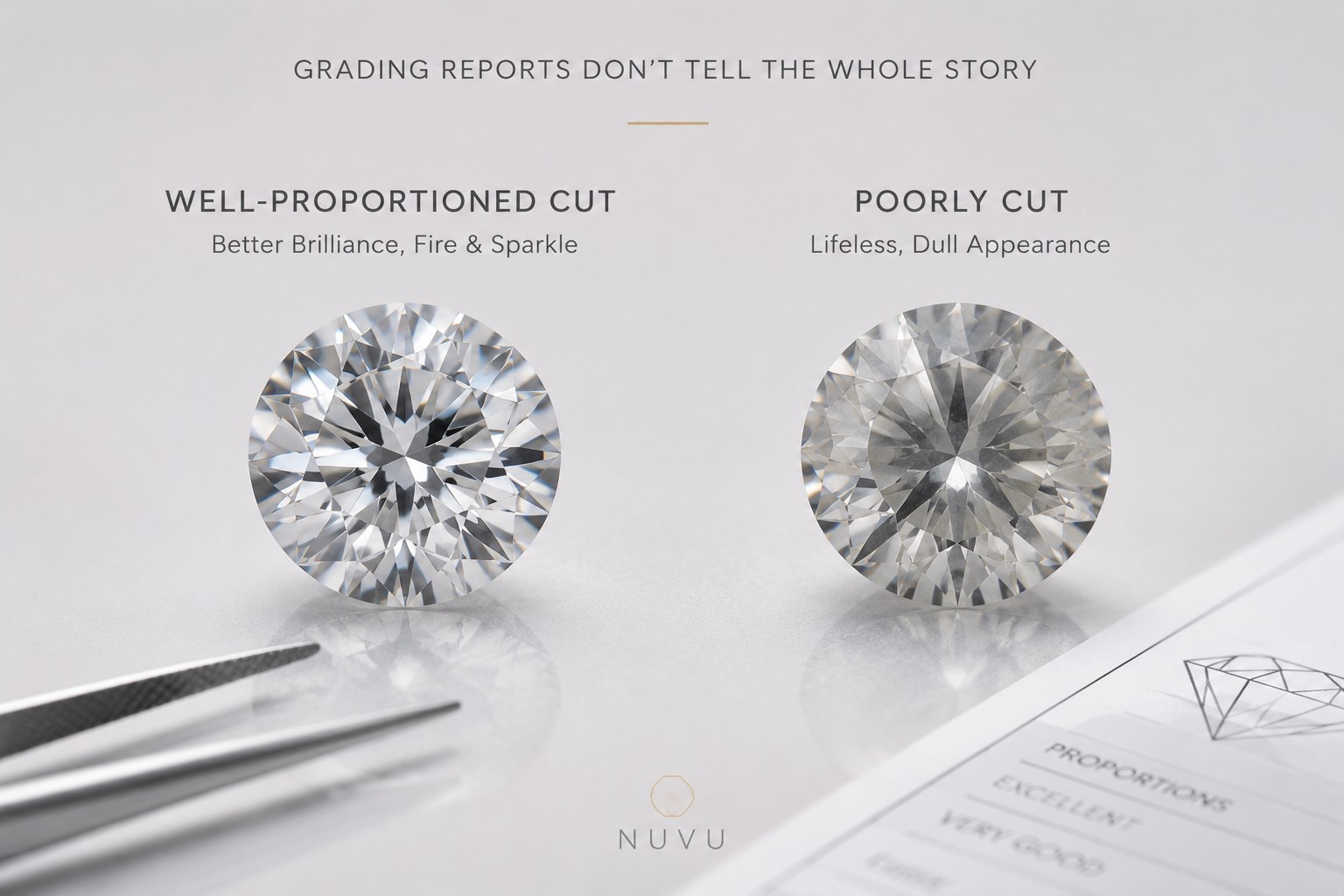
Low upfront pricing often results in stones that are poorly cut, have significant color or clarity issues not disclosed on reports, or are simply not available at the quoted price once you attempt to order. Some suppliers add shipping, insurance, certification, or packing fees later, turning what appeared to be a competitive price into an average or above-average one. Others deliver stones that are visually different from what the certificate suggests, because the grading was performed on a different stone or the report was obtained before final polishing.
Buyer Verification Checklist
Before accepting a low quote, compare it against current wholesale price data for that exact shape, carat, color, and clarity. Ask the supplier to confirm in writing that the price is all-inclusive of certificate, shipping, and any handling or packing fees. Request images or video of the actual stone, not a generic representation. If the supplier cannot or will not provide visual documentation of the specific stone, the quote is not reliable.
Certificate Avoidance, Refusal, or Confusion
Certification is not optional in wholesale lab-grown diamond buying. A supplier who is vague about grading, uses unfamiliar lab names, or refuses to share a report number is almost always hiding something. The certificate is the primary document that confirms what you are buying, and without it, you have no reliable basis for comparison or valuation.
The Role of Third-Party Certification in Wholesale Buying
Reputable wholesale suppliers provide complete certificate details from recognized labs—IGI, GIA, and GCAL are the most widely trusted in the lab-grown diamond market. Each stone should have a verifiable report number that can be checked on the grading lab’s official website. A supplier who is vague about certification, uses a lab name you have never heard of, or refuses to share the report number is likely hiding grading inconsistencies, misrepresentation, or a lower-quality stone than advertised.
Signs a Supplier Is Not Confident in Their Grading
Pay attention to how the supplier talks about certification. If they say “the certificate is accurate” but cannot or will not show you the actual report, that is a problem. If they claim a stone is GIA-graded but cannot provide a verifiable report number, the claim is not trustworthy. Some suppliers avoid sharing report numbers because the stone’s actual grades are lower than what they quoted verbally. Others use reports from labs with less rigorous standards to create the appearance of higher quality.
Certificate and Visual Review Check
Always ask for the full report number before committing. Verify it on the grading lab’s official website. Compare the reported measurements, color, clarity, and cut grade against images or video of the actual stone. If the visual appearance does not match the certificate, do not proceed. If the supplier refuses to provide the report number, consider that a hard stop. A transparent supplier has nothing to hide.
Vague Answers on Stock and Availability
A supplier who cannot clearly describe what they have on hand, how long it will take to get it to you, or how their inventory system works is a risk that compounds over time, making a repeatable lab-grown diamond sourcing system a necessary benchmark because one unclear answer might seem minor, but repeated vagueness about stock and availability usually points to a deeper operational problem.
What “We Have It in Stock” Really Means
When a supplier says they have a stone in stock, the natural assumption is that they hold physical inventory ready to ship. That is not always the case. A supplier who confirms a stone is available but cannot describe its physical characteristics beyond what is printed on the certificate is a warning sign. If they change the stone’s availability after you have placed an order, or if they quote a stone and then must “check with the factory” before confirming, you are likely dealing with a broker rather than a holder of inventory.
The practical consequence is predictable. Without reliable inventory management, shipments get delayed, and the stone that arrives is not always the stone you ordered. The substitution may be close enough on paper but different in visual appearance. For wholesale buyers who need consistency across multiple stones, this erodes trust with every order.
How to Test Inventory Claims
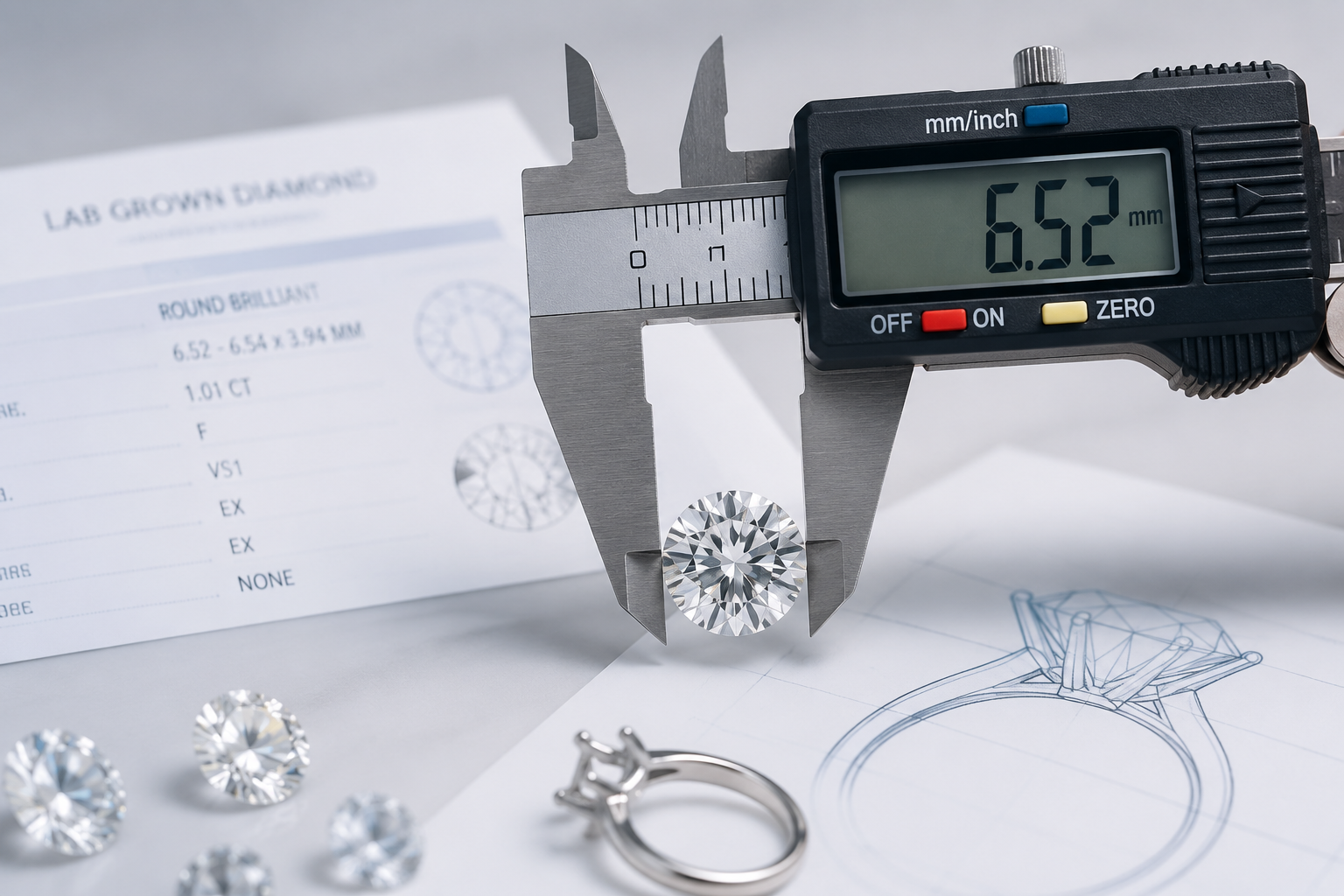
Testing a supplier’s inventory claims is straightforward if you know what to ask. Instead of asking whether a stone is available, ask for specific measurements: the exact diameter, table percentage, depth percentage, or a description of inclusion placement. A supplier who holds physical inventory can confirm these details from the stone itself without delay.
A supplier who must leave the conversation to “check with the warehouse” or “confirm with the factory” does not control their own stock. They are relaying information from someone else. That introduces a layer of uncertainty that makes matching, consistency, and timely delivery harder to guarantee.
Stone-to-Setting Fit Check
When ordering for a specific setting, carat weight is not enough. Two diamonds of the same carat weight can have noticeably different diameters depending on how they were cut. If the setting is designed for a stone of a certain diameter, the wrong measurement means the stone either does not seat properly or looks disproportionate.
Always confirm the exact measurements of the stone before committing. If possible, ask for a photo of the stone next to a ruler or scale. This is not an unreasonable request. A supplier working from physical inventory can do this quickly. A supplier who hesitates, makes excuses, or offers a generic image instead is likely working from a database of stones they do not actually hold.
Unclear Lead Times and No Escalation Process
A supplier who cannot give a clear timeline for production and shipping is not operating on a reliable schedule. The risk is not just that the delivery is late. It is that you have no way to predict how late, and no process for resolving the issue when it happens.
The Meaning of “Usually Two Weeks”
Phrases like “usually two weeks” or “typically ships in ten days” are not lead times. They are estimates without milestones. A supplier who uses this language often does not have a reliable manufacturing or fulfillment schedule. They may be waiting for rough material to arrive, waiting for cutting capacity to open up, or waiting for another middleman to deliver the finished stone.
For a wholesale buyer, this kind of ambiguity is costly. If you are manufacturing jewelry or fulfilling orders to your own customers, a vague timeline means you cannot plan production, manage expectations, or set delivery dates with confidence. The cost of uncertainty multiplies with every order.
The underlying issue is not just delay, but the absence of accountability. A supplier who defines no intermediate checkpoints cannot tell you where a delay originated, and therefore cannot prevent it from recurring. Over time, that pattern makes production planning unreliable and erodes the consistency a wholesale operation depends on.
What a Proper Lead Time and Escalation Process Looks Like
A professional supplier provides a timeline with defined stages. A typical breakdown includes cutting start, polishing completion, grading submittal, shipping, and estimated arrival. Each stage gives you a checkpoint to track progress.
Equally important is the escalation process. A named contact person or a clear procedure for what happens when a deadline is missed is not a luxury. It is the minimum standard for a serious wholesale relationship. Without it, delays are met with silence, and you are left chasing updates rather than receiving them.
What This Means in a Real Purchase
Before placing an order, ask the supplier what happens if the stone is not ready by the stated date. A serious supplier will offer a concrete plan: a timeline extension with a clear explanation, an alternative stone that meets your specifications, a partial refund for the delay, or at minimum an honest reason for the setback. A response like “we will update you when we know more” is not a plan. It is an attempt to buy time. In wholesale buying, time is a resource that should not be wasted on vague promises.
Overpromising on After-Sales Support and Quality Guarantees
Unconditional promises are easy to make and hard to enforce. A supplier who offers sweeping guarantees without written terms is usually not prepared to honor them. The gap between what is promised and what is delivered becomes apparent only after a problem arises.
The Gap Between Promise and Policy
Statements like “we always take care of it” or “no questions asked” sound reassuring but carry little weight without documentation. If the supplier cannot or will not provide written terms for returns, replacements, or defect claims, they are signaling that their after-sales support runs on goodwill rather than procedure. Goodwill works until it does not. When a defect dispute, a grading inconsistency, or a shipping damage claim occurs, there is no framework to resolve it. The supplier decides what “taking care of it” means, and that may not match your expectations.
What a Realistic After-Sales Policy Includes
Legitimate wholesale suppliers provide written policies that cover the common scenarios. Defect claims are typically accepted within a defined window, often 30 days from receipt. The policy should specify what is covered, what is excluded, and who bears the cost of return shipping, inspection fees, and replacement. It should also address grading report disputes. If a stone arrives with a certificate that does not match the stone, the supplier should have a clear procedure for resolution.
A vague or oral policy is not a policy. If the supplier asks you to trust them instead of showing you the terms, that trust is not backed by anything enforceable.
How to Verify This Before Buying
Request the supplier’s written after-sales policy before placing an order. If they cannot produce a document or an email outlining the terms, treat that as a red flag. Follow up with a specific question: what happens if the stone is returned because the grading report was incorrect? A transparent supplier explains their procedure without hesitation. A supplier who avoids the question or repeats a verbal assurance is giving you a reason to pause.
For wholesale buyers who place repeat orders, the practical test is even simpler: ask for a documented example of how a previous dispute was resolved. A supplier with a real after-sales process can describe a past case without hesitation. A supplier who cannot recall a single resolved dispute may not have been in business long enough to have faced one, which is itself a risk to evaluate.
The Danger of Promises That Sound Too Easy
The pattern is easy to spot once you know what to look for. A supplier who guarantees everything about a stone without any qualification is almost always unreliable. Real diamond production involves natural variation, tradeoffs, and constraints. No supplier can honestly claim that every stone is ideal for every purpose.
Common Overpromises in Wholesale Diamond Sourcing
Certain phrases should immediately raise your attention. “This stone is perfect for any setting” is not a statement supported by diamond manufacturing. Cut proportions, pavilion depth, and crown angle all affect how a stone fits into a specific mounting. A stone that works in a simple four-prong setting may be too shallow or too deep for a bezel or a halo design.
“You will never find a better price” is a pressure tactic, not a market analysis. Prices fluctuate based on rough availability, cutting yield, and current inventory. A supplier who insists on this claim is usually trying to prevent you from shopping around. “We guarantee you will love it” offers no enforceable standard. Love is subjective. A legitimate guarantee covers measurable qualities — color, clarity, cut grade, and certificate accuracy — not personal preference.
“We can match any shape or size instantly” is the most revealing statement of all. A supplier with actual inventory knows their limits. They know which shapes and sizes they stock and which require production lead times. A supplier who agrees to every request without pause is likely operating as a broker, not a producer. They plan to find the stone elsewhere after taking your order, which introduces risk of substitution, delayed delivery, or a different grade than expected.
Why a Serious Supplier Does Not Overpromise
Experienced suppliers know that every stone has a tradeoff. A higher color grade may mean a smaller carat weight at the same price point. A cleaner clarity grade may come with a less ideal cut. A supplier who claims every stone is ideal in every dimension is either inexperienced or deliberately misleading you.
A serious supplier explains the limitations of a stone and helps you find one that fits your specific needs. They will say, “This stone has strong fluorescence that may appear milky in direct sunlight,” or “The crown angle is a bit steep for a prong setting, but it works well in a bezel.” These are honest observations, not sales objections.
Their confidence comes from verifiable inventory and documented quality, the same evidence emphasized in a lab grown diamond supplier guide, not from pressure or vague promises. They let the stone speak for itself through video, measurements, and certificate data. They do not need to guarantee perfection because they can demonstrate what they have.
Buyer Verification Checklist
When a supplier makes a claim that sounds too good to be true, ask for documentation. Request a photo or video of the actual stone under direct, diffused, and natural lighting. Ask for specific measurement reports — table percentage, depth percentage, crown angle, pavilion angle. If they cannot produce evidence for their claims, assume the claim is false. Verbal assurances are not binding. A supplier who cannot document their inventory is asking you to trust them with no basis for that trust.
For buyers who source lab-grown diamonds for retail or custom work, the larger point is worth restating: the most reliable supplier relationships are built on verifiable information, not on comfort. A supplier who answers every question with clear data, written policies, and documented inventory is a supplier who values the transaction enough to make it traceable. That traceability is the foundation of trust in wholesale buying.
Why Traceability in Supplier Documentation Matters Throughout the Order Lifecycle
Traceability in a wholesale diamond transaction means that every claim made by a supplier can be tracked to a specific, verifiable source—whether it is the lab report, the invoice, the packing list, or the shipping record. A supplier who cannot document the chain of custody from rough growth to final grading introduces uncertainty at every stage of the order. For wholesale buyers, this uncertainty is not just an inconvenience; it can lead to disputes over grading accuracy, delivery timing, and product consistency that are difficult to resolve without a paper trail.
A traceable supplier provides clear documentation at four key points in the ordering process. First, at the quotation stage, they provide a written offer that includes the stone’s exact measurements, report number, growth method, and all-inclusive pricing. Second, at order confirmation, they issue an invoice that matches the quotation exactly and references the specific stone by its report number. Third, during fulfillment, they provide tracking information that corresponds to the agreed timeline and may offer intermediate checkpoints such as “sent to grading” or “packed for shipment.” Fourth, upon delivery, the packing list and certificate match the stone physically received. Any break in this chain—a missing report number, a vague invoice, or a packing list that does not match the certificate—is a warning that the supplier may not be fully transparent about what they are delivering.
For wholesale buyers, traceability is not an abstract concept. It is a practical tool. A supplier who can produce a complete set of documents for a previous order—quotation, invoice, grading report, shipping confirmation, and packing list—demonstrates that their process is built for accountability. A supplier who cannot produce such records, or who hesitates to share them, is asking for trust without supporting evidence.
How to Document the Supplier’s Communication Trail
Beyond internal paperwork, the communication trail between buyer and supplier is itself a form of documentation. A reliable supplier responds to email inquiries with consistent, specific information. If you ask a question about a stone’s cut proportions on Monday and receive a different answer on Wednesday, or if the written description of a stone changes between the quotation and the invoice, that inconsistency should be flagged and questioned. Keeping a written record of all communications—quotes, emails, and even chat logs—allows you to cross-check the supplier’s claims over time.
Buyers should also request that all key terms be confirmed in a single, consolidated document rather than scattered across multiple emails or calls. A clear order summary that includes the stone’s certificate number, agreed price, delivery timeline, and after-sales terms serves as a reference point for both parties. If the supplier is unwilling to provide such a summary, that reluctance itself indicates a low tolerance for documentation, which is a red flag in wholesale transactions where clarity and consistency are paramount.
Understanding How Growth Methods Affect Supplier Claims
The method used to produce a lab-grown diamond has practical implications for color, clarity, and how the stone responds to cutting. A supplier who cannot explain whether their inventory is grown by HPHT (high-pressure, high-temperature) or CVD (chemical vapor deposition) may lack the technical awareness to accurately represent the stones they sell. According to the Gemological Institute of America (GIA), both methods produce diamonds that are chemically and optically identical to mined diamonds, but the growth process can affect characteristics such as color zoning, fluorescence, and inclusion types.[1]
HPHT stones, for instance, often show distinct geometric growth patterns and metallic flux inclusions, while CVD stones tend to have layered growth structures and can require post-growth treatment to achieve higher color grades.[1] A supplier who cannot identify which method was used for a specific stone may not be evaluating its true quality characteristics. For wholesale buyers, this knowledge gap is significant. A CVD stone that has undergone post-growth HPHT treatment to improve color, for example, should be disclosed as such, as the treatment can affect long-term stability and grading consistency.
Buyers should ask suppliers directly about the growth method for each stone. A transparent supplier provides this information and may offer grading reports that include growth method identification. The GIA has noted that standard grading reports for lab-grown diamonds typically indicate the growth method.[1] If a supplier is unable to answer this question or treats it as irrelevant, that evasion is itself a warning sign. It suggests the supplier may be sourcing stones without understanding their production history, which increases the risk of receiving stones with undisclosed treatments or inconsistent quality.
Why a Documented Compliance and Disclosure Process Matters
Lab-grown diamonds are subject to specific advertising and disclosure guidelines that differ from natural diamonds. The U.S. Federal Trade Commission (FTC) has provided guidance that lab-grown diamonds must be clearly and conspicuously disclosed as such in advertising and sales materials, using terms like “laboratory-grown” or “laboratory-created.”[2] A wholesale supplier who is careless about this distinction may be exposing their buyers to legal risk, as downstream retailers who sell to consumers could face enforcement action for misrepresentation.
The FTC has emphasized that failing to disclose the nature of a laboratory-grown diamond can be deceptive if it misleads consumers about the stone’s origin.[2] For wholesale buyers, this means the supplier’s documentation practices directly affect the buyer’s own compliance obligations. A supplier who provides invoices or certificates that do not clearly state “laboratory-grown” or use ambiguous language like “cultured” or “synthetic” without proper context is creating documentation that may not meet regulatory standards.
Buyers should request sample invoices and confirm that the supplier’s paperwork consistently uses FTC-recommended terminology. A supplier who cannot produce compliant documentation, or who treats disclosure as an afterthought, is a supplier who may not be operating with the care required for a regulated market. In wholesale buying, where orders are large and repeat transactions are the norm, a single documentation error can cascade into customer disputes and compliance audits.
Additional Evidence to Verify Before Committing
Beyond the growth method and documentation compliance, there are two practical verification steps that help confirm a supplier’s reliability. First, confirm whether the supplier’s grading reports are issued by a lab that provides online verification for lab-grown diamonds. The GIA and IGI, among others, maintain searchable databases where a report number can be checked.[1][3] A supplier who provides a report from a lab without an online verification system is asking you to take the report on faith alone.
Second, ask whether the supplier has a process for handling grading report discrepancies. If a dispute arises—for instance, if a stone’s color grade appears different from its report—the supplier should have a documented procedure for submitting the stone to a neutral third-party lab for re-evaluation. A supplier who relies solely on their own grading assessment, or who uses a lab without independent verification, places the burden of proof on the buyer. As the Federal Trade Commission has noted, accurate disclosure and documentation are the foundation of fair dealing in the gemstone trade.[2] A supplier who cannot demonstrate that their documentation can withstand scrutiny is a supplier to approach with caution.
Recognizing When Supplier Claims About Market Position or Scale Are Unverifiable
In wholesale buying, a supplier may attempt to build confidence by claiming a certain market position, large production volume, or exclusive access to rough. These claims can be difficult to verify without direct knowledge of their operations. A supplier who says they are one of the largest producers in a region, or that they have a direct contract with every major rough grower, is making assertions that cannot be confirmed through the documents of a single order. This does not mean the claims are false, but it does mean they should not substitute for verifiable evidence about the specific stone you are buying.
A more reliable approach is to focus on what can be documented for each transaction: the stone’s certificate number, its measurements, and its growth method. Claims about overall market share, factory capacity, or exclusive partnerships may sound impressive, but they do not affect whether the individual stone you receive matches its documentation. If a supplier spends more time describing their market dominance than providing specifics about the stone at hand, that mismatch itself is a subtle red flag. A transparent supplier lets the documentation speak for each stone and does not rely on unverifiable statements about scale.
The Risks of Undisclosed Brokerage Relationships
Some suppliers present themselves as producers or direct holders of inventory when they are in fact brokers sourcing from third parties. This distinction matters because a broker cannot control the quality, timing, or consistency of stones they have not physically inspected. If a supplier claims to be a manufacturer but cannot describe their cutting facility or grading process in detail, the buyer should ask follow-up questions to clarify the supply chain relationship.
For wholesale buyers, undisclosed brokerage introduces specific risks. A broker may quote a stone that is already sold to another buyer, then substitute a different stone at the same price. They may also be unable to provide after-sales support for defects that arise from the original manufacturer. While some broker relationships are professional and transparent, the key for the buyer is to know who they are dealing with. A supplier who clearly describes their role—whether as a manufacturer, a direct distributor, or a broker—allows the buyer to evaluate the risk accordingly. A supplier who is vague about their sourcing structure may be hiding a lack of control over the stones they offer.
Why Buyer Onboarding and Inquiry Patterns Can Reveal Supplier Reliability
The way a supplier handles initial inquiries can be as revealing as the documentation they provide. A supplier who asks few questions and offers rapid confirmations may be more interested in closing a sale than in matching the stone to the buyer’s needs. Conversely, a supplier who asks detailed questions about the intended jewelry use, target retail customer, and preferred grading lab is demonstrating that they understand the transaction requires fit, not just availability.
Buyer onboarding that includes sharing the supplier’s own grading protocols, sample invoices, and a point of contact for post-sale issues signals a higher level of operational maturity. A supplier who treats every inquiry as a quick transaction may not have the infrastructure to handle the complexities of a wholesale order, including grading disputes, substitution requests, or multi-stone consistency. The first few exchanges between buyer and supplier often set the tone for the entire relationship. A professional onboarding process that emphasizes transparency and specificity is a stronger indicator of reliability than a process that emphasizes speed and low prices.
[1] Gemological Institute of America, “Lab-Grown Diamonds,” GIA.edu, accessed 2025. GIA explains HPHT and CVD growth methods and notes that lab-grown diamond grading reports typically indicate the growth method.
[2] Federal Trade Commission, “Jewelry Guides,” 16 CFR Part 23, FTC.gov, especially guidance on disclosure of laboratory-grown diamonds and related advertising requirements.
[3] International Gemological Institute, “Report Verification,” IGI.org, accessed 2025. IGI provides online report verification for lab-grown diamond grading reports.
Disclosure: This article is for general educational and buyer guidance purposes only. Diamond grading, pricing, availability, specifications, and supplier policies can change, and readers should verify important details through grading reports, official laboratory tools, written supplier documentation, or qualified professionals before making a purchase decision. Laboratory-grown diamonds should be clearly distinguished from natural diamonds, and claims about production volume, market position, or sourcing practices should be verified independently. No specific supplier, grading lab, or business policy is endorsed or guaranteed in this article.
Last updated: 2025