
Buying lab-grown diamonds wholesale from China is less about finding a low price and more about choosing the right order structure. A business that needs loose stones, finished jewelry, or a hybrid program will face very different minimums, lead times, paperwork tied to China lab-grown diamond export documents, shipping requirements, and inventory risk. The wrong setup can create delays, tie up cash, or leave you with stock that is hard to move.
For the full framework, read China Lab-Grown Diamond Supply Chain Guide.
This guide helps you judge what to order, how to verify MOQ and timing, and how to plan the first purchase so it can be repeated cleanly if demand holds. It also clarifies where delays usually appear, how payment terms should line up with approval stages, and why custom, stock, and mixed orders each need a different level of operational support.
Throughout this guide, “lab-grown diamond” refers to a laboratory-grown diamond, not a natural diamond and not a diamond simulant. Laboratory-grown diamonds and natural diamonds have different origins, and wholesale documentation, grading reports, invoices, and customer-facing descriptions should clearly disclose laboratory-grown origin where applicable.
| Decision Point | Best Fit | What to Verify First |
|---|---|---|
| Loose stones | Custom work, flexible inventory | Mounting, QC, and assembly capacity |
| Finished jewelry | Faster fulfillment, simpler workflow | Demand consistency and size mix |
| MOQ check | Not one fixed number | SKU, shape, size, and report type |
| Lead time | Stock, cut-to-order, or custom | Matching, grading, setting, QC, shipping |
| First order | Controlled test of repeatability | Docs, packaging, communication, pricing |
| Mixed order | A few strong, saleable specs | Item-level minimums and reorder ease |
Quick Questions Before You Read
Q: Is the lowest MOQ always the safest choice?
No. A low MOQ can still create problems if the specs are hard to reorder or slow to fulfill.
Q: Can a mixed order bypass minimums?
Not always. Mixed orders may still have minimums by item, shape, or size.
Q: When should I choose loose stones instead of finished jewelry?
Choose loose stones if you need flexibility, custom settings, or shared inventory across products.
Q: What usually causes wholesale delays?
Delays often come from matching, grading, setting, QC, or unclear approval steps before production.
How China Lab-Grown Diamond Wholesale Orders Are Structured
In China lab-grown diamond wholesale, the first decision is not price. It is order format. A buyer is not just choosing stones or jewelry; they are choosing how the order will be built, approved, packed, and repeated. That structure affects everything that follows, including how much flexibility you have, how much coordination is required, and how much risk you take on before inventory reaches your hands.
Traceability starts with this structure. A buyer should be able to follow each item from quote to spec sheet, from report or product document to packing list, and from packing list to receiving records. If those records do not connect cleanly, it becomes difficult to confirm what was approved, what was shipped, and what can be repeated later. In sourcing or wholesale conversations, documentation, consistency, and communication often matter as much as the headline specification.
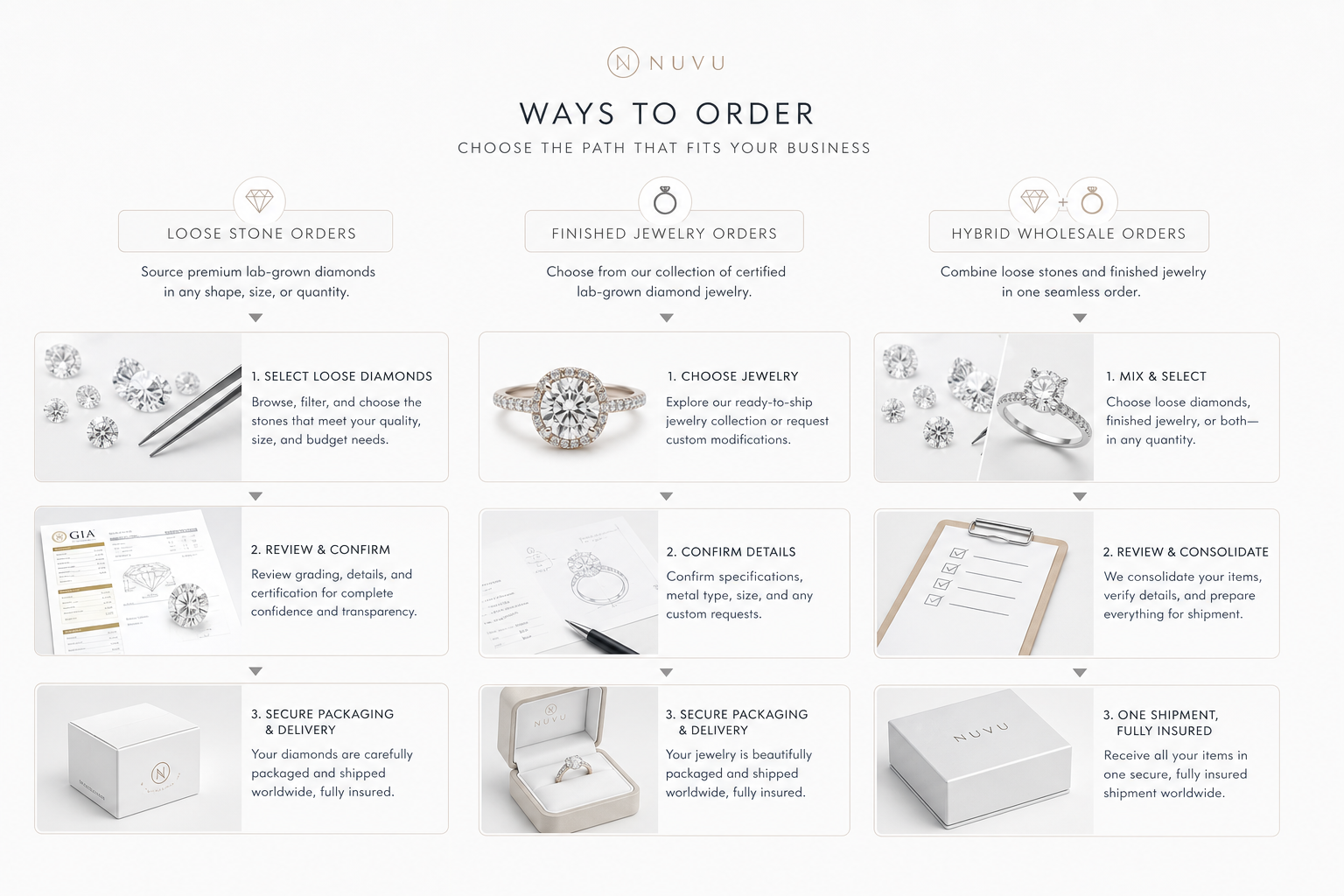
Loose Stones, Finished Jewelry, and Hybrid Programs
Loose stone orders are the most flexible model. They let a buyer control the setting, the final design, and sometimes the pace of production on their side. That works well for brands and retailers that already have in-house setting, custom manufacturing, or a clear plan for where the stones will be used. The tradeoff is that loose stone orders often require more judgment after delivery, because the stones still need to be matched to a setting or product line.
Finished jewelry orders move more of that work upstream. Instead of buying a diamond and building around it later, the buyer is placing an order for a completed ring, pendant, or other piece. This can simplify operations, especially for businesses that want fewer moving parts in fulfillment. The downside is less flexibility. If the assortment is off, or if the pieces do not match sell-through patterns, the inventory is harder to redirect than loose stones.
Hybrid programs sit between those two models. A buyer may order core loose stones for custom work while also placing a smaller finished-jewelry order for fast-moving items. For many U.S. retailers, this is the most practical route because it spreads risk across two inventory types instead of depending on one. It also helps a brand keep a visible product line while preserving room for custom work or later replenishment.
In practical buying, the same diamond specification can behave differently depending on the final use. A loose stone intended for a custom ring should be reviewed for measurements, visual performance, and setting compatibility, not only for the grade printed on a report. A finished jewelry order adds another layer: the buyer is also approving proportions, metalwork, finishing, and how the piece presents as a saleable item. This is where wholesale planning becomes more than a spreadsheet exercise.
Sample Orders Versus Repeat Purchase Orders
A sample order is usually a test of fit, not a long-term commitment. The buyer is trying to answer a small number of questions quickly: Do the stones match the stated specs? Is the documentation complete? Does the supplier communicate clearly? Do the pieces arrive in the condition and packaging the buyer expects? A sample order is most useful when it is designed to reveal whether the supplier can support a larger inventory program later.
Repeat purchase orders work differently. By the time a buyer places a repeat order, the goal is not discovery. It is consistency. The buyer already knows the shape, spec range, and product mix they want, and the supplier is expected to reproduce that result with less back-and-forth. That is why repeat orders usually depend on a cleaner process. If the first order was handled loosely, the second order often becomes slower, not faster.
A practical example is a U.S. retailer that starts with a small lot of loose stones to test customer response in a few core shapes. If the stones sell through and the grading paperwork matches the listing process, the next order can be built as a repeat inventory purchase instead of another test. That shift matters because it changes the buyer’s expectations. The question is no longer “Can this supplier deliver once?” It becomes “Can this supplier deliver the same way again?”
How Order Type Changes MOQ, Timing, and Risk
The order model affects more than convenience. It changes the economics of the purchase. Loose stone orders often give more room to mix and match, but they may still require specific approvals or minimums by size, shape, or report type. Finished jewelry orders usually introduce more production steps, which can increase coordination needs and make timing less predictable. Hybrid programs may reduce business risk, but they also require tighter inventory planning so the two sides of the order do not drift apart.
The main risk is mismatch between order intent and supplier setup. A buyer who thinks they are placing a simple stock order may actually be entering a cut-to-order or production-heavy workflow. That difference matters because a stock-based order can often move faster and with fewer revisions, while production-based orders depend on approval points and sequence. If the buyer does not identify that early, delays tend to appear later, when they are more expensive to fix.
For this reason, the right question is not whether one order type is universally better. It is whether the order type fits the business model. A brand that needs flexibility should not overcommit to finished inventory too early. A retailer that wants smoother fulfillment should not rely only on loose stones if it cannot manage setting and assembly efficiently. The structure should follow the operational reality, not the other way around.
What to Verify Before You Decide
Before placing the order, confirm what is actually being sold: loose stones, finished jewelry, or a mix of both. Then ask whether the order is stock-based, made to spec, or dependent on later approvals. A buyer should also verify how the supplier handles substitutions, whether mixed categories can be combined, and whether the same product format can be repeated later without rebuilding the order from scratch. Those answers reveal whether the order is a one-time purchase or the start of a repeatable sourcing path.
What MOQ Means in Practice for Lab-Grown Diamond Buyers
MOQ is one of the most misunderstood terms in China lab-grown diamond wholesale because it sounds simple and rarely is. In practice, minimum order quantity is not always a single number. It can apply to one SKU, one shape, one size range, one documentation level, or one finished product line. A buyer who treats MOQ as a flat total can easily overcommit to the wrong mix and still fail to satisfy the supplier’s real minimums.
MOQ by SKU, Shape, Size, and Documentation
The first thing to understand is that MOQ often follows product definition. A supplier may have one minimum for a specific SKU, another for a different shape, and another for a larger size or a higher documentation level. A round stone with one report type may be easier to produce or allocate than a specialty shape with tighter matching requirements. The result is that the true minimum is shaped by complexity, not just by quantity.
Documentation can matter too. A buyer asking for graded stones, matching reports, or specific packaging may find that the order minimum rises because the supplier has to coordinate more steps around the same shipment. That does not mean the supplier is being arbitrary. It usually means the order has become less standardized. The more the buyer asks the supplier to sort, verify, and prepare, the less likely the order is to behave like a simple bulk pull.
A grading report is useful because it documents key characteristics, but it should not be treated as the full quality decision. Reports help identify the stone and describe important features, while the buyer still needs to compare measurements, images, videos, and the intended setting. In wholesale buying, the practical question is whether the documented goods match the commercial purpose of the order, not whether a report alone makes the order suitable.
For evidence control, buyers should separate three kinds of documentation before negotiating MOQ: the supplier’s commercial quote, the grading or product documentation tied to the goods, and the internal purchase record your team will use later for receiving and resale. These documents do not serve the same purpose. The quote confirms pricing and order scope, the report or product document supports item identification, and the internal record helps your team reconcile what arrived against what was ordered.
When a grading report is available, buyers should verify the report details through the issuing laboratory’s official report-check tool where available, then compare those details with the item media, measurements, and purchase order line.
Mixed orders do not eliminate MOQ pressure. They may reduce it in one area while creating it in another. A buyer can combine several items in one purchase, but each item may still have its own minimum by shape, size, or finish. That is why a total cart value alone is not enough to judge whether the order works. The buyer needs to know where the minimum sits.
Price, Value, and Quote Comparisons Need Like-for-Like Controls
Wholesale buyers should be careful not to treat a lower quote as proof of better value. Prices can vary because of cut precision, report type, seller channel, size, shape, availability, order structure, packaging, payment timing, and documentation requirements. A quote for stock loose stones is not directly comparable to a quote for custom finished jewelry, even if the headline carat weight or grade range looks similar.
When comparing suppliers, build a like-for-like comparison table that separates stone specifications, report availability, metal details, finishing expectations, packaging, shipping assumptions, and payment milestones. Exact price comparisons should be verified at the time of purchase because market conditions, inventory availability, and supplier terms can change. The most useful quote is not simply the lowest number; it is the one that clearly explains what is included, what is excluded, and what must be confirmed before production or shipment.
Why Loose Stones and Finished Jewelry Have Different Minimums
Loose stones and finished jewelry are not interchangeable from a supplier’s point of view. Loose stones are simpler in some respects because they do not require setting, assembly, or final product finishing. But they can still require sorting and matching if the order includes multiple shapes or grades. Finished jewelry usually carries more production work, more labor coordination, and more risk of rework if any detail changes late in the process.
That is why finished jewelry often has a different minimum structure from loose stones. A supplier may be willing to move smaller stone quantities but require a larger threshold for a completed line. The reason is practical: it is easier to absorb a small stone allocation than to interrupt a production flow for one small finished-jewelry request. For the buyer, this means the better route depends on what kind of operational burden they want to carry themselves.
For a brand with design staff and a setting workflow, loose stones may offer a lower-friction entry point. For a retailer that wants ready-to-sell inventory, finished jewelry can make more sense even if the minimum is less flexible. The decision should follow the business model, not the assumption that one format is always easier to buy in small quantity.

Where to Negotiate and Where Not to Push
Buyers should negotiate around structure, not just number. It is usually more productive to ask whether the MOQ can be met through a mix of sizes or whether two related SKUs can be combined than to ask for a blanket reduction with no operational logic. Suppliers are more likely to work with buyers who understand the order model and can still place a clean, repeatable purchase.
What is usually worth pushing on is clarity. Ask how the minimum is calculated, whether the same minimum applies to each shape or only to the total order, and whether a test order can later count toward a larger commitment. What is usually not worth pushing is an unrealistic minimum that would force the supplier into a special production arrangement. If the order has unusual specs, the minimum is often tied to real handling cost, not arbitrary policy.
For first-time buyers, a better strategy is to ask for the smallest order that still reflects the real purchase pattern you want to repeat later. A test order that is too tiny can produce false confidence. A minimum that is too large can trap cash in inventory that does not yet match demand.
Buyer Verification Checklist
- Confirm whether MOQ is set by SKU, shape, size, report type, or finished versus loose format.
- Ask whether mixed items can be counted together or whether each item has its own minimum.
- Verify whether the quoted minimum applies to the first order only or to all future orders.
- Check whether a sample order can be scaled into a larger repeat order without redoing the spec from scratch.
- Make sure the supplier’s answer matches the exact product type you want, not a general wholesale assumption.
How Lead Time Is Actually Built in China Wholesale Orders
Lead time is not one block of waiting. It is a sequence of steps, and the length of each step depends on the order type. In China lab-grown diamond wholesale, some orders move quickly because the inventory already exists. Others slow down because the buyer is asking for production, matching, grading, approval, packing, and export handling in a specific sequence. If the buyer only asks how long the order takes, the answer is incomplete. The better question is where the time goes.
Stock Goods, Cut-to-Order Stones, and Custom Jewelry
Stock goods are the fastest path because the order is built around inventory that already exists or is already close to ready. These orders usually involve fewer approval steps and less production risk. The buyer still needs to confirm the exact spec, documentation, and packing, but the schedule is often easier to predict because the supplier is not starting from zero.
Cut-to-order stones take longer because the supplier may need to produce or select stones to a requested specification. Even when the product is not highly customized, this route can introduce delays if the buyer wants a narrower shape range, tighter color range, or specific matching standard. The more selective the request, the more the timeline depends on availability and production coordination.
Custom finished jewelry is usually the most time-sensitive route because the order often includes several linked stages. The diamond, the setting, the assembly, the finish work, and the final review all have to happen in order. If one stage shifts, the rest of the schedule shifts too. That makes custom finished jewelry the least forgiving format for a buyer who needs certainty on a fixed delivery date.
What Delays the Schedule: Matching, Grading, Setting, QC, and Shipping
Matching can slow an order when stones need to align across shape, size, or appearance. Grading can add time when the buyer wants documentation tied to a specific lot or finished piece. Setting is another common source of delay because the stone and jewelry components have to fit correctly before the piece can move on to final review. Quality control then becomes the gate that confirms the order is ready to ship, not just ready in theory.
Shipping is often treated as the last step, but it should be planned as part of the lead time rather than after it. A buyer may assume the production part is the only schedule risk, but in practice the handoff from completed order to export-ready shipment can also create delay if packing, labels, or paperwork need correction. The safest way to think about lead time is as production time plus approval time plus shipping time, with each part carrying its own possible friction.
Because lead time is built from separate steps, a buyer should ask the supplier to identify which steps are already complete and which steps are still pending. “Available” can mean different things in a wholesale conversation: ready to allocate, ready to inspect, ready to set, ready to pack, or ready to ship. Clarifying that status prevents the buyer from treating a partially prepared order as shipment-ready inventory.
A realistic buffer matters more than a precise promise. If the supplier gives a quoted window, the buyer should still plan around the possibility that one approval cycle, one documentation change, or one packing revision adds several days. That buffer is not pessimism. It is how a buyer avoids making a sales or replenishment promise that the supply chain cannot comfortably support.
How to Build a Realistic Buffer Into Your Purchase Order
The buffer should be tied to the order type. Stock goods may only need a short cushion, while cut-to-order or custom jewelry orders need more room because the schedule depends on several hands and several checks. A buyer should also keep a separate buffer for shipping, especially if the inventory is tied to a launch date, trunk show, or seasonal restock. If the order matters to revenue timing, the buffer should be built into the purchase decision, not added later as damage control.
The most useful habit is to treat the quoted timeline as the best-case operational path, not the guarantee. That perspective keeps the order plan honest. It also makes it easier to tell the difference between a supplier who is truly well organized and one who is simply quoting a short timeline to win the order.
What This Means in a Real Purchase
A buyer placing a mixed replenishment order for a U.S. retail line may see the schedule stretch less because the stock items are ready sooner, but the custom pieces still set the pace for the full shipment. If the buyer needs all items to arrive together, the slowest component controls the order. That is the operational rule that matters most: in a combined purchase, one delayed part can delay the whole plan.
For that reason, buyers should decide early whether the order is meant to be fully synchronized or staged in parts. If the business can receive inventory in phases, the custom lab grown diamond OEM timeline is easier to manage. If the full shipment must land at once, the order should be built around the slowest item from the start.
How to Move From a Small Test Order to a Repeat Inventory Program
A first wholesale order should prove more than that a supplier can sell you diamonds. It should show whether the line can be repeated without friction. For a buyer building repeat inventory, the real question is not whether the first lot arrives, but whether the supplier can match the same appearance, documentation, packaging, and communication standard again when it is time to reorder.
The cleanest way to think about a sample-to-bulk transition is to treat the first order as a controlled test. A smaller pilot lot is useful only if it tells you something specific about future buying. If the stones look right but the paperwork is inconsistent, or the product is solid but the packing is sloppy, the supplier is not yet ready for a larger replenishment cycle. Repeat inventory depends on consistency, not just availability.
What to Test in the First Order
The first order should test the parts of the process that are hardest to fix later. Appearance comes first: stones or finished pieces should match the photos, videos, and agreed specs closely enough that you are not guessing what the next batch will look like. Documentation comes next, because a polished product is far less useful if reports, labels, or item details do not line up cleanly with what was ordered.
Communication speed matters more than many buyers expect. A supplier who answers quickly but imprecisely can still create avoidable delays if the order needs confirmation before production moves forward. Packing consistency is also worth watching closely. If the first order arrives with mixed labeling, weak protection, or unclear sorting, that usually becomes more painful as order size increases.
A practical pilot order is usually small enough to limit exposure but large enough to reveal patterns. For many buyers, that means a narrow test lot rather than a scattered purchase across too many SKUs. The point is to learn whether the supplier can repeat a specific order cleanly, not to sample everything at once.
How to Decide When a Supplier Is Reorder-Ready
A supplier is reorder-ready when the first order proves that the buying process is stable, not just the product. If the stones matched the agreed appearance, the paperwork was accurate, the response time was consistent, and the shipment arrived organized the way it was discussed, the next order becomes a scaling decision instead of a guess. If one of those pieces broke down, the right move is usually to correct the weakness before increasing volume.
For a U.S. retailer, a simple example is a test lot of a few bestselling specs. If the first batch sells through cleanly and the supplier handles the follow-up questions without confusion, that is a stronger signal than a one-time discount. Reorder readiness is about repeatability under normal buying conditions, not a perfect first impression. At NUVU, we usually treat that distinction as the difference between a supplier that can quote and a supplier that can support inventory.
One useful rule is to reorder only after you can predict the next order with some confidence. If the first lot required repeated clarification, a second order should not be larger just because demand exists. It should be larger only if the supplier has already shown that the same spec can be produced and packed the same way twice.
How to Set a Reorder Threshold and Safety Stock
The reorder threshold should be tied to your actual sales pace, not to a generic wholesale rule. A practical starting point is to decide how much stock you need on hand to cover the next buying cycle with a cushion, then reorder before you fall below that level. For a small program, that cushion may be only a short window of coverage; for a faster-moving line, it needs to be larger.
Safety stock is most useful when demand is steady enough to measure. If a SKU sells regularly, the buffer can be built around the time it takes you to review sell-through, place the next order, and receive the replenishment. If demand is uneven, the safer move is usually to keep a slightly deeper reserve on your best-performing specs and avoid spreading inventory too thin across weaker ones.
The mistake to avoid is waiting until stock is nearly gone and then treating the next order as urgent. That creates pressure on both the buyer and the supplier. A better approach is to define a reorder point early, then adjust it after the first one or two cycles based on actual sell-through. For repeat inventory, discipline matters more than optimism.
How to Verify This Before You Buy
Before placing the first order, ask the supplier to confirm what exactly will be repeated if the pilot works. The useful question is not simply whether they can supply more, but whether they can reproduce the same spec, the same documentation, and the same packing standard without restarting the conversation each time. If that answer is vague, the order is not yet ready to become a replenishment program.
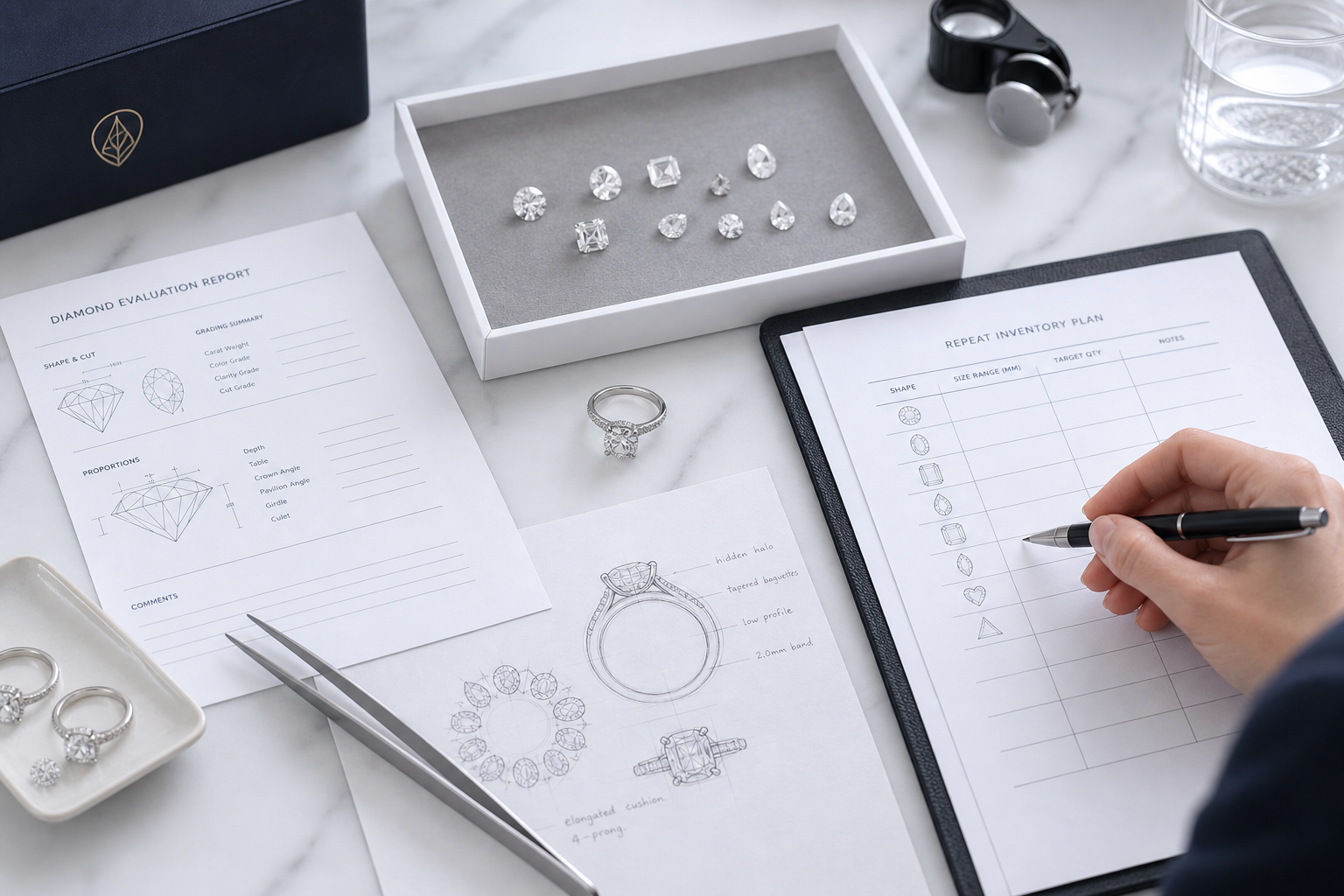
Ask for clarity on the sample lot size, the exact spec being tested, and the conditions that would trigger a second order. If the supplier cannot describe those points cleanly, it is usually smarter to keep the first order small. A repeat inventory program starts when the next order is a planned step, not a rescue mission.
Payment Terms, Deposits, and Cash-Flow Control
Payment terms are not just a finance detail. They shape how much risk the buyer carries before the order is complete, how much cash stays available for the next purchase, and how much confidence both sides have in the transaction. For a first wholesale order, the best structure is the one that matches the real approval points in the process, not the one that sounds simplest on paper.
The main decision is whether your cash leaves the business before you have enough confirmation to feel comfortable. If the order is custom, mixed, or still being refined, payment should ideally follow the stages that can be checked. If the order is standard and repeatable, the structure may be simpler, but it should still leave room to verify the details before the final balance moves.
Payment documentation should also connect to the same order record used for production. The deposit, balance, invoice, pro forma invoice, and packing list should refer to the same item descriptions or purchase order reference where possible. This does not eliminate risk, but it reduces ambiguity if the buyer later needs to reconcile a payment, confirm a shipment, or explain the order internally.
Common Payment Structures and What They Signal
A deposit plus balance payment is the most familiar structure because it splits commitment between buyer and supplier. It signals that both sides are moving forward, but neither side has fully closed the loop. For many first orders, that is a practical middle ground because it keeps the purchase active without forcing the buyer to pay everything before the order has been confirmed in full.
Milestone-based payment is more useful when the order has clear checkpoints, such as spec approval, production confirmation, inspection review, or shipping release. This structure works best when the buyer needs a tighter link between payment and proof of progress. Partial prepayment can also make sense, especially when a supplier needs working capital to begin production, but it should still be tied to a clear written understanding of what happens at each stage.
The most important judgment is not which structure sounds safer in theory. It is whether the payment schedule matches the actual risk in the order. A simple stock purchase may justify a simpler structure. A more complex order usually deserves more visibility before the final payment is made.
How Deposit Size Changes Buyer Risk
A larger deposit increases exposure if the order changes, stalls, or arrives with a mismatch. That does not automatically make it wrong, but it does mean the buyer is carrying more risk earlier in the process. A smaller deposit preserves cash and reduces early exposure, though it may limit flexibility if the supplier expects stronger commitment before production starts.
Deposit size also sends a signal. A supplier may read a reasonable deposit as a serious order, while a very low one may be seen as a weaker commitment. For the buyer, the goal is not to minimize the deposit at all costs. The goal is to avoid paying too much before the order is stable enough to justify it.
As a general rule, the right deposit is the one that still lets you manage the rest of your buying plan. If a deposit strains cash flow so badly that it affects the next replenishment or your ability to inspect the first order properly, it is probably too high for your model.
How to Match Payment Milestones to Approval and Shipping
The safest payment structure is usually the one that follows the order’s natural approval sequence. If the buyer needs to approve specs, review images or videos, and confirm packing before shipment, those checkpoints should appear in the payment schedule as well. That way, payment does not get ahead of verification.
This matters most when the order includes custom details or multiple SKUs. A buyer who pays too far in advance loses leverage if the order still needs clarification. A buyer who waits until after the correct approvals can keep the process moving while still protecting cash. The balance point is usually the stage where the order is finished enough to verify, but not yet beyond adjustment.
For first-time wholesale buying, the practical standard is simple: do not let the payment schedule run ahead of the information you need to feel confident. If the supplier cannot connect payment milestones to real order checkpoints, the structure is weaker than it should be.
What to Confirm in Writing
Before paying, confirm the deposit amount, the balance timing, the milestone that unlocks each payment, and what happens if the order details change after approval. Confirm whether the supplier expects payment before production, after approval, or at shipment, and make sure that sequence is written clearly enough to avoid interpretation later. A vague payment agreement usually becomes a cash-flow problem at the worst possible time.
If the supplier is flexible, ask for the same clarity in plain language. If the answer changes every time you ask, that is a sign to slow down. Good payment terms reduce uncertainty; they should not create it.
Mixed Orders, Inventory Mix, and Assortment Planning
Mixed orders can be useful, but only when the assortment is built with a clear merchandising purpose. A good mix helps you test demand across a small number of meaningful options. A bad mix spreads inventory so thin that nothing sells deeply enough to inform the next buy. The real issue is not variety itself. It is whether the mix improves sell-through and protects working capital.
Buyers often assume that more combinations create more flexibility. In practice, too many small combinations can make the order harder to track, harder to replenish, and harder to judge. A useful mixed order usually concentrates on the specs that are most likely to move, then leaves room to expand once those choices prove themselves.
When a Mixed Order Simplifies Buying
A mixed order simplifies buying when it lets you test a few high-confidence options in one purchase without scattering the budget across too many weak ones. For example, a retailer might want to compare a small number of top-selling shapes, sizes, or grades before deciding which line deserves deeper inventory. That kind of mix reduces guesswork because it gives you real sales data from more than one spec, while still keeping the order manageable.
Mixed orders are also useful when the buyer wants to support several sales channels at once. A store with both custom and ready-to-sell demand may need a broader assortment, but it still benefits from a disciplined mix. The most useful mixed orders are built around what is likely to replenish, not what simply fills space in the cart.
Which Mixes Are Easy to Manage and Which Create Problems
Simple mixes are easier to manage because they keep tracking, reordering, and customer communication straightforward. A clean assortment might focus on a few core shapes or a small set of sizes that can be monitored together. That kind of order gives you a usable picture of what customers actually want.
Overly fragmented mixes create the opposite problem. When the order is split across too many shapes, sizes, grades, or item types, each SKU may be too shallow to evaluate properly. The inventory can look broad on paper while remaining thin in reality. That is a bad tradeoff for most wholesale buyers because the working capital gets tied up without producing enough sell-through to justify the variety.
The better judgment is usually to favor depth over novelty. If one or two specs are already showing demand, they deserve more attention than a wide range of low-volume combinations. A buyer who trims the mix early usually gets a clearer read on the market and a cleaner reorder path.
How Mixed Orders Affect MOQ, Lead Time, and Working Capital
Mixed orders can make minimums easier to reach in some supplier setups, but they can also introduce more complexity if each spec carries its own requirement. That means the buyer should not assume that a mixed order automatically lowers the barrier. Sometimes it helps; sometimes it simply redistributes the minimum across more items. The real value of a mixed order is not just hitting a threshold, but doing so in a way that supports future replenishment.
Mixed assortments also affect working capital. The more fragmented the order, the more cash is tied up in slower-moving inventory. That is why assortment planning should always be tied to sell-through, not just to what looks complete. A buyer who chooses fewer strong specs usually has a better chance of turning the first order into a stable inventory program.
For most buyers, the right mix is the one that keeps the order readable. If the next reorder decision becomes difficult to explain from the first order, the assortment was probably too broad.
Stone-to-Setting Fit Check
If the mixed order includes stones that will later be set, confirm that the chosen shapes and sizes work together before you commit. A mix that looks balanced on a spreadsheet can still create problems if certain stones do not fit the intended settings cleanly. That is especially true when the assortment is meant to support custom or semi-custom production.
Measurements matter here because carat weight alone does not tell the full fitting story. Two stones with similar stated weights can have different spreads, depths, outlines, or corner shapes, and those differences can affect how securely and attractively they sit in a mounting. For custom design, the stone should be evaluated with the setting plan in mind, not as an isolated inventory item.
The practical check is simple: make sure the inventory mix matches the products you actually plan to sell. A buyer who skips this step may end up with attractive stones that are harder to place into finished goods than expected. In mixed-order planning, a clean fit between stone inventory and the next production step matters more than having every option represented.
Loose Diamonds vs Finished Jewelry: Which Wholesale Route Fits Your Business
The better wholesale route is the one that matches how your business actually sells. Loose diamonds make more sense when you want inventory flexibility, custom setting control, or the ability to use the same stones across different products. Finished jewelry makes more sense when you need faster fulfillment, fewer production steps, and less pressure on your own bench or design team.
This is not a style preference. It is an operating decision. If your team can set stones, manage mounts, or support custom work, loose inventory can keep more options open. If your business needs ready-to-ship products with fewer handoffs, finished jewelry usually reduces friction.
When Loose Inventory Gives More Flexibility
Loose diamonds are the stronger choice when you want one inventory pool to serve multiple settings, collections, or customer requests. A single stone can move into a solitaire ring, pendant, or custom order if the specs are right. That flexibility matters for buyers who do not want to tie up cash in one finished style that may sell unevenly.
This route also works better when your business sells through consultation rather than pure fulfillment. Custom design studios, small retailers with in-house setting capability, and brands that build around made-to-order pieces often benefit from loose stock because they can match the stone to the job after the sale is already in motion.
The tradeoff is labor and coordination. Loose inventory only helps if you have a real process for mounting, quality control, and final assembly. If the stone is sitting in inventory but no one on your side can turn it into a sellable piece efficiently, the flexibility becomes idle stock instead of an advantage.
When Finished Jewelry Simplifies Fulfillment
Finished jewelry is the better route when speed and simplicity matter more than inventory flexibility. It removes several steps from the order path: stone setting, final assembly, and some of the coordination that slows a custom production workflow. For a retailer that wants to ship quickly or a brand that does not have bench capacity, that reduction in labor is often more valuable than the extra control offered by loose stones.
Finished pieces are also easier to manage when your demand pattern is predictable. For buyers evaluating finished inventory against China lab-grown diamond supply chain manufacturing timelines, if certain styles sell consistently, stocking completed products can make fulfillment cleaner and reduce the chance that a sale sits waiting on production. That is especially useful for businesses that cannot afford a long internal bottleneck after the order comes in.
The downside is rigidity. A finished piece is a finished piece. If your customer wants a different center stone, altered proportions, or a variation in setting style, you lose the simplicity advantage and may end up rebuilding the product anyway. In that case, loose inventory would have been the more practical route.
How Margin, Labor, and Demand Shape the Choice
Margin should not be judged on the unit price alone. Loose diamonds can appear more efficient on paper, but the real margin depends on whether your business can turn them into a finished sale without adding too much labor, delay, or rework. If setting costs, design coordination, and production overhead are high, the apparent flexibility may not improve the bottom line.
Finished jewelry often carries a different cost structure. You may give up some build-to-order flexibility, but you also reduce the hidden expense of managing production. For businesses that operate with a lean team, that can be the better business decision even if the per-piece cost is higher.
Demand pattern matters just as much. If you know what sells and can forecast replenishment, finished jewelry can keep operations tight. If your customers change direction often, or if you need to adapt product mix quickly, loose diamonds usually give you a safer way to keep options open without overcommitting to one final style.
What This Means in a Real Purchase
A U.S. retailer testing a new bridal line might start with loose stones if the plan is to offer several setting options from the same core inventory. That approach keeps the assortment adaptable while the brand learns which styles move. A boutique that already has a clean best-seller and wants to reduce production work may do better with finished jewelry because it can reorder the exact item with fewer handoffs.
The right choice is not the one that sounds more sophisticated. It is the one that fits your labor capacity, your order size, and the way your customers actually buy.
In wholesale conversations, our team usually treats this as a workflow question first and a product question second. If the inventory format creates avoidable production steps on your side, it is probably the wrong route.
When a grading report is provided, buyers should compare the report details with the issuing laboratory’s verification tools where available. Report checks support document review, but they do not replace visual review, setting-fit checks, or receiving inspection.
For wholesale planning, certificate review should be treated as a normal operating step rather than an afterthought. When a stone is represented with a GIA, IGI, HRD Antwerp, or similar grading document, buyers should reconcile the report number, measurements, shape, color, clarity, and inscription information where available before approving the item for inventory or resale.
This type of verification is especially useful before a larger reorder, because it helps the buyer separate supplier communication from third-party document confirmation. It does not prove that the stone is the best commercial fit for every customer, but it gives the purchasing team a clearer basis for approving documented goods.
The Pre-Order Communication Checklist That Prevents Delays
Most wholesale delays start before the order is placed. The fix is not more communication in general; it is tighter confirmation of the details that actually control production. Before any deposit moves, the buyer should know exactly what is being made, how it will be documented, and what counts as approval.
A strong pre-order process reduces the chance that one small mismatch turns into a week of back-and-forth. If the spec sheet, report details, packaging, and ship-to assumptions are not aligned, even a good supplier can end up producing the wrong version of the order.
Spec Sheet Details to Lock Before Production
The spec sheet should be more specific than a simple product name. Shape, size range, color, clarity, cut expectations, report requirements, quantity by SKU, and acceptable tolerance all need to be clear before production begins. If the order includes multiple items, each line should stand on its own so there is no confusion about which details apply to which piece.
Packaging assumptions also belong here. A buyer should not discover after production that the supplier interpreted the order as bulk loose stones when the business needed individual packaging, or that a finished jewelry order was prepared without the presentation format the retailer requires. Those errors are usually not design failures; they are specification failures.
One practical rule helps: if a detail would change the final product, it belongs in writing before the order is confirmed. If it only lives in a phone call or chat thread, it is still vulnerable to being missed.
Photos, Video, Reports, and Packaging to Request
Visual confirmation should happen before shipment whenever the order has room for review. Photos and video are not a substitute for the grading report, but they do help catch obvious mismatches in appearance, proportions, labeling, or presentation. For a wholesale buyer, that is often the fastest way to prevent a wrong lot from leaving the supplier’s floor.
The report itself should be checked against the stones or finished pieces being produced, not assumed to be correct because it exists. Report numbers, grade details, and item counts should align with the order list. If a line item is supposed to ship with documentation and the paperwork is missing or inconsistent, the order is not truly ready.
It is also worth separating report verification from beauty judgment. A report can help confirm identity and documented characteristics, but it does not guarantee that a stone will face up the way a customer expects or suit a specific design. For buyer-facing inventory, compare the report with real media and the commercial use of the item before treating it as approved.
Packaging should be confirmed with the same level of attention. This is where many buyers lose time later, because the supplier shipped the right product in the wrong format for the next step in the buyer’s workflow. If the goods are heading into retail inventory, a design studio, or private-label presentation, the packaging assumption needs to be explicit.
Documentation Evidence Matrix for Wholesale Orders
| Evidence Item | What It Helps Confirm | What It Does Not Prove Alone |
|---|---|---|
| Supplier quote or pro forma invoice | Commercial scope, item list, payment schedule, and agreed order value | Final quality, final shipment condition, or future reorder consistency |
| Spec sheet | Shape, size range, metal details, quantity, tolerances, and packaging expectations | That production has been completed exactly as written |
| Photos and videos | Visible appearance, item matching, presentation, and obvious labeling issues | Complete grading accuracy or long-term durability |
| Grading or product documents | Documented characteristics and item-level identification where applicable | Whether the stone is the best commercial fit for a particular customer or setting |
| Packing list | Shipment count, SKU organization, and receiving workflow | That every item will sell through at the expected pace |
This kind of matrix keeps evidence in its proper lane. It prevents the buyer from over-relying on one document and helps the receiving team know what to check when the goods arrive. In a repeat program, the same matrix can also become the template for future purchase orders, which makes supplier communication easier to audit.
For traceability, the goal is to create an item-level trail that a receiving team can follow without asking the sales contact to reinterpret the order. A clean trail usually connects the quote, approved spec, grading or product document, photo or video review, packing list, and internal SKU. If any part of that trail uses different descriptions, the buyer should resolve the mismatch before approving shipment.
Origin, Growth Method, and Treatment Disclosure
Wholesale records should make origin disclosure clear enough that the buyer can describe the product accurately later. Laboratory-grown diamonds should be clearly identified as laboratory-grown, and they should not be presented as mined diamonds. If the order includes natural diamonds, laboratory-grown diamonds, or diamond simulants in different product lines, those categories should be separated in quotes, invoices, packing lists, and customer-facing descriptions.
When growth method or post-growth treatment is relevant, buyers should look for clear disclosure in the grading report or seller documentation. HPHT and CVD may describe laboratory diamond growth methods, while post-growth treatment should not be assumed unless it is specifically documented. This distinction matters because inaccurate wording can create confusion for internal inventory teams and end customers.
Questions That Expose Weak Supplier Communication
The clearest test is whether the supplier can repeat your order back accurately. If the response is vague, incomplete, or centered on price instead of specification, that is a warning sign. You are not just buying diamonds; you are buying a production process, and weak communication usually shows up as a production problem later.
Good questions are specific. Ask what will be produced line by line, what tolerances are acceptable, when approval is required, and what happens if the report or visual review shows a mismatch. If the supplier cannot answer those points clearly, the order is not yet ready for production.
A common delay scenario looks small at first. A buyer requests one size range, the supplier assumes a nearby range is acceptable, and the mismatch is only noticed when photos arrive. At that point, the order is already in motion. A written confirmation that names the exact size range and approval format would have prevented the delay entirely.
Certificate and Visual Review Check
Before confirming the order, compare the certificate or grading report details against the actual line items, then review the visual output against the commercial intent of the order. A stone can be technically documented and still be the wrong fit if the count, appearance, or packaging does not match the buyer’s use case.
The point of the review is not perfectionism. It is catching problems while the supplier can still correct them without turning the order into a shipping dispute.
When China Sourcing Makes Sense—and When It Does Not
China sourcing makes sense when the buyer needs repeatable production, enough volume to justify coordination, and a clear process for documentation and review. It is strongest for businesses that can work from a defined spec, accept a structured approval flow, and plan inventory with some discipline.
It is not the best path for every buyer. If the order is uncertain, the timeline is unstable, or the business does not want to manage production details closely, another sourcing route may be easier to handle. The right decision depends on fit, not assumption.
Signals That China Is a Strong Fit
China sourcing is often a strong fit for buyers with repeat demand and a need for assortment flexibility. If you expect to reorder the same core products, want access to customized specs, or need a supplier that can support a structured inventory program, this route can be practical. The value is not only in access to product; it is in the ability to build a repeatable sourcing rhythm.
It also fits businesses that can manage documentation well. When the buyer knows how to confirm specs, review reports, compare photos, and approve production stages, the sourcing relationship tends to work more smoothly. Consistency becomes easier to maintain when both sides are operating from the same written standard.
For some brands, that is the entire point. They do not need a one-off transaction. They need a process they can repeat.
Signals You Should Use a Different Buying Path
If demand is still unclear, China sourcing can create more coordination than value. A buyer testing a concept with no stable sales history may not need a production-heavy relationship yet. In that case, a simpler path with less operational overhead may be the better first step.
The same is true when the business has little appetite for production management. If no one on the team can handle spec confirmation, document review, and approval timing, the sourcing process can become a burden. The issue is not the supplier alone; it is the mismatch between the business model and the work required to keep the order controlled.
One-off purchases also deserve caution. When there is no expectation of repeat orders, the value of building a more complex sourcing setup drops quickly. A buyer in that situation may be better served by a route that prioritizes simplicity over customization.
A Simple Decision Framework for First-Time Wholesale Buyers
Start with demand. If you can forecast repeat sell-through and you know what product mix you want to carry, China sourcing is more likely to work for you. If you are still guessing at what will sell, the operational structure may be too heavy for the stage you are in.
Next, look at capacity. If your team can review specs, approve samples, and manage production follow-up, the sourcing path becomes far more usable. If you cannot support that workflow, the order is more likely to slow down than save time.
Then judge the importance of consistency. If your business depends on repeatable product standards, documentation and communication matter more than chasing the lowest headline number. If those controls are weak, the sourcing advantage disappears quickly.
Sustainability and sourcing claims should be handled with the same practical caution. Lab-grown diamonds can offer a different production path from mined diamonds, but broad claims about ethics or environmental impact should be supported by supplier documentation and transparent production information. For wholesale buyers, the useful standard is not a slogan; it is whether the supplier can provide clear records that match the claims being made to end customers.
When reviewing supplier claims, keep promotional language separate from verifiable order evidence. A supplier may describe a product line as responsible, efficient, premium, or retail-ready, but the buyer should still ask what documents, production details, packaging proofs, and item-level records support the specific claim being used in customer-facing sales. This protects the buyer from repeating language that is too broad for the evidence available.
For NUVU, the buyer-first approach is to make the comparison clearer: what the report shows, what the visuals reveal, whether the stone or finished piece fits the intended product, and whether the supplier communication can support a repeat order. That practical sequence is usually more useful than treating any single grade, price, or marketing phrase as the whole decision.
For a buyer comparing options, the cleanest question is simple: do you need a supplier relationship, or do you just need a single purchase? If it is the first, China sourcing may fit. If it is the second, a lighter buying path is usually the safer move.
What to Verify Before You Decide
Before committing, confirm whether the supplier can support your order structure, your documentation needs, and your review process without creating unnecessary friction. If the answers stay vague, treat that as a fit problem, not a negotiation problem.
The right sourcing choice is the one that matches your order volume, your ability to manage production, and your need for repeatability. Anything else is just a short-term win that may become a longer operational problem.
Disclosure: This article is for general educational purposes only. Diamond grading, pricing, availability, specifications, and seller policies can change, and readers should verify important details through grading reports, official laboratory tools, seller documentation, or qualified professionals before making a purchase decision. Laboratory-grown diamonds should be clearly distinguished from natural diamonds, and environmental or sourcing claims should be supported by specific documentation.