
Buying lab-grown diamonds from China can offer strong pricing, wide selection, and flexible sourcing, but the real challenge is knowing whether a supplier’s claims match what they can actually deliver. For overseas buyers evaluating a lab-grown diamond supply partnership, unclear stock ownership, incomplete certificate details, changing quotes, rushed payment requests, weak QC evidence, or uncertain after-sales responsibility can create serious sourcing risk. These issues do not always appear as one obvious warning sign; they usually show up as a pattern across communication, documentation, pricing, and accountability.
For the full framework, read China Lab-Grown Diamond Supply Chain Guide.
Laboratory-grown diamonds should be clearly identified as laboratory-grown, and they should not be presented as mined diamonds. They have a different origin from natural diamonds, even when their physical and chemical diamond properties are comparable for jewelry use.
This article helps buyers judge those patterns before money is sent. It explains when a low price may be reasonable, when certificate claims need deeper checking, how to test stock availability, what realistic lead times look like, and which supplier answers should raise concern. The goal is not to avoid every supplier with a minor delay, but to separate normal sourcing friction from risks that could lead to mismatched stones, shipment disputes, or costly replacement problems.
| Buyer Check | Acceptable Signal | Red Flag |
|---|---|---|
| Price quote | Discount explained by stock age, volume, grade mix, or certificate type | Far below comparable offers with vague reasons or changing terms |
| Certificate claim | Lab name, report number, inscription, video, and invoice details match | Only screenshots, unclear report status, or “certified” without specifics |
| Stock proof | Dated stock sheet, stone IDs, photos, reservation terms, and availability confirmed | Broad inventory claims with no specific stones or proof of control |
| Lead time | Timeline broken into confirmation, QC, certificate, setting, and shipping steps | Urgent payment pressure with no clear production or export schedule |
| QC and after-sales | Photos, videos, measurements, discrepancy window, and remedy terms agreed in writing | Dismissive answers or unclear responsibility for replacements, repair, or logistics |
Quick Questions Before You Read
Q: Is a very low quote from a China supplier always suspicious?
No. It may be valid if the reason is specific and verifiable, but unusually deep discounts need extra documentation before payment.
Q: Does a certificate prove the stone is safe to buy?
Not by itself. The report must match the exact stone, and visual review still matters for appearance, matching, and jewelry use.
Q: What is the fastest way to test a supplier’s reliability?
Ask for specific stock IDs, report numbers, dated proof, actual photos or videos, quote validity, and written responsibility for discrepancies.
Q: When should an overseas buyer walk away?
Walk away when key questions are repeatedly avoided, details conflict, payment is pressured, or after-sales responsibility remains unclear.
Why Supplier Red Flags Matter in China Lab-Grown Diamond Sourcing
China has a large and capable lab-grown diamond supply chain. For overseas buyers, that is both an opportunity and a reason to be careful. The market includes growers, cutters, wholesalers, jewelry manufacturers, trading companies, and hybrid suppliers that combine several roles. Some are highly organized and transparent. Others may be real businesses but still weak in documentation, inventory control, quality communication, or after-sales responsibility.
Supplier red flags are not about assuming that a China lab-grown diamond supplier is unsafe by default. They are about identifying where sourcing risk enters the transaction. A low quote, a fast reply, or a factory claim does not mean much unless the supplier can show what is being offered, what is actually available, how the goods are verified, and who is responsible if the order does not match the agreement.
China’s Supply Chain Can Be Strong, but It Still Requires Verification
China plays an important role in the global lab-grown diamond supply chain, especially for wholesale lab-grown diamonds, calibrated goods, jewelry manufacturing, and export-oriented sourcing. Buyers can find competitive pricing, broad product access, and suppliers with experience serving international markets. The mistake is treating supply-chain strength as a substitute for supplier evaluation.
A strong market still contains uneven operators. One supplier may control cutting and polishing but source certified stones from partners. Another may specialize in finished jewelry but rely on outside vendors for loose diamonds. A trading company may not own inventory but may still add value by coordinating stock, QC, communication, and export documents. None of these models is automatically wrong. The practical question is whether the supplier explains its role clearly enough for the buyer to judge risk.
The best suppliers usually do not resist verification. They may need time to confirm stock, request updated videos, or check certificate details, but they are willing to document what they know and separate confirmed information from pending information. A supplier that treats basic verification as an inconvenience is asking the buyer to carry risk that should have been clarified before payment.
A useful way to evaluate supplier answers is to separate facts, tradeoffs, and recommendations. A fact is a report number, measurement, stone ID, reservation window, or shipping stage. A tradeoff is a lower price because the goods are uncertified, mixed-grade, older stock, or less tightly matched. A recommendation is the supplier’s suggestion that the offer is suitable for your order. Overseas buyers should make sure the facts are documented first, understand the tradeoffs second, and only then decide whether the supplier’s recommendation makes sense.
Prices can change with market conditions, report type, seller channel, and stone-specific details, so exact comparisons should be verified at the time of purchase.
Use an Evidence Standard Before You Judge the Supplier
A practical supplier check should be built around evidence, not confidence. The buyer should ask: What can be independently checked, what can only be confirmed by the supplier, and what remains an assumption? Report numbers, measurements, videos of the actual stone, dated stock sheets, invoices, and written discrepancy terms are stronger evidence than verbal claims. Phrases such as “factory price,” “top quality,” “ready stock,” or “same as certificate” are weak unless they are tied to specific goods and documents.
This evidence standard is especially important because many sourcing conversations mix different types of claims. A supplier may make a product claim, such as carat weight or color range; a process claim, such as ready stock or in-house QC; and a business claim, such as direct factory status. Each claim needs a different kind of proof. A certificate may help verify a stone’s documented characteristics, but it does not prove stock control. A factory video may show production capability, but it does not prove the exact stones are reserved for your order. A low quote may show competitiveness, but it does not prove that the goods are equivalent to other offers.
A grading report helps document key characteristics, but it should not be treated as a guarantee of beauty, value, or sourcing ethics.
For overseas buyers, the safest habit is to ask for proof in the same sequence as the risk: first identify the exact goods, then verify documentation, then review visual QC, then confirm pricing and lead time, and finally agree on after-sales responsibility. This sequence prevents a common mistake: negotiating price and payment terms before the buyer knows whether the supplier can actually deliver the same goods being discussed.
A traceable order file is one of the simplest ways to turn supplier claims into usable evidence. The file can include the original quote, dated stock sheet, report numbers where applicable, videos, measurement records, invoice line items, packing references, and written answers to discrepancy questions. The value is not that every document proves the entire transaction by itself; the value is that the records can be compared against one another to see whether the same stone, parcel, or jewelry order remains consistent from inquiry to shipment.
The Real Risk Is Mismatch Between Claims and Actual Capability
For overseas buyers, the biggest sourcing problem is often not whether the supplier exists. It is whether the supplier’s claims match what it can actually control. A company may describe itself as a direct factory, but that label does not tell you whether it grows rough, cuts stones, coordinates grading, stocks finished goods, sets jewelry, or simply has access to other sellers’ inventory.
This mismatch matters because different supplier roles create different risks. If a supplier does not control the stock, availability can change quickly. If it does not handle grading coordination, certificate timing may be uncertain. If it is primarily a jewelry manufacturer, loose diamond matching may require extra confirmation. If it is a trader, the buyer needs to know whether the trader has reliable access, clear documentation, and accountability when discrepancies appear.
A reliable supplier does not need to control every stage of the diamond supply chain. In many cases, a well-organized wholesaler or trading company can be easier to work with than a factory that communicates poorly or has limited export support. The red flag is not the business model itself. The red flag is when the supplier uses broad claims to avoid specific answers about inventory, certificates, QC, timelines, or responsibility.
Red Flags Are Usually Patterns, Not One-Time Inconveniences
Overseas sourcing involves normal friction. Time zones slow communication. Stock can move. Certificate files may need to be retrieved. Videos may take time to prepare. A supplier may need to confirm details with another department or partner. These issues are not automatically warning signs if the supplier communicates clearly and follows up with usable information.
Risk becomes more serious when small problems form a pattern. A price changes every time the buyer asks for proof. A stock list looks broad but cannot be supported with stone IDs or current confirmation. Certificate numbers are delayed, then replaced, then explained vaguely. Videos are low quality or do not match the listed specs. The supplier gives confident answers before checking details, then revises them when the order moves closer to payment.
Patterns matter because they reveal how the supplier operates under pressure. A single delay may be normal. Repeated evasiveness is not. A single unavailable stone may be normal. Repeatedly advertising goods that cannot be reserved suggests weak inventory control. A supplier that corrects mistakes transparently may still be workable; a supplier that keeps shifting the explanation is harder to trust.
What This Means in a Real Purchase
Before sending payment for a wholesale order, overseas buyers should look beyond whether the supplier sounds professional. The useful test is whether the offer can be pinned down: stone details, certificate information, current stock status, QC evidence, price validity, timeline, and responsibility if something changes.
In a real purchase, the safest supplier is not always the one with the lowest quote or the strongest factory language. It is the one that can slow the conversation down enough to confirm the details that matter. If a supplier is willing to document the order before money changes hands, the buyer has a much better chance of catching problems while they are still negotiable.
Red Flag 1: Prices That Are Far Below the Market Without a Clear Reason
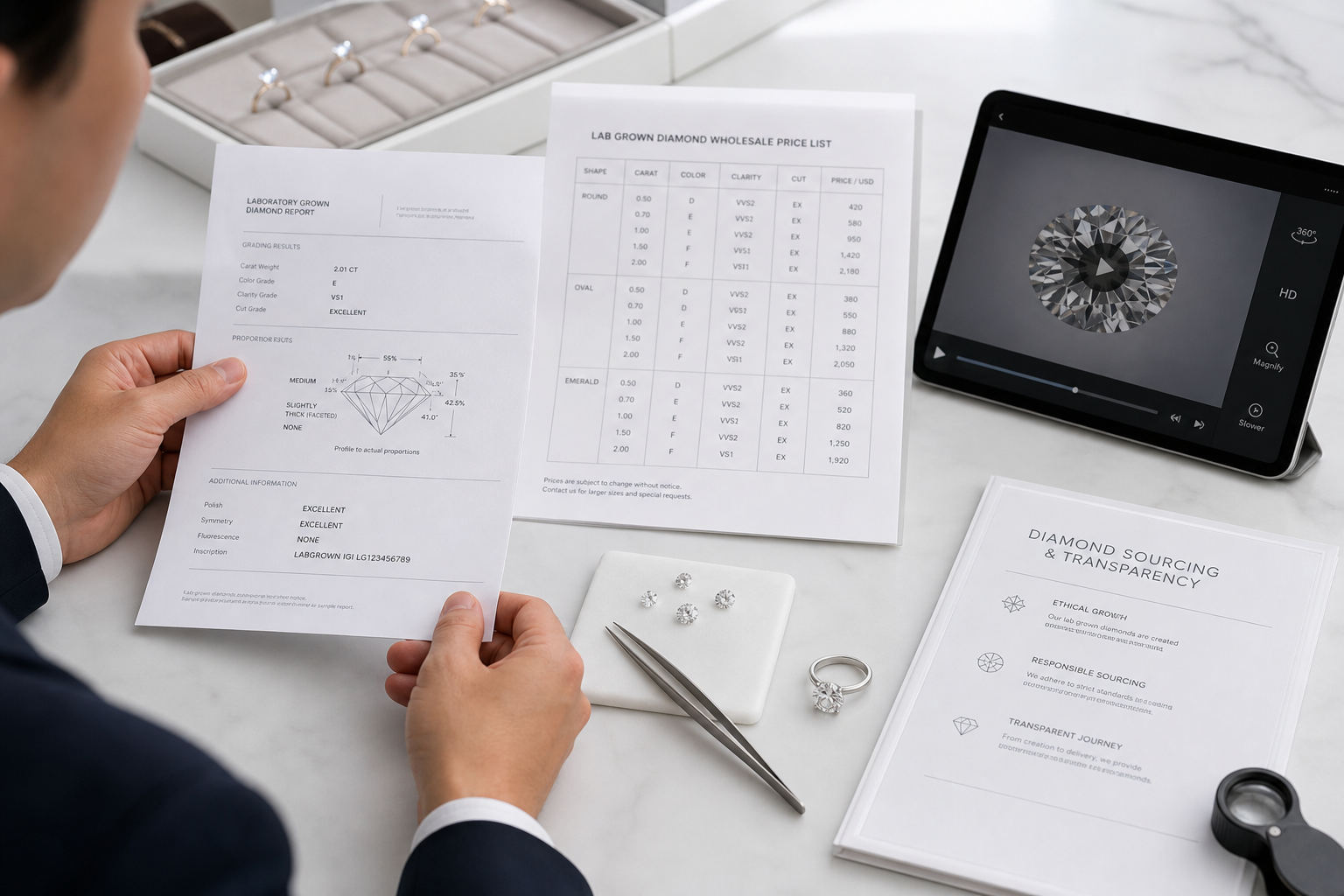
Low pricing is one reason many overseas buyers consider China lab-grown diamond suppliers, and a competitive quote is not automatically suspicious. Wholesale pricing can vary based on quantity, stock position, grading lab, shape, color, clarity, cut quality, payment terms, and how urgently a supplier wants to move certain goods. A lower sourcing quote may be legitimate if the supplier can explain the price difference in concrete terms.
The warning sign appears when a quote is far below comparable offers but the supplier cannot explain why. In lab-grown diamonds, headline price alone is a weak measure of value. A lower lab-grown diamond price may reflect a real advantage, but it can also reflect substituted specs, weaker documentation, goods that are not actually available, or stones that look less desirable than their grade suggests.
When a Low Quote Is Normal Competitive Pricing
A modest price difference can be normal in wholesale diamond sourcing. One supplier may have older stock, better access to a particular shape, lower margin expectations, or a larger parcel that allows more flexible pricing. For repeat buyers or larger orders, suppliers may also quote more aggressively to build the relationship.
A quote that is noticeably lower than several comparable offers may be explainable, especially if the supplier provides a clear reason. For example, the stones may be non-certified production goods, a mixed clarity parcel, a less in-demand size range, or inventory the supplier wants to clear. The key is that the explanation should connect directly to the specs, documentation, quantity, or stock condition.
The buyer’s mistake is assuming that all “same grade” stones are equivalent. Two stones with the same carat, color, and clarity can differ in cut quality, proportions, visual performance, fluorescence, transparency, bow-tie effect, or documentation strength. If the lower quote comes with weaker information, the buyer may not be getting the same product at a better price; they may be comparing two different offers that only look similar on a price sheet.
In practical buying, price per carat should be checked against face-up measurements and intended use, not only against the carat weight printed on a quote. A stone can be heavier but look smaller if weight is hidden in depth, while another can face up larger but show weaker light return or proportion issues. This is why a low quote should be reviewed together with measurements, video, and setting requirements rather than treated as a simple discount.
When a Low Quote Becomes a Warning Sign
A very large discount should slow the process down. If one China lab-grown diamond supplier is materially lower than several comparable quotes for the same carat weight, shape, color, clarity, cut quality, certificate type, and quantity, treat it as a due-diligence trigger. It does not prove the supplier is unreliable, but it does mean the buyer should ask more questions before moving forward.
The risk is highest when the supplier’s answer is vague. Phrases like “factory price,” “special stock,” or “best wholesale price” are not enough by themselves. A serious supplier should be able to explain whether the price difference comes from stock age, quantity, certification type, mixed grades, production source, urgency, or a specific concession in specs.
Extreme pricing becomes especially concerning when the supplier avoids direct comparison. If the buyer asks whether the quote includes the same certificate lab, exact color and clarity range, current stone IDs, matching requirements, or pre-shipment video, and the answer stays general, the price should not be treated as confirmed value. In overseas sourcing, unclear savings often become expensive problems later.
What Extreme Discounts May Indicate
A quote far below market may mean the goods are not equivalent to the comparison set. The supplier may be quoting lower-color or lower-clarity stones, uncertified goods instead of certified stones, less desirable makes, or stones with visual issues that are not obvious from the basic grade. For fancy shapes, the discount may be tied to proportions, poor symmetry, visible bow-tie, or shapes that are difficult to match in layouts.
Another possibility is that the supplier is quoting stock it does not actually control. In that case, the low price may be used to start the conversation, only for the buyer to learn later that the specific stones are gone, unavailable, or replaced with more expensive alternatives. This is not just a pricing issue; it is a stock control issue that affects delivery, planning, and buyer trust.
There can also be documentation gaps. A lower wholesale diamond price may exclude grading reports, use a different lab than expected, or rely on supplier descriptions rather than third-party grading. For some melee or production orders, that may be acceptable if the buyer understands the model. It becomes a red flag when the supplier implies full certification or equivalent documentation but cannot provide report numbers, lab names, or matching details.
Price Comparison Check Before You Commit
Compare quotes only when the underlying terms are truly comparable. The most useful comparison is not simply price per carat, but price against the full specification set: carat, shape, color, clarity, cut or make quality, measurements, certificate type, quantity, matching tolerance, QC evidence, and delivery terms.
Before accepting a very low quote, ask the supplier to confirm in writing why the price is lower and what is included. If the explanation is specific and supported by documents, the quote may be worth considering. If the answer remains broad, rushed, or dependent on immediate payment, the buyer should pause. A cheap quote is only useful when the product, documentation, and responsibility are clear enough to protect the order.
Red Flag 2: Prices Change Quickly After You Ask for Details
Some price movement is normal in lab-grown diamond sourcing. Inventory can move quickly, especially for popular sizes, certified stones, matched pairs, and wholesale parcels. Exchange rates, supplier stock levels, and availability from partner sources can also affect a lab-grown diamond wholesale quote. A price change is not automatically a red flag.
The concern is timing and pattern. If the price changes only after the buyer asks for a report number, video, measurements, stock confirmation, or payment terms, the supplier quote may not have been based on confirmed goods. For overseas buyers, that creates planning risk because the order is no longer anchored to a specific stone, parcel, or documented offer.
Normal Price Movement Versus Unstable Quoting
Normal price movement usually comes with a clear explanation. The supplier may say the quote is valid for a certain number of hours, or that the stone must be reserved before the price can be guaranteed. The buyer may also receive a written note that availability is subject to confirmation. This is not ideal for every purchasing situation, but it is transparent.
Unstable quoting looks different. The supplier advertises a price sheet, but the listed goods are not available when requested. A low quote is provided, then revised after the buyer asks for certificate details. A stone is offered at one price, but the “same” stone becomes more expensive once video or measurements are requested. These patterns suggest the supplier may be quoting speculatively rather than from controlled inventory.
The practical difference is accountability. A supplier that gives a quote with a clear validity window is telling the buyer how long the offer can be relied on. A supplier that keeps changing the offer without explaining the cause is asking the buyer to chase a moving target.
The “Stone Just Sold” Pattern
The phrase “that stone just sold” can be true. Lab-grown diamond inventory does move, and a supplier may lose access to a stone before it is reserved. The problem is when this happens repeatedly after the buyer asks for proof. If every low-priced stone disappears as soon as the buyer requests a report number, inscription check, video, or written confirmation, the original quote may have been used mainly to pull the buyer into the conversation.
A common pattern is that the supplier first offers an attractive stone, then says it is unavailable, then proposes a similar stone at a higher price. One occurrence may be normal. Repeated occurrences suggest the supplier’s advertised availability does not match actual stock control. For a retailer, wholesaler, or jewelry brand planning margins and delivery dates, this can create more damage than paying a slightly higher but stable price from the start.
This is especially risky when the buyer is sourcing for a customer order or production schedule. If the supplier cannot hold the quoted goods long enough to verify basic details, the buyer may end up promising inventory that does not exist. That risk should be handled before payment, not after the buyer has committed to a client.
Why Quote Validity Matters for Overseas Buyers
Quote validity is one of the simplest ways to test whether a supplier is organized. A reliable supplier should be able to state whether the quote is valid for a defined period, whether the stones are reserved, and what action is required to hold them. The window does not need to be long, but it needs to be clear.
For overseas buyers, time zones make this especially important. A buyer may need internal approval, customer confirmation, or comparison against other offers before sending payment, especially when working within China’s lab-grown diamond ecosystem for custom jewelry orders. If the supplier cannot hold pricing or availability even briefly, the buyer needs to know that upfront. Otherwise, the order may change between inquiry, approval, invoice, and payment.
Written confirmation also prevents later disputes. The buyer should know whether the quoted price includes the exact stones listed, whether substitution is allowed, whether certificate fees are included, and whether shipping or export-related costs are separate. A supplier that resists putting these details in writing may not be prepared to support a stable wholesale transaction.
Questions to Ask Before Sending Payment
Before sending payment, ask whether the quoted stones are currently available, whether they are owned or sourced from a partner, and how long the price is valid. Request written confirmation of the stone IDs, certificate numbers if applicable, measurements, total cost, and any conditions that could change the price.
If the supplier says the price is only valid immediately, ask what specifically is being reserved and what proof will be provided before shipment. Urgency by itself is not proof of risk, but urgency combined with vague stock details is a poor buying condition. A serious supplier should be able to move quickly without making the buyer accept unclear terms.
Red Flag 3: Vague or Incomplete Certificate Information
What a Reliable Certificate Claim Should Include
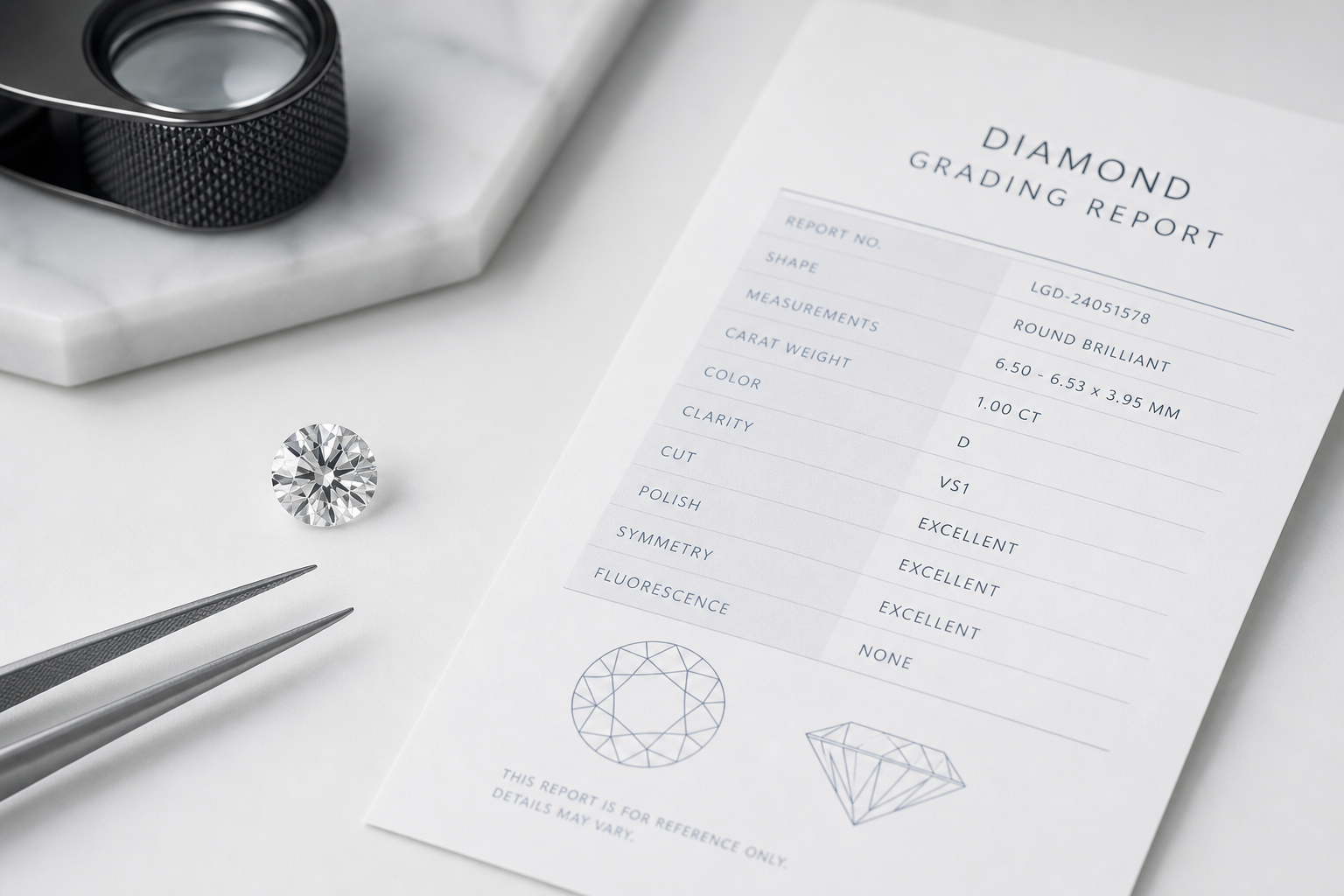
A lab-grown diamond certificate is useful only when the supplier can connect it clearly to the exact stone being offered. A serious certificate claim should include the grading lab name, report number, shape, carat weight, color, clarity, measurements, and any inscription information if the stone is laser inscribed. For certified loose diamonds, the supplier should be able to provide a copy of the grading report or a verifiable report number before the order is finalized.
The key issue is not whether every product category must come with an individual certificate. In wholesale lab-grown diamond sourcing, some melee diamonds, small calibrated goods, and production parcels may be sold with batch-level specifications rather than individual IGI report or GIA report documentation. That can be normal if the supplier explains it clearly. The red flag appears when a China lab-grown diamond supplier says a stone is certified but cannot name the lab, provide the report number, or show that the report matches the offered diamond.
When certificate language appears in a quote, buyers should separate three things: a grading report, a supplier specification, and a marketing description. A grading report is issued by a named laboratory and should be traceable to the stone details being discussed. A supplier specification may be useful for parcels or production goods, but it is not the same as an individual third-party report. A marketing description such as “GIA standard” or “IGI quality” should be treated as descriptive language unless it is tied to an actual report number and matching stone evidence.
Warning Signs in Report Numbers and Lab Names
Vague certificate language should slow the purchase down. Phrases such as “IGI quality,” “GIA standard,” “certificate available later,” or “same as certificate” do not mean the same thing as an actual grading report. If a supplier uses a lab name in the quote, the buyer should be able to verify the report through the grading lab’s online database and compare the report details with the stone being offered.
The most important checks are practical: the report number should exist, the lab name should be real and clearly stated, and the online report should match the quoted shape, carat weight, color, clarity, and measurements. Small differences in wording may not matter, but mismatched carat weight, different measurements, a different shape, or a report that cannot be found are serious warning signs. If the stone is supposed to have a laser inscription, ask for a clear image or video showing the inscription when practical.
A common mistake is treating any certificate image as proof. Screenshots can be reused, outdated, or attached to the wrong stone. The safer standard is simple: the certificate must be traceable, current enough for the transaction, and connected to the exact diamond through matching specs, stone video, supplier confirmation, and pre-shipment documentation.
When a grading report is available, buyers should verify the report details through the issuing laboratory’s official report-check tool where available, then compare those details with the quote, video, invoice, and shipment references.
Why a Certificate Still Does Not Replace Visual Review
A grading report does not show everything an overseas buyer needs to know. It confirms important information, but it does not fully communicate how a diamond looks in motion, whether inclusions are distracting in real viewing conditions, or whether a fancy shape has a noticeable bow-tie, poor symmetry impression, or weak visual spread. This matters even more when buyers are sourcing for finished jewelry, matched pairs, layouts, or repeatable wholesale stock.
For example, two oval lab-grown diamonds can have similar certificate grades and still perform differently in a ring because of length-to-width ratio, faceting pattern, windowing, or dark areas through the center. The report helps narrow the field, but video and QC confirmation help prevent the wrong stone from being approved simply because the paperwork looks acceptable.
A grading report also should not be stretched beyond what it documents. It may describe diamond characteristics such as carat weight, measurements, color, clarity, and other grading details, but it does not by itself prove sustainability practices, labor conditions, export compliance, long-term value, or suitability for a particular custom design. If a supplier makes ethical, environmental, or investment-related claims, those claims need separate documentation and should not be treated as guaranteed by the diamond report alone.
Environmental and sustainability claims should be specific, documented, and limited to what can be substantiated.
At NUVU, we usually treat diamond documentation as the starting point, not the final decision. Certificate verification reduces one type of risk, but visual review and shipment confirmation reduce the risk of receiving a stone that technically matches the report yet fails the buyer’s actual use case.
Certificate and Visual Review Check
- Ask for the grading lab name, such as IGI or GIA, without vague phrases like “certificate quality.”
- Request the report number and verify it directly through the lab’s online report lookup when available.
- Compare the report against the quoted shape, carat weight, color, clarity, measurements, and inscription details.
- Ask for current photos or video of the actual stone, not only a stock image or certificate screenshot.
- Confirm whether the stone being shipped is the same stone shown in the report, video, invoice, and packing details.
- For melee or production goods without individual certificates, ask how specifications are controlled and documented at parcel level.
If the supplier cannot connect the report, the stone, and the shipment details into one consistent record, the buyer should pause. In certificate-based sourcing, unclear documentation is not a minor admin issue; it is often the first sign that the transaction may become difficult to verify later.
Red Flag 4: Stock Claims That Sound Too Broad or Too Perfect
Access to Stock Is Not the Same as Owned Inventory
Large lab-grown diamond inventory is possible, especially in China’s diamond supply chain, but broad claims still need proof. A supplier saying “we have all sizes” or “any quantity is ready now” may mean several different things: they may own the goods, have access through partner suppliers, be pulling from a shared wholesale stock list, or be estimating what can be sourced after payment. These are not equal levels of control.
Access to network inventory is not automatically a problem. Many reliable suppliers, wholesalers, and trading companies use partner stock to serve overseas buyers efficiently. The risk comes when access is presented as confirmed inventory. If a supplier does not control the stones directly, availability can change quickly, certificate details may not be fully confirmed, and the final goods may differ from the first quote.
The practical question is not “Do you have many diamonds?” It is “Which exact goods are available, under your control, and reserved for this order?” A supplier who can answer that clearly is usually easier to evaluate than one who relies on general statements about having massive wholesale stock.
Why Matching Goods Require Extra Confirmation
Stock claims become more sensitive when the order depends on consistency. Calibrated diamonds, matching pairs, melee diamonds, layouts for earrings, tennis bracelets, halo settings, or multi-stone jewelry require more than similar grades on paper. A parcel can match by stated size and still look uneven if color range, proportions, table size, depth, cut style, or visual brightness vary too much.
This is especially important with fancy shapes. Matching pairs of ovals, pears, emerald cuts, radiants, or cushions need visual alignment, not just the same carat range. Two stones may both be listed as 1.00 carat, F color, VS clarity, yet differ enough in outline or length-to-width ratio that they look awkward side by side. For melee or calibrated production goods, the issue is consistency across a batch rather than one single stone.
A supplier who treats matching as a simple inventory count may be underestimating the order. For overseas buyers, that creates downstream problems: delayed production, higher rejection rates, inconsistent finished jewelry, and extra communication after goods arrive. The more the order depends on visual consistency, the more proof should be requested before approval.
For custom jewelry, stock verification also has to include setting compatibility. A diamond that looks acceptable as a loose stone may not suit a specific ring, pendant, or bracelet design if its measurements, depth, girdle area, outline, or pair-matching do not fit the planned setting. For buyers ordering both stones and finished jewelry, the supplier should connect the stone choice to the mounting requirements rather than treating the diamond and setting as separate decisions.
For custom design, trust comes from matching the stone to the setting, budget, and wearer’s daily use, not from choosing grades in isolation. Buyers should confirm stone measurements, setting style, prong or bezel requirements, metal choice, and design tolerances before the stone is treated as final, especially when the diamond and jewelry mounting are being sourced through the same supplier.
For custom jewelry, stone measurements and setting compatibility should be confirmed before finalizing a purchase.
How to Test Whether Stock Is Actually Available
The fastest way to test a stock claim is to ask for a current stock sheet with dates, stone IDs, certificate numbers where applicable, and specific quantities. A useful stock list should not feel like a generic catalog. It should show what is actually available now, what is pending, and what can be reserved.
For certified stones, ask for report numbers and videos tied to the specific stones. For calibrated goods or melee parcels, ask for parcel photos, layout images, size range, color and clarity range, quantity, and how the supplier confirms consistency before shipment. If the order involves matching pairs or layouts, request side-by-side images rather than individual stone photos only.
Reserved-stock confirmation matters because a stone that is “available” at the start of a conversation may not remain available while details are being reviewed. A reliable supplier should be able to state whether the goods are held, for how long, and under what conditions. If the answer keeps changing, the buyer may be dealing with access-based quoting rather than controlled inventory.
Stock Verification Checklist
- Request a dated stock sheet instead of relying on broad availability claims.
- Ask whether the supplier owns the inventory, controls it through a partner, or needs to source it after order confirmation.
- For certified stones, match stone IDs, certificate numbers, videos, and quoted specs.
- For matching pairs, request side-by-side images and confirm shape outline, measurements, color, clarity, and visual balance.
- For calibrated diamonds or melee diamonds, ask for parcel-level documentation, layout photos, and specification tolerances.
- Confirm whether the selected stock is reserved and how long that reservation is valid.
A broad stock claim is not proof of supply strength. The better signal is whether the supplier can move from general availability to specific, verifiable goods without changing the terms of the order.
Red Flag 5: “Direct Factory” Claims With No Clear Operational Detail
Why “Direct Factory” Is Not Always a Complete Answer
“Direct factory” is one of the most overused phrases in lab-grown diamond sourcing. It can mean a true grower, a cutter, a jewelry manufacturer, a wholesaler with factory partners, or a trading company using the phrase to suggest better pricing. The label alone does not tell an overseas buyer what the supplier actually controls.
A China diamond factory may grow rough material but not specialize in cutting finished stones for your order. A jewelry manufacturer may set lab-grown diamonds well but source loose stones from multiple suppliers. A wholesaler may not grow or cut diamonds but may have strong access to certified goods and better communication than a production-side operator. None of these models is automatically good or bad. The problem is when the supplier uses “factory” as a substitute for operational detail.
Buyers often overvalue factory status and undervalue accountability. A direct source is useful only if it improves control over specs, documentation, pricing, QC, production timing, and problem resolution. If a supplier cannot explain what part of the process they handle, the “direct factory” claim adds little value.
Factory, Cutter, Wholesaler, and Trading Company: What Each May Control
Different supplier types control different parts of the transaction. A grower may control production of rough lab-grown material but may not be the best source for finished certified stones in every shape and size. A cutter may influence proportions and make quality, but may still coordinate with outside grading labs or wholesalers. A jewelry manufacturer may control setting, finishing, and packaging, while buying diamonds from approved sources. A trading company may control communication, consolidation, export coordination, and supplier comparison across multiple sources.
The strongest supplier for a buyer is not always the one closest to the growth stage. For a U.S. retailer sourcing finished engagement ring centers, a supplier with reliable certificates, videos, QC, and shipment documentation may be more useful than a grower who cannot support small mixed orders. For a brand buying calibrated stones for repeat jewelry production, consistency and replacement handling may matter more than whether the supplier owns growth equipment.
This distinction protects buyers from the wrong assumption: factory access does not automatically mean better value. If factory status comes with weak documentation, unclear stock control, or poor after-sales responsibility, the sourcing risk may be higher than working with a transparent wholesaler or trading partner.
When a Middleman Can Still Be a Reliable Partner
A middleman can be a reliable partner when the role is disclosed and the value is clear. In lab-grown diamond sourcing, a competent wholesaler or trading company may help compare available goods, coordinate certificates, check videos, consolidate orders, communicate in the buyer’s language, manage export paperwork, and resolve discrepancies with upstream suppliers. For overseas buyers, that coordination can be valuable if it is honest and well documented.
The red flag is not the existence of an intermediary. The red flag is pretending not to be one while lacking control over the promises being made. If the supplier says “we are the factory” but cannot explain whether they grow, cut, grade-coordinate, set jewelry, inspect, pack, or export, the buyer has no clear way to assign responsibility if something goes wrong.
In wholesale conversations, the better test is transparency. A supplier who says, “We do not grow the rough, but we handle sourcing, QC, certificate confirmation, and export documentation” may be easier to evaluate than one who repeats “direct factory price” without answering operational questions.
Supplier Role Questions That Reveal More Than a Label
- Which part of the lab-grown diamond process do you directly handle: growing, cutting, sourcing, jewelry production, QC, packaging, or export?
- Do you own the listed inventory, hold it through partners, or source after order confirmation?
- Who coordinates grading reports, and when are report numbers available?
- Who performs pre-shipment QC, and what evidence is shared before shipment?
- If there is a mismatch in specs, certificate, quantity, or jewelry setting, who is responsible for the resolution?
- Can you provide business scope clarity without relying only on the phrase “direct factory”?
A supplier’s role does not have to be impressive; it has to be clear. Once the buyer knows what the supplier actually controls, pricing, documentation, QC, and accountability become much easier to judge.
When a grading report is provided, buyers should compare the report details with the issuing laboratory’s verification tools where available.
For buyer-facing selection and sourcing support, NUVU treats lab documentation as a working record rather than a decorative attachment. When a diamond is presented with a GIA, IGI, HRD Antwerp, or similar grading report, the useful trust signal is the ability to connect the report number, stone measurements, video, invoice reference, and shipment confirmation into one consistent chain. That process helps buyers distinguish a documented offer from a loosely described offer.
If a GIA report is provided, the report details can usually be checked through GIA’s official report verification system.
Where a GIA report is part of the offer, buyers can request the report number and compare the online record with the supplier’s quote before approving the order. For IGI or HRD Antwerp reports, the same principle applies through the relevant lab’s available report-check tools. This does not replace visual QC, but it gives overseas buyers a practical way to confirm that the paperwork being discussed belongs to the same stone being quoted.
Red Flag 6: Overpromised Lead Times and Rushed Commitments
Fast Delivery Is More Plausible for Confirmed Ready Stock
A short lab-grown diamond lead time is not automatically suspicious. If a supplier has a specific loose stone in confirmed ready stock, with the certificate number, measurements, video, and internal reservation already available, confirmation can move quickly. In that situation, the timeline is mostly about final QC, packing, export handling, and international logistics.
The risk starts when a supplier treats every order as if it were ready stock. A single certified round brilliant may be simple to confirm. A parcel of calibrated stones, a matched pair of fancy shapes, or a custom jewelry production order is different. Those orders depend on matching, inspection, setting work, documentation, and sometimes additional sourcing. A supplier who gives the same delivery promise for all of these categories may not be separating actual inventory from production-dependent work.
For overseas buyers, the practical test is whether the supplier can explain what has already been completed and what still has to happen. “Ready to ship” should mean more than “we can arrange it.” If the stone still needs to be sourced, inspected, certified, matched, mounted, or exported, the wholesale order timeline is not truly confirmed yet.
Custom, Matched, or Certified Orders Need More Time
Production-dependent timelines should be treated with more caution. Ready loose stones may be confirmed within a short window once reserved, but certification checks, matching work, custom jewelry production, and export preparation can add days or weeks depending on the order. The exact timing depends on the stone type, quantity, certificate requirements, setting complexity, and whether the supplier controls each step or coordinates through partners.
Matched goods are one of the most common areas where lead times are underestimated. Two stones with the same listed carat weight, color, and clarity may still need to be compared for measurements, shape outline, table size, face-up appearance, and visual balance. For melee or calibrated diamonds, the issue is not one stone but consistency across the full parcel. A rushed supplier may fill the order quickly, but the buyer may receive goods that meet the broad description while failing the visual requirement.
Custom jewelry adds another layer. Even if the center stone is ready, the production schedule may include CAD confirmation, metal casting, stone setting, finishing, inspection, packaging, and shipment coordination. A promise that ignores those stages is not a strong promise; it is a warning that the supplier may be trying to secure payment before the real timeline is known.
Pressure to Pay Quickly Can Hide Timeline Risk
Urgency is normal when a stone needs to be reserved. It becomes a red flag when the supplier uses urgency to avoid confirming the process. Phrases like “pay now or lose the price” or “shipment tomorrow” should be tested against specifics: Which stones are reserved? Has QC been completed? Are certificates already available? Has the export paperwork been prepared? Is the tracking timeline based on actual pickup or only an estimate?
The problem is not speed itself. The problem is speed without sequencing. A reliable supplier can usually break the diamond sourcing timeline into stages and identify where the order currently sits. An unreliable or disorganized supplier may collapse everything into one vague promise, then revise the timeline after payment because the stone was not available, the certificate was delayed, the parcel was not matched, or the setting was not finished.
A rushed commitment also reduces the buyer’s ability to catch mismatches before shipment. Overseas buyers do not have the advantage of inspecting goods in person before release. Written timeline stages create accountability, especially when the order involves wholesale lab-grown diamonds, custom settings, or goods that must match a production calendar on the buyer’s side.
Timeline Questions to Confirm in Writing
- Is this confirmed ready stock or does any part of the order still need to be sourced, matched, cut, certified, or produced?
- What is the expected timing for stock confirmation, QC, certificate verification, production, packing, export handling, and tracking?
- At what point is the stone or parcel reserved under our order?
- What could delay the shipment, and how will we be notified if that happens?
- Does the stated lead time begin before or after payment, QC approval, certificate confirmation, or final design approval?
If the supplier cannot separate these stages, the stated lead time should, as part of real supplier evaluation, be treated as an estimate rather than a commitment. A slower but documented production schedule is usually safer than a fast promise that cannot be explained.
Red Flag 7: Weak Quality Control Communication
What Strong QC Communication Looks Like
Lab-grown diamond QC is one of the clearest tests of supplier reliability because it shows how the supplier handles detail before a problem reaches the buyer. Strong quality control communication is not just a quick photo and a message saying “good quality.” It should show what was checked, what evidence is being shared, and how the supplier will handle any mismatch before shipment.
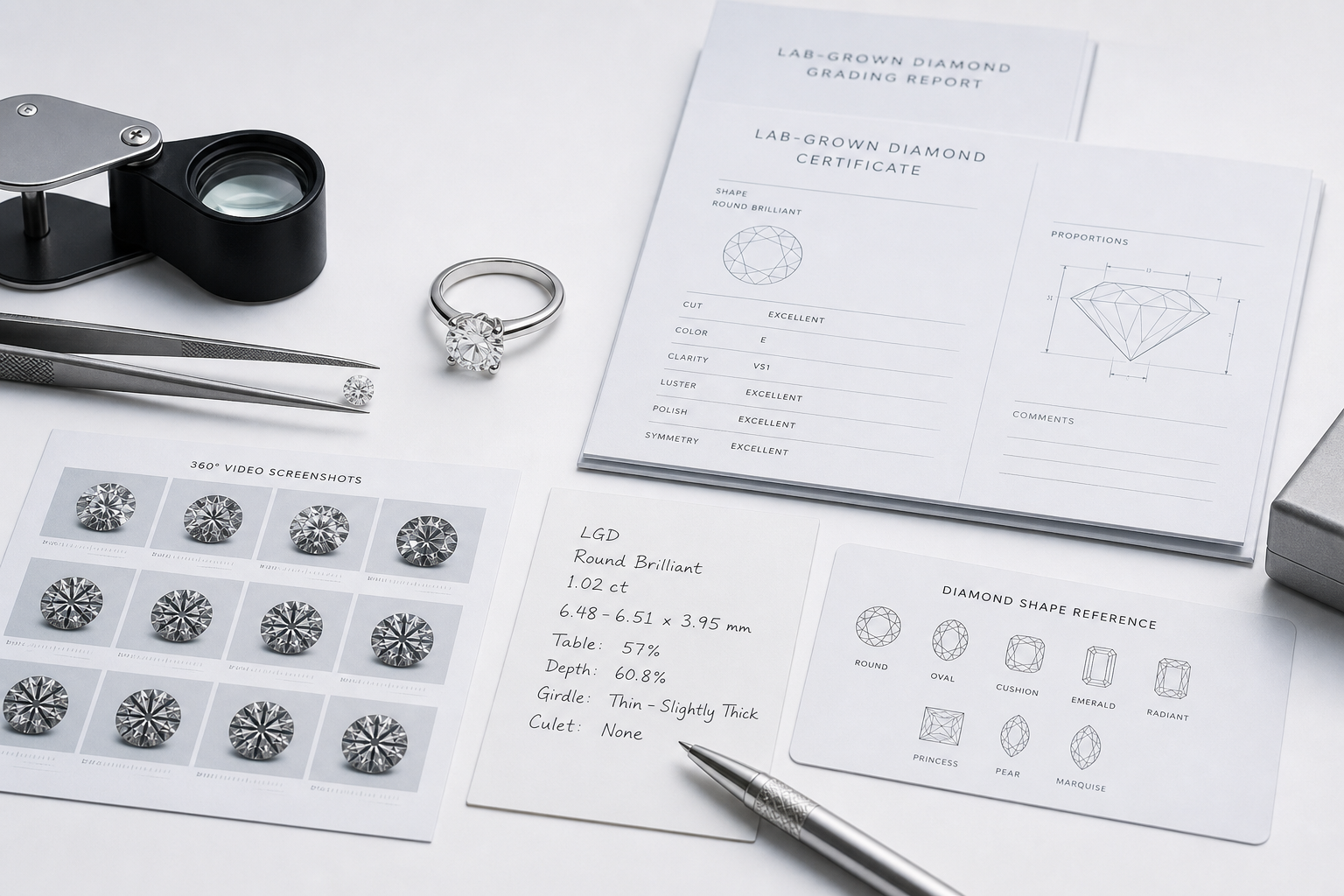
For loose stones, useful QC materials often include clear photos, a 360 video, certificate copy, stone measurements, and confirmation that the report details match the offered diamond. For parcels, pairs, or layouts, the buyer should also expect layout photos, matching notes, and consistency checks across size, color range, shape outline, and visual appearance. For jewelry, pre-shipment images should show the finished piece from practical angles, not only flattering presentation shots.
A 360 video is helpful, but it is not a substitute for full inspection. Video can reveal appearance, proportions, and some inclusions, but lighting, camera distance, background, and compression can hide issues. The stronger supplier does not rely on video alone. They explain what the video shows, what it cannot show, and what has been checked separately.
It is also worth asking the supplier to identify any limitations in the QC materials they provide. For example, a video may show face-up sparkle but not confirm exact measurements; a certificate may list clarity characteristics but not show how noticeable they are in normal wear; a group photo may show parcel size but not reveal small color or make differences. A supplier who can explain these limits is often giving the buyer a more useful basis for approval than one who simply says everything is “perfect.”
Warning Signs in Photos, Videos, and Measurement Details
Weak supplier communication often appears in small evasions. Photos are blurry or overly edited. Videos are too short, filmed under only one lighting condition, or do not show the full stone. Measurements are missing or copied from a certificate without confirming the actual stone. For parcels, the supplier may provide a group photo but no layout view that allows the buyer to judge matching.
Another warning sign is resistance to reasonable follow-up. If an overseas buyer asks for a clearer video, table measurements, inclusion visibility notes, or side-by-side confirmation for a matched pair, the supplier does not need to respond instantly. But they should understand the request and either provide the information or explain the limitation. Dismissive answers such as “all same,” “don’t worry,” or “quality is guaranteed” are weak substitutes for evidence.
The most important QC issue is not whether every stone looks flawless. It is whether the supplier can identify and communicate differences before shipment. In wholesale diamond sourcing, a minor variation may be acceptable if it is disclosed early. The same variation becomes a serious problem when the buyer discovers it only after the goods arrive and have already been assigned to client orders or production plans.
Scenario: Calibrated Ovals That Match on Paper but Not in Layout
Consider a U.S. retailer ordering 20 calibrated oval lab-grown diamonds for a custom jewelry line. On paper, the order may look simple: same size range, same color range, similar clarity, and similar carat weight. But “same size” does not guarantee that the stones will look matched once placed together.
Ovals can vary noticeably in length-to-width ratio, shoulder shape, table size, and bow-tie visibility. Two stones can both fit the requested millimeter range while one looks narrow and elongated and another looks rounded. If they are being used across earrings, pendants, or a repeatable ring design, those differences can create an inconsistent product line. The supplier who only confirms the spreadsheet is not giving enough information for a buyer who needs visual consistency.
A better QC process would include a layout photo of the full group, individual or grouped videos where needed, measurement ranges, color and clarity consistency notes, and confirmation of any stones that visually stand out. This does not require turning the buyer into a gemologist. It simply gives the buyer enough evidence to decide whether the parcel fits the intended use before the order leaves China.
Pre-Shipment QC Checklist
- Clear photos that show the actual stone, parcel, pair, or finished jewelry without excessive editing.
- 360 video for important loose stones, especially center stones and fancy shapes where face-up appearance matters.
- Certificate copy and report details matched against the offered stone, including carat weight, shape, color, clarity, and measurements.
- Stone measurements confirmed in a way that supports the intended setting, layout, or product line.
- Inclusion visibility notes when clarity characteristics may affect appearance, especially in larger stones.
- Layout photos for parcels, melee, calibrated goods, pairs, and sets where consistency matters more than a single-stone grade.
- Pre-shipment confirmation stating what has been checked and what happens if the received goods do not match the agreed details.
In supplier evaluation, weak QC communication is often more revealing than the diamond grade itself. A supplier who cannot show the goods clearly before shipment may be difficult to work with when a discrepancy appears after delivery.
Red Flag 8: Poor After-Sales Process or Unclear Responsibility
Why After-Sales Terms Should Be Discussed Before Payment
After-sales clarity matters most before the order is placed. Once goods have shipped internationally, every disagreement becomes harder to solve. Time zones, customs documents, return logistics, production deadlines, and client commitments can turn a small diamond order discrepancy into a costly operational problem.
A reliable supplier does not need to promise that problems will never happen. More importantly, they should be able to explain what happens if they do. Wrong specs, missing certificates, damaged goods, delayed shipment, inconsistent parcels, and documentation mismatches all need a defined resolution path. If the supplier avoids that conversation before payment, the buyer has little leverage later.
For overseas buyer protection, the key issue is responsibility. Who reviews the claim? What evidence is required? How quickly must the discrepancy be reported? Is replacement possible? If the item is jewelry, who is responsible for repair or remake if the issue comes from production rather than buyer-side handling? These questions are not minor administrative details. They determine whether the supplier is prepared to stand behind the order in a practical way.
Common Problems That Need a Clear Resolution Path
The most common after-sales problems are not always dramatic. A parcel may arrive with stones that technically fit the broad order description but vary too much for the intended layout. A certificate may be missing from the shipment. A stone may not match the report number provided earlier. A custom jewelry piece may have a setting issue, measurement mismatch, or finish concern. A shipment may be delayed after the buyer has already scheduled downstream production or client delivery.
These situations are manageable when expectations are written clearly. They become risky when the supplier’s only after-sales answer is “we will check later.” In wholesale diamond sourcing, delay itself can become a cost. If a buyer has to wait days just to learn whether a replacement is possible, the problem may already have affected customer commitments or production planning.
A weak after-sales process also shows how the supplier views accountability. Some suppliers are helpful before payment and vague afterward. The warning sign is not a strict policy by itself; strict terms can still be workable if they are clear. The real concern is unclear responsibility, shifting explanations, or no written process for handling errors.
What to Get in Writing Before an Overseas Order
Before sending payment, buyers should ask for written clarification on discrepancy reporting windows, evidence requirements, replacement options, and logistics responsibility. This does not need to be complex legal language. It should be clear enough that both sides know what happens if the order does not match the agreed specifications.
For loose stones, the written record should connect the order to specific specs, certificate numbers where applicable, agreed measurements, price, and pre-shipment materials. For parcels or calibrated goods, the record should describe acceptable ranges and matching expectations. For custom jewelry production, it should include design approval, metal details, stone details, sizing, finish expectations, and responsibility if repair or remake is needed due to a production issue.
Additional logistics costs should not be left vague. If the supplier sends the wrong item, who pays for replacement shipping? If a return is required, who handles customs documents and risk in transit? If the issue is caused by buyer-side changes after approval, how is the cost handled? The best time to discuss these points is before the order becomes urgent.
Buyers should be careful not to assume that common retail protections automatically apply to international wholesale sourcing. Return windows, replacement conditions, repair responsibility, customs handling, and insurance treatment can vary by supplier and order type. The practical protection is not a verbal reassurance that “we will solve it,” but a written process that matches the specific goods, value, and logistics path of the order.
After-Sales Questions That Reduce Confusion Later
- How long do we have to report a discrepancy after delivery?
- What evidence do you require for wrong specs, missing certificates, damaged goods, or inconsistent parcels?
- If the received stone does not match the agreed certificate number or measurements, what replacement process applies?
- For jewelry orders, who is responsible for repair or remake if the issue comes from production?
- Who pays additional shipping, insurance, customs, or handling costs when the error is supplier-side?
- What happens if the original replacement stone is no longer available?
A supplier who can answer these questions clearly is usually easier to work with, even if their terms are not the most flexible. A supplier who avoids them may be asking the buyer to accept risk that has not been priced into the order.
Red Flag 9: Communication That Avoids Specific Follow-Up Questions
Specific Questions Should Produce Specific Answers
A reliable China lab-grown diamond supplier does not need to have every answer instantly, but specific overseas sourcing questions should lead to specific follow-up. If you ask whether a stone is owned inventory or partner stock, the answer should not be “yes, available” with no further detail. If you ask for a report number, current video, price validity, or QC evidence, the supplier should be willing to verify rather than redirect the conversation back to payment.
This is one of the clearest supplier due diligence tests because it measures behavior, not marketing language. Many weak suppliers can send polished product photos and broad claims. Fewer can respond consistently when the buyer asks for traceable details across stock, certificate, price, timeline, and responsibility. The strongest signal is not speed alone; it is whether the answer reduces uncertainty.
Vague replies become especially concerning when they appear across multiple topics. One unclear answer about a lead time may be a normal delay. Repeatedly unclear answers about certificate details, stock status, QC materials, and replacement handling suggest the supplier may not control the order as closely as claimed.
When Slow Communication Is Different From Evasive Communication
Slow communication is not automatically a red flag in overseas diamond sourcing. Time zones, factory checks, certificate verification, production schedules, and translation can all create delays. In some cases, a supplier who says “I need to confirm this with the cutting team” or “Let me verify the report number before confirming” is behaving more responsibly than one who answers too quickly without checking.
Evasive communication feels different. The supplier avoids the exact question, gives a broad reassurance, changes the subject, or pressures the buyer to move forward before the missing detail is resolved. Phrases like “don’t worry,” “same quality,” or “trust us” are not enough when the issue involves paid inventory, grading documentation, matching, or shipment responsibility.
The practical distinction is simple: a slow answer should move toward evidence. An evasive answer moves away from evidence. If each follow-up creates more uncertainty than the original question, the buyer should treat communication itself as part of the risk profile.
A Safer Follow-Up Question Set for Overseas Buyers
A good diamond sourcing checklist does not need to be aggressive. The goal is to make the order testable before money changes hands. Overseas buyers should ask questions that require the supplier to confirm what they actually control, what is being offered, and what happens if the delivered goods do not match the agreement.
- Is this stock owned by your company, reserved from a partner, or subject to final availability?
- Can you provide the lab name, report number, carat weight, measurements, color, clarity, and any inscription details for each certified stone?
- How long is this quote valid, and does the price depend on immediate payment or confirmed stock reservation?
- Can you send current photos or video of the actual stones, not only sample images?
- For parcels, pairs, or calibrated goods, what matching standards are being used for size, color range, proportions, and visual layout?
- What QC evidence will be shared before shipment?
- What are the timeline stages for stock confirmation, QC, packing, export, and tracking?
- If the shipment arrives with wrong specs, missing certificates, damaged goods, or inconsistent parcels, what is the replacement or correction process?
- Which part of the supply chain do you directly handle: sourcing, cutting, grading coordination, jewelry production, QC, packing, or export documentation?
The answers do not all need to be perfect. The more important test is whether the supplier can make the order concrete. A supplier who openly says “we source this from partner stock, then verify before reservation” may be safer than one claiming to have everything in-house but refusing to document the details.
When to Pause, Verify, or Walk Away
Pause when the supplier gives an answer that is incomplete but still verifiable. Ask for the missing report number, updated stock sheet, video, written quote validity, or QC confirmation. A single gap should trigger follow-up, not immediate rejection.
Verify independently when two or three details do not line up. If the price is unusually low, the stock status is unclear, and the certificate information is incomplete, the risk is no longer isolated. At that point, compare the offer against other suppliers, check report numbers directly where possible, and avoid treating verbal reassurance as confirmation.
Walk away when reasonable questions are repeatedly avoided, especially after payment is requested. A supplier who cannot explain stock control, documentation, QC evidence, timeline stages, and discrepancy handling before an order is placed is unlikely to become clearer after a problem appears.
How to Build a Safer Supplier Evaluation Process
Use Red Flags as a Risk Pattern, Not a Single-Point Test
A safer supplier evaluation process does not depend on catching one dramatic warning sign. It depends on reading patterns. In China lab-grown diamond sourcing, some friction is normal: inventory moves, certificates need verification, matching can take time, and wholesale pricing changes with specification details. The issue is whether the supplier can explain those realities clearly and support the order with evidence.
One red flag should usually lead to better questions. Two or three related red flags should slow the order down. Repeated evasive answers, especially around payment, documentation, stock, and responsibility, should be treated as a serious reason to consider another supplier.
This approach helps buyers avoid two common mistakes. The first is rejecting every supplier that cannot answer instantly, which may eliminate legitimate operators who are actually checking details. The second is accepting weak answers because the price looks attractive. In wholesale supplier due diligence, the cheaper quote is not cheaper if it creates mismatched goods, delayed delivery, missing documentation, or unresolved claims.
Compare Documentation, Communication, and Accountability Together
Do not evaluate a China lab-grown diamond supplier on price alone, factory claims alone, or certificate claims alone. The safer test is how documentation, supplier communication, and accountability work together. A strong quote should identify what is being sold. A strong certificate process should allow verification. Strong QC communication should show what will ship. Strong after-sales terms should clarify what happens if the shipment does not match.
These factors are not equal in every order. For certified loose stones, report numbers and matching stone details carry more weight. For melee, calibrated layouts, or matching pairs, QC evidence and visual consistency may matter more than individual certificates. For custom jewelry or private-label production, timeline stages and remake responsibility become more important because the supplier is not only providing stones but coordinating a finished product.
At NUVU, we usually treat documentation as the starting point, not the whole decision. For sourcing conversations, the stronger signal is whether the supplier can connect the paperwork, product evidence, and order terms into one consistent picture.
Keep a Written Trail for Specs, Price, Timeline, and Responsibility
Written confirmation protects both sides, but it is especially important for overseas buyers who cannot inspect goods in person before shipment. Before payment, the buyer should have a written record of the agreed specs, certificate details where applicable, quantity, price, price validity, stock status, QC materials, shipment timing, and discrepancy process.
The written trail does not need to be complicated. A clear invoice, confirmed message thread, updated stock sheet, certificate references, and pre-shipment QC record are often more useful than broad promises. What matters is that the order can be checked against the agreement later.
Be cautious with agreements that rely on loose wording such as “high quality,” “same as sample,” “near colorless,” or “ready stock” without measurable details. Those phrases may sound harmless during negotiation, but they leave too much room for disagreement if the delivered stones differ from expectations. Specific language reduces conflict because it gives both buyer and supplier the same reference point.
Create a Traceability Pack Before Final Approval
For higher-value loose stones, matched goods, custom jewelry, or repeat wholesale orders, buyers can ask the supplier to assemble a simple traceability pack before final approval. This does not need to be a formal certification package or a new policy promise. It is a buyer-side record that links the quote, stone IDs, report numbers where applicable, videos, photos, measurements, invoice references, packing list details, and pre-shipment QC notes in one place.
The traceability pack should make it easy to answer one question: Are we still talking about the same goods at every stage? If the report number changes, the stock ID changes, the measurements differ, or the video no longer matches the quoted description, the buyer can identify the change before shipment. This is especially useful when several people are involved on either side, because the written chain reduces reliance on memory, chat summaries, or broad product descriptions.
In sourcing or wholesale conversations, documentation, consistency, and communication often matter as much as the headline specification. A supplier’s willingness to organize the record is a practical trust signal, but buyers should still verify the details themselves where possible.
Build a Claim-to-Evidence File Before Scaling Orders
Before increasing order volume, create a simple internal file that links each supplier claim to the evidence received. For example, a claim of certified stock should connect to report numbers, stone videos, and matching invoice details. A claim of ready inventory should connect to a dated stock sheet, reservation confirmation, and shipment timeline. A claim of custom jewelry capability should connect to CAD approval, production photos, finished-piece QC, and written remake terms.
This file does not need to be formal, but it should make the decision auditable. If a team member asks why a supplier was approved, the answer should not be “the price was good” or “they said they are a factory.” It should be possible to show the chain of evidence: what was quoted, what was verified, what was visually reviewed, what was agreed in writing, and what happened during or after delivery.
For repeat buyers, this record becomes more valuable over time. A supplier who consistently provides accurate stock information, matching documentation, reliable QC, and clear after-sales handling can earn larger orders. A supplier who repeatedly needs exceptions, explanations, or corrections should remain on limited test volume until their evidence quality improves.
A Practical Red-Flag Decision Framework
Use a simple risk framework before committing to a supplier or increasing order size. If there is one concern, ask targeted follow-up questions and request evidence. If the supplier responds clearly, the concern may be resolved. If there are two or three concerns across price, documentation, stock, QC, or timeline, slow down and verify independently before sending payment.
If the supplier repeatedly avoids specific questions, changes terms after verification requests, cannot document basic order details, or pressures quick payment while important points remain unclear, the safer decision is to stop the order or reduce it to a controlled test purchase. A small trial order does not remove all risk, but it limits exposure and gives the buyer a real view of communication, packing, documentation, and after-sales behavior.
A strong lab-grown diamond sourcing checklist should end with judgment, not just information gathering. Compare quotes, verify certificates, confirm stock, review QC evidence, document terms, and test communication before scaling. NUVU’s education resources can help buyers understand grading reports, loose diamond specifications, and sourcing models more clearly, but the final supplier decision should always come down to evidence, consistency, and accountability.
Disclosure: This article is for general educational purposes only. Diamond grading, pricing, availability, specifications, and seller policies can change, and readers should verify important details through grading reports, official laboratory tools, seller documentation, or qualified professionals before making a purchase decision. Laboratory-grown diamonds should be clearly distinguished from natural diamonds, and environmental or sourcing claims should be supported by specific documentation.