
Buying from a China lab-grown diamond supplier can be a practical sourcing option, but only if the supplier, stones, documents, and service process can be verified before money is committed. A polished website or attractive quotation is not enough when evaluating China lab grown diamond prices across suppliers. The real question is whether the company identity is consistent, the product matches your exact requirements, the grading reports can be checked, and the supplier can provide stone-specific proof rather than generic catalog material.
For the full framework, read China Lab-Grown Diamond Supply Chain Guide.
For practical buyers, verification works best when each layer answers a different question: who the company is, what it specializes in, what the paper trail proves, and whether the stone or finished piece matches the written claim. If one layer is weak, do not let another layer compensate for it.
This guide helps buyers move from guesswork to a structured decision. It explains what to confirm in writing, how to compare reports, invoices, measurements, videos, and laser inscriptions, and why a small sample order is often one of the most practical first tests. By the end, you should be able to decide whether to proceed, ask for more clarification, sample again, pause the order, or walk away from a supplier that presents unnecessary risk.
| Verification Area | What to Check | Risk Signal |
|---|---|---|
| Business identity | Company name, website, email, and payment entity align | Different names with no written explanation |
| Supplier type | Factory, trader, or hybrid role is clearly explained | No clarity on who controls stock or corrections |
| Product fit | Recent examples match your shape, size, color, clarity, and order type | Only generic catalog images are provided |
| Documentation | Report numbers verify through the lab’s official tool | Unverifiable reports or mismatched details |
| Stone proof | Photos, neutral-light video, measurements, and inscription confirmation match | Media or measurements conflict with the quote |
| Sample performance | Packaging, timing, paperwork, QC, and communication meet expectations | Supplier pressures you to scale before sample issues are resolved |
Quick Questions Before You Read
Q: Is a diamond certificate enough to trust a supplier?
No. A certificate helps verify a stone’s reported details, but it does not prove supplier consistency, stock control, or after-sales responsibility.
Q: Should I place a large order if the price is very competitive?
Not immediately. A small sample order is a practical way to test accuracy, documentation, packaging, timing, and communication first.
Q: What is the biggest warning sign when checking a supplier?
Inconsistent identity details, unverifiable report numbers, or refusal to confirm key information in writing should be treated seriously.
Q: How should matched stones or batch orders be verified?
Ask how the supplier matches size, color, clarity, shape, measurements, and appearance, then confirm the details against reports and media.
Separate Lab-Grown, Natural, and Simulant Language Before You Compare Quotes
Laboratory-grown diamonds should be clearly identified as laboratory-grown, and they should not be presented as mined diamonds. Natural diamonds and lab-grown diamonds have different origins, even when a seller uses similar marketing language. If a supplier also offers simulants or diamond lookalikes, those should be treated as a separate product category rather than grouped together.
This matters in supplier verification because the language in a quotation, report, and product listing should be internally consistent. If a report or invoice uses one term while the marketing copy uses another, ask for clarification before you treat the item as comparable to a natural diamond offer. Clear terminology is one of the easiest ways to reduce confusion later in the order process.
A grading report can document reported characteristics, but it should not be treated as proof that the seller has explained origin clearly or that every piece of marketing copy is accurate. Buyers still need to compare the stone, the paperwork, and the supplier’s written description together.
Start With Business Identity Before You Discuss Price
Before you compare stone quality, quote structure, or lead times, make sure the China lab-grown diamond supplier is real, traceable, and easy to identify across every point of contact. This is the first layer of supplier due diligence because a company that cannot keep its own identity consistent is difficult to trust with an order, even if the website looks polished and the replies are fast.
The goal here is not to prove perfection. It is to reduce uncertainty. A legitimate supplier can still have small name variations, a trading structure, or a different payment entity from the brand name shown on the website. The issue is whether those details make sense when you cross-check them, or whether they stay vague after you ask for clarification in writing.
It also helps to understand whether the names you see are brand names, trade names, or legal entity names. Those can differ for ordinary reasons, but the supplier should be able to explain the relationship clearly and consistently. If the story keeps changing, that is more important than the name variation itself.
Match the Company Name Across Documents and Communication
Start with the registered company name, the English business name, the website domain, the sender email, the payment account name, and the contact details listed on invoices or quotations. These should point back to the same business or to a clearly explained related entity. If the names do not line up, that is not automatically a red flag, but it does mean you need a direct written explanation before you go further.
A common mistake is to accept a friendly conversation as proof of legitimacy. It is not. A serious supplier should be able to explain why one name appears on the website, another on the bank details, and another on export paperwork. If the explanation changes from message to message, stop and clarify before discussing any order.
Confirm Whether You Are Dealing With a Factory, Trader, or Hybrid Supplier
Some buyers assume a factory is always better than a trader. That is too simplistic. What matters more is whether the supplier is structured for the type of order you want. A factory may be stronger on direct production control, while a trader or hybrid supplier may be better at handling sourcing coordination, mixed product requests, or communication across several categories.
For a China lab-grown diamond supplier, the label matters less than the actual operating model. Ask who owns the stock, who handles grading report coordination, who checks quality before shipment, and who is responsible if the order needs correction. If the supplier cannot answer those points clearly, it is not ready for a serious conversation yet.
Look for Consistent Export Experience, Not Just a Polished Website
A clean website is useful, but it is not evidence of export experience. You want signs that the supplier has worked through real cross-border orders: export invoices, shipping documents, trade references, and a process for handling international communication without confusion. A supplier that regularly ships abroad usually communicates in a more structured way and is less likely to stumble when you ask for written confirmations.
Look for background signals that support the company story. Social media presence can help, but only if it matches the product focus and shows ongoing activity rather than recycled images. Trade references matter more when they are specific and verifiable. If the supplier says it serves overseas buyers, ask what kinds of buyers, what product categories, and what markets they normally handle. The answer should sound practical, not scripted.
What to Check Before You Continue
- Registered company name and English business name
- Website domain, email domain, and payment entity consistency
- Whether the supplier is a factory, trader, or hybrid operator
- Evidence of export experience, not just marketing language
- Clear written explanations for any name or entity mismatch
- Basic trade references or export-related documentation where available
If the company identity stays coherent after these checks, you have enough ground to move on to product fit. If it does not, the more cautious decision is to pause, because no quote is useful if the supplier itself is hard to verify.
Review the Supplier’s Product Scope and Specialization
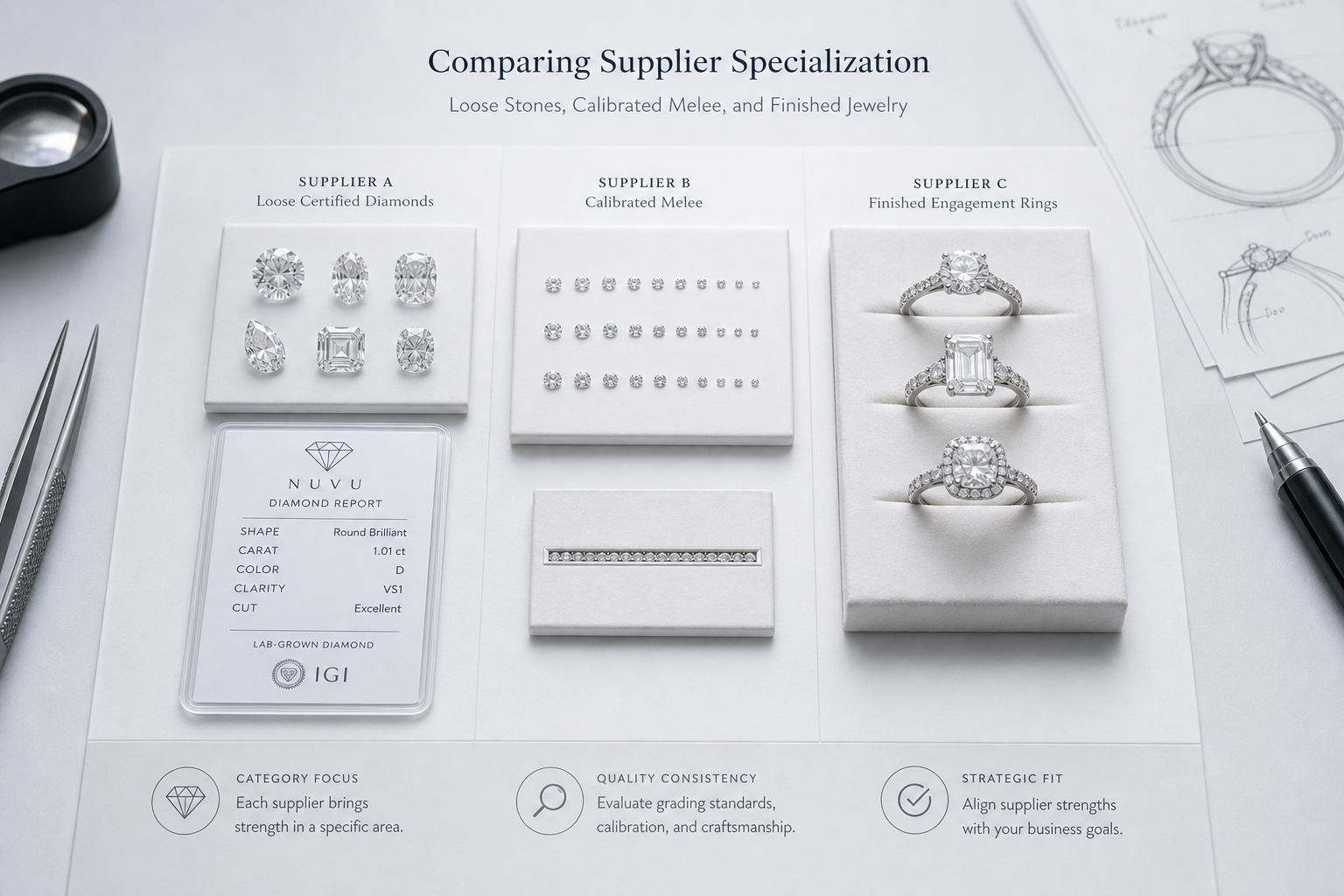
Once the business identity checks out, the next question is simpler and more important than most buyers expect: does this supplier actually specialize in the kind of product you need? A broad catalog can look impressive, but wide coverage does not guarantee repeatable capability in your category. A lab-grown diamond wholesale supplier that handles certified loose stones well may not be equally strong in calibrated melee, matching pairs, or finished custom jewelry.
This is where many sourcing mistakes begin. Buyers often treat product range as proof of strength, when it is really just a starting point. The better test is whether the supplier can show repeated work in the exact category, shape, and quality range you plan to order.
Separate Loose Stone Supply From Finished Jewelry Manufacturing
Loose lab-grown diamonds and finished jewelry are related, but they are not the same capability. Loose-stone supply depends on sourcing, grading coordination, matching, and documentation. Finished jewelry adds metal work, setting quality, sizing, finishing, and final inspection. A China custom lab-grown diamond jewelry supplier may be excellent at one side of that process and only average at the other.
For that reason, do not assume that strong loose-stone inventory means the supplier can also produce dependable engagement rings or private-label pieces. If your order is for finished jewelry, ask for examples of the exact type of setting, metal, and stone combination you want. If your order is for stones only, focus on how the supplier handles grading reports, consistency, and matching, not just how many jewelry photos are on the site.
Check Whether the Supplier Handles Your Exact Shape, Size, and Quality Range
Category fit matters at a more detailed level too. A supplier may list CVD diamonds and HPHT diamonds, but that does not tell you whether they are reliable in your target shape, size range, or clarity range. A buyer sourcing certified lab-grown diamonds for engagement rings should look for examples that match the exact oval, round, pear, or emerald profile they need. The same logic applies to calibrated stones and melee, where small inconsistencies become more obvious when pieces are meant to align.
Ask whether the supplier works regularly in the same range you are considering. If you need matched stones, ask how they group them. If you need custom jewelry, ask what stone sizes, setting types, and metal purities they normally produce. The most useful answer is not “yes, we can do it,” but “we do this often, and here is a recent example that looks like your request.”
What to Check Before You Continue
- Recent production examples that match your product type
- Whether the supplier handles loose stones, finished jewelry, or both
- Shape, size, and quality range experience
- Whether matching or calibrated work is part of the supplier’s routine
- Evidence that current output matches the product category you need
After you confirm the supplier’s product scope, the most useful trust signal is whether the company can back up its claims with records that can be rechecked later. In diamond sourcing, confidence should come from traceable documents, consistent measurements, and a willingness to let the buyer verify rather than rely on sales language.
Trace the Stone Through the Documentation Trail
Traceability becomes stronger when each document tells the same story. A useful documentation trail usually starts with the quotation, then moves to the stone media, the grading report, the invoice, the packing list, and any final written confirmation of the exact item or batch. Buyers should check whether names, weights, measurements, and product descriptions stay aligned from one document to the next. If one file uses a broad description while another uses a precise report number, ask the supplier to reconcile the difference before proceeding.
For wholesale or repeat orders, the most useful records are the ones that let you reconstruct what was approved. That means keeping the supplier’s version of the stone spec, any changes made during negotiation, and the final sign-off together in one place. If you ever need to reorder a matching stone or compare a later batch, this paper trail becomes more valuable than memory.
For NUVU, the goal is to make comparison clearer: what the report shows, what the visuals reveal, and whether the stone fits the intended piece. That approach is especially useful when the supplier is offering several similar options and the buyer needs a reliable way to separate the real item from a polished presentation.
When a grading report is available, buyers should verify the report details through the issuing laboratory’s official report-check tool where available, and compare the result with the stone’s measurements and media.
Ask for Recent Production Examples, Not Only Catalog Images
Catalog images are easy to reuse and often look better than the actual stock. Recent production examples are more useful because they show what the supplier is making now, not what it wants buyers to think it can make. Ask for photos or short videos from recent orders in the category you need, ideally with the same shape, size range, and product format.
If the supplier says it can source loose lab-grown diamonds for a U.S. boutique brand, request a recent example that resembles your intended order. If it claims strength in custom rings, ask to see a finished piece with the same setting style or stone arrangement. The point is not to ask for a perfect match. The point is to see whether the supplier’s actual output lines up with the claim.
Stone-to-Order Fit Check
Before you move on, make sure the supplier can show recent work that fits your order type, not just general capability. A strong fit usually means the same product category, the same stone format, a similar shape or setting style, and a quality level that sits in your target range. If those pieces do not line up, the supplier may still be worth keeping in view, but not yet worth trusting with a serious order.
Verify Grading Reports Without Treating Them as the Whole Answer
Grading reports are useful, but they are not a substitute for supplier verification. A China lab-grown diamond supplier can provide a clean-looking certificate and still fall short on consistency, communication, or order accuracy. The real question is whether the document matches the stone and whether the supplier can provide documentation that stays consistent across the order process.
Use grading report verification as a check on both the stone and the supplier’s handling of paperwork. If the report is real, the details should line up cleanly with the offered diamond. If the supplier is organized, the documents should be easy to match and easy to verify again later.
Check Report Numbers Through the Lab’s Official Verification Tool
When the report number is available, verify it directly through the grading lab’s official online database or lookup tool, if one exists. That is the most direct way to confirm that the report number corresponds to a real entry rather than a copied image. It is a basic step, but it catches a surprising number of avoidable problems.
For buyers comparing suppliers, this check also shows whether the supplier is handling documentation carefully. A supplier that gives you the wrong report number, delays the number, or cannot explain how it maps to the stone is not creating confidence. Even before you inspect the diamond itself, that is a sign to slow down.
Match the Report Details to the Offered Stone
Do not stop at the report number. Compare the report’s carat weight, measurements, shape, color, clarity, growth method if listed, laser inscription details, and report date against the stone being offered. If the supplier is sending a certified stone, those details should align without you having to guess.
Small mismatches are not always fraud, but they should be explained. A different report date, a changed measurement, or a shape description that does not match the media can point to a mix-up, a stock substitution, or poor recordkeeping. At the sourcing stage, any of those issues matter because they show how carefully the supplier handles details.
Understand What a Report Does Not Prove
A report does not prove that the supplier is reliable, communicative, or consistent. In discussions of HPHT vs CVD diamonds, it also does not guarantee that the stone will perform well in every lighting condition, or that the supplier will resolve problems smoothly if something goes wrong later. The document is one part of the decision, not the decision itself.
For that reason, do not let a certificate override basic judgment. A clean report is helpful only if the stone, the communication, and the underlying business identity all make sense together. At NUVU, we treat the grading report as a starting point, not the final answer, because paper accuracy and supplier reliability are different questions.
It is also worth remembering that a grading report documents specific characteristics, but it does not replace visual review. Two stones with similar paper specs can still look different once you compare brightness, shape outline, or how well they suit the intended setting. That is why documents and media should be read together rather than separately.
Certificate and Visual Review Check
- Confirm the report number through the lab’s official verification tool
- Match carat weight, measurements, shape, color, and clarity to the offered stone
- Check whether the laser inscription details align with the report
- Review whether the document date and product description fit the current offer
- Note any mismatch that needs written clarification before you continue
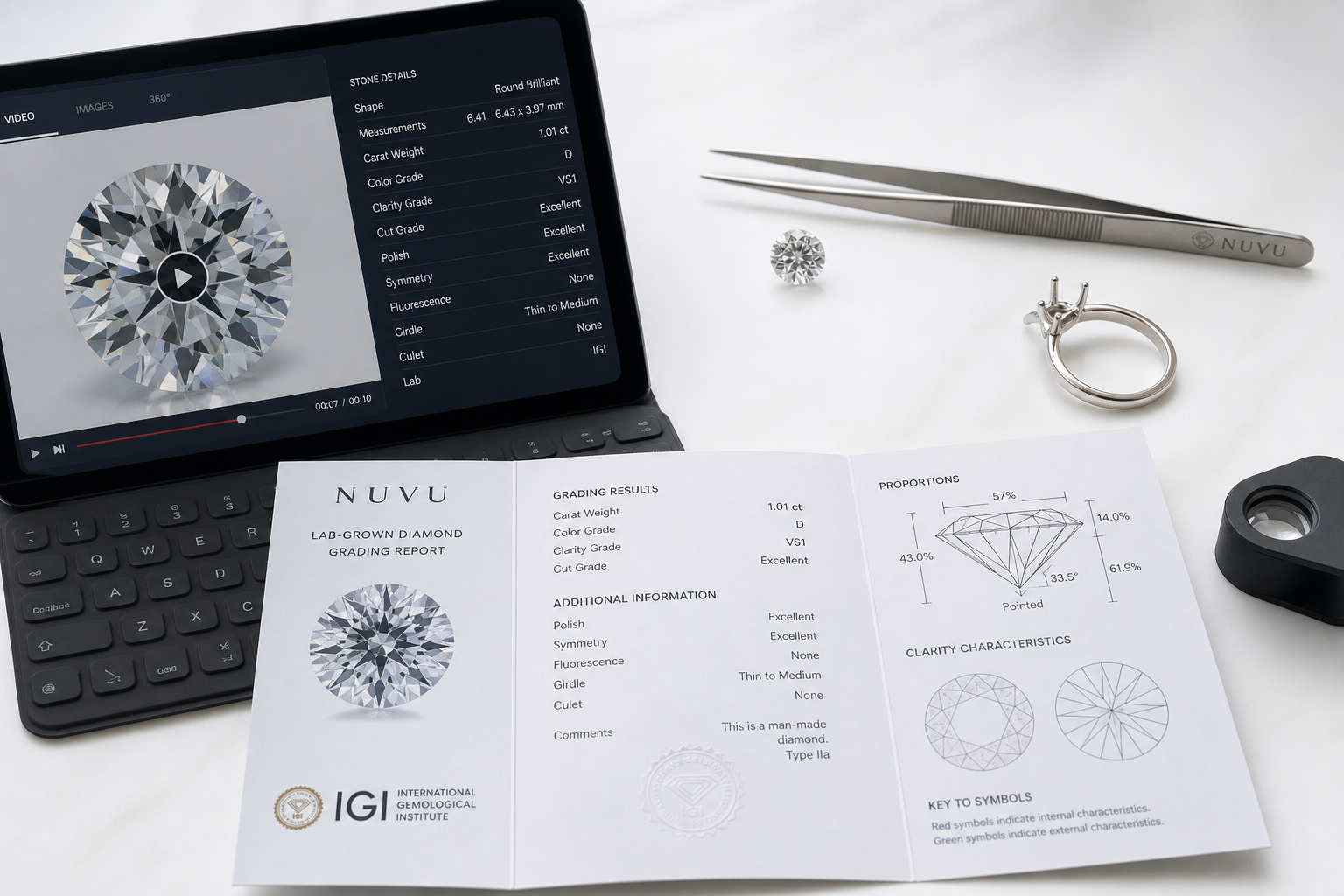
Clear media is only useful when it is tied to the exact item being sold. A supplier can send attractive photos and still leave the buyer uncertain about which stone or batch is actually being offered. That is why the best requests are specific, repeatable, and easy to compare against the written quote.
Request Real Photos, Videos, Measurements, and Batch Details
Catalog images can make a supplier look polished while hiding the details that matter in an actual order. Before you commit to a China lab-grown diamond supplier, ask for stone-specific evidence, not generic marketing assets. The real question is whether the supplier can show you the exact stone, or at least the exact batch, in a way that matches what they are offering in writing.
For loose stones, that means asking for a face-up photo, a side-view photo when the shape or proportions make it useful, a short video under neutral lighting, full measurements, the report number, and confirmation of any laser inscription on certified stones. For finished jewelry, the request should expand to include the stone measurements, setting dimensions, metal purity, CAD files or production images where relevant, and finished piece weight if that is part of the specification. If a supplier only sends polished product shots, you still do not know much.
The strongest suppliers usually understand this quickly. They can send media tied to a specific stone or batch, not just a catalog page. That is a meaningful signal because it shows they are used to being checked at the item level, which is the level that actually matters when you are verifying a lab-grown diamond before purchase.
It is also sensible to ask whether the media has been taken in neutral light and whether any edits were applied. Professional presentation is normal, but heavy retouching can hide the very qualities a buyer needs to judge. If the media looks too polished to be trusted, ask for a second clip or a simpler view rather than assuming the first one is fully representative.
Ask for Stone-Specific Media Instead of Generic Catalog Images
A real diamond video tells you more than a styled photo ever will. You want to see the actual stone in motion, in ordinary lighting, with enough clarity to judge whether it looks consistent with the report and the seller’s description. A still image can hide a lot. A short video usually reveals whether the stone looks clean, whether the shape is as described, and whether the visual presentation is honest.
For certified stones, ask the supplier to show the report number in the same set of media when possible, or to confirm that the stone shown is the one tied to that number. For jewelry, the same logic applies to the center stone, side stones, setting, and finish. If the supplier cannot provide stone-specific media on request, treat that as a limitation, not a minor inconvenience.
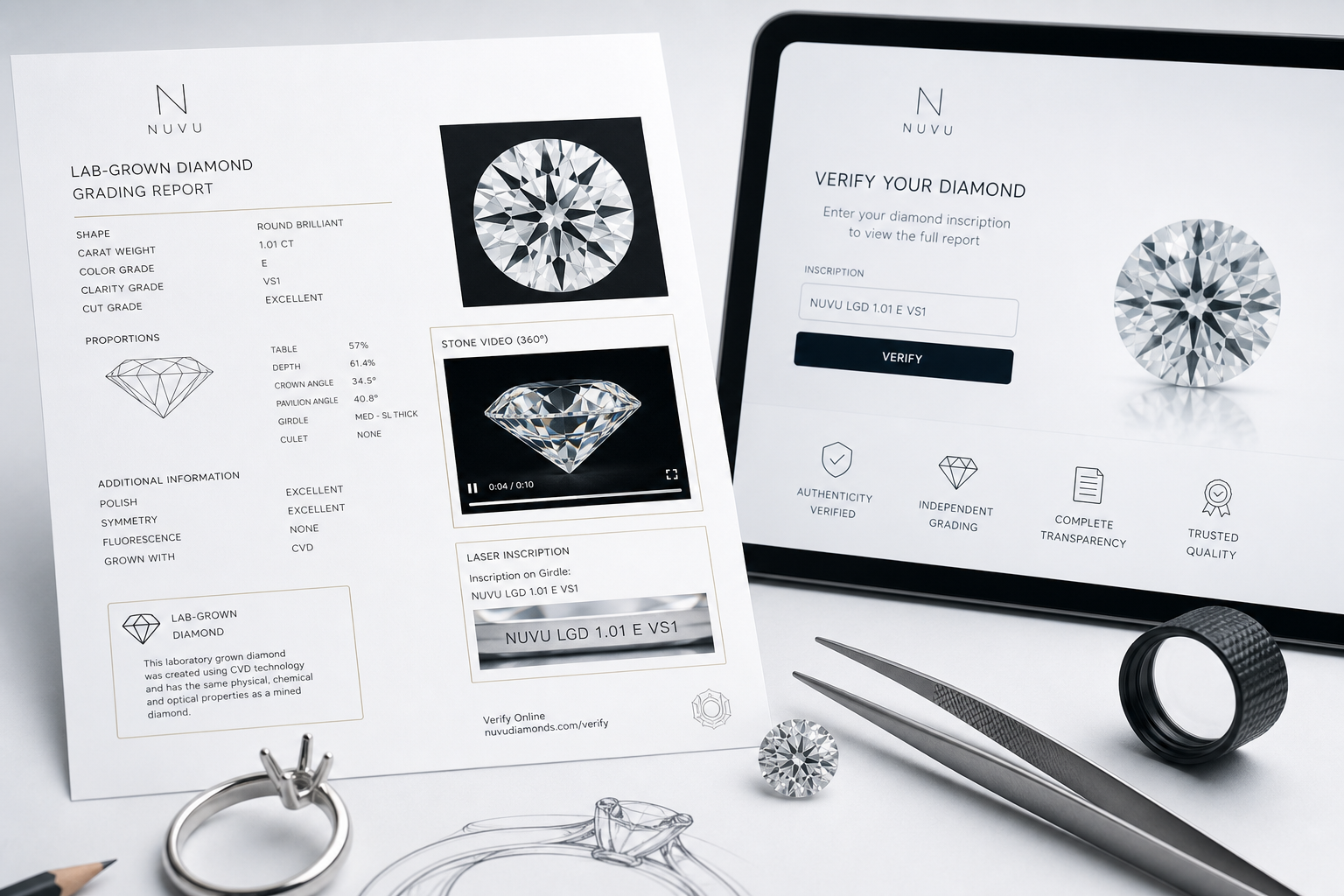
Compare Measurements Across the Report, Invoice, and Supplier Quote
Measurements are one of the easiest places for preventable mistakes to hide. A report may list one set of dimensions, while the quote or invoice uses a rounded description that sounds similar but is not exact. That gap matters more than many first-time buyers expect, especially when the order is for matched stones, calibrated sizes, or a custom setting with tight tolerances.
Check that the stone measurements on the report match the supplier’s written quote and the final invoice. If the supplier is selling a finished ring or pendant, confirm the stone size, setting dimensions, metal type, and finished weight if relevant. Even a small mismatch can create problems during production or setting. For custom orders, ask for written confirmation before payment if the numbers do not line up perfectly. A supplier who is careful with measurement details is usually easier to work with when the order gets more complex.
For Batch Orders, Ask How Stones Are Matched
If you are not buying one stone but a batch, the issue changes from simple verification to consistency. A supplier might have a strong individual stone but weak batch matching, which becomes obvious only when the order is used across multiple rings or pieces. That is especially important for melee, side stones, pairs, or any order where the customer will compare stones side by side.
Ask how the supplier matches a batch by shape, size spread, color range, clarity range, and visual appearance. If the stones are meant to work together, ask whether they are selected from the same production run or matched afterward. For a retailer or brand, that difference matters. A supplier that can explain its matching process clearly is usually a better fit for repeat business than one that can only promise “good quality” without showing how consistency is controlled.
Minimum Media and Measurement Request
A practical request set keeps the conversation focused and makes it easier to compare suppliers on equal terms.
- One face-up photo of the exact stone or batch representative
- One side-view photo when the shape or setting makes it relevant
- One short video under neutral lighting
- Full measurements in writing
- Report number for certified stones
- Confirmation of laser inscription for certified stones
- For jewelry, stone measurements, setting dimensions, metal purity, and finished weight when applicable
- For batch orders, a clear explanation of how the stones were matched
Ask for Specific Documentation Behind Origin, Sustainability, and Treatment Claims
Environmental and sustainability claims should be specific, documented, and limited to what can be substantiated. If a supplier says a stone or production process is lower impact, responsibly sourced, or environmentally preferred, ask what evidence supports that statement and whether the claim applies to the stone, the facility, the energy source, or some other part of the supply chain.
For lab-grown diamonds, growth method, any post-growth processing, and report language should be checked separately when relevant. Buyers should not assume that all lab-grown diamonds are described the same way, and they should not treat a broad ethical or sustainability statement as proof. When the issue matters to your purchase, ask for seller documentation that explains the claim in specific terms rather than general slogans.
If the supplier cannot support an origin or sustainability statement in writing, it is better to leave that claim out of the purchasing decision and evaluate the stone on the basis of its report, appearance, measurements, and order fit.
Compare Quotes on the Same Basis Before Treating One Offer as Better Value
Prices can change with market conditions, report type, seller channel, stone-specific details, and order quantity, so exact comparisons should be verified at the time of purchase. A quote for one stone may look lower until you notice that the report type, measurements, matching standard, finish, or documentation package is different from the next offer.
To compare quotes fairly, check the same shape, carat range, color, clarity, cut or finish standard, lab report requirement, and any added work such as matching, setting, or packaging. If one supplier includes more detail or a more complex matching request, the offer is not directly comparable unless the full scope is aligned. That is why “cheaper” on paper is not enough by itself.
If you are comparing supplier offers for a custom piece, make sure the stone dimensions and setting compatibility are part of the comparison. For custom jewelry, stone measurements and setting fit should be confirmed before finalizing a purchase, because a quote that ignores those details can create extra cost or delay later.
Use a Sample Order to Test the Supplier Before Scaling Up
A sample order is not just a small purchase. It is a controlled test of whether the supplier can actually do what they said they could do. That includes accuracy, packaging, documentation, communication, timing, and how they respond when something needs clarification. If those pieces are weak at the sample stage, they usually do not improve once the order gets larger.
A realistic example is a U.S. boutique jewelry brand planning to source 20 oval lab-grown diamonds for engagement rings. Before approving the full order, it places a trial order for two stones in the target range. The goal is not only to see the stones themselves, but also to test whether the report matches the stone, whether the video reflects the actual appearance, whether the packaging is secure, and whether the supplier responds cleanly when asked for confirmation. That extra step costs time, but it can prevent a much larger mistake later.
For many buyers, the right test size is 1 to 3 stones, or 1 finished sample piece if the order is jewelry rather than loose stones. The important part is not the quantity. It is whether the sample is close enough to the real order to reveal the supplier’s actual standard. Always confirm the dispatch or production timing in writing before you approve the trial, especially if the supplier gives a lead time that affects your own schedule.
It can also help to define the sample’s pass/fail points before it is ordered. If the buyer already knows which details matter most, it becomes easier to judge the sample fairly instead of reacting only to the overall first impression.
Define What the Sample Order Is Testing
Before you place a sample order, decide what success looks like. A sample is useful only if it checks the parts of the order that are hardest to fix later. For loose stones, that usually means report matching, measurements, visual appearance, and packaging. For jewelry, it may also include setting quality, metal finish, sizing, and how the piece is packed for shipment.
The sample should tell you whether the supplier can deliver the same result again, not just whether one stone looks acceptable. That is the difference between a purchase and a test. A supplier that passes the sample on appearance alone but misses documentation or timing is still telling you something important.
Compare the Sample Against the Supplier’s Original Claims
Once the sample arrives, compare it against the original quote, media, and written description. If the supplier promised a specific shape, range, or finish, check whether the sample actually reflects it. If the media showed a certain appearance under neutral light, look for consistency rather than perfection. Small differences can be normal. Broad mismatches are not.
This is also the point where batch consistency starts to matter. If the sample is supposed to represent a larger order, ask whether the same production method or selection standard will be used for the full run. A supplier that can explain that clearly is less likely to surprise you later.
Document Any Differences Before Approving a Larger Order
Do not rely on memory after a sample arrives. Record the differences while the order is still fresh in front of you. If anything does not match the supplier’s description, note it before approving the next step. That includes stone appearance, dimensions, report details, packaging, or communication gaps. The point is not to create conflict. It is to make sure the larger order is built on facts, not impressions.
If the sample is good, that is useful. If it exposes weaknesses, that is useful too. Either way, the sample has done its job.
Sample Order Review Points
- Report and stone match
- Measurements and stated size range
- Visual consistency with the supplier’s media
- Packaging quality and protection in transit
- Accuracy of communication before and after dispatch
- Any delay, omission, or correction that needed clarification
Evaluate Communication Quality as a Risk Signal
Communication is part of verification, not just customer service. A supplier that understands specifications, answers clearly, and confirms details in writing is easier to trust with an order than one that sounds confident but never gets specific. You are not just looking for speed. You are looking for whether the supplier can handle an order in a way that reduces ambiguity.
A reasonable benchmark is that routine replies should arrive within 24 to 48 business hours, though time zones can affect timing. What matters more is whether the reply answers the actual question. If you asked about report matching and got a pricing pitch instead, that is not a good sign. If you asked for a clarification and the supplier confirms the answer in writing, that is more useful than a fast but vague response.
Track Whether Replies Are Specific or Generic
Specific replies usually include measurements, report details, production notes, or a direct answer to the point you raised. Generic replies tend to repeat the same praise, avoid numbers, or send you back to the catalog. The more technical the question, the more informative the response becomes.
This is one of the easiest ways to test whether a China lab-grown diamond supplier is serious about order accuracy. Good communication does not mean fancy language. It means the person on the other end can actually handle the order you are trying to place.
Ask One Technical Question to Test Real Product Knowledge
A simple technical question can reveal a lot. Ask about matching, measurement tolerances, report verification, or how the supplier handles a specific stone type. You do not need a trap question. You need one that matters to your order.
For example, if you are buying oval stones, ask how they confirm consistency across the batch. If you are buying finished rings, ask how they verify setting dimensions before shipment. A supplier that answers clearly and without evasiveness is showing you how it will behave once the order is underway.
Watch How the Supplier Handles Uncertainty or Corrections
No supplier gets every detail right the first time. The real test is what happens when something needs correction. Does the supplier acknowledge the issue, confirm the fix in writing, and keep the conversation focused? Or does it get vague, defensive, or rushed?
That reaction matters because it often predicts how the supplier will handle production questions later. Buyers should pay attention to whether the supplier flags limitations on its own, confirms changes cleanly, and avoids pushing for payment before the details are settled.
Communication Red Flags to Record
- Repeatedly generic replies that do not answer the question
- Pressure to pay before key details are confirmed
- Unclear answers about measurements, report numbers, or batch matching
- Reluctance to confirm important points in writing
- Inconsistent contact names, email addresses, or company references
- Frequent changes in the story when you ask a follow-up question
Clarify Order Terms Before Payment or Production
A supplier can look reliable right up until the order details become vague. This is where many avoidable problems start: the stone looks right in chat, the quote seems acceptable, and then the final shipment does not match what the buyer thought was confirmed. Before any payment or production begins, the order needs to be specific enough that both sides can check it against the same written standard.
For a China lab-grown diamond supplier, a quotation is not enough if it still leaves room for interpretation. The buyer should turn the discussion into a written specification that names the exact product or jewelry item, the quantity, the quality range, and the documentation expected with it. If the supplier is serious, they should be able to restate the order clearly in writing without loosening the details.
Turn Product Discussion Into a Written Specification
The safest approach is to move from conversation to a written order confirmation that reads like a shared reference point. For loose stones, that usually means stone count, shape, carat weight or carat range, color, clarity, cut grade if it applies, and the grading lab. If report numbers have already been assigned, those should be listed too. For finished jewelry, the written order should also include metal type, ring size, setting style, stone size, and quantity.
This is not about making the order complicated. It is about removing room for the supplier to make a reasonable but undesired substitution. A buyer who says “oval lab-grown diamonds for engagement rings” has not yet given enough detail to protect the order. A buyer who says “20 oval stones, 1.00 to 1.10 carat, D to F color, VS1 to VVS2 clarity, IGI reports required, matching appearance preferred” is already in a much stronger position.
At NUVU, we usually treat the written specification as the real starting point of the order. If the supplier cannot reflect the request back accurately in writing, that is a sign to slow down before money moves.
Confirm Timeline, MOQ, Packaging, and Documentation
The order should also define the operational terms that affect delivery and acceptance. For buyers working within the China lab grown diamonds supply chain, MOQ, lead time, production timeline, packing, and shipping documents are not minor details. They determine whether the supplier can actually fulfill the order in the way the buyer expects.
MOQ matters because a supplier may be open to a relationship but unwilling to break a standard production threshold. Lead time matters because a buyer planning a launch, event, or custom build cannot rely on verbal estimates alone. If the supplier gives a dispatch window or production estimate, it should be written into the order confirmation, even if it remains approximate. If there is any range that matters to the buyer, that range should be stated in advance, not assumed later.
Packaging and documentation deserve the same attention. The buyer should confirm whether the order will ship with the expected certificate, invoice, packing list, and any other export or customs paperwork that the shipment requires. For jewelry, the final packaging format should also be clear if the pieces are being sent for retail presentation, not just safe transport. A supplier that is vague here may still be able to make the product, but the handoff process becomes harder to verify.
Make Discrepancy Handling Part of the Pre-Order Discussion
The most overlooked part of order terms is what happens if something does not match. Buyers often wait until a mistake appears before asking who is responsible, but that question is easier to resolve before production starts. The order discussion should address the practical scenarios: wrong stone count, incorrect measurements, missing report, wrong metal, ring size mismatch, packaging damage, or a production error that makes the item unusable.
This does not require a legal contract discussion in the first conversation. It does require a written answer about how discrepancies are handled. If the supplier says a problem will be reviewed, ask what evidence is needed and how the issue is documented. If they avoid the question or answer in broad terms only, that is a warning sign. A supplier that wants long-term business should be willing to explain the process before the first order is confirmed.
Written Confirmation Checklist
- Stone count or finished piece quantity
- Shape, carat weight, or carat range
- Color, clarity, and cut grade if relevant
- Certificate lab and report numbers, if assigned
- Metal type, ring size, and setting details for jewelry
- Packaging expectations
- MOQ, lead time, and production or dispatch timeline
- Shipping documents to be included
- What happens if the order does not match the confirmed specification
Use Independent Checks When the Order or Risk Level Is Higher
Not every order needs the same level of verification. A small trial order can often be handled with supplier documents, media, and written confirmation alone. As the order value, customization, or production complexity rises, it becomes smarter to add one more layer of independent checking so you are not relying entirely on the sales conversation.
Use a Live Video Call to Confirm the Exact Item or Batch
When the supplier is showing a stone, batch, or finished piece that matters to your purchase decision, a short live video call can help confirm that the item shown on camera is the one being discussed in chat. The purpose is not to inspect every detail remotely. It is to reduce the chance that the supplier is reusing old media or showing a different item than the one quoted.
During the call, ask the supplier to hold the stone next to the report, show the stone from multiple angles, and repeat the order number or SKU if one exists. For jewelry, ask to see the stone setting, finish, and any details that are hard to judge from still images. A supplier that can do this smoothly is usually easier to work with than one that resists any live confirmation.
Keep Every Version of the Paper Trail
Save the first quotation, revised quotation, written confirmations, report screenshots, media files, invoice, packing list, and shipping records in one folder. When a dispute or reorder comes up later, the main question is often not what happened in conversation, but what was actually written down. A tidy record makes it easier to compare one order against the next and notice when details drift.
This habit also helps if you work with multiple China lab-grown diamond suppliers at the same time. If you keep each supplier’s documents separate, you can compare response quality, measurement consistency, and problem handling more accurately. Over time, that record becomes part of your own supplier verification system.
Bring In a Third-Party Check When the Order Justifies It
For larger or more complex orders, some buyers choose to use an outside inspection step before shipment. That can be useful when the buyer cannot visit in person and the order has tighter quality requirements. The point is not to add cost for its own sake. It is to create one more checkpoint before the goods move from the supplier’s control to yours.
If you decide to use a third-party check, define exactly what the inspector should review: the selected stones or finished pieces, the report match, measurements, packaging, and any visible defects. The more specific the review scope, the more useful the result will be. If the order is small and the supplier has already passed the earlier checks, this extra step may not be necessary. If the order is larger or the risk is higher, it can be worth considering.
Assess Quality Control and Consistency for Repeat Orders
A supplier can handle one decent order and still fail on the second, third, or tenth. That is why quality control matters most when the buyer wants repeatability, not just a one-time shipment that looks fine on arrival. For brands, retailers, and wholesalers, consistency is often more valuable than a perfect isolated sample because the real risk shows up when the same supplier has to produce the same result again.
The right question is not only whether the stones or jewelry look acceptable once. It is whether the supplier has a process that supports batch consistency. That matters differently depending on what is being ordered. For certified loose diamonds, the buyer wants report matching and visual comparability across the lot. For melee, the issue is tighter size, color, and clarity consistency. For finished jewelry, the concern shifts to setting quality, metal finish, prong alignment, stone security, ring sizing, and packaging.
Ask How the Supplier Checks Stones Before Shipment
A supplier should be able to explain their inspection process in plain language. The buyer does not need a manufacturing lecture. What matters is whether the supplier checks the stones or finished pieces before they leave, and what they look for during that check. A vague answer such as “we inspect carefully” is not enough if the order is for multiple pieces or matched stones.
For loose stones, the supplier should be able to describe how they verify report matching, measurements, and basic visual consistency. For finished jewelry, the process should cover stone setting, finishing, symmetry, and whether the item is checked before packing. The more repeat-oriented the order is, the more important this becomes. A supplier that cannot describe its own inspection steps in a grounded way is harder to trust for ongoing work.
For Matched or Calibrated Orders, Define Acceptable Tolerances
Matched pairs and calibrated stones need more than a general quality promise. They need an agreed tolerance range. If two stones are supposed to match visually, the supplier should know what that means in practical terms: size difference, color spread, clarity spread, and overall appearance. If the order is for calibrated melee, the buyer should confirm the expected sizing consistency rather than assuming the supplier’s standard matches the buyer’s.
This is where many repeat-order disputes begin. One buyer thinks “matched” means nearly identical. The supplier thinks it means close enough for normal production. Those are not the same thing. If the order depends on consistency, the acceptable range should be clarified before production begins, not after the stones arrive.
For Jewelry Orders, Review Setting and Finishing Consistency
Finished jewelry adds another layer of QC because the stone may be correct while the build is still wrong. Ring sizing, prong alignment, polish, surface finish, and stone security all affect whether the piece is ready for retail or final delivery. A supplier that makes one sample ring well may still produce inconsistent finishing across a larger run.
For repeat jewelry orders, the buyer should ask how the supplier maintains consistency from one batch to the next. That includes whether the same setting style is repeated, whether the finish is checked before packing, and whether the supplier can maintain the same look across multiple units. If the order is for custom work, the repeatability of the CAD, setting detail, and final presentation matters as much as the stone itself.
Repeat Order Consistency Check
- Does the supplier explain how items are inspected before shipment?
- Are matched stones or calibrated pieces defined with tolerances?
- Is report matching checked for certified stones?
- Are jewelry setting, finish, and sizing checked consistently?
- Can the supplier repeat the same result in a second batch?
- Are packaging and presentation consistent across units?
Confirm After-Sales Responsibility Before There Is a Problem
After-sales responsibility is one of the clearest tests of whether a supplier is prepared for serious business. A supplier may seem cooperative until something is wrong, and then the quality of the relationship changes fast. Buyers should not wait for a damaged shipment or wrong stone to discover whether the supplier is willing to take responsibility. The better move is to ask in advance how the supplier handles specific problems and how they expect the issue to be documented.
This is especially important in cross-border sourcing, where communication delays can make a small problem harder to resolve. A supplier does not need to promise everything, but they should be able to state a written policy or a clear process for handling discrepancies. If they avoid specifics, the buyer should treat that as a risk factor, not a minor inconvenience.
Ask Scenario-Based Questions Instead of General Policy Questions
General questions often invite general answers. A better approach is to ask what happens in concrete situations. What if the report number does not match the stone? What if a finished ring arrives with the wrong size? What if a certificate is missing? What if a shipment is damaged in transit? What if the item does not match the approved sample?
These questions force the supplier to explain their actual process, not just their preferred image. A serious supplier should be able to answer at least at a practical level, even if the exact remedy depends on the case. Buyers do not need an emotional reassurance. They need a process they can understand before a problem occurs.
Confirm What Evidence Is Needed for a Claim
If the supplier expects photo or video evidence before opening a case, that should be clear up front. The same applies if they require the package to be kept, the report to be shown, or the issue to be reported within a specific window. None of that is unusual in itself. What matters is whether the requirement is stated in advance and whether it is realistic for the buyer to follow.
A buyer should also confirm how evidence is reviewed. If the supplier asks for detailed proof, they should also be willing to explain what they consider acceptable. Without that clarity, the buyer can end up doing everything right and still get nowhere because the dispute process was never defined in a usable way.
Check Whether the Supplier Solves Problems or Deflects Them
This is one of the most revealing parts of supplier verification. Some suppliers answer issue questions directly and calmly. Others become vague, defensive, or overly reassuring without giving a real path forward. The difference matters. A supplier that can talk through a mistake before the first order is more likely to handle one after shipment in a constructive way.
The goal is not to demand perfection. The goal is to see whether the supplier can own the process when something goes wrong. If the answers turn into excuses, pressure, or silence, that is useful information. It means the buyer should not treat the relationship as low-risk.
Problem-Resolution Questions to Ask
- What happens if the wrong stone or wrong item is shipped?
- How is a missing report handled?
- Who reviews damage claims?
- What evidence is required to open a claim?
- How are replacement, repair, or correction decisions made?
- Is the resolution process written down before the order is confirmed?
Build a Final Supplier Verification Scorecard
A supplier becomes easier to trust when the evidence points in the same direction. A polished website, a fast reply, and a competitive quote do not mean much if the company name is inconsistent, the documents do not match the stone, or the sample order exposes weak control. The practical move is to turn the supplier verification checklist into a simple due diligence scorecard and make the sourcing decision from that, not from instinct alone.
The scorecard is most useful when it helps you separate cosmetic strengths from core trust issues. A better photo set or a nicer sales pitch can be useful, but it should not outweigh identity gaps, unverifiable documents, or an unclear claim process.
Group the Evidence Into Clear Decision Categories
Use a simple 6-point supplier risk assessment and score each area as strong, acceptable with clarification, or high risk.
- Business identity and export background: Is the company traceable, consistent across its name, domain, payment details, and contact information?
- Product fit: Does the supplier actually specialize in the type of order you need, whether that is loose stones, melee, matched pairs, or finished jewelry?
- Documentation: Do the grading reports, report numbers, inscriptions, and measurements match what was offered?
- Media and measurements: Did the supplier provide stone-specific photos, videos, and usable dimensions instead of generic catalog material?
- Sample performance and QC: Did the sample order match the original claims, and does the supplier show repeatable quality control?
- Communication and after-sales responsibility: Are replies specific, written, and problem-solving in tone, with clear answers on what happens if something goes wrong?
A simple scale works well here: strong = 2 points, acceptable with clarification = 1 point, high risk = 0 points. A supplier with 10 to 12 points is usually worth moving forward with. A score in the middle range suggests caution and more written clarification. A low score means the supplier is not ready for a serious order, even if the price looks attractive.
The most important judgment is not the total score by itself. Documentation gaps, identity inconsistencies, or unclear after-sales responsibility carry more weight than a slightly weaker photo set or a slower reply. If those core trust issues are unresolved, the supplier should not move forward.
Separate Minor Gaps From Serious Red Flags
Not every gap means walk away. Some issues are fixable if the supplier answers clearly and puts the correction in writing. A missing video, an incomplete measurement sheet, or a vague first reply may only require clarification. Those are acceptable with clarification if the supplier is otherwise consistent and responsive.
By contrast, certain problems should be treated as serious red flags. If the company name changes from one document to another without a clear explanation, if the report number cannot be verified, if the supplier avoids written confirmation, or if the sample does not match the offered specification, the risk is no longer minor. At that point, the issue is not a detail. It is evidence that the supplier may not be ready for dependable work.
For U.S. buyers comparing two China lab-grown diamond suppliers, this distinction matters more than a small difference in quote structure. A lower price does not offset weak verification. Our team usually treats consistency and written accountability as the real filter, because those are the things that protect the order after payment has been made.
Decide Whether to Sample, Proceed, Pause, or Decline
Use the scorecard to make one of four decisions.
If the supplier scores strongly across identity, product fit, documentation, media, communication, and after-sales responsibility, you can usually proceed with normal order planning.
If the supplier is mostly strong but still has one or two unresolved details, place a sample order or pause until the supplier answers in writing. This is the right move when the relationship looks promising but not yet fully verified.
If the supplier is inconsistent in several categories, or if the sample order raises more questions than it answers, do not scale up. Ask for more evidence or move on to a different supplier.
If the supplier shows serious problems in identity, documentation, or problem resolution, decline the order. A supplier comparison only helps if you are willing to walk away from weak evidence.
For a buyer ordering 20 oval lab-grown diamonds for engagement rings, this is the practical filter: approve the supplier only after the stone data, sample results, and written order terms all line up. If any of those are still fuzzy, the more cautious move is to stay in the test stage rather than commit to the full run.
Keep a Reorder File for Long-Term Traceability
If you expect to reorder the same style, size, or quality range later, create a file that preserves the exact version you approved. Keep the quotation, report screenshots, product media, batch notes, and any written corrections together. That way, when you come back months later, you can compare the new offer against a real prior reference instead of relying on memory or a sales summary.
This is especially useful for brands that build matching lines over time. The supplier may still be capable, but the only way to know whether the next batch is truly consistent is to compare it to the last approved version. A simple traceability file makes that much easier.
Final Due Diligence Checklist
- Company name, website, email, and payment entity match or are clearly explained in writing
- The supplier’s product scope fits your exact order type
- Report numbers and stone details can be checked against the supplied documents
- Photos, videos, and measurements are stone-specific and usable for review
- The sample order matches the original claims closely enough to justify the next step
- Replies are specific, timely, and confirmed in writing when details matter
- Final order terms cover quantity, specs, timeline, packaging, and document handling
- The supplier can explain how it handles discrepancies, damage, or missing documentation
- QC expectations for repeat orders are clear, especially for matched stones or finished jewelry
- You know whether the next move is proceed, sample again, pause, or decline
A disciplined verification process does not eliminate every risk, but it does separate a real supplier from a polished presentation. When the evidence is clear, written, and consistent, the order becomes easier to approve with confidence.
Disclosure: This article is for general educational purposes only. Diamond grading, pricing, availability, specifications, and seller policies can change, and readers should verify important details through grading reports, official laboratory tools, seller documentation, or qualified professionals before making a purchase decision. Laboratory-grown diamonds should be clearly distinguished from natural diamonds, and environmental or sourcing claims should be supported by specific documentation.