
When designing multi-stone jewelry, assuming that identical 4Cs guarantee a visual match is one of the most expensive mistakes a jewelry brand can make. Standard grading reports simply lack the precision needed for matched pairs, making lab grown diamond certificates a necessary but not sufficient reference for calibrated stones, or balanced multi-stone layouts. Two diamonds with the same grade can differ noticeably in face-up size, color tint, or light behavior due to cut proportion variance, growth method differences, or tolerance stacking.
For the full framework, read Wholesale Lab-Grown Diamonds for Jewelers and Brands.
This guide moves beyond certificate-level thinking to show you the practical measurement and verification protocols that professional buyers use to avoid mismatch. You will learn how to specify dimensional tolerances for calibrated stones, how to pair stones with different shapes for visual balance, and how to build a match protocol that protects your final piece before the first stone is packed.
| Match Type | Common Pitfall | Verification Method |
|---|---|---|
| Matched pairs (earrings) | Identical 4Cs but different growth method or cut proportions | Side-by-side 5000K and 3000K lighting test; verify girdle thickness at multiple points |
| Calibrated stones (settings) | Stones fall within carat range but exceed ±0.05 mm dimension tolerance | Provide setting drawing to supplier; require per-stone measurement data |
| Tennis bracelet line-up | Step cuts with misaligned corners or varying table angles | Check corner alignment within 0.05 mm; photograph in a row on a flat surface |
| Mixed-shape multi-stone | Carat weight considered instead of face-up surface area | Match face-up area rather than carat; pair 1 ct emerald cut with 0.30–0.40 ct rounds |
| Large matched pairs | Mixed HPHT and CVD stones showing different undertones | Specify same growth method for both stones; verify under 3000K warm light |
Quick Questions Before You Read
Q: Can I trust a GIA report to ensure two lab-grown diamonds match?
Not fully. Two diamonds with identical grades can still differ in cut proportion, color tint at the edges of the range, or face-up size. Visual verification with controlled lighting is required.
Q: What is the most common cause of mismatch in tennis bracelets?
Inconsistent dimensions. Stones that match by carat weight can vary by more than 0.05 mm in diameter or step-cut corner alignment, creating a visibly uneven line.
Q: Should I match carat weight or millimeter size for multi-stone designs?
Prioritize face-up surface area and millimeter dimensions. Carat weight can mislead when cutting depths vary. A drawing with exact tolerances prevents loose or uneven stones.
Q: How do supplier match protocols actually work?
A formal protocol defines acceptable variance in diameter, depth, table, girdle, and growth method for each piece, alongside photographic proof. This should be agreed upon in writing before stones are selected.
Why Matching Diamonds Is Harder Than Buying Two Similar Stones
Buying a single loose diamond is straightforward. You evaluate the 4Cs, review a certificate, and decide. Buying two diamonds that are meant to be seen together is a different problem entirely. The standard tools and reports that work well for individual stones often fail when the goal is a visually matched pair. For jewelry brands producing earrings, tennis bracelets, or multi-stone settings, the difference between two diamonds with identical grades and two diamonds that actually look identical side by side can determine whether a finished piece feels precise or slightly off.
The Difference Between an Identical Grade and an Actually Matched Pair
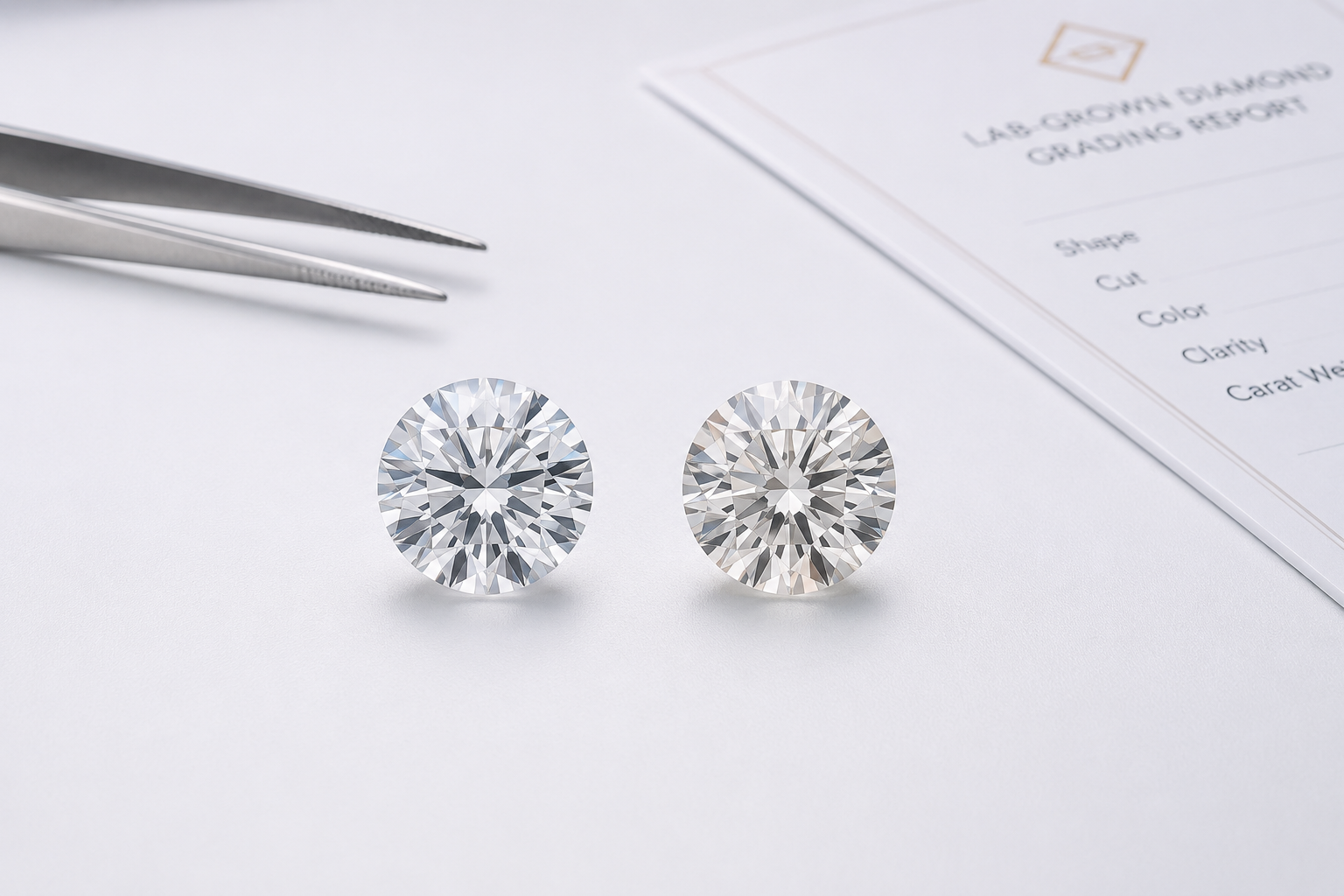
Two lab-grown diamonds graded F/VS2 at 1.00 carat each can arrive looking like different stones. This is not an error in grading. It is a limitation of how grades are assigned. A certificate places a diamond within a range for color and clarity, but it does not describe how that stone will appear next to another stone from the same range. Cut proportion variance is the most common source of mismatch. One stone may crown at 34.5 degrees while the other crowns at 35.2 degrees. That 0.7-degree difference changes how light enters and exits the diamond, creating a visible brightness gap in a side-by-side comparison. Crystal orientation and growth zone transparency further complicate matching. HPHT and CVD production streams leave different internal signatures. Two stones from different growth batches may have identical clarity grades but show noticeably different face-up transparency under direct light. The certificate does not capture this because it was never meant to.
Why Grading Reports Were Never Designed for Matching
Standard IGI and GIA reports exist to certify a single diamond against an objective standard. They report color within a range, clarity within a range, and dimensions to the hundredth of a millimeter. But a matched pair requires tolerances tighter than any grading report provides. Color grades, for example, span a range. One F diamond may sit at the top of the F range while another sits at the bottom. Graded individually, both are correctly called F. Placed side by side, the darker stone looks a full grade lower. The report does not flag this because the report was written for one stone, not two. The same logic applies to clarity. A VS2 diamond with a single feather near the girdle and another VS2 with a cluster of pinpoints in the table both carry the same grade. In a pair, one stone looks cleaner from the top. For flush-set earrings or asymmetric designs where both diamonds are visible at the same distance, these differences become the defining feature of the piece. The certificate cannot predict them.
What to Check Before You Decide
Request side-by-side photos under diffused lighting, 360-degree video from the same angle, and millimeter-level measurement sheets. Confirm that both stones share the same growth method. Mixing HPHT and CVD stones in a pair risks face-up color tone mismatches that become obvious under warm gallery or restaurant lighting. A visual comparison under controlled conditions will reveal more about a pair’s actual match than any certificate can.
Clarification on lab-grown vs. natural terminology: Laboratory-grown diamonds should be clearly identified as laboratory-grown in any documentation, product descriptions, or marketing materials. They should not be presented as mined diamonds, and buyers should verify that supplier invoices and grading reports use consistent disclosure language such as “laboratory-grown” or “lab-grown.”
Size Matching: Carat Weight, Millimeter Dimensions, and Face-Up Appearance
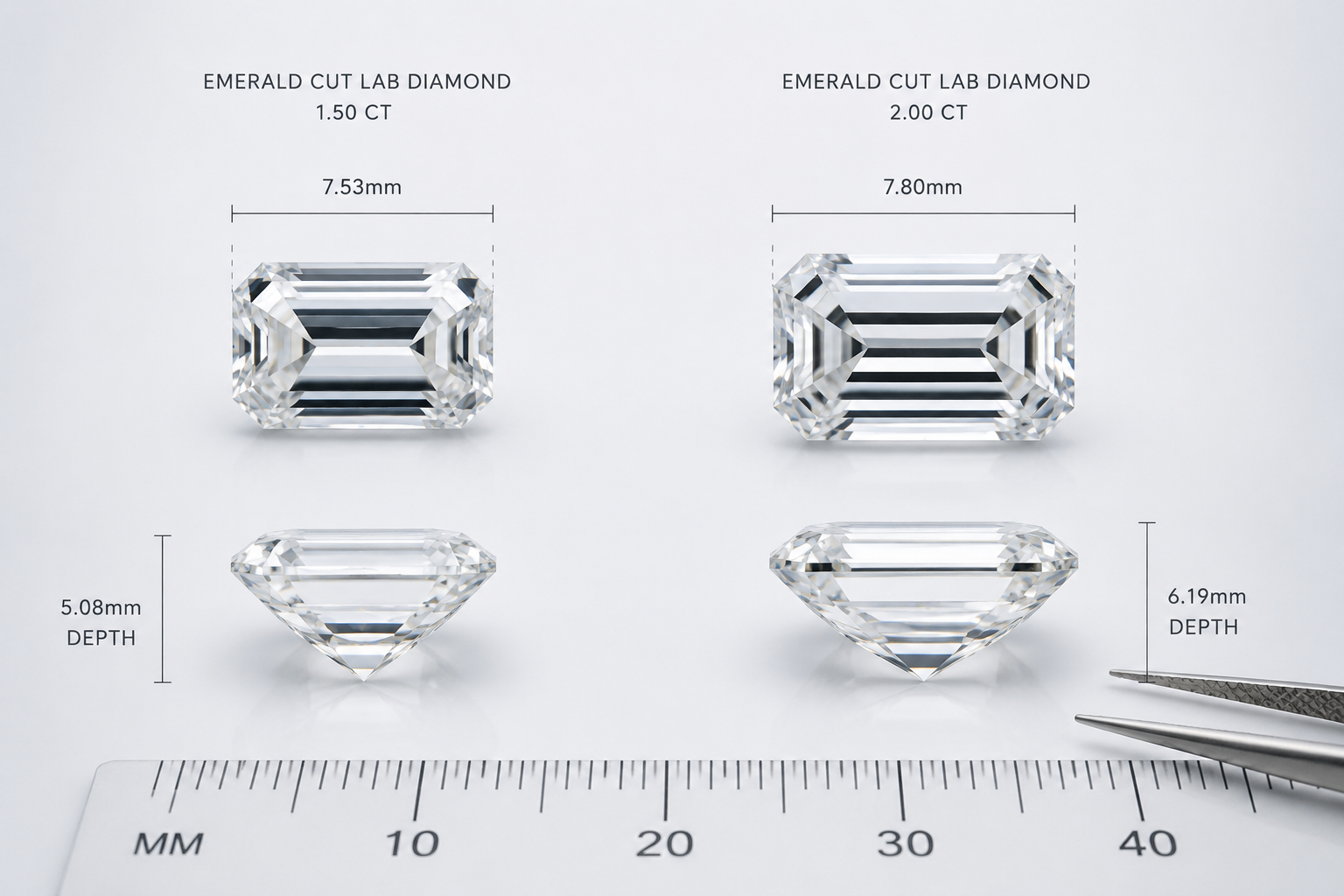
Carat weight is the most commonly quoted specification for a diamond pair, but it is the least reliable measure of visual matching. Two diamonds at the same carat weight can present noticeably different face-up sizes because carat is a measure of weight, not surface area. In matched pairs, what the eye actually sees is the face-up diameter and outline, not the carat number on the certificate. For jewelry brands, relying on carat weight alone when ordering pairs is one of the fastest ways to introduce visible asymmetry into a finished piece.
Why Millimeter Measurements Matter More Than Carat Weight
A 1.00 carat round brilliant can have a diameter ranging from 6.35 mm to 6.55 mm, depending on how the stone was cut. The difference between a shallow cut and a deep cut is roughly 0.2 mm across the table. In a pair of stud earrings viewed under direct daylight, a 0.15 mm diameter difference is detectable. The larger stone catches slightly more light and appears to dominate the ear. The smaller stone reads as subordinate rather than identical. This asymmetry undermines the entire purpose of a matched pair. For loose stone buyers selecting a single diamond, diameter variation within this range is usually irrelevant. For a jewelry brand producing earrings, it determines whether the pair looks correct.
Face-Up Size Consistency in Princess, Emerald, and Asscher Cuts
Step-cut shapes magnify size differences more aggressively than rounds because the table is rectangular and the facet structure produces a visible grid. A 0.10 mm width difference in an emerald-cut earring pair is visually detectable at arm’s length. The reason is geometric. In a round brilliant, the faceted crown scatters light in multiple directions, which partially masks small outline variation. In a step cut, the table occupies a larger percentage of the face-up area, and the parallel facets create a linear optical pattern. Any asymmetry in width or length breaks that pattern. For princess cuts in tennis bracelet layouts, corner-to-corner dimensions must match within 0.05 mm to maintain the visual rhythm of the line. A single stone that is slightly wider at the girdle will look out of place when set next to five or ten identical neighbors.
Depth and Profile Matching for Flush and Bezel Settings
Matching is not only about face-up appearance. Total depth determines how a stone sits in the setting. A flush or bezel setting uses fixed walls that lock the stone at a predetermined height. If one stone in a pair has a total depth of 3.85 mm and the other measures 3.95 mm, the deeper stone will sit higher in the setting. This changes its light interaction and makes the pair look mismatched from the side profile. In lever-back earrings or flush-set band rings where the stone profile is visible, the difference is immediately noticeable. For jewelry brands setting multiple stones in a shared-prong or channel setting, depth consistency across the entire batch prevents one stone from creating a visible high point in the line.
Stone-to-Setting Fit Check
Request total depth measurements for both stones and compare them against your setting drawing. For bezel or tension settings, request a silicone cast or 3D-printed trial fit before committing to final assembly. A stone that fits on paper may still sit unevenly in a physical setting if the depth tolerance is tighter than expected.
On pricing and market variation: Prices for calibrated stones and matched pairs can vary with market conditions, report type, seller channel, and stone-specific details such as growth method and cut precision. Exact comparisons should be verified at the time of purchase against like-for-like specifications, rather than treated as stable across orders or suppliers.
Color Consistency: Body Tone, Face-Up Color, and Warmth Under Gallery Lighting
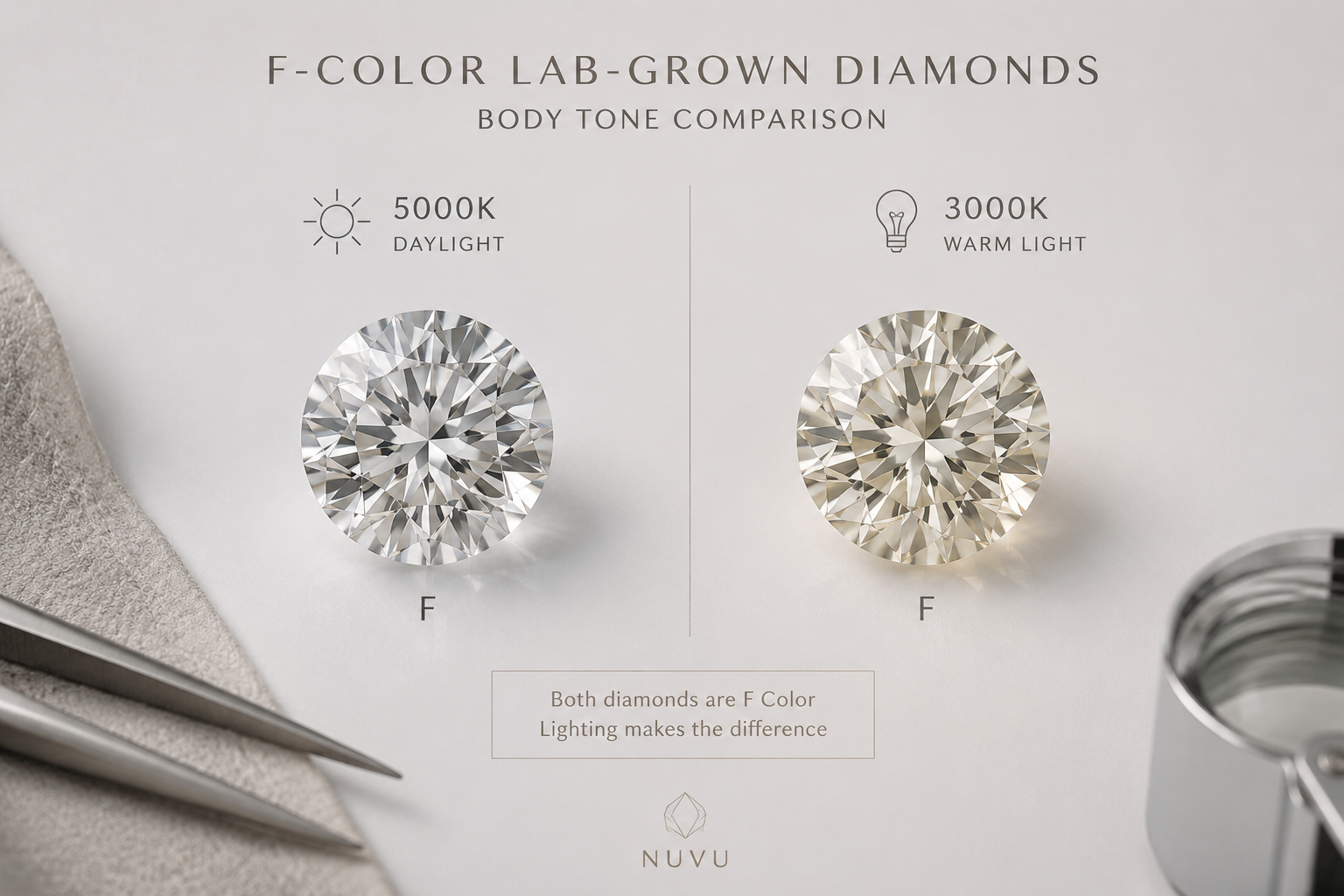
Color matching in lab-grown diamond pairs is more complicated than comparing two letter grades. The standard color grade describes where a stone falls on a D-to-Z scale when viewed table-down under controlled laboratory lighting. It does not describe undertone, warmth, or how the stone will look face-up in the gallery, restaurant, or daylight conditions where jewelry is actually worn. Two diamonds graded F can look noticeably different in a pair because their body tones differ even though their letter grades agree.
Why Two “F” Stones Can Look One Grade Apart in a Pair
The most common cause of color mismatch in lab-grown diamond pairs is growth method difference. A CVD stone that has undergone post-growth HPHT treatment to remove brown tones may still retain a subtle grayish or brownish undertone in the pavilion. An as-grown HPHT stone at the same F grade typically shows a cleaner, slightly blue tint depending on boron content. In isolation, neither stone looks wrong. Placed side by side, the warmth difference reads clearly. One stone appears neutral or slightly cool, while the other carries a faint brown note. The eye registers this as a color mismatch even though both certificates say F. This is not a grading error. It is a physical difference that standard grading was never designed to capture.
Growth Method Matching as a Color Stability Proxy
Requiring both stones in a pair to come from the same growth method is the simplest way to reduce color mismatch risk. HPHT stones grown in the same production batch tend to share a consistent body tone range. CVD stones from different growth runs can vary more noticeably because the growth environment and post-treatment processes differ from batch to batch. Matching growth method does not guarantee identical face-up color, but it eliminates one major variable. For larger matched pairs or calibrated lots, specifying growth method consistency in the purchase order prevents surprises at the setting stage.
When a grading report is provided alongside a matched pair, buyers should verify the report details through the issuing laboratory’s official report-check tool where available. This helps confirm that the reported growth method, color grade, and dimensions match the actual stones—but it does not replace the visual comparison described in this section.
Pair Lighting: How to Evaluate Color Under Intentional Side-By-Side Comparison
To properly evaluate a pair for color match, place both stones table-up on a white background under a 5000K daylight LED. Observe them straight on, then turn the pair 45 degrees and check for any body tone difference in the pavilion. Repeat the process under a 3000K warm light source. The warm light simulates jewelry store or restaurant lighting, where yellow tones in the environment can exaggerate any warmth difference between the two stones. A pair that matches under daylight but diverges under warm light will look mismatched in the settings where the jewelry is most often seen.
Certificate and Visual Review Check
Request both stones photographed side-by-side on the same surface under the same lighting. Look for any brown, green, or gray undertone visible through the pavilion. Use rotational video to confirm that both stones reflect the same warmth at multiple angles. If the video reveals a difference that the certificates do not explain, trust the video.
Note on environmental claims: Lab-grown diamonds are often chosen as an alternative to mined origin, but environmental and sustainability claims should be specific, documented, and limited to what can be substantiated. Broad terms such as “eco-friendly” or “sustainable” without supporting evidence about energy use, production practices, or supply chain documentation may not reflect the full picture.
Shape Outline and Face-Up Geometry for Matched Earrings and Tennis Bracelets
Once you move beyond basic carat and color matching, the next layer of precision is geometric. When diamonds sit side by side in stud earrings, a tennis bracelet, or a linear pendant, the human eye picks up tiny inconsistencies in outline shape, corner alignment, and facet symmetry that no grading report captures. For jewelry brands producing symmetrical layouts, visual geometry matters as much as the grade.
Round Brilliant Outline Consistency: Girdle Thickness and Lobe Shape
Two round brilliants can share the same diameter measurement but still look visibly different when set next to each other. The reason is usually girdle thickness variation. One stone may have a thin girdle throughout, while another has a medium-to-thick girdle with an uneven lobe — a bulge in the girdle outline at one point on the circumference, which is why minimum order quantity can reflect how closely matched stones are controlled before wholesale grouping. In a shared-prong setting where the stones sit in a continuous row, that lobe pushes the adjacent stone slightly off alignment. In a stud earring, an uneven girdle profile makes one stone appear to lean or sit asymmetrically relative to its partner.
The fix is not complicated but requires looking beyond the diameter number. A matched pair of rounds should be checked for girdle thickness consistency at multiple points around the stone. Necklace or bracelet layouts with more than ten stones amplify any single mismatch, turning a small girdle irregularity into a noticeable visual break.
Step-Cut Shape Alignment: Corner Sharpness and Table Outline Symmetry
Princess, emerald, and asscher cuts present a different matching challenge because their geometry is rectilinear. The eye reads the lines of a step-cut diamond like a grid, so any deviation at the corners or along the table outline becomes immediately apparent. In a tennis bracelet or straight-line earring stack, one stone with a slightly clipped corner or a marginally wider table will break the visual rhythm of the entire row.
The tolerance here is tight. Corners should match within 0.05 mm in both length and angle. A single clipped corner on a princess-cut bracelet creates a gap at the shared prong that draws the eye. For emerald cuts in linear layouts, the table outline itself must be consistent across all stones — a difference of even 0.10 mm in table width will look like one stone catching light differently than its neighbor. Digital overlay comparison before setting is the most reliable way to confirm this, as the difference is often too small to measure reliably by hand across a full lot.
Pavilion and Culet Alignment for Center-Mounted Pairs
In lever-back earrings, triangle-post studs, or open-back pendant settings, the back of the diamond remains visible. This means the pavilion pattern and culet size become matching factors that many buyers overlook. Two stones that match perfectly face-up can look unrelated from the side if one has a visible culet and the other does not, or if the pavilion facet patterns reflect heat and depth differently.
For center-mounted pairs, both stones should share the same culet size — either none or very small — and a consistent pavilion shape. When the back of the earring is exposed, the viewer sees both stones in profile simultaneously, and any mismatch in how the pavilion meets the setting becomes a visible asymmetry. The safest approach is to request side-profile photos at 10x magnification for both stones before setting, confirming that the culet and pavilion pattern align.
Buyer Verification Checklist
Before approving any matched pair for a symmetrical layout, request top-down and side-profile photos at 10x magnification. Compare girdle thickness at four points — 12, 3, 6, and 9 o’clock — and flag any lobe or unevenness. For step cuts, overlay the stone outlines digitally to confirm corner alignment within 0.05 mm. Confirm both stones show the same culet condition and pavilion orientation in side profile. These checks take minutes and prevent the most common geometry-related mismatches.
Calibrated Stones for Standardized Settings: Why Tolerance Matters
Calibrated stones are diamonds cut to meet specific dimensional tolerances so they fit standardized settings without individual adjustment. For jewelry brands producing multiple pieces from the same setting design, calibrated stones eliminate the single most time-consuming variable in the assembly process: having to modify prongs, bezels, or shared-seat grooves to accommodate stone-to-stone variation. The tolerance range determines whether a setting takes twenty minutes per stone or twenty seconds.
What Calibrated Stones Really Are: Diameter, Depth, and Shape Tolerance Contracts
A calibrated stone is not a specific carat weight — it is a dimensional contract between supplier and buyer. A calibrated 6.50 mm round brilliant, for example, is expected to fall within ±0.05 mm in diameter and ±0.05 mm in total depth. This allows the setting manufacturer to build prong seats, bezel walls, or shared-groove channels to a fixed measurement, confident that every stone in the lot will seat consistently.
Stones outside this range require the setter to adjust each seat individually — bending prongs, filing bezel walls, or shimming gaps. That process multiplies labor time and increases the risk of prong inconsistency across a finished bracelet or earring set. For large lots, even a few out-of-tolerance stones can disrupt production flow and delay delivery. The tolerance range is the single most important specification in a calibrated stone order.
How Jewelry Brands Should Specify Calibrated Tolerances to Suppliers
The most common error in ordering calibrated stones is not providing the setting manufacturer’s drawing to the diamond supplier. The supplier needs three numbers: maximum diameter, minimum diameter, and total depth range. These come directly from the stone seating cavity in your setting design. Without them, the supplier has no reference point for screening and may pack stones that fit a generic calibration but not your specific setting.
Provide the drawing with the stone seat dimensions clearly marked. Require the supplier to screen stones against those measurements before packing, and request physical confirmation — either millimeter-precise measurement data for each stone or a random sample batch test against your setting sample. A supplier who cannot provide per-stone measurement data for a calibrated lot is not equipped to supply calibrated stones reliably.
Common Calibrated Dimension Profiles for Earrings, Bracelets, and Pendants
Standardized setting designs typically fall into repeatable dimension profiles. For small stud earrings, 4.00 mm rounds are common. Medium studs often use 6.50 mm rounds. Oval side stones frequently run at 3×5 mm. Pear-shaped drop earrings tend toward 4×6 mm. Micro-pavé semi-mounts use 2.00 mm rounds. These profiles exist because they match widely available setting cavity sizes, and suppliers maintain production consistency around them.
For custom profiles outside these common dimensions, expect tighter supply and longer lead times. The tradeoff is worth it if your setting design requires a specific millimeter size that does not fall into a common profile — just confirm the tolerance band before placing the order.
Stone-to-Setting Fit Check
Request a sample stone from each calibrated batch before the full lot ships. Physically insert it into your setting sample. The stone should seat flush without rocking or tilting. The girdle should sit fully inside the bezel wall or below the prong tip — not exposed above it. If the stone shifts or wobbles when pressed, the tolerance is too wide for that setting design. A five-minute physical fit check at the start of an order prevents a full lot of stones that require individual modification during assembly.
Documentation Integrity: Verifying Grading Reports and Authenticity
Beyond selecting the right stones, jewelry brands also need confidence that the documentation accompanying a matched pair or calibrated lot is authentic and accurate. In a supply chain where certificates accompany stones across borders and through multiple transactions, a document mismatch or a misreported grade can delay production and erode buyer trust. A systematic approach to verifying documentation protects your brand and your customers.
Why Certificate Verification Matters for Matched Pairs and Calibrated Lots
A grading report is only as reliable as the data it contains. When a supplier ships a lot of one hundred 6.50 mm rounds with IGI certificates, the buyer should confirm that each certificate number is valid and that the reported dimensions, weight, and grade match the actual stone. A single misreported stone in a calibrated lot can throw off a setting plan that assumes consistent dimensions across all stations. For matched pairs, a certificate with incorrect dimensions or an inaccurate growth method notation can lead to a pair that fails visual inspection even though the paperwork appears in order. Running report checks through the issuing lab’s online portal, such as IGI’s or GIA’s report verification services, is a straightforward step that adds a layer of security to your receiving process.
These verification capabilities mean that any stone shipped with a grading report can be independently confirmed by the buyer or the end consumer. For jewelry brands, offering this verification step as part of your own quality assurance documentation is a practical way to strengthen downstream buyer confidence. Including the report check link in your product documentation or on your retailer-facing order sheets allows your customers to confirm the stone details themselves, adding transparency to every transaction.
Note on grading report limitations: A grading report documents key characteristics such as color, clarity, and dimensions, but it should not be treated as a guarantee of beauty, visual match quality, or sourcing ethics. The report’s value depends on how it is used alongside visual evidence, measurements, and the intended jewelry application.
How to Brief a Supplier Before Ordering Matched Pairs or Calibrated Lots
The quality of a matched pair or calibrated lot depends almost entirely on how well the buyer communicates requirements before the order is placed. A vague brief invites interpretation gaps. A detailed, written brief — covering dimensions, tolerances, growth method, photography standards, and return thresholds — creates a repeatable framework that prevents mismatches, reduces rework, and keeps production on schedule.
The Minimum Information Package Every Supplier Needs
Every matched-pair or calibrated-lot order should include the following in writing: target stone count, required shape, millimeter dimension range (not carat weight alone), growth method preference (HPHT or CVD), minimum color and clarity grade, and tolerance bands for diameter, depth, and shape outline. Carat weight is useful as a reference but should never replace millimeter dimensions as the primary matching criterion.
Also include the intended setting type — shared-prong, bezel, tension, flush — because different settings impose different tolerance requirements. A shared-prong bracelet needs tighter diameter consistency than a four-prong stud setting, and the supplier should know this before screening stones.
How to Request Photography and Measurement Screening Before Packing
Do not accept certificate-grade matching alone. Require side-by-side table-up and table-down photos of each matched pair or representative stones from a calibrated lot. Request a 360-degree video under diffused light showing the pair rotating together. The video reveals undertones, facet brightness consistency, and outline symmetry that still photos can hide.
Reserve the right to reject stones that show visible color or outline mismatch even if they fall within the stated grade range. A stone that matches on paper but looks mismatched in person is a failed match. Make this explicit in your brief so the supplier screens for visual parity, not just grade range compliance.
Setting a Return Threshold for Unmatched or Out-of-Tolerance Stones
Agree in writing on the return threshold before the stones ship. Stones outside the specified diameter tolerance (±0.05 mm), depth tolerance (±0.05 mm), or visible color mismatch under agreed lighting conditions should be accepted for return or credit. Do not rely on certificate grades to resolve tolerance disputes — the certificate was not designed for side-by-side matching, and the supplier knows this.
A written return threshold creates accountability. Without it, suppliers may replace a rejected stone with another that passes certificate grade but fails the same visual or dimensional check. Define the measurement method, lighting standard, and acceptance criteria in the brief, and require sign-off from both teams before production begins.
Buyer Verification Checklist
Attach a tolerance acceptance clause to your purchase order. Require weight, diameter, and depth measurements for every stone in a calibrated lot. Establish a routine to spot-check 5% of received stones against your setting sample before accepting the full shipment. Define the lighting standard for color evaluation — 5000K daylight LED is a common reference — and require that any return request be honored under that standard. A well-written brief is the difference between a smooth production run and a cycle of returns, rework, and delayed deliveries.
Matching Across Shapes: Custom Earring and Three-Stone Ring Profiles
Once matching logic extends beyond pairs of identical stones into multi-shape sets, the criteria shift. A pear-shape center with round side stones, or an emerald center with trapezoid sides, introduces a different kind of symmetry—one based on visual balance rather than geometric duplication. The goal is not that every stone looks the same, but that the set reads as intentional and harmonious. Achieving that requires controlling surface area, color consistency, and setting compatibility across dissimilar shapes.
How to Match Across Different Shapes by Face-Up Surface Area
When shapes differ, carat weight loses its usefulness as a matching metric. A 1.00 ct emerald cut has a larger face-up surface area than a 1.00 ct round brilliant because the emerald cut has less depth and a wider table. Side stones chosen by carat weight alone will almost always look undersized next to a step-cut center. The better approach is to match by face-up surface area rather than weight, a principle often emphasized in a lab grown diamond wholesale guide when evaluating calibrated side stones across different shapes. For a 1.00 ct emerald center, round side stones in the 0.30 to 0.40 ct range usually provide the visual balance most designers expect. For a pear center, side stones should be evaluated by their face-up width relative to the center stone’s widest point. The goal is a proportional silhouette, not identical carat totals.
Color and Clarity Consistency Across a Multi-Stone Set
A multi-stone set with different shapes should still maintain a tight color and clarity range. All stones should come from the same or immediately adjacent color grades—F across the set, or a mix of E and F. Jumping from a G center to E side stones creates an unintended hierarchy where the smaller stones appear whiter than the center. The same logic applies to clarity. A center stone graded SI1 with visible inclusions paired with VVS1 side stones draws the eye away from the center toward the cleaner, brighter side stones. This reverses the design intent. For three-stone rings and multi-stone earrings, VS1-VS2 across the entire set is a practical target. It keeps the stones clean enough without creating a distracting gap in clarity appearance.
Different shapes require different prong profiles, and those differences become visible when stones sit next to each other. A pear-shape center typically needs a V-shaped prong at the point, while round side stones use standard round prongs. If the prong heights are not adjusted to match, the center stone may sit higher or lower than the side stones, breaking the top-surface continuity. The same issue appears in shared bezel settings where one stone shape demands a thicker wall than another. The solution is to confirm, before setting, that the prong height and seating depth for each stone shape produce a consistent top surface height across the entire piece. A difference of 0.10 mm in seated height is visible under direct light because the higher stone will catch a brighter reflection.
What to Check Before You Decide
Request a digital rendering or CAD file with all stone dimensions applied. Verify that no stone sits higher or lower than its neighbor in the seated position. Before final assembly, ask your setter to physically test the stones in the semi-mount. A CAD check is useful, but physical fit confirmation catches tolerance issues the file cannot show.
Common Matching Mistakes Jewelry Brands Make and How to Avoid Them
Most matching problems are preventable. The mistakes that cause returns, rework, and production delays tend to follow the same patterns. Understanding these patterns makes it easier to avoid them in the ordering process rather than fixing them after delivery.
Mistake 1: Trusting Certificate Grades Alone for Visual Matching
Standard grading reports were designed for individual stone evaluation, not side-by-side comparison. Two stones with identical IGI or GIA reports—both graded F color, VS2 clarity, 1.00 carat—can still show a visible face-up mismatch in a significant percentage of tested pairs. The reason is simple: certificates report ranges, not visual parity. Color grade allows for variation within the same letter. Clarity grade covers multiple inclusion types and positions. Two F stones can differ in body tone, and two VS2 stones can have inclusions in different locations that affect face-up appearance differently. Certificates are useful starting points. They are not match guarantees. Side-by-side video and diffused-light photography are the only reliable verification methods.
Mistake 2: Ordering Calibrated Stones Without Providing the Setting Drawing
A 6.50 mm calibrated round is not a universal fit. It depends on the bezel wall thickness, prong seat depth, and overall seating geometry of your specific setting. Without providing the setting drawing, the supplier has no way to screen against your actual tolerance requirements. The same stone may seat perfectly in one design and sit too high in another. The fix is straightforward: send the stone seating drawing with your purchase order, including maximum and minimum diameter, total depth range, and any bezel or prong clearance specifications. This allows the supplier to measure and screen stones against your design, not against a generic dimension.
Mistake 3: Not Specifying Growth Method Consistency for Large Matched Pairs
HPHT and CVD stones have different growth characteristics. HPHT stones often show a slightly blue or colorless body tone depending on boron content. CVD stones typically require post-growth treatment to remove brown tones. A 2.00 ct pair containing one HPHT and one CVD stone may match on paper but show different warmth when viewed at an angle under gallery lighting. For large matched pairs, specifying that both stones come from the same growth method—and ideally the same production batch—reduces the risk of undertone mismatch. This is especially important in pairs that will be seen together at arm’s length, such as stud earrings or cluster pendants.
Mistake 4: Accepting Pair Returns Without a Formal Match Protocol
When a matched pair is returned for visual mismatch, the supplier will typically replace one stone. Without a written match protocol, the replacement stone is likely to be screened against the same loose grading criteria that caused the problem in the first place. The result is a second failure. To prevent this, define the match protocol in the initial purchase order. Include acceptable diameter variance (±0.05 mm), depth variance (±0.05 mm), lighting conditions for color evaluation (5000K daylight and 3000K warm light), and the requirement for side-by-side video. Require sign-off on the protocol from both your team and the supplier before the order is packed.
Buyer Verification Checklist
Include a match protocol attachment with every purchase order for matched pairs or calibrated lots. Define acceptable variance limits and lighting conditions. Require weight, diameter, and depth measurements for every stone in the lot. Spot-check at least five percent of received stones against your setting sample. A few minutes of verification at receipt saves weeks of rework later.
Industry Standards and Disclosure Requirements for Lab-Grown Diamonds
Beyond the technical matching considerations, jewelry brands also need to understand how lab-grown diamonds are classified, described, and disclosed under current industry and regulatory frameworks. This is not just a compliance concern — accurate labeling and terminology directly affect buyer confidence and legal exposure for brands selling matched pairs and calibrated lots. Consumers and trade partners alike expect clarity on what they are purchasing, and inconsistent disclosure erodes trust across both retail and wholesale channels.
Official Terminology: Why “Lab-Grown” Is the Preferred Term
The Federal Trade Commission (FTC) has provided guidance on how laboratory-created diamonds should be marketed and described. The FTC advises that terms such as “lab-grown,” “laboratory-created,” or “laboratory-grown” are appropriate, while terms such as “cultured” or “cultivated” may create confusion with cultured pearls and are best avoided in diamond disclosure.[1] The GIA also uses the term “laboratory-grown” in its identification and grading reports for these stones, reinforcing the need for consistent and unambiguous terminology in trade documents and consumer-facing materials.[2] For jewelry brands ordering calibrated stones or matched pairs, ensuring that all supplier invoices, grading reports, and product descriptions use the same standard terminology reduces the risk of miscommunication and regulatory scrutiny.
Disclosure Boundaries in Jewelry Advertising and Labeling
When advertising jewelry set with lab-grown diamond pairs, the FTC has emphasized that disclosure of the diamond’s origin must be clear and conspicuous. Terms like “diamond” alone, without a qualifier, may imply a natural mined stone to consumers. The FTC guidance is especially relevant for environmental or ethical claims: any claim that a lab-grown diamond is “eco-friendly,” “sustainable,” or “conflict-free” must be substantiated with specific evidence rather than treated as an inherent attribute of the growth method.[1] For brands selling matched pairs, this means that marketing claims tied to the lab-grown origin should be precise and limited to what the seller can document. A vague sustainability claim on a product page could invite regulatory attention if not backed by verifiable data on energy sourcing, production practices, or lifecycle analysis.
Traceability in Practice: Understanding the Limits of Supplier Documentation
While grading reports provide a starting point for traceability, the documentation chain for a lab-grown diamond often stops at the certificate. The certificate itself typically records only the diamond’s characteristics at the time of grading, not its full production history. For a matched pair or calibrated lot, the buyer may not have access to information about the original growth batch, the post-growth treatment history, or the specific growth reactor used. Asking a supplier about batch-level documentation — such as a production batch number or a treatment record — can reveal how much traceability the supplier can actually provide. In many cases, the best available traceability is a consistent growth method notation on the certificate, combined with a visual match check at the buyer’s receiving dock. For jewelry brands that require deeper traceability for their own downstream disclosure or for specific retailer requirements, it is worth confirming with the supplier what batch-level records exist and whether those records can be shared with the buyer.
Grading Report Verification for Matched Pairs and Calibrated Lots
The GIA, IGI, and GCAL all offer verification tools that allow buyers to confirm the details reported on a diamond’s grading report.[3] For a jewelry brand receiving a lot of calibrated stones or a matched pair, running the report numbers through the issuing lab’s online check service is a quick confidence measure. The report check confirms that the stone’s reported weight, dimensions, color, and clarity match the official database. This is not a substitute for side-by-side visual matching, but it ensures that the documentation is authentic and correct. GIA’s report check page, for example, allows users to verify laser inscriptions and report data directly from the GIA database.[3] For large calibrated lots where per-stone grading reports are common, making report verification a standard step in the receiving protocol adds a layer of documentation integrity that benefits both the buyer and the end consumer.
Supplier Communication Checklist
Before finalizing a purchase order for matched pairs or calibrated lots, confirm that all supplier communications and invoices use standard terminology such as “laboratory-grown” rather than ambiguous terms. Request grading report numbers in advance of shipment and verify them through the issuing lab’s online portal. Ask the supplier what batch-level documentation exists and whether it can be shared. Ensure that any environmental or ethical claims related to the stones are limited to what the supplier can document with verifiable evidence. These steps protect your brand from disclosure errors that can lead to costly regulatory or reputational problems down the line.
Matching and Quality Control Protocols: A Practical Framework for Repeatable Orders
For jewelry brands that order matched pairs or calibrated lots on a recurring basis, standardizing the matching and quality control process is essential for maintaining consistency across production cycles. Without a written protocol that is shared with the supplier and enforced at the receiving dock, every new order reintroduces the same risks: dimensional variance, undertone mismatch, and shape misalignment. A repeatable framework removes guesswork and creates a baseline that both buyer and supplier can refer to for every batch.
Building a Written Match Protocol for Your Supply Chain
A formal match protocol should define, in document form, the exact dimensional tolerances, lighting conditions, photographic requirements, and acceptance criteria for every matched pair or calibrated lot. The protocol should include the following: acceptable diameter variance (±0.05 mm), acceptable depth variance (±0.05 mm), color evaluation lighting conditions (5000K daylight LED and 3000K warm light), growth method consistency requirement, photographic documentation standards (side-by-side table-up and table-down images), and video documentation requirements (360-degree rotation under diffused light). This protocol should be attached to every purchase order and signed by both the buyer and supplier before the order is processed. A written protocol eliminates ambiguity and creates a clear reference point for dispute resolution if a pair arrives mismatched.
Incoming Inspection: A Cost-Effective Receiving Process
Even with a strong match protocol in place, incoming inspection remains the buyer’s last line of defense against mismatched stones. A practical receiving process does not need to be expensive or time-consuming. For a calibrated lot of one hundred princess-cut stones, a spot-check of five stones against the setting sample, combined with a quick measurement of all stones using a digital caliper, can be completed in under an hour. For a single matched pair of stud earrings, a ten-minute visual comparison under both 5000K and 3000K lighting, along with a profile photo check, is sufficient to confirm the match before the stones are sent to the setter. Establishing a standard receiving process and documenting the results for each order creates a paper trail that helps identify supplier drift — the tendency for a supplier’s quality to gradually decline between batches — before it becomes a pattern of production-delaying returns.
Maintaining Supplier Accountability Through Batch Tracking
For brands that place multiple orders with the same supplier over time, maintaining a simple log of match protocol compliance and return rates provides data that can be used in supplier reviews and contract negotiations. If a supplier consistently fails to meet the dimensional tolerances defined in the match protocol for three consecutive orders, the brand has documented evidence to support a supplier change or renegotiation of terms. Conversely, a supplier that consistently exceeds the protocol requirements becomes a more valuable partner for high-volume, high-precision orders such as tennis bracelets and continuous line earrings. Batch tracking turns match data into a strategic tool rather than a reactive problem-solving method.
Documentation Best Practices
Maintain a digital folder for each order that contains the signed match protocol, the supplier’s measurement data for each stone, the side-by-side photography used for approval, and the incoming inspection results. This folder serves as the definitive record for any future dispute and also provides a reference for subsequent orders of the same product line. Over time, this repository becomes a valuable source of information for identifying which stone profiles, suppliers, and growth methods produce the most consistent matches for your specific setting designs.
For wholesale and sourcing conversations, documentation, consistency, and communication often matter as much as the headline specification. A supplier’s willingness to share batch-level records, provide per-stone measurement data, and agree to a written match protocol is a more reliable indicator of long-term fit than a single low price on a graded lot.
Final Buyer Guidance: Making Informed Choices for Matched Pairs and Calibrated Lots
This guide has covered the technical, procedural, and documentation considerations that go into successful matching. But beyond the specific checklists and protocols, there is a broader principle that applies to every order: the best choice for a matched pair or calibrated lot depends on the specific design, setting type, budget, and quality expectations of the project at hand. There is no single universal rule that guarantees a perfect match across all situations.
For some projects, a pair of stones from the same HPHT batch with verified dimensions and growth method will deliver the visual parity needed. For others, a calibrated lot with tight ±0.03 mm tolerances and per-stone measurement data will be the better route. The right approach depends on what the final piece demands. Buyers who take the time to define their match protocol, verify supplier documentation, and confirm visual parity through controlled side-by-side comparison will consistently get better results than those who rely on certificate numbers alone.
The practical takeaway is this: treat matching as a verification process, not a specification sheet. A grading report records useful data, but it is the verification — dimensional checks, lighting comparisons, photographic evidence, growth method consistency — that determines whether a matched pair or calibrated lot actually performs in the finished jewelry.
[1] Federal Trade Commission, “FTC Guides for the Jewelry, Precious Metals, and Pewter Industries: 16 CFR Part 23,” U.S. Federal Trade Commission, compliance guidance available at FTC Jewelry Guides.
[2] Gemological Institute of America, “Lab-Grown Diamonds: GIA Identification & Grading,” GIA, educational resource available at GIA Lab-Grown Diamond Information.
[3] Gemological Institute of America, “GIA Report Check: Verify Diamond Grading Reports,” GIA, online verification tool available at GIA Report Check.
Disclosure: This article is for general educational and buyer guidance purposes only. Diamond grading, pricing, availability, specifications, and seller policies can change, and readers should verify important details through grading reports, official laboratory tools, seller documentation, or qualified professionals before making a purchase decision. Laboratory-grown diamonds should be clearly distinguished from natural diamonds in all documentation and marketing materials. Environmental, sustainability, or ethical claims should be supported by specific, verifiable documentation rather than treated as inherent attributes of the growth method. Prices and availability may vary with market conditions, report type, seller channel, and stone-specific details, and exact comparisons should be verified at the time of purchase.