
Choosing a wholesale lab-grown diamond supplier based on price per carat alone is a fast track to costly mistakes. A low quote often hides loose grading, inconsistent stone appearance, and unpredictable supply that leads to rejected pieces, delayed orders, and expensive remakes. For jewelry brands, the real challenge is distinguishing a genuine, reliable partner from a low-cost broker who cannot deliver the visual uniformity your customers expect.
For the full framework, read Lab-Grown Diamond Suppliers and Wholesale Buying Guide.
This guide moves beyond the price sheet to help you evaluate suppliers on the factors that actually determine long-term reliability: supply chain stability, stone consistency within a grade, communication transparency, and the practical verification methods that separate serious producers from middlemen. You will learn how to structure test orders, what documentation to demand, and which red flags to trust.
For the jewelry brand buyer, the practical question is not just whether a stone is “G VS1” on paper, but whether two stones ordered today will visually match two stones ordered three months from now — and whether the supplier can help you confirm that match before the setting is made.
| Evaluation Factor | What a Reliable Supplier Does | What a Risky Supplier Does |
|---|---|---|
| Pricing strategy | Prices competitively but shares detailed specs for each stone | Offers very low prices without providing specific measurements or videos |
| Stone consistency | Delivers stones that match face-up appearance within the same grade | Relies on certificate numbers alone; visual appearance varies batch to batch |
| Communication | Answers technical questions on growth method, treatments, and inscriptions fluently and quickly | Gives vague answers; avoids providing specific measurements or certificate numbers upfront |
| Verification process | Welcomes sample orders of 5–10 stones and provides videos under natural light | Pressures for large minimum orders; reluctant to share documentation or follow-up data |
| Return policy | Has a clear, written return or exchange policy for wholesale orders | Has no stated return policy or makes exceptions verbally only |
| Lead time | Provides predictable, transparent lead times and meets them consistently | Lead times shift frequently; unclear whether product is in stock or sourced after order |
Quick Questions Before You Read
Q: Can I trust a supplier who shows me a GIA or IGI certificate for each stone?
A certificate is necessary but not sufficient. Two stones with the same color and clarity grades can look noticeably different face-up. Always request videos and measure actual dimensions to confirm consistency.
Q: How many stones should I order for a test batch?
Start with a small test order of 5–10 stones. This is large enough to evaluate consistency across a batch but small enough to limit your risk if the quality does not meet expectations.
Q: Is a direct producer always better than a broker?
Direct producers typically offer better stone consistency and supply stability because they control rough material and cutting. However, a well-vetted broker with strong quality control can also be a reliable partner—verify with test orders first.
Q: What is the biggest red flag in a supplier conversation?
When a salesperson focuses on price per carat and avoids sharing specific measurements, certificate numbers, or videos of actual stones. Transparent suppliers provide detailed data without being asked.
Why Price Alone Fails as a Supplier Evaluation Metric
For a jewelry brand, evaluating a wholesale lab-grown diamond supplier primarily on price per carat is a shortcut that regularly leads to expensive problems. A low quote on paper does not reflect what you will actually receive in the box, what it will cost you in remake labor, or how much time you will spend managing mismatched stones and delayed orders. Price is the most visible number on a quote sheet, but it is also the least revealing one.
The Hidden Cost of the Lowest Quote
When a supplier undercuts the market, the savings have to come from somewhere. A low per-carat price often signals inconsistent sorting standards at the cutting level, loose grading tolerance on color or clarity call-outs, or a production model that prioritizes volume throughput over batch uniformity. For a jewelry brand, the risk is concentrated: a single off-color stone in a three-stone ring or one poorly executed cut in a pair of studs can trigger a full remake. That remake cost — including labor, setting time, and potential lost sale — is never captured in the original quote. The lowest price per carat can become the highest total cost per finished piece.
How Price Compression Affects Supplier Behavior
The wholesale price of lab-grown diamonds continues to compress, and that pressure changes how some suppliers operate. To maintain margins at lower price points, they relax proportion tolerances, skip internal verification steps, or mix stones certified by different labs without clear labeling. A stone that meets the laboratory minimum for its grade can still fail a visual check or cause problems during setting. Brands that buy on quote alone may receive stones that match the paper spec but look noticeably different side by side. The certificate says G VS1, but the face-up appearance tells a different story.
What the Quote Sheet Doesn’t Show
A competitive price list will not tell you whether the supplier has consistent access to rough material, stable cutting capacity, or a disciplined quality-check process. It does not reveal how the supplier handles stones that fall outside spec during production, or whether they sort inventory by visual appearance rather than only by certificate grade. These factors — production continuity, sorting discipline, and internal quality tolerance — are what determine whether your second order matches your first. A quote sheet cannot show you that, but a test batch can.
What to Check Before You Decide
Request a sample batch of five to ten stones across different sizes or color grades. Compare their actual visual appearance against the certificate specifications side by side. Measure how much variation exists within a single grading call-out — for example, how two G VS1 stones from the same supplier compare face up. A reliable supplier will show minimal spread within a grade. A price-driven supplier will show wider tolerance, and that tolerance is where your remake costs come from.
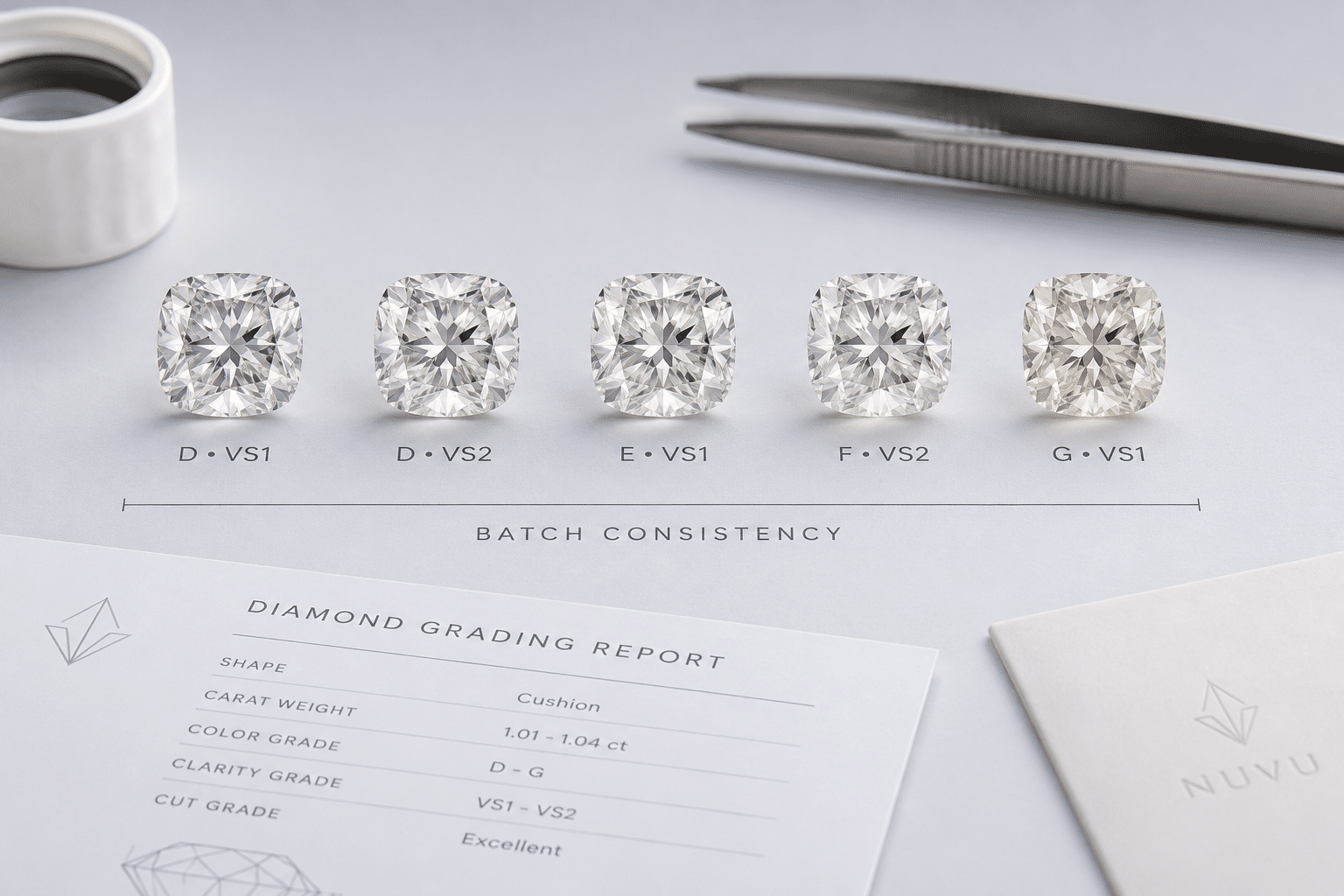
Supply Stability: Evaluating Production Continuity and Lead Time Reliability
For a jewelry brand, an inconsistent wholesale supplier does not just create inconvenience. It disrupts production timelines, delays customer deliveries, and forces costly last-minute sourcing. Evaluating supply stability before committing to a relationship matters more for long-term procurement cost than any single price negotiation.
Rough Stock Access and Production Capacity
A supplier with direct access to CVD or HPHT rough material and in-house cutting capacity can maintain far more consistent output than a broker who sources finished stones from multiple third-party cutters. When a supplier controls its own rough procurement and cutting parameters, it can reproduce the same visual result across orders. A broker, by contrast, depends on whatever inventory is available on the spot market at the time of your request. Ask directly whether the supplier owns its rough supply chain and cutting operation, and what the typical lead time is for a repeat order of the same spec. The answer will tell you whether you are dealing with a manufacturer or a middleman.
Batch-to-Batch Consistency and Reorder Behavior
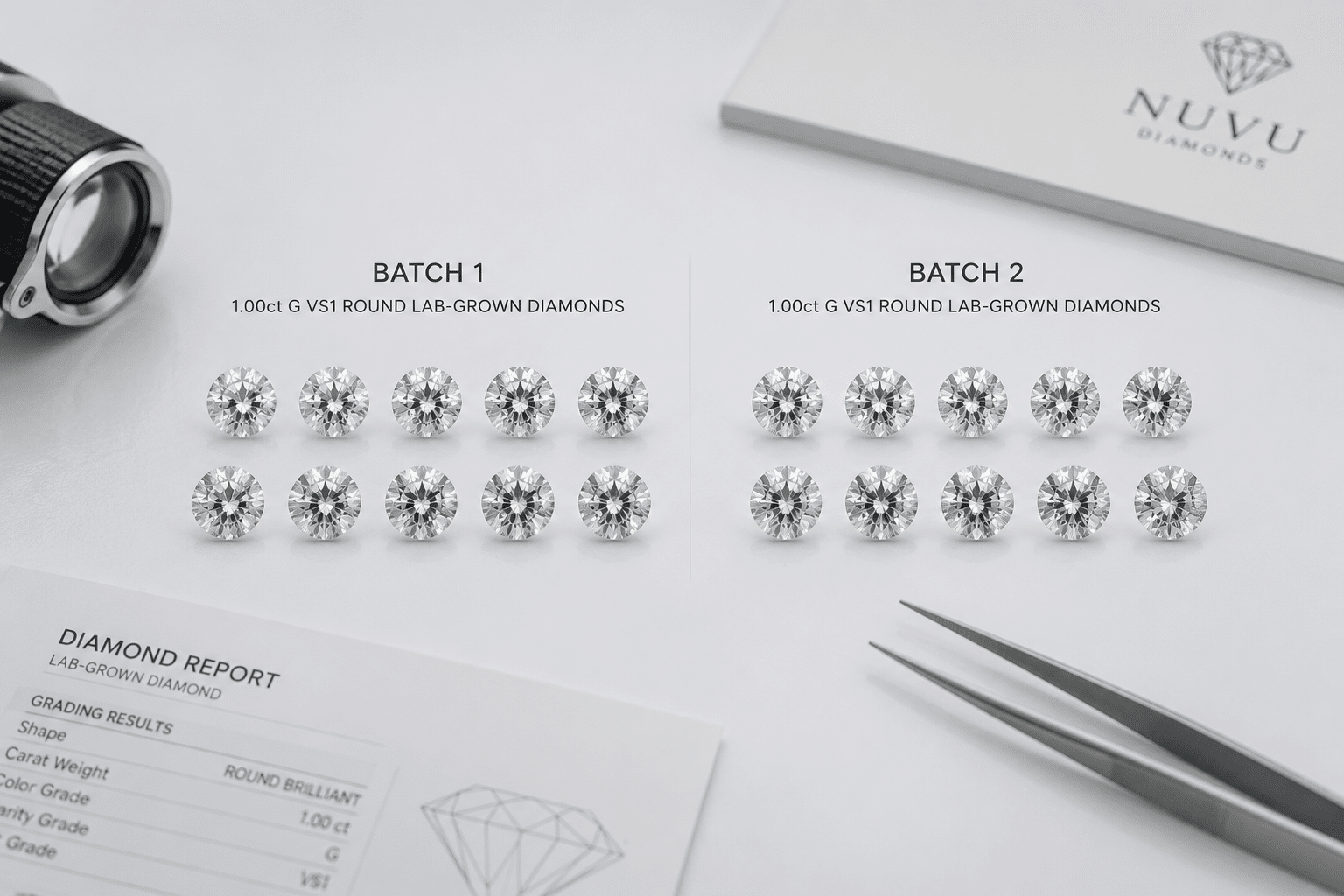
When you order the same specification — for example, a 1-carat G VS1 round — across multiple batches, the stones should look interchangeable. A trustworthy supplier maintains consistent rough sources and cutting parameters, so the second batch closely matches the first. A supplier that sources inventory on demand will deliver higher variance between batches, because each batch comes from a different production run with potentially different rough material. The risk for your brand is that a customer who sees two pieces from different batches notices the difference.
In practical terms, batch-to-batch consistency is often more important than the headline grade. A stone that consistently sits at the middle of its grade range across orders is more valuable to a jewelry brand than a stone that occasionally grades higher but drops lower on the next order. The supplier’s sorting discipline determines whether you get predictable repeatability or unpredictable variation.
Lead Time Transparency and Production Buffer
Reliable suppliers communicate realistic lead times and maintain production buffers for common specifications. A supplier that always promises immediate availability may be carrying excess inventory of less desirable stones rather than maintaining a disciplined production pipeline. Conversely, a supplier that quotes a short lead time for every custom request without explanation may not have a predictable process. The most trustworthy response is specific: a clear lead time based on current production load, with a buffer for common specs and a realistic estimate for custom orders.
Buyer Verification Checklist
Place a small test order for the same spec line across two different order dates. Compare the stones side by side for consistent color face-up, brightness, and clarity visibility. Ask directly about the supplier’s rough sourcing model — is it vertically integrated, or does it rely on spot market inventory? The answers and the visible consistency of the test stones will tell you more than any quote sheet.
Stone Consistency: Grading Tolerance, Cutting Discipline, and Visual Uniformity
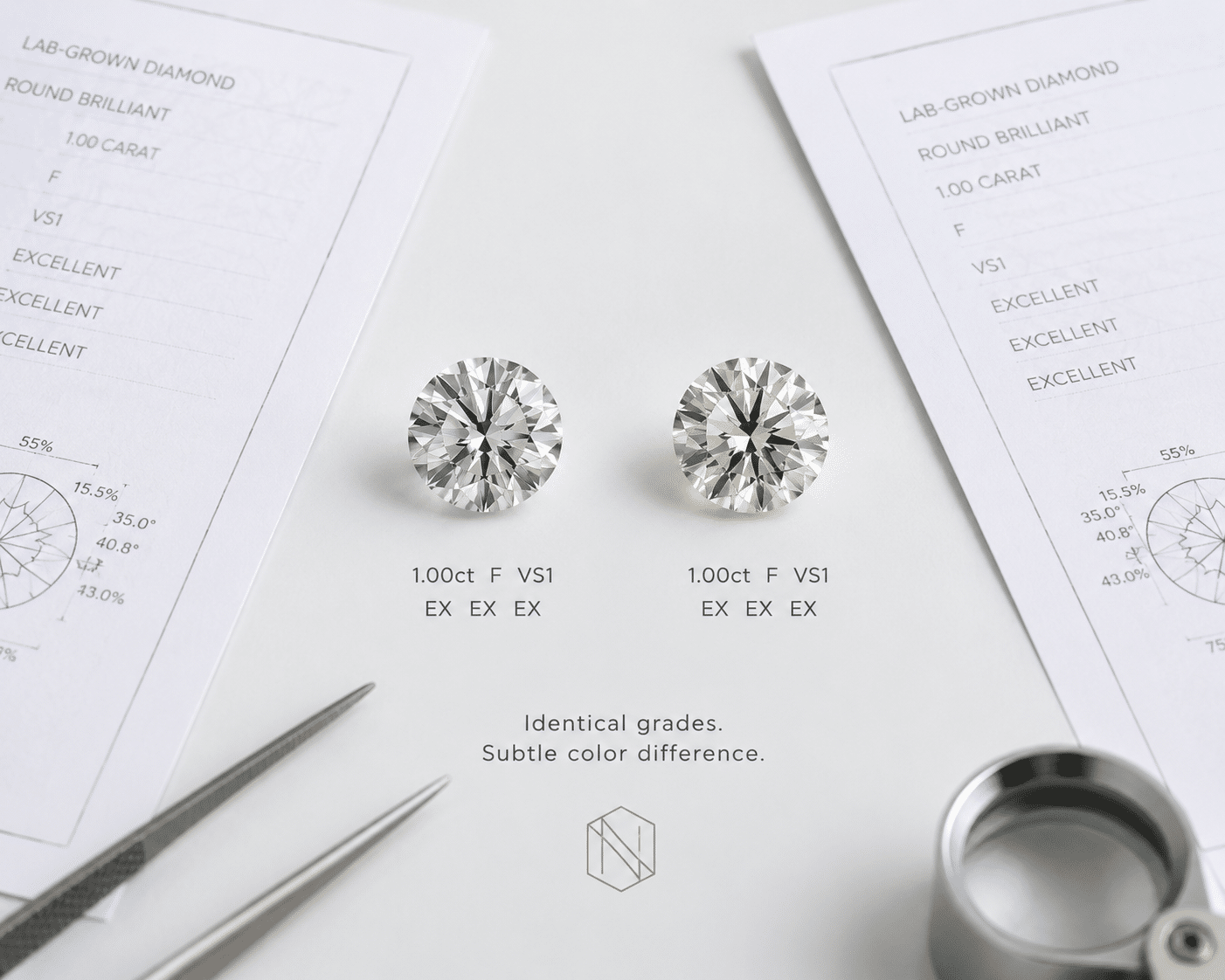
The difference between a reliable wholesale supplier and a transactional one often comes down to stone consistency — not whether the stones match their certificates, but how much real variation exists within the same grade. Two stones with identical grades can look noticeably different, and for a jewelry brand, that difference matters.
Grading Tolerance vs. Actual Stone Quality
A grading laboratory works within a defined tolerance range. Two stones both graded G VS1 by the same lab can look different if one sits at the top of the G color range and the other at the bottom, or if one has a VS1 clarity grade with very minor inclusions and the other has a VS1 grade that just barely qualifies. A reliable supplier maintains internal grading standards that are stricter than the laboratory minimum. They sort stones within a grade, not just by the grade. Ask potential suppliers how they handle internal sorting and whether they separate top-of-range stones from bottom-of-range stones within the same call-out. The supplier that does this offers real consistency; the one that does not offers only a certificate number.
Cut Quality Beyond the Certificate
For round brilliants, IGI and GIA reports include a cut grade, but the visual gap between an Excellent cut and a very good cut is significant — less brightness, less fire, and a less lively stone overall. For fancy shapes — oval, pear, emerald, marquise — no standardized cut grade exists on most reports. That means the supplier’s internal discipline in proportion selection, facet symmetry, and polish consistency becomes the only quality control point. A supplier with disciplined cutting standards produces fancy shapes that perform well visually. A supplier that prioritizes carat yield over cut precision produces stones that look dull or uneven. Since no certificate grade tells you which one you are getting, the only way to know is by examining the supplier’s cut philosophy and asking to see actual stones.
Visual Matching for Multi-Stone Settings
When a jewelry brand orders a pair of studs, a three-stone ring, or a halo setting, the stones must match face-up appearance even if the certificates show the same grade. Two G-color stones from different growth runs can look mismatched side by side under natural light. A reliable supplier handles visual matching as a separate step from grading: they photograph stones, offer side-by-side video, and can pair stones that are not from the same rough but still look identical face up. A supplier that does not offer this service is not set up to serve jewelry brands that care about final piece quality.
For buyers, a useful distinction to make is between “grading consistency” and “appearance consistency.” Grading consistency means the supplier reliably delivers stones within the certificate range. Appearance consistency means the stones look the same when placed side by side. Both matter, but for multi-stone settings, appearance consistency is the higher priority — and it is not captured by any single grade on a report.
Stone-to-Setting Fit Check
Before placing a large order, ask for actual measurement data — diameter, depth, table size, crown angle — rather than relying only on carat weight and certificate grade. A stone that is slightly wider or deeper than expected may not fit a pre-modeled setting. Verify that the supplier can provide measurement data for each individual stone, not just a range. A supplier that hesitates to share detailed measurements likely has limited sorting capability and may not be able to guarantee consistent fit across an order.
Communication Quality: How a Supplier Responds Separates Professionals from Brokers
How a supplier communicates is one of the fastest indicators of whether they run a disciplined operation or are simply moving inventory. In wholesale diamond buying, the quality of the conversation before the first order often predicts the quality of the relationship afterward.
Response Speed and Transparency Level
A professional wholesale supplier responds with clear, specific information — measurements, photos, certificate numbers, availability, and pricing — without requiring repeated follow-ups. The response is complete enough that you can evaluate the stone without asking five more questions. A supplier that delays replies, avoids direct questions about stone details, or provides vague answers like “I’ll check” is likely working with limited inventory or passing inquiries to a third party who controls the actual stock. That lack of direct control almost always creates delays and errors later.
Ability to Answer Technical Questions
Reliable suppliers can discuss rough type (CVD vs. HPHT), post-growth treatment such as HPHT color enhancement, cutting parameters, fluorescence, and certificate interpretation without hesitation. They do not need to put you on hold or forward your question. A supplier that can only quote price per carat lacks the technical depth needed for brand-level purchasing. If your supplier cannot tell you whether a stone has been treated or what growth method was used, you are taking on risk that belongs on their side of the transaction.
Pricing Communication and Policy Clarity
A professional supplier provides pricing based on specific stone parameters, not broad ranges. They are transparent about whether the price includes shipping, insurance, or duties. They communicate payment terms, return policies, and dispute resolution procedures upfront, without being asked. When a supplier only offers pricing after multiple emails or refuses to clarify what is included, that lack of clarity usually extends to the rest of the transaction.
How to Verify This Before Buying
Create a test inquiry with specific technical requirements — for example, a 2 carat ideal cut round, G VS1, no HPHT treatment, IGI certified. See whether the supplier asks clarifying questions or simply sends a price list. The best suppliers qualify the buyer as much as the buyer qualifies them. If they accept any request without asking about your use case, they are treating every inquiry as interchangeable, which usually means the stones are interchangeable too.
Industry Terminology and Disclosure Standards
How a supplier uses terms like “lab-grown,” “synthetic,” “cultured,” or “man-made” can reveal their familiarity with industry disclosure standards. The Federal Trade Commission (FTC) has issued guidance emphasizing that marketing terms should not mislead consumers about the nature of a diamond. A reliable supplier uses clear, accurate terminology consistent with federal advertising guidelines and is specific about the growth method when asked. Vague or evasive language about what the product is — or using terms that blur the boundary between lab-grown and natural diamonds — indicates a supplier who may not prioritize transparency. For your brand’s compliance risk, it matters that your upstream partner shares this commitment to clear, accurate language. A supplier who is careless with terminology increases your own exposure to regulatory or reputational problems downstream.
Language and Documentation: Clear Distinction Between Diamond Types
In wholesale transactions, the terms used in communications, invoices, and certificates should consistently and clearly identify whether a stone is a laboratory-grown diamond or a natural diamond. A responsible supplier explicitly distinguishes the origin of each stone in all documentation and will not use language that could confuse the two categories. For example, a certificate for a lab-grown diamond should state “Laboratory-Grown Diamond” or a similar clear designation. When evaluating suppliers, ask to see a sample invoice or certificate to confirm that the origin is stated unambiguously. A supplier who conflates or obscures this distinction in any document creates a compliance risk that extends to your brand. For the jewelry brand buyer, it is worth verifying that the downstream documentation you will pass to your own customers meets the same standard of clarity.
Documentation Habits: Certificates, Traceability, and Internal Quality Records
Documentation is the paper trail that turns a loose stone into a verifiable product. A supplier’s documentation habits reveal whether they are running a controlled process or simply passing stones through the supply chain with minimal oversight.
Certificate Verification and Lab Selection
IGI is the most common certifying lab for lab-grown diamonds, but some suppliers also offer GIA or GCAL reports. A reliable supplier can explain why they use a particular lab and whether they verify certificates before shipping. Ask whether the supplier checks certificate numbers against the stone’s laser inscription. Many do not, and a mismatch between inscription and certificate is a straightforward quality control failure that should have been caught before shipment.
Internal Quality Records and Sourcing Documentation
Well-run suppliers maintain internal records for each stone — growth method, rough source, cutting batch, and final quality check results. They can provide this documentation upon request. A supplier that cannot produce any internal record beyond the certificate may not have a disciplined quality process. The certificate is a third-party opinion, not the supplier’s own inspection record. If they have no record of their own, they are effectively operating without quality control.
Report Verification and Digital Check Support
All major grading labs now offer online report verification. A reliable supplier provides the certificate number and actively supports the buyer’s ability to verify it. They do not discourage verification or claim that the certificate is sufficient without additional checks. Any hesitation to help verify a report is a practical warning that the documentation may not match the stone.
For a jewelry brand, documentation habits also affect how you present the product to your own customers. A supplier who provides clear, verifiable documentation and can explain the origin of each stone gives you a stronger basis for customer confidence. A supplier who treats documentation as an afterthought forces you to fill that gap yourself — which is an added cost that does not appear on the quote sheet.
Certificate and Visual Review Check
For any stone you are considering, request the certificate number and verify it online. Ask whether the supplier can provide a video showing the stone under natural light and a 10x loupe view of the laser inscription. A supplier that hesitates to help with verification is a supplier to avoid. A few minutes of verification upfront can prevent weeks of frustration later.
Understanding What a Grading Report Documents — and What It Does Not
Because a grading report is a central part of the documentation a supplier provides, it is worth understanding exactly what it captures. According to GIA, a grading report documents a diamond’s specific characteristics — including the 4Cs (carat weight, color grade, clarity grade, and cut grade for standard round brilliants) — and serves as an independent, scientific assessment of the stone at the time of grading. The report establishes a common language for comparing stones. However, as GIA itself notes, the report does not evaluate a diamond’s value, nor does it assign a price or a performance rating. For the jewelry brand buyer, this distinction is critical: the report tells you the stone fell within a certain range of color and clarity on a given day under controlled conditions. It does not guarantee that two stones with the same grade will match visually side by side. A report is an essential baseline, but it is not a substitute for visual inspection, side-by-side comparison, and the supplier’s own internal sorting.
The Role of Documentation in Verifying Production Claims
When a supplier makes claims about growth method, energy sources, or supply chain practices, documentation becomes the only way to verify those claims. A grading report addresses a stone’s characteristics — it does not typically document the energy used to grow it or the specific reactor type. For claims beyond the 4Cs, a buyer may need to request additional documentation, such as an extended report from the grading lab or a separate document from the supplier. A supplier who can provide this supplementary documentation, even in a basic format, demonstrates a higher level of process control than one who offers only a standard grading report. For the jewelry brand, the practical question is: what verifiable information does the supplier have about the stone beyond the certificate? The more a supplier can document, the more reliable their process tends to be.
Execution Reliability: Order Accuracy, Packaging, and After-Sale Support
The point where an order becomes a shipment is where a supplier’s actual discipline becomes visible. A well-run operation handles fulfillment quietly. A weak one creates problems that cost you time and money.
Order Accuracy and Fulfillment Process
A professional supplier double-checks orders before shipping — stone specifications, quantity, certificate matching, and packaging. A supplier that ships the wrong grade, wrong shape, or incomplete documentation is either disorganized or lacks a proper fulfillment process. Mistakes happen, but habitual mismatches between what was ordered and what arrives indicate that the supplier is not reviewing orders before they go out.
Packaging, Shipping, and Delivery Protocols
Lab-grown diamonds should be shipped in secure, padded packaging with individual stone compartments. Certificates should be protected from bending or moisture. Reliable suppliers use tracked, insured shipping and provide the tracking information promptly. Ask about preferred carriers and whether shipping costs are included. A supplier that uses uninsured or untraceable shipping for any order is taking a risk that becomes your problem if the package is lost or damaged.
After-Sale Support: Returns, Exchanges, and Problem Resolution
Even the best supplier occasionally ships a stone that does not meet expectations. A reliable supplier has a clear policy for returns, exchanges, and quality disputes. They respond to issues within 24 to 48 hours and work toward a resolution rather than becoming defensive or slow to respond. The most revealing test of a supplier is not how they handle a perfect order, but how they handle one that needs correction.
What This Means in a Real Purchase
Before committing to a large order, place a small test order and evaluate every step — response time, documentation accuracy, packaging quality, shipping speed, and the supplier’s responsiveness if a stone needs to be returned. This test run provides a reliable prediction of how the large order will be handled. A supplier who passes the test order is worth scaling with. One who fails will only fail more expensively at volume.
When a grading report is available, buyers should verify the report details through the issuing laboratory’s official tools where available and compare those details with the stone’s visual evidence. A grading report can narrow the comparison, but it should be read alongside the stone’s proportions, visual evidence, and intended jewelry use.
In sourcing or wholesale conversations, documentation, consistency, and communication often matter as much as the headline specification. Buyers should confirm the seller’s documentation, return policy, and after-sales support in writing before committing to an order.
Red Flags to Watch for When Evaluating Wholesale Suppliers
A reliable supplier and an unreliable one often look similar on a quote sheet. The differences only become visible once you look beyond price. These red flags will help you identify which suppliers to avoid before you commit to an order.
The Price-Only Sales Approach
If the supplier leads every conversation with price per carat and consistently deflects questions about grading tolerance, measurement data, or sourcing, they are prioritizing volume over partnership. The price-only supplier typically sources the cheapest inventory available on the spot market and passes it through with minimal vetting. They are not invested in whether the stones work for your specific designs or quality standards. When a supplier cannot or will not discuss what sits behind the per-carat number, assume you will receive the lowest-cost stones that meet the certificate minimums — nothing more.
Reluctance to Provide Specific Stone Details
A supplier that hesitates to share measurements, certificate numbers, growth method, or treatment history is either concealing something or working with inventory they do not directly control. Specific questions about diameter, depth, table size, crown angle, or fluorescence should receive direct answers, not vague assurances. If a supplier treats detailed inquiries as burdensome, that pattern will only worsen once an order is placed.
Inconsistent Certificate Labs or Vague Lab References
Some suppliers mix stones from multiple labs — IGI, GIA, and smaller, less-known certifiers — within the same inventory without clear labeling. Others use less-established labs that may apply looser grading standards. If the supplier cannot explain why they use a particular lab or cannot commit to providing all stones from a single preferred lab, you lose the ability to offer consistent documentation to your customers. Ask directly: which labs do you use, and can you supply all stones from one lab if needed?
No Return or Dispute Policy
A supplier that cannot clearly describe their return, exchange, and dispute resolution process before purchase is not operating at a professional level. Every reliable wholesaler has a written policy. If the policy is absent, vague, or communicated only after a problem arises, that absence is itself a strong predictor of post-sale difficulties. The best time to understand how a supplier handles problems is before you have one.
Beyond the obvious red flags, pay attention to how the supplier responds to a request for a small test order. A reliable supplier will see this as a reasonable step in building a relationship. A supplier who pressures you to skip the test and go straight to a larger order is signaling that they are either impatient, overstocked with less desirable inventory, or confident that you will not be satisfied once you inspect a batch. The pressure itself is a red flag.
Buyer Verification Checklist
Before placing any significant order, send a short set of specific questions: “Can you provide diameter and depth for each stone? Which lab certifies your stones? What is your return policy if a stone doesn’t match the certificate? Can you provide a video of the stone under natural light?” Evaluate both the content of the answers and the speed and clarity of the response. A reliable supplier answers thoroughly and promptly. A supplier to avoid will dodge, delay, or deflect.
Building a Long-Term Relationship: Beyond the First Order
The difference between a transactional supplier and a long-term partner becomes clear only after the first few orders. A reliable wholesale relationship delivers value that a low per-carat price cannot replicate.
Consistency as a Partnership Metric
A supplier that delivers consistent quality, accurate documentation, and reliable communication across the first three orders is likely to remain dependable. Use these early orders to understand the supplier’s operational rhythm — how quickly they respond, whether stones match across batches, how they handle shipping and packaging. This is the foundation of a working relationship. If consistency falters in the first few orders, it will not improve at scale.
Volume Pricing and Priority Access Over Time
Reliable suppliers reward consistent buyers with better pricing and priority access to their best inventory. Once trust is established, brands can negotiate volume pricing, reserve desirable stones before they are publicly listed, and receive faster fulfillment during high-demand periods. The supplier who knows your preferences and tolerances becomes more efficient with every order. This efficiency translates into lower total cost than any one-time price negotiation with an unknown vendor.
Co-Development and Custom Cutting Potential
For jewelry brands with specific needs — unusual sizes, custom cuts, or specialty shapes — a strong supplier relationship opens the door to co-development. A supplier who understands your brand’s design language and quality standards can cut custom stones for exclusive collections, match stones more precisely for multi-stone settings, and flag potential issues before they reach your workbench. This level of collaboration is simply not available from a transactional, price-driven supplier.
What This Means in a Real Purchase
A long-term wholesale relationship creates operational efficiency that a low price per carat cannot match. Fewer returns, faster problem resolution, better stone matching, and priority inventory access all reduce total procurement cost over time. The savings from avoiding remakes, delays, and mismatched stones often exceed the difference between a transactional supplier’s price and a reliable partner’s price.
FAQ: Common Questions from Jewelry Brands Evaluating Wholesale Suppliers
How do I verify that a supplier’s stones match their certificates?
Request the certificate number and verify it on the issuing lab’s website. Ask for a video showing the stone under natural light and a close-up of the laser inscription. If possible, request a sample stone for physical inspection before placing a large order. Verification should be a routine step, not an unusual request.
What certificate labs are most trusted in lab-grown diamonds?
IGI is the most common certifying lab for lab-grown diamonds, while GIA is also well established. GCAL offers additional testing for cut quality and light performance. The specific lab matters less than the consistency of grading within the supplier’s inventory. A supplier whose stones consistently grade near the top of their stated range is more reliable than one whose stones sit at the bottom, regardless of which lab issued the report.
How much inventory should I test before committing to a large order?
Start with a test order of 5–10 stones in the specs you plan to buy regularly. Evaluate consistency, communication, documentation, and fulfillment accuracy. Place a second small order to confirm that the supplier delivers at the same quality level a second time. Two consistent small orders provide a much stronger signal than a single test.
Is it better to work with a direct producer or a broker?
Direct producers with their own cutting capacity generally offer better consistency and more transparent communication. Brokers may provide wider variety but have less control over quality, documentation, and lead time. For brand-level purchasing where consistency matters across orders, a direct producer relationship is typically more reliable.
What role should sustainability documentation play in supplier evaluation?
Sustainability claims in the lab-grown diamond market vary widely in what they actually document. A supplier who can provide specific details about energy sources used in growth, the type of reactor (CVD or HPHT), and any post-growth treatments offers more verifiable information than one who only uses general terms like “eco-friendly” or “sustainable.” For a jewelry brand, the practical value of these claims depends on whether you can pass the same documentation to your customers. A supplier who provides clear records about production methods gives you a stronger basis for your own marketing, while vague claims without supporting data add little to the buyer’s decision. The most reliable approach is to treat sustainability information as a documentation question — what exactly can the supplier provide, and is it verifiable?
How can I cross-check a supplier’s production claims against what they actually deliver?
Traceability in the lab-grown diamond supply chain begins with asking the right questions and then verifying the answers against the physical product. Start by asking the supplier to identify the growth method (CVD or HPHT) and whether any post-growth treatments were applied. Then, when you receive a test order, check each stone for a laser inscription. For many lab-grown diamonds, the inscription includes the certificate number and may also include a growth method indicator. Cross-reference this with the certificate. If a supplier claims a stone is “as-grown” (no post-growth treatment) but the certificate notes HPHT color enhancement, that discrepancy needs an explanation. Over multiple orders, look for consistency: does the same spec always come from the same growth method, or does it vary without disclosure? A supplier who can produce consistent, documented production runs across orders demonstrates a level of process control that supports traceability. One whose inventory shifts between methods without notice is harder to audit downstream.
[1] Federal Trade Commission, “Guides for the Use of Environmental Marketing Claims” (Green Guides) and “Guides for the Jewelry, Precious Metals, and Pewter Industries,” available at ftc.gov. These sources establish the legal framework for accurate advertising terminology regarding product origin, environmental claims, and material disclosure.
[2] Gemological Institute of America (GIA), “Diamond Grading Reports: What They Include and What They Do Not,” GIA.edu. This source clarifies that a diamond grading report documents the 4Cs and other identified characteristics of a diamond at the time of examination, but does not assign a price or a value, and does not guarantee visual equivalency between stones with matching grades.
Disclosure: This article is for general educational and buyer guidance purposes only. Diamond grading, pricing, availability, specifications, and supplier policies can change, and readers should verify important details through grading reports, official laboratory tools, seller documentation, or qualified professionals before making a purchase decision. Laboratory-grown diamonds should be clearly distinguished from natural diamonds in all documentation and marketing materials. Environmental, sourcing, or production claims should be supported by specific and verifiable documentation. No specific supplier, lab, or stone is endorsed or guaranteed by this guide.