
If you are a jeweler or small brand sourcing lab-grown diamonds, the term MOQ does more than define a minimum order—it determines your cash commitment, pricing tier, and flexibility. A supplier’s MOQ signals whether they are targeting producers with high-volume budgets or boutiques testing a new collection for wholesale loose lab-grown diamonds. Commit to the wrong MOQ and you could lock cash into slow-moving inventory or pay wholesaler margins on single stones that eat your profit.
For the full framework, read Wholesale Lab-Grown Diamonds for Jewelers and Brands.
This article breaks down how MOQs work across different supplier types, what 10-stone vs. 100-stone orders actually cost after hidden fees, and how to spot terms that will trap you. The goal is to help you match a supplier’s minimum to your business stage without overcommitting or overpaying.
For buyers evaluating these thresholds, the practical question is not just whether the MOQ fits your budget, but whether the supplier’s operational model aligns with how you intend to sell. A low MOQ from a broker may be ideal for a custom jeweler who needs one-off specs, while a higher MOQ from a producer may work better for a retailer who turns consistent inventory weekly. The right match depends on your sales cycle, not just your price preference.
| Your Business Stage | Recommended MOQ Range | Key Consideration |
|---|---|---|
| Startup testing demand | 1–10 stones | Higher per-stone cost but low risk. Use to verify quality and market fit before scaling. |
| Growing brand with storage | 10–50 stones | Significant per-stone savings if inventory moves in 3 months. Requires reliable supplier mixing. |
| Established retailer with sales data | 50–200+ stones | Producer-level pricing (20-40% lower). Must verify grading tolerance and substitution policy in writing. |
| Ordering from a producer | Generally 50–100+ stones | Lowest per-stone cost. Often limited mixing per spec. Best for consistent, high-volume SKUs. |
| Ordering from a wholesaler | Often 5–50 mixed stones | Mid-range flexibility and price. Confirm MOQ applies to the mixed order, not each spec individually. |
| Ordering from a broker | Often 1–5 stones | Highest per-stone price. Best for sourcing difficult specs or testing a new supplier. |
| Red flag to avoid | Vague or unwritten MOQ | Unclear mixing rules, no grading tolerance, no substitution/return process. Risk of unexpected costs. |
Quick Questions Before You Read
Q: Does a higher MOQ always mean a lower price?
Usually yes, but only if the per-stone savings are not erased by hidden costs like shipping, grading fees, carrying costs for unsold inventory, or mandatory settings.
Q: Can I mix different shapes and sizes in one MOQ?
Depends on the supplier. Always ask if the MOQ applies to the entire mixed order or per unique spec. Some suppliers require 50 stones per specific shape and color, not 50 total.
Q: What happens if stones arrive looking different from the certificate?
This is a common risk with batches over 20 stones. If the MOQ agreement does not include a written grading tolerance and a documented dispute or return process, you may be stuck with off-spec inventory.
Q: How much of my budget should a single MOQ order consume?
A good rule is no more than 20–30% of your projected sales for that inventory over three months. If a $25,000 MOQ would tie up two months of working capital, it is too large for your current stage.
What MOQ Actually Means in Lab-Grown Diamond Wholesale
A minimum order quantity in lab-grown diamond wholesale is not just a number a supplier picks arbitrarily. It is a signal of how that supplier operates, what their cost structure looks like, and which buyers they are actually equipped to serve. Reading an MOQ correctly tells you whether the supplier is a good fit for your business stage before you ever place an order.
For the buyer, what matters most is distinguishing between a supplier whose MOQ reflects genuine operational efficiency and one whose MOQ simply shifts inventory risk onto the customer. A producer with a 100-stone minimum may offer a compelling per-carat price, but if that price depends on the buyer absorbing grading variance and slow-moving batches, the actual value is lower than it appears. The MOQ is a starting point for evaluation, not a measure of deal quality.
Industry guidance from the Federal Trade Commission (FTC) is particularly relevant here. The FTC’s Jewelry Guides require clear and accurate disclosure of the nature of lab-grown diamonds, including terms like “laboratory-grown” and “laboratory-created.”[1] This disclosure obligation extends to wholesale transactions, meaning that the MOQ terms a supplier offers should be transparent about what the buyer is receiving. A supplier who is vague about their MOQ may also be vague about disclosure requirements, which can create downstream compliance risks for the jeweler or brand.
Why Suppliers Set MOQs: Production Scale vs. Inventory Flexibility
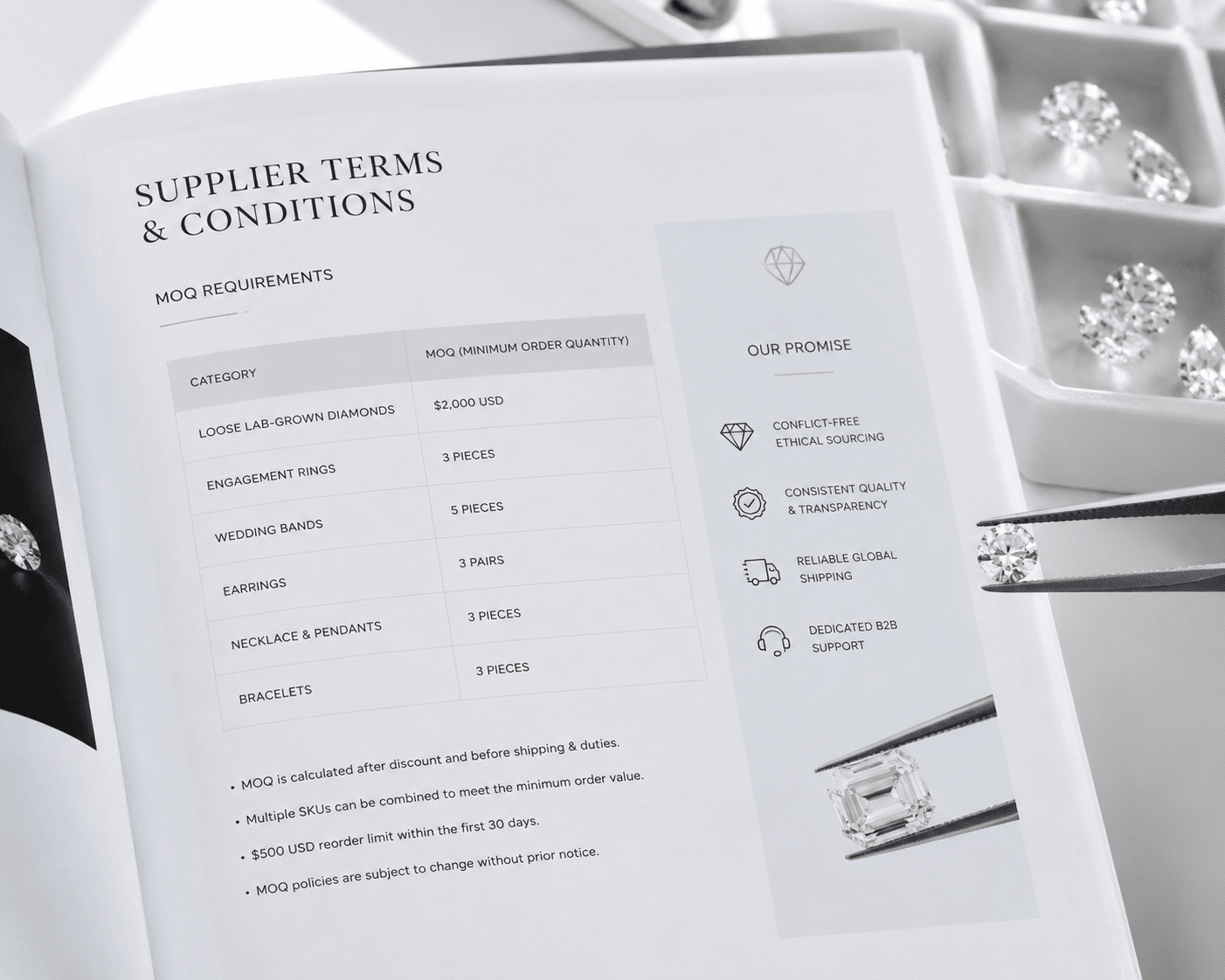
Larger CVD and HPHT production facilities run on batch cycles. A factory operating 100 or more reactors per week has a fixed cost structure that demands consistent volume movement. Their MOQ reflects the output of a production run, not a flexible pick-and-choose inventory. On the other end, a boutique cutter who sources rough on a per-order basis can accept lower MOQs because they are not carrying the same overhead. The MOQ tells you whether the supplier is moving standardized production, managing loose inventory from multiple sources, or offering a full cut-to-order service. Each model serves a different type of buyer.
Understanding the growth methods behind the supplier’s offering adds another layer of clarity. GIA explains that the two primary methods for producing lab-grown diamonds are High Pressure-High Temperature (HPHT) and Chemical Vapor Deposition (CVD).[2] Each method produces diamonds with distinct characteristics, and the production scale required for each affects the supplier’s cost structure and, in turn, their MOQ. A producer running a fleet of HPHT presses, which operate under extreme conditions, will have a different cost recovery timeline than a CVD producer running reactors at lower pressure, which can influence the flexibility of their minimum order thresholds.
A buyer who understands these production models can approach the MOQ with clearer expectations. For example, a supplier whose MOQ is driven by batch yield from a specific production run may have less flexibility to mix specs, but may offer more predictable quality across the batch. In contrast, a supplier sourcing loose inventory from multiple producers may offer greater mixing flexibility, but the buyer should verify that the grading and origin documentation for each stone is consistent. The production context behind the MOQ is as relevant as the number itself.
What a Low MOQ Signals: Flexibility, and What It Costs
Suppliers offering MOQs of 1 to 5 stones are typically aggregators or mid-tier brokers rather than primary producers. Their flexibility comes from holding inventory, not from production-line efficiency. That means they can ship a single stone quickly, but the per-stone cost will be higher. Selection breadth is usually narrower, and consistency across repeat orders can vary because the supplier is pulling from different source batches rather than a controlled production line. For a buyer testing a new product line or filling a one-off custom order, this model works well. For repeat volume at competitive pricing, it is rarely the right fit.
What a High MOQ Signals: Producer-Level Pricing, and What It Requires
MOQs of 50 to 100 or more stones typically come from primary producers or large wholesalers with dedicated production lines. The per-carat price will be significantly lower, often by 20 to 40 percent compared to a broker or small wholesaler. But the buyer must have cash flow, secure storage, and a realistic plan to sell or set the volume within a reasonable window. This model rewards consistent replenishment buyers who order the same specifications repeatedly. It punishes buyers who need variety, small runs, or the ability to pivot quickly based on sales data.
What to Check Before You Decide
Before accepting or rejecting an MOQ, confirm whether it applies per SKU or across a mixed order. A 50-stone MOQ that allows mixing across 3 to 4 specifications is dramatically more workable than 50 stones per individual specification. Also request written confirmation of substitution tolerance within the same price tier. If the supplier cannot guarantee that a substitution will stay within an agreed grade range, the MOQ becomes a gamble rather than a purchasing threshold.
How MOQ Changes by Supplier Type: Producer, Wholesaler, and Broker
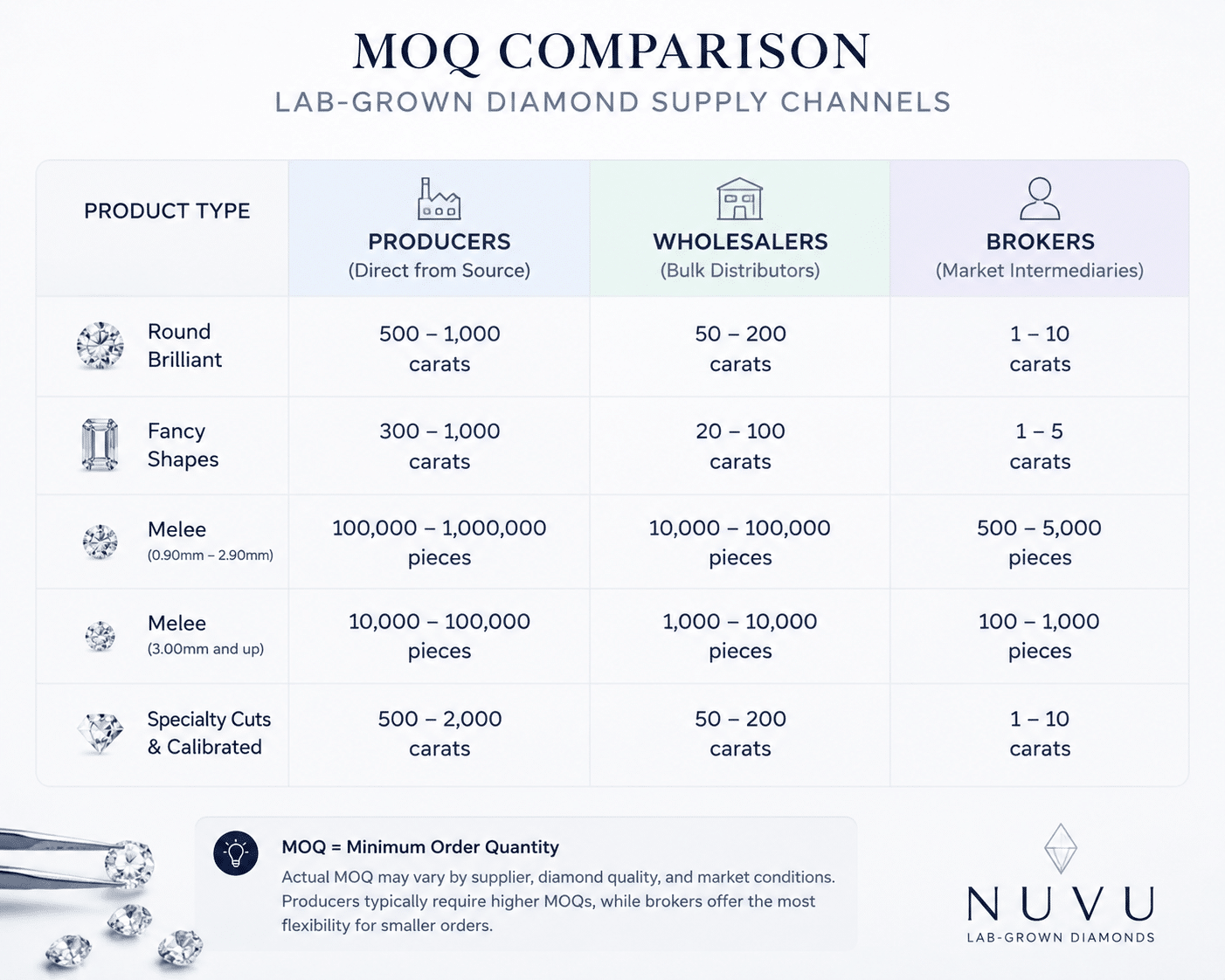
The same MOQ number means different things depending on who is offering it. A 20-stone MOQ from a primary producer signals something very different than a 20-stone MOQ from a broker. Understanding which supplier type fits your buying stage and volume needs prevents costly mismatches.
Primary Producer MOQ: High Floor, Lower Per-Stone Cost
Producers grow rough in batches, and their MOQ reflects minimum batch yield and per-stone cost recovery. CVD producers may offer rough stones at a lower MOQ, but the buyer then handles cutting, which adds complexity and cost. HPHT producers with integrated cutting lines typically require a higher MOQ for finished, graded stones because their process is more capital-intensive. The buyer’s real cost includes shipping, grading fees if the stones are not pre-graded, and setting. The headline per-carat price from a producer is attractive, but the total landed cost can surprise an unprepared buyer.
The distinction between HPHT and CVD is not merely academic. As GIA’s research notes, HPHT and CVD diamonds can sometimes be differentiated by their internal growth features and types of impurities, which trained gemologists can identify.[2] For a buyer evaluating a producer’s MOQ, this means that the supplier’s choice of growth method has downstream implications for how the diamonds are identified, graded, and sold. A buyer sourcing HPHT stones from a producer may need to work with a lab like GIA or IGI that is experienced in identifying HPHT-grown diamonds, which could add time or cost to the verification process.
Wholesaler MOQ: Mid-Range, Greater Mixing Flexibility
Wholesalers aggregate from multiple producers, which gives them more inventory variety than a single manufacturer. Their MOQ is typically 10 to 30 stones, with higher per-stone margins than a producer but much greater flexibility to mix shapes, sizes, and grades within one order. This is often the best fit for independent jewelers and small brands who need variety without overcommitting to a single specification. A wholesaler who allows mixing across 4 to 5 different stone profiles within a 20-stone MOQ effectively lets the buyer test multiple retail price points with a single order.
When evaluating a wholesaler’s mixed MOQ, buyers should also verify how the supplier documents the origin of each stone in the batch. Because wholesalers source from multiple producers, the documentation for a mixed order may include reports from different laboratories or different grading standards. A buyer receiving a 20-stone mixed batch should confirm that each stone’s laboratory-grown origin is clearly disclosed on its individual report or in the accompanying documentation. The FTC’s guidance on clear disclosure applies to every stone in a mixed order, not just to the batch as a whole, so buyers should ask how the supplier ensures consistent origin documentation across all stones in the order.
Broker MOQ: Lowest Threshold, Highest Per-Stone Price
Brokers connect buyers to specific inventory without holding stock themselves. Their MOQ can be as low as 1 to 5 stones, but the price reflects sourcing effort, verification, and logistics coordination. This model is ideal for one-off custom pieces, specific shape or size needs, or testing a new product line before committing to volume. The tradeoff is straightforward: maximum flexibility at the highest per-stone cost. Brokers are not the right partner for a brand that needs consistent monthly replenishment at competitive pricing.
For buyers working with a broker at a low MOQ, the documentation verification step takes on added importance. Because the broker does not hold inventory, the buyer may rely on the broker’s sourcing network for grading reports and origin documentation. A buyer should request the original grading report or laboratory documentation for each stone before committing to purchase, and verify the details using the issuing laboratory’s report check tool where available. This step ensures that the stone’s documented characteristics match what the broker has described, and that the origin disclosure (laboratory-grown) is present on the report.
Buyer Verification Checklist
When evaluating a supplier type, request a sample order of 2 to 3 stones at their stated MOQ tier. Compare not just price, but consistency in color and clarity across the sample. A producer who ships 5 identical D-VVS1 stones offers a fundamentally different value than one who ships 5 stones across the G-J, VS-SI range. The sample reveals whether the supplier controls their grading or simply passes through whatever batch happens to be available.
For buyers, the sample order is also a test of communication and documentation. A supplier who provides clear photos, measurements, and grading details for each sample stone is more likely to deliver consistent batch quality. A supplier who sends a single certificate for a mixed batch or avoids sharing specific dimensions may be operating with looser inventory controls that will surface only after the full MOQ is placed.
GIA’s lab-grown diamond identification and terminology guidance also reinforces the importance of documentation. GIA states that a grading report for a lab-grown diamond should clearly identify the stone as laboratory-grown and describe its color, clarity, and any post-growth treatment, such as HPHT color enhancement.[3] For a buyer receiving a batch of stones, each individual report should contain these clear disclosures. If a supplier’s sample order lacks individual reports or provides only a single report for a mixed batch, the buyer has no verifiable documentation for each stone, which can be a problem at retail.
Why MOQ Is a Signal of Supplier Reliability, Not Just Price
A rational, well-communicated MOQ with written terms is a stronger reliability signal than a rock-bottom price with vague availability. How a supplier talks about their MOQ tells you how they treat their buyers.
MOQ and Order Fulfillment Consistency
A supplier who clearly states their MOQ, allows mixing within the threshold, and provides written tolerance for substitution is far more likely to fulfill repeat orders consistently. Vague MOQ language, such as “contact us for minimum”, represents one of the key wholesale lab grown diamond supply red flags, often indicating inventory variability or reliance on a third-party sourcing network. That kind of supplier may deliver a perfect first order and struggle to match it on the second. For any buyer who needs repeat supply, clear MOQ terms are worth more than a slight discount on the first order.
MOQ as a Filter: Which Buyers It Serves and Which It Excludes
A 100-stone MOQ naturally filters out one-off custom buyers and startup jewelers. That is not inherently negative. The real question is whether the supplier’s MOQ aligns with their stated target buyer. A supplier who claims to serve independent jewelers but requires 50 stones per SKU is either mismarketing or will struggle to serve smaller buyers well. The MOQ reveals who the supplier actually wants as a customer, regardless of what their website says.
How MOQ Affects Returns, Replacements, and Dispute Resolution
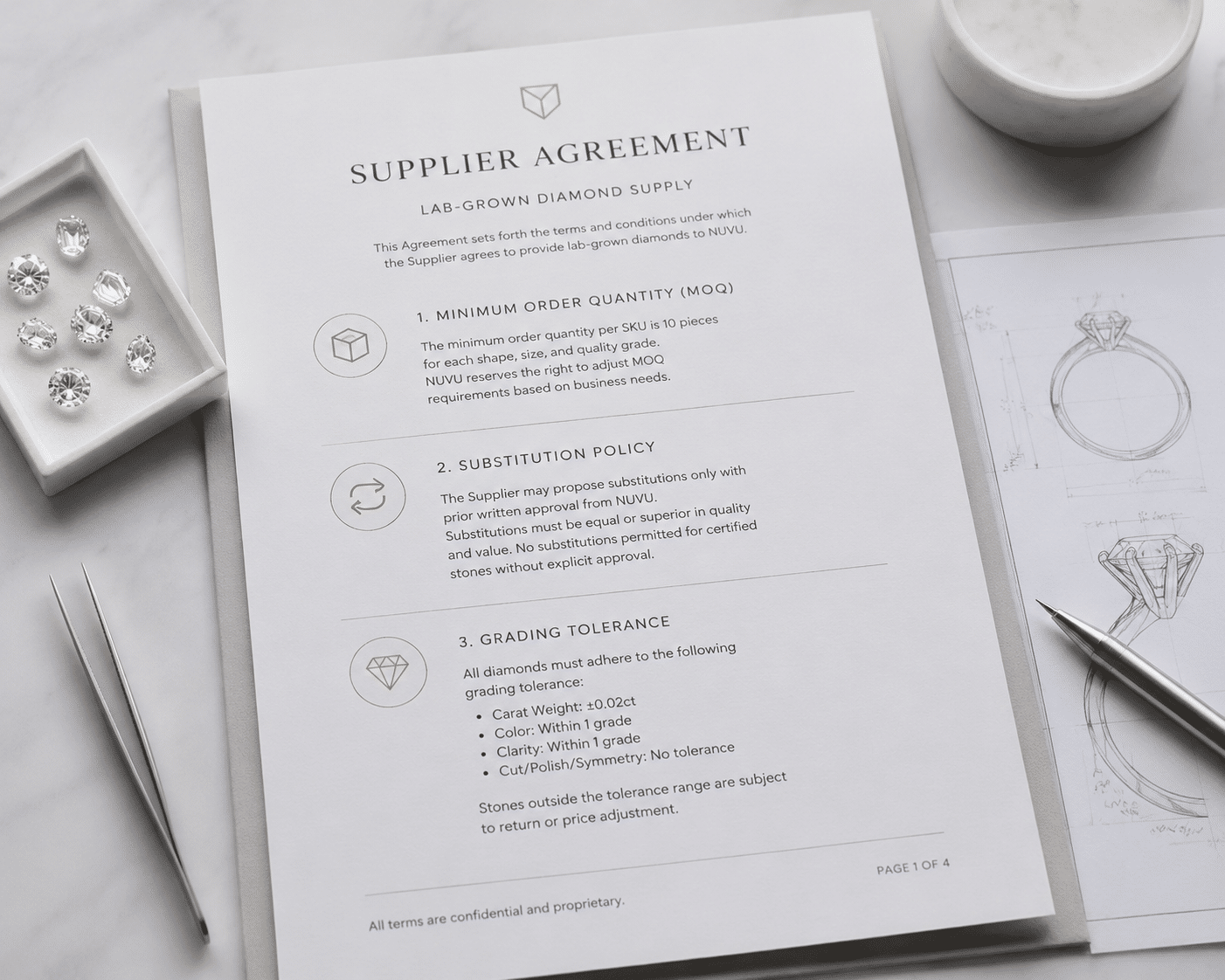
Written MOQ terms should also define return and replacement policy. Some suppliers apply a higher MOQ to replacement orders than they do to initial orders. Others offer no return beyond the initial MOQ threshold at all. Before committing, buyers should confirm what happens if 10 percent of the batch falls below the agreed grading tolerance. Is replacement within the same MOQ batch, or does it require a new MOQ? The answer determines how much risk the buyer actually carries.
Beyond the direct replacement terms, the MOQ agreement should also address how the buyer can verify a grading discrepancy. A supplier who requires the buyer to rely solely on a single batch report or on the supplier’s own grading may be creating a dispute process that is difficult for the buyer to use effectively. Buyers should ask whether they can submit disputed stones to an independent third-party lab for re-verification, and whether the supplier will cover the cost of that re-verification or replacement if the stone is found to be outside the agreed grade. These procedural details matter as much as the numerical MOQ threshold.
What This Means in a Real Purchase
If a supplier states an MOQ of 20 stones but cannot provide written confirmation of grading tolerance, substitution policy, or return terms for defective stones within that order, the MOQ becomes a liability rather than a purchasing threshold. A slightly higher per-stone price from a supplier who documents these terms clearly is almost always better value. The supplier who puts terms in writing is the supplier who will honor them.
Here, the FTC’s guidance on advertising and terminology provides a useful backdrop. The FTC’s Guides for the Jewelry, Precious Metals, and Pewter Industries advise that claims about a product’s characteristics must be substantiated and not misleading.[1] This principle applies to any claim a supplier makes about grading tolerance, substitution policy, or the exact specifications of the stones in an MOQ batch. A supplier who makes verbal promises but cannot commit them to writing is creating a gap that could lead to a misrepresentation claim. For the buyer, a written MOQ agreement that includes clear dispute resolution terms is not just good business practice — it is a form of consumer protection for the buyer’s own business.
Real MOQ Scenarios: What a 10-Stone, 50-Stone, and 100-Stone Order Actually Looks Like
The difference between MOQ tiers is easiest to understand when you map them to real dollars, real inventory, and real sales capacity. A number on a price sheet does not tell you whether the order fits your business. These three scenarios show what each tier actually requires.
Scenario One: 10-Stone Mixed Order for a Small Boutique Jeweler
A 10-stone order mixing 3 round brilliant 1-carat D-F VS-SI diamonds and 7 oval 0.5-0.75 carat stones lands at a total approximate cost of $3,000 to $5,000. That cash exposure is manageable for a small jeweler testing two shapes and two size categories. This order size allows you to create 2 to 3 custom rings and 2 to 3 pairs of studs, then gauge which shape sells faster before placing a larger order. The per-stone cost is higher at this tier, but the cost of being wrong about demand is low. You are buying flexibility, not efficiency.
Scenario Two: 50-Stone Order for a Growing Brand
A 50-stone order of all 1-carat round brilliant, G-H color, VS-SI clarity, costs roughly $18,000 to $28,000. At this volume, you can stock a core engagement ring offering, create 10 to 15 rings with consistent specification, and offer a ready-to-ship product line. Some within-batch variation is normal, but the brand must have storage for loose stones, a process for grading review upon arrival, and a setting partner who can handle consistent volume. The per-stone savings over a 10-stone order are significant, but only if you can actually move the inventory within a reasonable window.
Scenario Three: 100-Stone Order for a Larger Retailer
A 100-stone order mixing 50 round 1-carat and 50 oval 1-carat stones, G-H, VS-SI, totals approximately $36,000 to $56,000. This is not a test order. This is a full product launch across two silhouettes. The retailer needs setting partners capable of handling 100 units within a 4 to 6 week window, plus a sales plan that moves the inventory within 3 to 4 months. The per-carat price at this tier is the lowest of the three scenarios, but the cash commitment, storage requirement, and production coordination are orders of magnitude higher. This MOQ rewards businesses that already have their supply chain and sales pipeline running reliably.
Across all these scenarios, the role of a third-party grading report is critical. Organizations like the International Gemological Institute (IGI) provide grading reports that document a diamond’s 4Cs (carat weight, color, clarity, and cut) and confirm whether the stone is laboratory-grown.[4] For a buyer receiving a 10-stone batch, each individual IGI report provides a verifiable record of that stone’s characteristics. For a 100-stone batch, the buyer should confirm whether each stone will come with its own report or whether the supplier will provide batch-graded documentation. The cost of individual reports is a real factor in the per-stone total, and it influences which MOQ tier actually delivers the expected savings.
It is also worth noting that the grading report does not replace visual inspection. A report documents a stone’s characteristics at the time of grading, but a buyer receiving a batch of stones weeks or months later should confirm that the stones’ appearance and measurements match the report details. For batch orders, a buyer may also want to establish an in-house verification process, such as using a portable scope or loupe to spot-check a sample of stones from each order. This does not replace third-party grading, but it adds a layer of confirmation that reduces the risk of accepting a batch that varies from the documented specs.
When a grading report is provided, buyers should verify the report details through the issuing laboratory’s official report-check tools where available. This step ensures that the report number, stone characteristics, and origin disclosure match the stone you are purchasing.
Certificate and Visual Review Check
For any batch order above 20 stones, request a pre-shipment inspection report from a third-party lab or verification service. Batch grading consistency cannot be assumed. A 5 to 10 percent variance rate within the agreed grading tolerance is normal. A variance rate above 15 percent should trigger a review of the supplier’s sorting and grading process before you pay the balance or place a repeat order.
The Hidden Costs Behind an MOQ: What the Stated Price Does Not Include
The per-stone price is only the beginning. A low MOQ or a low per-carat number can look attractive until you add the costs that sit outside the stone price. Calculating total landed cost, not just stone cost, is the only way to evaluate whether a wholesale offer actually saves you money.
Shipping, Insurance, and Customs for Wholesale Orders
International shipping for a 50-stone order from a China-based producer typically costs $150 to $400, including insurance and customs brokerage. Domestic shipping within the U.S. for a similar order runs $50 to $150. Customs clearance may require an Importer of Record, a customs bond, or a broker, adding $100 to $300 in one-time or per-shipment fees. These numbers are not large relative to the stone cost, but they are real and they add up across multiple orders. If you are comparing a domestic supplier at a slightly higher per-stone price against an international supplier at a lower per-stone price, include these logistics costs in the comparison.
Grading and Verification Costs for Uncertified or Batch-Graded Stones
Uncertified stones from a producer may require third-party grading through GIA or IGI before you can sell them with confidence. Grading 50 stones at $30 to $60 per report adds $1,500 to $3,000. Some suppliers offer batch grading with a single report covering the entire order’s overall range, but that report does not certify individual stones. If you sell to end consumers who expect individual grading reports, batch grading is not sufficient. The cost of individual certification may erase the per-stone savings you gained from a higher MOQ.
Official grading labs provide clear documentation that helps establish trust with end consumers. GIA’s grading reports for laboratory-grown diamonds, for instance, include a report number, the 4Cs, and a clear statement of the stone’s origin as “Laboratory-Grown.”[3] This level of documentation is important because it provides an objective, third-party record of the stone’s characteristics. A buyer who receives a 50-stone batch with individual GIA or IGI reports can offer their retail customers verifiable information about each stone. A buyer who receives batch-graded stones without individual reports carries the burden of explaining the stone’s quality to the customer without independent documentation.
For buyers, the grading question is also a trust question. A supplier who offers batch grading may be transparent about their process, but the buyer should verify whether the batch report covers the entire order or only a sample subset. If the report covers a sample, the buyer has no individual documentation for the remaining stones. This creates a gap between what the seller claims and what the buyer can prove to a retail customer. The cost of closing that gap, through individual certification or in-house verification, should be factored into the MOQ decision.
Setting and Manufacturing Costs Per Stone
If you are a jeweler or brand setting these stones, the setting cost can multiply the total expense significantly. Setting 50 stones at $80 to $150 per stone for a simple four-prong or bezel setting adds $4,000 to $7,500. More complex settings, shared prong, or pave settings increase per-stone cost to $150 to $300. The stone MOQ may work for your inventory plan, but the total ring production cost may be two to three times the stone cost. A low MOQ on stones does not help if the setting cost per unit makes your final retail price uncompetitive.
Storage and Inventory Carrying Cost
Storing 100 loose stones requires secure storage, ideally a safe or insured vault. Inventory carrying cost, including insurance, security, and opportunity cost, typically runs 1 to 3 percent of inventory value per month. For a $50,000 order, that adds $500 to $1,500 per year. Small brands often underestimate this cost when evaluating a high-MOQ offer. If the stones sit unsold for six months, the carrying cost alone can offset the per-stone savings from buying at a higher volume tier.
Stone-to-Setting Fit Check
Before committing to an MOQ, confirm stone measurements including diameter, depth, and table percentage for standard mounting. A 1-carat round brilliant designed for a 4.0 mm setting will not fit a 4.5 mm mounting. Request measurement tolerance per stone within the batch. A 0.2 mm variance is normal. Above 0.3 mm variance creates setting complications that add labor time and risk damaging the stone during mounting. A batch that looks good on paper but varies widely in physical dimensions can turn a cost-efficient MOQ into a production headache.
How to Negotiate MOQ: Practical Strategies for Small Buyers
MOQ is not always a fixed number. Many suppliers are willing to adjust the threshold for a buyer who demonstrates professionalism and genuine intent. The key is to negotiate in a way that reduces the supplier’s risk while increasing your flexibility.
Offer a Trial Order with a Staged Second Order Commitment
Propose a 10-stone trial MOQ accompanied by a written purchase order for a 50-stone second order contingent on the trial’s quality and delivery timeline. This structure reduces the supplier’s risk while signaling that you are serious, not just price-shopping. Most suppliers will accept a staged commitment if you provide a business reference, a retail location, whether physical or online, and a realistic timeline for the second order. A written commitment carries more weight than a verbal expression of interest.
Ask for Mixed-Specification MOQ Flexibility
The most common negotiation lever is asking whether you can mix shapes, sizes, and grades within the same MOQ. Many producers will allow mixing across two to three specifications if the total volume meets their threshold. A 20-stone MOQ that allows mixing between round and oval, or between 1-carat and 0.75-carat stones, dramatically increases your ability to test multiple retail price points with a single order. This flexibility is worth more than a small reduction in per-stone price.
Request a Pre-Pack Curation Service
Some suppliers offer a buyer-matched pack for a slightly higher per-stone price within the stated MOQ. For example, a 20-stone MOQ of 1-carat rounds can be curated by the supplier to include 10 D-VVS1, 5 E-VS1, and 5 F-VS2 stones. This creates variety without requiring you to select each specification individually. The per-stone price is higher than a single-specification order, but the ability to test multiple price points with one batch often justifies the premium.
Buyer Verification Checklist
When negotiating, get all terms written. Confirm whether the MOQ applies per order or per specification. Document the acceptable mixing ratio, substitution policy, grading tolerance, replacement terms, and shipping timeline. A supplier who resists documenting these terms is likely less reliable regardless of the MOQ level. The written terms matter more than the number itself.
When negotiating terms, remember that the supplier’s disclosures about the diamonds must be accurate. The FTC’s Guides specifically require that terms like “laboratory-grown,” “laboratory-created,” or “cultured” be used to describe the nature of the diamond, and that the product be clearly identified as not being a natural diamond.[1] Any MOQ agreement that includes language about the stone’s origin should use these precise terms. Getting the terminology right in the purchase order and invoice protects both the buyer and the supplier from potential misrepresentation claims, and it ensures that the buyer’s own retail advertising will be accurate from the start.
When MOQ Is a Warning Sign: Red Flags in Supplier Terms
Not every MOQ is a fair deal. Some supplier terms signal deeper problems that have nothing to do with the per-carat price. Learning to spot these red flags before placing an order can save far more than negotiating a lower minimum.
Red Flag One: Vague MOQ with No Clear Per-Specification Rules
If a supplier says “MOQ 20 stones” but cannot tell you whether that means 20 stones per shape, per size, per color grade, or mixed across your entire order, ask directly. The inability to answer this question usually means the supplier does not have tight control over their inventory. They may be pulling from a loose pool of stones rather than maintaining sorted stock. The result is predictable: substitution of stones that fall outside the grade or size range you requested. What arrives may be technically within the MOQ count but useless for your actual product line.
Red Flag Two: MOQ That Drastically Changes After the First Order
A supplier who offers an MOQ of 10 stones on the first order and then demands MOQ 100 on the restock is not being deceptive per se, but they are telling you something important. Their real minimum is 100. The first low MOQ was a test to see if you were a serious buyer. This pattern is common with producers who need to commit production line time. The risk is that you build a retail offering around a specific stone specification, then discover you cannot reorder without tripling your cash commitment. Before accepting a low initial MOQ, ask what the minimum will be for a repeat order. If the jump is steep, plan your inventory and pricing accordingly.
Red Flag Three: MOQ with No Written Grading Tolerance or Dispute Process
The highest-risk MOQ is one with no written policy for what happens when stones arrive below agreed grading. If a supplier cannot put in writing what they will do when 10–20% of a batch falls short of the stated color or clarity range, you are carrying all the risk, wholesale lab grown diamond supply evaluation; a reliable supplier will document their tolerance (for example, accepting a 5% variance within one grade step) and will commit to replacing out-of-tolerance stones within the same MOQ structure, not as a new minimum order. Without this, a batch that is technically “delivered” can be functionally unsellable in your retail channel.
From a compliance perspective, a lack of written grading tolerance and dispute process is also a red flag for future advertising accuracy. The FTC’s guidance emphasizes that any claim about a product’s characteristics must be supported with reliable evidence.[1] If a buyer cannot prove to a supplier that a stone fell outside the agreed grade range, they cannot substantiate a claim that the supplier failed to deliver. This makes the dispute process a critical component of the MOQ agreement. A supplier who provides a clear, written process for verifying and disputing grading discrepancies is showing a commitment to fair dealing. A supplier who avoids this is creating a situation where the buyer has no recourse.
Certificate and Visual Review Check
Before committing to any batch order above 20 stones, ask for a video of a representative sample. This should include a close-up under 10x loupe of each stone’s table, crown, and pavilion. A supplier who refuses to provide video or photo verification for batch orders is a high-risk source. If the MOQ terms themselves are unclear, the visual evidence becomes your only protection before payment.
How to Choose the Right MOQ for Your Business Stage
The right MOQ is not the lowest number or the best per-carat price. It is the one that matches your actual capacity today, not the volume you hope to reach next year. Choosing an MOQ that exceeds your operational reality is how cash flow problems start.
Early Stage Jewelers: MOQ 1–10 Stones
If you are building your first collection or testing market response, a broker or small wholesaler MOQ is the right fit. You will pay more per stone, but your cash exposure stays low. This matters because you do not yet know which shapes, sizes, or price points will sell in your market. A 10-stone order lets you test two or three specifications, gather real sales data, and reorder what actually moves. Flexibility matters more than unit cost at this stage.
Growing Brands: MOQ 10–50 Stones
Once you have validated demand for at least one core specification, you can step up to a wholesaler or light producer MOQ. The per-stone cost drops noticeably at this tier, and the higher volume allows you to build a consistent product line. You can stock a core engagement ring offering across a single clarity and color range and offer ready-to-ship pieces rather than made-to-order only. This is the stage where consistency across the batch becomes as important as price, because every ring you sell from that batch must match your brand standard.
Established Retailers: MOQ 50–200+ Stones
At this stage, you have retail capacity, setting partner relationships, and inventory management systems in place. Direct producer MOQ is appropriate, and the per-stone cost will be at its lowest. But the commitment is real. A 100-stone order requires a written import plan, a grading schedule, and a setting timeline. You need the cash flow to carry the inventory, the storage to secure it, and the sales velocity to move it within a reasonable window. The savings per stone only matter if you can actually sell the volume.
A common mismatch at this stage is ordering a producer-level MOQ before confirming that the supplier’s grading consistency matches your brand standard. A producer who ships 100 stones with a 10 percent variance in color may still offer an attractive per-carat price, but if your retail brand requires tight consistency within a single grade band, those 10 off-spec stones represent wasted cost, not savings. The MOQ that works on paper may not work on the bench or in the display case.
What This Means in a Real Purchase
A startup jeweler with no existing stone inventory should not accept a 100-stone MOQ from a producer, no matter how attractive the per-carat price looks. The total cash exposure, storage requirement, and setting cost will far outweigh the per-stone savings. The smarter sequence is to start with a broker MOQ, validate your sales, then scale to a wholesaler MOQ. Let the data, not the price sheet, determine your next step.
As you evaluate which MOQ tier fits your business stage, the concept of “total landed cost” should include the cost of verifying the diamond’s origin and quality through a third-party report. The GIA’s verification services allow anyone to check a report online using the report number, ensuring that the documented characteristics match the stone.[5] This is especially relevant for a growing brand or established retailer that is building a reputation on consistency. Being able to provide each retail customer with a verifiable GIA or IGI report number is a trust-building step that a lower per-stone price from a less documented supplier cannot replace.
Summary: The MOQ Decision Framework for Lab-Grown Diamond Wholesale
Every MOQ offer can be evaluated with a consistent process. The framework below applies whether you are buying 5 stones or 200.
Five Questions to Ask Before Accepting Any MOQ
1. Is this MOQ per order or per specification? — The answer determines how much usable inventory you will actually receive.
2. What is the acceptable mixing ratio? — Can you combine shapes, sizes, and grades within the minimum?
3. What is the written grading tolerance and substitution policy? — What variance is allowed, and who absorbs the cost when stones fall outside it?
4. What are the return and replacement terms for defective or out-of-tolerance stones? — Is replacement within the same batch, or does it trigger a new MOQ?
5. What is the total landed cost? — Add shipping, insurance, customs, grading reports, and setting to the per-stone price. The headline number is never the full number.
One Rule for MOQ Fit
The MOQ should not exceed 20–30% of your projected three-month sales volume for that specification. If the minimum is larger than what you can sell in a quarter, the carrying cost and cash exposure are too high for your current stage. Negotiate a lower MOQ, or find a supplier whose structure fits your actual sales capacity.
Final Recommendation: Start Small, Scale with Data
For any new supplier, place a trial order at their stated MOQ. Evaluate grading consistency, communication quality, delivery timeline, and return policy performance on that first order. Only after two or three successful trials should you commit to a volume-level MOQ that requires significant cash and inventory commitment. The supplier who delivers reliably on a small order is the one worth scaling with. The supplier who performs well only at volume is a supplier you have not tested yet.
Documenting the Supply Chain: A Note on Traceability
As the lab-grown diamond market matures, buyers are increasingly being asked about the provenance and documentation of the stones they sell. While every supplier operates differently, a buyer who can clearly describe where their stones came from, under what production method they were grown, and through which grading labs they were verified, is in a stronger position with their own customers. This does not require a blockchain ledger or a certificate of origin from the producer. It requires a clear paper trail: purchase orders that specify growth method (CVD or HPHT) and any post-growth treatment, individual grading reports for each stone, and a written record of any batch-level testing performed by the buyer or a third party.
For the buyer evaluating an MOQ, traceability begins with documentation. A supplier who provides individual GIA or IGI reports for each stone in a batch is offering a verifiable record that can follow each stone through the supply chain. A supplier who provides only a single batch report or no reports at all is asking the buyer to accept the stone’s quality on trust alone. In a wholesale context, trust without documentation is a risk that compounds with every stone in the order. Buyers should prioritize suppliers whose documentation practices align with the level of traceability their own retail customers expect.
It is also worth noting that documentation consistency across the batch is a practical indicator of supplier reliability. A supplier who provides uniform, individual reports for every stone in a 50-stone batch is demonstrating that they have invested in the sorting, grading, and quality control processes that produce consistent output. A supplier who provides a mix of individual reports, batch certificates, and verbal assurances is signaling that their inventory control may be inconsistent. The buyer’s decision to accept an MOQ should include an assessment of not just the price and the quantity, but the quality of the paper trail that comes with it.
Understanding the Role of Environmental and Ethical Claims in MOQ Evaluations
Some suppliers may present their MOQ terms alongside claims about the environmental or ethical attributes of their lab-grown diamonds. For a buyer evaluating a supplier, these claims should be treated as information that requires documentation, not as a basis for decision-making without verification. Sustainability and ethics are not inherent properties of a lab-grown diamond; they depend on the specific production practices, energy sources, labor conditions, and supply chain controls of each facility.
If a supplier makes a claim about sustainability or ethical production, the buyer should ask for substantiation. This could include documentation about the supplier’s energy source for growth reactors, waste management practices, or third-party audits of labor conditions. A vague claim such as “eco-friendly” or “fully sustainable” without specific, verifiable evidence does not provide a reliable basis for a buyer’s own marketing or retail claims. The FTC’s guidance on substantiation applies to these claims as well — any claim a supplier makes about the environmental or ethical attributes of their stones should be supported with reliable evidence.
In the context of an MOQ agreement, a buyer may also want to confirm whether the supplier’s documentation practices extend to environmental or ethical disclosures. A supplier who provides individual grading reports and clear origin documentation is more likely to also maintain records about production practices. A supplier who avoids providing documentation about environmental or ethical claims may be making claims that cannot be substantiated. For a buyer who intends to use sustainability or ethical sourcing as part of their brand story, the MOQ evaluation should include an assessment of whether the supplier can back up those claims with verifiable documentation.
[1] Federal Trade Commission, “Guides for the Jewelry, Precious Metals, and Pewter Industries,” 16 CFR Part 23, as amended, 2018. Read the FTC Jewelry Guides
[2] GIA, “HPHT and CVD Diamond Growth Processes,” GIA.edu, educational resource. GIA: HPHT and CVD Diamond Growth
[3] GIA, “Laboratory-Grown Diamond Reports,” GIA.edu, official guidance. GIA: Laboratory-Grown Diamond Reports
[4] IGI, “Lab-Grown Diamond Grading,” International Gemological Institute, official service description. IGI: Lab-Grown Diamond Grading
[5] GIA, “Report Check,” GIA.edu, online verification tool. GIA Report Check
Disclosure: This article is for general educational purposes only. Diamond grading, pricing, availability, specifications, and seller policies can change, and readers should verify important details through grading reports, official laboratory tools, seller documentation, or qualified professionals before making a purchase decision. Laboratory-grown diamonds should be clearly distinguished from natural diamonds, and environmental or sourcing claims should be supported by specific documentation.
Last updated: September 2025