
Most jewelers discover a supplier’s true reliability not on the first order, but on the second or third. The initial shipment often gets preferential treatment—better grading, faster delivery, and more responsive communication. It is only when you place a repeat order that subtle but costly problems emerge: grading drift, unannounced lab changes, and cut-quality shifts that certificates fail to catch. These patterns are rarely isolated mistakes; they indicate structural issues in how a supplier operates, frequently tied to their wholesale lab-grown diamond MOQ frameworks and broader B2B diamond supply chain strategies.
For the full framework, read Wholesale Lab-Grown Diamonds for Jewelers and Brands.
Ignoring these early warning signs compounds risk across future orders, leading to setting errors, remakes, and eroded client trust. This article gives you a practical framework for evaluating wholesale suppliers beyond the first transaction. You will learn which documentation gaps to treat as red flags, how to score a supplier before scaling an order, and when it is smarter to walk away rather than commit.
| Red Flag | What It Looks Like in Practice | Action to Take Before Repeat Orders |
|---|---|---|
| Grading drift between orders | First order stones grade G/VS1; subsequent orders grade H/SI1 for the same price tier. | Request third-party verification for a sample from each new batch. |
| Unannounced lab switching | Supplier changes from GIA to IGI or smaller labs without notice or price adjustment. | Ask explicitly which lab will issue each certificate before payment. |
| Vague or batch-level invoices | Invoice lists a total carat weight and price but omits individual stone details or batch numbers. | Demand an itemized sample invoice before committing to any order. |
| Unexplained price swings above 15% | Price for comparable goods fluctuates sharply between orders with no clear market explanation. | Request three months of pricing history on standard goods for comparison. |
| Refusal of pre-shipment video | Supplier is unwilling to provide video confirmation of stones before dispatch. | Make video confirmation a non-negotiable requirement for all repeat orders. |
| Empty promises vs. actual lead times | Supplier promises 10-day delivery but consistently takes 18–22 days. | Track actual delivery dates across three orders and compare to quoted timelines. |
Quick Questions Before You Read
Q: Can a small grading difference really affect setting and customer satisfaction?
Yes. A one-grade shift in color or clarity may pass a quick check, but over multiple stones it creates visible inconsistency in a finished piece. Customers notice mismatched stones in a setting, and remakes cut your margin.
Q: Should I require a specific lab certificate for every wholesale lab-grown diamond?
For repeat orders, yes. If a supplier switches from GIA to a less rigorous lab without notice, you are paying the same price for a stone that may be harder to verify or resell. Specify the lab in your purchase agreement.
Q: What if my current supplier passes all checks but I still feel uneasy?
Trust that discomfort. The evaluation framework in this article includes communication consistency and willingness to provide production access. If a supplier is opaque or defensive about standard information, structural risk may still exist.
Laboratory-grown diamonds should be clearly identified as laboratory-grown, and they should not be presented as mined diamonds. This distinction matters most in wholesale documentation, where a buyer must be able to trust that the origin disclosure on an invoice or certificate is accurate and consistent from one order to the next.
Why Wholesale Risk Detection Matters Before Repeat Orders
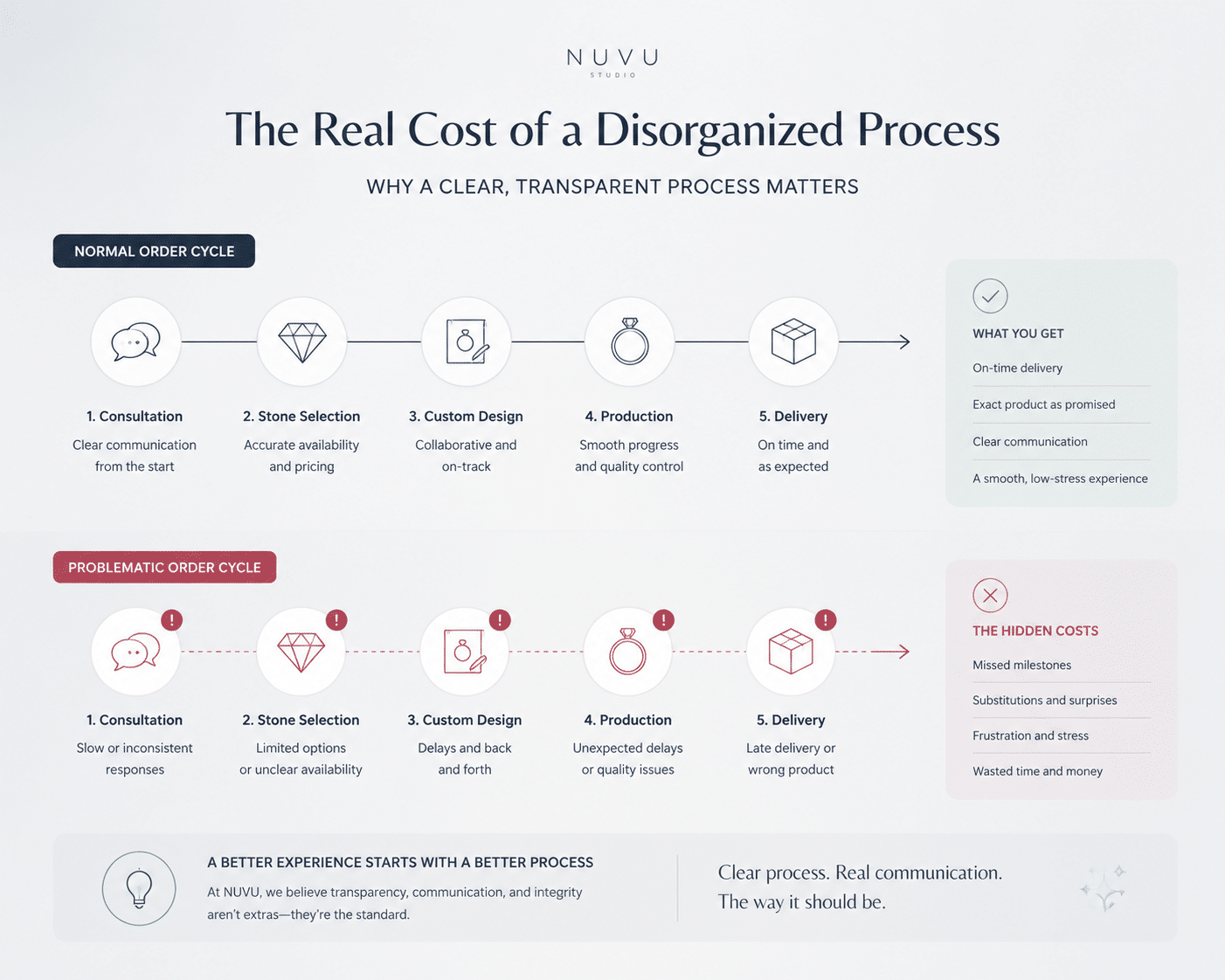
The first order from a new wholesale supplier almost always goes smoothly. Communication is fast. Grading is tight. Inventory is available. Terms are flexible. This is not necessarily manipulation — it is simply how most supplier relationships begin. The real test starts with the second and third orders, when the operational reality behind the initial performance becomes visible.
For a jeweler moving from a trial order to a committed wholesale relationship, the stakes change. A one-stone mismatch or a single delayed shipment rarely matters much. But when small inconsistencies reappear across multiple order cycles, the cumulative cost becomes real: setting errors, remake delays, customer complaints, and lost trust. The risk is not in isolated incidents. It is in patterns that compound over time.
This article is not a general guide to finding a supplier. It is a risk-detection framework for jewelers who already have a wholesale relationship and need to evaluate whether that relationship is built to last.
The Gap Between First Order and Long-Term Reliability
First orders receive preferential treatment because the supplier is incentivized to make a strong impression. Communication channels are more responsive. Grading tends to be conservative. Inventory is carefully selected. Lead times are managed tightly. This makes sense from the supplier’s perspective — a smooth first order lowers the buyer’s hesitation.
The real supplier profile emerges only when the relationship moves beyond the trial phase. At that point, the supplier must operate at production scale, not curated-sample scale. Consistency, operational discipline, and documentation habits become the relevant metrics. A supplier who performed well on a 15-stone trial order may look very different on a 150-stone repeat order.
Why Warning Signs Compound Across Orders
No supplier is perfect. A single delayed shipment or one ambiguous certificate is rarely enough to justify switching partners. But the danger is not in the isolated red flag — it is in recurrence. When the same kind of inconsistency appears across two or three order cycles, the pattern becomes expensive to ignore and difficult to reverse.
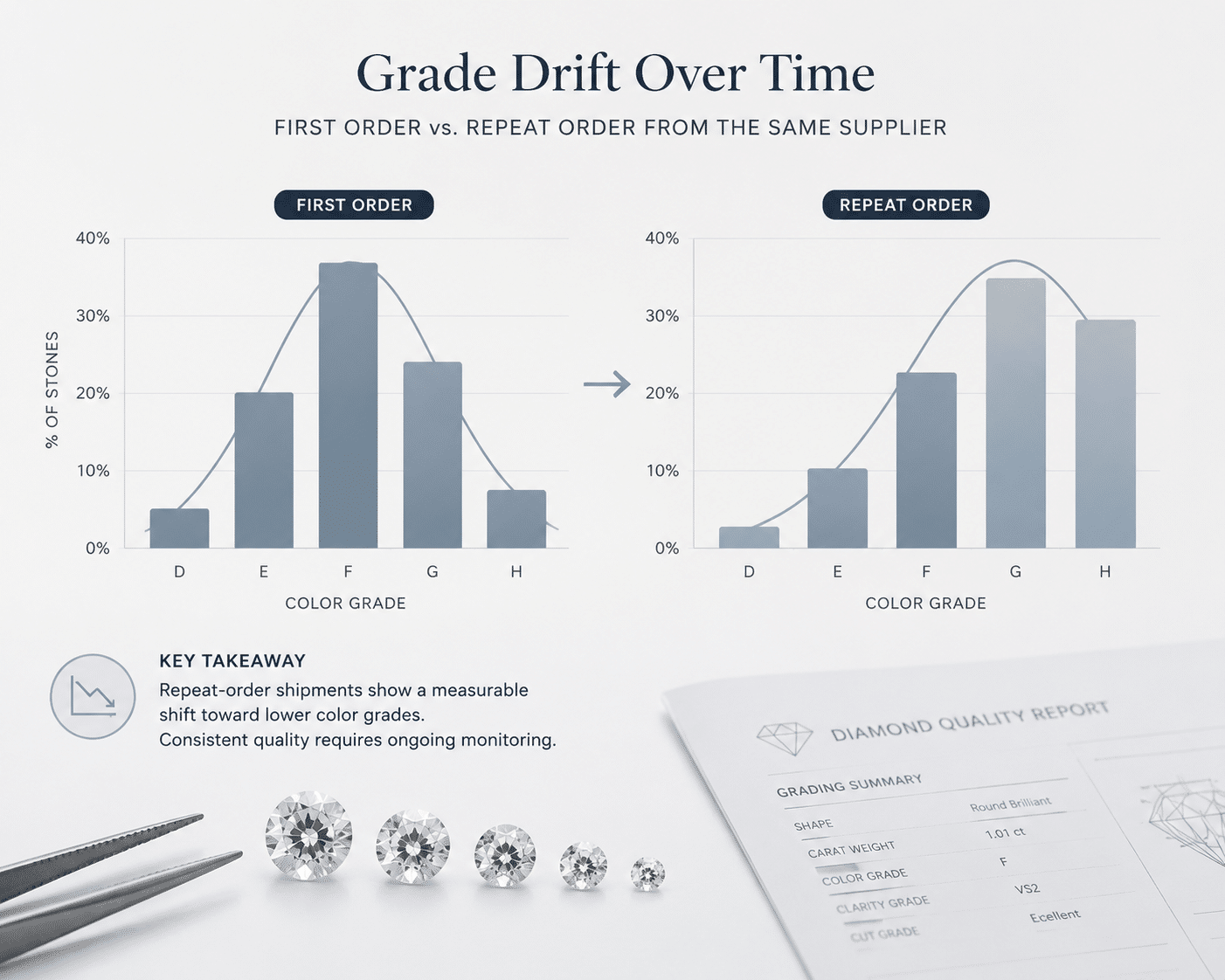
A grade drift that starts at half a color step in the first order and reaches a full step by the third order creates real problems in matching, setting, and customer satisfaction. A communication gap that appears minor during the first order becomes frustrating by the third. The cumulative cost of these patterns is almost always higher than the unit price difference that made the supplier attractive in the first place.
The right question is not “Did this order have a problem?” The right question is “What pattern is emerging across my orders with this supplier?”
What to Check Before Committing to a Second Order
Before placing a repeat order, review three specific patterns from your first interaction with the supplier. First, did the grading consistency hold across the initial shipment, or were there surprises when you compared the stones to their certificates? Second, did communication speed and accuracy improve as the relationship progressed, or did responsiveness degrade once the order was placed? Third, were any pricing or availability adjustments communicated in advance, or did they appear without explanation?
These three checks will not tell you everything, but they will tell you whether the supplier treats the relationship as a partnership or as a transaction. That distinction usually determines everything that follows.
Inconsistent Grading Standards Across Orders
Grading inconsistency is the most expensive hidden risk in lab-grown diamond wholesale. It is also the most difficult to detect early because the first order is often deliberately tight. The problem reveals itself only when repeat orders begin to drift — and by then, the jeweler may already have set stones, made sales, and built customer expectations around a quality standard that the supplier cannot maintain.
When Supplier-Graded Parcels Do Not Match Certificate Grading
Some wholesale suppliers provide internal grade estimates for bulk parcels while sending only representative stones for third-party certification. This practice is not inherently problematic, but it creates a gap that needs monitoring. When the gap between internal estimates and formal certificate grades exceeds one color or one clarity grade, the pattern usually indicates one of two things: over-optimistic internal sorting or deliberate grade inflation.
The critical observation is whether this gap widens as order volume increases. A supplier who delivered a first order with internal estimates within half a grade of certificate results, but whose third order shows a full grade or more of drift, is not controlling their sorting process tightly enough. The buyer absorbs that cost in the form of stones that do not match what was quoted.
Shifting Cut Quality Between Sample and Production
Cut quality is harder to catch on a certificate than color or clarity because most grading reports confirm that a stone falls within an acceptable range — excellent, very good, good — without distinguishing between the top and bottom of that range. A sample stone sent for approval may be cut near the top of the excellent range, with precise optical symmetry and ideal proportions. Production-run stones may fall at the bottom of the same excellent range, where visual performance drops noticeably even though the certificate grade remains the same.
This difference matters most in rounds and fancy shapes where precision cutting directly affects light return. A round brilliant that is technically excellent but cut at the low end of that grade will look less bright and less crisp than a stone cut near the top. The certificate will not show the difference. Only side-by-side visual comparison will.
Certificate Lab Switching Without Explanation
A supplier who shifts from one grading laboratory to another between orders — especially from a stricter lab to a more commercially oriented lab — is often managing grade expectations rather than inventory. Each major lab applies slightly different standards for color, clarity, and cut. A stone graded GIA versus IGI or IGI versus a smaller lab may carry different practical grades even if the certificate grade is the same.
Unannounced lab switching is not necessarily fraudulent, but it is a behavioral pattern worth evaluating. If the supplier changed labs between your first and second order without explaining why, ask directly. The answer will tell you whether the change was driven by buyer preference, inventory availability, or grade management.
For the buyer, the practical point is that certificate-grade equivalence across labs is rarely precise. The stone that arrives with an IGI certificate graded G in color may face a different visual reality when placed next to a GIA-graded G from a previous order. The grading report documents the opinion of one lab on one day. It does not guarantee that two stones from different labs with the same grade line will appear identical in a setting.
Recognizing the limits of what a grading report confirms. The Gemological Institute of America (GIA) has published guidance emphasizing that its reports document a diamond’s specific characteristics at the time of grading but should not be interpreted as a universal guarantee of quality across labs.[1] Similarly, the Federal Trade Commission (FTC) advises that any claims about diamonds offered for sale should be accurate and not misleading, which directly applies to how suppliers describe the consistency of grading across different laboratories.[2] For a jeweler, this means that relying on a single lab’s report to guarantee consistency across multiple orders from different certificate sources is a risk. The most practical safeguard is to request visual confirmation—video or high-resolution images—of the actual stones, and to compare those visuals against the report data before committing to a repeat order. A grading report helps document key characteristics, but it should not be treated as a guarantee of beauty, value, or sourcing ethics.
Certificate and Visual Review Check
Before placing a repeat order, lay out the grading reports from both the first and second shipments side by side. Look for systematic differences in how color grades are distributed, where clarity grades cluster, and whether cut quality proportions shifted. A supplier whose first shipment leaned toward G-VS2 and whose second shipment leans toward H-SI1 may not be drifting randomly — they may be managing inventory by sending the buyer stones that were previously rejected.
Also request 360-degree video or high-resolution images of representative stones from each batch, and compare face-up appearance between the first and second orders for wholesale lab grown diamonds, not just certificate data. If the visual performance drops while the certificate grades remain similar, cut quality is the likely cause.
Shipping Time Shifts and Availability Inconsistency
Operational red flags often appear before grading issues do, because they are harder for a supplier to control during a trial period. Shipping times, inventory availability, and substitution behavior reveal the actual production capacity and inventory management discipline of a wholesale partner.
The Gap Between Promised and Actual Lead Times
Many wholesale suppliers quote lead times based on ideal production scenarios — fully stocked inventory, no production backlog, and perfect logistics timing. In reality, lead times slip for reasons that are usually predictable: production scheduling conflicts, raw material shortages, or overcommitment to multiple buyers simultaneously.
A single lead time slip of a few days is not a concern. But when actual delivery exceeds promised lead time by more than 20% across two consecutive orders, the cause is no longer a one-time logistics issue. It reflects a structural gap between what the supplier promises and what their operations can deliver.
Out-of-Stock Patterns for Commonly Requested Specifications
A reliable wholesaler maintains consistent availability for moderate-volume, mid-range specifications. Stones in the 1.0 to 1.5 carat range at G-H color and VS-SI clarity are the workhorses of most jewelry businesses. A supplier who is repeatedly out of stock on these common specifications — or who can only fulfill them with longer lead times — is signaling thin inventory management.
This pattern often indicates that the supplier operates on a spot-production model rather than a stockholding model. They produce to order rather than maintaining inventory. That is not inherently wrong, but it changes what the buyer should expect in terms of lead time consistency and matching across orders.
Last-Minute Substitutions Without Prior Approval
Substituting stones that do not match the original order specification — especially when the substitution is communicated after manufacturing or at the time of shipment — is one of the clearest operational red flags in wholesale. It indicates that the supplier either cannot produce to the agreed specification or is managing cash flow by shipping whatever inventory is available rather than what the buyer ordered.
Not all substitutions are problematic. A supplier who communicates the substitution early, explains the reason, and offers comparable or better stones at the same price is acting in good faith. A supplier who ships substitutions without discussion is not.
Stone-to-Setting Fit Check
When stones arrive from a new order, measure a representative sample against the stated diameter, girdle thickness, and depth percentage before setting them. Discrepancies of more than 0.1 mm in diameter or more than 1% in depth percentage across multiple stones suggest inconsistency in the cutting process, not random variation.
This check is especially important for melee and smaller stones, where dimensional variation is more common and harder to catch during visual inspection. A batch of stones that varies in diameter by 0.15 mm may set acceptably in some settings but will cause problems in channel settings, pave work, or any design requiring tight dimensional tolerance.
Vague or Inconsistent Documentation Practices
A supplier’s paperwork reveals more about their operational discipline than almost any sales conversation. In wholesale lab-grown diamond supply, documentation is not just an administrative formality — it is the primary record of what was ordered, what was delivered, and what can be verified later. When that record is vague, inconsistent, or incomplete, the risk does not belong to the supplier. It belongs to the buyer.
Invoice Descriptions That Lack Specificity
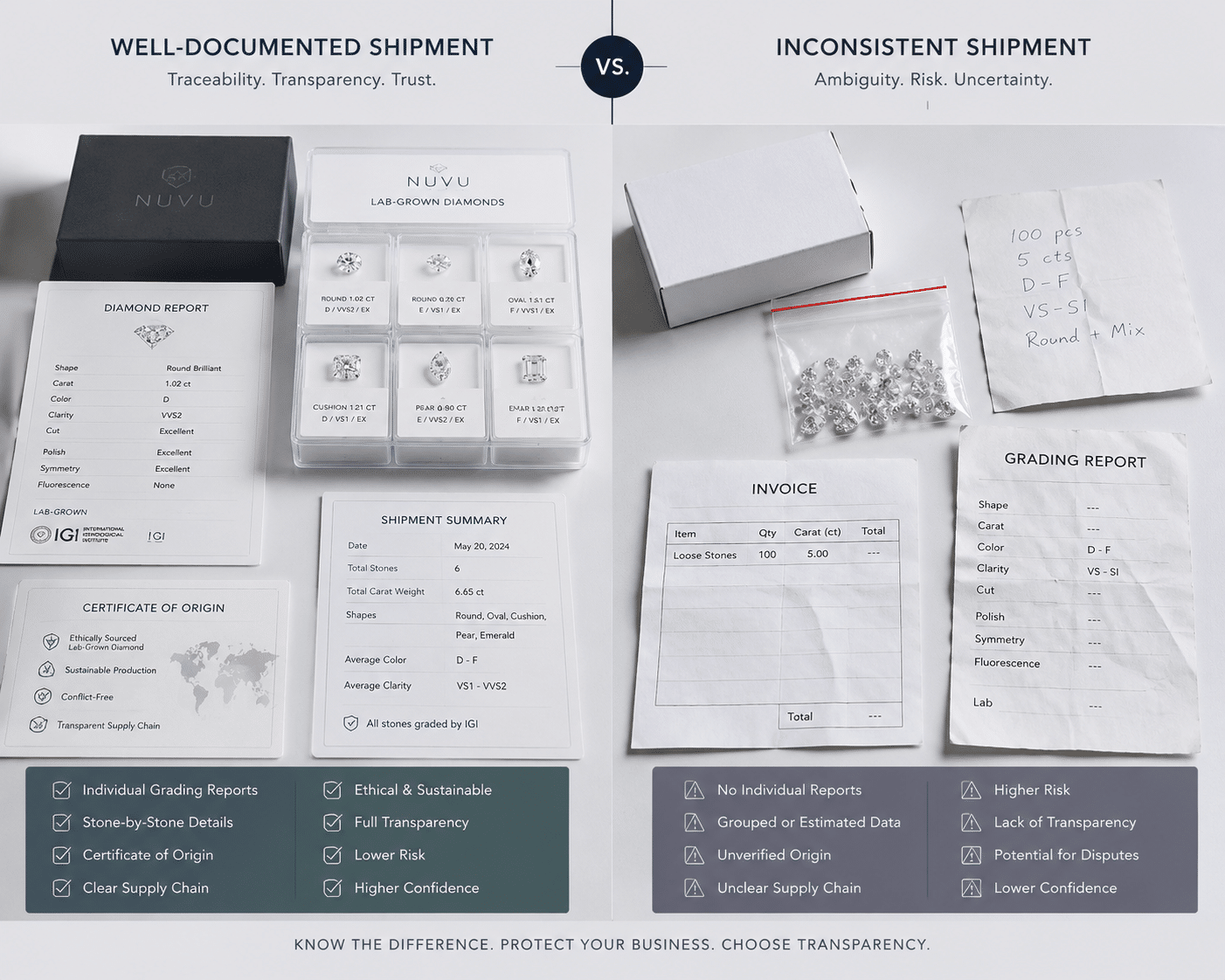
A well-structured invoice should allow a jeweler to reconcile every stone in a shipment without reference to external records. When an invoice lists stones only by total carat weight and a broad grade range — “10 stones, G-H, VS-SI, 12.5 carats total” — it creates ambiguity at every stage of the process. Individual stones cannot be tracked through quality control. Returns become difficult because the specific stone in question cannot be identified. And verifying whether the delivered stones match the quoted grading becomes a matter of trust rather than verification.
This type of vague invoicing is common among suppliers who manage inventory loosely or who work with multiple finishing partners without centralizing their records. It is not always a sign of bad intent, but it is always a sign of weak operational control. The supplier either does not track individual stones, or they prefer not to create a paper trail that could be checked.
Certificate Mismatch Reports Across Batches
When certificates arrive from multiple laboratories across different orders, the differences in measurement standards, cut grade thresholds, and color clarity reporting formats become immediately visible. A stone graded by one lab may carry a color grade that would be one or two levels lower at another. Cut proportions that qualify as “Excellent” at one lab may fall into “Very Good” at a stricter facility.
Some variation between labs is normal. What matters is whether the supplier is managing that variation on behalf of the buyer. A supplier who ships stones with certificates from four different laboratories across two orders, without acknowledging the reporting differences, is not controlling for grade standardization. This does not mean the stones are misgraded. It means the buyer is responsible for reconciling the differences, which defeats the purpose of using a wholesaler.
Absence of Lot or Batch Numbering
Without a unique lot number or batch reference assigned to each shipment, traceability is effectively absent. If a problem is discovered after a stone has been set or sold — a color grade that does not match the setting, a measurement discrepancy, a certificate that does not correspond to the stone — the supplier has no way to identify which production run, which quality control check, or which inventory batch produced the issue.
This becomes most expensive when the problem is discovered weeks or months after delivery. Without batch tracking, the supplier cannot investigate root causes, and the buyer cannot demonstrate that the issue originated from a specific shipment. The cost of replacement, labor, and client dissatisfaction falls entirely on the jeweler.
What This Means in a Real Purchase
Before committing to a repeat order, ask the supplier to provide a sample invoice formatted at the level of detail you expect. It should include individual stone references, corresponding certificate numbers, exact measurements, and lot numbers. If the supplier cannot produce this for a sample document, the operational reality will not improve as volume increases. What you accept in documentation before the order is what you will receive after it.
Practical steps for verifying documentation against actual inventory. The GIA maintains a free report check service that allows buyers to verify the details of a GIA report number online.[1] This tool is particularly useful when a supplier provides a copy of a certificate but the stone has not yet arrived. A buyer can cross-reference the weight, measurements, and proportions before shipment, catching discrepancies early. For stones graded by other major labs such as IGI or GCAL, similar online verification tools are available. Making this verification a routine step before payment—not just after delivery—reduces the odds of importing a stone with a mismatched or inaccurate certificate.
Practical Invoice Verification Steps
A simple two-step invoice check can prevent most document-related problems. First, verify that every stone on the invoice has a unique identifier that matches a certificate number. Second, confirm that the total carat weight reported on the invoice matches the sum of the individual stone weights. If either check fails, ask for a corrected invoice before making payment.
Traceability Gaps in Production Records
Beyond batch numbering, the broader question of traceability in production records can reveal how deeply a supplier controls its own supply chain. A supplier who cannot produce a clear record of when and where specific stones were grown, cut, and graded is operating with limited visibility into its own operations. This is not necessarily a sign of deception, but it means the supplier may be unable to answer specific questions about a stone’s history if a problem arises.
For lab-grown diamonds, production records can include information such as growth method (CVD or HPHT), growth date, and post-growth treatment history. If a supplier cannot provide basic documentation on these points when asked, the buyer may be inheriting traceability gaps that could later become verification problems with end customers. Some buyers also find it useful to ask for information on the geographic origin of the rough material, though this is less standardized in the lab-grown sector than in natural diamond supply chains.
In wholesale conversations, documentation should be seen as a shared responsibility. A buyer who requests specific record-keeping early in the relationship signals that operational clarity matters. A supplier who responds by providing written documentation—rather than vague assurances—has demonstrated a willingness to make the process transparent. This kind of transparency is often a better predictor of long-term reliability than any single pricing or grade advantage. When documentation is clear, laboratory-grown diamonds are properly identified, and grading reports are verified against online tools, the buyer is in a stronger position to evaluate supplier claims before scaling the relationship.
The Operational Language vs. Reality Mismatch
The most reliable leading indicator of future supply problems is not found in certificates or pricing. It is found in the gap between what a supplier promises and what they can actually deliver. This gap tends to emerge early in the relationship, often visible before any order goes wrong. The key is knowing where to look.
Sales Overpromise vs. Operations Underdeliver
A supplier whose sales team consistently promises faster lead times, better grades, or higher availability than the operations team can confirm during production has a structural misalignment. This is not a one-time communication error. It reflects a cultural or process failure in how the business manages customer expectations. The sales team is incentivized to win orders. The operations team is constrained by actual capacity, inventory, and production schedules. When these two functions are not coordinated, the buyer absorbs the gap.
The warning sign is subtle at first. A sales representative quotes four-day lead time, but the production manager later says the order requires eight days. The sales team describes a batch as “G color, eye clean,” but quality control identifies several stones in the parcel as slightly lower. Individually, these incidents seem minor. Patterned across multiple interactions, they reveal a business that prioritizes order capture over order fulfillment.
When specific technical questions arise — about cut quality parameters, certificate verification procedures, or inventory availability — a supplier who cannot or will not provide direct contact with the production manager, quality control lead, or cutting facility is managing information as a buffer. This often indicates that the supplier has limited control over the actual production process and is relaying information through a sales layer that may not fully understand the technical details.
The practical test is simple: ask a question that requires a production-level answer, such as the specific girdle thickness tolerance for a particular shape or the lot number of the stones currently being cut. If the sales representative cannot answer and cannot connect you to someone who can, the supplier’s operational visibility is limited.
Refusal to Provide Pre-Shipment Visuals or Video
For loose lab-grown diamonds, video verification of the actual stones being shipped is a reasonable and low-cost request. Catalog imagery or photos of sample stones are not sufficient. The buyer needs to see the specific stones that will arrive, under consistent lighting, from multiple angles.
A supplier who resists or avoids providing pre-shipment visuals may have inconsistency between what was shown during the selection process and what will be delivered. The refusal itself is more informative than any explanation offered. In a market where video capture is inexpensive and fast, particularly for wholesale lab grown diamonds, the absence of pre-shipment verification is a choice, not a logistical limitation.
Buyer Verification Checklist
Before committing to a repeat order, test the supplier’s communication consistency. Ask a technical question about cut quality, certificate verification, or inventory availability. Then verify the answer by contacting the operations team or production manager directly. If the sales answer and the operations answer differ, or if direct access to operations is denied, you have identified a reliable leading indicator of future problems. The gap between sales and operations is one of the most predictive signals available.
Pricing Instability Without Transparent Reasoning
Price behavior is one of the clearest diagnostic signals for supplier health. Inconsistent or unexplained pricing does not always indicate bad intent, but it always indicates something worth investigating. A reliable wholesaler treats pricing as a reflection of production cost and market position. An unstable wholesaler treats pricing as a negotiation lever, adjusted opportunistically based on who is asking.
Unexplained Price Variance Between Sequential Orders
Reliable wholesalers maintain relatively stable pricing for comparable specifications across short timeframes. Raw material costs fluctuate, and some variation is normal. But an unexplained price increase of more than 15% between orders for the same or similar specifications — without a corresponding change in raw material cost, grade, or specification — is a signal worth examining.
Possible causes include inventory pressure — the supplier is running low on the requested specification and pricing to slow demand — or cash flow concerns that force opportunistic margin management. Neither scenario benefits the buyer. In both cases, the supplier is transferring operational risk to the customer rather than absorbing it internally.
Price Sensitivity to Small Specification Changes
A supplier who prices a 1.5 carat stone at a significantly higher per-carat rate than a 1.4 carat stone — beyond what normal market logic would dictate — may be pricing based on available inventory rather than production cost efficiency. This is not inherently problematic. Inventory-based pricing is common. But it signals that the supplier is not optimizing for consistent partner pricing. The buyer cannot rely on stable pricing across similar specifications, which makes project quoting and margin planning more difficult.
The more important test is whether the supplier can explain the pricing difference clearly. A reasonable explanation based on raw material input costs, cutting yield, or market demand for that specific weight range is a good sign. A vague response or deflection is a warning.
Discount Offered Immediately After a Price Increase
A supplier who raises prices and then quickly offers a “special discount” to match the original price is not offering a discount. They are testing price tolerance. This behavior often indicates that the supplier is price-setting opportunistically — starting high to see if the buyer accepts, then adjusting only when resistance appears.
Over time, this approach erodes trust because the buyer cannot determine the actual price floor. Every negotiation becomes a test of willingness to push back rather than a transparent exchange based on cost reality. Prices can change with market conditions, report type, seller channel, and stone-specific details, so exact comparisons should be verified at the time of purchase. A supplier who can explain price movements in terms of documented cost factors is more trustworthy than one who adjusts prices solely based on who is asking.
What to Check Before You Decide
Request a pricing history or price list for the specific specifications you order regularly, covering at least three months. A good supplier will be able to explain price trends based on raw material cost changes, cutting process improvements, or market demand shifts. Avoid partnering with suppliers who cannot or will not explain pricing beyond “market conditions.” That phrase is almost always a substitute for a real answer.
How to Evaluate a Supplier Before Placing a Repeat Order
The most common mistake jewelers make in wholesale is treating a successful first order as proof of long-term reliability. First orders receive preferential attention. The real supplier profile emerges over time, and the most reliable way to read it is through structured observation rather than gut feel.
The Three-Order Observation Rule
Most supplier patterns — both good and bad — become visible within three order cycles. By the third order, a reliable supplier should demonstrate consistent grading, stable communication, predictable lead times, accurate documentation, and transparent pricing. If these patterns are still unclear or worsening by the third order, the relationship is unlikely to improve with volume. The first order establishes baseline behavior. The second order tests whether that behavior was real or manufactured. The third order confirms the trend. A supplier who performs well across three orders has likely earned the right to scale. One who does not will rarely improve with more business.
Scoring Criteria for Repeat-Order Readiness
A practical scoring framework helps remove emotion from the evaluation. Five categories matter most: grading consistency (weight 25%), documentation accuracy (weight 20%), lead time reliability (weight 20%), communication responsiveness (weight 15%), and pricing transparency (weight 20%). Score each category based on observed behavior across at least two orders. Promises and sales talk should not factor into the score. A supplier scoring below 70 out of 100 across these categories is not ready for a long-term commitment. A score above 85 suggests the relationship can scale with manageable risk.
This scoring approach is most useful when applied consistently across multiple suppliers. A score of 72 from one supplier and 88 from another gives a clearer comparison than relying on general impressions. The numbers also create a documented record that can be revisited if problems arise later, helping distinguish between a supplier who was always marginal and one who drifted over time.
When a grading report is provided, buyers should compare the report details with the issuing laboratory’s verification tools where available. This step helps confirm that the certificate corresponds to the stone in hand, reducing the risk of document-based mismatches before repeat orders are placed. A grading report documents key characteristics, but it should be read alongside visual evidence, measurements, and the intended jewelry use.
When to Test a Smaller Repeat Order Before Scaling
The most dangerous move in wholesale is scaling from a trial order of 10–20 stones directly to 100 stones or more. The jump skips the volume where supplier weaknesses first appear. A safer path is to place one intermediate order of 30–50 stones and evaluate whether grading consistency, documentation quality, and lead time performance hold at the higher volume. If the supplier maintains quality at 50 stones, scaling to 100 is reasonable. If problems emerge at 50, the financial exposure is still contained.
What This Means in a Real Purchase
Before scaling to a long-term wholesale agreement, create a simple internal document for each supplier that tracks order dates, specifications, lead times, certificate consistency, and communication notes. Within three orders, the pattern will be clear. If the pattern includes more than two of the red flags described in this article, rotate suppliers or shortlist alternatives before committing further. A structured evaluation process does not guarantee perfect supplier relationships, but it dramatically reduces the chance of discovering a problem only after it becomes expensive.
Building a Supplier Risk Management Process
Reactive observation is useful, but proactive supplier management is better. Once you have identified a reliable wholesale partner, the next step is to build systems that protect your business from dependency and drift.
In sourcing and wholesale conversations, documentation, consistency, and communication often matter as much as the headline specification. A buyer who establishes clear expectations early—around grading reports, invoice format, lead time, and substitution protocols—creates a shared baseline that both parties can refer back to. This reduces ambiguity and makes performance reviews more objective.
Dual Supplier Strategy for Critical Specifications
For high-volume or frequently ordered specifications, maintaining a secondary supplier relationship provides leverage, reduces dependency risk, and creates a comparison baseline for pricing and service quality. Even if you rarely use the second supplier, knowing you have an alternative changes how negotiations feel and how much risk you carry. This is standard practice in mature wholesale buying organizations but often overlooked by smaller and mid-size jewelers who focus entirely on unit price. The premium you pay for occasional orders from a secondary supplier is effectively an insurance cost against supply disruption.
How to structure a secondary supplier relationship. The FTC has long provided guidance on advertising and disclosure for the jewelry industry, including rules about accurate descriptions of diamond products.[2] Best practices for maintaining secondary sourcing include keeping a separate approved-supplier list, establishing pre-negotiated pricing tiers, and periodically ordering small qualification batches (5–10 stones) to confirm grading consistency and service quality. These small orders are not about immediate need — they are about preserving a documented relationship so the buyer already has a working channel if the primary supplier fails an exit-indicator check.
When evaluating a secondary supplier, the same compliance principles apply. Laboratory-grown diamonds should be clearly identified as such in all documentation. Environmental or sourcing claims should not be accepted at face value — they should be supported by specific documentation from the supplier. A secondary supplier who cannot provide clear origin disclosure, production records, or verified grading reports is not a reliable backup.
Quarterly Supplier Performance Review
Schedule a quarterly review with each active wholesale partner. Evaluate grading consistency, lead time variance, documentation quality, and pricing stability over the past three months. This should not be a casual conversation. Bring your tracking document, compare actual performance against expectations, and discuss any drift before it becomes a pattern. A partner who cannot or will not participate in a structured review is likely not operating with the discipline needed for long-term B2B cooperation. The review also signals that you are paying attention, which tends to improve supplier behavior.
The quarterly review also serves as a documentation point for your own business. If a supplier’s performance drifts and you later decide to switch partners, having a dated record of review conversations strengthens your position. It clarifies whether the issue was discussed and whether corrective action was taken, which matters when managing internal decision-making or explaining a supplier change to clients.
Exit Indicators That Trigger Immediate Action
Some behaviors should trigger immediate re-evaluation, not just observation. These include: unannounced certificate lab switching, substitution without approval, refusal to provide pre-shipment visuals, price increases above 20% without explanation, and two consecutive shipments that fail grading consistency checks. Any one of these indicators is sufficient to pause new orders and request a review conversation. None of these are ambiguous. They are not red flags to monitor — they are signals that the relationship has already shifted.
What to Check Before You Decide
If any of the five exit indicators appear in a current supplier relationship, place new orders on hold. Request a conversation with the supplier’s operations lead — not just the sales representative — to understand the root cause. If the supplier cannot provide a clear, verifiable explanation, rotate to a secondary supplier for at least one order cycle before deciding whether to resume or terminate the relationship. The goal is not to cut suppliers quickly. The goal is to make sure that when you scale a relationship, you are scaling with someone who has proven they can handle the volume, the communication, and the detail work that wholesale demands.
Disclosure: This article is for general educational purposes only. Diamond grading, pricing, availability, specifications, and seller policies can change, and readers should verify important details through grading reports, official laboratory tools, seller documentation, or qualified professionals before making a purchase decision. Laboratory-grown diamonds should be clearly distinguished from natural diamonds, and environmental or sourcing claims should be supported by specific documentation. A grading report helps document key characteristics but should not be treated as a guarantee of beauty, value, or sourcing ethics.
[1] GIA, “GIA Report Check Service,” Gemological Institute of America, accessed 2025. Available at: https://www.gia.edu/gia-report-check.
[2] Federal Trade Commission, “Guides for the Jewelry, Precious Metals, and Pewter Industries,” 16 CFR Part 23, revised 2019. Available at: https://www.ftc.gov/legal-library/browse/rules/guides-jewelry-precious-metals-pewter-industries.