
Buying lab-grown diamonds at the right price hinges on understanding who you are actually dealing with. The industry uses three distinct labels—manufacturer, wholesaler, and supplier—but sellers often use them interchangeably. Without a clear framework for wholesale price list comparisons, this confusion leads to paying factory-direct prices for what is actually a brokered stone, or locking into a minimum order with a manufacturer when a flexible wholesaler would better serve your business. Misreading these roles wastes money and time, yet most first-time buyers assume they are all the same.
For the full framework, read Lab-Grown Diamond Manufacturers in China Guide.
This article clarifies the real operational differences behind each label. It helps you match your order volume, risk tolerance, and timeline to the correct partner type. By the end, you will know which role to approach, which questions to ask before your first order, and how to avoid the common mismatches that sour buying relationships before they begin.
| Role | Best For | Key Risk |
|---|---|---|
| Manufacturer | Large, repeatable orders (100+ stones) with consistent specs | Minimum order requirements, long lead times, prepayment |
| Wholesaler | Mixed orders, smaller volumes, faster access to varied inventory | Higher per-stone markup, no production control |
| Supplier (Broker) | Very small or exploratory orders with no need for transparency | No direct relationship with source, highest price, lowest visibility |
| Factory-Direct Assumption | Only when the factory grows your specific stone | Hidden reselling if the factory does not produce that shape or size |
| Trial Order Strategy | Always the first order with any new partner | Placing large orders before verifying quality and communication |
Quick Questions Before You Read
Q: Is buying factory-direct always cheaper for lab-grown diamonds?
No. Factory-direct saves money only when that factory produces the specific shape, size, and quality you need. Otherwise, they act as a reseller and you lose the price advantage, often paying more than a wholesale price.
Q: What is the main difference between a manufacturer and a wholesaler?
Manufacturers own the production equipment and require large, consistent orders to run efficiently. Wholesalers buy finished stones from multiple sources, offer smaller and mixed orders, and can ship faster, but at a higher per-stone cost.
Q: How can I tell if a “supplier” is really a broker?
Request proof of inventory ownership or direct factory relationships. If the supplier cannot name the production source or refuses a factory visit, they are likely a broker with limited control over quality and price.
Why the Role Labels in Lab-Grown Diamonds Actually Matter for Buyers
Most buyers use the terms supplier, manufacturer, and wholesaler as if they mean the same thing. In practice, each label describes a different type of operation with different capabilities, pricing structures, and service levels. Calling a manufacturer a supplier or treating a wholesaler like a factory seems like a minor language issue, but it creates mismatched expectations from the first conversation. A buyer who expects factory-direct pricing from a company that does not own production equipment will waste time negotiating against the wrong cost structure. A buyer who approaches a manufacturer expecting single-stone flexibility and quick shipping will be frustrated by minimums and lead times. The terms matter because they predict how the other side actually operates, and guessing wrong leads to poor sourcing decisions.
For buyers evaluating a new partner, the practical starting point is not the label they use but the evidence they provide. A manufacturer should be able to describe their growth process and show production capability. A wholesaler should show inventory they hold. If neither is forthcoming, the label alone should not be trusted as a description of what they actually do.
What a Real Manufacturer Does in the Lab-Grown Diamond Industry
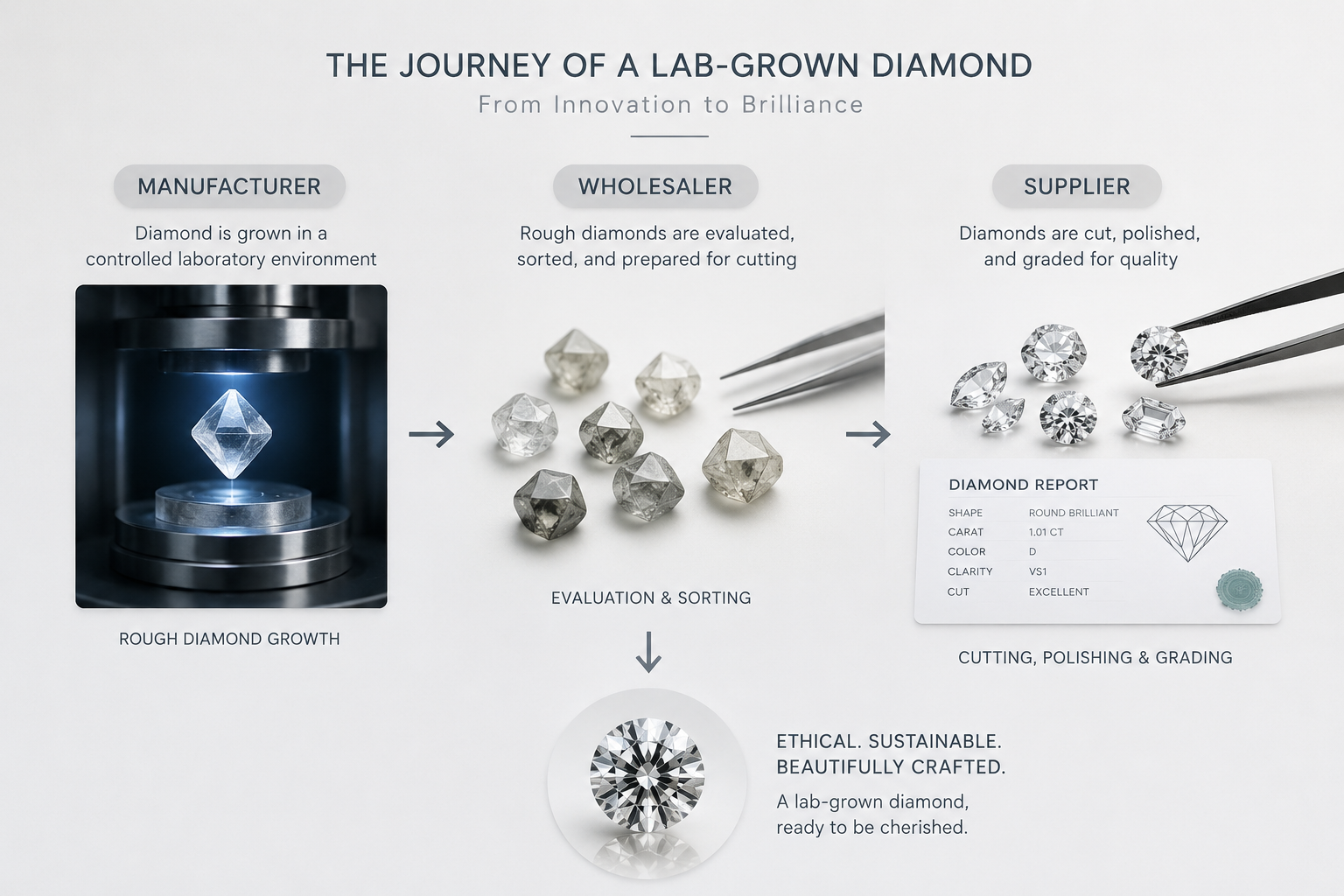
A manufacturer owns the physical production process. They grow the rough diamond using CVD or HPHT methods, then cut and polish the stone into a finished loose diamond. They control the equipment, the growth parameters, and the cutting decisions. That ownership gives them the lowest cost position on the stones they actually produce, but it also creates structural constraints. Most manufacturers operate on batch production cycles. They are set up to grow and cut stones in quantity, not to fulfill single-stone requests efficiently. If you ask a manufacturer for one specific stone with a narrow combination of size, color, and clarity, they may not have it in current production, and a custom growth run for one stone is rarely economical.
The distinction between HPHT and CVD growth methods is worth noting here, as it affects what a manufacturer can realistically produce. HPHT (high pressure, high temperature) and CVD (chemical vapor deposition) are the two primary methods for creating lab-grown diamonds, and each has different implications for equipment cost, growth time, and the typical color and clarity outcomes.[1] A manufacturer who uses only one method may be better suited to certain specifications than another. For example, some HPHT facilities produce stones in a narrow color range, while CVD-grown diamonds may require post-growth treatment to achieve certain color grades. When a buyer asks a manufacturer about their growth method, the answer provides insight into what that factory produces most efficiently and what lies outside their normal capability.
Minimum order quantities are standard. A manufacturer who grows rough in batches of several hundred carats and cuts to a narrow specification range will expect buyers to purchase in volume. They are also less likely to invest time in individual stone photography, detailed grading, or per-stone customer service because their business model depends on throughput, not retail interaction.
What a Wholesaler Does That a Manufacturer Does Not
A wholesaler does not grow or cut diamonds. They buy finished, polished stones from multiple manufacturers in bulk, aggregate the inventory, and resell to retailers, smaller buyers, or jewelry makers. The wholesaler’s value is in selection and speed. A good wholesaler holds stones across a range of sizes, colors, and clarities from several production sources, so a buyer can see options side by side rather than waiting for a single factory to produce the right spec.
Because wholesalers handle stones from different manufacturers, they also perform grading and sorting. They may reject stones that fall below a certain quality threshold or repackage inventory into more useful combinations for their buyers. The tradeoff is that the wholesaler adds a markup on top of the manufacturer’s price, and they do not control the original production process. If a quality issue traces back to the rough or the cutting, the wholesaler can replace the stone but cannot fix the root cause. The buyer gets faster access and more choices but loses visibility into how the diamond was actually grown and finished.
This lack of visibility into the supply chain is why disclosure guidelines from the Federal Trade Commission (FTC) are especially relevant for wholesalers. The FTC has issued guidance on how lab-grown diamonds should be described in advertising and sales, emphasizing that terms like “cultured” or “laboratory-created” must be clear and prominent to avoid misleading buyers.[2] A wholesaler who sources from multiple factories must be able to accurately communicate the origin of each stone to the buyer. If a wholesaler cannot confirm whether a stone is HPHT or CVD grown, or if they use inconsistent terminology, it becomes harder for the buyer to make informed decisions about quality and consistency across orders.
What a Supplier Means in Practice and Why It Is the Most Common Label
Supplier is the broadest label and the most common because it carries no specific commitment. A company calling itself a supplier may be a manufacturer with a direct sales desk, a wholesaler with a warehouse, a broker who sources stones only after receiving an order, or a trader who moves diamonds between other dealers without ever holding physical inventory. The term alone tells you nothing about who grows the diamond, who cuts it, or whether anyone has inspected it before it reaches you.
This ambiguity is what causes the most confusion in buyer expectations. A buyer reads “supplier” and assumes a single company controls the entire process from rough to finished stone. In reality, that supplier may be a one-person operation emailing requests to three different factories and two wholesalers, then forwarding the best quote. The price may be competitive, but the buyer has no direct relationship with the actual producer, no visibility into production consistency, and no guarantee of quality control beyond what the supplier chooses to perform. The supplier label is a starting point for a conversation, not a reliable description of capabilities.
For buyers, the most useful approach is to treat the term “supplier” as a neutral descriptor that requires further investigation. Ask specific questions about inventory ownership, factory relationships, and how quality checks are performed before shipment. The answers will clarify whether the supplier operates more like a manufacturer, a wholesaler, or a broker — and that real operational role is what matters for the buying decision.
How Compliance and Disclosure Requirements Affect All Three Roles
Beyond the operational differences described above, buyers should be aware that all three roles — manufacturer, wholesaler, and supplier — operate under the same regulatory framework when it comes to how lab-grown diamonds are marketed and sold. The FTC’s Jewelry Guides, originally established to prevent deceptive advertising in the diamond and jewelry trade, specifically address the need for clear disclosure when a diamond is laboratory-created.[2] This means that regardless of whether a buyer sources directly from a manufacturer or through a wholesaler, the seller must use unambiguous terms such as “laboratory-grown,” “laboratory-created,” or “[manufacturer name]-created” in advertising and on invoices.
For the buyer, this creates a practical verification opportunity. A manufacturer who understands these disclosure requirements should be able to produce documentation that clearly identifies the stone’s origin and growth method on every invoice and certificate. A wholesaler who sources from multiple factories should be able to do the same for each stone in their inventory. If a supplier is unable or unwilling to provide consistent documentation about the stone’s origin, that is a red flag that may indicate a lack of control over their supply chain. The same FTC guidance also cautions against using terms like “eco-friendly” or “sustainable” without substantiation, so buyers should treat broad environmental claims from any role — manufacturer, wholesaler, or supplier — with appropriate scrutiny unless specific evidence is provided.
The Role of Traceability Documentation in Sourcing Confidence
As the lab-grown diamond market matures, traceability has become an increasingly practical concern for buyers who need to maintain consistent quality across multiple orders. Traceability in this context means the ability to follow a specific stone back to its original growth batch, production run, or manufacturing facility. For a manufacturer, traceability is inherent: stones come from their own reactors and cutting lines. For a wholesaler or supplier who aggregates inventory from multiple sources, traceability requires deliberate internal systems to record which factory produced each stone, when it was grown, and what method was used.
A buyer who can request and receive this information gains an important advantage. If a stone performs well for a specific jewelry design or retail program, traceability allows the buyer to reorder from the same production source rather than hoping the wholesaler happens to source a similar stone again. If a quality issue arises, the documentation helps isolate whether the problem is isolated to one batch or reflects a broader production issue. Conversely, when a supplier cannot provide any production-level documentation — such as batch numbers, growth method records, or factory origin — the buyer is essentially relying on trust alone that the next order will match the first.
For many buyers, the standard to look for is not a full blockchain ledger or a third-party certification of traceability, but rather simple internal consistency. Does the supplier consistently label stones by source? Can they provide a rough-to-polish record, even in summary form? Do their invoices reference the growth method and production batch? A supplier who treats traceability as a routine part of their documentation is operating with a higher level of internal quality control than one who treats such questions as unusual or unnecessary.
When Direct Factory Access Gives You Real Advantages and When It Does Not
The phrase “direct factory” carries strong appeal in lab-grown diamond sourcing. It suggests lower prices, fewer middlemen, and better quality control. For buyers, a structured lab-grown diamond supplier evaluation helps separate real production capability from marketing language before pricing or sample discussions begin. In some cases, that is accurate. In others, the label means less than it seems. The question is not whether factory access is good or bad, but when it actually helps and when it does not.
What Direct Factory Access Actually Means for Pricing in Practice
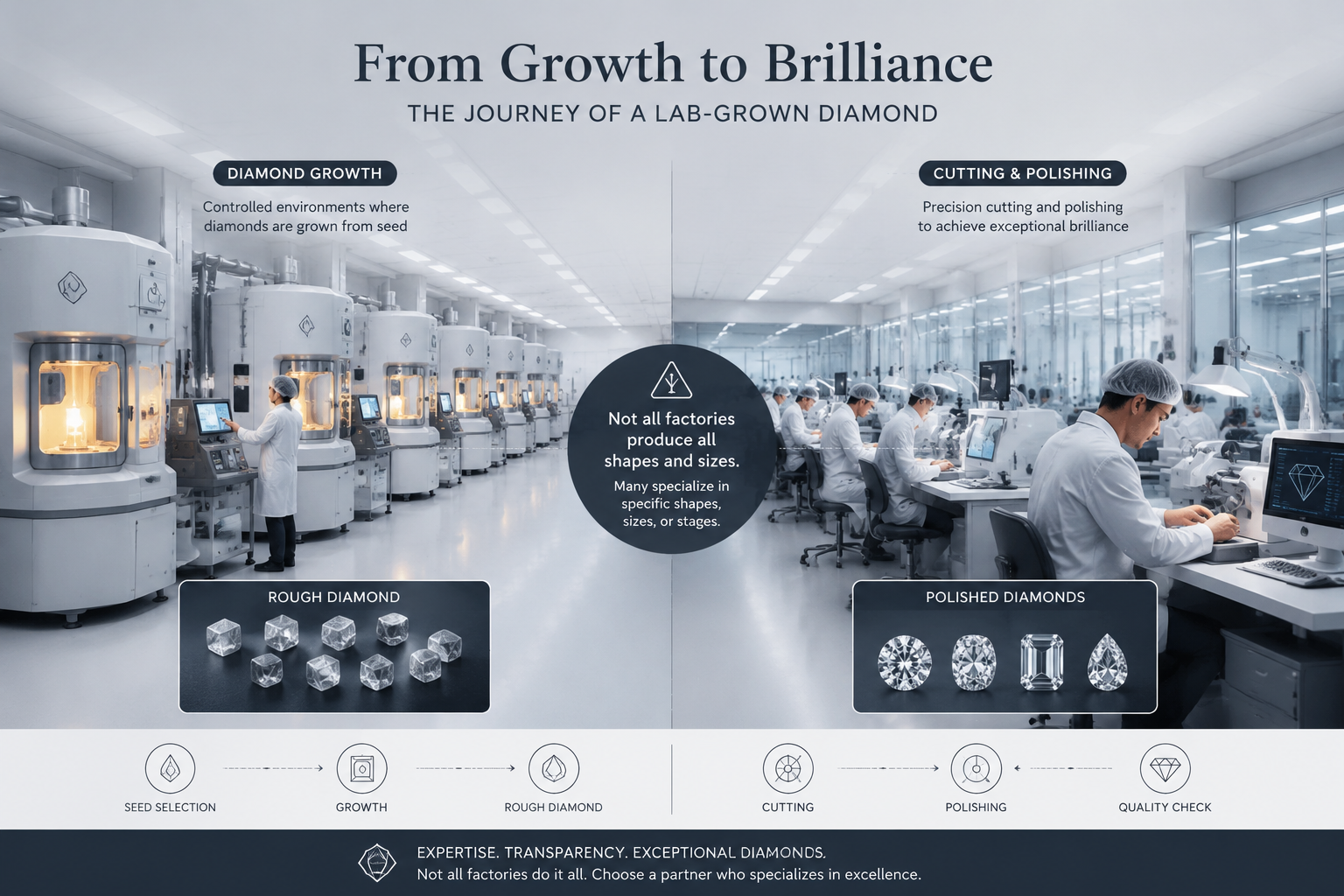
A manufacturer that grows its own rough, cuts and polishes in-house, and sells finished stones directly can price closer to the cost of production than any intermediary. That is the theoretical advantage. In practice, it depends entirely on whether the factory produces the specific stone you need.
Most factories specialize. One facility may focus on rounds in the 0.5 to 1.5 carat range. Another may produce mostly fancy shapes above 2 carats. If your request falls outside their normal production range, they may source the rough or even the finished stone from another facility. At that point, the “direct” advantage disappears, and the pricing may not differ from what a wholesaler would offer.
The savings are real only when your specification matches the factory’s normal production line. For anything outside that, the factory becomes a reseller, and the buyer is paying for the label, not the efficiency.
The Hidden Costs of Dealing Directly That Buyers Rarely Factor In
Direct factory relationships come with structural requirements that do not appear on the price sheet. Minimum order quantities are standard. Many factories require full or significant prepayment before starting production. Lead times are measured in weeks, not days. Communication moves through time zones and often requires a translator or a liaison.
These costs are not hidden in the sense of being undisclosed. They are hidden in the sense that buyers focused on the unit price do not always account for them. A wholesaler who holds fifty to two hundred stones from multiple factories can ship within days, accept partial payment terms, and handle returns or substitutions without disrupting a production cycle. The net cost advantage of the direct factory shrinks considerably once these factors are included.
For a buyer placing a single order, the direct factory price may look lower on paper but cost more in time, risk, and flexibility. The tradeoff is real, and it favors direct relationships only for buyers who can absorb the structural friction.
When a Supplier or Wholesaler Beats Direct Factory Access on Total Value
The scenario where an intermediary delivers better value is more common than most buyers assume. If your order requires mixed specifications, such as different shapes, sizes, or color grades, a manufacturer’s production line is not designed for that. A wholesaler who assembles inventory from multiple sources can fill mixed orders in a single shipment.
If you need fast delivery, a wholesaler shipping from existing stock beats any factory lead time. If you need individual stone inspection or the ability to reject stones without disrupting a larger production batch, a supplier who inspects each stone before shipping provides better quality control than a factory that treats them as part of a standard production lot.
The decision is not about which label sounds more direct. It is about which structure fits the buyer’s actual needs. For many buyers, the small price premium paid to a wholesaler or supplier buys more flexibility, less risk, and faster speed than a direct factory relationship can offer.
Buyer Verification Checklist
Calculate your total cost including communication time, shipping delays, rejection rates, and minimum order commitment. If the direct factory price is 5 to 10 percent lower but requires a 100-stone minimum and full prepayment, that may be a worse value than a wholesale source at a 3 percent higher price with no minimum and partial payment terms.
When a grading report is provided, buyers should compare the report details with the issuing laboratory’s verification tools where available. A grading report can narrow the comparison, but it should be read alongside the stone’s proportions, visual evidence, and intended jewelry use.
How to Evaluate a Supplier, Manufacturer, or Wholesaler Before Committing
Because the labels are not consistently used, the only reliable evaluation method is behavioral. What a company says matters less than what they can show, how fast they respond, and how well they perform on a small order. The following steps work regardless of the label the company uses.
What Documentation to Request Before the First Order
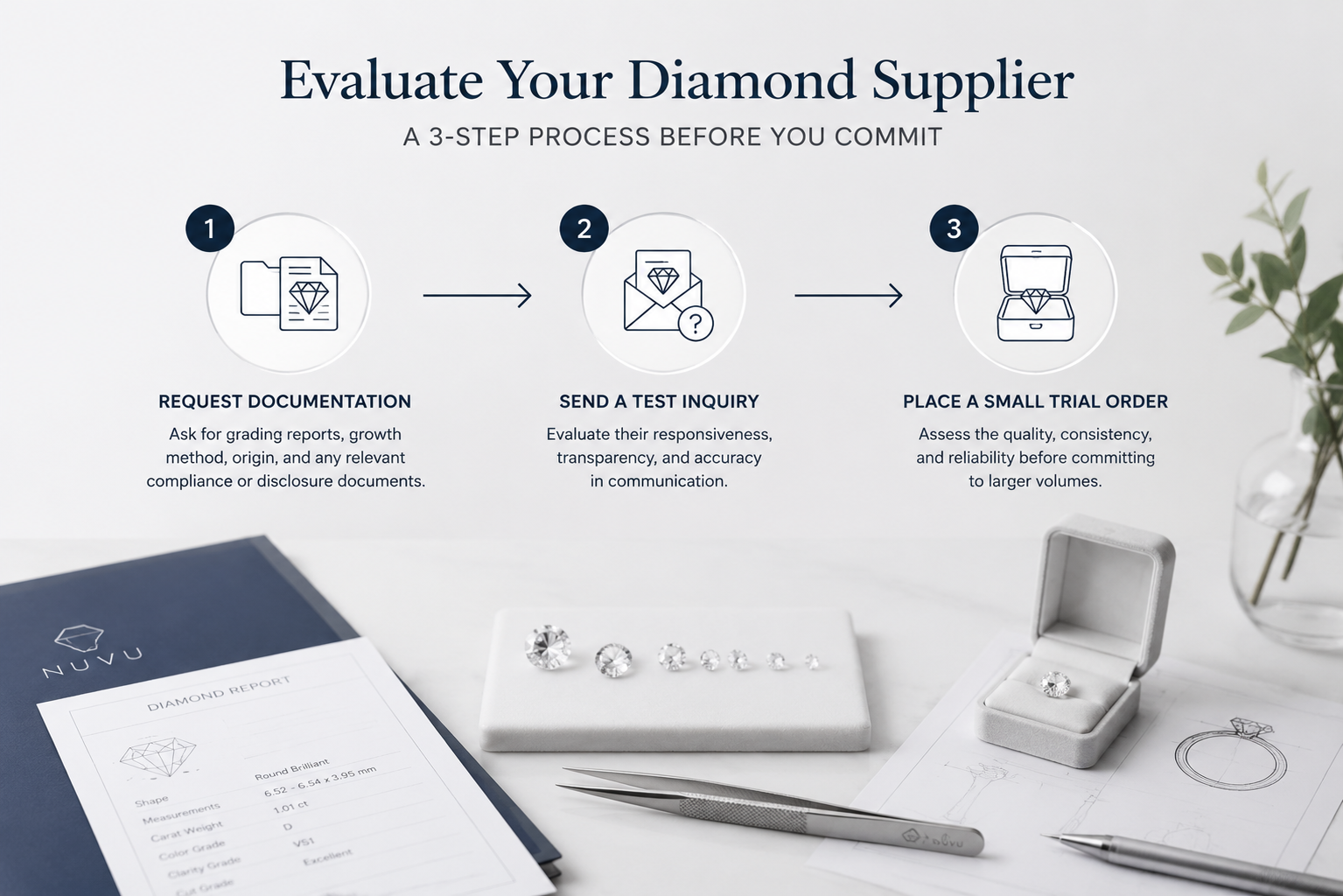
Request a current inventory list with stone-level detail, grading reports from a recognized laboratory such as GIA or IGI, and written confirmation of lead time and payment terms. A manufacturer should be able to provide production batch records or rough origin documentation that shows the stone came from their own growth and cutting operation. A wholesaler should provide inventory availability and grading reports for the specific stones they hold.
If the response is vague, delayed, or includes only marketing language, treat that as a warning signal. The documentation a partner can provide on request is a direct indicator of how organized, transparent, and reliable they actually are.
It is also worth understanding what a grading report actually documents versus what it does not. A report from GIA or IGI will note the stone’s carat weight, color grade, clarity grade, and cut grade (for round brilliants), along with measurements and proportions.[3] What a grading report does not do is evaluate subjective beauty, confirm ethical sourcing claims, or verify that the stone matches marketing descriptions beyond the listed characteristics. Two stones from different sources with identical report grades can appear different in person due to variations in proportions, fluorescence, or internal crystal structure that fall outside the grading scope. A buyer who relies solely on a report number without examining the actual stone or requesting detailed measurements and images may overlook meaningful differences between suppliers.
How to Test Communication Responsiveness and Reliability
Send a test inquiry that includes a specific specification requirement, a realistic order volume, and a request for stone-level pricing with report numbers. A responsive partner gives you specific answers within 24 to 48 hours. A slow or vague partner is a higher risk regardless of their label.
Pay attention to whether they answer your actual question and whether they provide the specific information you asked for. Generic responses, references to a catalog without details, or requests for you to clarify your needs further are signs that the partner is not operating with organized inventory or clear processes.
Why a Small Trial Order Is Worth More Than Any Marketing Claim
No pitch, website, or reference matters as much as the actual experience of placing an order. Make your first order small, even if the unit price is slightly above the quoted bulk rate. Use this order to evaluate diamond quality against the grading report, measurement accuracy, packaging, shipping time, and after-sales communication.
The experience on a small order predicts the experience on a large order. A partner who handles a small order carefully, communicates clearly, and resolves any issues honestly is worth continuing with. A partner who is slow, inaccurate, or indifferent on a small order will not improve when the volume increases.
Buyer Verification Checklist
Make your first order no more than 10 to 15 percent of your expected total volume. Evaluate stone quality against the grading report, measurement accuracy, packaging, and whether the seller responds to quality issues after delivery. Buy the next order based on real experience, not the label or the price promise.
How to Verify Grading Reports Independently
One practical step that applies regardless of whether you are dealing with a manufacturer, wholesaler, or supplier is independent report verification. Major laboratories including GIA and IGI offer online report check tools that allow buyers to confirm that a certificate number corresponds to a valid report issued by that lab.[4] This does not verify that the physical stone in your hand is the same stone described on the report — that requires a physical check — but it does confirm that the report itself is authentic and that the documented characteristics were recorded by the laboratory.
For a buyer working with a new partner, this simple verification step should be part of the standard process before payment and again upon receipt of the goods. If a supplier provides a report number that does not return a match on the lab’s official database, that is a clear warning signal. Even when the report checks out, comparing the stone’s measurements and inclusions against the report using a loupe or a gemscope adds a second layer of verification. A wholesaler or manufacturer who is confident in their inventory will not object to a buyer performing these checks.
Common Buyer Mistakes When Reading Supplier Roles and How to Avoid Them
Misunderstanding role labels is not a minor terminology problem. It directly leads to poor sourcing decisions that cost time, money, and trust. The mistakes below are the most frequent ones, and each is avoidable with straightforward verification.
Mistake One: Assuming Factory Direct Means Best Price Every Time
The assumption that any factory direct source offers the lowest price is false in a significant number of cases. Factory direct pricing, even in a lab grown diamond wholesale guide context, is advantageous only when the factory actually produces the specific stone you need. Many factories outsource rough, subcontract cutting for certain shapes, or have production capacity concentrated in a narrow specification range.
When a factory must source from outside its own production line to fulfill your order, the “direct” pricing advantage disappears, but the buyer still assumes they are getting a better deal. The result is that you may pay a direct factory price for a stone that went through the same supply chain as a wholesale stone, but without the wholesaler’s selection and flexibility. The term “direct” often refers to a commercial relationship rather than a physical production line.
Furthermore, the nuances of growth method and post-growth treatment can complicate direct factory pricing even further. As GIA explains, some lab-grown diamonds, particularly those created via CVD, may undergo high-pressure, high-temperature (HPHT) treatment after growth to improve or alter color.[1] A manufacturer who performs this post-growth treatment in-house may have a different cost structure than one who does not. A buyer asking for a specific color grade from a direct factory should inquire whether post-growth treatment is used, and if so, whether the resulting color is natural to the growth process or achieved through treatment. This distinction can affect both pricing and the stone’s long-term documentation. A factory that is transparent about these details is operating at a higher level of quality control than one that treats them as proprietary information.
Mistake Two: Picking a Wholesaler Without Verifying Inventory Ownership
Some wholesalers operate on a brokerage model. They do not hold inventory and instead source stones after receiving an order. The implication for the buyer is significant. A broker cannot inspect a stone before purchase, cannot reject a stone that does not match the buyer’s expectations, and cannot guarantee availability because they do not control the inventory.
If you need stone-level quality control, confirm that the wholesaler physically holds inventory or inspects every stone before shipping. Ask directly: do you have this stone in your warehouse, or are you sourcing it after I commit? The answer tells you whether you are buying from an inventory holder or a middleman with limited control over quality.
Mistake Three: Treating All Suppliers as Replaceable Commodity Sources
Not all suppliers are the same, even when they offer similar pricing. A supplier who has maintained long-term relationships with specific factories knows those factories’ quality patterns, rejection rates, and production consistency. That knowledge translates into better matching, fewer surprises, and more reliable repeat orders.
A supplier who sources from open market listings or spot purchases has no such institutional knowledge. They may offer a competitive price on this order, but they cannot guarantee the same quality on the next one because they do not know where the next batch will come from. Relationship quality, not price, determines consistency over multiple orders. Buying on price alone in this context is a bet that every batch will be equally good, and the odds are not in your favor.
Buyer Verification Checklist
Before placing a repeat order, ask directly: can you show me the same stone quality from the same production batch as my first order? Can you guarantee consistent grading across multiple orders from the same source? If the answer is vague or conditional, the supplier relationship is not as stable as it appears.
A related mistake is assuming that a grading report alone guarantees consistency across orders. Even when stones carry reports from the same lab, two diamonds with the same assigned grade can look noticeably different under natural light or in different jewelry settings. The report standardizes the grade description, but it does not standardize visual performance. Buyers who rely solely on report grades without comparing actual stones, measurements, or proportions may find that stones from different batches or different sources perform differently, even on paper. For repeat orders, the most reliable approach is to request stone images, videos, or measurements alongside the report, and to compare them directly with the first order before committing to a larger purchase.
A grading report should be verified through the issuing laboratory when report-check tools are available. For custom design, trust comes from matching the stone to the setting, budget, and wearer’s daily use—not from choosing grades in isolation.
Final Decision Framework: Matching the Role to Your Real Buying Situation
Build the Decision by Order Volume, Not by Price or Label
The single most useful filter is your order size and how often those specifications repeat. If you buy single stones or small batches with mixed specs, a flexible supplier or wholesaler who aggregates inventory from multiple sources will almost always serve you better than a manufacturer. The manufacturer is not set up to handle variety efficiently, and the pricing advantage disappears once you factor in minimum order requirements and communication overhead. If your orders are over 50 to 100 stones with consistent size, color, and clarity ranges, a direct manufacturer relationship becomes worth the setup friction. The price difference between roles only makes sense to compare within the same role type. A manufacturer who undercuts another manufacturer is a meaningful price signal. A wholesaler who undercuts a manufacturer is not necessarily offering better value; they may simply be operating a different business model that fits a different buyer situation.
Match the Role to Your Risk Tolerance and Time Horizon
A direct manufacturer relationship works best when you can plan ahead, accept longer lead times, and commit to minimum volumes in exchange for lower per-stone pricing over repeated orders. This is a multi-order relationship, not a one-time transaction. A wholesaler or supplier relationship suits buyers who need faster shipping, lower upfront commitment, and the ability to shift specifications between orders. The cost difference is real, but it is also the price of flexibility. A buyer who has stable demand and can forecast 6 to 12 months out should lean toward a manufacturer. A buyer whose demand fluctuates or who is still testing a market should lean toward a wholesaler or supplier. Choosing a role that does not match your risk tolerance creates friction that no price discount can fix.
Make the First Order a Learning Step, Not a Commitment
The most reliable way to evaluate any partner, regardless of their label, is to place a small order and observe what happens. Check whether the stone quality matches the grading report. Check whether the measurements, proportions, and visual appearance are consistent with what was promised. Check how the seller handles communication during the process and whether they respond to issues after delivery. The role label tells you what to expect in theory. The actual experience tells you whether that expectation holds. A manufacturer who ships sloppy stones on the first order will not ship better stones on the tenth. A wholesaler who ignores grading discrepancies on a small order will not become more thorough when the order size grows. Treat the first order as diagnostic, not decisive.
In sourcing or wholesale conversations, documentation, consistency, and communication often matter as much as the headline specification. A partner who can provide production-linked records from the first interaction is operating at a different level of reliability than one who can only offer a price and a grading report. For NUVU, the goal is to make diamond comparison easier to understand, especially when buyers are weighing report details, visual evidence, setting fit, and budget together.
What This Means in a Real Purchase
Write down your typical order volume, how often your specifications change, what lead time you can accept, and whether you prefer prepayment or partial terms. Compare that profile to the descriptions in this article. If your volume is under 10 stones with mixed specs, a manufacturer is the wrong starting point regardless of the price they quote. If your volume is over 100 stones with repeatable specs, a wholesaler is a higher long-term cost than a direct factory relationship. Match the role to your actual situation, not to the pricing figure that looks best on a quote sheet. The relationship that works is the one that fits how you actually buy, not the one that sounds most impressive in a marketing pitch.
In practice, many buyers benefit from a tiered approach. Start with a flexible wholesaler or supplier for initial orders, while using those transactions to learn more about production consistency and specifications. As demand stabilizes and repeatable patterns emerge, shift toward a manufacturer relationship for the core product lines that make up the bulk of volume. This phased strategy avoids the risks of an early large commitment while still building toward the cost advantages of a direct relationship when the buying situation is ready for it. The labels are useful as starting categories, but the real decision is a process that changes as the buyer’s own operation matures.
Important Considerations for Buyer Due Diligence
Across all the roles discussed in this article, a few key principles remain consistent. Laboratory-grown diamonds should always be clearly identified as laboratory-grown in any transaction documentation, and they should not be presented as mined diamonds. Environmental or sustainability claims made by any partner — manufacturer, wholesaler, or supplier — should be specific and supported by documentation, not treated as general promises about the industry.
A grading report helps document key characteristics such as carat weight, color, and clarity, but it should not be treated as a guarantee of beauty, value, or sourcing ethics. Buyers should verify report details through the issuing laboratory’s verification tools and compare them with the physical stone where possible. Prices can change with market conditions, report type, seller channel, and stone-specific details, so exact comparisons should be verified at the time of purchase rather than assumed from past quotes. For any custom jewelry arrangement, stone measurements and setting compatibility should be confirmed before finalizing a purchase commitment.
[1] GIA, “HPHT and CVD: How Lab-Grown Diamonds Are Made,” Gemological Institute of America, accessed 2025. Source
[2] Federal Trade Commission, “Jewelry, Precious Metals, and Pewter Industries Guides,” 16 CFR Part 23, including guidance on lab-grown diamond terminology and environmental claims, updated 2018. Source
[3] GIA, “Diamond Grading Reports: What They Cover and How to Use Them,” Gemological Institute of America. Source
[4] GIA, “GIA Report Check,” online verification service for GIA-issued grading reports. Source
Disclosure: This article is for general educational purposes only. Diamond grading, pricing, availability, specifications, and seller policies can change, and readers should verify important details through grading reports, official laboratory tools, seller documentation, or qualified professionals before making a purchase decision. Laboratory-grown diamonds should be clearly distinguished from natural diamonds, and environmental or sourcing claims should be supported by specific documentation.