
When evaluating a lab-grown diamond supplier, a large catalog and low prices are often misleading, especially when buyers do not separate supplier manufacturer wholesaler differences from actual production capability and fulfillment control. A big inventory may be repurposed stock or lead-generation images, with no guarantee that a specific stone is available. The cheapest price typically signals inconsistent grading or risk that gets passed to the buyer. These early signals can hide serious issues like certificate substitution, unreliable confirmation, and weak payment protections that surface after the order is placed.
For the full framework, read Lab-Grown Diamond Suppliers and Wholesale Buying Guide.
This article gives you a clear, practical framework to test a supplier before committing. You will learn exactly how to verify grading reports, structure payment terms to limit your risk, and spot the warning signs that indicate a supplier treats inventory as interchangeable. The goal is to help you make a confident, informed decision based on process and trust, not promises.
| Signal | What It Looks Like | Why It Matters |
|---|---|---|
| Large catalog | Thousands of stones listed online | Often aggregated or repurposed images; does not confirm real-time availability of a specific stone. |
| Lowest price | Price significantly below market | May indicate loose lab grading standards or risk of a substitute stone at shipment. |
| Certificate shared before payment | Supplier provides a PDF or lab link before payment | Allows you to independently verify the exact stone details on the lab’s website in minutes. |
| Certificate substitution | Shipped stone does not match the quoted certificate | Breaches trust and signals the supplier treats inventory as interchangeable — a hard stop. |
| Upfront payment demand | 100% payment requested before shipping | Transfers all risk to buyer; indicates supplier lacks confidence or capital. |
| Test order terms | 30-50% deposit, balance after verification | Proves the supplier is willing to share risk and back their product documentation. |
| Vague inventory answers | Unclear about stock location or confirmation process | Often hides a lack of real inventory or reliable logistics. |
Quick Questions Before You Read
Q: Can I trust a supplier with a huge diamond catalog?
Not without testing. A large catalog often repurposes images or aggregates other suppliers’ stock. Always confirm a specific stone is available and real before ordering.
Q: Is the lowest-priced diamond a good deal?
Rarely. The cheapest price usually comes with looser grading or higher substitution risk. The real cost appears when the stone doesn’t match the quoted specs.
Q: How do I know the diamond I order is the one I receive?
Get the certificate number before payment, and verify the stone’s exact carat weight, color, and clarity on the lab’s website. If the supplier refuses or sends only a screenshot, treat that as a warning sign.
Q: What payment terms should I demand for a first order?
Offer a 30-50% deposit with the balance paid after you inspect and verify the diamond. Walk away from any supplier demanding 100% payment upfront.
Why Catalog Size and Low Prices Are Not Reliable Signals
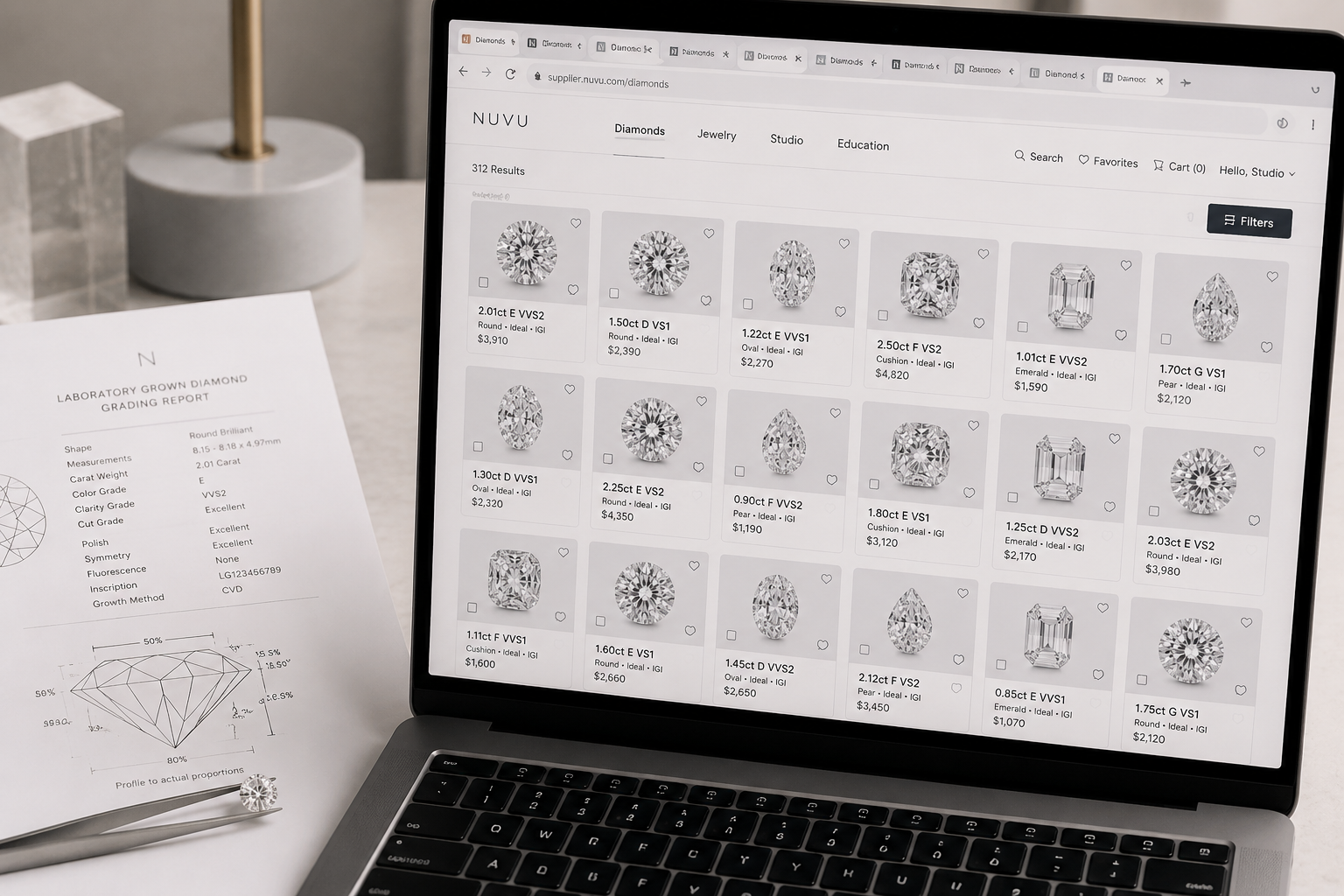
The most common mistake new buyers make is judging a supplier by surface signals: the size of their catalog and the low price of their first offer. Both are easy to manipulate and tell you very little about whether the supplier can actually deliver consistent, matchable stones under reliable terms.
When a Large Catalog Signals a Problem
A supplier listing thousands of diamonds on their website looks impressive. It suggests scale, inventory depth, and buying power. But a large catalog can come from a single photo shoot of a few dozen stones, with images reused across multiple listings. It can also come from an aggregated inventory feed that pulls diamonds from other suppliers, meaning the person you are emailing does not actually hold the stone they are advertising.
The real test is not how many diamonds are listed. It is whether the supplier can confirm a specific stone in real time. When you email them about a particular 1.50ct G VS1 round, do they confirm the stone is physically present, send a video, and verify the certificate number? Or do they reply with a price list and ask you to choose again? A catalog that functions as a shopping interface rather than an actual inventory is not a reliability signal. It is a lead generation tool.
For buyers building a retail or wholesale business, the practical question is not whether the supplier has many stones but whether each stone they show is matchable to a verifiable certificate. A large catalog that cannot support this kind of per-stone confirmation offers little more than distraction from the real evaluation process.
The Real Cost of the Lowest Price
Lab-grown diamonds have become more price-competitive, but the lowest available price is rarely a sign of efficiency. More often, it signals inconsistent grading, looser quality control, or a supplier operating on margins so thin that they cannot absorb any error, which means the buyer assumes all the risk.
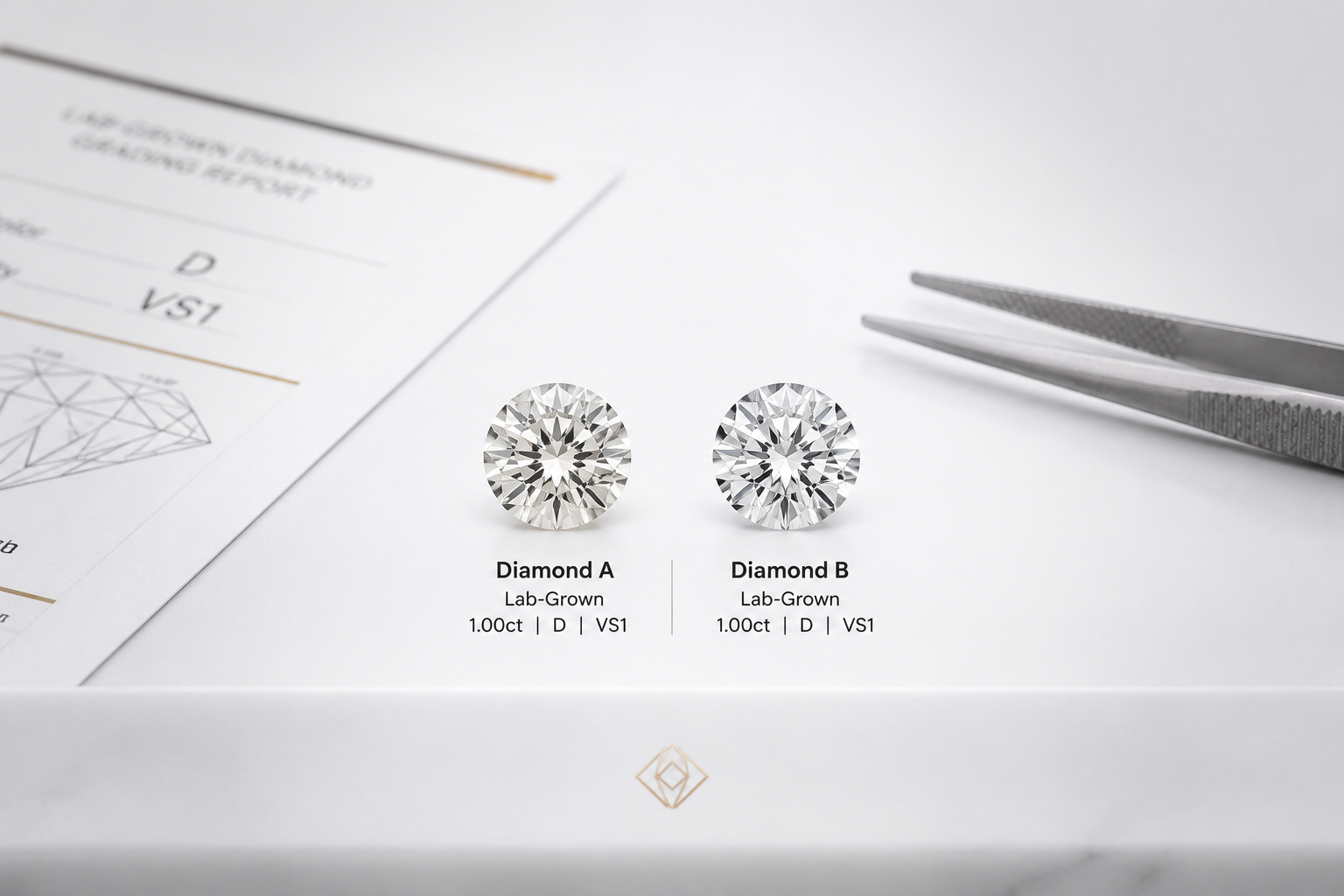
A price that falls well below the median for comparable specs should raise questions, not excitement. The stone may carry a certificate from a lab with looser standards. The color or clarity grade may be borderline within its category. The supplier may be substituting a different stone at shipment, banking on the assumption that most buyers will not verify every detail. A low price is only valuable if the delivered product matches what was quoted. When it does not, whatever you saved on the unit price is quickly lost in return shipping, lost sales, and customer dissatisfaction.
The goal of supplier evaluation is not to find the biggest catalog or the cheapest stone. It is to find a partner whose process matches what you need to run your business. That starts by ignoring what looks good on the surface and focusing on what a supplier can confirm, document, and deliver every time.
Understanding Growth Method Documentation
Beyond catalog size and price, one additional factor that directly affects product consistency is the supplier’s transparency around the diamond growth method. Lab-grown diamonds are produced through two primary processes: High Pressure High Temperature (HPHT) and Chemical Vapor Deposition (CVD). Each method can produce high-quality stones, but the way a supplier documents the growth method on the grading report or in their product descriptions matters for buyers who need to maintain consistent inventory.[1]
GIA explicitly notes that for laboratory-grown diamonds, the growth method, including identification as HPHT or CVD, is included in the identification section of a standard grading report.[2] A responsible supplier should be able to clearly state the growth method for each stone they offer. If a supplier is vague about how their diamonds are produced or cannot provide documentation indicating the method, this may reflect a lack of direct control over their sourcing chain. For a wholesale buyer planning repeat orders, knowing this detail helps ensure that the stones you receive will perform predictably under the same cutting and setting conditions.
Certificate Handling: How a Supplier Manages Grading Reports
A supplier’s approach to grading reports reveals more about their reliability than almost any other single factor. Certificates are the primary documentation a buyer receives, and how a supplier handles them tests both their honesty and their operational discipline. A legitimate supplier has the certificate ready for every stone they offer and can share the number before any payment changes hands. That is the baseline. Anything less requires scrutiny.
The certificate number is the simplest tool you have for verifying what you are being offered. A supplier who provides the number before payment allows you to look up the grading report independently on the issuing laboratory’s website. You can confirm the carat weight, color grade, clarity grade, dimensions, and any comments on the stone without relying on the supplier’s summary. A supplier who hesitates to share a certificate number or offers a “similar stone” with a different number is asking you to trust their description over documented evidence. That is an unnecessary risk that no buyer should accept.
The ideal response to a request for a specific stone is an email containing the certificate number, the dimensions, and a video or photo showing the stone alongside the open report. Anything less indicates either disorganization or a deliberate attempt to limit your ability to verify the stone.
How to Verify a Report Without Relying on the Supplier’s Word
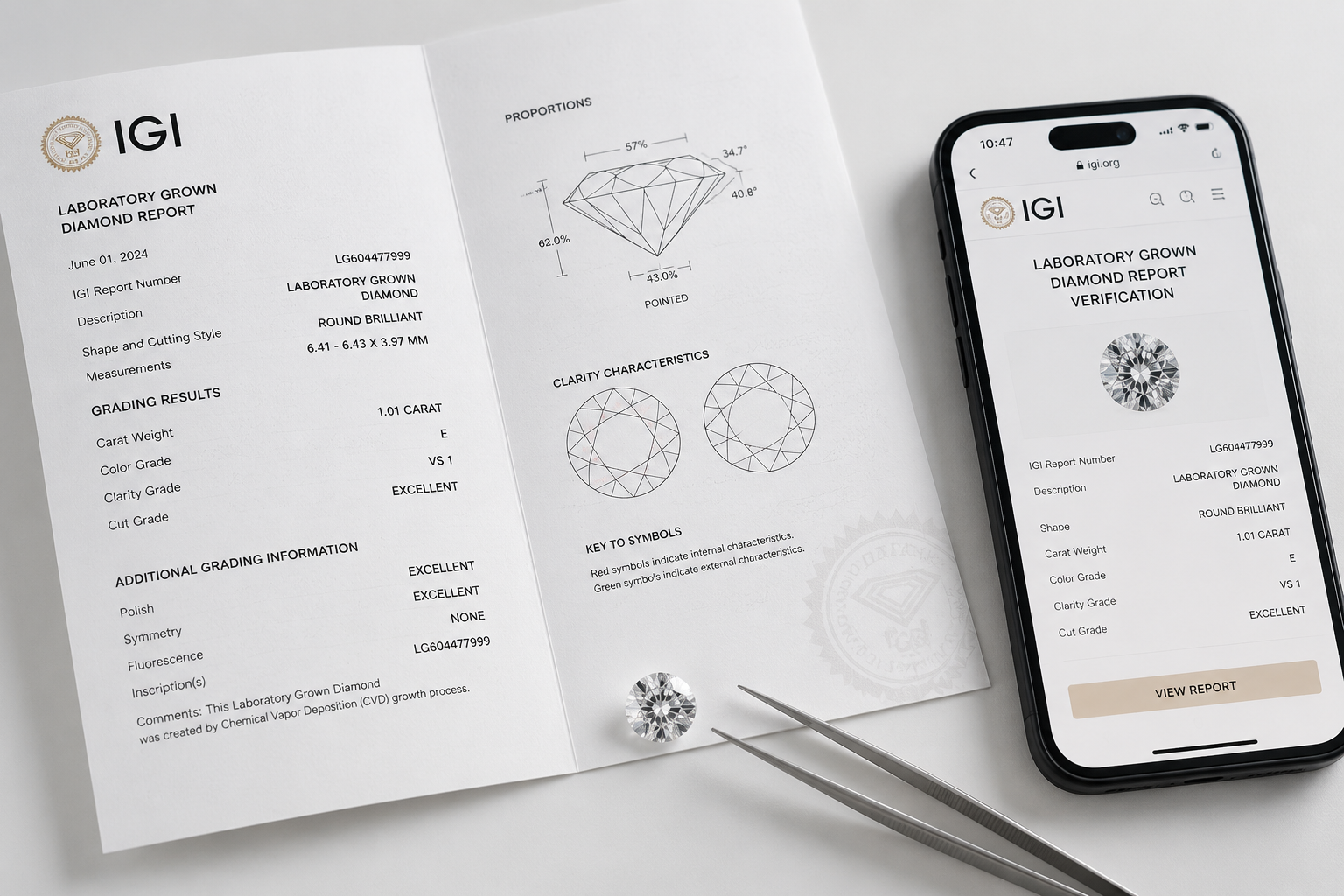
Verification takes less than five minutes. Go to the website of the grading laboratory printed on the report. Every major lab that grades lab-grown diamonds, including IGI and GIA, maintains a public database where you can enter the certificate number and pull up the full report.[3] Compare the report’s data against the supplier’s quote. The carat weight and dimensions should match exactly. The color and clarity grades should be the same. If there are laser inscriptions on the stone, confirm they are recorded on the report.
Be cautious with suppliers who send only screenshots or cropped images of a certificate instead of the certificate number. A screenshot can be edited or taken from a different stone. A PDF of the full report or a direct verification link from the lab’s website is the only reliable format. If the supplier refuses to provide either, consider that a stop signal.
It is also worth noting that a grading report documents a specific stone at a specific point in time, but it does not describe how the stone will appear in a finished setting or under varied lighting. For buyers placing a first order, the report is essential documentation, but it should be complemented by video or direct inspection to confirm visual performance.
What Certificate Substitution Tells You About the Supplier
Certificate substitution occurs when a supplier quotes a specific stone and its report, then ships a different stone with a different report. This happens in two forms. The more obvious version is when the certificate number on the shipped package does not match what was quoted. The more subtle version is when the supplier claims the original stone was “no longer available” and sends a replacement with a new report, sometimes without informing you until the package arrives.
Both scenarios indicate a supplier who treats inventory as interchangeable. For a wholesale buyer considering lab grown diamond wholesale, this is a serious problem. If the substitute stone has weaker dimensions, a less favorable cut grade, or a different fluorescence reading, it may not meet your specifications. At NUVU, we treat certificate substitution as a clear breach of trust. The grading report is the binding document that describes what you are buying. When a supplier treats it casually, they are unlikely to improve on larger orders.
What the Grading Report Includes and Excludes
Understanding what a grading report does and does not cover is essential when comparing supplier quotes. A standard grading report from an established laboratory like GIA or IGI documents the 4Cs — carat weight, color grade, clarity grade, and cut grade (for round brilliant diamonds) — along with measurements, fluorescence, and any identifying inscriptions.[4] The report may also note clarity characteristics by type and location, and it will identify whether the stone is natural or laboratory-grown.[1]
What a report does not provide is an assessment of the stone’s beauty under specific lighting, its performance in a particular setting design, or a price valuation. It also does not guarantee the stone will meet your supplier’s visual quality standards for inclusions that are not marked on the plot. For these reasons, the grading report should be treated as a starting verification tool, not a complete substitute for in-hand inspection or detailed video review. A reliable supplier will acknowledge this distinction and offer supplementary media to support the report data.
Establishing a Traceability Protocol for Your Orders
Beyond verifying a single report, a serious buyer should develop a traceability protocol for every order. This means creating a structured process to document each stone’s certificate number, growth method, dimensions, and supplier lot identifier before payment is made. When the shipment arrives, the first step should be to cross-reference every received stone against this pre-order record, matching certificate numbers exactly.
A practical traceability protocol includes three steps. First, before payment, request and save the certificate numbers and report links for every stone in the order. Second, upon receiving the shipment, open each package and compare the inscribed certificate number on the stone with the number on the report before proceeding further. Third, photograph or video the stones alongside their reports for your own records. This three-step process does not rely on the supplier’s honesty; it relies on your own verification. Suppliers who are comfortable with this level of scrutiny are demonstrating confidence in their inventory consistency. A supplier who resists or tries to shortcut this protocol is raising a signal worth heeding.
Payment Terms and Risk Allocation Before Your First Order
Common Payment Methods and Their Risk Profiles
The method you use to pay your supplier is one of the clearest indicators of how the relationship will go. The most common options are wire transfer, credit card, and escrow services. Each carries a different level of risk.
Wire transfers are the industry standard, especially for international transactions, but they also carry the most risk for the buyer. Once the money leaves your account, reversing the transaction is very difficult. A wire transfer essentially asks you to trust the supplier with the full amount before you have seen the goods.
Credit cards offer more protection, but many suppliers limit their use for first orders because of chargeback risk. Some may accept a credit card payment up to a certain amount, or through a secure payment gateway, which gives you a layer of recourse if the order goes wrong.
Escrow services act as a neutral third party. You deposit the funds, the supplier ships the order, and the money is released once you confirm the goods match the agreement. This structure is fair to both sides, but not every supplier offers it, and the service usually comes with a small fee.
What Payment Term Flexibility Tells You About the Supplier
A supplier who demands 100 percent payment upfront for a first order, with no alternative options, is making a statement. They are transferring all the risk to you. This is not necessarily a sign of dishonesty, but it is a sign that they are unwilling to share the burden of proving their reliability.
A supplier who offers partial payment, such as 50 percent upfront with the balance due upon inspection or after receiving the goods, is showing confidence in their product. They are willing to absorb some risk because they believe you will be satisfied with what you receive.
Payment terms are not fixed rules. They are part of the negotiation. How a supplier responds to a request for modified terms tells you a great deal about their business practices. A willingness to discuss alternatives suggests a partner-oriented approach. A flat refusal without explanation should raise a question.
Negotiating Terms for Your First Transaction
The most practical approach for a first order is to start small and keep terms simple. If a supplier requires full payment upfront, keep the order size low enough that a loss would be manageable. A few stones as a test is different from risking thousands of dollars on an unknown partner.
If the supplier is open to negotiation, propose a structure that aligns incentives. Offer a deposit of 30 to 50 percent, with the balance paid after you have received and verified the stones against their certificate numbers. This is a reasonable request from a serious buyer, and a reliable supplier will understand why.
Once you have completed a small order successfully, you have earned leverage. Future orders can be structured more favorably, with larger deposits for larger quantities or better pricing in exchange for consistent volume. Payment terms should evolve as trust builds. The goal is not to win a negotiation on the first transaction, but to establish a pattern that works for both sides over time.
Before a first order, buyers should confirm the seller’s payment terms, return policy, and inspection process in writing. A clear agreement on what happens if the stone does not match the quoted report is more valuable than any implied guarantee.
Warning Signs That Should End the Evaluation Immediately
Some behaviors from a supplier are not worth working around. When you encounter any of the following, the correct response is to stop the evaluation and move on. No single stone or price is worth the risk of a business relationship that starts with these signals.
A supplier who will not provide the certificate number for a specific stone before payment is asking you to buy blind. A grading report number can be verified online in minutes. If the supplier refuses to share it, or sends a sample report instead of the exact one for the stone you requested, the stone may not exist, may not match the quoted specifications, or may not have a verifiable report. There is no legitimate reason to withhold this information from a buyer who has shown serious intent.
Inconsistent Disclosure Language
The Federal Trade Commission (FTC) has provided guidance specifically on how lab-grown diamonds should be described in advertising and sales materials. The FTC advises that marketers must clearly and conspicuously disclose that a diamond is laboratory-grown if that is the case, and that terms like “cultured” or “lab-created” should be used carefully to avoid misleading consumers.[5] A supplier’s own product descriptions and communication language are early signals of their compliance posture. If a supplier’s website or correspondence uses ambiguous terms like “synthetic” without clear identification as lab-grown, or if they avoid using disclosure language altogether, this is a red flag. A supplier that treats disclosure casually in their own materials is more likely to create documentation and compliance issues that could eventually reach your customers.
Price Inconsistency Without a Clear Reason
If a supplier quotes one price for a stone and then changes the price in a follow-up email without explaining why, the pricing is not reliable. This can happen when the supplier does not actually hold the stone and is sourcing it from another party. A price that shifts by 20 percent between two conversations on the same day is a signal that the operation is not built around inventory accuracy. If the price cannot stay stable during a conversation, it will not stay stable during an order.
Pressure to Skip a Sample Order or Pay in Full Upfront
A supplier who discourages a sample order is either confident you will find problems, or unwilling to support the transparency that a small test provides. Similarly, pressure to pay 100 percent upfront for a large first order, especially when you have requested more balanced terms, is a significant risk. Legitimate suppliers understand why new buyers want to start small. Resistance to this request is a sign that the supplier is prioritizing their own convenience over building trust.
Vague or Contradictory Answers About Inventory
When you ask for a specific stone and the supplier replies with a general price list or asks you to pick from a different set of options, the inventory may not be what it appears. A supplier who cannot confirm whether a specific certificate number is available, or who gives different availability answers in back-to-back messages, is operating without a clear view of their own stock. This leads to delays, substitutions, and miscommunication once an order is placed.
Buyer Verification Checklist
If any of the following occur, stop the evaluation and look for another supplier:
– Certificate number is withheld or substituted with a generic sample.
– Price for the same stone changes between conversations without explanation.
A supplier that pushes for 100 percent upfront payment on a large first order should be evaluated against a lab grown diamond suppliers framework, including verified company credentials, quality control records, certifications, export experience, and custom design support before any wholesale commitment is made.
– Supplier actively discourages placing a small sample order.
– Responses about specific stone availability are vague or contradictory.
– Supplier uses unclear disclosure language for lab-grown diamonds or avoids the term entirely.
Understanding the Limits of Certificate Traceability
While a grading report is the most important documentation for verifying a specific stone, it is worth understanding the practical limits of certificate traceability. The report number confirms that a stone with those documented characteristics was graded by a specific laboratory at a specific date, but it does not, on its own, connect that stone to a specific supply chain or batch. For wholesale buyers who need to maintain consistency across multiple orders, the certificate is a starting point for traceability, not its completion.
Buyers who require additional traceability should ask the supplier whether they maintain internal lot numbers or batch records that link a certificate back to a specific production run or inventory arrival. Not all suppliers will have or share this information, but asking the question reveals how seriously the supplier takes inventory management. A supplier who can connect a certificate number to an internal record of when the stone was purchased, from which source, and with which associated documentation is demonstrating a level of operational discipline that supports reliable, repeatable orders.
Communication Quality: Testing Responsiveness and Clarity
Before placing an order, the quality of a supplier’s communication is one of the few things you can observe directly. How quickly they reply, how clearly they answer your questions, and whether they provide the specific information you request are all signals of their operational discipline.
A supplier who gives short, vague, or incomplete answers to straightforward questions during the evaluation phase is unlikely to improve once an order is in progress. If a supplier cannot clearly explain their confirmation process for a single stone, they are unlikely to manage a multi-stone order with accurate documentation. Communication quality is a leading indicator of reliability.
It is useful to test responsiveness under different conditions. Send a request on a weekday afternoon, then another late in the evening or on a weekend. A supplier who replies consistently across different times and days likely has a structured process. One who disappears for days without explanation may have a thin team or unreliable staffing. For a buyer who needs consistent supply, this difference matters.
Also pay attention to how the supplier handles questions about your specific business model. A supplier who asks about your typical order sizes, preferred shapes, or retail price points is showing interest in a long-term fit, not just a single transaction. A supplier who never asks about your needs and only sends generic price lists is treating you like any other lead, not a potential partner.
Testing the Supplier’s Knowledge of Your Market
A further dimension of communication quality is whether the supplier demonstrates awareness of your target market and its requirements. If you are sourcing stones for an engagement ring buyer, the supplier should understand the importance of cut precision and color consistency more than if you are sourcing for fashion pieces. A supplier who asks direct questions about your typical customer profile — such as preferred carat ranges, budget thresholds, or common setting types — is taking the time to align their offers with your actual needs. This level of engagement is a stronger sign of a potential long-term partner than any catalog size.
Verification of Documentation Formats and Data Consistency
An often-overlooked dimension of communication quality is the supplier’s ability to provide documentation in a consistent, machine-readable format. A supplier who sends grading reports as clear PDFs with legible certificate numbers, rather than as low-resolution images or screenshots with cropped edges, is demonstrating respect for the buyer’s verification process. Likewise, a supplier whose pricing sheets use consistent naming conventions — for example, always listing shape, carat weight, color, clarity, and certificate number in the same order — is saving you time and reducing the chance of misreading a spec.
For buyers managing multiple suppliers, this consistency in documentation format directly affects operational efficiency. A supplier whose data is easy to compare, sort, and verify against the issuing laboratory’s records is a supplier whose process supports your business. Small differences in how data is presented during the evaluation phase often predict how well the supplier will handle order accuracy at scale.
Building a Long-Term Supplier Relationship After the First Order
A successful first order is not the end of the evaluation. It is the beginning of a working relationship that should become more efficient and more reliable over time.
Communicating Your Consistent Specifications
The best supplier relationships are built on clarity about what you actually need. If your store consistently sells stones in the G-H color range and VS2-SI1 clarity, tell the supplier. If you favor certain shapes or cut tolerances, share that preference. A supplier who pays attention will begin to anticipate your needs, sending relevant inventory before you ask. This only happens if you communicate your parameters clearly and consistently. A supplier who repeatedly sends offers that miss your range is either not listening or not suitable as a long-term partner.
Gradually Increasing Order Size and Complexity
Once you have verified that the first order arrived as described, with correct certificates and matching quality, you can expand. Increase order size gradually, not in a single leap. A second order of five to ten stones is reasonable. A third order can go larger. Scaling this way gives the supplier time to demonstrate consistency across multiple batches. It also gives you a track record to reference if any issue arises later.
When to Re-Evaluate a Long-Term Supplier
Even a good supplier can drift over time. If response times slow down, if certificate accuracy drops, or if the quality of the stones you receive begins to vary from earlier orders, it is time to re-evaluate. Re-evaluation does not mean an automatic breakup. It means going back to the same test inquiry structure you used before the first order. Ask specific questions, request videos, verify certificates, and compare the response quality to what you received months earlier. A supplier who has become complacent will show it in the same patterns that helped you identify a good one in the beginning.
Keeping Documentation Aligned as You Scale
As your order volume grows, maintaining information discipline becomes more important. Each order should come with matching grading reports that you can cross-reference against your initial verification. You should also keep a simple record of preferred supplier specifications — shapes, color and clarity ranges, acceptable cut parameters, and typical growth methods — so that when you order from multiple sources, the documentation is easy to reconcile. A supplier who continues to offer clear, matchable documentation as order sizes increase is demonstrating the operational consistency that supports a durable business relationship.
The Role of Communication in Traceability Across Repeat Orders
Traceability is not only a first-order concern. It becomes more important as your order volume grows and you begin to rely on a supplier’s consistency across multiple batches. A good practice for repeat orders is to request a packing list that matches each stone’s certificate number to a line item on the invoice. This simple document makes it possible to reconcile an entire shipment in minutes, rather than opening and inspecting every package before verifying the contents.
A supplier who routinely provides this level of documentation is demonstrating that their internal processes support traceability. A supplier who resists this request or provides incomplete packing lists may not have the internal systems needed to maintain accuracy across larger orders. For wholesale buyers, this difference in documentation discipline often determines whether scaling a supplier relationship leads to smoother operations or to recurring verification headaches.
Disclosure: This article is for general educational purposes only. Diamond grading, pricing, availability, specifications, and seller policies can change, and readers should verify important details through grading reports, official laboratory tools, seller documentation, or qualified professionals before making a purchase decision. Laboratory-grown diamonds should be clearly distinguished from natural diamonds, and environmental or sourcing claims should be supported by specific documentation.
[1] GIA, “How Lab-Grown Diamonds are Made,” Gemological Institute of America, accessed 2025.
[2] GIA, “Lab-Grown Diamond Reports,” Gemological Institute of America, accessed 2025.
[3] GIA, “Report Check,” Gemological Institute of America, accessed 2025.
[4] GIA, “GIA Diamond Grading Reports,” Gemological Institute of America, accessed 2025.
[5] Federal Trade Commission, “Guides for the Jewelry, Precious Metals, and Pewter Industries,” 16 CFR Part 23, as updated, accessed 2025.