
For small jewelry brands, buying lab-grown diamonds wholesale is a strategic minefield. The promise of a volume discount can quickly backfire, making lab-grown diamond supplier evaluation essential before capital is committed to stones that don’t move, forcing you to miss opportunities in design, marketing, and cash flow. The real challenge isn’t finding a supplier—it’s learning how to buy without overbuying.
For the full framework, read Wholesale Lab-Grown Diamonds for Jewelers and Brands.
This article helps you navigate that challenge. It moves past generic advice to focus on practical, budget-protecting strategies: negotiating better terms on small test orders, using the 80/20 rule to stock versatile inventory first, and knowing exactly when and how to reorder based on proven sell-through data. The goal is to help you build a wholesale relationship that preserves flexibility and scales with real demand, not one that fills your shelves with dead stock.
| Decision Point | Common Trap | Smarter Approach |
|---|---|---|
| First order size | Ordering 50+ stones for a 15% discount, but tying up capital | Negotiate a small test batch (e.g., 5–10 stones) with an MOQ waiver |
| Stone selection | Buying unique shapes that don’t match your current collection | Apply the 80/20 rule: 80% versatile rounds, 20% specialty on demand |
| Quality check | Relying solely on a certificate without inspecting the stone | Use a loupe, light box, and macro lens to verify depth, table, and color |
| Reordering trigger | Reordering based on intuition or a calendar reminder | Wait until roughly 60% of a test batch sells through |
| Reorder quantity | Reordering the same small quantity as the test batch | Scale up to 2–3 times the quantity of your proven bestseller |
| Supplier relationship | Treating every order as an isolated transaction | Use a successful reorder to shift to a partnership with better terms |
Quick Questions Before You Read
Q: Why is “overbuying” such a risk for small brands?
Tied-up capital in unsold stones prevents you from investing in responsive inventory, marketing, or new designs—effectively starving your business’s most critical growth levers.
Q: Should I always buy the most popular shape (round brilliant) first?
Yes, as a rule of thumb. Reserve specialty shapes like pears or cushions only for confirmed customer orders or pieces already in your design pipeline to avoid dead stock.
Q: How do I know when it’s time to place a bigger order?
When roughly 60% of a small test batch sells, it’s a strong signal. Then, scale up by 2–3 times the quantity of your best-selling stone shape to concentrate budget on proven demand.
Q: Is a certificate alone enough to guarantee quality for my setting?
No. A certificate gives a grade, but visual and dimensional checks (depth, table, color consistency) are essential before setting, as minor flaws invisible to a grader can ruin a custom piece.
The Overbuying Trap: Why Small Brands Lose Money Before They Even Start
A small jewelry brand finds a wholesale supplier offering a solid price for a 40-stone batch. The discount per stone is meaningful. The brand owner places the order, anticipating steady sales across their upcoming collection. Eight months later, 28 of those stones are still sitting in a drawer.
This is not an unusual outcome. It is the most common financial mistake small brands make when they start buying wholesale lab-grown diamonds. The logic that works for large retailers—buy in volume to lower unit cost—breaks down completely when applied to a brand that sells in small quantities across varied designs.
The Cash Flow Trap: Why Volume Discounts Aren’t Always a Deal
The math on volume buying looks simple at first glance. A 50-stone order at a 15 percent discount saves several hundred dollars compared to buying smaller batches. But that calculation only works if all 50 stones sell within a reasonable time frame. When they do not, the discount becomes irrelevant.
Consider what happens when 15 stones from a 50-stone order sit unsold for seven months. The capital tied up in those stones could have been used to buy fresh inventory that actually matches customer demand, fund marketing for existing pieces, or simply stay liquid through a slow season. The carrying cost of slow-moving inventory—the cash that is locked in stones you cannot use—often exceeds the per-stone markup you saved by ordering in bulk.
For a small brand with limited cash flow, a single overbuying mistake can delay growth for months. The discount that looked like profit becomes a drag on every other decision.
For buyers, the practical point is that volume pricing and total cost of inventory are not the same number. A per-stone discount matters only if the inventory turns over. The more relevant question for a small brand is not “How much can I save per stone?” but “How quickly can I convert this batch into finished pieces and revenue?”
Design Fit vs. Stockpiling: The Stone That Doesn’t Sell
A separate but equally dangerous risk is buying stones that do not match your actual design needs. A supplier offers a good price on a batch of cushion cuts in a specific ratio. The price is attractive. You buy them. Then you realize your current collection is built around elongated shapes and that the cushion ratio does not work with your standard setting designs.
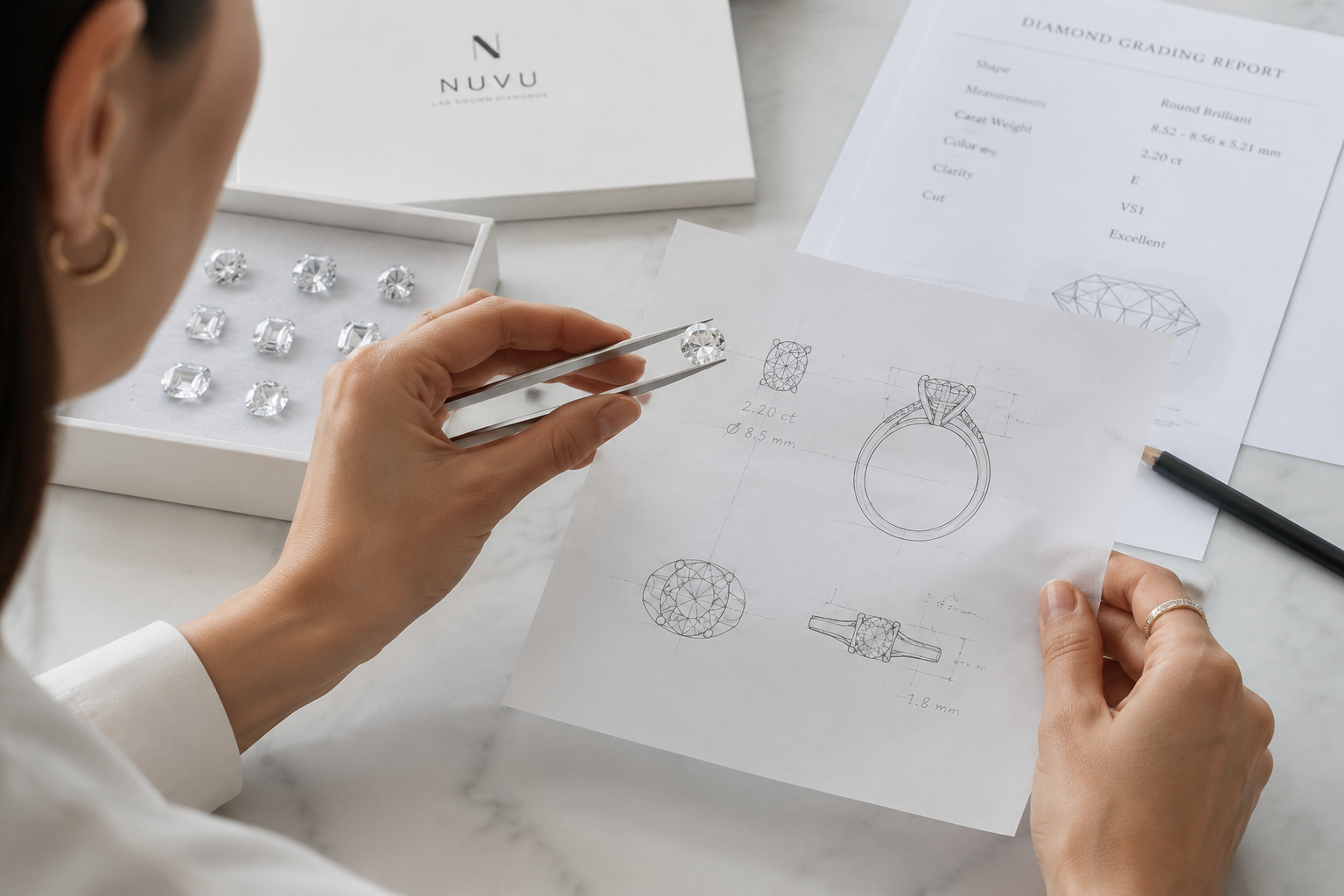
Stone selection and design planning must happen together. A stone that cannot be easily integrated into your current or planned collection is not inventory. It is dead stock at full cost. The most common version of this mistake is buying a single shape and size in quantity because the price is right, only to find that only a fraction of those stones fit the brand’s actual design language.
The better approach is not to avoid wholesale buying. It is to order in a way that preserves both capital and flexibility. The following sections walk through a practical method for doing exactly that.
Negotiating Flexibility: Small MOQ, Consignment, and Partial Shipments
Most wholesale suppliers advertise minimum order quantities that assume a certain scale. A 30-stone or 50-stone MOQ might be routine for a mid-size retailer, but for a brand placing its first wholesale order, that number can feel like gambling on untested product. The good news is that listed MOQs are often negotiable, especially with suppliers who are evaluating new buyer relationships.
The key is understanding how to ask.
Why “Small but Growing” is a Strong Negotiating Position
A supplier who sees potential in a long-term relationship is more likely to accommodate a smaller first order than one who treats every buyer as a one-off transaction. When you approach a supplier as a new brand with a specific design direction and a plan to scale, you signal that this test order is the beginning of something larger, not a single purchase.
Most suppliers would rather start with a small, successful partnership than push a buyer away with a rigid MOQ and lose future business entirely. The negotiating leverage here is not about volume. It is about demonstrated intent. If you can show that you understand your product range, know what stones you need, and have a realistic timeline for growth, many suppliers will meet you partway.
How to Phrase Your First Order Request to a Supplier
Instead of asking for a lower MOQ outright, frame the request around testing product fit and building a reliable workflow. A reasonable opening might sound like this:
“I am launching a small collection with three design silhouettes. I would like to start with 10–12 stones across two color brackets to verify cut consistency and setting compatibility before committing to a larger production run. Can we structure the first order as a smaller test batch, with the understanding that reorders will follow at full MOQ once the designs are confirmed?”
This approach does a few things. It gives the supplier a concrete reason for the smaller order. It promises future volume without overcommitting. And it treats the negotiation as a business alignment, not a demand.
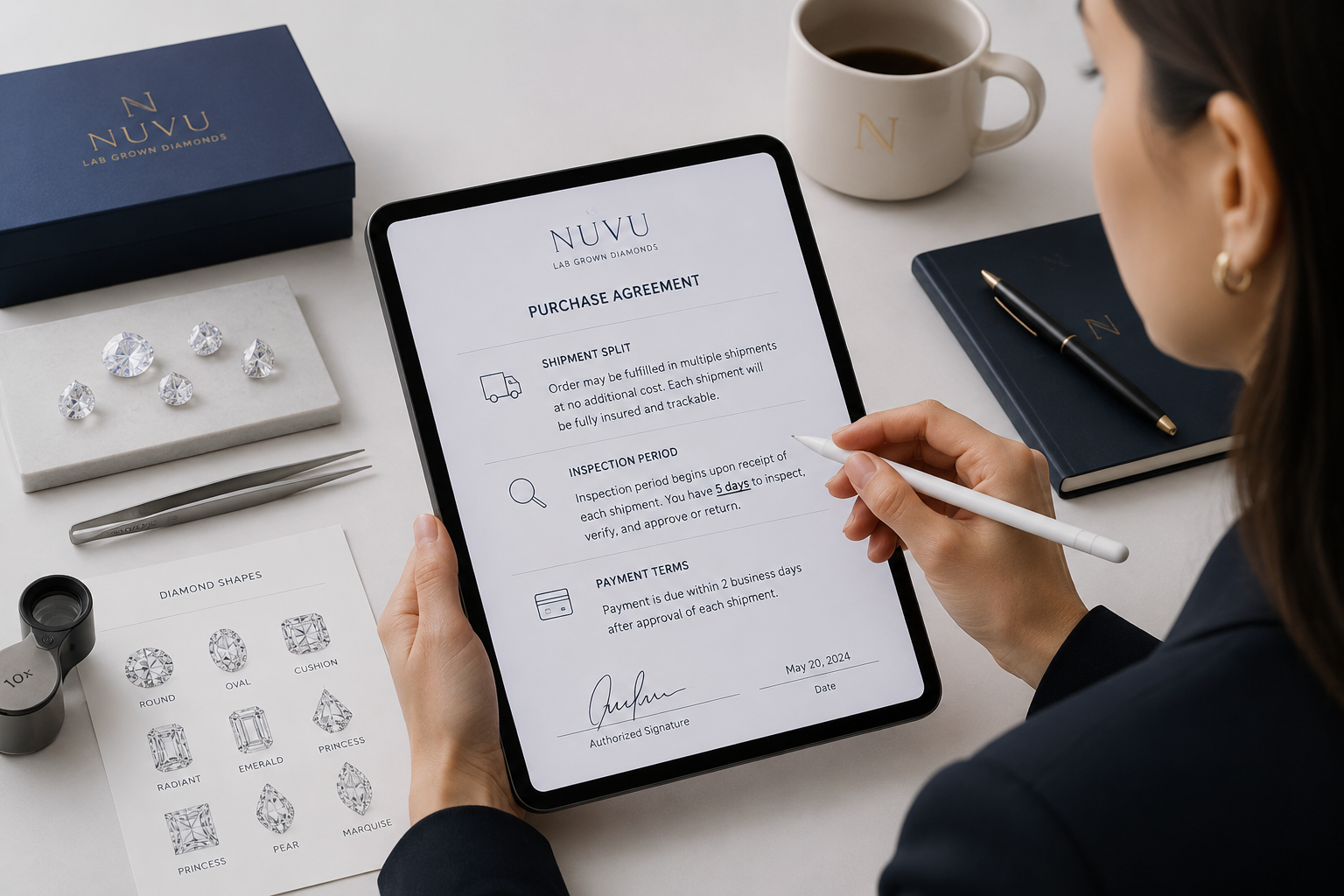
Some suppliers may still hold to a minimum. But many will offer alternatives: splitting a 30-stone MOQ into three shipments over 60 days, offering a sample-set option at a slightly higher per-stone price, or placing a few stones on consignment so you only pay for what sells. A partial shipment agreement allows you to test a subset of stones before the full order ships, reducing the financial risk of a batch that does not meet your design needs.
Consignment is rarer in wholesale, but some suppliers consider it for small brands with a strong buyer profile. If consignment is not available, a partial shipment with staggered payment terms can achieve a similar effect, especially when framed within a lab grown diamond wholesale inquiry that clarifies order scope, supplier expectations, and verification steps, while preserving lower upfront cash and a chance to verify quality before the full order is finalized.
Not every supplier will agree to flexible terms, but many will if you present yourself as organized, serious, and worth the accommodation. The goal is not to get the best price on a test order. It is to establish a working relationship that allows you to grow into larger orders on your own timeline, with confidence that the stones will actually sell.
Building a Product-Range Buying Plan: Stones That Fit Multiple Designs
A common mistake in early wholesale buying is selecting stones that are too specific for one design. A marquise with a 2.0 length-to-width ratio or a cushion with an exact 1.45 ratio may be perfect for a single setting, but if that design does not sell, the stone sits in inventory with no backup use. For a small brand with limited capital, every unsold stone reduces the flexibility to reorder what actually moves.
The smarter approach is to prioritize versatile inventory first, then add specialty shapes as your sales data tells you what works.
The 80/20 Rule for Wholesale Inventory: Versatile First, Specialty Second
Think of your first inventory batch as divided into two categories. The first category, roughly 80 percent of your stones, should be design-neutral: shapes and qualities that can serve multiple designs without modification. The second category, the remaining 20 percent, can be reserved for specific, planned settings where you have high confidence in demand.
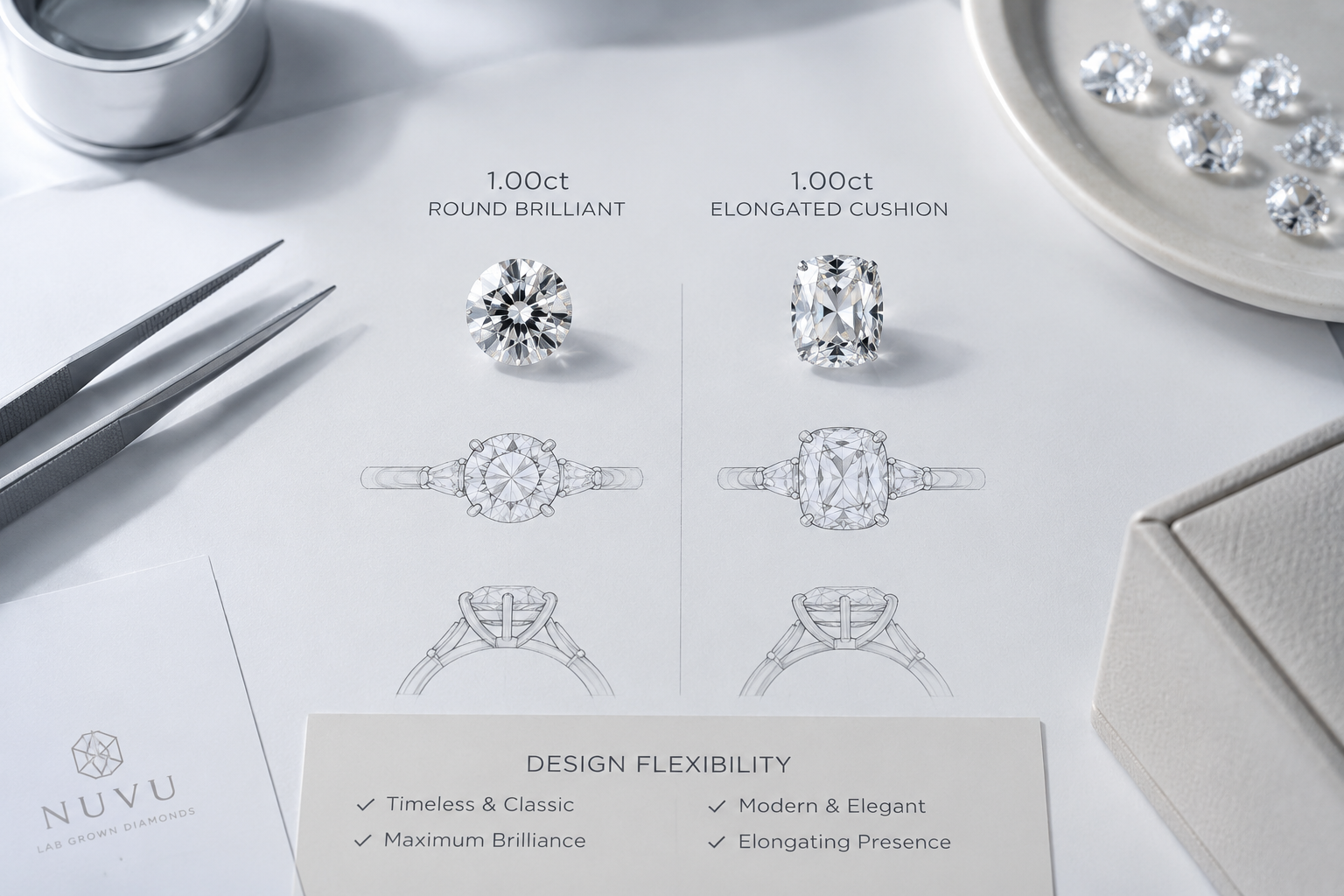
A 1-carat round brilliant in G-H color and SI1 clarity is a strong candidate for versatile inventory. It can anchor a solitaire engagement ring, sit as the center in a three-stone design, work as a pendant, or pair as a stud earring. A buyer can place it into multiple product lines without redesigning around the stone. By contrast, a 1.5-carat elongated cushion with a precise 1.45 ratio and strong blue fluorescence is likely usable only in one specific halo setting. If that setting does not convert, the entire investment is locked into a single design gamble.
This does not mean avoiding specialty shapes altogether. It means buying them only when you have confirmed demand, either through pre-orders, custom requests, or a clear sales pattern from your existing collection. Round and oval shapes, along with mid-range color and clarity brackets, tend to offer the highest design flexibility and resale liquidity. Buy those first. Let your customers tell you when it is time to move into more specific cuts.
Matched Stone Planning: Buying for Earrings and Three-Stone Settings
Another inventory trap is buying single stones without considering how they pair. If part of your collection includes stud earrings or three-stone rings, you need stones that match closely enough to look intentional. A 1-carat round and a 0.98-carat round may be the same carat weight on paper, but if the color grade differs by more than one level, the mismatch becomes visible in direct comparison.
For matched pairs, buy stones from the same batch, ideally cut at the same time under similar conditions. Ask your supplier specifically for stones with matching proportions within a tight tolerance: depth within half a percent of each other, color within one grade, clarity characteristics in the same range. This is easier to negotiate when you order multiple stones at once rather than trying to match single purchases later.
At NUVU, our team treats matched-stone planning as part of the initial buying conversation, not an afterthought. If a supplier cannot provide consistent documentation and visual data across a batch of two or four stones, that is a strong signal about their quality control. Consistency across a batch is worth paying slightly more per stone, because it reduces the risk that your finished pieces will look mismatched on the sales floor.
Plan your inventory around what you can actually sell, not what looks interesting in a supplier catalog. Round and versatile shapes with mid-range grades give you the broadest product range with the least dead-stock risk. Specialty cuts can wait until your brand has enough data to place those bets with confidence.
Quality Control Without a Lab: Visual and Documentary Checks
A grading report tells you what the stone should be. It does not guarantee that every stone in a wholesale batch matches its own certificate, nor that the stones will look consistent when placed side by side. For a small brand without an in-house gemologist, the question is not whether you can perform a full laboratory analysis. It is whether you can catch the most common and costly problems before the stones go into settings.
With a few basic tools and a structured approach, you can filter out the majority of problematic batches before they become expensive mistakes.
The Essential Tools for a Small-Brand QC Kit
You do not need a spectroscope or a darkfield illuminator. A practical QC kit for a small brand includes three things: a quality 10x triplet loupe, a daylight-balanced light source or light box, and a smartphone with a macro lens attachment for video capture. Total investment is under $100, and the return is the ability to reject a bad batch before it reaches your clients.
A loupe allows you to check clarity characteristics against the certificate plot diagram, verify that no black inclusions sit under the table, and inspect girdle thickness and polish quality. A light box gives consistent color temperature so you can compare stones side by side without fighting mixed lighting. Smartphone macro video is surprisingly useful for catching tilt-window effects or dark zones that might not be obvious in a static inspection.
What many first-time buyers overlook is that a grading report captures a stone under controlled laboratory lighting, not under the mixed lighting of a retail environment or the warm spotlight of a jewelry display. For this reason, checking stones with your own light source and against a white background provides a more realistic sense of how they will appear to your customers. It is a simple check, but it often reveals differences that the certificate alone does not communicate.
Red Flags in Documentation: What a Bad Wholesale Report Looks Like
Not all grading reports are created equal. For wholesale buying, the report should come from a recognized laboratory — GIA, IGI, GCAL, or AGS are commonly referenced sources. Reports from lesser-known labs may be worth treating with additional caution, not because they are always incorrect, but because grading standards can vary from one laboratory to another. A grading report documents key characteristics under specific conditions, and its value depends on the consistency and reputation of the issuing lab.
Even with a report from a major lab, buyers should check for inconsistencies. If the certificate lists a depth percentage of 61.5 percent and your measurement shows 64 percent, the stone either does not match the certificate or was mislabeled. A gap of more than one grade between what the stone shows visually and what the certificate states is worth flagging, especially for color and clarity. Some lower-cost wholesale batches contain stones with post-growth treatment residue that can give a faint blue or gray tint under natural light. This is not always captured in the report. Hold the stone against a white background in indirect daylight. If you see a cool tint that does not match the certified color grade, flag it.
Buyer Verification Checklist
| Check | What to Look For | Acceptable Tolerance |
|---|---|---|
| Depth & Table % | Matches certificate; not outside GIA Excellent range for rounds | Depth: 59-62.5%, Table: 54-57% |
| Color Hue | No visible blue/gray tint in normal light | Within one grade of certified color |
| Clarity Plot | Identifiable inclusions match the certificate’s plot diagram | No black inclusions under table |
This checklist is a filter, not a substitute for a third-party report. If a stone fails any of these checks, do not assume a setting will hide the issue. Setting a stone with visible inclusions under the table or off-color tint will only produce finished pieces that are harder to sell. Return the stone before setting, not after.
At NUVU, we treat the grading report as the starting point. The report narrows the field. Visual inspection and batch comparison confirm whether the supplier delivered what they promised. For a small brand placing a first wholesale order, that confirmation is worth the few minutes it takes to check each stone against these parameters.
It is also worth noting that a grading report does not typically measure how a stone performs in a specific setting. A round brilliant graded Excellent in cut can still show reduced brilliance if set too deeply or at an angle that blocks light return. For any custom or non-standard setting, verifying the stone’s measurements against the setting dimensions is a separate step that the certificate alone cannot address. This distinction between laboratory grade and setting performance is one of the most common sources of post-production disappointment for new brands.
Understanding the Growth Method: HPHT vs. CVD in Wholesale Batches
Although not always a focus for small brands placing their first wholesale order, the growth method of lab-grown diamonds—high-pressure high-temperature (HPHT) or chemical vapor deposition (CVD)—can affect how stones appear and perform in finished pieces. The Gemological Institute of America notes that both methods produce genuine diamond crystal structures, but they leave different trace characteristics that a grading report may document. [1]
HPHT rough tends to crystallize more quickly and may contain metallic flux inclusions, while CVD stones are grown in a vacuum chamber and sometimes show strain lines under magnification. For wholesale buyers, these differences matter most when matching pairs or building a consistent batch. A four-stone order of entirely HPHT or entirely CVD stones is generally easier to match than a mixed batch, because the internal features and reaction to lighting can differ subtly between the two processes. [1]
Asking your supplier to confirm the growth method for each stone in a wholesale lot is a reasonable request. While it does not replace visual inspection, it adds an extra data point that helps you evaluate consistency across the batch. [1]
Traceability Documentation: What to Ask Your Supplier and Why It Matters
For small jewelry brands, traceability in lab-grown diamonds does not mean tracking a stone back to a specific reactor or growth run in a way that is verifiable through a public ledger. Instead, it means maintaining a clear, documented chain of information from supplier to jeweler: what the stone is, how it was grown, what grading report covers it, and whether any post-growth treatments were applied. These details form the documentation foundation that allows a brand to describe its products accurately and responsibly to customers.
When evaluating a supplier, consider asking for the following documentation or confirmation for each wholesale lot: the growth method (HPHT or CVD), the specific grading laboratory and report number, the presence or absence of post-growth treatments, and any available visual records such as magnification images or video. A supplier who can provide consistent documentation across a batch signals stronger internal quality control than one who offers only a price list and a verbal assurance. In sourcing and wholesale conversations, documentation, consistency, and communication often matter as much as the headline specification.
It is important to be realistic about what traceability documentation can and cannot do. A grading report confirms the identity and quality parameters of a stone at a specific point in time. It does not, by itself, track the stone through every step of the supply chain. For a small brand, the practical goal, even when using a lab grown diamond wholesale guide to screen sourcing partners, is not to reconstruct the entire production history of each stone. It is to ensure that every stone in your inventory is accompanied by a clear, independently verified description that you can rely on when communicating with your customers. Traceability in this sense is a communication discipline, not a supply-chain audit.
When a grading report is provided, buyers should verify the report details through the issuing laboratory’s official verification tools where available. This step is straightforward for reports from major laboratories such as GIA, IGI, and GCAL, which maintain online report-check databases. For reports from lesser-known labs, or when no report is provided, the documentation gap itself becomes a signal that additional caution is warranted before purchase.
At NUVU, traceability means being ready to share the relevant documentation and grading details that support the stones we discuss with buyers. The goal is to help buyers make informed comparisons, not to present a closed-loop system that claims to verify every production step. For small brands building their sourcing process, asking for and reviewing this documentation is a practical habit that reduces uncertainty and builds a clearer foundation for customer communication.
Practical Limits of Certificates: What a Grading Report Does Not Show
Even when a grading report is genuine and accurately reflects the stone, it has inherent limits that wholesale buyers should understand. A report typically captures color, clarity, carat weight, and cut quality under standardized conditions. It does not usually describe post-growth treatments such as HPHT color enhancement or irradiation, unless the laboratory specifically tests for and notes them. It does not measure how the stone will appear under mixed retail lighting. It does not certify that the stone will match another stone in a pair for color or clarity beyond the broad grade assigned to each individually.
For these reasons, a grading report is best understood as a starting filter rather than a comprehensive guarantee. A report can narrow the comparison and confirm basic quality parameters, but it should be read alongside the stone’s proportions, visual evidence under your own light source, and intended jewelry use before finalizing a purchase. Buyers who treat the report as the final word often encounter surprises after setting, when the stone’s performance in the finished piece does not match what the certificate suggested.
Distinguishing Lab-Grown from Natural: Clarity in Supplier Communication
When evaluating wholesale lab-grown diamonds, it is essential that the supplier clearly identifies each stone as laboratory-grown. Laboratory-grown diamonds and natural diamonds have different origins, and a grading report should clearly disclose the stone’s growth origin. If a supplier is vague about whether a stone is lab-grown or natural, that lack of clarity is a red flag worth taking seriously. For small brands that want to describe their products accurately, relying on a supplier who provides clear, upfront disclosure about stone origin is a practical foundation for honest customer communication.
Scaling Up: When and How to Place Your First Large Reorder
The shift from testing a supplier to placing a real production order is the moment most small brands get nervous. The logic that guided your small test order—protect cash, limit risk, keep inventory small—now has to bend just enough to let you grow. The goal is not to abandon that discipline. It is to apply it at a larger scale.
Sales Data as Your Guide: The Reorder Trigger
The single most reliable signal for reordering is not a feeling or a calendar date. It is the actual sell-through rate of your test batch. Once roughly 60 percent of your test stones have been sold, set into finished pieces, or allocated to confirmed orders, you have enough data to act on.
At that point, do not reorder the same small quantity again. That keeps you in a perpetual trial phase. Instead, place an order that is two to three times the quantity of your fastest-selling shape and color combination. If a particular 1-carat round G-H SI1 is moving steadily, that is the stone to scale. Do not spread the same small budget across ten new variables. Concentrate your reorder on what has already proven itself with real customers.
Increasing Supplier Commitment: From Test Partner to Production Partner
A larger order changes your relationship with the supplier. When you placed a test order, you were evaluating them. When you place a production order, you are signaling commitment. This shift gives you leverage to ask for better terms, not because you are tough, but because you are now a more predictable buyer.
Before placing the reorder, confirm that the supplier can deliver batch consistency at the larger volume. Ask for additional photos or videos of the specific stones in the lot. Request that the grading reports accompany the shipment, not arrive days later. If the supplier has been reliable on communication and documentation during your test order, that pattern is likely to continue. If they were slow, vague, or inconsistent at small scale, a larger order will not fix it.
The reorder itself should follow the same quality checks you used on the test batch. Inspect each stone against its report. Compare the stones to each other for color and clarity consistency. The difference now is the volume: you are not checking ten stones, but thirty. The process does not change. It just takes longer, which means you need to build that time into your production calendar.
For wholesale buyers, consistency often matters as much as the headline price. A supplier who delivers tight batch consistency at moderate pricing is generally more valuable than one who offers a lower per-stone cost but sends stones with noticeable variation across color or clarity. The time and frustration spent rejecting, returning, and reordering inconsistent stones can quickly cancel out any initial price advantage. Evaluating a supplier on consistency, not just price, is a practical discipline that pays off most clearly at the reorder stage.
At NUVU, we consider a successful reorder the real beginning of a wholesale relationship. The test order tells you whether a supplier is worth working with. The reorder tells you whether that relationship can scale.
Pricing and Value Considerations: What Wholesale Pricing Actually Reflects
When scaling up from a test order to a production reorder, the pricing conversation with your supplier will naturally shift. However, it is important to understand what wholesale pricing actually reflects. Prices for lab-grown diamonds can vary based on cut precision, report type, seller channel, stone size, shape, availability, and documentation. A lower per-stone price from one supplier compared to another may reflect differences in grading consistency, batch quality, or the level of documentation provided — not simply a better deal.
Based on publicly available market information, wholesale pricing for lab-grown diamonds can range broadly depending on these factors. For example, an ungraded 1-carat round may carry a different price from one with a full GIA report, and pricing for larger or specialty shapes can differ accordingly. The key insight for small brands is that like-for-like comparisons — same carat weight, shape, color, clarity, and report type — are the only meaningful way to evaluate whether a price is competitive. A price that looks low may reflect a looser grading standard or less documentation, not a genuine saving.
For these reasons, it is worth verifying pricing details with your supplier at the time of reorder, and confirming that the stones offered match the specifications and documentation you expect. Prices can change with market conditions, so exact comparisons should be made against current offers, not historic quotes. The goal is not to chase the lowest price, but to find consistent pricing that aligns with a reliable level of quality and documentation.
Disclosure and Terminology: Why Clear Descriptions Matter for Your Brand
As lab-grown diamonds become more common in retail jewelry, the terminology used to describe them in your product listings and customer conversations deserves attention. The Federal Trade Commission (FTC) has issued guidance emphasizing that terms like “sustainable” and “eco-friendly” should not be used without specific, substantiated evidence. [2] The same guidance clarifies that the term “diamond” may be used for both natural and lab-grown stones, as long as the origin is clearly disclosed. [2]
For small jewelry brands, this matters in two concrete ways. First, your product descriptions should make it clear to customers that the diamonds are lab-grown, using terms such as “lab-grown diamond” or “created diamond.” Second, any broader environmental or ethical claims you make about your supply chain should be limited to what you can directly document. Avoiding vague promotional language is both a compliance best practice and a way to build trust with informed buyers. [2]
Although this article focuses on wholesale buying strategy, knowing the regulatory boundaries around disclosure helps you evaluate what your own supplier tells you about their stones. A supplier who uses ambiguous or exaggerated language about their inventory—especially regarding origin or environmental impact—may not be the most reliable partner for a brand that wants to build honest customer relationships. [2]
Sustainability claims made by suppliers should be specific and documented. Broad green language is less useful than clear information about production methods, energy sources, and sourcing transparency. For a small brand, building a responsible position does not require making grand environmental promises. It requires understanding what your suppliers can actually document and communicating that information in a truthful and specific way to your own customers. Avoiding vague terms like “eco-friendly” or “sustainable” without supporting evidence is both a safer compliance practice and a stronger trust signal for informed buyers.
Putting It All Together: A Practical Decision Framework for Reordering
After working through the test order, documentation review, and first reorder, a small brand should have enough information to build a repeatable buying process. The following framework distills the key decisions into a sequence that protects capital while allowing for measured growth.
| Stage | Key Action | Trust & Documentation Focus |
|---|---|---|
| Test order | Negotiate 5-10 stones across two color brackets | Verify grading reports through lab check tools; inspect each stone visually |
| Evaluation | Track sell-through; note which shapes and grades move fastest | Compare supplier documentation consistency; flag any discrepancies |
| First reorder | Scale 2-3x on proven bestseller shape/color | Request batch photos/videos; confirm growth method for lot consistency |
| Supplier review | Assess communication, documentation quality, and batch consistency | Evaluate whether documentation meets the level your brand needs for customer disclosure |
| Scaling | Negotiate better terms based on proven partnership | Maintain the same documentation and visual checks at higher volume |
This framework is designed to be iterative. Each cycle of order, evaluate, and reorder provides more data about customer demand and supplier reliability. A brand that follows this sequence gradually shifts from testing a supplier to building a sourcing relationship grounded in documented consistency rather than price alone.
For NUVU, the goal in sharing this approach is to make the comparison and selection process more transparent for buyers who are learning to navigate wholesale sourcing. The documentation, visual checks, and batch consistency conversations described in this article are tools that help small brands buy with more confidence and less risk—not guarantees, but practical methods for reducing uncertainty at each stage of growth.
[1] GIA, “Lab-Grown Diamonds: GIA Lab-Grown Diamond Reports,” Gemological Institute of America, accessed via GIA.edu. Source describes HPHT and CVD growth methods, identification features, and GIA’s grading services for lab-grown diamonds.
[2] Federal Trade Commission, “Guides for the Jewelry, Precious Metals, and Pewter Industries,” 16 CFR Part 23, FTC, 2018. Source provides regulatory guidance on terminology, disclosure, and environmental claims for diamonds and jewelry products.
Disclosure: This article is for general educational purposes only. Diamond grading, pricing, availability, specifications, and seller policies can change, and readers should verify important details through grading reports, official laboratory tools, seller documentation, or qualified professionals before making a purchase decision. Laboratory-grown diamonds should be clearly distinguished from natural diamonds, and environmental or sourcing claims should be supported by specific documentation.