
When buying lab-grown diamonds from China, the word “manufacturer” can be misleading. A supplier may grow rough diamonds, cut and polish stones, assemble jewelry, hold inventory, coordinate partner factories, or simply resell available stock. The difference matters because each role affects price, consistency, customization, delivery risk, and who is accountable if the finished order does not match expectations.
For the full framework, read Lab-Grown Diamond Manufacturers in China Guide.
This guide helps buyers look beyond supplier labels and judge what a company actually controls. It shows which questions to ask before paying a deposit, how to verify stock and grading reports, when growth capacity matters, and when cutting, matching, QC, CAD approval, or jewelry production control matters more. The goal is to help you compare suppliers on evidence, not claims.
| Buying Situation | What to Verify | Main Risk to Avoid |
|---|---|---|
| Certified center stone | Report number, current video, exact measurements, availability | Quoting a stone that is unavailable or substituted later |
| Melee, pairs, or layouts | Calibration tolerance, matching standard, rejection process | Uneven color, size, cut, or visual performance |
| Custom jewelry order | CAD approval, metal details, setting method, timeline | Unclear production responsibility or design changes |
| Supplier claims to grow diamonds | CVD or HPHT proof tied to rough production | Mistaking polished inventory for growth capacity |
| Large inventory claim | Owned stock, memo stock, partner stock, hold terms | Assuming listings are physically controlled by the supplier |
| Very low quote | Included reports, QC level, visuals, shipping, substitutions | Comparing prices without matching specifications |
Quick Questions Before You Read
Q: Is a real manufacturer always better than a trading company?
Not always. The better choice depends on the order type and what the supplier actually controls.
Q: Does a grading report prove the supplier is reliable?
No. A grading report documents characteristics of a specific stone; it does not prove the supplier’s inventory control, QC, sourcing model, or production ability.
Q: What is a careful way to check if stock is real?
Ask for report numbers, current photos or videos, location, hold terms, and substitution rules before payment.
Q: When does growth capacity matter most?
It matters most for rough buyers or buyers evaluating long-term production supply, not every finished jewelry order.
Why “Manufacturer” Can Mean Different Things in China’s Lab-Grown Diamond Supply Chain
In China’s lab-grown diamond trade, the word “manufacturer” is often used more broadly than many international buyers expect. A China lab-grown diamond manufacturer may be referring to a company that grows rough diamonds, cuts and polishes stones, assembles jewelry, manages wholesale lab-grown diamonds, or coordinates orders through factory relationships. Those are not the same role, and they do not create the same buyer risk.
This ambiguity does not automatically mean a supplier is dishonest. B2B diamond sourcing often runs through layered networks, especially when a buyer needs different shapes, sizes, grading reports, jewelry settings, or private-label packaging in one order. A lab-grown diamond supplier China buyers find online may have real access to production without owning CVD reactors or HPHT presses. The practical question is not whether the supplier uses the word “factory,” but what part of the supply chain they actually control.
Compliance boundary: laboratory-grown diamonds should be clearly identified as laboratory-grown, and they should not be presented as natural or mined diamonds. CVD and HPHT usually describe growth methods in this context, not automatic “treatments.” When growth method or post-growth treatment is relevant, buyers should look for clear disclosure in the grading report or seller documentation.
Evidence point: treat every supplier label as a claim that needs a matching proof type. A growth claim should be supported by growth-related evidence, an inventory claim should be supported by exact stone confirmation, and a jewelry-production claim should be supported by CAD, sample, setting, and QC documentation. When the proof does not match the claim, the safest assumption is that the supplier may still be useful but should not be classified as controlling that part of the chain.
Traceability in this context means keeping each claim connected to a practical piece of evidence. If a supplier says it owns stock, the trace should lead to exact report numbers, current media, and availability status. If it says it controls jewelry production, the trace should lead to CAD records, metal specifications, setting details, and finished QC photos. This does not require the buyer to demand confidential factory data in every case, but it does require the supplier to show a clear chain between the product being quoted and the order being placed.
For buyers, the practical distinction is evidence-based rather than label-based. A supplier can be useful without owning every step, but the buyer should know whether the supplier is making the stone, selecting it, reserving it, setting it, exporting it, or simply arranging access to it. That distinction helps set realistic expectations for price, lead time, repeatability, and responsibility if the order changes.
The Difference Between Producing, Cutting, Stocking, and Selling
A true growth producer makes lab-grown diamond rough through CVD or HPHT technology. That role matters most when the buyer needs rough supply, large-volume production planning, or direct discussion about growth output. But growth ownership alone does not guarantee attractive polished stones, the widest certified inventory, or strong jewelry production capability.
A cutting or polishing operation adds value after rough production. This type of supplier may not grow diamonds, but it can have meaningful control over proportions, calibration, matching, and final visual consistency. For buyers ordering polished stones, melee, pairs, or repeatable layouts, cutting control may be more relevant than whether the company owns growth equipment.
A stocking supplier or wholesaler focuses on available inventory. It may hold loose lab-grown diamonds in different sizes and qualities, or it may access stones through a supplier network. This can be useful when speed and selection matter, but the buyer needs to know whether the stones are physically in the supplier’s possession, on memo, reserved through another party, or simply listed from an aggregated database.
A trading company coordinates sales without direct production ownership. Some resell what they can source; others manage communication, consolidation, inspection, export paperwork, and mixed-category orders. A diamond trading company can be a poor fit if the buyer needs direct manufacturing control, but it can be useful for smaller orders, mixed specifications, or buyers who need help navigating multiple suppliers.
Why Supplier Labels Often Sound Similar Online
Online listings often compress different business models into the same language. A lab-grown diamond factory, integrated supplier, wholesaler, and trading company may all describe themselves as a “manufacturer” because the term performs well with buyers and suggests better pricing or stronger control. The label may also reflect a real relationship with production rather than direct ownership.
This is where buyers can make a costly mistake: assuming that “manufacturer” means lower price, fixed availability, or better accountability. A company connected to a growth facility may still rely on outside cutters. A jewelry workshop may produce finished rings but buy all stones from the market. A wholesaler may have strong inventory access but no influence over original growth batches. These distinctions affect delivery, consistency, substitution risk, and what the supplier can realistically promise.
The strongest suppliers usually explain their role clearly instead of hiding behind a broad label. If a company says it “produces” diamonds, it should be able to describe whether that means growing rough, cutting rough into polished stones, setting diamonds into jewelry, or coordinating production through partners. Vague answers are not proof of fraud, but they are a sign that the buyer should slow down before placing a deposit.
Why the Buyer’s Risk Depends on the Supplier’s Actual Role
The wrong supplier type creates different problems depending on the order. If a retailer needs six matched 2.00 ct ovals for client presentations, a supplier with real-time inventory control may be safer than a growth-focused company with limited finished stock. If a private-label brand needs repeatable rings, the important issue may be CAD, setting quality, stone matching, and production coordination. If a buyer needs rough diamond supply, then access to growth output becomes much more important.
The risk increases when the supplier’s claimed role does not match the buyer’s expectation. A company that only resells stones may struggle to explain cutting consistency. A jewelry assembler may not be able to answer growth-process questions. A growth facility may not want to handle small mixed orders or customized jewelry. None of these gaps are automatically disqualifying, but they change how the buyer should evaluate the relationship.
A useful way to separate roles is to ask whether the supplier primarily produces, processes, stocks, coordinates, or resells. Producing means creating rough through CVD or HPHT growth. Processing means cutting, polishing, grading preparation, or jewelry assembly. Stocking means controlling available inventory. Coordinating means managing suppliers and export execution. Reselling means offering goods sourced from other parties with limited operational control. Most confusion starts when buyers treat these roles as interchangeable.
What to Clarify in the First Conversation
The first conversation should establish the supplier’s real position before discussing large quantities or target pricing. Ask what they physically control, what they outsource, and which parts of the order depend on third parties. The answer does not need to disqualify them; it should tell you what type of evidence and expectations are reasonable.
A supplier that is clear about its limits is often safer than one that claims to do everything. In lab-grown diamond sourcing, “we can arrange it” and “we produce it” are very different statements. Buyers should listen for that difference early, because it affects every later question about availability, quality control, customization, lead time, and responsibility if something changes.
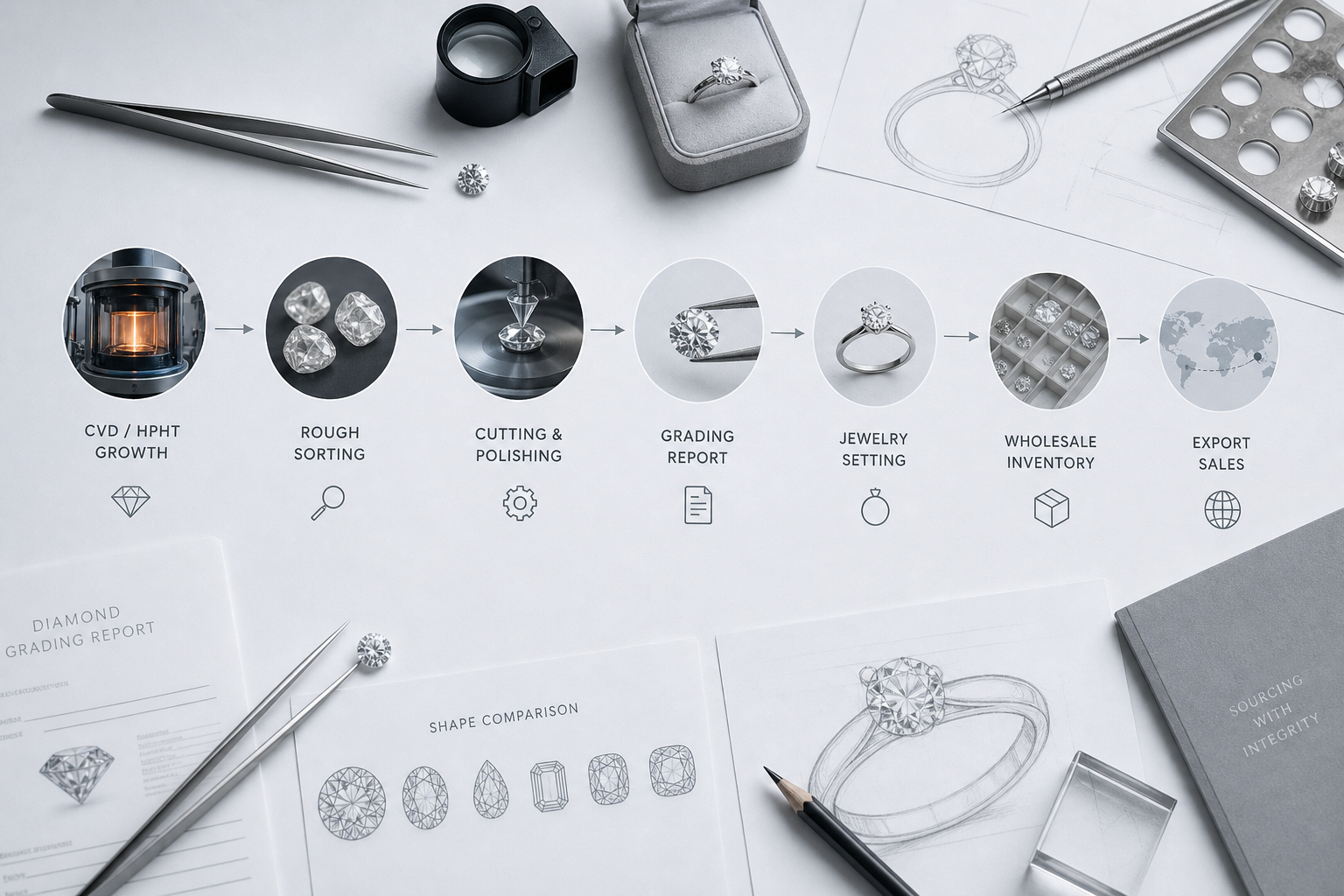
The Four Common Supplier Types: Growth Facility, Integrated Supplier, Wholesaler, and Trading Company
Most China-based lab-grown diamond suppliers fall into one of four practical categories: growth facility, integrated supplier, inventory wholesaler, or trading company. These categories are not status rankings. They describe what the supplier is likely to control, where its value may be strongest, and where a buyer should ask more questions before ordering.
The better choice depends on the order. A large buyer looking for rough output may prioritize a lab-grown diamond growth facility. A retailer buying certified center stones may care more about inventory accuracy and visual review. A jewelry brand may need an integrated diamond supplier that can coordinate stones, CAD, setting, finishing, and packaging. A small importer may benefit from a diamond trading company in China if it provides clear communication and reliable consolidation.
Real Growth Facilities: Companies Connected to CVD or HPHT Rough Production
A real growth facility controls rough production through CVD diamond manufacturing, HPHT diamond manufacturing, or both. Its core asset is not a stock sheet of finished stones; it is access to growth equipment, rough output, production batches, and process knowledge. This type of supplier is most relevant when the buyer needs rough diamonds, high-volume planning, or deeper visibility into production origin.
The limitation is that a growth facility is not automatically the strongest polished-stone partner. Some growth factories sell rough to cutters, some work through export partners, and some may carry only limited finished inventory. If a buyer needs many shapes, grading reports, calibrated layouts, or finished jewelry, the growth factory may still depend on downstream partners. Factory ownership can be valuable, but it does not replace cut selection, matching discipline, or export execution.
Integrated Suppliers: Cutting, Polishing, Jewelry Production, and Export Coordination
An integrated supplier usually combines several downstream functions. It may coordinate cutting and polishing, select loose stones, arrange grading, produce jewelry, handle custom design steps, and manage export communication. It may or may not own CVD or HPHT growth equipment. For many international buyers, this model is more practical than buying directly from a growth facility because the supplier is built around finished product delivery.
The strength of an integrated supplier is operational connection. If a buyer needs a ring line, matched side stones, repeatable melee quality, or private-label production, the ability to manage multiple steps can matter more than direct rough growth. The risk is that “integrated” is also an easy claim to overstate. Buyers should not assume integration means every process is in-house; the important point is whether the supplier can control specifications, communication, inspection, and accountability across the order.
Inventory Wholesalers: Stock Access, Matching, and Fast Availability
A lab-grown diamond wholesaler is most useful when the buyer needs available stones quickly. Wholesalers may carry loose diamonds, maintain access to partner inventory, or specialize in matching stones across size, color, clarity, and shape. Their value is often speed, selection, and practical availability rather than manufacturing ownership.
This can be the right model for retailers sourcing certified center stones, pairs, or replacement options for client requests. The risk is stock accuracy. A wholesaler with broad access may show thousands of available lab-grown diamonds, but not all may be physically owned or immediately reservable. For buyers quoting customers, the difference between owned inventory and network inventory is not a detail; it affects whether the order can actually be fulfilled as shown.
Trading Companies: Sourcing Coordination Without Direct Production Ownership
A trading company sources from manufacturers, cutters, wholesalers, or jewelry workshops and then sells to buyers under its own communication and service process. This model is common in China diamond sourcing and should not be dismissed automatically. A good trading company can help small buyers consolidate different specifications, communicate with multiple factories, and manage export details more smoothly than going directly to several production-side suppliers.
The tradeoff is control. A trading company may not be able to answer technical production questions directly, reserve inventory without checking another party, or adjust manufacturing details quickly. It becomes a poor fit when the buyer needs direct batch planning, strict repeatability, or deep technical accountability. It can be a good fit when the buyer values flexible sourcing, smaller quantities, mixed goods, or communication support more than factory ownership.
Quick Classification Test
A simple classification test is to ask what the supplier can control without waiting for another company. If they can discuss rough production, growth method, and batch output with specific operational knowledge, they may be connected to growth. If they can explain cutting, calibration, matching, jewelry production, and QC flow, they may be an integrated supplier. If they can confirm specific stones, report numbers, videos, and reservation status quickly, they may be a true inventory wholesaler. If they need to check every technical or availability question with outside sources, they are likely operating as a trading company or broker.
The point is not to eliminate every supplier that uses partners. Many reliable suppliers depend on partners for part of the process. The practical goal is to match the supplier’s actual role to the order you are placing, then judge whether their evidence, communication, and control are strong enough for that role.
Practical evidence matrix: for a growth facility, ask for process-related proof; for an integrated supplier, ask for order-flow proof; for a wholesaler, ask for stock-control proof; and for a trading company, ask for sourcing-transparency proof. A buyer should not expect every supplier type to provide the same evidence, but each supplier should be able to prove the role it is claiming in a way that connects directly to the order.
| Supplier Claim | Useful Supporting Evidence | Evidence That Is Not Enough by Itself |
|---|---|---|
| “We grow lab-grown diamonds” | Growth method explanation, rough-production context, batch or process discussion where available | Only polished diamond stock photos |
| “We control cutting and matching” | Measurement sheets, matching notes, rejection standards, side-by-side visuals | Only broad color and clarity ranges |
| “We own inventory” | Report numbers, current videos, hold terms, physical location or stock status | A large static stock list without confirmation |
| “We make jewelry” | CAD approval records, metal and setting specifications, finished QC photos | Only catalog images or previous samples |
At NUVU, this kind of classification is treated as a practical sourcing question rather than a supplier-status label. The useful comparison is whether the supplier can document the parts of the order that matter most: exact stone identity for loose diamonds, matching discipline for layouts, CAD and setting control for jewelry, and clear communication when any step depends on a partner.
For wholesale buyers, traceability should also include how information moves between parties. If the supplier is coordinating partner stock or partner production, the buyer should ask how specifications are transferred, who confirms final goods, and which documents will identify the actual stones or finished jewelry. Clear communication does not turn a trading company into a factory, but it does make the sourcing route easier to evaluate and reduces the chance that important details disappear between the quote and shipment.
How to Verify Whether a Supplier Actually Grows Lab-Grown Diamonds
If a supplier claims to be a lab-grown diamond manufacturer, the first issue to verify is whether it actually grows diamond rough or simply sells finished stones. Growth manufacturing is a specific capability. It involves equipment, production batches, rough output, and process control that are different from polishing, jewelry setting, or wholesale trading.
Buyers do not always need to audit a factory in person, especially for smaller orders. But if the supplier’s factory claim is central to the relationship, the evidence should be more specific than showroom photos, generic machinery images, or broad statements about “direct production.” Real lab-grown diamond manufacturing proof should connect the supplier to a growth process, not just to finished inventory.
Ask What Technology They Use: CVD, HPHT, or Both
A real growth-side supplier should be able to explain whether it uses CVD lab-grown diamond production, HPHT production, or both. CVD and HPHT are different manufacturing methods with different equipment, production planning, and rough characteristics. The buyer does not need a laboratory-level explanation, but the supplier should not answer as if the method is irrelevant.
A vague claim such as “we make all lab diamonds” is weaker than a clear statement about the technology used, the type of rough produced, and whether any post-growth treatment may apply. Some suppliers may be cautious about sharing sensitive production details, which is reasonable. But basic process identity should not be treated as confidential if the supplier is using growth ownership as a selling point.
Look for Evidence of Rough Production, Not Just Finished Inventory
Finished polished stones do not prove growth manufacturing. A trading company, wholesaler, or integrated supplier can all show certified loose lab-grown diamonds without owning growth reactors. To verify a growth claim, buyers should look for evidence related to diamond rough, seed plates, growth reactors, HPHT presses, production batches, or rough-to-polished tracking where available.
Photos alone are weak evidence unless they are recent, specific, and connected to the supplier. A useful image or video should show something identifiable: the facility environment, relevant equipment, rough material, batch handling, or a process stage that aligns with the supplier’s claim. Generic factory photos can be copied, reused, or taken from unrelated partners, so they should be treated as supporting material rather than proof by themselves.
The strongest evidence is usually process-specific. For example, a supplier that grows rough should be able to discuss what happens after growth, how rough is sorted, whether cutting is internal or outsourced, and how batches move into polished inventory. A supplier that cannot explain anything before polished stones appear may still be a useful seller, but its growth-manufacturer claim needs caution.
Check Whether Production Claims Match Their Product Range
A supplier’s product range should make sense against its claimed manufacturing role. If a company says it grows all stones directly but offers every shape, every size, every color and clarity, every report type, and immediate availability across thousands of polished diamonds, that should trigger more questions. Growth output does not automatically translate into unlimited finished inventory.
Some mismatches are easy to overlook. A true HPHT diamond manufacturer may be strong in certain categories but still source specific CVD goods elsewhere. A CVD producer may grow rough but depend on outside cutters for fancy shapes. A supplier may produce part of its offering and trade the rest. The risk is not the mixed model itself; the risk is when the supplier presents mixed sourcing as full direct production and the buyer builds expectations around that claim.
Buyers should pay attention to whether the supplier can separate self-produced goods from sourced goods. A supplier that says, “These categories are from our production, and these are sourced through partners,” is giving you a more usable answer than one that labels every product as factory-direct without distinction.
Understand Why Some Growth Factories May Still Use Cutting Partners
Growth ownership and cutting capability are separate. A lab-grown diamond growth facility may produce rough but send it to specialized cutting workshops because cutting requires different equipment, labor, planning, and quality control. This is common in the diamond trade and does not weaken the supplier’s growth claim by itself.
What matters is whether the supplier can explain how responsibility is managed after growth. If rough is sent to cutting partners, who controls yield decisions, proportions, inspection, and final selection? If polished stones are later graded, who prepares the goods and checks that the finished result matches the order? These details affect consistency more directly than the simple statement “we have a factory.”
For buyers sourcing polished stones, this distinction is important. A real growth factory with weak cutting coordination may deliver less predictable finished goods than an integrated supplier that does not grow rough but tightly controls polishing and QC. Growth access is valuable when it fits the order, but it should not be treated as a shortcut around finished-stone evaluation.
Buyer Verification Checklist
- Ask whether the supplier grows diamonds through CVD, HPHT, or both.
- Request process-specific evidence related to rough production, not only finished stone photos.
- Clarify whether the supplier owns growth equipment or works through a related factory or partner facility.
- Ask what product categories are self-produced and what categories are sourced from outside suppliers.
- Check whether their claimed production role matches the size, shape, report, and availability range they offer.
- Confirm whether cutting and polishing are in-house, partner-managed, or fully outsourced.
- Treat generic factory images as weak evidence unless they are current, specific, and tied to the supplier.
The main judgment is simple: a supplier does not need to grow diamonds to be valuable, but if it claims to be a growth manufacturer, the proof should relate to growth. If the evidence only shows polished inventory, the safer classification is supplier, wholesaler, or trading company until stronger manufacturing proof is provided.
How to Tell If a Supplier Controls Cutting, Polishing, and Quality Selection
A supplier does not need to own CVD reactors or HPHT presses to be operationally valuable. For buyers ordering polished stones, melee diamonds, matched pairs, or finished jewelry, control over diamond cutting and polishing can matter more than growth ownership. A growth factory may produce rough material, but the final commercial result depends on how that rough is planned, cut, polished, measured, selected, and matched.
This is where many overseas buyers misread the supplier landscape. A company that cannot grow diamonds may still have strong control over loose lab-grown diamonds if it manages polishing partners closely, maintains QC standards, keeps calibrated stock, and understands how finished stones perform in real jewelry. On the other hand, a supplier that calls itself a lab-grown diamond factory may have weak finished-stone selection if it mostly sells rough or relies on outside cutting without disciplined quality review.
Why Cutting Control Can Matter More Than Growth Ownership for Finished Stones
For polished diamonds, the growth method explains origin, not finished beauty. Cut quality, proportions, symmetry, polish, measurements, and visual selection determine whether a stone is commercially usable for a retailer, a private-label jewelry brand, or a matching order. A supplier with real cutting control should be able to explain why two stones with the same carat, color, and clarity are not equal in appearance or fit.
This is especially important for elongated shapes, pairs, side stones, and melee layouts. An oval, pear, marquise, or radiant can look very different even when the grading report details appear similar. Bow-tie intensity, spread, depth, table size, outline, and light return all affect whether the stone works in a ring or jewelry layout. A supplier that only forwards report details may miss these issues; a supplier involved in cutting, polishing, or final selection is more likely to flag them before shipment.
The better question is not simply, “Do you manufacture diamonds?” A more useful question is, “Who controls the cutting decision, final QC, and matching approval before the stones are offered to me?” If the supplier cannot answer that clearly, the buyer may be dealing with a stock-list reseller rather than an operator with real product control.
What to Ask About Polishing, Calibration, and Matching
Buyers should ask whether polishing is done in-house, through dedicated workshops, or through open-market cutting partners. In-house polishing can indicate tighter process control, but outsourced polishing is not automatically a weakness if the supplier can show stable QC procedures, consistent measurements, and clear rejection standards. The risk comes when the supplier cannot explain who checks the goods after polishing or what happens when stones fall outside the agreed specification.
For melee diamonds and side stones, calibration is often more important than broad grading language. A parcel described only as “DEF VS” may still create setting problems if the diameters vary too much or the stones do not match visually. Depending on the size range and jewelry design, matched melee may require narrow millimeter tolerances, although this should always be confirmed by product type, setting style, and buyer requirement. Tight pavé, halo, and channel settings usually need stricter consistency than loose assortments sold for general use.
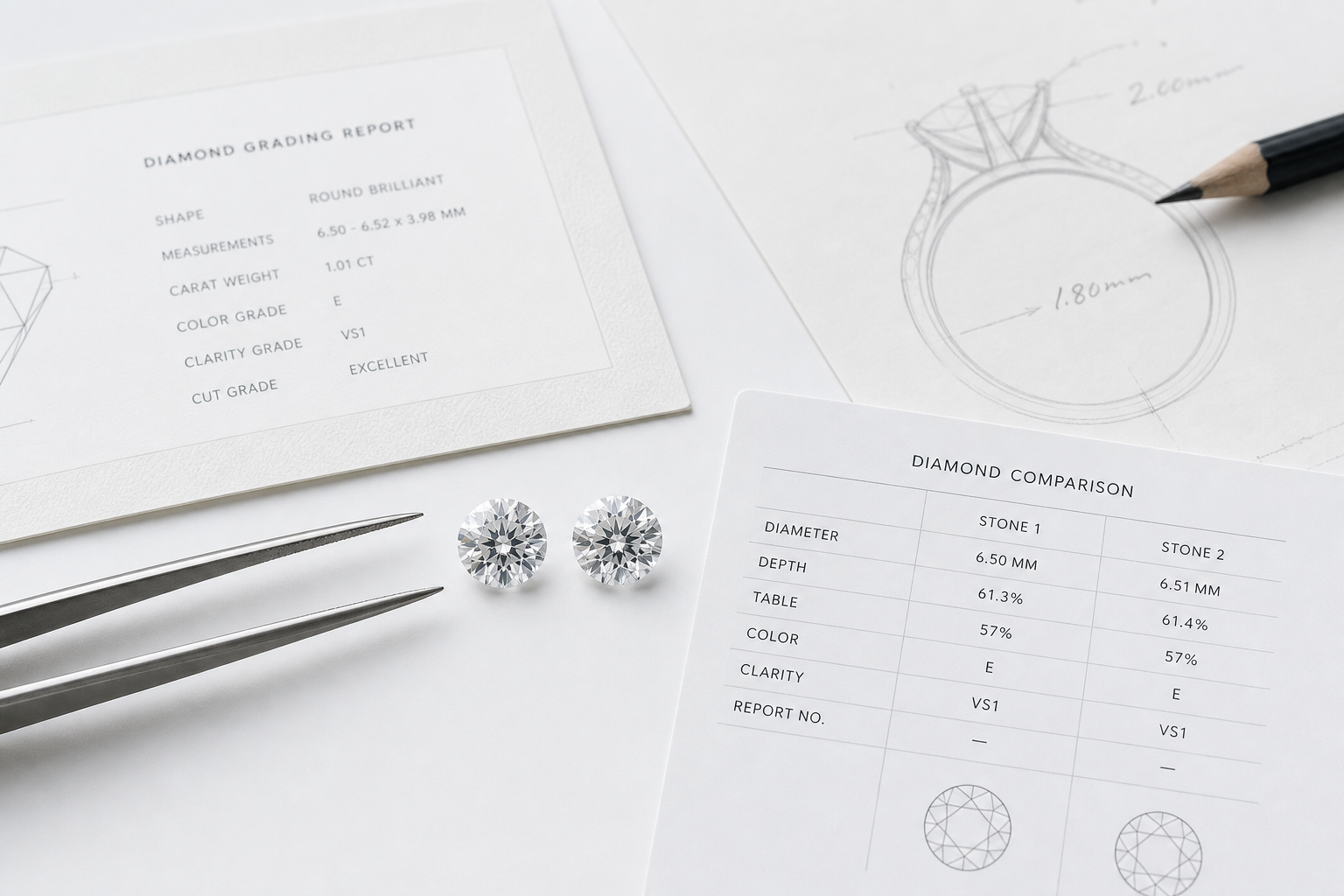
For pairs and matched layouts, the supplier should be able to compare diameter, depth, table, color, clarity, fluorescence where applicable, outline, and visual balance. A pair of 1.00 ct rounds may be easier to match than a pair of fancy-shape stones, where outline and face-up appearance can vary more dramatically. If the supplier treats matching as a simple grade match, that is a warning sign for jewelry buyers.
Useful questions include:
- Do you polish these stones in-house, through fixed partners, or through outside market sourcing?
- What measurement tolerance do you use for calibrated melee in this size range?
- Can you provide diameter, depth, table, and video for each matched stone?
- Who performs final QC before shipment?
- What defects or inconsistencies would cause a stone or parcel to be rejected?
How Repeat-Order Consistency Reveals Real Operational Control
One sample order can look good even when the supplier has limited control. Repeat orders reveal more. If a buyer orders the same melee specification three times and receives noticeably different color ranges, diameter spreads, or make quality, the supplier may be sourcing opportunistically rather than controlling production or selection.
Consistent repeat supply does not mean every stone is identical. Lab-grown diamond calibration still depends on rough availability, cutting yield, size range, and the strictness of the specification. The practical test is whether the supplier can maintain an agreed standard and explain any variation before shipping. A supplier with real control will usually document the tolerance, confirm what is available, and separate goods that do not fit the order instead of blending them into the parcel.
For wholesale buyers, repeat-order consistency often matters more than a single low quote. A small difference in unit price loses value quickly if stones require re-sorting, repairs, remounting, or customer explanations. In jewelry production, poor calibration can create uneven setting height, visible gaps, weak alignment, or additional labor costs. These are operational costs, not just quality preferences.
Stone-to-Stone Consistency Check
Before accepting a matched group of loose lab-grown diamonds, buyers should compare the stones beyond the headline grades. For certified stones, check report numbers, measurements, table, depth, color, clarity, fluorescence if listed, and the visual media for each stone. For non-certified melee, request parcel-level specifications, size tolerance, color and clarity range, and QC photos or videos where practical.
The most useful review is a side-by-side comparison under the same conditions. A supplier that can provide aligned videos, measurement sheets, or clear matching notes is showing more operational involvement than a supplier that only sends a mixed stock list. If the order is for jewelry production, ask for the tolerance standard in writing before the deposit, because “matched” can mean very different things depending on the supplier.
Inventory Claims: How to Separate Real Stock from Aggregated Listings
Large inventory claims need careful reading. A supplier may advertise thousands of available lab-grown diamonds, but those stones may come from owned inventory, partner stock, memo inventory, shared databases, or aggregated diamond listings that are not updated in real time. Broad access can be useful, especially for buyers comparing many sizes and shapes, but it is not the same as physical stock control.
The risk for buyers is not only that a stone is unavailable. The larger problem is substitution. If a retailer quotes a customer based on a specific grading report, measurement set, or video, then learns later that the stone is gone, the replacement may not be commercially equivalent even if the basic 4Cs look similar. This matters most for fancy shapes, pairs, and tight customer requests where appearance cannot be reduced to carat, color, and clarity.
Owned Inventory vs Network Inventory
Owned inventory usually means the supplier has purchased or controls the stones directly and can confirm availability quickly. Network inventory means the supplier has access to stones through other wholesalers, factories, cutters, or trading platforms. Memo inventory may be available to the supplier temporarily, but it may also be offered to multiple buyers at the same time.
None of these models is automatically bad. Owned loose diamond stock can be faster and more reliable, but it may limit selection. Network inventory can give buyers more options, especially for less common specifications, but availability must be confirmed before the buyer quotes a customer or sends payment. The mistake is treating every diamond stock list as if the supplier physically holds every stone.
A serious supplier should be able to distinguish between “in our office,” “with our partner,” “available on memo,” “needs confirmation,” and “sold.” If every stone is described as available without checking, the buyer should assume the stock list is a starting point, not a reservation.
Why Stock Sheets Can Become Outdated Quickly
Lab-grown diamond inventory moves quickly across shared supplier networks. A report number can appear on more than one list, and a stone may be sold, held, transferred, or repriced before a buyer acts. This is especially common with popular commercial goods such as 1.00 to 3.00 ct certified rounds, ovals, cushions, radiants, and emerald cuts.
For example, a U.S. jewelry retailer may select six 2.00 ct oval diamonds from a supplier’s stock sheet for customer presentation. After requesting confirmation, only two are physically available. The supplier then offers substitutes with similar carat, color, and clarity, but the measurements are different and the bow-tie appearance is stronger. On paper, the replacements may look close. In a sales conversation with a customer, they are not the same offer.
This is why buyers should avoid building customer quotes or production promises from unconfirmed lists. A stock sheet is useful for narrowing options, but availability confirmation is the step that turns a listing into a real sourcing option.
What Real-Time Availability Confirmation Should Include
Real-time confirmation should include more than a casual “yes, available.” For certified loose lab-grown diamonds, the buyer should ask for the report number, current availability date, updated photo or video, location of the stone, and whether it can be held. If the supplier says the stone can be reserved, the buyer should ask how long the hold lasts and what action is required to secure it.
For larger orders, the confirmation should also identify whether stones are being pulled from one supplier-controlled parcel or assembled from multiple sources. Mixed-source orders are common, but they create more room for variation. This is not a problem if the supplier is transparent and performs proper selection. It becomes a problem when the buyer expects uniformity and the supplier treats the order as a simple collection of available reports.
Useful confirmation details include:
- Report number for each stone
- Current availability status and confirmation date
- Updated image or video, especially for fancy shapes
- Physical location or control status of the stone
- Hold period and reservation conditions
- Substitution rules if the stone becomes unavailable
When Substitution Is Acceptable and When It Changes the Order
Substitution is acceptable when the buyer has approved a clear range and the replacement fits the original commercial purpose. For example, a melee parcel may allow a defined color, clarity, and size tolerance if the stones are intended for production use. A certified center stone order is different. Replacing one oval, emerald, or pear with another can change the face-up size, outline, light performance, and customer appeal.
The safest standard is simple: if the report number changes, the buyer should treat it as a new stone requiring approval. If the stone is part of a matched pair or layout, any replacement should be reviewed against the other stones, not only against the original specification. A substitute that is acceptable as an individual diamond may be wrong for the set.
Low-friction substitution works best for buyers who prioritize speed and broad commercial availability. It works poorly when the buyer is serving a specific customer, designing a ring around exact measurements, or matching stones for a production run. In those cases, availability proof and written approval matter more than speed.
What to Confirm Before Reserving Stones
Before reserving stones, buyers should confirm the exact report numbers, availability status, hold period, payment requirement, expected shipment timing, and whether updated visual media is available. For fancy shapes, ask for videos rather than relying only on grading reports, because the report will not show bow-tie strength, outline appeal, or face-up character in the way a buyer needs for selection.
The key judgment is whether the supplier controls the stock or only has access to it. Access can still be valuable, but the buyer should manage it differently. Owned stock can often support faster decisions; network or memo inventory requires confirmation before quoting, reserving, or paying a deposit.
Documentation That Helps Prove Supplier Capability
Documentation is one of the strongest tools for evaluating a China lab-grown diamond supplier, but it has limits. A lab-grown diamond grading report can confirm the documented characteristics of a specific graded stone. It does not prove that the supplier grew the diamond, owns the inventory, controls cutting, or operates a jewelry workshop. Buyers should use documents as evidence of control, not as a substitute for supplier due diligence.
The most useful documents are the ones that connect the supplier’s claim to the actual order. A grading report supports stone identity. Invoice documentation shows what is being sold. Packing lists and product specifications confirm what should ship. QC photos, videos, CAD files, and production records help show whether the supplier is managing selection or production rather than only forwarding third-party information.
A grading report helps document key characteristics, but it should not be treated as a guarantee of beauty, value, or sourcing ethics. Buyers should read the report alongside visual evidence, measurements, seller documentation, and the intended jewelry use.
Grading Reports Confirm the Stone, Not the Supplier’s Business Model
An IGI report, GIA report, GCAL report, or other recognized grading document can help verify the stone’s stated characteristics when the report number matches the diamond. Buyers should check the report through the issuing lab’s database where available rather than relying only on a PDF or image sent by the supplier. The report number, carat weight, measurements, shape, color, clarity, and inscription details should align with the stone being offered.
When a grading report is available, buyers should verify the report details through the issuing laboratory’s official report-check tool where available, then compare those details with the stone’s current visual media and written quote.
The common mistake is assuming that certified inventory proves factory ownership. It does not. A trading company, wholesaler, integrated supplier, or growth-related company can all sell diamonds with grading reports. The report verifies the graded item, not the supplier’s role in producing or sourcing it.
This distinction matters when a supplier uses grading reports to support a broader claim such as “we are the manufacturer.” The buyer should separate the two questions. Is the stone real and correctly represented? That is a grading report and visual review issue. Does the supplier control production, cutting, or inventory? That requires additional evidence.
A grading report is also not a complete beauty assessment. It can document important characteristics, but it will not fully show how a fancy shape faces up, how visible a bow-tie appears, whether a pair looks balanced together, or whether the measurements suit a specific mounting. In practical buying, the report narrows the shortlist; the final decision still depends on visual media, measurements, intended setting, and the buyer’s commercial purpose.
Documents That Support Inventory and Order Control
For inventory orders, useful documentation includes invoices that list report numbers or parcel specifications, packing lists that match the invoice, updated product photos or videos, and written confirmation of availability. For calibrated melee or non-certified goods, buyers should request clear product specifications covering size range, color range, clarity range, quantity, and any tolerance requirements.
For jewelry orders, documentation should extend beyond the stones. CAD files, design specifications, metal details, stone layout, ring size, engraving details if applicable, and production approval records all help reduce misunderstandings. A supplier claiming custom production capability should be able to keep the approved design, stone specifications, and finished product details connected throughout the order.
Export documents are useful for shipment and compliance review, but they should not be confused with manufacturing proof. A company that can issue export paperwork may be an exporter, wholesaler, trading company, or integrated supplier. The more important question is whether the documents are consistent with the goods being purchased.
Evidence Should Connect Claim, Stone, and Order
A useful document trail has three connections: the supplier’s claim, the exact product, and the buyer’s order. For example, a report number connects to a specific loose diamond; a CAD file connects to a specific jewelry design; a QC video connects to the finished item before shipment. If the supplier sends documents that are general, recycled, or not tied to the confirmed goods, the documents may still be informative but should not be treated as proof of control.
Buyers can reduce confusion by asking the supplier to repeat critical details in one written confirmation before payment. That confirmation should identify the stone or parcel, report numbers where relevant, physical availability, tolerances, approved design files, metal details, substitution rules, QC steps, and shipping plan. When the written confirmation is complete, the buyer has a practical reference point if the supplier later changes stones, timing, or specifications.
Why Photos, Videos, and Report Numbers Should Match
Photos and videos are only useful when they are connected to the exact stone or order. Generic diamond videos, showroom images, and factory photos are weak evidence because they can be reused across many sales conversations. For certified stones, the report number or laser inscription should be traceable to the visual media wherever practical, especially for higher-value center stones.
For fancy shapes, updated videos are particularly important. A grading report may show measurements and grades, but it will not fully show bow-tie appearance, transparency, outline, or how the stone handles light. If a supplier refuses to provide any current visual confirmation for a stone they claim to have in stock, the buyer should treat the availability claim cautiously.
For jewelry, QC photos should show the actual finished piece, not only a model image or previous sample. The buyer should be able to compare the finished item against the approved CAD, stone details, metal specification, and order invoice. Small differences may be normal in production, but major changes should be approved before shipment.
When Batch References or Production Records May Be Useful
Batch references, rough-to-polished records, or production documentation can be useful when the supplier claims direct manufacturing, specialized cutting, or controlled production. These records may help connect a group of stones to a production batch, cutting lot, or QC process. They are especially relevant for buyers ordering repeated specifications, calibrated goods, or private-label jewelry programs where consistency matters over time.
Buyers should be realistic about what suppliers will disclose. Some legitimate companies may not share sensitive production details, equipment information, or full supplier-chain records. Refusal to disclose everything is not automatically a red flag. The concern is when a supplier makes strong claims but cannot provide any practical evidence that connects those claims to the order.
Written confirmation of treatments or post-growth processes can also be important where relevant. The buyer does not need a technical dissertation, but the supplier should be willing to state what is known and what will appear on the grading report when applicable.
Certificate and Visual Review Check
Before payment, buyers should match the grading report, visual media, invoice, and product specification against the same stone or order. The report number should match the supplier’s quote. The measurements should match the described item. The photos or videos should show the correct stone or finished jewelry. The invoice should repeat the critical details rather than relying on vague product descriptions.
A clean document set does not prove that the supplier is a growth factory, but it does show whether the supplier can manage an order with discipline. For international buyers, that discipline is often the difference between a smooth sourcing relationship and a shipment that requires costly correction after arrival.
Communication Signals That Reveal Whether a Supplier Understands the Product
Supplier communication is one of the most practical tools in lab-grown diamond supplier verification because it shows whether the company understands the product or is simply forwarding details from another source. Fast replies are useful, but speed alone does not tell you whether the supplier can identify risk, explain differences, or control the order after payment.
For international buyers, the stronger signal is specificity. A knowledgeable wholesale diamond supplier can explain why a stone fits or does not fit your requirements, what information is still missing, and which details should be confirmed before deposit. A weaker supplier may respond quickly but avoid report numbers, measurements, videos, or written product specification details.
Specific Answers Matter More Than Fast Answers
A strong supplier answer usually narrows the decision. If you ask about two lab-grown diamonds with the same carat weight, color, clarity, and report type, a capable supplier should be able to discuss proportions, table and depth, measurements, fluorescence if applicable, growth method disclosure when relevant, and visible performance from video. The answer should not stop at “same grade, same quality.”
This matters because two stones with identical headline grades can perform differently in real jewelry. One oval may have a more obvious bow-tie. One emerald cut may show windowing more clearly. One round may have better proportions even if both are listed as excellent or ideal by a report. In China diamond sourcing, the supplier who can explain those differences is usually closer to product selection than the supplier who only repeats the report line.
Good supplier communication also includes limits. If a supplier says a specific visual effect cannot be fully judged without video, or that a matching request requires checking actual stones rather than relying on the stock sheet, that is not a weakness. It is often a sign that the supplier understands where paper specifications end and quality control communication begins.
Product Knowledge Signs in Loose Diamond Orders
For loose lab-grown diamond orders, look for responses that connect the report to the physical stone. A capable supplier can confirm report number, carat weight, measurements, shape, color, clarity, cut grade where applicable, and whether new photos or videos are available. They should also be able to explain if a substitute is truly comparable or only similar on paper.
Elongated shapes are a useful test. If you ask about ovals, pears, marquise, or radiant cuts, a knowledgeable supplier should mention bow-tie visibility, length-to-width ratio, depth, table, and face-up appearance. A supplier who treats every 2.00 ct F VS1 oval as interchangeable is not giving enough information for a retailer quoting a customer or building a ring around a specific look.
For pairs and layouts, product understanding becomes even more visible. A real operator will not promise effortless matching across size, color, clarity, fluorescence, and dimensions without checking available stones. For matched pairs, diameter, depth, table, outline shape, and face-up color can matter as much as the report grade. A supplier who explains the matching tradeoff is more useful than one who promises “no problem” before reviewing the goods.
Product Knowledge Signs in Jewelry and Custom Orders
Finished jewelry requires a different type of communication. The supplier should understand not only the stones but also the design, metal, setting method, production tolerance, and timeline. For custom lab-grown diamond jewelry, a reliable answer may involve CAD confirmation, stone size compatibility, setting security, ring size, metal karat, plating details if applicable, and sample approval before bulk production.
A supplier with real operational involvement will usually ask follow-up questions before quoting too confidently. For example, a halo ring order may require center stone measurements, not just carat weight, because two stones of the same weight can require different setting adjustments. A tennis bracelet order may require clarity on total length, stone size, clasp type, metal weight expectations, and acceptable variation across the line.
For custom jewelry, stone measurements and setting compatibility should be confirmed before finalizing a purchase. A lab-grown diamond may have documented grades that look attractive, but the actual millimeter dimensions, depth, girdle, and shape outline still need to work with the intended setting.
In wholesale and private-label conversations, our team usually treats careful clarification as a positive sign. A supplier who asks for a missing specification may feel slower at first, but that is often better than a smooth answer that leaves production assumptions unresolved.
Warning Signs in Overly Broad Claims
The weakest communication often sounds confident but remains vague. Phrases such as “any size available,” “same as report,” “best quality,” or “factory price” do not help unless the supplier can support them with report numbers, actual availability, videos, specifications, and written confirmation. Broad claims become especially risky when the supplier is quoting rare sizes, tight matching requests, or custom jewelry timelines without checking production or stock.
Inconsistent terminology is another warning sign. If a supplier uses CVD and HPHT interchangeably, confuses report numbers with internal stock codes, or cannot explain the difference between owned inventory and goods sourced from a partner, the buyer should slow down. This does not always mean the company is dishonest, but it may mean the sales contact is too far removed from quality control or actual supply.
Be careful with substitutes that are presented as equivalent without explanation. If the original diamond is unavailable, a serious supplier should explain how the replacement compares in carat weight, measurements, color, clarity, cut, fluorescence, visual appearance, report status, and price. If the substitute changes the look, timeline, or value of the order, it is not a simple replacement.
Questions That Separate Operators from Resellers
- Can you provide the report number, measurements, and current video for this exact stone?
- What visual differences should I expect between these two stones with the same 4Cs?
- For this oval, pear, or radiant cut, have you checked bow-tie visibility from video?
- Are these stones physically in your stock, on memo, or sourced from a partner after confirmation?
- If the selected stone is unavailable, what exact differences does the substitute have?
- For melee or pairs, what tolerance do you use for size, color, clarity, and visual matching?
- For custom jewelry, what details must be confirmed before CAD, sample, or production starts?
- Which parts of the order can you confirm in writing, and which parts depend on final stock or production review?
Pricing Clues: What Supplier Type Can and Cannot Explain
Pricing can reveal useful clues about a supplier, but it does not prove factory ownership. A low diamond supplier quote may come from real production access, older inventory, a short-term stock adjustment, lower grading cost, looser quality selection, or a stone that is less attractive than its paper grade suggests. A higher quote may include stronger matching, better documentation, more reliable availability, or service that reduces sourcing risk.
For buyers comparing China lab-grown diamond pricing, the practical question is not simply “Who is cheapest?” The better question is whether the supplier can explain why the price is different. If the explanation is specific and tied to product details, it may be useful. If the explanation is only “we are factory,” it is not enough.
Price should be read together with evidence. A quote attached to an exact report number, current visual media, clear hold terms, and written substitution rules is more meaningful than a lower quote attached only to a broad stock description. In practical buying, the lower offer may still be the right one, but only after the buyer understands what is included, what is excluded, and what product risk remains.
Prices can change with market conditions, report type, seller channel, and stone-specific details, so exact comparisons should be verified at the time of purchase. Buyers should compare like-for-like specifications before treating one stone, parcel, or supplier channel as a better value.
Why the Lowest Quote Does Not Prove Factory Ownership
A common mistake in wholesale diamond sourcing is assuming the lowest price must come from the real manufacturer. In practice, a trading company may quote aggressively to win an order, a wholesaler may have access to discounted inventory, or a supplier may list stones that are not yet confirmed. A low quote can be legitimate, but it is not evidence by itself.
The risk increases when the quote is materially lower than comparable stones with similar carat weight, shape, color, clarity, grading report, and measurements. In that situation, the buyer should check report status, actual availability, proportions, video performance, treatment disclosure where relevant, and whether the supplier can reserve the exact stone. A low price that cannot be tied to an exact report number and current availability is not a reliable basis for quoting your own customer.
Why a Manufacturer May Not Offer the Better Finished-Stone Price
A growth facility may control rough production, but that does not automatically make it the better source for finished polished stones. Cutting, polishing, grading submission, inventory sorting, matching, and export handling all add layers to the final lab-grown diamond wholesale price. A company focused on rough output may not hold the widest finished-stone selection or the most competitive certified inventory in every shape and size.
This is where the buyer’s order type matters. If you are buying rough or need direct production access, a growth-connected supplier may be the right fit. If you are buying certified 1–3 ct center stones for retail orders, an inventory wholesaler or integrated supplier with strong stone selection may offer better practical value, even if it does not own CVD reactors or HPHT presses.
How Service, Matching, Certification, and Availability Affect Quotes
Two quotes that look different may not be quoting the same service level. Report type, report availability, updated photo and video review, matching work, QC standards, payment terms, packaging, logistics, and response time can all affect the final number. A quote for a single certified loose stone is not comparable to a quote for a matched parcel, a calibrated melee order, or custom jewelry with CAD and sample review.
Matching difficulty is often underestimated. Finding one 1.50 ct round may be straightforward; finding a consistent group of ovals with similar measurements, color, clarity, and bow-tie control is more demanding. The supplier who charges slightly more but prevents inconsistent delivery may create better practical value than the supplier who quotes low and later pushes substitutes.
Order size also changes pricing logic, but not always in a simple way. Larger orders may support better unit pricing, yet they also require more inventory control and tighter QC. If the order needs consistent pairs, layouts, or repeated private-label production, the value of reliability can outweigh a small difference in headline price.
When a Low Price Should Trigger More Verification
A low price becomes a warning sign when it is paired with weak evidence. If the supplier cannot provide report numbers, avoids video, refuses to confirm availability, gives vague answers about treatment or growth method, or changes the stone after payment discussion, the issue is not only price. The issue is whether the quoted product exists in the condition described.
Buyers should also be cautious when a quote is low because important costs are missing. Grading reports, shipping, insurance, duties, payment fees, jewelry labor, CAD work, sample cost, or special packaging may be excluded. A supplier does not need to include everything in the first number, but they should be clear about what is and is not covered before deposit.
Quote Comparison Check
- Are the compared stones the same shape, carat range, color, clarity, and report type?
- Do the measurements, table, depth, and visual performance support the quoted value?
- Is the exact stone available now, or is the supplier quoting from a network list?
- Does the quote include grading report, QC photos, packaging, shipping, or only the stone cost?
- For matched goods, does the price include selection labor and tolerance control?
- For custom jewelry, does the quote include CAD, sample review, metal specification, and setting labor?
- If one quote is much lower, what specific tradeoff explains the difference?
Which Supplier Type Fits Your Order: Loose Stones, Melee, Jewelry, or Private Label
The right supplier type depends on what you are actually buying. A growth facility, integrated supplier, wholesaler, and trading company can each be useful, but not for the same order. The mistake is treating “factory” as the only goal when the real requirement may be inventory confirmation, matched quality, jewelry production control, or export coordination.
For international buyers, the better fit is usually the supplier whose strengths match the order risk. A rough buyer needs different proof than a retailer buying certified center stones. A private-label jewelry brand needs different communication than a loose diamond dealer. The supplier type should reduce the specific risk in your order, not simply sound stronger on paper.
If You Buy Certified Center Stones
For certified 1–3 ct center stones, the most important supplier capability is reliable access to exact stones with verifiable reports, current videos, and clear availability. Growth ownership is secondary if the supplier cannot confirm the stone you want or explain why one option is better than another. A lab-grown diamond supplier China buyer should prioritize report verification, measurements, visual review, and reservation clarity before comparing only price.
An inventory wholesaler or integrated supplier may be the strongest practical fit here because they are often closer to polished stock and can compare multiple stones quickly. A trading company can also be useful if it communicates clearly, verifies report numbers, and explains substitutions honestly. Stock-stone confirmation timing depends on whether the stone is physically held, on memo, or sourced from a partner.
If You Buy Melee, Pairs, or Matched Layouts
For lab-grown diamond melee, pairs, and matched layouts, calibration and QC usually matter more than growth ownership. The key risk is inconsistency across stones: small differences in diameter, color, clarity, cut style, or fluorescence can become visible once the stones are set together. A supplier who owns growth equipment but lacks strong matching control may not be the best fit for this type of order.
Buyers should look for a supplier that can define tolerance ranges, confirm matching standards, and explain what happens if exact consistency is not possible. Depending on the size and design, tight melee calibration may require narrow millimeter tolerances, and the acceptable range should be confirmed in writing. For pairs, matching should consider not only carat weight but also outline, dimensions, depth, table, face-up color, and visual balance.
If You Need Finished Jewelry or Private Label Production
For finished jewelry or private-label production, the strongest supplier is usually an integrated diamond supplier or private label jewelry manufacturer with control over CAD, sample review, metal specification, stone setting, QC, and packaging requirements. The supplier does not need to grow the diamonds to be the right partner. It needs to manage the finished product reliably.
Custom lab-grown diamond jewelry adds practical steps that a loose-stone supplier may not handle well. CAD approval, sample development, stone fitting, prong structure, metal weight expectations, ring size, finishing, and production sequencing all affect the final result. CAD and sample review timing depends on complexity, while full production timing should be confirmed by the supplier after design, materials, and order quantity are clear.
For a private-label brand, communication gaps can be more expensive than a slightly higher unit price. If the supplier cannot confirm metal details, stone setting methods, acceptable tolerance, packaging requirements, and reorder consistency, the order may become difficult to scale even if the first quote looks attractive.
For custom design, the stone should not be evaluated separately from the setting. A center stone with attractive grades may still be unsuitable if its measurements require redesign, if its shape leaves gaps in a halo, or if its depth affects setting height and wearability. Buyers planning jewelry production should confirm stone dimensions, CAD compatibility, and setting method before treating a loose-stone quote as final.
For NUVU, the buyer-first approach is to make this fit logic clearer: what the report shows, what the visuals reveal, whether the stone suits the intended setting, and which production details still need written confirmation. This is especially important when a buyer is comparing several suppliers that use similar grade language but provide different levels of documentation.
If You Need Rough or Direct Production Access
If your business buys rough lab-grown diamonds or needs direct production access, then a real growth facility becomes more relevant. In that case, the buyer should care about CVD or HPHT production capability, rough output, batch consistency, size range, post-growth processes where applicable, and whether the supplier can provide repeatable supply rather than occasional availability.
This type of sourcing is less about browsing finished inventory and more about production planning. A large rough buyer may accept fewer finished-stone services in exchange for better access to rough supply. A retailer or jewelry brand usually should not over-prioritize this route unless it has the cutting, grading, and QC network to turn rough into usable finished goods.
Supplier Fit Decision Framework
If your order depends on exact certified center stones, choose a supplier with strong inventory confirmation, report verification, and visual review. If your order depends on melee, pairs, or layouts, prioritize calibration and QC standards. If your order depends on finished jewelry or private label production, look for CAD, sample, setting, metal, and timeline control. If your order depends on rough supply, focus on growth capability and production access.
A trading company is not automatically the wrong choice, especially for small mixed orders, sourcing coordination, or buyers who need communication support across multiple product types. It becomes the wrong fit when it cannot prove availability, cannot explain product differences, or hides the fact that it is coordinating rather than producing. The safer supplier is the one whose role is clear and whose evidence matches the order you are placing.
When grading reports are provided, buyers should treat them as traceable reference documents and compare the report details with the issuing laboratory’s verification tools where available.
For buyer confidence, grading reports should be treated as traceable reference points rather than decorative documents. When a supplier provides a GIA, IGI, HRD Antwerp, or other recognized grading report, the report number, measurements, shape, carat weight, color, clarity, and inscription details should be checked against the official lab record whenever the lab provides an online verification tool. This step does not prove the supplier’s business model, but it helps confirm that the diamond being discussed is the same diamond described in the documentation.
If a GIA report is provided, the report details can usually be checked through GIA’s official report verification system; buyers should also verify comparable report information through other issuing laboratories when tools are available.
When a purchase decision depends on a specific certified center stone, buyers should ask the supplier to keep the report number, current visual media, invoice description, and pre-shipment confirmation aligned in writing. A transparent supplier should be able to support reasonable report-aware checks, because they reduce misunderstanding for both sides. This is especially useful for international orders where the buyer cannot inspect the diamond in person before shipment.
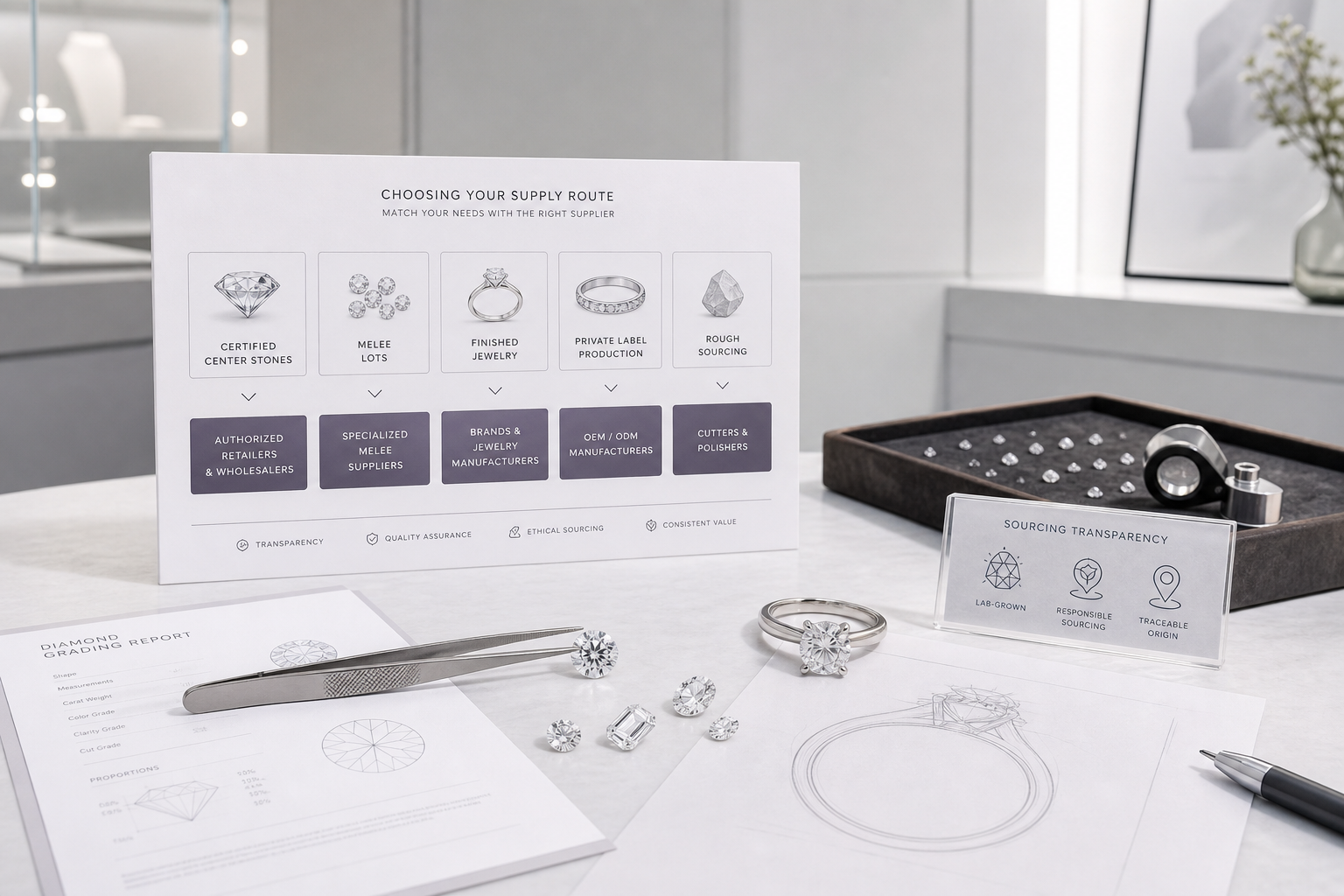
Practical Questions to Ask Before Placing an Order
A supplier’s website, stock sheet, and sales pitch can all look convincing. Before paying a deposit, the buyer’s job is to turn broad claims into specific, written answers. The best questions for a lab-grown diamond supplier are not aggressive; they are precise enough to show who controls the order, who is sourcing from elsewhere, and where the risk sits if something changes.
Use the questions below as a practical diamond supplier due diligence tool. A strong supplier should be able to answer most of them clearly, even if they cannot disclose every production detail. Vague answers are not automatically a deal-breaker, but they should slow the order down until the important points are confirmed.
Questions About Their Role in the Supply Chain
Start by asking the supplier to define their actual role, not just their business label. “Manufacturer” can mean rough growth, cutting, jewelry production, inventory ownership, or export coordination. The question is not whether one role is better than another; it is whether the supplier’s role matches the order you are placing.
- Do you grow lab-grown diamond rough, cut and polish stones, manufacture jewelry, wholesale finished inventory, or coordinate sourcing from partner factories?
- If you describe yourself as a China lab-grown diamond manufacturer, which part of production do you directly control?
- Do you own or operate CVD or HPHT growth equipment, or do you work with growth partners?
- For polished stones, do you cut in-house, use dedicated cutting partners, or source finished goods from the market?
- For jewelry orders, do you produce settings in your own workshop or through a partner factory?
- Who is responsible if the finished goods do not match the agreed specifications?
The strongest answer is usually specific rather than broad. A supplier who says, “We do not grow rough, but we control cutting selection, matching, jewelry setting, QC photos, and export documentation,” may be more useful for a finished jewelry order than a growth facility that cannot manage small custom work efficiently.
Questions About Inventory, Reports, and Availability
Inventory questions should separate available goods from theoretical access. This matters most when you are quoting customers, building a matched parcel, or reserving center stones with exact report numbers. A stock list is useful only if the supplier can confirm what is physically available, what is on memo, and what may be substituted.
- Is this stone or parcel physically in your possession now?
- If not, who currently holds it, and how long will it take to secure?
- Can you confirm the report number before payment?
- Can you provide current photos or videos of the actual stone, not a sample stone?
- Can the stone be placed on hold, and for how long?
- What happens if the stone sells before payment is completed?
- Are the listed stones owned inventory, memo goods, partner inventory, or aggregated market listings?
For certified loose diamonds, report verification should happen before deposit. The report number, carat weight, shape, color, clarity, measurements, and inscription details should align across the supplier’s quote, grading report, photos, videos, and final invoice. If those details shift without explanation, treat it as a new offer rather than the same confirmed stone.
Questions About Cutting, Matching, and QC Standards
Quality control questions are where many supplier claims become clearer. A reseller may still provide good stones, but a supplier with real operational control should be able to explain how stones are checked, matched, rejected, or reselected before shipping.
- What measurements and visual factors do you check before confirming a stone?
- For pairs, do you match diameter, depth, table, color, clarity, fluorescence, and visual appearance?
- For melee, what size tolerance do you use, and does it change by stone size or setting type?
- Can you provide a QC photo or video before shipment?
- Who approves the final matching before the goods are packed?
- If a stone has strong bow-tie, windowing, poor symmetry, or visible color mismatch, will you flag it before shipment?
- What is your process if the received goods do not match the confirmed specifications?
For wholesale diamond orders, the most important QC issue is often consistency rather than one exceptional stone. A single attractive sample does not prove repeat-order control. If you plan to reorder the same melee size, matched pairs, or private-label design, ask how the supplier will maintain consistency across batches and what differences are considered acceptable.
Questions About Custom Jewelry and Production Timelines
Custom jewelry adds another layer of verification because the supplier must coordinate stones, CAD, metalwork, setting, finishing, inspection, and packing. A supplier that is strong in loose stones may not be the best fit for private-label jewelry unless it can document the production steps clearly.
- Do you provide CAD drawings before production?
- Will I approve the CAD before casting or setting begins?
- What metal, alloy, stone size, setting style, and finishing details will be confirmed in writing?
- Do you make a sample before bulk production?
- How are center stones, side stones, and melee matched to the design?
- What is the estimated timeline for CAD, sample review, production, QC, and shipping preparation?
- Which timeline steps depend on stone availability or design complexity?
For private-label or repeat jewelry production, timeline promises should be treated carefully. Stock-stone confirmation, CAD review, sampling, and full production timing can vary depending on availability, complexity, approval speed, and order size. The safer approach is to request a step-by-step schedule instead of accepting one general delivery date.
Questions About Substitution, Documentation, and Written Confirmation
Substitution rules should be clear before money changes hands. In lab-grown diamond sourcing, substitution can be reasonable when the replacement is equal or better by agreed criteria. It becomes a problem when the buyer expected a specific stone, report number, measurement range, or visual appearance and receives something materially different.
- Can any stone be substituted without my written approval?
- If substitution is needed, which details must remain the same: report lab, carat weight, color, clarity, measurements, ratio, fluorescence, visual appearance, or price?
- Will the invoice list the exact report numbers and stone specifications?
- Can you provide packing list details that match the confirmed order?
- For jewelry, will the final documentation include metal type, stone details, quantity, and design reference?
- Will you confirm any post-growth treatment disclosure or relevant product notes in writing where applicable?
- What is the process if the final shipment does not match the written confirmation?
Written confirmation protects both sides. It should include the supplier’s role, exact product details, report numbers where relevant, quantities, tolerances, substitution rules, production timeline, payment terms, and documentation to be provided before shipment. If a key point matters to the order, it should not remain only in a chat message with unclear wording.
It is also useful to separate facts, assumptions, and preferences in writing. A report number, measurement, metal type, and approved CAD file are factual order details. A target look, acceptable bow-tie level, or preferred face-up spread may require visual approval. A supplier’s statement that a stone is “similar” or “good quality” should be translated into measurable details or approved media before the buyer relies on it.
How to Keep an Evidence File for Supplier Comparison
For higher-value orders or repeat sourcing programs, keep a simple evidence file for each supplier. Save the original quote, stock confirmation, report numbers, videos, CAD approvals, QC photos, payment terms, substitution rules, shipping documents, and post-delivery feedback in one place. This makes it easier to compare suppliers over time based on documented performance rather than memory, price alone, or sales claims.
The evidence file is also useful when a problem occurs. If the delivered goods differ from the confirmed order, the buyer can compare the shipment against the written specifications, visual approvals, and invoice details. If the supplier performs well across several orders, the same file becomes a record of reliability and can support larger orders with more confidence.
For traceability, organize the file by order stage: supplier role, stone or parcel identity, design approval, production confirmation, pre-shipment review, and final documents. This makes gaps easier to see. For example, a report number without a matching invoice line is incomplete; a CAD file without final QC photos may not prove the finished item followed the approved design; and a stock list without dated availability confirmation should not be treated as reserved inventory.
Responsible Claims to Confirm Before You Rely on Them
Some supplier claims sound reassuring but need specific documentation before they should influence a buying decision. “Factory-direct,” “responsible sourcing,” “sustainable,” “lowest price,” “guaranteed quality,” and similar phrases should be translated into verifiable details. Environmental and sustainability claims should be specific, documented, and limited to what can be substantiated.
For China-linked supply chains, buyers should avoid assuming that overseas sourcing automatically means lower cost, higher risk, stronger scale, or weaker quality. China-linked supply chains can offer manufacturing depth and scale in some categories, but buyers still need to evaluate consistency, documentation, communication, and quality control. The supplier’s location is less important than what it can prove about the exact goods, production role, and order process.
Before purchase, buyers should also confirm seller policies directly instead of assuming standard terms. Return terms, resizing, warranty coverage, shipping responsibility, insurance, customs duties, after-sales support, and dispute handling can vary by seller and order type. Unless these terms are provided in writing by the supplier, they should not be treated as part of the offer.
Final Verification Checklist Before Payment
Before paying a deposit or approving production, use this lab-grown diamond manufacturer checklist to confirm the order is specific enough to proceed.
- The supplier’s actual role in the supply chain is clear.
- Growth, cutting, inventory, jewelry production, and export responsibilities have been separated instead of grouped under one vague “manufacturer” claim.
- Report numbers, stone specifications, and visual materials have been checked for consistency.
- Inventory availability has been confirmed, especially for specific loose stones or matched goods.
- QC standards are written clearly enough to judge acceptance or rejection.
- Custom jewelry details, CAD approval steps, materials, and production timing are confirmed before work begins.
- Substitution rules require buyer approval when the change affects value, appearance, report details, or design fit.
- Invoice, packing list, report information, and product specifications will match the confirmed order.
The goal is not to eliminate every sourcing risk; that is unrealistic in any international supply chain. The goal is to verify a China diamond supplier well enough that you know what they control, what they are coordinating, and what evidence supports the order before you commit funds.
Disclosure: This article is for general educational purposes only. Diamond grading, pricing, availability, specifications, and seller policies can change, and readers should verify important details through grading reports, official laboratory tools, seller documentation, or qualified professionals before making a purchase decision. Laboratory-grown diamonds should be clearly distinguished from natural diamonds, and environmental or sourcing claims should be supported by specific documentation.