
Lab-grown diamond sourcing often looks simple until an order moves through cutting, grading, matching, setting, inspection, documents, and shipping. In practical buying workflows, HPHT and CVD production also affects how buyers evaluate origin, consistency, availability, and downstream readiness before committing to an order. The real issue is not only where a stone is grown, but how many separate parties must coordinate before the buyer receives goods that are actually ready to approve, sell, or set. A diamond marked “available” may still need measurement checks, report matching, inscription review, visual approval, or production work.
For the full framework, read China Lab-Grown Diamond Supply Chain Guide.
This article explains why China’s clustered lab-grown diamond supply chain can shorten timelines for custom jewelry, matched stones, private-label runs, and wholesale orders. It also shows where speed can become risky if specifications, tolerances, documents, or final-mile logistics are unclear. The practical question is whether a supplier can control the full order path, resolve problems quickly, and prove readiness before shipment.
Laboratory-grown diamonds should be clearly identified as laboratory-grown, and they should not be presented as mined diamonds. Lab-grown diamonds and natural diamonds have different origins, even when both are diamonds; diamond simulants are a separate category and should not be confused with laboratory-grown diamonds.
Prices can change with market conditions, report type, seller channel, and stone-specific details, so exact comparisons should be verified at the time of purchase. A faster supply chain can reduce coordination time, but it should not be treated as proof of lower cost, higher value, or better commercial outcome without like-for-like comparison.
| Buying Situation | What to Verify | Why It Matters |
|---|---|---|
| Loose stones listed as available | Current stage, report status, images, measurements | Available does not always mean ready to ship |
| Matched pairs or layouts | Diameter, depth, shape, color match, tolerance | Small size differences can affect setting and appearance |
| Custom jewelry production | CAD fit, stone approval, setting workflow, rework owner | Stone and setting decisions must align before finishing |
| Wholesale or private-label orders | Batch consistency, repeatability, packaging, counts | Speed is useful only if goods arrive consistently sale-ready |
| Comparing supplier promises | Number of handoffs, QC process, documents, tracking | The shortest quoted lead time may hide coordination risk |
Quick Questions Before You Read
Q: Is China faster simply because it produces more lab-grown diamonds?
Not necessarily. The main advantage is often tighter coordination between growers, cutters, setters, inspectors, document teams, and logistics partners.
Q: Does a grading report mean a stone is ready for a jewelry order?
No. A grading report helps document key characteristics, but buyers still need measurements, visual checks, inscription matching where applicable, and design fit confirmation.
Q: When is fragmented global sourcing still acceptable?
It can work for simple loose-stone purchases when reports, photos, measurements, and shipping details are already complete.
Q: What is the biggest mistake buyers make with fast sourcing?
Assuming speed equals control. Clear specifications, approval points, QC ownership, and shipment documentation still matter.
The Real Problem: Fragmented Global Sourcing Slows Every Step
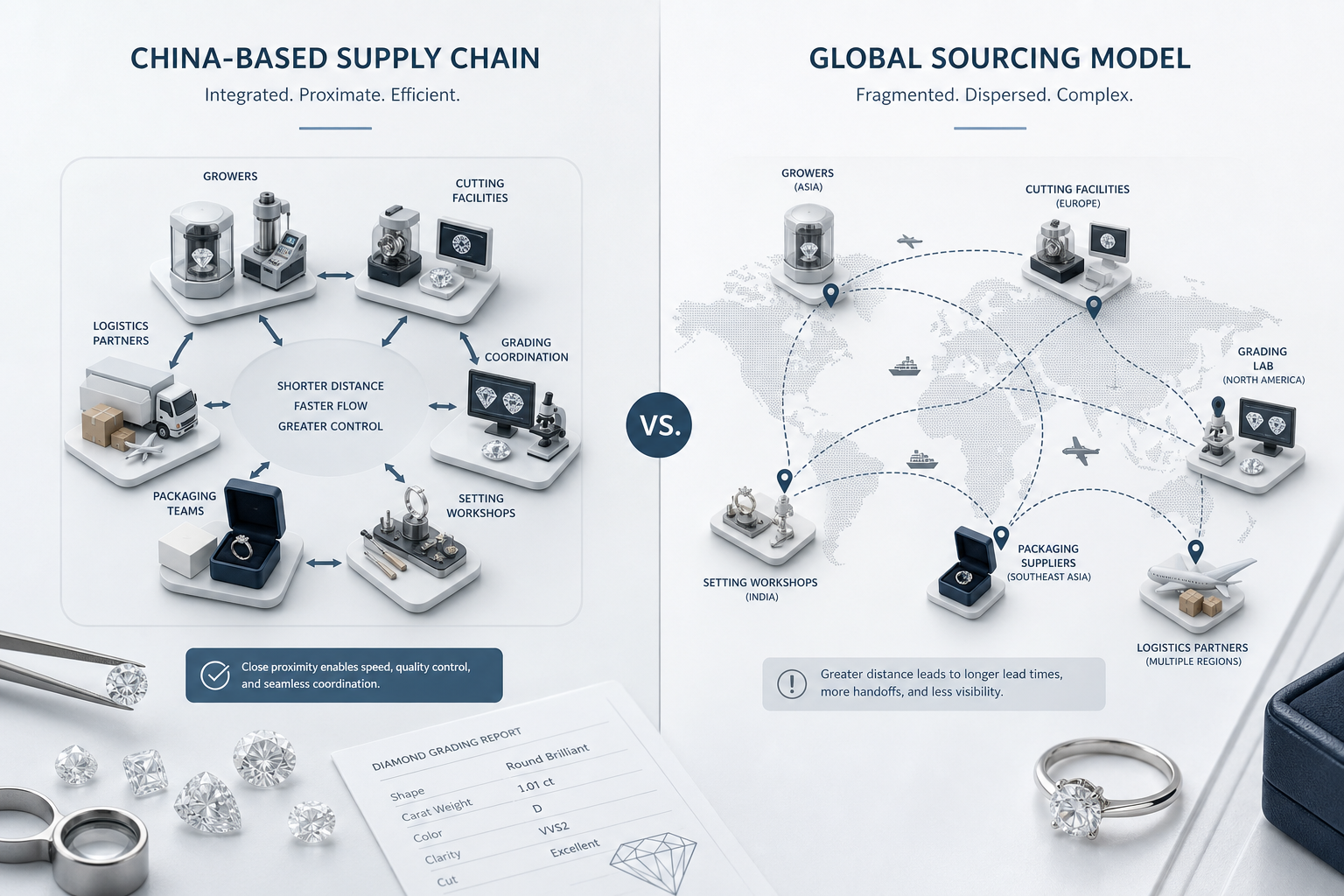
A lab-grown diamond order rarely slows down because one person is doing nothing. More often, the delay comes from too many separate parties waiting on each other. A grower confirms rough availability, a cutter checks whether the requested shape and size are realistic, a grading route is chosen, a setting workshop waits for exact measurements, and a logistics partner cannot move anything until the documents match the goods.
This is where fragmented global sourcing becomes difficult to manage. The buyer may receive a lead time that sounds reasonable at the beginning, but that estimate often assumes every handoff happens cleanly. If stock data is outdated, if a stone needs re-polishing, if a grading report is delayed, or if a setting has to be adjusted after measurements come back, the lab-grown diamond sourcing timeline stretches quickly.
The contrast with a denser China lab-grown diamond supply chain is not simply about one country being faster by default. The real issue is operational friction. When each stage sits in a different city, country, time zone, or vendor system, the order carries more points of failure before it ever reaches the buyer.
In practical buying, this is where timeline comparisons can become misleading. A supplier who quotes a short lead time may be describing the fastest possible path, while another supplier may be including grading, matching, final inspection, and document preparation in the estimate. Before comparing speed, buyers should ask what the quoted timeline includes and which steps still require approval, third-party handling, or shipment between vendors.
Why one diamond order can involve five or more separate handoffs
A single order can look simple from the outside: one parcel of loose stones, one engagement ring, or one private-label jewelry batch. Behind it, the order may pass through a rough supplier, a cutting and polishing team, a stock consolidator, a grading coordinator, a jewelry workshop, a quality-control contact, a packaging provider, and an international shipping channel.
Each handoff creates a moment where the order can lose time. The next vendor may not have the latest specification. Measurements may need to be reconfirmed. A stone listed as available may already be reserved. A cutter may need approval before changing proportions. A setting workshop may not begin CAD adjustment until the exact stone dimensions are confirmed.
The most expensive mistake is assuming that “available” means “ready for the next step.” In sourcing, those are not the same thing. A diamond can be physically available but not yet graded, not matched, not measured for the setting, not approved by video, or not packaged with the correct documentation. Buyers who plan around the word “available” without asking what stage the stone is actually in often underestimate the real timeline.
Where delays usually appear: stock confirmation, cutting, grading, setting, and shipment
Stock confirmation is often the first weak point. In fragmented sourcing, inventory may be shown by one seller but held by another party. If the buyer needs a specific carat range, color grade, clarity range, shape, ratio, or matched layout, the first answer is rarely enough. Someone has to confirm that the stones are still available, that the specifications are accurate, and that the stones can move into the next stage without replacement.
Cutting and polishing can add another delay when the required stone is not already finished to the buyer’s needs. Fancy shapes, calibrated stones, matched pairs, and melee layouts all demand more coordination than a single standard round stone. If cutting is handled by a separate overseas vendor, even a small revision can become a multi-day loop of photos, measurements, approvals, and shipping.
Grading can support trust, but it can also become a bottleneck if it is treated as an afterthought. The buyer may want an IGI, GIA, GCAL, or other grading report, while the supplier may have planned only basic internal documentation. Report type, stone size, lab availability, inscription requirements, and batch quantity all affect timing. A grading report request made late in the process can disrupt the entire delivery plan.
Setting and shipment create the final set of risks. A ring workshop cannot properly finalize prong placement or seat depth without accurate stone dimensions. A shipment cannot move cleanly if report numbers, stone counts, invoices, and packing details do not align. Many jewelry production delays happen near the end because earlier stages were not documented tightly enough.
Why distance and disconnected vendors create timeline uncertainty
Distance does not only mean shipping time. It also means slower clarification. A buyer in the U.S. may ask a question during their business day, but the cutter, grading contact, or workshop may already be offline. If the answer depends on another vendor, one clarification can take two or three communication cycles before anyone can act.
Disconnected vendors also make responsibility harder to assign. If the diamond does not match the listed measurements, is that a stock data issue, a cutting issue, or a seller communication issue? If the setting needs adjustment, does the stone supplier coordinate with the workshop, or does the buyer have to manage both sides? If a grading report is delayed, who updates the production schedule?
This uncertainty matters more than many buyers expect. A quoted timeline is only useful if someone controls the dependencies behind it. When no single party has a clear view of stock, cutting status, documentation, setting readiness, and shipment preparation, the buyer is not managing a timeline; they are managing a chain of assumptions.
Evidence Point: What a buyer should ask suppliers to prove
To make a timeline defensible, ask the supplier to separate confirmed facts from estimates. Confirmed facts include the current stone stage, actual measurements, whether the report is already issued or still pending, whether the stone has been reserved, and whether the setting workshop has reviewed the measurements. Estimates include expected grading time, expected production slots, expected shipment timing, and expected rework feasibility. Mixing those two categories is one reason sourcing conversations become unclear.
A useful supplier update should therefore include more than “in process” or “soon.” It should identify the last completed step, the next dependency, who is responsible for that dependency, and what information the buyer must approve before work moves forward. This type of order trail does not slow the process down; it reduces the chance that the buyer approves a deadline based on assumptions rather than visible progress.
Traceability in this context is not only a question of origin; it is a question of continuity. Buyers should be able to follow how a stone moves from available material to selected diamond, then to report details, setting decision, final inspection, and shipment line. If those links are missing, the order may still be fast, but it becomes harder to confirm whether the approved goods are the same goods being packed.
What This Means in a Real Purchase
For a U.S. jewelry brand ordering a small batch of matched lab-grown diamond pendants, the risk is not just that production takes longer. The larger risk is that the buyer cannot tell which step is holding the order back. The stones may be waiting for confirmation, the workshop may be waiting for measurements, the grading request may not have been submitted, or the shipment may be paused because documents do not match the final goods.
A fragmented model can still work when the buyer has strong vendor relationships, flexible timing, and a simple specification. It becomes less reliable when the order depends on matching, customization, grading coordination, or a fixed launch date. The more stages that must align, the more important supply-chain coordination becomes.
China’s Speed Advantage Comes From Supply-Chain Density, Not Just Scale
China’s speed advantage in lab-grown diamond sourcing is often misunderstood. It is not only about producing more stones or offering lower costs. The more practical advantage is supply-chain density: growers, cutters, polishers, jewelry manufacturers, grading coordination contacts, packaging teams, and logistics providers often operate within connected production regions rather than scattered across unrelated markets.
That density changes how work moves. A stone can be checked, measured, transferred, revised, set, photographed, packed, and prepared for shipment with fewer long-distance pauses. Not every order moves through the same pathway, and not every supplier controls every step, but a dense lab-grown diamond manufacturing ecosystem gives buyers more opportunity to compress the time between stages.
This is the core reason why China lab-grown diamond sourcing is faster in many commercial situations. The gain is not automatic; it comes from reducing idle time. A production cluster does not eliminate quality control, documentation, or buyer approval, but it can make those steps easier to coordinate before they become delays.
Density should still be verified at the supplier level. A company may be located near a production cluster but still operate through loosely connected brokers, while another supplier may have clearer communication with cutters, setters, document teams, and logistics partners. For buyers, the useful question is not only “Where is the supplier based?” but “How are the stages connected, and who is accountable when the order changes?”
How clustered suppliers reduce waiting time between production stages
In a fragmented model, the order often waits between stages. The cutter finishes stones and ships them elsewhere. The grading request is handled by another contact. The jewelry workshop waits for confirmed dimensions. Packaging starts only after someone reconciles the stone list, report numbers, and final product details.
In a clustered supplier environment, those waiting periods can shrink because the next stage is closer and more familiar with the previous one. A cutter may regularly work with the same setting workshops. A jewelry factory may already know how a supplier measures ovals, cushions, or calibrated melee. A logistics partner may be used to handling parcels that include stones, finished jewelry, grading documents, and commercial paperwork.
The practical advantage is especially clear when something needs correction. If a stone needs re-polishing, a measurement needs to be checked, or a setting needs a small adjustment, nearby coordination can prevent a minor issue from turning into a week-long interruption. For buyers, this is where speed becomes useful: not in the easiest order, but in the order that needs one or two controlled fixes before shipment.
Why proximity makes communication faster when specifications change
Specifications often change during real sourcing. A requested stone may not be available in the exact ratio. A matched pair may need a slightly different millimeter spread. A ring design may require a lower profile setting than originally planned. A private-label buyer may change packaging or stone layout after reviewing photos.
When production partners are close to each other, those changes can be tested faster. The cutter can confirm whether the adjustment is realistic. The setting workshop can check whether the stone will fit the design. The quality-control contact can request updated images or measurements before the order moves too far downstream.
The key benefit is not just faster messages. It is faster decision-making. In disconnected sourcing, a buyer may receive separate answers from separate vendors that do not fully align. In a denser ecosystem, the answer is more likely to reflect what can actually be produced, set, documented, and shipped within the same working process.
How dense ecosystems support both loose stones and finished jewelry
Supply-chain density matters for loose lab-grown diamonds because buyers often need quick confirmation of availability, grading status, matching potential, and shipment readiness. A loose stone order is not automatically simple; parcels, matched pairs, fancy shapes, and calibrated stones still require sorting and documentation discipline.
It matters even more for finished jewelry. A custom lab-grown diamond ring or private-label jewelry batch connects stone sourcing with CAD, casting, metalwork, setting, finishing, inspection, packaging, and export preparation. If those steps are handled through unrelated vendors, the buyer may spend as much time coordinating as producing.
A dense ecosystem is most valuable when the order requires alignment across multiple details. A single standard stone may not need much infrastructure. A matched earring batch, a custom engagement ring, or a branded jewelry launch benefits more from nearby production partners because the stones and settings have to be planned together, not treated as separate purchases.
Buyer Verification Checklist
- Ask which stages are handled directly and which are outsourced. A supplier can be fast at sourcing stones but slower at jewelry production if the setting workshop is not closely coordinated.
- Confirm the current stage of the goods. “Available” should be clarified as rough, cut, graded, matched, set, inspected, or ready to ship.
- Request written specifications before production moves forward. Shape, carat range, measurements, color, clarity, report requirements, metal, setting style, and packaging should not depend on chat history alone.
- Clarify who owns quality control across handoffs. The strongest timeline is the one where responsibility is clear if a stone, report, setting, or shipment detail needs correction.
Growth and Rough Stone Availability Set the Pace for the Whole Timeline
Every sourcing timeline starts upstream. Before cutting, grading, setting, or shipment can be planned, the supplier needs access to suitable material. That may mean rough lab-grown diamonds ready for cutting, pre-cut stones that can be matched or re-polished, or finished inventory that already meets the buyer’s basic requirements.
This stage is easy to underestimate because buyers usually focus on the final diamond specifications: carat, color, clarity, shape, and price. In practice, rough stone availability can determine whether the order starts immediately or waits for the right material to enter the production flow. A sourcing team with better visibility into available rough and finished stock can build a more realistic timeline from the beginning.
The mistake to avoid is treating production capacity as a single number. A supplier may have strong general capacity but limited availability for a specific size range, shape, color target, or matched layout. Speed depends less on how much total production exists and more on whether the right material is available for the actual order.
Why available rough or pre-cut inventory matters before customization starts
Customization does not always begin with a blank slate. If the buyer needs a 2-carat oval center stone, a matched set of emerald-cut side stones, or a batch of calibrated round diamonds for a jewelry line, the supplier first has to identify whether suitable rough or pre-cut inventory exists. If it does, the timeline can move into cutting, matching, grading coordination, or setting much faster.
If it does not, the order becomes more speculative. The buyer may need to wait for new growth output, accept a different size range, adjust color or clarity expectations, or change the design around stones that are already available. The earlier this is known, the better. A delayed discovery at the cutting or setting stage can force the buyer to revise the product after time has already been spent.
Pre-cut inventory can be useful, but it should not be accepted blindly. A stone that is close to the requested specification may still be wrong for the project if its measurements do not fit the setting, if the pair does not match well enough visually, or if the report status does not meet the buyer’s requirements. Fast sourcing only helps when the available material is actually compatible with the intended use.
How CVD and HPHT production streams affect sourcing flexibility
CVD diamonds and HPHT diamonds can both support commercial lab-grown diamond sourcing, but their availability patterns may differ by supplier, size range, color outcome, and production plan. For the buyer, the point is not to choose a growth method in isolation. The more practical question is whether the supplier can provide the required stone type with the right specifications, documentation, and timing.
CVD production may be relevant for certain larger stones and specific cutting plans, while HPHT production may be more common in other size ranges or color profiles depending on the supplier’s network. Post-growth treatment considerations, color consistency, and matching strategy may also affect how stones are selected. These details vary, so broad claims about one method being faster are usually too simple.
When growth method or post-growth treatment is relevant, buyers should look for clear disclosure in the grading report or seller documentation. HPHT and CVD may describe laboratory diamond growth methods; treatment status should not be assumed unless it is specifically documented for the stone being considered.
A buyer who is flexible on growth method may have more sourcing options, especially for commercial jewelry batches where appearance, consistency, report requirements, and fit matter more than the manufacturing route itself. A buyer who requires a specific growth method should build more time into the plan, because that requirement narrows the available pool.
Growth method is also not a shortcut for judging beauty or suitability. Two lab-grown diamonds with the same stated method can still differ in color nuance, transparency, cut proportions, face-up appearance, and setting compatibility. If the growth method matters to the buyer’s customer or sales channel, it should be documented clearly; if it does not, the decision should usually return to visual performance, measurements, report details, and use in the final jewelry design.
Evidence Boundary: Growth method is not proof of the whole order
When a supplier identifies a stone as CVD or HPHT, that information can help the buyer understand the production route, but it should not be stretched into conclusions about value, beauty, sustainability, or shipment readiness. Those are separate questions. The buyer still needs the stone’s measurements, visual media, report details if required, and confirmation that the stone matches the intended design or batch.
This distinction is especially important for brands using lab-grown diamonds in marketing. A manufacturing method can be part of product disclosure, but it should not replace specific substantiation for broader claims. If a seller wants to make claims about sourcing, environmental impact, energy use, or responsible production, those claims should be supported by separate documentation rather than assumed from the fact that the diamond is lab-grown.
Sustainability language should be specific rather than broad. Buyers comparing suppliers can ask what information is available about production route, energy context, manufacturing location, and documentation boundaries, but they should avoid treating “lab-grown” as a complete environmental claim by itself.
Why matched stones require planning earlier than single-center stones
A single center stone can often be sourced by comparing individual options until one stone fits the brief. Matched stones are harder because the buyer is no longer choosing one diamond; they are choosing a relationship between multiple diamonds, where a lab-grown diamond supply partnership can support consistent screening across size, shape, color, clarity, table appearance, ratio, depth, and visual spread so all stones work together.
This is why matched pairs, melee parcels, and layout-based jewelry orders should be planned earlier than single-stone purchases. A pair of oval earrings may look uneven if one stone is slightly longer, darker, or more bow-tie visible than the other, even when the grading details appear similar. A line bracelet or multi-stone ring can look inconsistent if the melee is technically within range but visually poorly sorted.
The timeline risk is that matching problems often appear late if the supplier only checks grading reports or inventory lists. Stronger planning starts with the intended layout, not just the stone grades. For matched orders, buyers should ask how stones will be compared visually, what measurement tolerance is acceptable, and whether replacement stones are available if one piece does not fit the set.
What to Confirm Before Building a Timeline
- Confirm whether the order will use rough, pre-cut, or finished inventory. Each starting point creates a different timeline and different risks.
- Ask whether the required shape, size, and color range are currently available. General production capacity does not guarantee availability for a specific specification.
- Clarify whether CVD, HPHT, or either growth method is acceptable. Flexibility can widen the sourcing pool, while strict method requirements may extend timing.
- Set matching expectations before cutting or selection begins. Matched stones should be evaluated by measurements and visual consistency, not report data alone.
Cutting and Polishing Nearby Shortens Revisions and Matching
Why cutting location matters for custom measurements
Lab-grown diamond cutting is one of the places where sourcing speed can either hold together or fall apart. A stone may be available in the right general size and quality range, but custom jewelry often depends on more exact physical requirements: millimeter spread, depth, symmetry, outline, girdle condition, and how the stone will sit in the setting.
This matters most when the buyer is not simply choosing a finished solitaire from inventory. A custom engagement ring, a halo layout, a three-stone ring, or a private-label earring run may require stones that fit a design rather than stones that only look acceptable on a grading report. If cutting and polishing are handled far from the sourcing team or setting workshop, every measurement question becomes a longer handoff. The buyer asks the supplier, the supplier asks the cutter, the cutter checks availability or feasibility, and the answer may come back after another business day or two.
Nearby cutting capacity changes the timing because measurement problems can be addressed before they become production problems. If a fancy shape diamond needs a slightly different length-to-width ratio, or if side stones need to sit evenly beside a center stone, the cutting team can confirm what is realistic sooner. The practical advantage is not that every request can be made instantly. It is that unsuitable options can be ruled out faster, and workable options can move into production with fewer pauses.
How nearby polishers help with matched pairs, layouts, and calibrated stones
Matching is often underestimated because buyers tend to focus on carat weight and grade. In actual jewelry production, the visual match between stones can matter more than a small difference on paper. Matched pairs for earrings, side stones for rings, calibrated stones for repeatable designs, and melee diamonds for pavé settings all need consistency in size, shape, color impression, and cut behavior.
For tight visual consistency, small side stones may need to be matched within narrow millimeter tolerances, depending on the design, stone size, and how exposed the stones are in the setting. That tolerance is not universal. A bezel-set layout may tolerate difference differently than a shared-prong setting, and larger stones usually make small inconsistencies easier to notice. The setting design should decide the tolerance, not a generic matching standard.
Nearby diamond polishing helps because the matching process is rarely just a spreadsheet exercise. Stones may need to be laid out together, checked under consistent lighting, compared by spread, and adjusted if one stone sits visually larger or smaller than its listed measurements suggests. This is especially relevant for oval, emerald, pear, marquise, and other fancy shape diamonds, where outline and face-up appearance can vary even when the carat weight is similar.
Calibrated stones create a different speed issue. For wholesale lab-grown diamond jewelry or private-label production, the same design may need repeatable stone dimensions across multiple units. If a production run depends on consistent round sizes or matched oval pairs, inconsistency can slow setting, increase breakage risk, or force last-minute stone substitutions. A nearby polishing network makes it easier to correct a batch before the workshop has already committed labor to the wrong stones.
Why faster rework matters when stones must fit a specific setting
Rework is where distance becomes expensive in time. A stone that is slightly too deep, slightly off in outline, or poorly matched to its companion stone may not be a failure as a loose diamond, but it can fail the jewelry project. If that stone must be shipped back to a separate cutting location, the timeline stretches quickly and responsibility can become unclear.
Faster lab-grown diamond cutting and polishing for custom jewelry is valuable because revisions are often small but urgent. A pavilion may need review, a girdle edge may need attention, or a pair may need one replacement stone to bring the layout into balance. These adjustments are not always possible or advisable, but when they are, local coordination can prevent a minor fit issue from becoming a missed production window.
The highest-risk mistake is approving stones before the setting requirements are fully understood. A buyer may secure diamonds that look attractive individually, only to discover that the measurements create problems for prong placement, stone height, or symmetry in the final piece. The better sequence is to confirm the design’s acceptable measurement range before finalizing stones, especially for custom rings, matched earrings, and multi-stone layouts.
Stone-to-Setting Fit Check
- Confirm millimeter measurements, not just carat weight. Carat weight does not tell you whether the stone will physically fit the design.
- Match tolerance to the setting style. Tight shared-prong and symmetrical layouts usually need stricter matching than more forgiving designs.
- Review fancy shape outlines visually. Two stones with similar measurements can still look different face-up.
- Check depth and girdle condition before setting. A stone that looks suitable from the top may create security or height issues in the mount.
- Clarify rework responsibility before production begins. Speed helps only if the supplier can explain who handles corrections and how approval decisions are made.
Grading Coordination Moves Faster When Documentation Is Planned Early
Why grading requirements should be decided before final production
A lab-grown diamond grading report can support trust, but it can also become a bottleneck if the documentation requirement is handled too late. The buyer should decide early whether a stone needs an IGI report, GIA report, GCAL report, or another accepted form of diamond grading documentation, because report choice affects routing, timing, and final approval.
The mistake is assuming that documentation can be added at the end without changing the schedule. If a buyer needs a specific laboratory, report format, inscription, or report verification step, those requirements should be built into the production plan before the stone is committed to a setting or shipment. Once a diamond is already moving through jewelry manufacturing, pausing for documentation can disrupt the entire timeline.
For loose stones, grading coordination is usually more straightforward than for finished jewelry, but it still depends on stone size, lab availability, and the type of report requested. For mounted jewelry, documentation choices may be more limited or may require separate planning before setting. The faster route is not always the right route if the buyer’s sales channel or end customer expects a particular report.
How report type, lab choice, and stone quantity affect turnaround
Not every grading request has the same timing profile. A single center stone may be easier to plan than a large parcel of matched stones. A standard grading report may move differently from a more detailed document. Some buyers may need report numbers and laser inscriptions matched to individual stones, while others may only require documentation for center diamonds above a certain size.
Lab choice also matters because IGI, GIA, GCAL, and other grading providers do not function as interchangeable timing tools. Each has its own report options, market recognition, submission process, and availability depending on location and stone type. The point is not that one lab is universally better for every buyer. The better question is whether the chosen report fits the buyer’s customer expectations, resale channel, internal compliance process, and production deadline.
Quantity can create a hidden delay. A supplier may be able to confirm ten stones quickly, but if all ten need individual reports, inscription checks, and document matching before shipment, the documentation timeline can become longer than the cutting or setting timeline. For wholesale buyers and private-label programs, this is where early planning prevents the final approval stage from becoming congested.
Why grading reports support trust but do not replace visual review
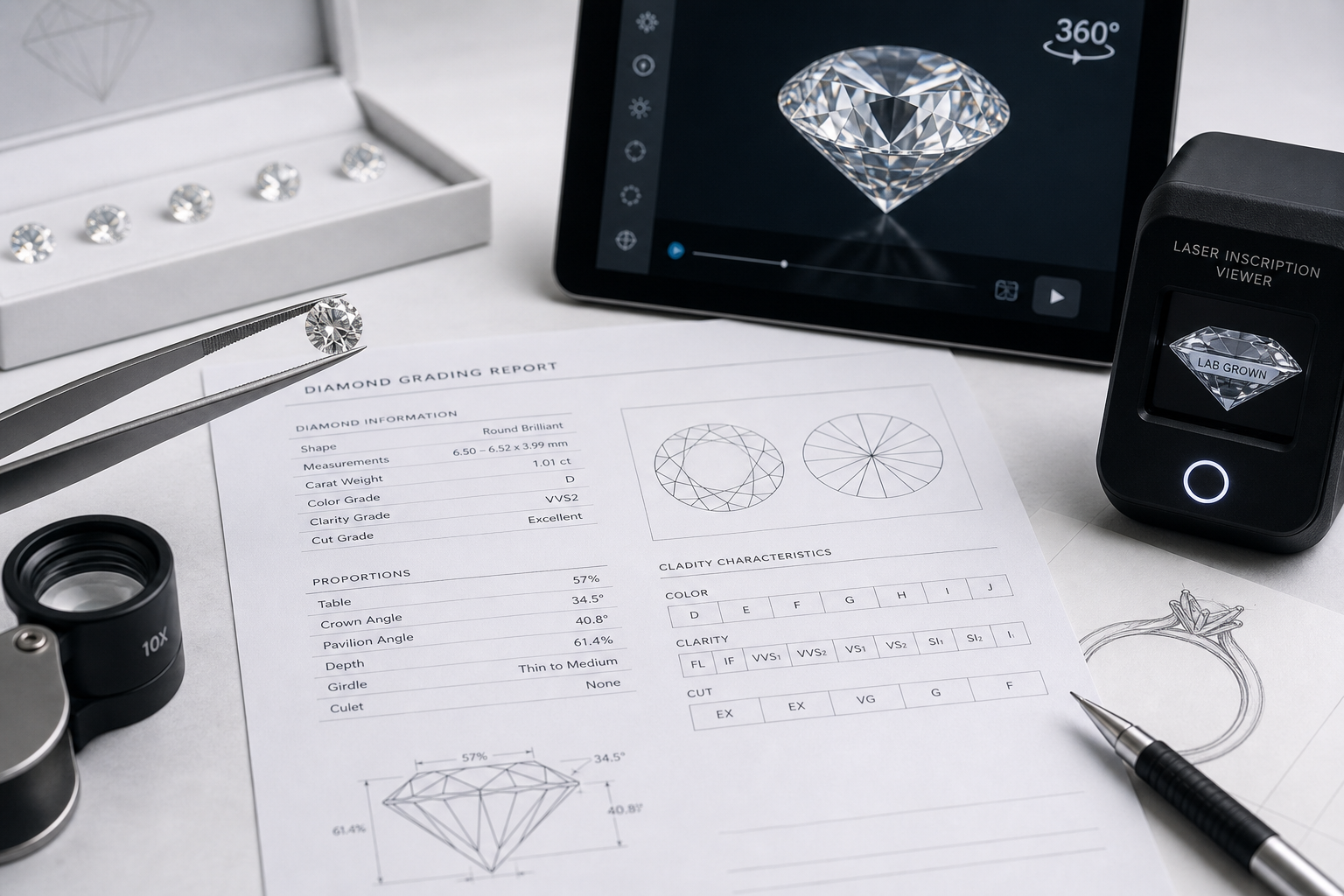
A grading report documents key characteristics, but it does not show every practical detail a buyer needs before approval. It will not fully explain face-up beauty, bow-tie visibility in an oval, windowing in an emerald cut, or how a diamond will look next to its matched partner in a finished layout. A report is a control point, not the whole quality review.
Report verification should be part of the sourcing process where available. Buyers should confirm the report number, inscription when applicable, carat weight, measurements, color, clarity, and shape against the actual stone being offered. This is especially important when multiple stones are moving through the same order, because document mismatch can create downstream problems for inventory, customer delivery, and after-sales communication.
A grading report also should not be read as a promise about every commercial concern. It can document diamond characteristics, but it does not automatically prove beauty, setting compatibility, sustainability, resale value, or that the order is packed and ready to ship. Those questions require separate evidence: actual media, measurement review, sourcing documentation where relevant, and a clear item-by-item shipment record.
At NUVU, documentation is treated as the starting point for comparison, not the final buying decision. The stronger approval process combines the lab-grown diamond grading report with photos, video, measurement data, and a clear understanding of how the stone will be used.
When a grading report is available, buyers should verify the report details through the issuing laboratory’s official report-check tool where available and compare those details with the actual stone, inscription, visual media, and order records.
Documentation Evidence: What buyers should keep in the order file
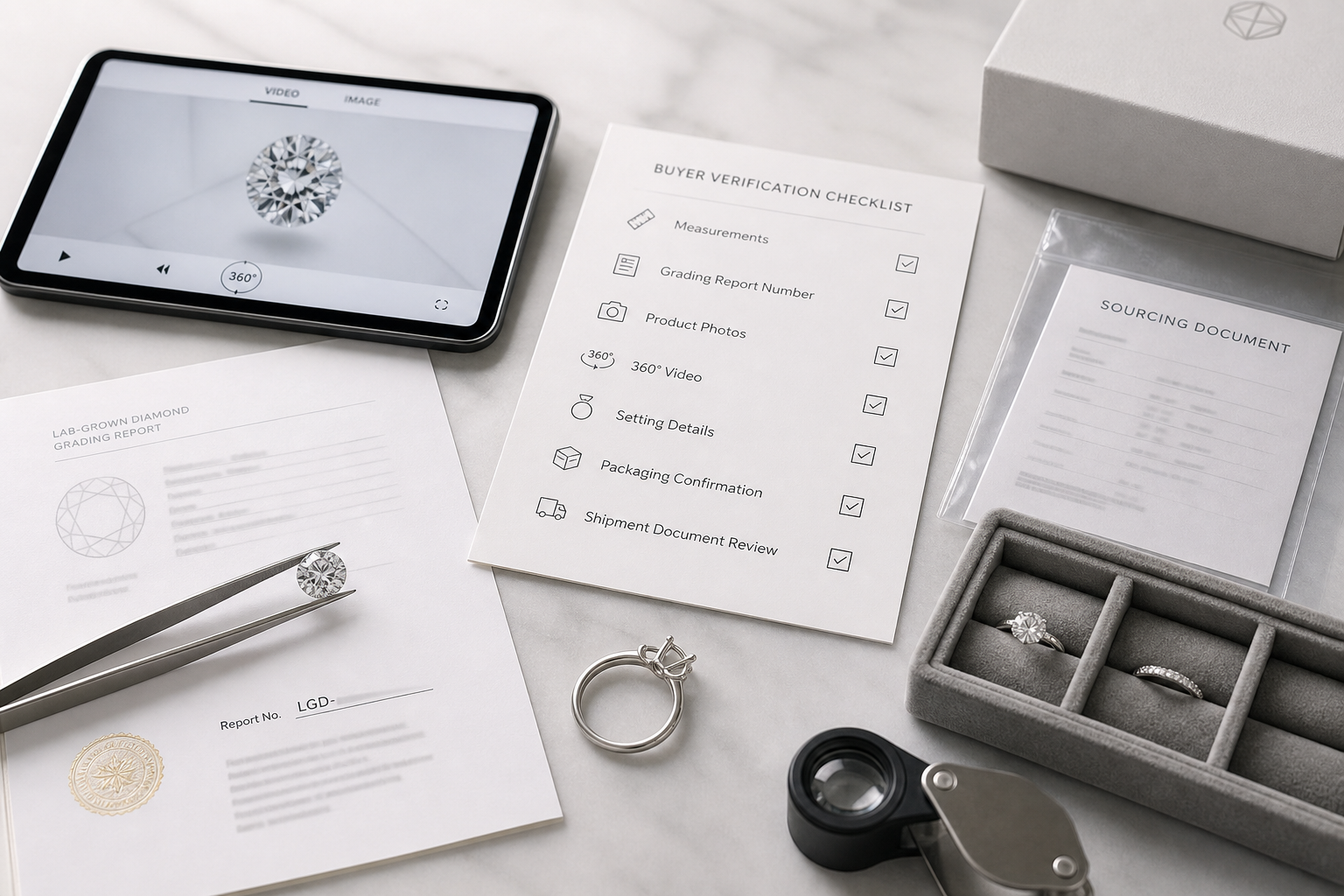
A well-supported purchase file should connect the commercial order to the physical goods. For a loose stone, that means the supplier quotation, confirmed measurements, actual photos or video, report information if applicable, inscription confirmation if applicable, and final shipment list. For finished jewelry, the file should also include the design specification, metal and setting details, stone layout, final inspection media, packaging confirmation, and any product labels needed for resale.
This order file matters because disputes are rarely about one isolated detail. They usually involve the relationship between several details: a stone measurement and a CAD file, a report number and a shipment line, a matched pair and a final earring set, or a retail label and the finished product. The stronger the evidence trail, the easier it is to confirm that the buyer received the goods that were approved.
A traceable file should also record changes, not only final approvals. If the buyer accepts a substitute stone, adjusts a tolerance, changes the report requirement, or approves a CAD revision, that update should be captured in writing. This prevents the final shipment from being judged against an outdated specification and gives both sides a clearer record of what was actually approved.
Certificate and Visual Review Check
- Decide the required lab before production is finalized. Changing the report requirement late can slow the entire order.
- Confirm whether the stone needs a laser inscription. If it does, the inscription should match the report and the internal order record.
- Review measurements against the design. A stone with a grading report can still be the wrong physical fit for a setting.
- Use video for visual judgment. Grading reports do not fully show light behavior, shape appeal, or matching quality.
- Match each document to the correct stone before shipment. This is especially important for multi-stone and wholesale orders.
Setting Workshops Reduce Custom Jewelry Delays When They Work Near the Stone Source
How stone measurements affect CAD, prong placement, and setting security
Custom lab-grown diamond jewelry depends on the relationship between the stone and the setting. A diamond can have the right carat weight, color, clarity, and report, yet still create problems if its measurements do not work with the CAD design. Length, width, depth, girdle thickness, corner shape, and pavilion profile can all affect how securely the stone can be set.
This is especially important for an engagement ring setting, where the center stone must sit at the right height and the prongs must hold the diamond without looking bulky or underbuilt. Fancy shapes make the issue sharper. Pears, ovals, emerald cuts, radiants, and elongated cushions can vary widely in outline, so a setting designed around a generic stone size may need adjustment once the actual diamond is selected.
When the setting workshop is near the stone source, CAD design can respond to the real stone faster. Instead of designing around assumed dimensions and correcting later, the workshop can build around confirmed measurements. That reduces the risk of late-stage problems such as uneven prong placement, poor stone seating, exposed corners, or a center stone that sits too high for the wearer’s daily use.
For custom design, the stone cannot be evaluated separately from the setting. A visually attractive oval, pear, or emerald cut may still be the wrong choice if its depth, corner shape, or spread creates a setting that is too high, too exposed, or difficult to secure. The better approval process checks the diamond as a loose stone and then checks it again as part of the intended mount.
For custom jewelry, stone measurements and setting compatibility should be confirmed before finalizing a purchase. This is especially important when a buyer is approving remotely, because photos and report details may not reveal every fit issue that affects prong placement, profile height, or long-term wearability.
Why nearby workshops make revisions easier before final finishing
A practical time to fix a custom setting issue is before casting, finishing, and final stone setting. Once metalwork is complete, even a small design mismatch can require extra labor or remaking parts of the piece. Nearby workshops help because questions can be resolved while the project is still flexible.
A simple custom ring workflow may include CAD adjustment after specifications are confirmed, followed by casting, metalwork, finishing, stone setting, and quality check. The exact timing depends on design complexity, workshop capacity, material availability, revision rounds, and inspection requirements. The important point is that each stage depends on the accuracy of the stage before it.
If the stone, CAD team, and setting workshop are disconnected across vendors and regions, revisions can slow down for reasons that have nothing to do with craftsmanship. The stone may need to be remeasured, photos may need to be resent, a CAD file may need clarification, or a workshop may discover too late that the selected diamond does not match the approved model. Nearby coordination makes those issues easier to catch before they become expensive delays.
How loose stone sourcing and finished jewelry production connect
Loose lab-grown diamonds and finished jewelry are often treated as separate sourcing decisions, but for custom and private-label jewelry production, they are part of the same timeline. The stone determines the setting requirements, and the setting determines which stone measurements are acceptable. Separating those decisions too aggressively can create a clean purchase order but a messy production process.
This is where a connected supply chain has practical value. A sourcing team can confirm whether the selected diamond fits the intended design, whether a matched pair will sit evenly in earrings, or whether a batch of calibrated stones is suitable for repeatable production. For a private-label jewelry order, this coordination can matter as much as the headline lead time because one inconsistent component can slow the entire batch.
The better buying judgment is to approve the stone and setting together whenever fit is critical. For a standard solitaire, the margin for adjustment may be broader. For a shaped center stone, halo, three-stone design, pavé layout, or matched earring pair, separating stone approval from setting approval increases the chance of preventable rework.
What to Check Before Approving a Custom Setting
- Confirm the exact stone measurements used in CAD. Do not rely on carat weight alone for design approval.
- Check prong placement against the actual diamond shape. This is especially important for corners, points, and elongated outlines.
- Review stone height and setting profile. A secure setting still needs to be practical for daily wear.
- Approve matched stones as a layout, not only individually. Earrings, side stones, and halos should be judged together.
- Clarify when changes become costly. Revisions are easier before casting and final finishing than after stone setting begins.
Logistics Coordination Compresses the Final Mile of Sourcing
The final stage of lab-grown diamond sourcing is where many timelines look finished but are not actually ready to ship. A stone may be cut, graded, and set, yet the order can still stall if inspection photos are missing, report numbers are not matched, stone counts are unclear, packaging has not been confirmed, or export documentation is prepared too late.
In a dense production environment, diamond logistics tend to move faster because the service providers involved are used to working around jewelry shipment coordination. That does not remove the need for checks. It simply reduces the number of disconnected handoffs between quality control, packaging, document preparation, and international shipping.
Why final inspection and document matching prevent avoidable delays
Final inspection should happen before an order is treated as shipment-ready, not after a carrier has already been scheduled. For loose stones, this means checking the stone count, carat weight, measurements, inscriptions where applicable, grading report numbers, and any parcel-level matching requirements. For finished jewelry, it also means reviewing setting security, stone alignment, metal finish, engraving details, ring size, clasp function, and visible workmanship.
The most avoidable delays usually come from small mismatches that should have been caught earlier. A grading report number may not match the listed stone. A parcel may include one stone outside the agreed size tolerance. A ring may be finished correctly but packed with the wrong document set. None of these issues are necessarily major production failures, but they can stop shipment because the buyer cannot responsibly approve the order without correction.
Document matching matters most when the order includes center stones with grading reports, matched pairs, or mixed jewelry pieces going to different retail customers. If report verification is left until the end, one unclear inscription or missing file can hold up the entire shipment. The better approach is to connect each stone or finished piece with its documentation before packing begins.
How packaging, export paperwork, and carrier handoff affect timing
Packaging is not just presentation. It protects stones, separates inventory, supports count accuracy, and reduces confusion when the shipment arrives. Loose lab-grown diamonds may need individual labeling, parcel separation, report pairing, and secure internal packaging. Finished jewelry may need protective boxing, anti-scratch separation, product labels, and packaging that matches the buyer’s retail or private-label requirements.
Export documentation can also become a bottleneck if the shipment details are not aligned with the physical goods. Descriptions, quantities, declared values, material details, and supporting documents need to be consistent. Buyers do not need to micromanage every logistics document, but they should understand that international shipping is not a single final step. It is a sequence: final quality control, report matching, packing, document preparation, carrier handoff, tracking, and receipt confirmation.
The advantage of a coordinated jewelry production area is that packaging teams, documentation support, and logistics partners often understand the rhythm of diamond and jewelry exports. The risk is assuming this coordination will happen automatically. A fast production handoff can still lose time if the order is packed before the buyer has approved final photos, videos, or itemized shipment details.
Why fast production still needs disciplined shipment coordination
Fast sourcing creates value only if the final mile is controlled. A rushed shipment with incomplete documentation can be worse than a slower shipment that is cleanly prepared, because the problem often appears after the order has already left the supplier’s hands. At that point, correcting a missing report, unclear item label, or mismatched product list becomes harder and more expensive.
The strongest shipment process is boring by design. The buyer receives the final inspection materials, confirms the order contents, verifies the key documents, and approves packing before the carrier handoff. This may add a small step before shipment, but it reduces the chance of a larger delay after dispatch.
For wholesale lab-grown diamonds, private-label jewelry, and custom orders, disciplined shipment coordination should be treated as part of quality control. A clean handoff is not just about speed; it protects inventory accuracy, customer confidence, and the ability to resolve questions quickly if something looks different on arrival.
Audit Trail: The final evidence package before shipment
Before shipment, the buyer should receive a concise evidence package rather than scattered messages. A practical package can include the final item list, stone or jewelry photos, videos where useful, report references if applicable, inscription confirmation if applicable, packaging details, and shipment preparation status. For multi-piece orders, each document should correspond to a specific shipment line so the receiving team can check goods efficiently.
This audit trail is especially useful when goods are going directly into retail inventory, client delivery, or a private-label launch. If a customer later asks about a stone, setting, document, or packaging detail, the buyer can trace the answer back to the approved shipment file rather than relying on memory or chat history. In a fast supply chain, this kind of documentation is what keeps speed from becoming disorder.
Shipment Readiness Check
Final inspection completed: Loose stones, finished jewelry, settings, metalwork, and visible workmanship have been reviewed before packing.
Reports matched: Grading report numbers, inscriptions where applicable, and stone identities align with the shipment list.
Stone count confirmed: Parcels, matched pairs, melee, center stones, and finished pieces are counted against the buyer’s order.
Photos or videos reviewed: The buyer has received enough visual confirmation to approve the order before carrier handoff.
Packaging confirmed: The packaging method fits the product type, buyer requirements, and shipment organization.
Shipping documents prepared: Export documentation is consistent with the physical goods and order details.
Tracking process clear: The buyer knows when the shipment has been handed to the carrier and how updates will be communicated.
Which Buyers Benefit Most From a Faster China-Based Supply Chain
The buyers who benefit most from a faster China-based supply chain are not simply those looking for the lowest quote. They are the buyers whose timelines depend on coordination across several steps, where real supplier evaluation can clarify whether a diamond company can manage stone selection, matching, cutting or polishing adjustments, grading documentation, setting, packaging, and shipment. The more connected those steps need to be, the more valuable a shorter sourcing loop becomes.
This is where China lab-grown diamond sourcing is most relevant for commercial buyers. Speed matters less for a one-off stone with flexible timing. It matters much more when a buyer needs repeated replenishment, consistent batches, matched diamond parcels, or finished jewelry that must arrive before a launch, client deadline, or retail season.
For wholesale buyers, consistency often matters as much as the headline price or fastest dispatch date. A batch that arrives quickly but varies in measurements, color impression, documentation format, or packaging method can create extra work for inventory teams and retail staff. The more repeatable the product needs to be, the more important it is to verify how the supplier maintains specifications across batches.
Wholesale buyers managing repeated replenishment
Wholesale buyers often need consistency more than novelty. If a buyer is replenishing loose lab-grown diamonds in popular size, color, and clarity ranges, the main challenge is not finding one acceptable stone. It is maintaining comparable inventory across multiple orders without restarting the sourcing process each time.
A faster supply chain helps when replenishment depends on quick stock confirmation, parcel matching, report coordination, and shipment preparation. The practical benefit is not only shorter lead time; it is fewer interruptions between orders. For wholesale lab-grown diamonds, a supplier that can respond quickly but cannot keep documentation, measurements, and matching standards consistent may still create downstream problems.
Private-label brands coordinating stones, settings, and packaging
Private-label jewelry sourcing depends on more than stone availability. The buyer may need stones matched to specific designs, settings produced to brand specifications, packaging aligned with retail presentation, and shipment organization that supports inventory intake. A fragmented model can slow this down because each part of the order depends on a different vendor’s timeline.
A more connected production environment is useful when the brand is building repeatable products rather than one-off pieces. Earrings, tennis bracelets, pendants, bridal styles, and small-batch collections often require consistent stone sizes, matching standards, metal finishes, and packaging details. If any one part drifts from the approved specification, the finished product may no longer feel like part of the same line.
Custom jewelers working under client timeline pressure
Custom jewelers benefit when loose lab-grown diamonds and jewelry manufacturing can be coordinated without long gaps between approval steps. A client may approve a center stone, but the project can still slow down if CAD adjustments, prong placement, casting, setting, finishing, and final review are handled through disconnected channels.
The biggest advantage is responsiveness. If a stone measurement affects the setting, or a design needs a small adjustment before finishing, nearby coordination can prevent a minor revision from turning into a week-long pause. For custom jewelry brands, this is often where speed has real value: not in rushing craftsmanship, but in reducing idle time between decisions.
Retailers needing matched stones or consistent product batches
Jewelry retailers often feel supply-chain delays most clearly when they need matched products. A single pendant may be simple to source, but matched studs, bracelet layouts, side-stone sets, and repeated ring styles require tighter control. Visual consistency becomes part of the retail experience, especially when products are photographed together or displayed in the same case.
Matched diamond parcels are where fragmented sourcing can create hidden problems. Stones may look acceptable individually but fail as a group because of slight differences in size, shape outline, color impression, or cutting style. A faster supply chain is useful only if it can support both speed and matching discipline.
Scenario: A Seasonal Jewelry Launch With a Tight Production Window
A U.S. boutique brand needs 30 pairs of matched oval lab-grown diamond earrings for a seasonal launch, with photography scheduled before the collection goes live. In a fragmented sourcing model, the brand may have to confirm stones with one supplier, matching with another, settings with a workshop, packaging with a separate vendor, and shipment through another channel. Each handoff adds a chance for delay or misunderstanding.
A clustered supply chain can coordinate stone matching, setting production, packaging, and shipment preparation more tightly, which may make the timeline easier to manage. The buyer still needs to confirm size tolerances, color and clarity ranges, report requirements if applicable, earring pair consistency, final photos, and quality control before relying on the schedule. Speed helps most when it is paired with clear approval points.
For buyers comparing China-based sourcing with fragmented global sourcing, the most useful trust signal is not a broad promise of speed. It is whether the supplier can connect each approved diamond to its measurements, report details when applicable, visual media, setting requirements, and final shipment line. This is especially important for wholesale replenishment, matched pairs, and private-label jewelry programs where one documentation gap can affect many finished items.
When a lab-grown diamond is supplied with a grading report, buyers should confirm that the report number, carat weight, shape, measurements, color, clarity, and inscription where applicable match the exact stone being approved. This report-aware workflow helps prevent the common problem of treating a stone with a grading report as automatically ready for production, when it may still need visual review, layout matching, or setting-fit confirmation.
When a grading report is provided, buyers should compare the report details with the issuing laboratory’s verification tools where available and keep a record that links the report to the exact stone or finished item being approved.
If a GIA, IGI, GCAL, or other laboratory report is part of the order, the buyer should confirm the available verification method through the issuing laboratory rather than relying only on a supplier screenshot or summary.
For finished jewelry and custom orders, confidence should come from a complete approval trail rather than from verbal assurances alone. A practical trail includes the selected diamond specifications, CAD or design details, metal and setting information, final inspection media, packaging confirmation, and the documents that will travel with the order. This gives the buyer a clear way to check that the item delivered is the same item approved before production or shipment.
Return, resizing, documentation, and after-sales terms can affect timeline planning, especially when a buyer is sourcing for resale, customer delivery, or a launch schedule. Because these are seller-specific policies, buyers should confirm them in writing before purchase rather than assuming they are included. Clear terms do not replace quality control, but they help the buyer understand what process applies if an item does not match the supplied documentation or agreed specification.
Before purchase, buyers should confirm the seller’s documentation, return policy, resizing terms, and after-sales support in writing, especially for custom jewelry, wholesale batches, and time-sensitive retail orders.
Where Faster Sourcing Still Needs Caution
Faster sourcing is useful only when it is controlled. A shorter production loop can reduce waiting time, but it does not automatically guarantee quality control, documentation accuracy, stone consistency, or clear responsibility if something needs correction. This is true in any sourcing region, and it becomes especially important when buyers are working remotely across time zones.
The main lab-grown diamond sourcing risk is not that speed exists. The risk is treating speed as proof that the process is reliable. A supplier can move quickly and still miss a measurement detail, ship incomplete documentation, use unclear product descriptions, or assume that a visual match is acceptable when the buyer expected a tighter standard.
Why faster production can still fail without clear specifications
Clear specifications matter more when the timeline is compressed. If the buyer has not defined shape, measurements, color range, clarity range, ratio, report requirements, setting details, metal type, finish, packaging expectations, and acceptable tolerances, the supplier has to make assumptions. Those assumptions may be reasonable from a production standpoint but wrong for the buyer’s use case.
This is especially important for matched stones and custom jewelry. “Matching ovals” is not a complete instruction. The buyer may need agreement on length-to-width ratio, millimeter spread, color impression, bow-tie visibility, and how closely the stones must match when viewed as pairs. For a finished ring, the center stone measurements should be confirmed against CAD and setting design before final production, not after the piece is finished.
Speed becomes a liability when it moves an unclear order forward too quickly. A slower approval process at the beginning is often better than fast rework at the end.
How inconsistent documentation creates downstream problems
Documentation is not only a trust signal; it is an operational control. If grading report numbers, inscriptions, stone measurements, parcel details, or product labels do not align, the buyer may struggle to receive inventory, list products accurately, satisfy customer questions, or resolve after-sales issues.
A grading report can document important details about a diamond, but it does not organize the order by itself. The buyer still needs the report connected to the correct stone, the correct product, and the correct shipment line. For jewelry retailers and private-label brands, one mismatched document can create confusion across photography, product pages, customer service, and inventory systems.
Documentation also needs to match the level of the order. A center stone with an individual grading report may require a different review process than melee in a bracelet or accent stones in a fashion piece. The mistake is applying one documentation expectation across every product type without deciding what level of verification is actually needed.
Why photos, videos, measurements, and written confirmations matter
Remote sourcing depends on evidence. Photos and videos help confirm appearance, but they should not be treated as a replacement for measurements, written specifications, and report verification where applicable. A stone can look attractive in a video and still be the wrong size for a setting, the wrong ratio for a matched pair, or outside the buyer’s agreed tolerance.
Written confirmations reduce ambiguity. They should define what is being supplied, what has been approved, what documentation is included, how the stones or jewelry are packaged, and who is responsible if an item does not match the approved specification. This does not need to be complicated, but it does need to be explicit.
At NUVU, speed is treated as valuable only when the comparison materials are clear enough for the buyer to make a real judgment. A fast answer without measurements, documentation, and visual confirmation is not transparency; it is just a shorter conversation.
Supplier Verification Checklist
Written specifications: Shape, size, color, clarity, carat range, ratio, report requirements, setting details, metal, finish, and packaging expectations are confirmed before production or shipment.
Measurement review: Center stones, matched pairs, calibrated stones, and setting-dependent diamonds are checked against the design or order requirement.
Report matching: Grading report numbers and inscriptions where applicable are matched to the correct stones and shipment lines.
Visual confirmation: Photos and videos show the actual stones or jewelry being approved, not only representative examples.
Sample approval: For repeat or private-label production, a sample or first batch is reviewed before relying on larger quantities.
Quality control responsibility: The buyer knows who checks the order, what is checked, and how corrections are handled if something does not match.
Packaging and shipment clarity: Packaging format, item labeling, document inclusion, and shipment preparation are confirmed before carrier handoff.
Communication standards: Approval points, update expectations, and correction procedures are clear enough to prevent rushed assumptions.
How to Compare a Dense Supply Chain With Fragmented Global Sourcing
The right way to compare lab-grown diamond sourcing is not to ask which supplier quotes the shortest timeline. Ask which sourcing model gives you the most control over that timeline. A fast estimate is easy to promise before production starts; reliable production coordination is harder to prove.
China sourcing versus global sourcing is not a simple winner-take-all comparison. A dense supply chain can be faster when the order depends on matching, customization, rework, or finished jewelry production. Fragmented global sourcing can still work well for straightforward orders when inventory is already available, documentation is complete, and the buyer does not need many adjustments. The mistake is treating both models as equal after seeing the same quoted lead time.
Count the handoffs, not just the quoted production days
A quoted sourcing timeline usually counts the visible production window. It may not fully account for waiting between vendors, repeated approvals, report handling, re-shipping, packaging corrections, or final inspection. Those gaps are where fragmented sourcing often loses time.
For a simple loose stone purchase, the difference may be minor if the stone is already cut, graded, photographed, and ready to ship. For a matched parcel, custom ring, private-label batch, or calibrated jewelry program, every extra handoff adds risk. One vendor confirms stones, another handles cutting or matching, another manages reports, another produces the setting, and another prepares shipment. If one detail changes, the order can move backward instead of forward.
When comparing suppliers, ask for the operational map behind the timeline. A buyer should know how many parties touch the order, where the stones move between stages, who confirms measurements, who approves quality control, and who is responsible if a stone does not match the specification. A shorter quoted timeline with unclear handoffs is usually weaker than a slightly longer timeline with clear ownership.
Ask who controls cutting, grading coordination, setting, and shipment
The most useful supplier evaluation question is not “Can you do this quickly?” It is “Which parts do you directly coordinate, and which parts depend on outside vendors?” Direct coordination does not require that one company physically performs every task, but it does require that someone owns the sequence and can resolve issues without sending the buyer in circles.
For loose lab-grown diamonds, the key control points are inventory accuracy, measurement confirmation, report matching, photo or video review, and final shipment preparation. For finished jewelry, the control points expand to CAD fit, setting compatibility, stone security, finishing, packaging, and product-level inspection. If no one can explain how those steps connect, the sourcing model is not transparent enough for a tight deadline.
Documentation matters here because diamond supply chain transparency is practical, not just ethical language. A buyer should be able to match the stone, report number, inscription when applicable, measurements, images, and final product details before payment or shipment. If documentation arrives late or from disconnected sources, the buyer may only discover a mismatch after the order is already difficult to correct.
Compare timeline confidence, not only speed claims
Speed claims are easy to exaggerate because they often describe the best-case version of an order. Timeline confidence is more useful. It measures how likely the quoted schedule is to hold when normal sourcing problems appear: a stone needs replacement, a pair does not match closely enough, a report is delayed, a setting needs adjustment, or shipment paperwork requires correction.
A dense supply chain usually has an advantage when rework must happen quickly. If cutting, grading coordination, setting, and logistics are closely connected, a supplier can often identify the problem and move the order to the next correction step faster. In fragmented global sourcing, the same issue may require emails across time zones, new shipping between vendors, and repeated quality checks because no single party has full visibility.
The practical question is whether the order has enough complexity to justify prioritizing supply-chain density. If you are buying one available loose stone with a verified report, speed may depend more on documentation and shipping readiness than on the wider production ecosystem. If you are building a batch of matched jewelry or a custom piece with specific measurements, production coordination becomes the main driver of reliability.
Final Decision Framework
Use this framework when comparing lab-grown diamond suppliers by timeline and documentation:
- Count the vendors involved. Fewer visible handoffs usually means fewer opportunities for delay, but only if quality control is still properly documented.
- Identify who owns corrections. If a stone, setting, report, or shipment detail is wrong, one responsible party should be able to resolve it.
- Check matched-stone capability early. Matching pairs, layouts, melee, and calibrated stones should be confirmed before production timing is treated as reliable.
- Verify documentation flow. Reports, inscriptions, measurements, images, and final product details should connect clearly before shipment.
- Separate available inventory from made-to-order work. Ready stones and custom jewelry follow different timeline logic, even when quoted by the same supplier.
- Judge communication speed by issue handling. Fast replies are helpful, but the real test is how clearly a supplier responds when a specification changes or a problem appears.
Compliance-Safe Claims Buyers Should Expect
Clear sourcing language protects both the buyer and the seller. A supplier can explain that laboratory-grown diamonds have a different origin from natural diamonds, that a stone is produced through a CVD or HPHT growth method when documented, and that a dense production network may shorten coordination time. Those statements should remain tied to the specific order, available documents, and actual workflow rather than becoming broad claims about every stone or every supplier.
Environmental and sustainability claims should be specific, documented, and limited to what can be substantiated. A laboratory-grown origin may appeal to buyers looking for an alternative to mined origin, but it should not be used by itself as proof of low impact, carbon neutrality, or responsible sourcing. If a buyer plans to repeat sustainability or sourcing claims to retail customers, the supporting information should be reviewed before the product is marketed.
A grading report helps document key characteristics, but it should not be treated as a guarantee of beauty, value, or sourcing ethics. Buyer confidence should come from a combination of report details, visual evidence, measurement checks, setting compatibility, seller documentation, and clear written approvals.
Evidence-Based Sourcing Summary
The most reliable comparison is not “China versus everywhere else” in the abstract. It is whether the supplier can show a shorter, better-controlled path from stone selection to final shipment. Buyers should look for visible proof of stage control: confirmed inventory, measurement records, grading coordination, setting fit checks, quality-control media, document matching, and organized shipment preparation.
A dense supply chain can reduce waiting time because the people who solve problems are closer to the problem. But density only becomes a buyer advantage when the supplier turns that proximity into clear specifications, accountable handoffs, and documented approvals. Without those controls, fast sourcing can still produce uncertainty.
A dense China-based supply chain can shorten sourcing timelines because related capabilities are closer together and easier to coordinate. Fragmented global sourcing can still be suitable when the order is simple, documented, and already available. The stronger choice is the model that gives you clearer control over handoffs, corrections, documentation, and shipment readiness, not the one with the most aggressive lead-time claim.
Disclosure: This article is for general educational purposes only. Diamond grading, pricing, availability, specifications, and seller policies can change, and readers should verify important details through grading reports, official laboratory tools, seller documentation, or qualified professionals before making a purchase decision. Laboratory-grown diamonds should be clearly distinguished from natural diamonds, and environmental or sourcing claims should be supported by specific documentation.