
HPHT and CVD are often treated as shortcuts for judging lab-grown diamonds, especially when sourcing from China, but Chinese supplier verification should focus on more than the production method alone, because it does not tell you whether a stone, parcel, or finished piece is the right buy. The more important questions are practical: what is actually in stock, what documentation supports it, how consistent the stones look, whether treatments are disclosed, and which parts of production the supplier truly controls.
For the full framework, read Lab-Grown Diamond Manufacturers in China Guide.
This article helps buyers look past simple method comparisons and evaluate the full sourcing picture. Whether you are choosing a reported center stone, buying matched melee, building custom jewelry, or comparing wholesale suppliers, the goal is to judge the final product by verified details: reports, measurements, images, videos, batch tolerances, lead time assumptions, and written handling expectations if goods do not match the approved specification. The right choice may be HPHT, CVD, or a mixed supply approach, depending on the product and the level of control required.
Laboratory-grown diamonds should be clearly identified as laboratory-grown, and they should not be presented as mined diamonds. HPHT and CVD describe growth methods for laboratory-grown diamonds; they are not the same as diamond simulants and should not be used to blur the difference between laboratory-grown and natural diamond origin.
Because no single document or supplier label proves every part of a sourcing claim, buyers should separate evidence into categories. A grading report can support stone-level characteristics; a video can support visual review; a batch sheet can support parcel specifications; and a written supplier statement can clarify production method, treatment disclosure, or inventory status. Keeping those evidence types separate makes the buying decision more defensible and reduces the risk of treating a marketing claim as proof.
| Buying Situation | What to Verify | Main Risk to Avoid |
|---|---|---|
| Single center stone | Report, inscription, proportions, video, treatment disclosure | Assuming method equals beauty or value |
| Matched parcels | Color range, size tolerance, brightness, repeat supply | Receiving stones that do not match in finished jewelry |
| Custom jewelry | Stone-to-setting fit, layout approval, production timeline assumptions | Approving diamonds before confirming design compatibility |
| China wholesale sourcing | Supplier role, stock status, QC process, substitution expectations | Buying from a trader without clear control or accountability |
| Comparing HPHT and CVD quotes | Cut, clarity, color nuance, documentation, lead time assumptions | Choosing the lowest per-carat price without total value review |
| Sustainability or origin claims | Written evidence, traceability limits, supplier disclosures | Treating broad claims as proof of responsible sourcing |
Quick Questions Before You Read
Q: Is HPHT better than CVD?
Not automatically. Either method can produce attractive laboratory-grown diamonds, so judge the specific stone or parcel by verified quality details.
Q: Does a grading report prove everything I need to know?
No. A grading report helps document key characteristics, but it should be checked against videos, measurements, inscriptions, disclosures, and seller terms.
Q: Why does the supplier’s role in China matter?
Because a grower, cutter, jewelry factory, wholesaler, and trader may control different parts of the process and offer different levels of consistency.
Q: When is mixed HPHT and CVD sourcing useful?
It can work well for brands buying different product types, as long as specifications, approvals, and quality checks are tightly controlled.
HPHT and CVD in China: The Practical Difference Buyers Need to Know
For buyers evaluating HPHT lab-grown diamonds in China or CVD lab-grown diamonds in China, the production method is useful information, but it should not be treated as a shortcut for quality. HPHT and CVD describe how the diamond crystal was grown. They do not, by themselves, tell you whether a stone is well cut, visually attractive, properly documented, or suitable for your product line.
The practical difference is this: HPHT and CVD can influence the kinds of goods a supplier commonly offers, how stones are disclosed, what quality issues need closer review, and whether the supplier is truly aligned with your sourcing goal. A buyer asking about HPHT vs CVD diamonds is usually not just asking a science question. The real question is whether the production route supports the inventory, consistency, documentation, and communication the buyer needs.
For buyers, the practical point is not just what the production method says, but how the finished diamond performs visually and whether the supplier can connect that performance to documents, measurements, and reliable communication. A grading report, supplier video, and written quotation each answer different questions. The report describes measurable characteristics, the video helps judge appearance, and the quotation defines what is being sold. Treating any one of these as the whole answer can lead to a weaker sourcing decision.
What HPHT Production Means in Practical Terms
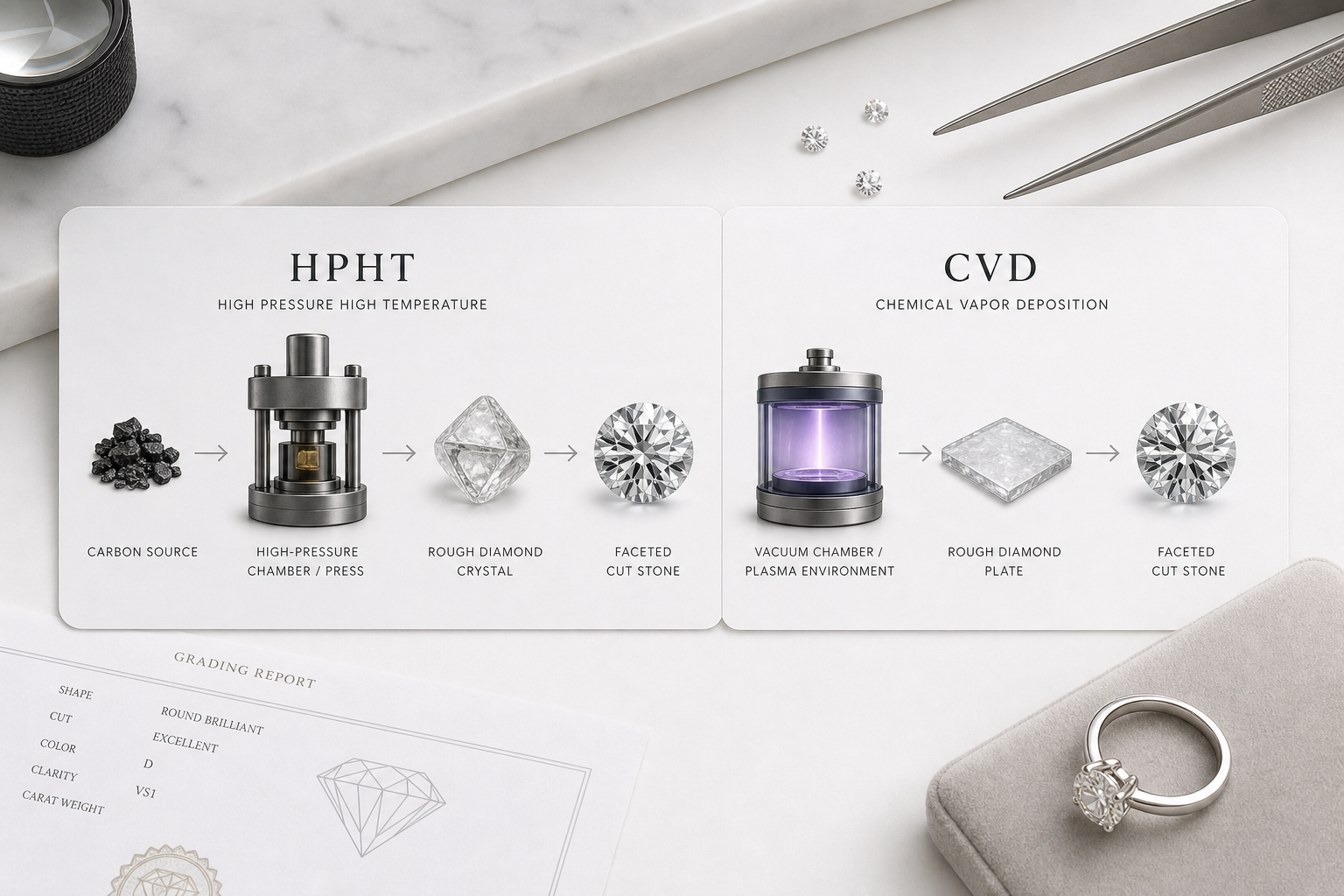
HPHT stands for high pressure, high temperature. In simple terms, this method grows diamond under very high pressure and temperature conditions. In China lab-grown diamond manufacturing, HPHT production is one of the established routes for creating diamond crystal that can later be cut, polished, graded, and sold as loose stones or set into jewelry.
For sourcing purposes, the key point is not the equipment itself. Buyers should focus on what the supplier can reliably provide from that production route. Some HPHT-focused suppliers may be strong in certain sizes, shapes, or repeatable product categories, while others may mainly trade stones produced elsewhere. The production label is only useful if it connects to real inventory capability and clear documentation.
A common mistake is assuming that “HPHT” automatically means better or worse than CVD. It does not. An HPHT stone still needs to be evaluated through its grading report, proportions, measurements, visual performance, and any relevant disclosure. If a supplier leans heavily on the method as a selling point but cannot provide consistent specifications or clear review materials, the buyer should slow down rather than treat the method as proof of value.
What CVD Production Means in Practical Terms
CVD stands for chemical vapor deposition. This method grows diamond crystal in a carbon-containing gas environment, layer by layer. It is another major route used in lab-grown diamond production and is widely discussed in China-based sourcing conversations, especially when buyers compare available loose diamonds, larger stones, or supplier specialization.
From a buyer’s perspective, CVD is best understood as a production category that may shape the supplier conversation. It can affect what the supplier regularly stocks, what kinds of grading reports are available, and what questions should be asked about post-growth treatment or visual review. The method itself is not a final quality grade.
The non-obvious risk with CVD sourcing is treating the production term as if it explains the whole stone. Two CVD diamonds with the same carat weight and color grade can still perform very differently once cut. One may face up bright and balanced; another may show less appealing proportions, strain-related visual effects, or a look that does not match the buyer’s intended setting. The right comparison is not only HPHT versus CVD, but documented stone versus undocumented claim, inspected inventory versus generic listing, and supplier capability versus supplier promise.
Why Production Method Matters More in Sourcing Than in Marketing
For retail marketing, HPHT and CVD are often presented as simple labels. For sourcing, they are more useful as clues. They help buyers ask better questions about availability, treatment disclosure, quality control, and supplier specialization. The method can guide the conversation, but it should not replace the inspection process.
This matters most when the buyer is sourcing for a specific business outcome. A retailer looking for reported center stones needs different support than a jewelry brand ordering matched accent stones for repeat production. A custom ring project may depend on one carefully selected diamond, while a wholesale jewelry program may depend on consistency across many stones. In each case, the production method is only one input in a larger sourcing decision.
The stronger approach is to ask what the supplier can prove. Can they identify whether a stone or batch is HPHT or CVD? Can they provide grading reports where applicable? Can they disclose whether post-growth treatment is relevant? Can they provide images, videos, measurements, and written specifications? A supplier who answers these questions clearly is more useful than one who only promotes a production method as superior.
When growth method or post-growth treatment is relevant, buyers should look for clear disclosure in the grading report or seller documentation. HPHT and CVD should normally be understood as laboratory-grown diamond production methods unless the discussion is specifically about a post-growth treatment or enhancement.
Buyer Verification Checklist
- Confirm whether the stone or batch is HPHT-grown, CVD-grown, or mixed inventory.
- Ask whether any post-growth treatment is disclosed or relevant to the stones being offered.
- Request grading reports for reported stones, and do not rely on production method as a substitute for grading.
- Review photos, 360-degree videos, measurements, and proportions before approving important stones.
- Ask whether the supplier is producing, cutting, trading, or assembling goods from multiple sources.
- For repeat orders, confirm whether the supplier can maintain consistency beyond the first sample.
The careful sourcing position is to treat HPHT and CVD as starting points for verification, not final judgments. A buyer who understands the method but still checks the stone, the paperwork, and the supplier’s role is less likely to make a decision based on incomplete information.
How China’s Lab-Grown Diamond Supply Chain Uses HPHT and CVD Production
China’s lab-grown diamond supply chain is not a single type of supplier offering one kind of product. It includes growth facilities, cutting and polishing operations, loose diamond wholesalers, jewelry manufacturers, export-focused trading companies, and integrated suppliers that manage several steps of the process. HPHT diamond production and CVD diamond production both fit into this broader ecosystem, but not every supplier is involved in every stage.
This distinction matters because a buyer may believe they are dealing directly with a manufacturer when they are actually speaking with a trading company, or may assume a jewelry factory controls diamond growth when it only sources stones for finished pieces. Neither model is automatically a problem. The risk comes from misunderstanding what the supplier can actually control.
Growth Facilities, Cutting Workshops, and Finished Jewelry Production
Lab-grown diamond manufacturing begins with crystal growth, but the buyer rarely purchases a finished product at that stage. Rough material must be planned, cut, polished, inspected, and in many cases submitted for grading. If the diamond is being used in jewelry, it must also be matched to a setting, produced to the right measurements, and checked for final appearance.
In China, some businesses specialize in one part of that chain. A growth facility may focus on producing rough material. A cutting workshop may focus on turning rough into polished stones. A jewelry manufacturer may specialize in rings, bracelets, earrings, or private-label production while sourcing stones from outside partners. A wholesaler may hold ready inventory across HPHT and CVD categories without growing the diamonds directly.
The practical takeaway is that “manufacturer” can mean different things in different conversations. A buyer sourcing loose reported diamonds should ask different questions than a buyer sourcing finished jewelry. The first needs strong stone-level documentation and visual review. The second also needs stone-to-setting coordination, matching discipline, and production communication.
Why Supplier Type Affects What You Can Actually Source
Supplier type affects inventory access, flexibility, response time, and accountability. A supplier close to growth and cutting may have better visibility into upcoming goods, but may not be the right partner for every finished jewelry project. A jewelry manufacturer may be excellent at setting and assembly, but may depend on outside diamond sources for specific HPHT or CVD inventory. A trading company may offer broad selection, but the buyer should be clear about how quality claims are verified.
This is where sourcing from China requires more than comparing product lists. If a supplier offers wholesale lab-grown diamonds across many sizes, shapes, and qualities, the buyer should ask which goods are in hand, which are sourced after order confirmation, and which can be repeated in future batches. A large catalog does not always mean controlled inventory.
The mistake to avoid is choosing a supplier only because they show the widest range. Breadth can be useful, but repeatability is often more important for retailers and jewelry brands. If a buyer needs consistent 1.50 carat oval center stones or calibrated melee for a bracelet line, the most suitable supplier is not necessarily the one with the most listings. It is the one that can explain what is available now, what can be matched, and what must be confirmed before production.
In practical buying, “factory direct” should be treated as a claim to clarify, not a conclusion to accept. A direct grower may still outsource cutting, a jewelry factory may still buy polished stones from several channels, and a trader may still provide strong service if documentation and quality control are disciplined. The useful question is not whether the label sounds impressive, but whether the supplier’s responsibilities are clear enough for the buyer to hold the order to a written standard.
China-linked supply chains can offer manufacturing depth and scale in some categories, but buyers still need to evaluate consistency, documentation, communication, and quality control. Sourcing from China should not be treated as automatically cheaper, lower risk, higher quality, or better suited to every buyer; the result depends on the specific supplier, order type, verification process, and written expectations.
Factory, Trading Company, or Integrated Supplier: Why the Difference Matters
A factory, a trading company, and an integrated supplier can all be legitimate sourcing partners, but they create different buyer-side risks. A factory may provide stronger production control in its specialty area, but may have narrower inventory. A trading company may help buyers access a wider range of HPHT and CVD goods, but the buyer needs clear documentation and quality control standards. An integrated supplier may coordinate stones, cutting, jewelry production, and export communication, but buyers should still verify which steps are handled directly and which are outsourced.
For wholesale buyers, the most practical question is not “Are you a factory?” It is “Which part of the supply chain do you directly control for this order?” That question produces more useful answers. A supplier may grow HPHT rough but outsource cutting. Another may not grow diamonds at all but may have strong relationships with cutters and grading workflows. A finished jewelry producer may be the right choice if the order depends more on setting accuracy and matched layout than on direct growth access.
A supplier’s role should match the buyer’s risk. If the project depends on exact diamond specifications, documentation and stone-level review matter most. If the project depends on finished jewelry consistency, production coordination becomes equally important. If the order will repeat seasonally, the supplier’s ability to reproduce the same look may matter more than whether they can source a one-time attractive price.
In sourcing or wholesale conversations, documentation, consistency, and communication often matter as much as the headline specification. A supplier who clearly separates what is in stock, what must be sourced, what is being produced, and what is only an estimate gives the buyer a better basis for planning than a supplier who compresses all of those points into a single attractive quotation.
What to Confirm About the Supplier’s Role
- Whether the supplier grows diamonds, cuts and polishes stones, trades polished inventory, manufactures finished jewelry, or coordinates multiple partners.
- Which production methods they regularly handle, including HPHT, CVD, or both.
- Whether the quoted stones are currently in stock or sourced after order approval.
- Who is responsible for grading reports, report verification, measurements, and final inspection.
- Whether the supplier can repeat the same specifications for future orders.
- How quality issues, substitutions, or mismatched goods are handled in writing.
China’s supply chain can be useful for many kinds of lab-grown diamond sourcing, but only when the buyer understands where the supplier sits inside that chain. A clear supplier role reduces confusion before it turns into product mismatch, documentation gaps, or production delays.
How Production Method Can Affect Availability, Size Range, and Inventory Planning
HPHT and CVD do not matter only after a diamond is graded. They can also affect what a buyer can source efficiently from a particular supplier. Availability, size range, shape mix, and matching capacity often depend on the supplier’s production relationships and inventory structure, not just on broad market claims about one method versus the other.
The most useful way to approach lab-grown diamond availability is to start with the product goal. A buyer sourcing one reported engagement ring center stone has a different sourcing problem than a brand ordering matched stones for tennis bracelets, halo rings, or earrings. In one case, the priority is selecting the right individual stone. In the other, consistency across many stones can be the harder requirement.
Why Size and Shape Availability May Vary by Supplier
Some suppliers may have stronger access to certain HPHT diamond sizes, while others may be more competitive in specific CVD diamond sizes or shapes. This does not mean one growth method is universally better for a given size. It means the buyer should ask what that supplier can provide consistently, with documentation, at the quality level required.
A buyer looking for 1.00 to 2.00 carat round brilliant stones for engagement rings may find multiple suppliers able to quote options quickly. The more important question becomes whether those stones have reliable grading reports, appealing proportions, and enough visual material to compare. A buyer seeking larger elongated fancy shapes, such as ovals, emerald cuts, or radiants, may need a more selective review because shape appeal depends heavily on cut style, outline, bow-tie visibility, and face-up appearance.
For small accent stones, the conversation changes again. The issue may not be whether each individual stone looks impressive on its own, but whether hundreds of stones look consistent together. A supplier that is strong in reported loose center stones may not be equally strong in calibrated parcels. The reverse can also be true.
Single Stones Versus Matched Parcels
Single-stone sourcing rewards selectivity. The buyer can compare one diamond against another and reject stones that do not meet the desired balance of carat weight, shape, color, clarity, cut quality, and documentation. If the stone is for a custom engagement ring, one well-matched option may be enough.
Matched parcels require a different standard. A parcel for a tennis bracelet, eternity band, halo setting, or pair of earrings must be judged as a group. Even if the individual stones are acceptable, the parcel can fail if the stones vary too much in diameter, depth, color impression, or overall brightness. For small accent stones where appearance consistency matters, buyers often need measurement tolerances discussed in millimeters, not just carat weight.
As a practical planning point, buyers sourcing small calibrated stones should confirm acceptable measurement tolerance before approving a batch. For tight jewelry layouts, a tolerance around 0.05 to 0.10 mm may matter, depending on stone size, setting style, and design sensitivity. This is not a universal rule for every order, but it is the kind of detail that prevents a parcel from looking uneven once the stones are set.
How Inventory Planning Changes for Engagement Rings, Melee, and Fine Jewelry
For engagement ring center stones, the buyer can usually prioritize stone-by-stone review. A smaller number of candidates can be compared through reports, measurements, videos, and setting suitability. If a supplier offers both HPHT and CVD options, the buyer should compare the actual stones rather than choosing by method first.
For melee and accent stones, planning should focus on batch consistency and repeat availability. The buyer needs to know whether future orders can match the first approved parcel closely enough for the same jewelry line. A one-time attractive parcel may create problems if the next batch looks noticeably different in color, size, or brightness.
For fine jewelry programs, the sourcing decision often sits between these two extremes. Earrings may require pair matching. Line bracelets require consistency across many stones. Pendant and ring collections may require a mix of center stones and calibrated accents. In these cases, the more suitable supplier is usually the one that can coordinate inventory by product need, not merely quote HPHT or CVD categories.
Before placing a larger wholesale diamond inventory order, a sample order of 3 to 10 stones or a small trial parcel can be more useful than extended negotiation over the lowest unit price. Samples reveal how the supplier grades, measures, communicates, packs, and responds to specification questions. Lead time assumptions should also be confirmed in writing because availability can change quickly, especially when the order depends on matching, grading reports, or finished jewelry production.
What This Means in a Real Purchase
Consider two buyers sourcing from China. One needs a few 1.50 to 2.00 carat reported oval diamonds for custom engagement rings. The smarter path is to request individual reports, exact measurements, videos, and confirmation of whether each stone is HPHT or CVD, then choose based on appearance and fit for the setting. A broad claim that one method is better will not answer whether a specific oval has an attractive outline or acceptable bow-tie effect.
Another buyer needs several hundred small stones for a bracelet line. For that order, production method is less important than matching control, measurement tolerance, color consistency, and the supplier’s ability to repeat the parcel later. A lower quote can become a poor decision if too many stones fail layout review or if the second order no longer matches the first.
The practical sourcing rule is to plan around the finished use. HPHT and CVD may influence the supplier conversation, but inventory strategy should be driven by the product category, the required consistency, and the evidence the supplier can provide before the buyer commits.
Color, Clarity, and Post-Growth Treatment: What Buyers Should Ask About
Production method can influence the color and clarity conversation, but it should not be treated as a shortcut for judging a stone. HPHT and CVD diamonds can both be attractive, well-graded, and suitable for fine jewelry. They can also both have issues that are easy to miss if China lab-grown diamond supply chain speed is mistaken for verification and the buyer relies only on a brief supplier description.
The practical question is not “Is HPHT better?” or “Is CVD better?” The better question is whether the specific diamond or batch has the color, clarity, treatment disclosure, and visual appearance needed for the buyer’s product. A diamond grading report helps, but it does not replace reviewing the actual stone, especially for wholesale orders, custom jewelry, or matched layouts where consistency matters.
Why Production Method Can Influence Color Conversations
HPHT and CVD production can be associated with different color considerations, but buyers should avoid broad assumptions. Some CVD lab-grown diamonds may require closer review for brownish, grayish, or warm undertones. Some HPHT lab-grown diamonds may require closer review for blue nuance or other subtle color characteristics. These are not automatic defects, and they are not present in every stone from a given method.
The mistake is treating the color grade as the whole answer. Two lab-grown diamonds with the same stated color grade can face up differently depending on body tone, cut style, lighting, and the buyer’s tolerance for nuance. This matters more in certain use cases. A faint color nuance may be less noticeable in a yellow gold fashion ring, but it can become more obvious in a white metal engagement ring or in a matched parcel where one stone looks cooler or warmer than the others.
For sourcing from China-based suppliers, buyers should ask for the stated color grade, the production method, and visual confirmation under consistent lighting. If a supplier is offering a batch of stones rather than one reported center stone, the key question is whether the stones match each other well enough for the intended design. In bracelets, earrings, and multi-stone rings, color consistency across the layout can matter more than chasing the highest individual color grade.
Color review is also affected by how the media is produced. A video taken under strong studio lighting may make most stones look lively, while a neutral comparison video can make subtle warmth or coolness easier to see. Buyers do not need a laboratory setup for every purchase, but they should ask for consistent lighting, comparable backgrounds, and side-by-side footage when matching matters. This is especially useful when comparing stones that share the same report color grade but appear different in real jewelry conditions.
Clarity Features Buyers Should Review Beyond the Grade
Lab-grown diamond clarity is not only about the grade printed on the report. The location, size, type, and visibility of inclusions matter. A VS1 diamond with an inclusion near the edge may be easier to work with than a similar grade with a feature under the table. A stone that looks clean in a supplier’s still photo may reveal growth-related features, strain patterns, or reflections more clearly in video.
For center stones, buyers should pay close attention to whether inclusions are visible face-up and whether they affect the stone’s transparency or overall crispness. This is especially important in step cuts, elongated shapes, and larger carat weights, where open facets can make internal features easier to see. For small accent stones, the priority changes. Individual clarity features may be less important than whether the parcel looks bright, clean, and consistent once set.
Clarity grades can also create false confidence. A high clarity grade does not guarantee strong visual performance if the cut is weak, and a slightly lower clarity grade may still be appropriate if the inclusion is not visible in normal wear. Buyers should avoid paying more for clarity that does not improve the finished piece, especially when the stone is small, heavily protected by the setting, or used as part of a larger layout.
Post-Growth Treatment: A Disclosure Question, Not an Automatic Red Flag
Post-growth treatment is common enough in the lab-grown diamond market that buyers should ask about it directly, but it should not be treated as an automatic reason to reject a stone. HPHT treatment and CVD post-growth treatment may be used to improve or adjust color after the diamond is grown. The issue is not simply whether treatment occurred. The issue is whether it is properly disclosed, documented where relevant, and reflected in the buyer’s expectations for the stone.
A treated lab-grown diamond can still be beautiful, stable, and appropriate for jewelry. The risk comes from vague or incomplete disclosure. If a supplier cannot clearly answer whether a stone has undergone post-growth treatment, or if the information conflicts with the diamond grading report or invoice description, the buyer should slow down before committing. Unclear disclosure is a supplier evaluation problem, not just a diamond detail.
For wholesale buyers, treatment disclosure becomes more important when purchasing batches that will later be represented to retail customers. If some stones in a parcel are treated and others are not, or if documentation is inconsistent across the batch, customer communication becomes harder. A lower price does not compensate for confusion that affects product descriptions, sales training, or after-sale trust.
Certificate and Visual Review Check
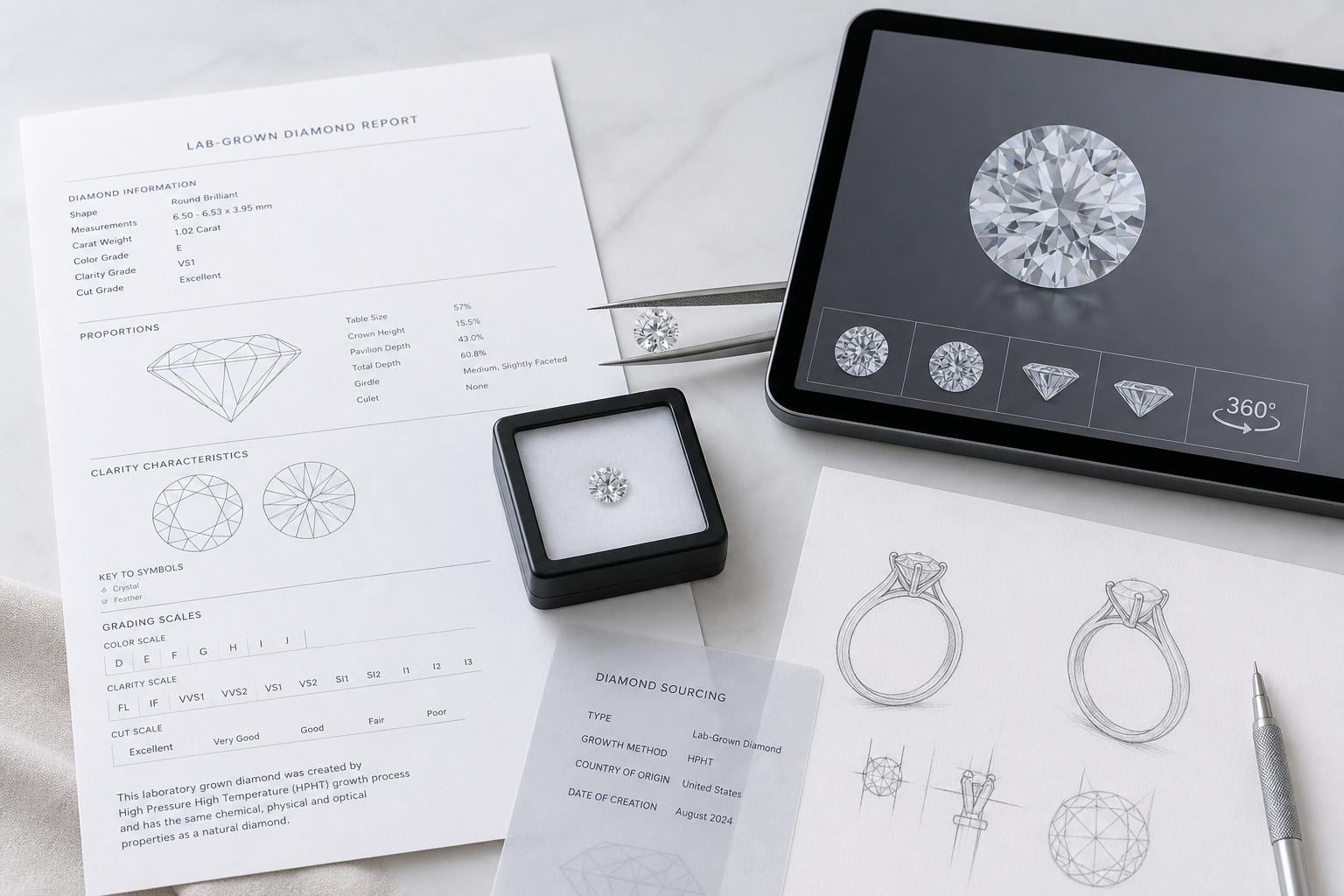
A reliable review process should connect the paperwork to the actual diamond. Start with the diamond grading report and confirm the report number, carat weight, measurements, color, clarity, polish, symmetry, and any listed comments. If laser inscription is available, ask the supplier to confirm that it matches the report number. For larger or higher-value stones, this step should not be skipped.
A grading report helps document key characteristics, but it should not be treated as a guarantee of beauty, value, or sourcing ethics. Reports are most useful when they are read together with visual evidence, measurements, seller documentation, and the intended jewelry use.
Next, compare the report to images and video. A 360-degree video can reveal body color, transparency, facet contrast, and visible inclusions more effectively than a single supplier photo. Still images are useful, but they can hide issues depending on lighting and angle. For matched parcels, ask for group images or layout videos rather than judging stones one by one in isolation.
The strongest buying position is built from three sources together: the grading report, the supplier’s written disclosure, and the visual evidence. If one of those sources is missing or inconsistent, the buyer should ask for clarification before approving the stone or batch.
Supplier Specialization: Matching HPHT or CVD Production to Your Buying Goal
Supplier specialization matters because not every HPHT supplier or CVD supplier is built for the same buyer. Some China diamond manufacturers and supply partners are stronger in loose reported center stones. Others are better at calibrated melee, matched parcels, or finished jewelry production. A supplier can be competent in one category and still be a poor fit for another.
This is where buyers often make the wrong comparison. They compare production method first, then price, then availability. A better order is to define the buying goal first. The right supplier for a 2.00 carat reported oval center stone is not necessarily the right supplier for hundreds of small stones for line bracelets, even if both products are lab-grown diamonds and both are available through China-based sourcing channels.
Loose Certified Center Stones
For loose reported center stones, the supplier’s strength should be access to specific stones, clear documentation, reliable visual review, and accurate communication. A buyer sourcing 20 reported oval diamonds from 1.50 to 2.50 carats for custom engagement rings needs more than a broad inventory list. They need stones that match the requested range, have suitable proportions, show well on video, and arrive with the expected grading reports.
In this scenario, an HPHT supplier or CVD supplier may both be viable, depending on the actual stones available. The deciding factor is not the production method alone. It is whether the supplier can provide enough properly documented options for comparison and whether the buyer can reject stones that do not meet the visual or specification standard. A supplier with fewer stones but stronger documentation may be safer than a supplier with a large list and weak follow-through.
For center stones, buyers should also be careful with overly broad promises. “We can supply any size and quality” sounds convenient, but it may mean the supplier is sourcing reactively through a trading network rather than controlling the product directly. That is not automatically bad, but it changes the buyer’s expectations. The more specific the order, the more important it becomes to confirm actual availability before quoting customers or building a custom ring timeline around a stone.
Calibrated Stones and Matched Jewelry Parcels
Calibrated stones and matched parcels require a different kind of supplier capability. Here, the buyer is not just asking whether each stone is acceptable. The buyer is asking whether the group works together. Size tolerance, color consistency, make, brightness, and layout appearance can matter more than individual grading detail.
A buyer sourcing stones for tennis bracelets, eternity bands, hoop earrings, or pavé settings should evaluate the supplier’s matching discipline. A parcel with attractive unit pricing can become expensive if stones vary too much in diameter, depth, color, or visual brightness. For small accent stones, a practical matching tolerance may need to be discussed in millimeters, not just carat weight. If appearance consistency matters, even a 0.05 to 0.10 mm difference can be relevant in tightly set layouts, depending on stone size and design.
This is where lab-grown diamond supplier specialization becomes visible. A supplier focused mainly on reported center stones may not be the right partner for large matched melee orders. A supplier experienced in jewelry production or calibrated parcels may better understand layout requirements, replacement needs, and how stones behave once set. The lowest quote is weak value if the bench jeweler later has to sort, reject, or request alternatives for a meaningful portion of the parcel.
Custom Jewelry Production and Stone-to-Setting Coordination
Custom jewelry sourcing adds another layer because the diamond and setting have to work together physically, not just visually. A stone may meet the requested color, clarity, and carat range but still be difficult to set if the measurements, depth, girdle condition, or shape outline do not fit the design. This is especially relevant for elongated fancy shapes, three-stone rings, hidden halo designs, and fitted wedding bands.
For custom work, a supplier who understands both stone sourcing and jewelry manufacturing can reduce friction. The buyer should confirm whether the supplier is only providing loose diamonds, only manufacturing settings, or coordinating both. If those responsibilities are split between different vendors, the buyer needs clear measurement data before production begins.
A U.S. boutique brand sourcing custom rings may prioritize reported 1.50 to 2.50 carat ovals with strong visuals and reliable reports. Another buyer producing line bracelets may care less about individual reports for each small stone and more about calibrated consistency across hundreds of stones. Both buyers are sourcing lab-grown diamonds, but their supplier evaluation criteria should be different from the start.
For custom design, trust comes from matching the stone to the setting, budget, and wearer’s daily use—not from choosing grades in isolation. A high color or clarity grade may not solve a poor fit issue, and a visually appealing stone can still be the wrong choice if its length-to-width ratio, depth, or outline conflicts with the intended mounting.
For custom jewelry, stone measurements and setting compatibility should be confirmed before finalizing a purchase. This is especially important when the buyer approves the diamond first and the mounting is produced later, because even stones with similar carat weights can require different prong placement, basket proportions, or CAD adjustments.
Stone-to-Setting Fit Check
Before approving a custom jewelry order, the buyer should confirm the diamond’s exact millimeter measurements, not only carat weight. For center stones, length, width, depth, table, and shape outline affect setting compatibility. For side stones and accent stones, diameter consistency and layout matching can determine whether the finished piece looks intentional or uneven.
The safer workflow is to approve the stone specifications before finalizing the setting. If the setting is already made and the stone is sourced afterward, the buyer has less flexibility and may have to accept a weaker match. For custom jewelry sourcing, the most useful supplier is often the one that communicates fit limitations early rather than saying yes to every request.
When a grading report is available, buyers should verify the report details through the issuing laboratory’s official report-check tool where available, then compare those details with the specific stone, video, inscription, and invoice description.
Quality Control in China-Based HPHT and CVD Sourcing
Quality control in China-based HPHT and CVD sourcing should be treated as a documented workflow, not a vague promise that stones are “high quality.” The buyer needs a way to connect the requested specifications to the actual diamond or parcel being delivered. Without that connection, production method, price, and supplier reputation are not enough protection.
A practical QC process should answer four questions before payment or shipment approval: Does the stone match the stated specifications? Does the documentation match the stone? Does the visual evidence support the grade and description? Does the product fit the intended use? If any one of these is skipped, the buyer increases the chance of receiving a technically acceptable diamond that is still wrong for the order.
At NUVU, this kind of comparison is treated as a practical selection question rather than a single-grade decision: the report narrows the field, but the final approval still depends on visual performance, measurements, intended setting, and whether the written order terms match the buyer’s expectations. This approach is especially useful when the same project involves both loose stone selection and finished jewelry production.
What a Practical QC Workflow Should Include
For reported center stones, diamond inspection should begin with the grading report. Buyers should confirm carat weight, exact measurements, color, clarity, table, depth, polish, symmetry, fluorescence if reported, and any comments listed by the grading lab. If a laser inscription is available, the supplier should confirm that the inscription matches the report number.
The report number should be checked through the issuing lab when possible. Grading report verification is a basic step, but it is often treated too casually in fast wholesale conversations. A report screenshot or PDF is useful only if the buyer confirms that it corresponds to the stone being offered. If a supplier provides multiple stones with similar specs, report numbers and measurements help prevent substitution or confusion.
For non-reported or small calibrated stones, QC needs to shift toward batch specifications. The buyer should ask for exact size ranges, color range, clarity range, quantity, shape, cut style, and agreed tolerance before approving the parcel. Written specifications matter because “DEF VS” or “1.5 mm melee” can still leave too much room for interpretation if the finished jewelry requires tight matching.
Why Photos and 360-Degree Video Still Matter
Photos and 360-degree video remain important because grading reports do not show everything a buyer needs to judge. A report can list color and clarity, but it does not show how the stone handles light in motion, whether an inclusion is visually distracting, whether the diamond has noticeable tint, or whether the cut pattern looks balanced.
For center stones, video review is especially useful for elongated shapes, step cuts, and larger carat weights. These stones can show bow-tie effects, windowing, uneven contrast, or inclusions in ways that a still image may not reveal. A buyer who approves only from a report may receive a stone that is accurately graded but visually weaker than expected.
For parcels, a group photo or layout video can be more useful than dozens of individual images. The goal is to see whether the stones look consistent together. If a bracelet or eternity band will place stones side by side, batch consistency is not a secondary concern. It is part of the quality control standard.
How Batch Consistency Differs From Single-Stone Quality
Single-stone quality and batch consistency are not the same skill. A supplier may be able to source one strong reported diamond but struggle to assemble a parcel of stones that match well in size, color, and visual brightness. For wholesale diamond verification, the buyer should judge the order the way the final customer will see it: as one finished piece or product line, not as isolated stones on a spreadsheet.
For calibrated jewelry stones, measurement consistency can matter as much as individual grades. A parcel with acceptable color and clarity may still create setting problems if diameter or depth varies too widely. Uneven stone height can affect setting security, surface alignment, and the overall look of pavé, channel-set, or line bracelet designs.
This is why written tolerances should be part of supplier QC. If the buyer needs stones within a narrow millimeter range, that requirement should be confirmed before the supplier prepares the batch. If similar stones may be needed later, the buyer should ask whether matching stones can be supplied from similar specifications. The mistake is assuming that a reordered parcel will automatically match the first one.
How to Verify This Before Buying
Before approving a center stone, request the grading report, report number, exact measurements, supplier photos, and 360-degree video. Confirm whether the stone is HPHT or CVD, whether any treatment disclosure applies, and whether the information is consistent across the report, invoice, and supplier communication. If anything conflicts, resolve it before payment.
Before approving a batch or parcel, request written specifications that include quantity, shape, size range, color range, clarity range, tolerance, and whether the stones are intended to match a sample. If the order is for finished jewelry, ask for layout confirmation before setting begins. A small mismatch caught before production is a sourcing issue; the same mismatch found after setting becomes a manufacturing problem.
The most reliable suppliers are usually not the ones who answer every request with immediate certainty. They are the ones who can document what they are offering, explain what still needs confirmation, and put the final specifications in writing before the buyer commits.
Documentation, Grading Reports, and Traceability Limits
Documentation is one of the most useful tools in China-based lab-grown diamond sourcing, but it has limits. A diamond grading report can help confirm the identity and measurable attributes of a specific stone. It does not, by itself, prove that every supplier claim about factory origin, energy use, production history, or long-term reliability is accurate.
This distinction matters because buyers often treat lab-grown diamond certification as a complete trust signal. It is not. Good documentation reduces ambiguity, but it should be read alongside supplier transparency, visual review, written specifications, and a clear purchase agreement. The strongest sourcing process uses documents to verify specific facts, not to replace judgment.
What a Grading Report Can Help Confirm
A diamond grading report can help confirm the core identity of a loose lab-grown diamond: carat weight, measurements, shape, color grade, clarity grade, cut information where applicable, polish, symmetry, fluorescence if reported, and sometimes growth method or treatment-related comments. Reports from labs such as IGI or GIA are commonly encountered in the market, though buyers should focus less on brand familiarity alone and more on whether the report details match the actual stone being offered.
For individual center stones, the report number is especially important. If a stone has a laser inscription, the inscription should match the report number, and the measurements on the report should align with the supplier’s listing, invoice, and video file. A mismatch does not always mean fraud; it can be a cataloging error. But it should stop the transaction until the supplier explains it clearly and provides corrected documentation.
For wholesale parcels or small calibrated stones, full individual grading reports may not be practical or cost-effective for every stone. In those cases, lab-grown diamond documentation may include a batch list, specification sheet, invoice description, or internal QC record. That can be acceptable for the right product category, but the buyer should understand the tradeoff: batch documentation supports consistency claims, while individual reports support stone-specific verification.
What Documentation Does Not Automatically Prove
A grading report does not automatically prove the exact factory where the diamond was grown, the full supply-chain path, the energy source used in production, or whether the supplier has stable quality control across future orders. Those claims belong to supplier transparency, not standard grading alone.
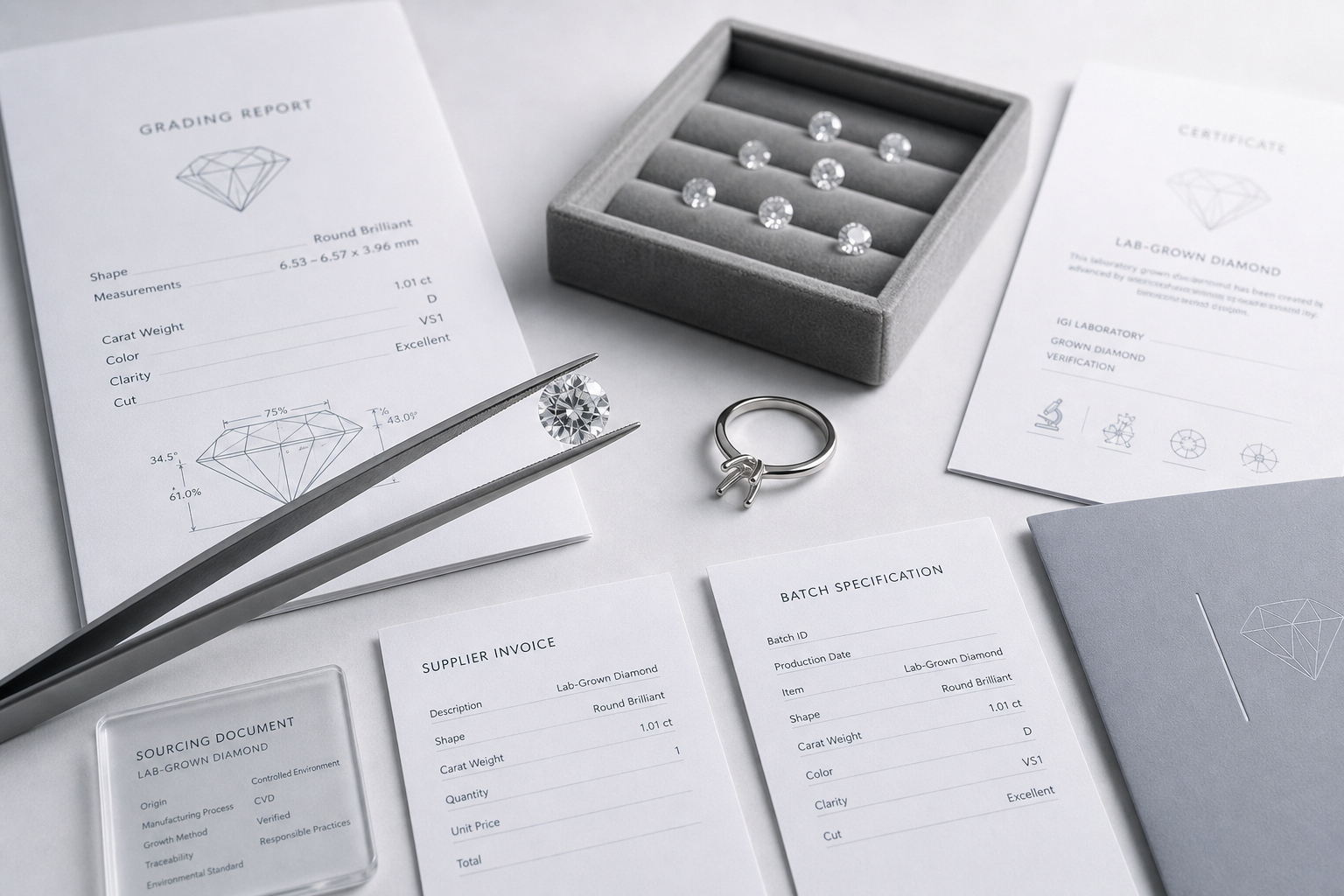
This is where buyers can get misled by polished language. A supplier may describe stones as “factory direct,” “traceable,” or “sustainably produced,” but those phrases need supporting documents and careful boundaries, especially when applying real supplier evaluation standards to lab grown diamond manufacturers in China. An invoice can show who sold the goods. A grading report can describe the stone. A batch specification can outline agreed product standards. None of these automatically proves every broader supply-chain claim unless the documentation is designed to support that specific claim.
The most practical approach is to separate documents by function. A grading report verifies diamond attributes. An invoice confirms the commercial transaction. A batch list helps identify grouped inventory. A supplier statement explains what the supplier is claiming. Treating all four as the same type of proof is a common sourcing mistake.
Sustainability and origin claims deserve the same discipline. Lab-grown diamonds can offer a different sourcing route from mined diamonds, but that does not automatically prove lower impact or stronger ethics in every case. If sustainability is part of the buying reason, buyers should ask what the supplier can document, where the documentation stops, and which claims are being made by the grower, the manufacturer, the trader, or the jewelry brand.
Environmental and sustainability claims should be specific, documented, and limited to what can be substantiated. Broad green language is less useful than clear information about production, energy context, sourcing path, and seller transparency. If a claim cannot be tied to a specific document or clearly limited statement, buyers should avoid carrying that claim into product pages, sales scripts, or customer-facing materials.
Evidence Boundaries Buyers Should Set Before Approving Claims
Before using any supplier claim in retail copy, product listings, sales training, or customer conversations, buyers should ask what specific evidence supports that claim. “Lab-grown,” “HPHT,” “CVD,” “certified,” “traceable,” “factory direct,” and “sustainable” do not carry the same evidentiary weight. A grading report may support a lab-grown identification or stone characteristic, but it does not automatically support a factory-origin or environmental claim. A supplier statement may explain the seller’s position, but buyers should still decide whether it is detailed enough for customer-facing use.
A practical internal rule is to keep product claims narrow unless the supplier provides narrow evidence. If the document shows only carat weight, color, clarity, and measurements, use it for those details. If the supplier provides a written production-method disclosure, use it for method identification, not for claims about value or environmental benefit. This careful separation protects the buyer from overpromising and makes customer communication easier to defend.
Why Report Verification Should Be Part of Sourcing
Report verification should be a routine part of diamond supplier verification, especially for higher-value stones. When possible, buyers should check the report number through the issuing lab’s online verification system and compare the result against the stone being offered. The goal is not to second-guess every supplier; it is to catch avoidable errors before money, production time, or customer commitments are involved.
At NUVU, we usually treat the grading report as the starting point rather than the final answer. The report helps narrow the decision, but the buying judgment still depends on whether the stone, documentation, visual review, and written terms all agree with each other.
For sourcing from China, this habit becomes more important when communication passes through multiple parties. A manufacturer, trading company, sales representative, and jewelry production partner may all handle the same inventory information. Each handoff creates room for incorrect file names, outdated reports, wrong videos, or mixed batch references. A buyer who verifies reports early reduces the risk of discovering a mismatch after a ring has entered production or a customer order has been promised.
If a GIA, IGI, GCAL, HRD Antwerp, or other grading report is provided, buyers should use the issuing laboratory’s available report-check tools or official verification process where available. Verification supports document matching, but it should still be paired with visual review, measurements, disclosure checks, and written order details.
Buyer Verification Checklist
- Confirm the grading report number through the issuing lab when online verification is available.
- Match the report number to the laser inscription if the stone is inscribed.
- Compare carat weight, measurements, shape, color, clarity, polish, symmetry, and fluorescence details against the supplier listing.
- Request the invoice or pro forma invoice to describe the stone or batch with enough detail to avoid substitution confusion.
- For parcels, ask for a batch specification sheet with size range, color range, clarity range, quantity, and matching tolerances.
- Keep supplier claims about origin, traceability, sustainability, and production method separate from standard grading data unless specific documentation supports them.
The key judgment is simple: documentation is strongest when it confirms narrow, specific facts. It becomes weaker when buyers expect it to prove broad claims it was never designed to verify.
Pricing and Value: Why Production Method Is Only One Part of the Cost
HPHT diamond price and CVD diamond price can differ in some sourcing situations, but production method should not be treated as the main value score. In China diamond sourcing, the better question is whether the quoted stone or batch meets the buyer’s product goal with acceptable documentation, consistency, and production risk.
A lower quote can look attractive on a spreadsheet and still become expensive if the stones do not match the approved specification, require additional sourcing, delay jewelry assembly, or create customer-facing quality concerns. Lab-grown diamond pricing is not just a number per carat. It is the combined cost of the stone, the grading, the supplier channel, the QC process, the matching requirement, and the consequences if something is wrong.
Prices can change with market conditions, report type, seller channel, and stone-specific details, so exact comparisons should be verified at the time of purchase. Buyers should compare like-for-like specifications before treating one stone, parcel, or supplier quote as a better value.
Why Two Similar Lab-Grown Diamonds Can Be Priced Differently
Two lab-grown diamonds with the same carat weight, color grade, and clarity grade may still be priced differently because the underlying value factors are not identical. Shape, cut precision, face-up appearance, growth method, post-growth treatment disclosure, grading report type, supplier availability, and demand for that specific size range can all influence price.
Cut quality is often underestimated in price comparisons. A 2.00 carat oval with a cleaner outline, better spread, and stronger visual balance may cost more than another oval with the same headline grades because it is easier to sell, easier to set, and less likely to disappoint in customer review. The lower-priced stone may still be usable, but it is not automatically equal value.
Production method can matter, especially if a buyer is sourcing a category where one supplier has stronger HPHT production access or another has deeper CVD inventory. But HPHT versus CVD is only one input. A well-cut, properly documented stone from a reliable supplier is usually a better sourcing decision than a cheaper stone chosen mainly because the method appears favorable on paper.
When a Lower Quote May Not Be the Better Value
A low wholesale lab-grown diamond cost becomes less useful when rejection rates rise. If a buyer orders a matched parcel and a meaningful portion of the stones fail the agreed size, color, or visual matching requirements, the real cost is no longer the quoted unit price. The buyer must account for additional review, alternative sourcing conversations, possible shipping delays, and production disruption.
This matters most for jewelry programs that depend on consistency. A single loose diamond can be evaluated one stone at a time. A tennis bracelet, eternity band, or multi-stone custom design needs the group to work together. In that setting, a slightly higher quote from a supplier with better matching discipline may be the safer value.
The same logic applies to reported center stones. If a supplier offers a lower price but provides incomplete videos, unclear report references, or inconsistent response times, the buyer is accepting operational risk. That may be tolerable for speculative inventory, but it is harder to justify for a customer-specific engagement ring or a custom jewelry order with a deadline.
Total Project Cost for Finished Jewelry Buyers
Finished jewelry buyers need to evaluate total project cost, not just diamond cost. A lab-grown diamond price comparison should include the stone, setting requirements, matching work, CAD or design coordination, metal production, QC review, documentation handling, and communication reliability.
For example, a custom ring buyer sourcing a center stone from one supplier and a setting from another may save on the stone but lose time if the measurements are not suitable for the mounting. A wholesale jewelry buyer ordering calibrated stones for a production run may face the opposite issue: the individual stones are inexpensive, but inconsistent millimeter sizing can slow setting work and increase labor waste.
Current price ranges require up-to-date supplier quotes because the market moves, availability shifts, and order details change the final cost. The safer way to compare value is to ask what the quote includes, what it excludes, and what happens if the delivered goods do not match the approved specification.
What to Compare Before You Decide
- Compare the exact specifications, not only carat, color, and clarity.
- Check whether the quote includes grading reports, videos, photos, batch lists, or inspection documents.
- Ask whether the stones are available now or require sourcing, cutting, or matching time.
- For parcels, confirm the allowed tolerance in millimeters, color range, clarity range, and visual matching standard.
- For finished jewelry, include setting fit, production coordination, handling expectations for mismatches, and approval workflow in the cost comparison.
- Do not treat HPHT or CVD as a shortcut for value; use production method as one factor inside a broader sourcing review.
The strongest quote is rarely just the lowest quote. It is the one that delivers the required product with fewer hidden risks.
Key Questions to Ask Chinese HPHT and CVD Lab-Grown Diamond Suppliers
The most useful questions to ask lab-grown diamond suppliers are specific enough to reveal how the supplier actually works. Broad questions such as “Do you have good quality?” or “Are your diamonds certified?” rarely produce meaningful answers. A stronger sourcing conversation asks about production method, treatment disclosure, inventory depth, matching standards, documentation, lead time assumptions, and what happens when the delivered goods do not match the approved sample.
For buyers working with a China lab-grown diamond supplier, the goal is not to demand access to every proprietary factory detail. The goal is to create a written understanding of what is being purchased, how it will be verified, and how problems will be handled before payment or production approval.
Questions About Production Method and Treatment Disclosure
Start by asking whether the stone or batch is HPHT, CVD, or mixed. If the supplier cannot answer clearly, that is a warning sign for buyers who need consistent documentation or customer-facing product information. The question is not about declaring one method better; it is about knowing what is being sold.
- Which production method is used for this stone or batch: HPHT, CVD, or mixed supply?
- Is any post-growth treatment disclosed for these stones?
- Will the production method or treatment information appear on the grading report, batch document, or supplier specification where applicable?
- If this is a mixed batch, how are stones separated, labeled, and documented?
The practical judgment is that uncertainty becomes more costly as order complexity increases. A loose stone buyer may be able to review one report and one video. A wholesale buyer building repeatable inventory needs the supplier’s labeling and disclosure process to be consistent across many stones.
Questions About Inventory, Matching, and Batch Consistency
Inventory questions should reflect the product you are actually buying. A buyer sourcing reported 1.50 to 2.50 carat oval center stones needs different information from a buyer sourcing hundreds of small matched stones for line bracelets. Asking the same questions for both categories leads to weak sourcing decisions.
- Are these stones in stock, reserved inventory, or sourced after order confirmation?
- For matched stones, what millimeter tolerance do you use?
- What color and clarity range will be included in the parcel?
- Can you provide photos or videos of the full parcel, not just a representative sample?
- What happens if delivered stones do not match the approved sample or agreed specification?
For small jewelry stones, measurement consistency can matter as much as the individual grade. If the design depends on visual uniformity, a tolerance that looks minor on paper may become visible in the finished piece. This is why matched parcels should be approved by specification and appearance, not by price alone.
Questions About Reports, Photos, Videos, and Written Specifications
Documentation questions should be asked before the supplier issues a final invoice. Once goods are packed, shipped, or assigned to production, correcting documentation gaps becomes harder. For higher-value stones, the report, video, and invoice should all describe the same item without ambiguity.
- Can you provide the grading report number before payment?
- Can the report be verified through the issuing lab?
- Is there a laser inscription, and does it match the report number?
- Can you provide actual photos and 360-degree video of the stone or parcel?
- Will the invoice include shape, carat weight, color, clarity, report number if applicable, and quantity?
- For batches, can you provide a written specification sheet instead of only a verbal description?
A supplier who answers these questions clearly is easier to evaluate. A supplier who relies on vague descriptions may still have access to inventory, but the buyer carries more verification risk.
Questions About Lead Time, Alternatives, and Communication
Lead time should be confirmed in writing because it depends on inventory status, grading needs, matching work, jewelry production, and shipping coordination. Avoid treating estimated timing as guaranteed unless the supplier has stated clear terms. For custom orders and wholesale programs, the more important question is what happens when something changes.
- What is the expected lead time for this stone, batch, or finished jewelry order?
- Is the lead time based on current stock or new sourcing?
- If a stone is unavailable after approval, how will alternatives be selected?
- Who confirms that alternative stones match the original specification?
- How quickly do you provide updated reports, videos, or batch lists when substitutions are made?
- Who is responsible for communication if the order involves both stones and finished jewelry production?
Communication quality is not a soft issue in lab-grown diamond procurement. It affects whether the buyer can approve stones on time, catch documentation issues, manage customer expectations, and avoid production delays.
Supplier Conversation Checklist
- Confirm HPHT, CVD, or mixed production method for the specific stone or batch.
- Ask about post-growth treatment disclosure and where it appears in documentation.
- Request grading reports, report numbers, actual videos, photos, and written specifications before approval.
- For matched stones, define size tolerance, color range, clarity range, and visual matching expectations.
- Clarify whether inventory is in stock, reserved, or sourced after order confirmation.
- Agree in writing on what happens if stones do not match the approved sample or specification.
- Confirm lead time assumptions and alternative-selection procedures before committing to a customer or production schedule.
The strongest supplier conversations are not the most technical ones. They are the ones that turn assumptions into written, verifiable terms before the buyer has to depend on them.
How to Decide Whether HPHT, CVD, or a Mixed Sourcing Strategy Fits Your Needs
The right HPHT vs CVD sourcing decision should start with the product you are trying to sell or produce, not with the growth method itself. For most buyers, the stronger question is not “Which method is better?” but “Which supplier can consistently deliver the stone profile, documentation, matching standard, and communication process this purchase requires?”
A wholesale lab-grown diamond buying strategy that works for reported solitaire stones may fail for calibrated jewelry parcels. A supplier that performs well on one-off loose stones may not be the right fit for repeat bracelet, band, or private-label jewelry production. In China diamond sourcing, production method matters, but supplier execution usually matters more.
When an HPHT-Focused Supplier May Make Sense
An HPHT-focused supplier may be a good fit when the available inventory aligns with your target product category and the supplier can show consistent grading, measurements, and visual appearance across the stones you need. This can be useful for buyers sourcing certain loose diamonds, repeatable commercial qualities, or specific inventory ranges where that supplier has clear strength.
The mistake is assuming that HPHT automatically means better value or more stable quality. It does not. An HPHT supplier still needs to provide the same buyer-facing proof as any other supplier: accurate specifications, grading documentation where required, clear disclosure, usable videos or images, and a process for handling stones that do not match the agreed standard.
Choose an HPHT-focused path when the supplier’s actual stock supports your size, shape, and quality requirements without forcing compromises. Avoid it when the recommendation is based mainly on the method name rather than the finished stones available for review.
When a CVD-Focused Supplier May Make Sense
A CVD-focused supplier may make sense when your sourcing goal depends on product ranges that the supplier can produce or access reliably, especially if you need specific shapes, sizes, or documented stones for loose diamond sales, custom jewelry, or engagement ring programs. The practical advantage is not the label “CVD” by itself; it is whether the supplier can repeatedly deliver stones that meet your visual and specification standards.
This path can work well for buyers who have a defined procurement process: requested grades, preferred shapes, required reports, image or video review, and written approval before shipment or setting. Without that structure, CVD sourcing can become too dependent on broad supplier claims, especially when stones vary in appearance within the same paper grade.
A CVD-focused supplier is a stronger choice when they are transparent about treatment questions, report availability, and visual review. It becomes a weaker choice if the supplier treats the production method as a substitute for documentation or asks you to accept mixed inventory without clear stone-by-stone confirmation.
When a Mixed Supplier Network Is More Practical
For many buyers, a mixed lab-grown diamond sourcing strategy is more practical than committing to HPHT or CVD alone. This is especially true for jewelry brands carrying multiple product categories, such as reported center stones, matched accent stones, fashion jewelry, and custom ring projects. Different product lines may require different supplier strengths.
A mixed approach can reduce sourcing risk because it keeps the buying decision tied to availability and performance instead of a single production route. If one supplier is stronger in reported center stones and another is stronger in calibrated matched parcels, forcing all purchasing through one method or one supplier may create unnecessary delays or quality compromises.
The tradeoff is management. A mixed network requires tighter specification control, cleaner documentation, and more disciplined comparison across suppliers. If two suppliers describe quality differently, use different tolerances, or provide uneven media, the buyer must standardize the approval process. Otherwise, a mixed strategy can create inconsistency across finished jewelry even when each individual order seems acceptable.
Final Sourcing Decision Framework
Start with the finished product. If you are buying loose reported stones, prioritize report verification, visual performance, proportions, and supplier responsiveness. If you are sourcing matched jewelry parcels, prioritize measurement tolerance, repeatability, batch consistency, and how mismatches are handled. If you are producing custom jewelry, prioritize stone-to-setting fit, communication, and the supplier’s ability to coordinate specifications before production begins.
Then evaluate the required specifications. Size range, shape, color, clarity, grading report needs, matching standards, and treatment disclosure should be defined before supplier comparison. A vague request such as “high quality lab-grown diamonds” invites inconsistent quotes; a precise request gives you a real basis for diamond supplier evaluation.
Next, compare supplier capability rather than method preference. An HPHT-focused supplier with weak documentation is not safer than a CVD-focused supplier with strong verification. A CVD supplier with attractive pricing is not better if stones fail visual approval or arrive outside agreed measurements. Production method is one input in lab-grown diamond procurement, not the final decision.
The cleanest decision path is product first, specifications second, supplier capability third, verification process fourth. If all four align, HPHT, CVD, or a mixed sourcing model can work. If one of those four is weak, the method name will not protect the buyer from sourcing problems.
Final Evidence-Based Takeaway for Buyers
HPHT and CVD are useful production terms, but buyers should not use either term as a substitute for verification. The more defensible sourcing decision is built from a chain of evidence: production-method disclosure, grading or batch documentation, actual visual media, written specifications, supplier role clarity, and clear expectations for how discrepancies will be addressed. When those pieces agree, the buyer has a stronger basis for approval. When they conflict, the order should be paused until the discrepancy is resolved.
For China-based sourcing, this evidence-first approach is especially important because the supply chain may involve several parties between growth, cutting, grading, jewelry manufacturing, and export communication. A supplier can still be a good partner even if it does not control every step, but the buyer should know exactly which claims the supplier can substantiate and which claims require additional documentation. In practice, trust is strongest when it is supported by specific, narrow, reviewable details.
For NUVU, the goal is to make diamond comparison easier to understand, especially when buyers are weighing report details, visual performance, setting fit, documentation, and budget together. A careful sourcing process does not need exaggerated claims; it needs clear evidence, limited assumptions, and a written standard that matches the way the diamond or jewelry will actually be used.
Disclosure: This article is for general educational purposes only. Diamond grading, pricing, availability, specifications, and seller policies can change, and readers should verify important details through grading reports, official laboratory tools, seller documentation, or qualified professionals before making a purchase decision. Laboratory-grown diamonds should be clearly distinguished from natural diamonds, and environmental or sourcing claims should be supported by specific documentation.