- Shop
Diamonds & Jewelry
Loose Lab Diamonds Yellow Lab Diamonds Pink Lab Diamonds Blue Lab Diamonds Engagement Rings Fine Jewelry Shop All Loose lab-grown diamonds10 shapes · IGI, GIA or NGTC reports
- Wholesale
- Custom Design
- Education
- About
HPHT vs CVD Lab-Grown Diamonds: What Actually Differs and What Matters When You Buy
- CVD vs HPHT at a glance
- How each method grows a diamond
- HPHT-grown is not the same as HPHT-treated
- Where the growth method can make a difference
- Myths worth dropping
- How to identify HPHT vs CVD
- How grading reports show the growth method
- Which should you choose?
- Specifying HPHT or CVD in a wholesale or OEM order
- HPHT and CVD questions
- Specify growth method and treatment in your order
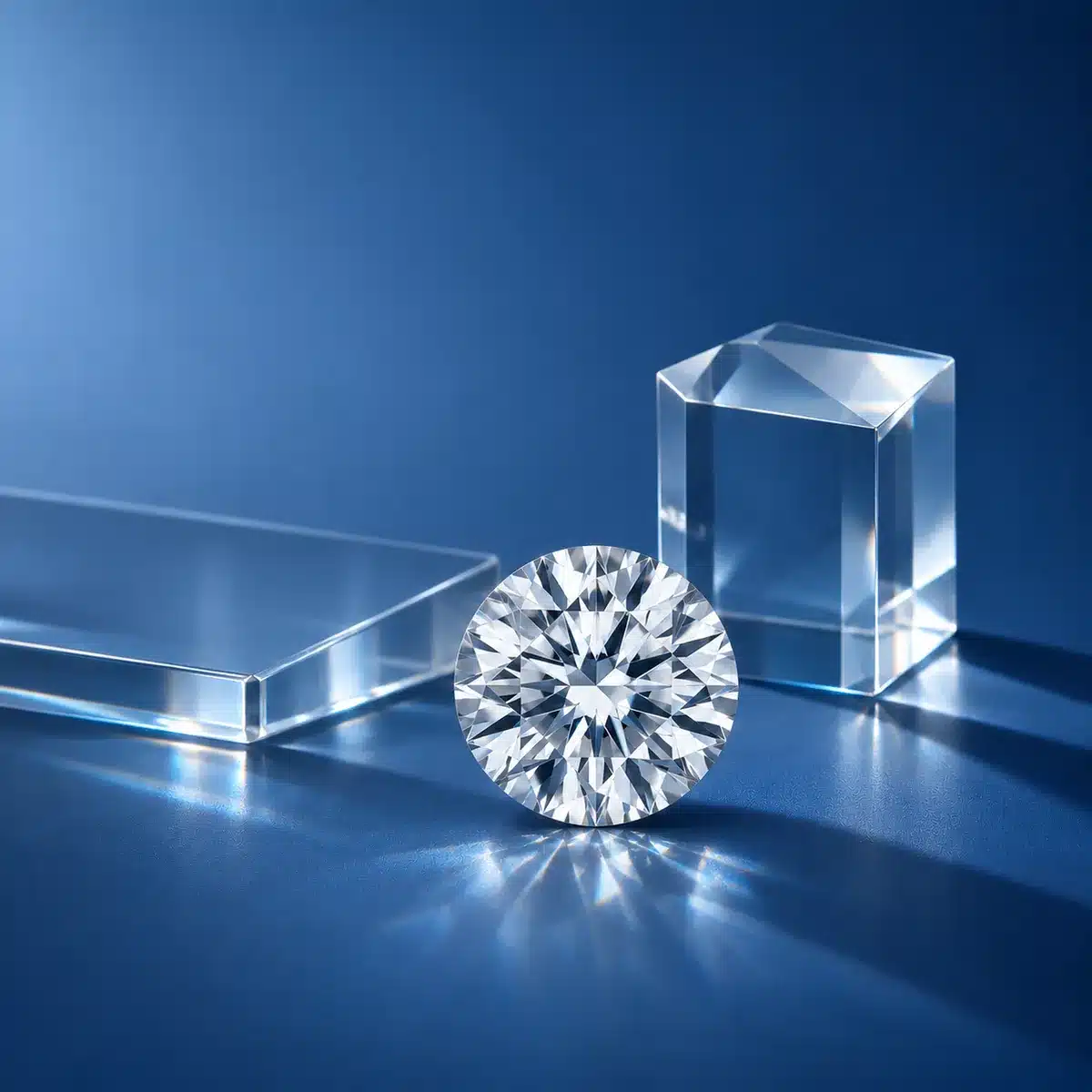
Two 1.20 ct rounds, both F VS1 with an Excellent cut, sit side by side. One grew in a press over several days, the other in a vacuum chamber over three or four weeks and was then heat-treated to remove a brown tint. On the hand nobody can tell which is which. The difference shows up on the report and in the order specification.
HPHT and CVD are the two ways lab-grown diamonds are made. Both produce diamond, with the same carbon crystal structure, hardness and optical properties as mined diamonds. The growth method is not a quality grade. Both methods produce excellent stones and poor stones, so choose the individual stone, not the label. The method does matter in a few specific situations, which this guide covers: treatment disclosure, fancy blue color, matched sets, and wholesale orders where your product claims depend on it.
CVD vs HPHT at a glance
How each method grows a diamond
HPHT recreates the conditions under which diamonds form deep in the earth. A small diamond seed is placed with a carbon source and a metal catalyst inside a large press. At 1,300 to 1,600°C and pressures above 870,000 pounds per square inch (about 60,000 atmospheres), the metal, usually iron, nickel or cobalt, melts, dissolves the carbon, and carbon atoms crystallize onto the seed. Depending on the press and the target size, a growth cycle runs from several days to a few weeks.
CVD builds a diamond from gas. Thin diamond seed plates are placed in a low-pressure chamber with a carbon-bearing gas, usually methane, and hydrogen. At about 900 to 1,200°C, a microwave beam breaks the gas down, and carbon atoms settle on the plates layer by layer. Growth takes about three or four weeks, with the crystals taken out every few days to polish the surface. Many plates can grow in one chamber at the same time.
Both processes produce rough crystals that are then planned, laser-cut and polished like mined rough. From here, cutting quality drives most of what you see.
HPHT-grown is not the same as HPHT-treated
This is the most common point of confusion when reading a report or writing an order.
- HPHT-grown describes how the diamond was created.
- HPHT-treated describes a process applied after growth, usually a short high-pressure, high-temperature step that improves color.
- A stone can be CVD-grown and HPHT-treated. Many near-colorless CVD diamonds on the market are exactly that.
So “HPHT” on a listing can mean two different things. If you need untreated stones, specifying “HPHT-grown” is not enough. You have to specify as-grown, no post-growth treatment as a separate requirement, and confirm it on the grading report. Post-growth color treatment is permanent under normal wear and care, and it does not affect durability. It is a disclosure and preference issue, not a quality defect.
Where the growth method can make a difference
Color: HPHT vs CVD
HPHT growth can produce near-colorless stones directly from the press, and adding boron during growth produces the blue seen in many blue lab diamonds. CVD stones often grow with a brownish or grayish tint, which post-growth treatment can reduce. What your customer sees is the final color grade and how it reads against the metal: a G or H can look whiter in white gold or platinum than a buyer expects, while yellow and rose gold hide more warmth.
Clarity and inclusions: HPHT vs CVD
Each method leaves different fingerprints. HPHT stones can contain metallic flux inclusions, which look like dark, sometimes reflective specks. CVD stones can show dark graphite pinpoints and growth-related strain. In higher clarity grades these features are usually not visible face-up, but “usually” depends on the stone. Shape, size and where the inclusion sits all matter. Step cuts such as emerald and Asscher show inclusions more readily than brilliant cuts, and larger stones have bigger facets to look through, so a VS2 emerald cut or a 3-carat round should be checked stone by stone. Judge the actual inclusion from photos or video, not the method.
Size and shape
Both methods now cover sizes from small melee to multi-carat center stones; GIA reports colorless HPHT stones of 10 ct and more. Availability in a given size, shape and grade depends more on current supply than on the method, so ask what can be delivered consistently, not which method is “better.”
HPHT vs CVD price: which is cheaper?
The growth method on its own is a minor price factor. Carat weight, cut, color, clarity, shape, report choice and current market supply drive cost far more. When you see a price gap between an HPHT and a CVD stone of the same specification, it usually comes from one of these:
- Different details behind the same grades. Proportions, measurements, polish, symmetry, fluorescence or treatment status can differ even when the 4Cs match. Within the same cut grade, compare the actual proportions.
- Report type. A GIA, IGI or NGTC report, or no report, changes cost, especially on small stones.
- Stock and timing. Supply of specific sizes from each method shifts, and prices follow.
- Selection work. Matched pairs, calibrated sizes and strict untreated requirements take sorting time.
If a supplier quotes a premium for HPHT or CVD, ask which of these it reflects. A good supplier can explain it in specification terms.
Myths worth dropping
- “HPHT is always better.” Quality is decided by cut and the 4Cs of the individual stone.
- “CVD diamonds are inferior because they are treated.” Treatment improves color and is permanent. It must be disclosed, and some buyers prefer as-grown stones, but it does not make a diamond weaker.
- “You can tell the method by looking at the ring.” Nobody can reliably identify the growth method by eye or with a loupe. That does not mean two stones with the same grades look identical; compare the actual stones.
- “One method is more natural.” Both are laboratory-grown diamonds. Neither is a simulant, and neither is mined.
How to identify HPHT vs CVD
You cannot reliably do it at the counter. Gemological laboratories use spectroscopy, fluorescence imaging and growth-pattern analysis, which reveal the different growth structures: multi-sector patterns for HPHT, layered growth for CVD. Some screening devices used by the trade can flag a stone as laboratory-grown and refer it for testing, but the method itself is confirmed by the lab. For a buyer, the practical answer is the grading report, matched to the stone by its laser inscription.
How grading reports show the growth method
Reports are not all the same, and they change over time, so check the laboratory, the report type and the issue date.
- IGI laboratory-grown diamond reports identify the stone as laboratory-grown and usually state the growth method. Since January 2021 the comments also record treatment: “As Grown – No indication of post-growth treatment”, or “Indications of post-growth treatment” when the lab finds signs of it.
- GIA changed its service for laboratory-grown diamonds on October 1, 2025. Eligible colorless to near-colorless lab-grown diamonds now receive a Premium or Standard quality assessment instead of the full D-to-Z color and Flawless-to-I3 clarity scales, and fancy-color lab-grown diamonds have a separate report service (GIA). A recent GIA report and an IGI report therefore do not present quality in the same way. Do not compare them field by field.
- HRD Antwerp announced it would stop issuing quality certificates for commercial loose lab-grown diamonds from 2026 (AWDC). Older HRD reports remain valid documents for the stones they describe.
- NGTC and other national labs issue reports mainly used in their home markets.
What to check on a report:
Before ordering, confirm that the report type you choose states the growth method and treatment information you need. If a report does not mention treatment, that does not prove the stone is untreated.
- The stone is described as laboratory-grown, and the report number matches the laser inscription on the girdle, where one is present.
- The comments or origin section, for growth method and any post-growth treatment, if the report includes them.
- Measurements and proportions, which affect face-up size and appearance more than the method does.
- The report on the laboratory’s own website, using the report number.
NUVU can arrange IGI, GIA or NGTC reports on request, depending on the stone and the order, and can provide proof of no post-growth treatment for as-grown orders.
See our certification guide for a field-by-field walkthrough.
Which should you choose?
For a center stone or engagement ring: leave the method open unless you have a preference. Compare cut quality, measurements, color against your metal, the actual inclusions in photos or video, and the report. If two stones look equally good and the reports check out, take the better price.
- Your brand makes claims about growth method or untreated stones, so every stone must match.
- You want fancy blue, where HPHT growth with boron is the usual route.
- You are buying matched pairs or calibrated layouts and want to reduce variation in color and tone. Same source helps, but the set should still be checked side by side under the same lighting before approval.
- Your customers ask for as-grown stones, so any material with post-growth treatment must be excluded, whether it was grown by HPHT or CVD.
Specifying HPHT or CVD in a wholesale or OEM order
For retailers, jewelry brands and private label buyers, growth method is one line in a sourcing specification. A clear brief gets faster, more accurate quotes:
Swipe the table to see more →
| Write in your inquiry | Why |
|---|---|
| Shape, size range or millimeter sizes, and quantity | Defines what can be supplied consistently |
| Color and clarity range | Sets price and appearance |
| Growth method: HPHT, CVD, or either | Restrict it only if your product claims require it |
| Treatment: as-grown only, or treated accepted | A separate requirement from growth method |
| Report: none, every stone, or above a set size | Report fees add up on small stones |
| Matching: pairs, calibrated melee, layouts, and size tolerance | Determines sorting work and inspection method |
| Delivery date and destination | Confirmed against current stock |
Specification example (an example, not an actual order): 200 pcs round brilliant, 1.30 mm ±0.02 mm, F–G color, VS clarity, HPHT or CVD accepted, treated accepted, no individual reports, sorted for consistent color, packed by size in labeled parcels, delivery to Antwerp in four weeks.
Calibrated and matched goods are inspected against the tolerances agreed in the order, following standard trade practice for size measurement, color sorting and sampling, before shipment.
MOQ, lead time and price are confirmed against each actual specification. See our bulk loose stones service, or how stones fit into private label and OEM jewelry projects.
HPHT and CVD questions
Which is better, HPHT or CVD?
Neither, as a rule. Compare the individual stones. Specify a method only when your claims, color target or matching needs require it.
Are CVD diamonds treated?
Many near-colorless CVD diamonds receive post-growth treatment to improve color, but not all. Check the report comments, and order “as-grown only” if you need untreated stones.
Is HPHT or CVD more durable?
Neither. Both are diamond, 10 on the Mohs scale, and equally suitable for daily wear.
Is a CVD diamond cheaper than an HPHT diamond?
Not as a rule. At the same specification, price depends on supply, report type and the individual stone more than the method.
Specify growth method and treatment in your order
Send the shape, size, quantity and quality range, and say whether you need a particular growth method, as-grown stones only, or reports for every stone. Restricting the method can narrow stock in some sizes and grades, so leave it open unless your product claims depend on it. Send your requirements or WhatsApp / WeChat +86 191 1840 3930.
Sources
- GIA: HPHT and CVD diamond growth processes
- GIA Gems & Gemology: Update on laboratory-grown diamonds (2024)
- GIA Gems & Gemology: HPHT-grown synthetic diamonds review (2017)
- GIT: IGI lab-grown reports to indicate treatments (Jan 2021)
- GIA: Updated laboratory-grown diamond services (Aug 2025)
- FTC Guides for the Jewelry, Precious Metals, and Pewter Industries (16 CFR Part 23)
More guides on this topic

9+ years optimizing HPHT & CVD growth recipes and overseeing large-scale lab-grown diamond manufacturing.
About NUVU. NUVU is the international brand of New Perspective Superhard Materials Co., Ltd. in Zhecheng, Henan, China. We grow HPHT lab-grown diamonds in-house and cut, polish and match stones in our own workshop.
Related Guides
How Are Lab-Grown Diamonds Made? HPHT and CVD
How lab-grown diamonds are made: HPHT presses and CVD reactors, temperatures and growth times, treatment…
Read more →GrowthPost-Growth Treated Lab-Grown Diamonds Explained
What post-growth treatment means for lab-grown diamonds: why CVD stones are often treated, HPHT-grown vs…
Read more →NUVULab-Grown Diamond Certification Guide
IGI, GIA and NGTC lab-grown diamond reports explained: what each lab grades, GIA's 2025 Premium/Standard…
Read more →