
Post-growth treatment is a standard production step for many lab-grown diamonds, typically using HPHT processes to improve color by reducing brownish or grayish tints. This permanent structural change is separate from the growth method itself, HPHT vs CVD for engagement rings, and does not indicate a defect or inferior quality. However, treatment disclosure practices vary across sellers, and understanding what you’re buying requires knowing how to read grading reports and what questions to ask.
For the full framework, read HPHT vs CVD Lab-Grown Diamonds Guide.
This article explains what post-growth treatment actually does, how it differs from the original diamond growth process, and why the real concern for buyers is transparency rather than treatment itself. You’ll learn how to verify treatment status through reputable laboratory reports, recognize red flags in seller communication, and make informed comparisons between treated and untreated stones. The goal is to help you evaluate diamonds based on documented facts rather than marketing narratives.
| Scenario | What to Check | Decision Guidance |
|---|---|---|
| Treatment clearly disclosed on report | IGI, GIA, or GCAL grading report with comments section | Proceed with confidence; compare pricing to similar stones |
| No treatment mentioned on report | Laboratory reputation and report format | Verify lab credibility; request clarification if needed |
| Seller dismisses treatment questions | Transparency of communication | Consider alternative sellers; disclosure matters more than treatment status |
| Unfamiliar laboratory name | Lab accreditation and industry recognition | Seek second opinion from major lab before purchasing |
| Price seems unusually low | Documentation completeness and girdle inscription | Verify diamond matches report; request full disclosure in writing |
| Comparing treated vs untreated stones | Current color grade, cut quality, and visual appearance | Evaluate based on actual characteristics, not process history |
Quick Questions Before You Read
Q: Does post-growth treatment mean the diamond is lower quality?
No. Treatment is a production decision that adjusts color and does not affect durability, authenticity, or physical properties. Quality is determined by current characteristics like cut, color, and clarity.
Q: Will treatment affect resale or trade-in value?
Treatment status has minimal impact on resale compared to factors like cut quality and market conditions. Proper documentation matters more than treatment history for future transactions.
Q: How can I tell if a diamond has been treated?
Reputable laboratories like IGI, GIA, and GCAL identify and report treatments in the comments section of grading reports. Always review the full report, not just the summary.
Q: Should I avoid treated diamonds?
Not necessarily. A properly disclosed treated diamond from a transparent seller can be an excellent choice. The real risk is non-disclosure, not treatment itself.
What Post-Growth Treatment Actually Means in Lab-Grown Diamond Production
Post-growth treatment has become one of the most misunderstood topics in lab-grown diamonds. Some marketing suggests that treated stones are somehow inferior or problematic. The reality is more straightforward: treatment is a production decision that becomes a buyer concern only when it is not properly disclosed.
Laboratory-grown diamonds should be clearly identified as laboratory-grown, and they should not be presented as mined diamonds. This distinction extends to treatment disclosure as well—just as natural diamonds may undergo treatments that require disclosure, lab-grown diamonds may undergo post-growth processes that should be documented. The transparency principle applies regardless of the diamond’s origin.
Defining Treatment vs. Synthesis
Post-growth treatment refers to any process applied after the diamond crystal has finished growing. This is entirely separate from the growth method itself. A diamond grown by CVD (Chemical Vapor Deposition) or HPHT (High Pressure High Temperature) synthesis may or may not undergo additional treatment after growth is complete.
The growth method creates the diamond. Post-growth treatment modifies certain characteristics of that already-formed diamond, typically color. Treatment is a production choice made by the grower or manufacturer, not a defect category or a sign that something went wrong during synthesis.
Confusion often arises because HPHT can refer to both a growth method and a treatment process. A diamond grown by CVD can receive HPHT post-growth treatment. A diamond grown by HPHT can also receive HPHT post-growth treatment. The growth method and treatment status are independent variables, and understanding this distinction is essential for reading grading reports accurately.
When growth method or post-growth treatment is relevant, buyers should look for clear disclosure in the grading report or seller documentation. Major laboratories have developed specific protocols for identifying and reporting both the growth method and any subsequent treatments, and understanding these distinctions helps buyers make informed comparisons between stones.
Why Some Lab-Grown Diamonds Undergo Post-Growth Processing
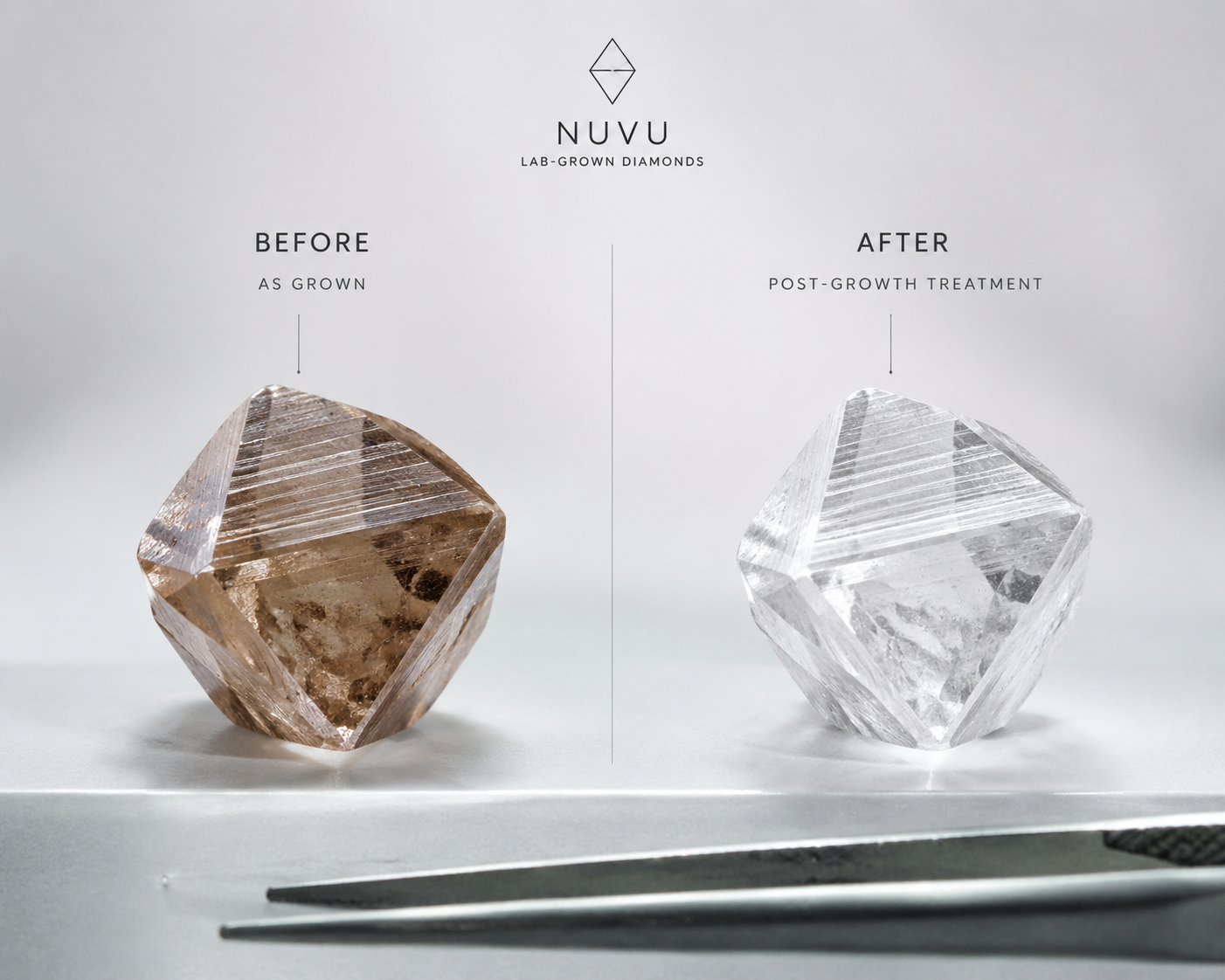
The primary reason is color adjustment. Some lab-grown diamonds emerge from the growth process with brownish or grayish tints that would place them in lower color grades. Post-growth treatment can reduce or eliminate these tints, shifting the stone into a more marketable color range.
This is not about hiding flaws. It is about making a production decision that affects the final product’s appearance and market position. A grower might choose to treat certain stones to achieve specific color grades, while leaving others untreated based on their as-grown characteristics.
The tradeoff is straightforward: treatment allows more of the rough production to become saleable at desirable color grades, but it introduces an additional processing step that should be documented. For buyers, the relevant question is not whether treatment occurred, but whether it was disclosed and whether the price reflects the stone’s characteristics fairly.
GIA and other major gemological laboratories distinguish between growth method and any subsequent treatments in their reporting, noting that both CVD and HPHT methods can produce diamonds that may or may not undergo additional processing.[1] This separation of growth method from treatment status is reflected in how grading reports are structured: the identification section specifies the growth method, while the comments section discloses any post-growth processes.
For buyers who want to verify the treatment information on a grading report, major laboratories provide report-check tools that allow you to confirm the document matches the laboratory’s records. This verification step adds confidence that the report is genuine and that the treatment disclosure is accurately recorded. When a report number is provided, using the issuing laboratory’s verification system is a practical way to confirm that the document corresponds to an actual stone and that the stated characteristics match what the laboratory recorded.
The Key Distinction: Treatment Exists, Non-Disclosure Is the Problem
Treatment itself is not inherently good or bad. It is a technical reality of diamond production, both for lab-grown and some natural diamonds. The issue that should concern buyers is non-disclosure.
Reputable grading laboratories identify and report post-growth treatments. IGI, GIA, and GCAL all have protocols for detecting and disclosing treatment. When a grading report clearly states that a diamond has undergone post-growth treatment, the buyer has the information needed to make an informed decision.
Problems arise when treatment is not disclosed, when report language is vague or evasive, or when sellers dismiss treatment questions as irrelevant. These are transparency failures, not treatment failures. A disclosed treated diamond from a transparent seller is often a better choice than an untreated stone from a seller who avoids direct questions.
For buyers comparing multiple stones, the practical distinction is not between treated and untreated, but between documented and undocumented. A grading report that clearly states treatment status allows for informed comparison; a report that omits this information for a commonly treated stone type leaves the buyer guessing.
When a grading report is available, buyers should verify the report details through the issuing laboratory’s official report-check tool where available. This confirms that the document is genuine and that the stated characteristics match the laboratory’s records.
What to Check on Your Grading Report
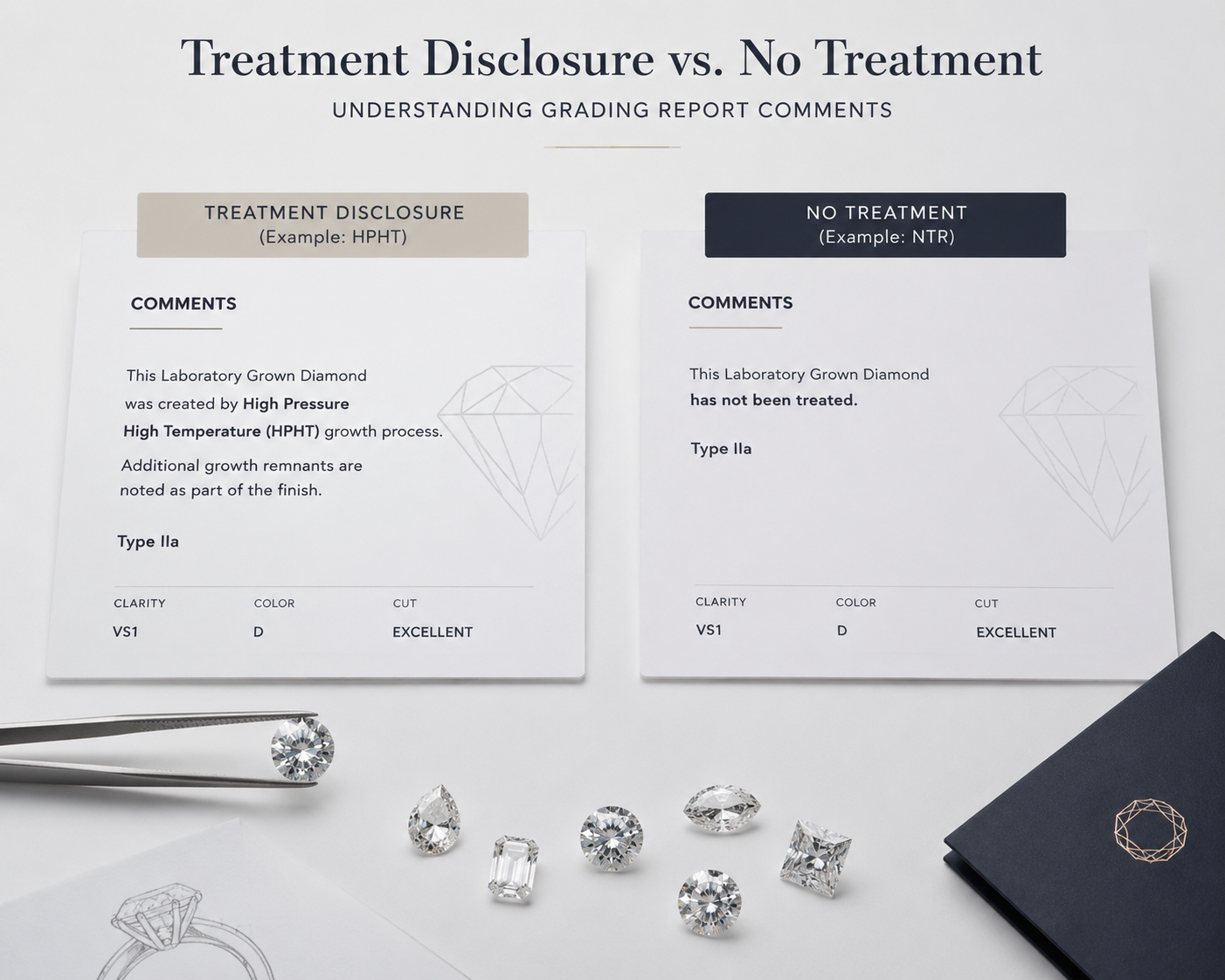
Major grading laboratories use specific language to indicate post-growth treatment. On IGI reports, look for notations such as “HPHT Processed” or “Post-Growth Treatment” in the comments section. GIA uses similar terminology, typically stating “HPHT Annealed” or “Treated” with specific details about the process. GCAL reports will clearly indicate any treatment in the identification and treatment disclosure sections.
The comments section is where treatment disclosure typically appears. If the comments mention nothing about treatment, the diamond is being sold as untreated. However, if the stone type is commonly treated and the report is silent, this warrants a direct question to the seller.
Ask specifically: “Does this diamond have any post-growth treatment disclosed on the report?” If the seller confirms there is no treatment, request written confirmation. If the report language is unclear or missing, consider it a transparency concern rather than assuming the best interpretation.
A grading report helps document key characteristics, but it should not be treated as a guarantee of beauty, value, or sourcing ethics. The report is a technical document that records specific measurements and observations at a point in time. Buyers should use it as one tool among many—alongside visual evidence, seller communication, and personal preferences—when making a purchasing decision.
HPHT Post-Growth Treatment: Process and Buyer Implications
HPHT post-growth treatment is the most common form of post-growth processing for lab-grown diamonds. Understanding what it does and does not do helps buyers evaluate treated stones on their merits rather than through fear-based marketing narratives.
How HPHT Treatment Affects Diamond Color
HPHT post-growth treatment uses controlled high pressure and high temperature to alter a diamond’s atomic structure. The process targets color-causing defects in the crystal lattice, often reducing brown or gray tints and shifting the diamond into a higher color grade.
This is a permanent structural change, not a coating or surface treatment. The diamond remains a diamond with the same chemical composition and physical properties. The treatment does not wear off, cannot be washed away, and does not require special care during everyday wear.
The color shift can be significant. A diamond that would have graded as light brown or brownish without treatment might grade as G, H, or I color after treatment. The final color grade depends on the starting material and the treatment process, but the result is a stone that visually appears whiter than it would have without treatment.
It is worth noting that the color improvement from HPHT treatment is not always uniform across all viewing angles or lighting conditions. While the grading report captures the face-up color grade under standardized lighting, buyers evaluating a treated stone may want to view high-resolution images or videos to assess how the color performs in different environments. This is good practice for any diamond, treated or not, but it can provide additional confidence when the stone’s color has been adjusted through processing.
Which Lab-Grown Diamonds Are Most Likely to Receive HPHT Treatment
HPHT treatment is particularly common for CVD-grown diamonds that exhibit brownish tints from the growth process. CVD growth can produce stones with brown coloration due to specific defect structures, and HPHT treatment effectively addresses this characteristic.
HPHT-grown diamonds may also receive post-growth treatment in some cases, though the application varies by producer and by stone. Not all lab-grown diamonds are treated. Some emerge from growth with desirable color grades and require no additional processing.
The decision to treat depends on the grower’s production economics, the stone’s as-grown characteristics, and the target market. Treatment is not a sign of low-quality rough or failed synthesis. It is a calculated production decision based on what the market wants and what the rough material can yield.
Understanding why certain stones receive treatment can help buyers contextualize what they see on a grading report. A CVD-grown diamond in the colorless to near-colorless range that shows no treatment notation may have grown with naturally high color, or it may have been selected from a production batch that did not require adjustment. The absence of treatment notation is not inherently a quality indicator—it simply reflects what the laboratory observed and recorded.
What HPHT Treatment Does Not Do
HPHT treatment does not make a diamond fake. The stone was already a diamond before treatment and remains a diamond after treatment. Treatment does not indicate a defect, does not mean the grower cut corners, and does not suggest the stone will fail or deteriorate over time.
The treatment also does not automatically mean the diamond is a bargain or a problem. A treated diamond can be visually excellent, well-cut, and perfectly suitable for an engagement ring or other jewelry. The relevant buyer questions are whether the treatment is disclosed, whether the grading report accurately reflects the stone’s characteristics, and whether the price is fair for what is being offered.
What treatment does change is the stone’s history. The diamond reached its current color grade through processing rather than emerging from growth with that grade naturally. For some buyers, this matters. For others, the final appearance and value proposition matter more. Both perspectives are valid, and the choice depends on personal priorities.
Buyer Verification Checklist for HPHT-Treated Stones
- Confirm treatment disclosure on the grading report. Look for “HPHT Processed,” “Post-Growth Treatment,” or similar language in the comments section.
- Verify the grading laboratory is reputable. IGI, GIA, and GCAL have established treatment detection and disclosure protocols. Reports from unknown or unverified laboratories warrant additional scrutiny.
- Compare pricing to similar untreated stones. Treatment may or may not affect price significantly. The comparison helps you understand whether the price is fair relative to the market.
- Request written seller confirmation if the report notation is ambiguous. If the report language is unclear, ask the seller to confirm treatment status in writing before purchase.
- Review the 360-degree video or high-resolution images. Visual inspection helps you evaluate whether the stone’s actual appearance matches the documented grades.
CVD Post-Growth Treatment: Understanding the Differences
Why Some CVD Diamonds Receive Post-Growth Treatment
CVD-grown diamonds form through a gas deposition process that can leave certain trace characteristics in the crystal structure. One common result is a brownish or grayish tint in the as-grown stone, caused by irregularities in the carbon lattice during the layer-by-layer growth. This coloration is not a defect in the traditional sense—it is simply how some CVD diamonds emerge from the reactor.
Post-growth treatment, most often HPHT annealing, applies controlled heat and pressure to adjust the diamond’s atomic arrangement. This can reduce or eliminate the brownish tint, shifting the stone into a higher color grade. For buyers, the key point is straightforward: treatment in CVD diamonds is a production decision made to improve marketability, not evidence of a problem with the stone.
GIA notes that CVD-grown diamonds may show specific spectroscopic characteristics related to their growth environment, and these characteristics can inform laboratory identification and treatment disclosure practices.[2] Understanding that treatment disclosure is grounded in detectable scientific differences—not marketing categories—helps buyers approach the topic with appropriate perspective.
The Relationship Between CVD Growth and Treatment Decisions
Whether a CVD diamond undergoes post-growth treatment depends on several factors: the specific growth conditions used by the producer, the stone’s as-grown color characteristics, and the target market segment. Some CVD diamonds are sold without any treatment because their as-grown color already meets the desired grade. Others are treated to achieve a specific color position that would otherwise require longer or more expensive growth conditions.
This means treatment status alone does not tell you whether a diamond is better or worse. A treated CVD diamond can be visually excellent and fairly priced. An untreated CVD diamond is not automatically superior—it simply followed a different production path, as detailed in the HPHT vs CVD certification. The relevant buyer question is whether the treatment is disclosed clearly and whether the price reflects the stone’s characteristics honestly.
In practical buying situations, the distinction between treated and untreated CVD stones often matters less than the overall combination of cut, color, clarity, and price. A well-cut treated stone with accurate documentation may outperform an untreated stone with less precise proportions or higher pricing. The useful comparison is between specific stones, not between abstract categories.
When evaluating a CVD diamond, the documentation chain matters as much as the technical specifications. A grading report from a recognized laboratory provides a snapshot of the stone’s characteristics at the time of grading, but the connection between that report and the specific diamond you are considering should be verifiable. The girdle inscription, report number, and measurements should all align. This is particularly important for CVD stones, where treatment disclosure practices have evolved over time and where earlier reports from some laboratories may use different terminology than current standards.
What CVD Treatment Means for Visual Appearance and Value
Post-growth treatment does not affect a diamond’s durability, hardness, or structural integrity. The stone remains a diamond with the same physical and chemical properties as an untreated lab-grown or natural diamond. What changes is the color grade the diamond presents after treatment.
For visual appearance, treatment can produce a stone that looks colorless or near-colorless at a price point that might otherwise require a higher budget. This is a legitimate option for buyers prioritizing appearance and value over treatment history. For resale or trade-in, treatment status is one factor among many, but the larger reality is that lab-grown diamonds as a category have different value retention dynamics than natural diamonds. Buyers should focus on purchasing from reputable sellers with clear documentation rather than assuming treatment status will be the dominant factor in future transactions.
Prices can change with market conditions, report type, seller channel, and stone-specific details, so exact comparisons should be verified at the time of purchase. A treated stone may be priced differently than an untreated stone with similar grades, but the difference varies based on seller strategy, market positioning, and availability rather than a fixed formula.
How to Interpret CVD Treatment Information on Reports
Reading a grading report for a CVD diamond requires attention to two separate pieces of information: the growth method and the treatment status. The report will typically state “CVD” as the growth method in the identification section. In the comments area, look for notations such as “HPHT Processed,” “Post-Growth Treatment,” or “Color Enhanced.”
One common source of confusion is seeing “HPHT Processed” on a CVD diamond report. This does not mean the diamond was grown using the HPHT method. It means the CVD-grown diamond underwent HPHT annealing as a post-growth treatment. The growth method and the treatment method are separate designations. If the report shows CVD as the growth method with HPHT treatment in the comments, you are looking at a CVD diamond that received post-growth color enhancement.
For buyers who want to understand the full production story, this distinction between growth method and treatment method is worth clarifying with the seller. A reputable seller should be able to explain exactly what the report notations mean and how they relate to the stone’s characteristics. If the seller cannot explain the difference between CVD growth and HPHT treatment, or seems confused by the question, that may indicate a gap in expertise that could affect other aspects of the transaction.
Why Treatment Disclosure Matters More Than Treatment Itself
The Role of Grading Laboratories in Treatment Identification
Major grading laboratories—IGI, GIA, and GCAL chief among them—have established protocols for identifying and disclosing post-growth treatments. These laboratories use spectroscopic analysis and other testing methods to detect evidence of treatment that may not be visible to the naked eye or even under standard magnification.
This is why purchasing a lab-grown diamond with a report from an established laboratory matters. A reputable lab provides independent verification of both the diamond’s characteristics and its treatment status. The alternative—relying solely on a seller’s representation—leaves you with no independent confirmation of what the stone has undergone. For a purchase of this significance, third-party documentation is not an optional extra. It is the foundation of informed decision-making.
GIA and other major laboratories publish guidance on how lab-grown diamonds are identified and how treatments are detected and reported, providing buyers with a framework for understanding what grading reports actually document.[3] This transparency about laboratory methodology means that when a report states “no indications of post-growth treatment,” that statement carries specific technical weight—rather than simply being the absence of a comment.
The laboratory’s role in treatment identification creates an important layer of traceability for buyers. When a diamond is submitted to a recognized grading laboratory, the resulting report becomes a document that travels with the stone through subsequent transactions. This continuity allows future buyers, sellers, and appraisers to verify what the stone is and what it has undergone. Without this documentation, each subsequent owner would need to rely on verbal representations or commission new testing, creating uncertainty and potential for miscommunication.
A grading report can document key characteristics, but it should be read alongside visual evidence, measurements, seller documentation, and the intended jewelry use. The report is one important piece of the evaluation, not a complete picture on its own.
What Incomplete or Missing Disclosure Looks Like
Warning signs are not always obvious, but they follow predictable patterns. A report that omits any mention of treatment for a diamond type commonly treated—particularly CVD stones in the colorless to near-colorless range—should raise questions. Seller claims that treatment is irrelevant, standard, or not worth mentioning are another signal. So is vague language that avoids direct disclosure, such as “enhanced for beauty” without specifying what that means.
The concern is not that treatment has occurred. The concern is that a seller who avoids clear disclosure may be hoping you will not ask. Non-disclosure can indicate a broader approach to transparency that puts the seller’s interests ahead of your ability to make an informed choice. This is a larger risk than the treatment itself, because it affects every aspect of the transaction.
How to Ask Sellers About Treatment History
Asking about treatment should feel like a standard verification question, not an accusation. Direct, neutral phrasing works best. Ask: “Does the grading report note any post-growth treatment?” Ask: “Is this diamond sold as untreated, or has it undergone color enhancement?” Ask: “Can you confirm in writing that the treatment status matches what appears on the report?”
A transparent seller will answer these questions directly, point to the relevant section of the grading report, and provide written confirmation if requested. If the answers feel evasive, incomplete, or dismissive, that tells you something important about how the seller approaches customer communication.
Red Flags and Green Lights in Treatment Communication
Green lights include a grading report with clear treatment notation, a seller who proactively explains treatment status before you ask, and written confirmation available upon request. Also positive: the seller treats your question as routine and answers without defensiveness.
Red flags include a report that lacks treatment information for a stone type where treatment is common, a seller who dismisses the question as unnecessary or overly detailed, and claims that treatment is standard practice and therefore does not require disclosure. Any suggestion that you should not concern yourself with treatment history is a signal to seek a different seller.
Treated vs. Untreated Lab-Grown Diamonds: A Practical Comparison
Visual and Structural Differences
Treated and untreated lab-grown diamonds are both real diamonds. They share identical chemical composition, hardness, and optical properties. Treatment does not make a diamond fake, synthetic in a pejorative sense, or structurally inferior. It does not affect durability, brilliance, or everyday wearability.
The visual difference between a treated and untreated stone is not in the fundamental nature of the diamond. It is in the color grade achieved. A treated diamond may have reached its current color through post-growth processing rather than emerging from the reactor that way. Both stones will look the way their grading report describes. The question is whether you care how they got there.
Laboratory-grown diamonds should be clearly distinguished from natural diamonds in any comparison, and both treated and untreated lab-grown diamonds fall under this same disclosure requirement. The treatment question is separate from the origin question—buyers should understand both what the diamond is (lab-grown) and what processes it has undergone (treatment status).
Pricing Considerations for Treated Stones
Treatment status does not automatically translate into lower pricing. The market for lab-grown diamonds is influenced by the 4Cs—cut, color, clarity, and carat weight—along with brand positioning, seller strategy, and overall supply conditions. A treated diamond with excellent cut and clarity may be priced similarly to an untreated stone with comparable grades.
What matters is whether the price reflects honest disclosure. A treated diamond priced fairly, with transparent documentation, can be an excellent value. An untreated diamond priced at a premium simply for being untreated may or may not be worth that premium to you. The decision should rest on the stone’s actual characteristics and your budget, not on a marketing narrative that positions treatment as a defect.
When comparing prices between treated and untreated stones, make sure you are comparing like for like. A treated D-color diamond and an untreated D-color diamond may have different production histories, but if both are accurately graded and documented, the price difference (if any) often reflects seller positioning rather than objective quality. The more meaningful question is whether each stone’s price is fair for its documented characteristics, regardless of treatment status.
Resale and Trade-In Implications
Lab-grown diamonds as a category have different resale and trade-in dynamics than natural diamonds. The broader market conditions matter more than treatment status alone. Some buyers may prefer untreated stones for personal reasons, which could affect demand in certain resale scenarios. But treatment is one factor among many, and it is not the dominant driver of future value.
If resale or trade-in is a consideration, prioritize purchasing from a reputable seller with clear documentation. A well-documented treated diamond from a transparent seller is likely to present fewer complications than an undocumented stone from a seller who avoids disclosure questions. Documentation protects your ability to accurately represent what you own.
The documentation that accompanies a lab-grown diamond serves as its identity record. When the time comes to resell, trade in, or insure the stone, having a clear paper trail—from a recognized grading laboratory and, where applicable, from the original seller—makes those processes smoother. Treatment status that is clearly documented from the beginning reduces the need for explanations or additional verification later. This is not about treatment being a negative, but about the practical value of complete records for any significant purchase.
Decision Framework: When Treatment Status Matters to You
Whether treatment status should influence your decision depends on what you prioritize. If documentation accuracy and full transparency are primary concerns, verify treatment disclosure and consider whether you want a stone with a simpler production history. If visual appearance, budget, and overall value are primary, focus on the stone’s actual characteristics—cut quality, color appearance, clarity, and price—rather than treatment history alone.
The practical reality is that many buyers will never notice a difference between treated and untreated stones with identical grading reports. The difference matters most when you care about the production story, when you want to minimize questions in future resale scenarios, or when a seller’s disclosure practices affect your trust. In those cases, treatment status becomes a proxy for transparency rather than a quality judgment.
Common Misconceptions About Post-Growth Treatment
Misconception: Treated Lab-Grown Diamonds Are Lower Quality
Post-growth treatment is a production decision, not a quality grade. A diamond that has undergone HPHT annealing or similar processing can achieve excellent cut, color, clarity, and visual performance. The treatment altered the color trajectory, but the final product stands on its own merits.
Quality is determined by what the diamond looks like and how it performs now—not by what process was used to get there. A treated stone with a precision cut, attractive face-up color, and clean clarity will outperform an untreated stone with poor proportions or visible inclusions. The grading report documents the actual characteristics. Treatment history belongs in the disclosure column, not the quality column.
This misconception often stems from natural diamond marketing, where “treated” can signal a lower-value stone. Lab-grown diamonds operate under different economics. Treatment is sometimes the most efficient path to a desirable color grade, and it does not inherently signal a compromised product.
Misconception: Treatment Means the Diamond Is Not “Real”
Post-growth treatment does not change what the diamond is. A treated lab-grown diamond remains a diamond—carbon atoms arranged in a crystal lattice, with the same hardness, refractive index, and thermal conductivity as any natural or untreated lab-grown diamond.
Treatment adjusts color by modifying atomic-level defects or impurities within the crystal structure. This is not a coating, not a filler, and not a synthetic overlay. The diamond is not “less real” because it underwent a color improvement process after growth. Natural diamonds also undergo treatments, and they remain diamonds.
The question is not authenticity. The question is whether the treatment is disclosed and whether the price reflects the stone’s actual characteristics and market positioning.
Misconception: Only “Cheap” or “Low-End” Lab Diamonds Are Treated
Treatment decisions are driven by production economics, not a simple quality hierarchy. Some CVD-grown diamonds develop brownish or grayish tints during growth due to process conditions. These stones can become visually appealing color grades through post-growth treatment. The alternative—selling them at lower color grades—might not serve any buyer segment better.
Well-cut, eye-clean lab-grown diamonds with strong light performance sometimes reach the market with treatment history. The treatment allowed them to achieve a color grade that matches their cut quality and overall appeal. Dismissing these stones as “cheap” ignores the actual product in favor of a simplistic narrative.
Production choices vary by grower and target market. Some producers optimize for untreated output; others use treatment as a standard step. Neither approach automatically indicates higher or lower final quality.
How to Separate Marketing From Facts
Be cautious when a seller uses treatment as a fear-based marketing tool. Claims like “our diamonds are never treated” or “treated diamonds are inferior” are designed to create anxiety, not to inform. The more useful question is whether the seller provides transparent documentation and clear disclosure.
A seller who dismisses treatment questions as irrelevant, or who claims that treatment information is too technical for buyers to understand, is not prioritizing your ability to make an informed decision. The sellers worth trusting are the ones who answer directly, show you the grading report, and explain what the notations mean.
Facts come from grading reports, not marketing narratives. If a report from a reputable laboratory clearly states treatment status, you have the information you need. If a seller avoids documentation or relies on emotional claims, treat that as a warning sign regardless of what they say about treatment.
How to Evaluate a Lab-Grown Diamond When Treatment Is Disclosed
Focusing on the Final Product, Not the Process History
Once treatment is disclosed and documented, evaluate the diamond on what it is today. Cut quality, color appearance, clarity characteristics, carat weight, overall visual appeal, and HPHT vs CVD lab grown diamonds determine whether the stone is right for you. The treatment history is part of the transparency record, but it does not override the actual characteristics.
A diamond with disclosed treatment should be judged against other stones in the same grade range. If the cut is excellent, the color faces up well, and the clarity is appropriate for your preferences, the treatment is background information—not a reason to disqualify the stone.
The mistake would be to treat disclosed treatment as a hidden defect. The defect is non-disclosure, not the treatment itself.
Using Grading Reports as Your Primary Verification Tool
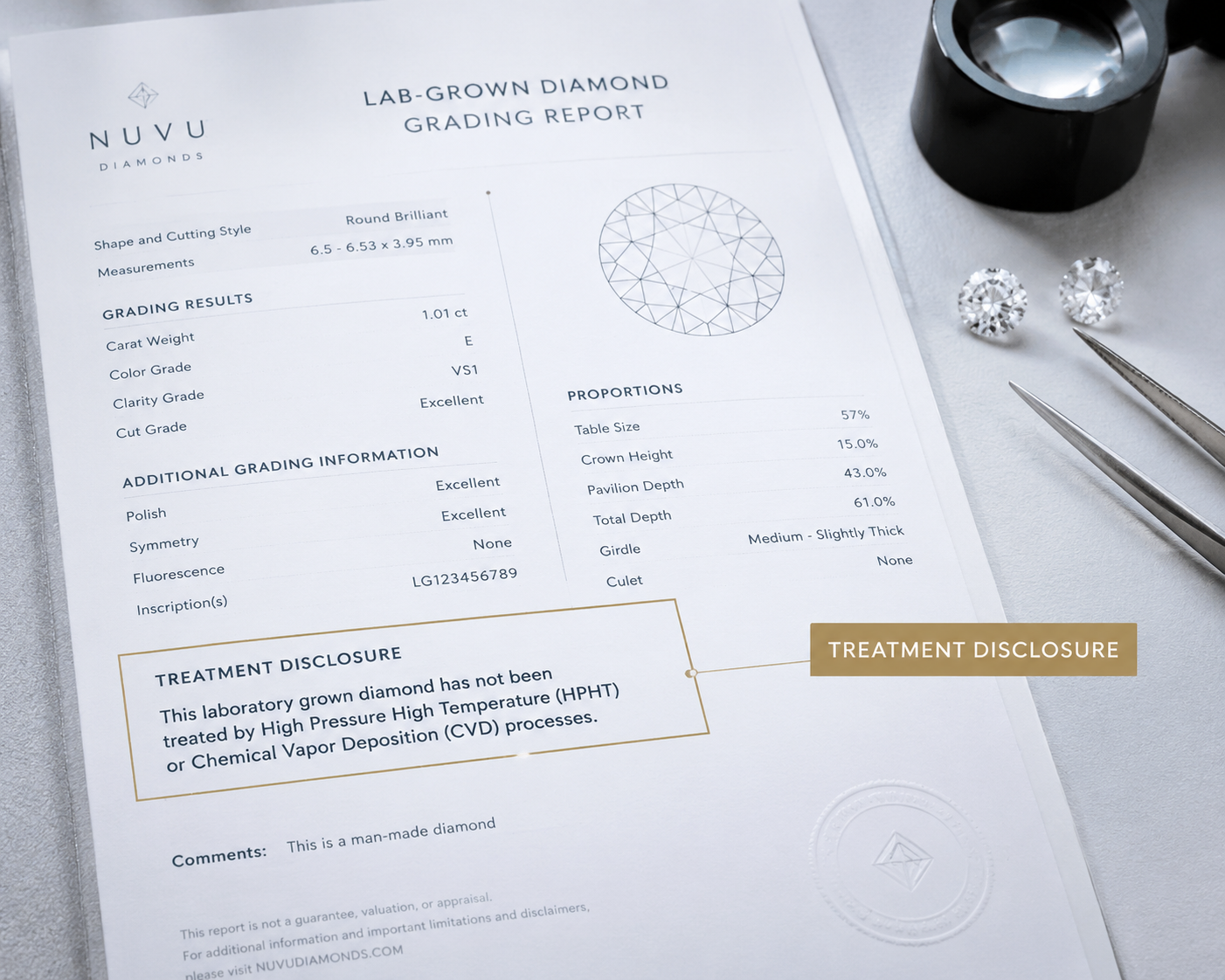
The grading report is your main document for confirming treatment status, cut grade, color, clarity, and measurements. Reputable laboratories like IGI, GIA, and GCAL have established protocols for identifying and disclosing post-growth treatments. Look for comments such as “HPHT Processed,” “Post-Growth Treatment,” or “Color Enhanced” in the report notes.
Cross-reference the report with the actual stone. The laser inscription on the diamond’s girdle should match the report number. Use high-resolution images or 360-degree video to verify that the stone you are buying matches the report specifications. If the seller cannot provide matching documentation, that is a larger concern than the treatment status itself.
A grading report is not a guarantee of value, but it is a verification tool. Use it to confirm that what you are buying matches what is being represented.
One practical step that many buyers overlook: compare the measurements on the report to the stated carat weight and visual appearance. A 1.00-carat diamond with measurements that seem inconsistent with its weight may indicate a reporting error or a mismatch between the stone and the document. This verification step applies to any diamond purchase, but it is especially worth doing when treatment status adds another layer of information to confirm.
Comparing Treated and Untreated Options Side by Side
If you are uncertain whether treatment status should affect your decision, compare similar stones directly. Look at treated and untreated lab-grown diamonds in the same carat range, cut grade, color grade, and clarity grade. Assess whether you can see meaningful differences in appearance or whether the distinction is primarily on paper.
Often, the comparison shows that treatment is one factor among many, not a dominant determinant of visual appeal or value. Two stones with identical grades may look nearly identical face-up, regardless of treatment history. The more relevant differences are usually cut precision, fluorescence, and specific clarity characteristics—not whether the stone underwent post-growth processing.
Price differences, when they exist, are often driven by market positioning and seller strategy rather than objective quality gaps. Use side-by-side comparison to ground your decision in what you can actually observe.
Verification Steps Before Purchase
Before committing to a purchase, run through a verification checklist. Confirm that the grading report comes from a recognized laboratory with clear disclosure standards. Verify that the treatment status is explicitly stated in the report comments, not omitted or buried in vague language. Match the laser inscription on the diamond to the report number. Review available video or high-resolution images to ensure the stone matches the documentation. Compare the pricing to similar stones with and without treatment to assess whether the price is fair given the disclosure. If any information is unclear, request written confirmation of treatment status from the seller.
What Sellers and Brands Should Communicate About Treatment
The Minimum Standard: Clear, Written Disclosure
Responsible sellers provide clear, written disclosure of treatment status before you commit to a purchase. This disclosure should appear on the grading report from a reputable laboratory, or in supplementary documentation if the report language is ambiguous. You should not have to extract this information through persistent questioning.
If a seller cannot or will not provide documentation that explicitly states whether a diamond has undergone post-growth treatment, that is a transparency failure. The treatment itself may be routine, but the lack of disclosure is not.
Written disclosure protects both parties. It ensures you know what you are buying, and it gives you a record if questions arise later.
The Federal Trade Commission’s guidance on jewelry marketing emphasizes that material information affecting a buyer’s decision should be disclosed clearly and conspicuously.[4] While the FTC does not prescribe specific language for lab-grown diamond treatment disclosure, the principle of transparent communication applies: buyers should have access to information that would influence their purchasing decision, presented in a way they can understand and verify.
Beyond Disclosure: Educating Buyers Without Creating Fear
The best brands explain treatment in neutral, educational terms. They clarify that treatment is a production reality for some lab-grown diamonds, that it does not affect durability, and that disclosure is the key to informed buying. They do not use treatment as a weapon against competitors, and they do not dismiss buyer questions as irrelevant.
Brands that rely on fear-based marketing—either by exaggerating the risks of treated stones or by claiming their untreated stones are automatically superior—are not prioritizing your understanding. They are using information asymmetry to create anxiety and drive a specific purchasing decision.
Transparent brands answer questions directly, show you the documentation, and let you make the decision based on facts. If a seller cannot explain treatment without resorting to scare tactics or evasion, consider whether that seller deserves your trust.
How NUVU Approaches Treatment Transparency
At NUVU, we provide grading reports from established laboratories for our lab-grown diamonds, and we ensure that treatment disclosure is clearly visible in the product information. If a stone has undergone post-growth treatment, that information is not hidden in fine print or omitted from the listing.
Our team answers treatment questions directly. We explain what the report notations mean, how treatment affects the stone (and how it does not), and how pricing reflects the documented characteristics. We do not use treatment as a marketing angle to create fear about other options, and we do not dismiss the question as irrelevant.
The goal is to give you the information you need to make a confident decision, not to steer you toward a specific product based on incomplete or manipulative framing.
For NUVU, the focus is on making the comparison clearer: what the grading report shows, what the visual evidence reveals, and whether the stone fits your intended design and budget. Treatment disclosure is part of that picture, but it does not stand alone. The complete evaluation includes cut quality, proportions, visual performance, and how the stone will work in the jewelry piece you are planning. When all of these elements are documented and accessible, the treatment question becomes one data point among many rather than a source of uncertainty.
Questions to Ask Any Seller About Treatment
When evaluating a lab-grown diamond, ask the seller directly: Is treatment disclosed on the grading report? Can you provide written confirmation of treatment status? How does treatment affect pricing for this stone compared to similar untreated options? What laboratory graded this diamond, and do they have clear treatment disclosure protocols? Can I see the full report before purchase?
These questions are reasonable and expected. A transparent seller will answer them without hesitation. If the answers are evasive, incomplete, or dismissive, you have learned something valuable about the seller—regardless of what they say about the diamond.
Making an Informed Decision About Treated Lab-Grown Diamonds
When Treatment Disclosure Is a Positive Signal
A seller who clearly states that a diamond has undergone post-growth treatment is telling you something important about how they do business. They are choosing documentation over convenience, even when staying quiet might make the sale easier. That choice matters more than most buyers realize.
A treated diamond with full, upfront disclosure from a transparent seller is often a safer purchase than an untreated stone from a seller who dodges direct questions or provides vague paperwork. The treatment itself is a known, documented variable. A seller’s reluctance to clarify what is on the grading report is an unknown—and unknowns are where buying mistakes happen.
Clear disclosure also gives you leverage. When you know a stone’s treatment history, you can evaluate its price accurately, compare it against similar options, and make a decision based on facts rather than assumptions. A seller who volunteers that information is working within that same framework, which is a strong indicator that other aspects of the transaction—return policies, grading accuracy, stone matching—are likely handled with the same level of care.
When to Seek Additional Verification
Not every transaction requires deep investigation, but certain situations should prompt you to slow down and ask more questions. If a grading report omits treatment information for a stone type that is commonly treated—such as a CVD-grown diamond in the D–F color range with no treatment notation in the comments—that gap is worth investigating. It may simply be an untreated stone, but the absence of information is not the same as confirmation.
An unfamiliar grading laboratory is another reason to verify. IGI and GIA have established protocols for identifying and disclosing post-growth treatments. Smaller or newer labs may follow different standards, and their reports may not carry the same weight if you ever need to resell or trade in the stone. If you cannot find independent information about the laboratory’s reputation, treat the report as incomplete until you can confirm its reliability.
Seller behavior is the most immediate warning sign. If you ask whether a diamond has been treated and the response is evasive, dismissive, or framed as unnecessary—(“Treatment is standard, it doesn’t matter,” or “You don’t need to worry about that”)—the seller is making a decision about what you should know. That is a red flag regardless of the stone’s actual characteristics. A price that seems unusually low for the stated 4Cs, combined with unclear documentation, also warrants closer scrutiny. The discount may reflect legitimate market positioning, or it may reflect a gap in disclosure.
For buyers purchasing from online sellers or distant retailers, verification becomes even more important. Request the full grading report before purchase, not just a summary. Confirm that the girdle inscription number matches the report. Ask for high-resolution images or 360-degree video that shows the stone from multiple angles. If the seller cannot provide these materials, the lack of visual documentation is a separate concern from treatment disclosure—but it compounds the risk. A transparent seller should be able to show you exactly what you are buying.
The Bottom Line: Documentation Over Marketing Narratives
Post-growth treatment is a standard part of lab-grown diamond production. It is used to adjust color, improve visual appearance, and bring stones to market-ready grades. It does not make a diamond fake, defective, or inherently inferior. What creates risk for buyers is not the treatment itself, but the absence of clear, written information about it.
The most reliable way to navigate this topic is to rely on documentation rather than marketing. A grading report from a reputable laboratory that clearly states whether a diamond has undergone post-growth treatment gives you the information you need to evaluate the stone on its merits. Marketing language—whether it weaponizes treatment to scare you away from competitors or dismisses your questions as irrelevant—does not serve your decision. It serves the seller’s positioning.
At NUVU, we treat treatment disclosure as a baseline requirement, not a differentiator. Every stone we offer comes with a grading report from an established laboratory, and the treatment status is available for review before purchase. The goal is not to convince you that treatment is either good or bad, but to make sure you have the documentation to decide for yourself.
Your Pre-Purchase Treatment Verification Checklist
- Confirm the grading report is issued by IGI, GIA, or an equivalent reputable laboratory with established treatment disclosure protocols.
- Locate the treatment status in the report’s comments section. Look for specific notations such as “Post-Growth Treatment,” “HPHT Processed,” or “Color Enhanced.” If the comments are silent on treatment for a commonly treated stone type, ask the seller directly.
- Request written confirmation of treatment status from the seller if the report language is ambiguous or if you want an additional layer of documentation for your records.
- Compare pricing to similar stones with the same carat weight, cut, color, and clarity grades to determine whether treatment status correlates with a meaningful price difference.
- Verify that the laser inscription on the diamond’s girdle matches the report number, confirming the document corresponds to the specific stone you are purchasing.
- Proceed with confidence when disclosure is transparent, the report is verifiable, and the seller answers questions directly and in writing.
Explore Lab-Grown Diamonds with Clear Documentation and Full Transparency
Post-growth treatment is a standard part of how many lab-grown diamonds reach their final color grade. It is not a warning sign, a defect, or a reason to walk away from a stone you otherwise like. The real risk lies in buying from a source that will not tell you whether treatment occurred.
At NUVU, every lab-grown diamond is accompanied by a grading report from a reputable laboratory, and treatment status is disclosed clearly in the product details. If a stone has undergone post-growth processing, you will see it noted on the report—not buried in fine print or hidden behind vague language.
Before making a purchase, take the time to review the full grading report. Verify the treatment disclosure. Ask questions if the documentation is unclear. A transparent seller will answer directly.
If you want help interpreting a grading report, comparing treated and untreated options, or understanding how treatment status fits into your buying priorities, contact NUVU. Our team is available to walk through the details so you can move forward with confidence.
Browse the full collection of lab-grown diamonds to compare stones side by side, review certificates, and see exactly what you are buying—before you commit.
[1] GIA, “Lab-Grown Diamonds,” Gemological Institute of America, accessed 2025.
[2] GIA, “Lab-Grown Diamonds: Information on CVD and HPHT Growth Methods and Identification,” Gemological Institute of America, accessed 2025.
[3] GIA, “How to Read a GIA Grading Report for Lab-Grown Diamonds,” Gemological Institute of America, accessed 2025.
[4] Federal Trade Commission, “Guides for the Jewelry, Precious Metals, and Pewter Industries,” FTC, 2023.
Disclosure: This article is for general educational purposes only. Diamond grading, pricing, availability, specifications, and seller policies can change, and readers should verify important details through grading reports, official laboratory tools, seller documentation, or qualified professionals before making a purchase decision. Laboratory-grown diamonds should be clearly distinguished from natural diamonds, and environmental or sourcing claims should be supported by specific documentation.
Last updated: January 2025