 Get a Quote
 Loose lab-grown diamonds10 shapes · IGI, GIA or NGTC reports
How Are Lab-Grown Diamonds Made? HPHT and CVD Explained for Buyers
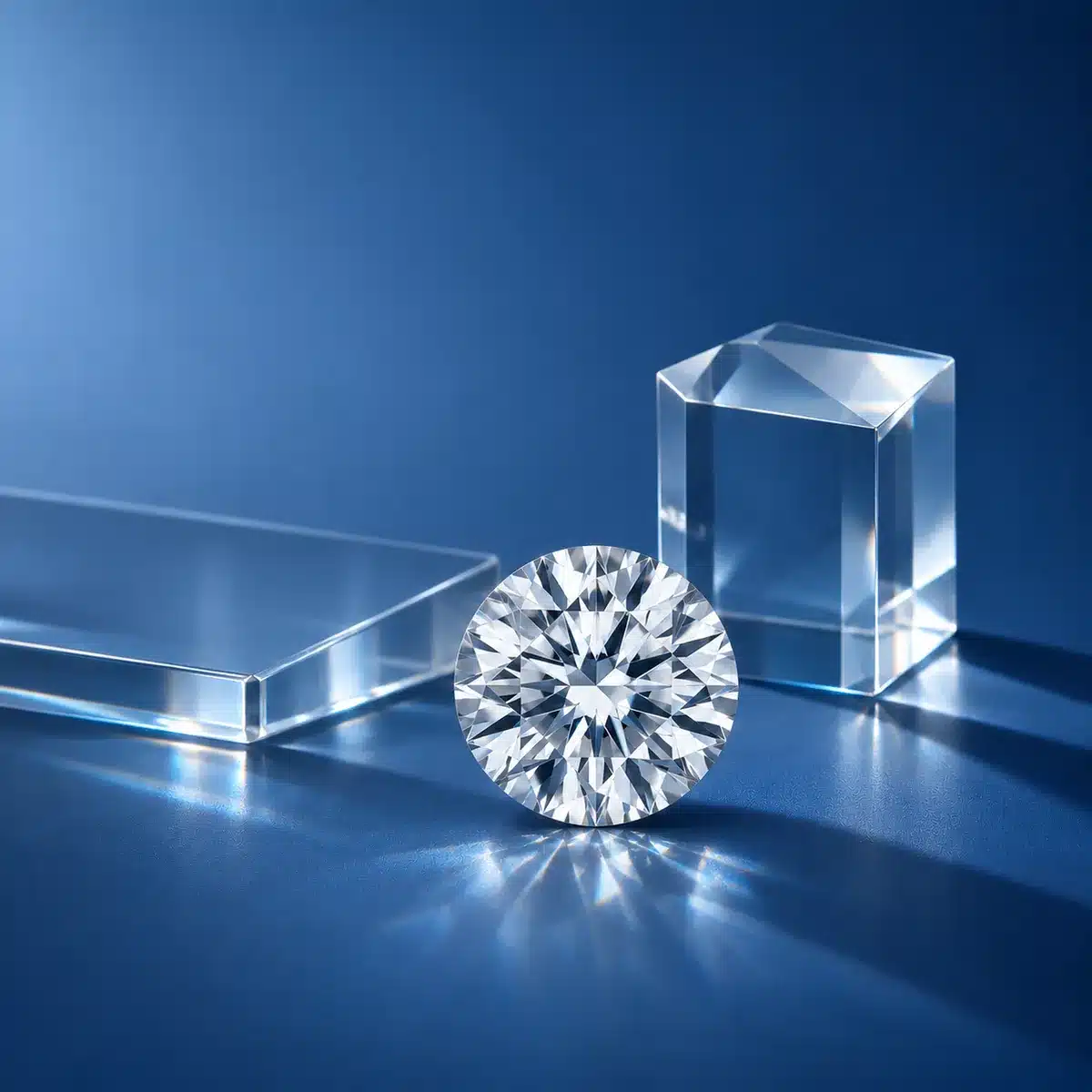
A CVD reactor can run for three or four weeks to grow one batch of crystals, and every few days the operators stop it, take the crystals out and polish their top surfaces before growth continues. An HPHT press works the other way round: a sealed cell, more than 870,000 pounds per square inch, 1,300 to 1,600°C, and crystals that form over several days to weeks. Two very different machines, one product: diamond.
There are two ways to grow a gem diamond. HPHT (high pressure, high temperature) dissolves carbon in molten metal around a small diamond seed and lets it crystallize. CVD (chemical vapor deposition) breaks down a carbon-bearing gas and lets carbon settle on flat diamond seed plates. The rough is then cut, polished and graded like mined rough. Neither method makes a better stone by itself.
From seed to finished stone
- SeedA small diamond crystal (HPHT) or thin diamond plates (CVD) start the growthTypical time: Prepared in advance
- GrowthPress or reactor grows rough crystalsTypical time: HPHT several days to weeks; CVD about 3–4 weeks
- Treatment, some stonesAnnealing to improve or change colorTypical time: Hours to days
- Planning and cuttingThe rough is mapped, laser-sawn, shaped and polishedTypical time: Days
- GradingA laboratory report, or supplier grading for small stonesTypical time: Days to weeks
- SettingThe stone goes into a ring, earrings or another pieceTypical time: Days
How HPHT works
A small diamond seed is placed in a growth cell with a carbon source, such as graphite, and a metal solvent, usually iron, nickel or cobalt. The metal lowers the temperature and pressure the carbon needs. A press then heats the cell to 1,300–1,600°C at more than 870,000 psi, about 60,000 atmospheres. The metal melts, dissolves the carbon, and the carbon crystallizes on the seed over several days to weeks. HPHT crystals are cubo-octahedral, with several crystal faces. GIA now sees colorless HPHT stones cut at 10 ct and above. Adding boron during growth gives blue.
How CVD works
Thin, flat diamond seed plates go into a vacuum chamber with hydrogen and a carbon-bearing gas such as methane. A microwave beam breaks the gas down at about 900–1,200°C, and carbon atoms settle on the plates layer by layer. The result is a flat, tabular crystal. Its edges often carry black graphite, which is cut away. Many CVD crystals grow with a brown tint, which is removed by heat treatment before cutting: GIA found that about 80% of the CVD stones it received since 2020 had been treated after growth.
HPHT and CVD side by side
For what the method means for color, clarity, price and order specifications, see HPHT vs CVD.
Treatment after growth
“HPHT” can describe the growth method or a treatment. A CVD stone annealed under high pressure and temperature is CVD-grown and HPHT-treated, not an HPHT diamond. Treatment is permanent and does not weaken the stone, but it has to be disclosed. If you need untreated stones, ask for as-grown stones and check the report comment. See post-growth treatment.
Why growth is slow
Diamond grows a little carbon at a time. Pushing it faster tends to add inclusions, strain or color, so producers trade speed against quality. Larger, cleaner crystals need longer, steadier runs, and a CVD run is interrupted every few days for surface polishing.
Cutting and grading
The rough is mapped to decide which shapes and sizes give the best yield, then laser-sawn, shaped and polished. Cutting decides how bright the stone looks more than the growth method does. Larger stones go to a laboratory such as IGI, GIA or NGTC; small stones and melee are usually graded by the supplier. See manufacturing from growth to jewelry.
Energy use
Both methods use a lot of electricity, for the press heating or the plasma. The footprint depends mostly on the energy source and the efficiency of the plant. Broad claims such as “eco-friendly” need specific support under the FTC Green Guides, and in the EU generic environmental claims have been banned since September 27, 2026. See are lab-grown diamonds more sustainable?
A short history
Diamond was first grown in the laboratory in the 1950s, for industrial abrasives. General Electric made the first gem-quality crystals in the 1970s, and CVD growth became reproducible in the late 1980s. Gem production has grown quickly over the past ten years.
What to check when you buy
Growth questions
How long does it take to grow a lab-grown diamond?
HPHT takes several days to weeks; a CVD run about three or four weeks. Cutting and grading add more time.
Can you tell HPHT from CVD by eye?
No. Laboratories identify the method with spectroscopy and ultraviolet imaging.
Is a lab-grown diamond the same as moissanite or cubic zirconia?
No. Those are different materials, called simulants. See lab-grown diamonds vs simulants.
Is one method better?
No. Both produce excellent and poor stones. Judge the individual stone and its report.
Choose by the stone, not the machine
Send the shape, size, quality range and quantity you need, and say whether the growth method or as-grown status matters for your product. NUVU can arrange IGI, GIA or NGTC reports and can provide proof of no post-growth treatment on request. Send your requirements or message us on WhatsApp / WeChat at +86 19118403930.
Sources

9+ years optimizing HPHT & CVD growth recipes and overseeing large-scale lab-grown diamond manufacturing.
About NUVU. NUVU is the international brand of New Perspective Superhard Materials Co., Ltd. in Zhecheng, Henan, China. We grow HPHT lab-grown diamonds in-house and cut, polish and match stones in our own workshop.
Related Guides
Lab-Grown Diamond Education & Buying Guides
Every NUVU lab-grown diamond guide in one place: 4Cs, certificates, HPHT vs CVD, prices, shapes,…
Read more →NUVULab-Grown vs Natural Diamonds
Lab-grown vs natural diamonds compared on six points: what they are, how they look, price, resale, how to…
Read more →GrowthHPHT and CVD Diamond Production in China: Buyer Guide
How HPHT and CVD lab-grown diamond production works in China, where it is concentrated, what it means for…
Read more →