- Shop
Diamonds & Jewelry
Loose Lab Diamonds Yellow Lab Diamonds Pink Lab Diamonds Blue Lab Diamonds Engagement Rings Fine Jewelry Shop All Loose lab-grown diamonds10 shapes · IGI, GIA or NGTC reports
- Wholesale
- Custom Design
- Education
- About
China Lab-Grown Diamond Manufacturing Explained: From Growth to Cutting and Jewelry Production
- The stages at a glance
- 1. Growth: the starting point
- 2. Rough planning: where value is first shaped
- 3. Cutting and polishing
- 4. Sorting, matching and quality control
- 5. Grading and documentation
- 6. Jewelry production
- Timeline from rough to finished piece
- Who does what in a typical order
- Quality checkpoints along the way
- Manufacturing questions
- Ask for a stage-by-stage schedule
A 1.50 ct oval in a finished ring may have spent three or four weeks in a CVD reactor, a few days in an annealing press, a week or two with a cutter, a few days in a sorting room and some days at a laboratory before it reached the setter’s bench. Each of those hands changed what the buyer finally sees, and each can be asked about.
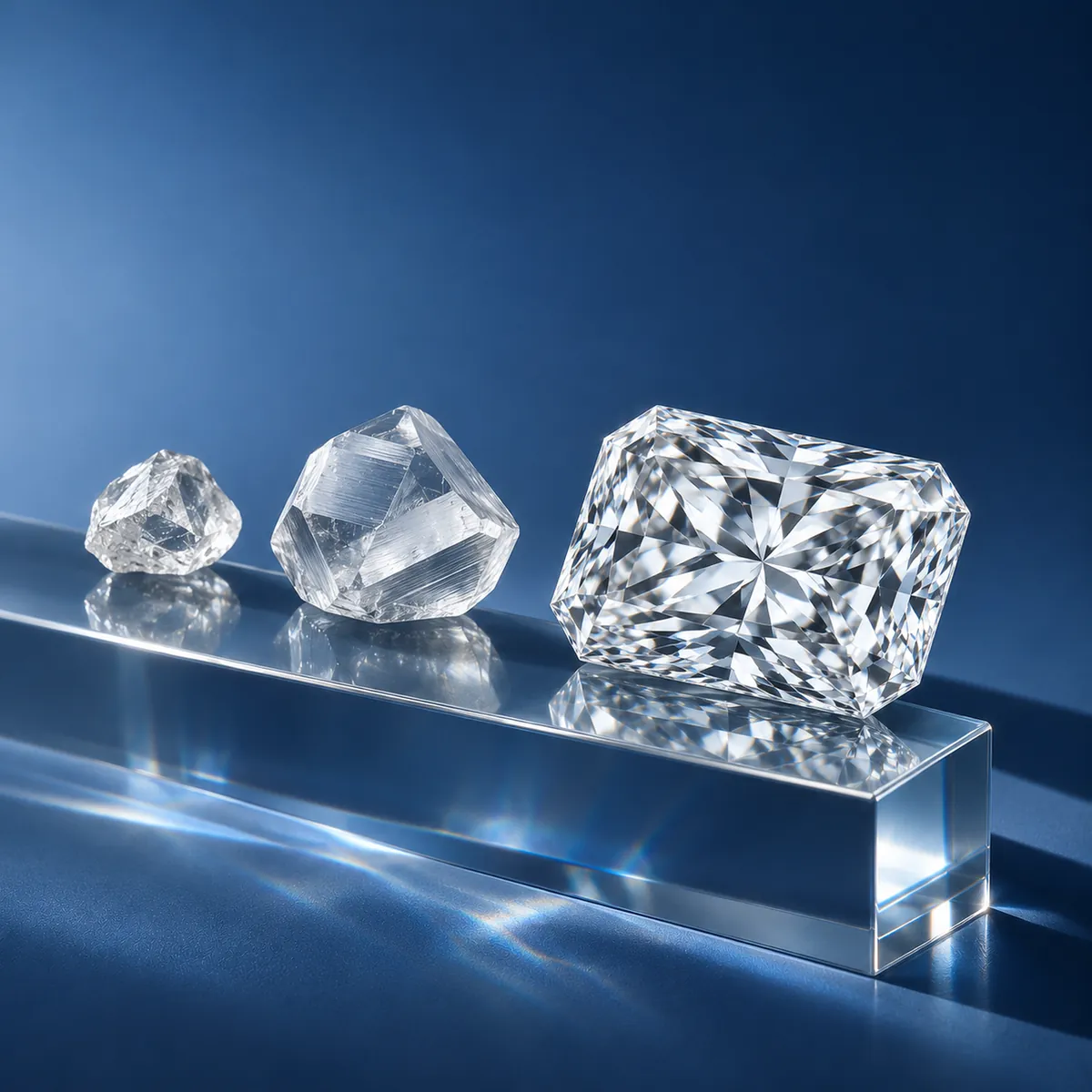
A lab-grown diamond goes through six main stages: growth by HPHT or CVD, rough assessment and planning, cutting and polishing, sorting and matching, grading, and, for jewelry, setting and finishing. Each stage shapes what you finally buy. Growth sets the raw material, but cutting decides how the stone looks, sorting decides how consistent a parcel is, and grading documents the result. Knowing the stages helps you ask the right supplier the right questions.
The stages at a glance
1. Growth: the starting point
HPHT (high pressure, high temperature) dissolves carbon in molten metal at 1,300–1,600°C and more than 870,000 psi and lets it crystallize on a diamond seed over several days to weeks. It is the main method in China, especially in Henan, and many colorless HPHT stones need no treatment.
CVD (chemical vapor deposition) grows diamond layer by layer from a carbon-bearing gas onto flat seed plates at about 900–1,200°C, in runs of three or four weeks. Most CVD stones are HPHT-treated after growth to remove a brown tint: about 80% of those GIA received since 2020. See how lab-grown diamonds are made.
Both produce diamond with the same chemical and physical properties. See HPHT vs CVD.
2. Rough planning: where value is first shaped
Each rough crystal is assessed for size, shape, color and inclusions, then planned for a final shape. Planners balance yield (keeping carat weight) against appearance (good proportions). A plan that keeps more weight can produce a deeper, less bright stone. For calibrated orders, rough must be planned to hit set millimeter sizes, which needs different planning from one-off stones.
3. Cutting and polishing
The main steps are sawing or laser cutting, bruting or shaping the outline, faceting, and polishing. Precision here affects appearance more than many buyers expect: two stones from similar rough can look very different depending on proportions and symmetry. Some shapes are harder than others; step cuts such as emeralds show cutting errors clearly. See why cutting and polishing matters.
4. Sorting, matching and quality control
After polishing, stones are sorted by size, color, clarity and cut. This is where parcels, matched pairs, layouts and calibrated melee are built. Sorting quality decides whether a parcel is consistent and whether repeat orders look the same. Discuss tolerances in writing: millimeter size range, color range, and how stones are compared side by side.
5. Grading and documentation
Larger stones are usually sent to a laboratory such as IGI, GIA or NGTC for a report. Small stones and melee are usually graded by the supplier and documented by lot. A report confirms the stone is laboratory-grown and records its grading, but it does not show how stones match each other or how a stone looks face-up. See our certification guide.
6. Jewelry production
For finished pieces, the process continues with CAD design, casting or die-striking, stone setting, polishing and quality checks. Stone measurements must fit the setting, which is why calibrated stones matter for standard designs. Custom pieces are built around the stone; repeat products are built around a fixed specification.
Timeline from rough to finished piece
Swipe the table to see more →
| Stage | Typical duration (varies) |
|---|---|
| Growth | Days to weeks |
| Post-growth treatment (if any) | Hours to days |
| Planning, cutting, polishing | Days to weeks, depending on size and quantity |
| Sorting and matching | Days |
| Laboratory grading | Days to weeks |
| Jewelry production | Days to weeks, depending on design |
Lead times for an order are confirmed per specification; ask for a stage-by-stage schedule.
Who does what in a typical order
Most orders pass through more than one company. Ask your supplier which stages it handles itself, which partners it uses, and who is responsible if a stone does not match. The China supply chain guide compares growers, cutters, integrated suppliers, traders and jewelry factories.
Quality checkpoints along the way
- Rough selection against the target specification.
- Polished stones measured and sorted.
- Reports checked against stones.
- Stones matched to settings before setting.
- Finished pieces inspected before packing.
Manufacturing questions
How are lab-grown diamonds made in China?
By HPHT or CVD growth, followed by planning, cutting, polishing, sorting, grading and, for jewelry, setting and finishing.
How long does it take to make a lab-grown diamond?
HPHT growth takes several days to weeks; a CVD run about three or four weeks. Cutting, sorting, grading and setting add more time.
Does growth method affect quality?
Both methods can produce high-quality stones. Cutting and sorting usually matter more to the finished look.
Ask for a stage-by-stage schedule
Send your specification and quantity, and ask the supplier to show which stage your order is at and what is checked at each one. NUVU supplies loose stones and finished jewelry, and can arrange IGI, GIA or NGTC reports. Send your requirements or WhatsApp / WeChat +86 191 1840 3930.
Sources

9+ years optimizing HPHT & CVD growth recipes and overseeing large-scale lab-grown diamond manufacturing.
About NUVU. NUVU is the international brand of New Perspective Superhard Materials Co., Ltd. in Zhecheng, Henan, China. We grow HPHT lab-grown diamonds in-house and cut, polish and match stones in our own workshop.
Related Guides
China Lab-Grown Diamond Supply Chain: A Buyer's Guide
How China's lab-grown diamond supply chain works, from HPHT and CVD growth in Henan to cutting, grading…
Read more →NUVULab-Grown Diamond Education & Buying Guides
Every NUVU lab-grown diamond guide in one place: 4Cs, certificates, HPHT vs CVD, prices, shapes,…
Read more →NUVULab-Grown Diamond Factory Tour: Growth to Jewelry
Follow a lab-grown diamond from HPHT growth in Zhecheng through cutting, matching, setting and final…
Read more →