Pink Lab-Grown Diamonds
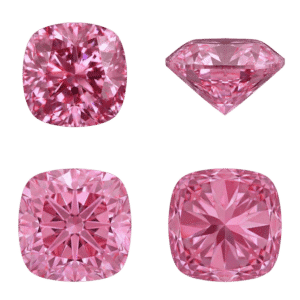
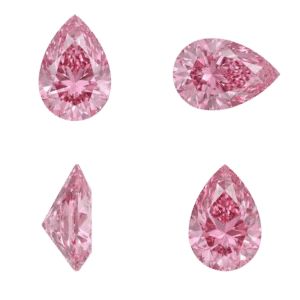
Yes, pink diamonds can be lab grown, and most of them owe their pink to a second step after growth. Irradiation followed by controlled heating creates nitrogen-vacancy (NV) centers in the crystal, and those centers give the stone its pink. We state that treatment on the report and the invoice for every pink stone. Choose from ten loose shapes (round, oval, cushion, pear, heart, marquise, princess, radiant, emerald and asscher) or a finished pink piece: oval, cushion, heart and marquise halo rings, pear and cushion earrings, pendants and solitaire necklaces. Each stone is quoted to your size and color range, with an IGI or GIA report on request.
Get a Quote · All loose lab-grown diamonds · Fancy color wholesale
Pink, Shape by Shape
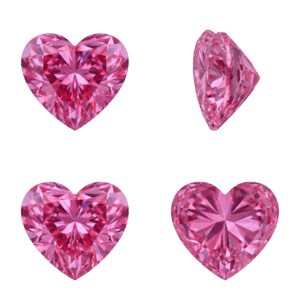
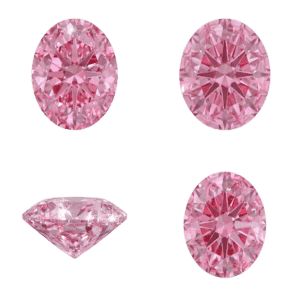
Ten loose shapes and finished pieces in pink. Tap a stone for its page, or jump to a product type below.
Pink is created after growth: irradiation and annealing form NV centers. Every pink stone is quoted with the treatment stated on the report and invoice.
How Pink Lab-Grown Diamonds Get Their Color
Both growth methods can end in pink, but neither usually grows pink directly. The color is added afterwards.
| Route | What happens | What the report usually shows |
|---|---|---|
| CVD-grown pink | The crystal is often HPHT-processed first (the step commonly used to remove brown), then irradiated, then annealed at a lower temperature to form NV centers. GIA has documented this multi-step sequence on Fancy Vivid orangy pink CVD stones. | Growth method CVD, plus a post-growth treatment comment |
| HPHT-grown pink | Low-nitrogen HPHT crystals are irradiated and annealed at low temperature. GIA’s review of HPHT-grown stones attributes pink, purple-pink and red to this treatment. | Growth method HPHT, plus a post-growth treatment comment |
| Pinkish CVD that shifts | Some silicon-bearing CVD stones look pinkish brown in room light and turn bluish after UV exposure. GIA found the shift temporary and reversible. | Judge color only after the stone has rested under normal light |
Two practical consequences follow. First, a pink lab-grown diamond described as “as-grown” is unusual, so ask how the color was produced before you rely on that claim. Second, NV centers often make treated pinks fluoresce orange to red under UV, one of the clues gemologists use to read a stone’s treatment history.
Pink Color Grades: Fancy Light to Fancy Vivid
Colored diamonds are graded on hue, tone and saturation, not on the D-to-Z scale. GIA’s fancy-color terms run from Faint, Very Light and Light through Fancy Light, Fancy, Fancy Intense and Fancy Vivid, with Fancy Dark and Fancy Deep for darker stones. A pink strong and dark enough can be called red.
| Grade on the report | How it looks | Often used for |
|---|---|---|
| Faint / Light Pink (comment on a D–Z report) | A white stone with a pink tint | Center stones for buyers who want a hint of warmth |
| Fancy Light Pink | Soft blush | Halos, eternity bands, small accents |
| Fancy Pink | Clear, even pink | Stud earrings, pendants, fashion rings |
| Fancy Intense Pink | Saturated pink | Center stones |
| Fancy Vivid Pink | The strongest saturation | Statement center stones |
How the two main laboratories describe them:
- IGI grades lab-grown pinks with fancy-color terms. A published IGI report for a 1.54 ct pear reads “Fancy Vivid Pink”, names CVD as the growth process and adds “Indications of post-growth treatment.”
- IGI on near-colorless stones: when a D–Z lab-grown stone shows a pink body tone, IGI adds a comment such as Faint Pink (G–H range), Light Pink (I–J), Fancy Light Pink (K–M) or Fancy Pink (N–Z).
- GIA issues Laboratory-Grown Colored Diamond Reports for fancy colors. Its Premium / Standard assessment, introduced in October 2025, covers D-to-Z lab-grown stones only.
Most pinks carry a secondary hue: purplish pink, orangy pink or brownish pink. The modifier appears in the grade name and changes the look, so compare stones by eye as well as by report.
What Sets the Price of a Pink Lab-Grown Diamond
We quote pink stones individually rather than from a fixed list, because these factors move the price in different directions:
- Intensity. GIA notes that Fancy Intense and Fancy Vivid colors generally command higher prices than lighter grades.
- Modifier. A clean pink and an orangy or brownish pink of the same intensity are priced separately.
- Carat. Price rises with weight, and larger pinks are quoted stone by stone.
- Shape. GIA notes that oval, pear, radiant and cushion cuts concentrate color, so they can show more pink than a round of similar weight.
- Clarity and report. Clarity and a per-stone report add to the price of a single stone; small accent pinks are usually sold by parcel.
How much is a pink lab-grown diamond compared with a mined pink? Much less. IGI describes the price difference between natural and lab-grown fancy-color diamonds as substantial, which is also why parcels should be screened. Send the shape, size and grade you want and we reply with a quote within one business day.
How to Choose a Pink Lab-Grown Diamond
Pink Lab-Grown Diamond Questions
Guides:
Can pink diamonds be lab grown?
Are pink lab-grown diamonds treated?
Do pink lab-grown diamonds fade?
How do I clean pink lab-grown diamond jewelry?
How can I tell a lab-grown pink from a mined pink?
Can I set a pink lab-grown diamond in a custom ring?
Pink Lab-Grown Diamonds for Retailers and Brands
Pinks vary more within one grade name than white stones do, so a parcel order needs more than the word “pink”. Before you approve a lot, check these points:
- Reference stone: Hold a master stone or a retained sample from the approved lot, and match reorders to it face-up.
- Grade and modifier in words: Write “Fancy Pink, no orange modifier” or “Fancy Light purplish pink”, not just “pink”.
- Treatment line: The invoice and each report should state the growth method and the post-growth treatment.
- Natural / lab-grown screening: IGI warns that most screening devices cannot reliably separate natural and lab-grown fancy colors, because treatment changes fluorescence. Keep lab-grown pinks in separate, labeled parcels.
- Size tolerance for accents: For halos and eternity bands, agree the calibrated size and tolerance (for example ±0.02 mm) along with the color range.
- Lead time: Stock loose stones ship in 3–7 business days and matched pairs or calibrated small lots in 7–15, before international transit; the quote confirms the date.
See fancy color lab-grown diamonds wholesale, or send a reference stone or photo for a quote.
Sources: GIA: Colored diamonds buyer’s guide · GIA: Pink diamond engagement ring buying guide · GIA Gems & Gemology: Treated orange and pink CVD laboratory-grown diamond (Fall 2022) · GIA Gems & Gemology: Observations on HPHT-grown synthetic diamonds (Fall 2017) · GIA Gems & Gemology: Update on laboratory-grown diamonds (Summer 2024) · IGI: Are post-growth treatments permanent? · IGI: Identifying lab-grown fancy-colored diamonds · IGI report LG738520975 (sample)
Thank you
We’ll reply within one business day with price, stone options and delivery time.