
Choosing between D, E, F, G, and H color lab-grown diamonds is not just a grading report decision. Two stones with adjacent grades can look nearly identical once cut, shape, size, lighting, and setting are considered, especially when evaluated alongside an eye-clean diamond guide that helps separate visible clarity impact from unnecessary overpaying, while the same grade can appear warmer in a different design. Paying for the highest color is not always the clearest upgrade if it means compromising cut quality, carat size, or the finished look you actually want.
For the full framework, read Lab-Grown Diamond 4Cs Guide.
This guide helps you decide when color differences are likely to be visible and when a lower grade may still look bright and white. It focuses on practical buying judgment: how to compare stones fairly, when G or H is safe to consider, when D–F is worth choosing, and how metal color, accent stones, and diamond shape can change what your eye sees.
Laboratory-grown diamonds should be clearly identified as laboratory-grown, and they should not be presented as mined diamonds. Lab-grown diamonds and natural diamonds share diamond material characteristics, but they have different origins, and any grading report or seller description should make that origin clear. Diamond simulants are a separate category and should not be confused with laboratory-grown diamonds.
| Buying Situation | Color Range to Consider | What to Check Before Deciding |
|---|---|---|
| Brilliant-cut round or oval in a simple setting | F, G, or H | Face-up video and cut quality |
| Emerald, Asscher, or other step cut | D, E, F, or cautious G | Side views and body warmth |
| Platinum or white gold ring | D through G | Contrast against the metal |
| Yellow or rose gold setting | G or H often works well | Whether warmth blends with the design |
| Halo or side-stone design | Match center and accents closely | Accent-stone color consistency |
| Larger center stone | Lean higher if color-sensitive | Comparable videos in the same shape |
Quick Questions Before You Read
Q: Is D color always the best choice?
No. D is the highest color grade, but it may not be the right value if the visible difference is small or cut quality suffers.
Q: Can a G or H lab-grown diamond still look white?
Yes, especially in well-cut brilliant shapes, smaller sizes, and yellow or rose gold settings.
Q: When should I be more careful with lower color grades?
Be more cautious with larger stones, step cuts, elongated shapes, white metals, and designs with very white accent stones.
Q: Should I choose color before cut?
No. A strong cut usually has more impact on brightness and face-up beauty than moving one color grade higher.
Start With the Practical Answer: Which Lab-Grown Diamond Color Grade Should Most Buyers Choose?
A useful lab-grown diamond color guide should start with the decision, not the grading theory: many buyers should begin their search around F or G, then move higher or lower only if the diamond shape, size, setting, or personal color sensitivity justifies it.
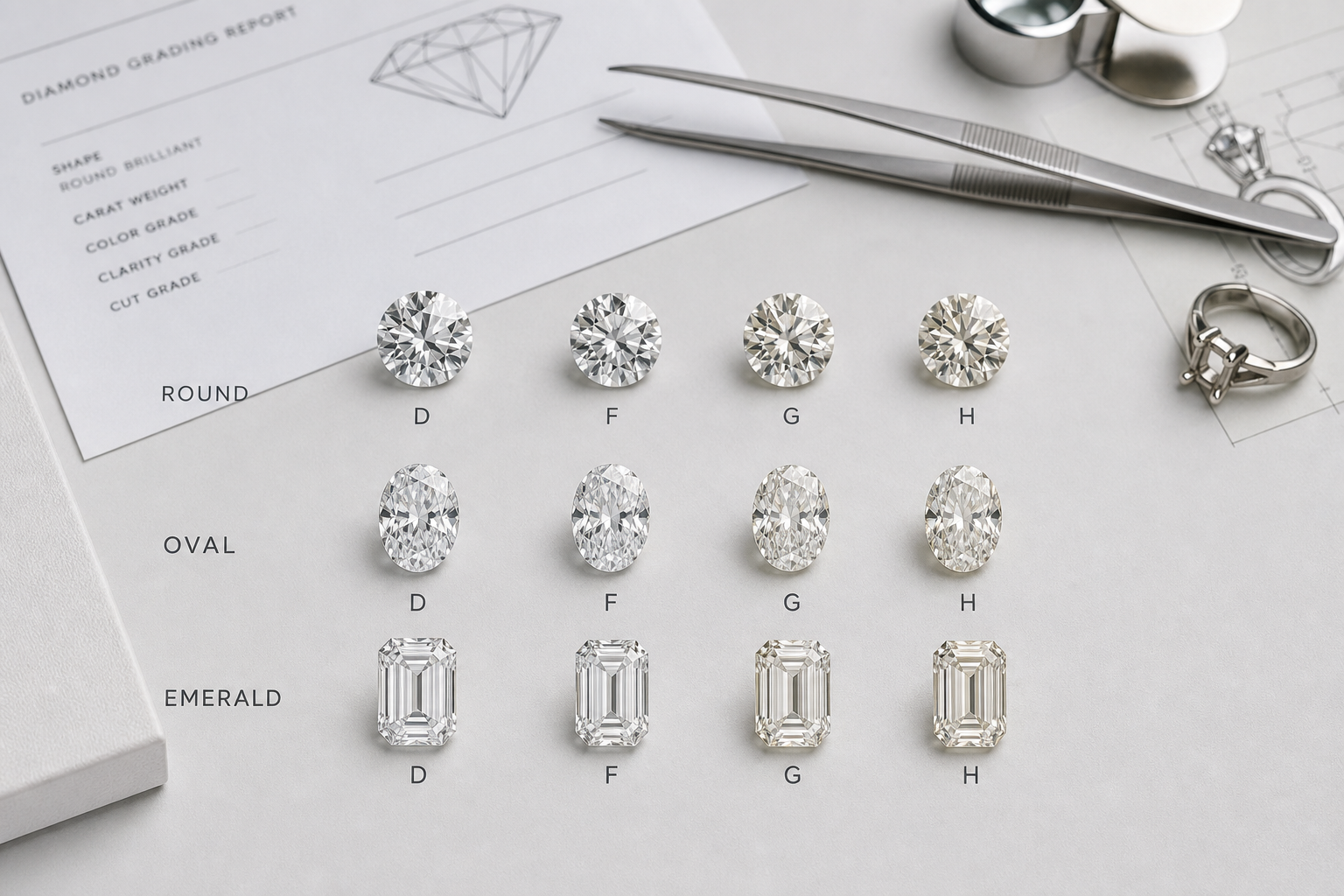
The D E F G H diamond color range covers the grades many engagement ring buyers compare when they want a white-looking stone. D, E, and F are considered colorless. G and H are considered near-colorless. The practical difference is not that D always looks beautiful and H looks yellow. The real question is whether the grade difference will be visible once the diamond is cut, set, and worn in normal lighting.
For many buyers, the most practical color grade for lab-grown diamond value is not the highest grade available. It is the lowest grade that still looks clean, bright, and white in the chosen diamond and setting. That may be F for a platinum emerald cut, G for a round solitaire, or H for a well-cut oval in yellow gold. The mistake is choosing color as if the report will be worn on the hand.
For buyers, the practical point is not just what the report says, but how the stone performs visually and fits the intended design. A color grade is a useful filter, but it should be tested against the diamond’s shape, measurements, cut quality, and the setting where it will actually be worn.
The Short Recommendation by Buyer Type
Choose D, E, or F if you want the iciest possible look, are buying a larger center stone, prefer a step cut such as emerald or Asscher, or plan to set the diamond in platinum or bright white gold. These situations make color more visible, so staying in the colorless range can be a safer choice, especially for buyers who notice warmth easily.
Choose G or H if you want strong visual value in many round, oval, pear, cushion, radiant, or yellow-gold designs. A near-colorless lab-grown diamond can still face up very white when the cut is strong and the setting does not exaggerate warmth. This is where many buyers find a better balance: they can avoid paying for a color difference they may not see and put more attention toward cut quality, size, or the ring design.
This is a starting point, not a rule. A G emerald cut in platinum may need more scrutiny than a G round brilliant in yellow gold. An H cushion may look excellent in one stone and slightly warm in another. The grade narrows the search, but the actual diamond and final ring design decide whether the choice works.
Why D Color Is Not Automatically the Best Purchase
D is the highest color grade on the standard diamond scale, so it carries a clear appeal for buyers who want the most colorless designation possible. If owning the top grade matters to you, or if the diamond is large, open-faceted, and set in a cool white metal, D can be a reasonable choice.
Where buyers may overpay is assuming D must look noticeably better in every ring. In many finished designs, especially brilliant-cut diamonds viewed face-up, the visual gap between D and lower colorless or near-colorless grades can be small. Paying more for D makes sense when the difference is either visible to you or emotionally valuable to you. It is weaker value when the upgrade exists mostly on paper and forces compromises elsewhere.
A better way to frame the choice is this: D is the safest technical answer for color, but not always the strongest overall purchase. If moving from D to F or G lets you choose a better-cut diamond or a setting that fits the design more beautifully, the lower color grade may produce the stronger finished ring.
Where Most Buyers Can Safely Consider G or H
G and H are often misunderstood because “near-colorless” sounds like a warning. In practice, near-colorless does not mean visibly yellow by default. It means a trained grader may detect slight body color under controlled conditions, and that warmth may or may not be noticeable in everyday wear.
Many buyers can safely consider G in brilliant-cut diamonds, especially round brilliants, ovals, pears, cushions, and radiants with strong light return. H can also be a practical value choice when the stone is well cut, not overly large for its shape, and set in yellow gold, rose gold, or a design where subtle warmth will not be highlighted by contrast.
The main risk with G or H is not the grade itself. The risk is choosing it blindly. A near-colorless stone should be judged in context: shape, size, cut, setting metal, and nearby accent stones all affect how white it appears. If those factors work in your favor, G or H can be a rational purchase.
What to Check Before You Decide
- Compare diamonds in the same shape, not across unrelated shapes.
- Keep carat weight close, ideally within a narrow range, so size does not distort the comparison.
- Hold cut quality as constant as possible before judging color.
- Review the grading report to confirm the assigned color grade and laboratory-grown origin.
- Look at face-up images, side views when available, and 360-degree video rather than relying on a single edited photo.
- Compare stones under similar lighting and background conditions.
- Confirm the setting metal before finalizing color, especially if choosing platinum, white gold, yellow gold, or rose gold.
If you are deciding between adjacent grades, compare the actual stones before assuming the higher grade is worth the premium. The right choice is the one that looks right in the ring you are making, not the one that wins a grading chart in isolation.
How Diamond Color Grades Are Judged and Why Lab-Grown Diamonds Use the Same D-to-Z Scale
Diamond color grades measure the presence or absence of body color in a diamond. The standard scale runs from D to Z, with D representing the most colorless grade and later letters showing increasing visible warmth. Lab-grown diamonds use the same grading language as natural diamonds because they are judged by the same color appearance standards, not by a separate visual category.
The lab-grown diamond color scale matters because it gives buyers a shared reference point. A D lab-grown diamond and a D natural diamond both sit at the top of the color scale. A G or H lab-grown diamond is still in the near-colorless range, just as it would be for a natural diamond. The origin of the diamond does not create a different color alphabet, but the origin should still be clearly disclosed.
The practical limitation is that the grade is a controlled assessment, not a guarantee of how the stone will look in every real-life situation. A report can tell you the assigned grade. It cannot fully show how that diamond will appear once it is set, viewed under warm indoor lighting, or compared against bright white accent stones.
A grading report should also be read as documentation, not as a complete beauty judgment. It helps confirm key characteristics such as color grade, but it does not prove that a diamond has pleasing light return, a balanced outline, or the right proportions for a specific ring. That is why report review and visual review should work together rather than replace one another.
Evidence Boundary: What a Color Grade Can and Cannot Prove
A color grade is useful because it gives the buyer a documented starting point, but it should not be treated as proof that two diamonds will look identical in a ring. The grade does not describe every viewing condition, and it does not account for the way a particular setting, facet pattern, or lighting environment may affect the finished appearance. When this guide recommends F, G, or H for certain situations, those recommendations are practical buying ranges rather than guarantees.
This distinction is especially important for lab-grown diamond shopping because online listings can make grade comparisons feel more exact than they are. A report-supported grade helps keep the comparison honest, while images, video, measurements, and setting details help determine whether the stone is visually successful. The strongest decision uses both kinds of evidence: formal documentation for the grade and real visual review for the finished look.
A grading report helps document key characteristics, but it should not be treated as a guarantee of beauty, value, or sourcing ethics. It can support a more informed comparison, but the buyer still needs to review the diamond’s actual appearance, the seller’s documentation, and the way the stone will be used in jewelry.
What D, E, and F Mean in the Colorless Range
D, E, and F are the colorless diamond grades. They are grouped together because they show little to no detectable body color in standard grading conditions. For buyers who want a crisp white look, this range provides the safest color category.
The differences inside the colorless range are usually subtle. A trained grader may distinguish D from E or F under controlled lighting and comparison conditions, but the difference can be difficult to detect in casual viewing, especially once the diamond is mounted. This is why F can often be a practical choice for buyers who want a colorless diamond but do not need the top letter grade.
The key judgment is simple: D, E, and F are not three dramatically different visual experiences for most people. They are tighter refinements within the same high-color category, and the value of moving upward depends on how much the buyer cares about that refinement.
What G and H Mean in the Near-Colorless Range
G and H are near-colorless diamond grades. They sit just below the colorless category, but they should not be treated as automatically yellow or visibly tinted. Many G diamonds, and many well-selected H diamonds, still look white face-up in finished jewelry.
Near-colorless warmth becomes more relevant when the diamond shape exposes more body color, the stone is larger, or the ring uses a very white metal that creates contrast. In smaller or brilliant-cut diamonds, especially in warmer metal settings, the difference between near-colorless and colorless may be hard for many buyers to see without a side-by-side comparison.
The common mistake is rejecting G or H based only on the category name. Near-colorless is not a defect. It is a range where visual judgment becomes more important because some stones offer strong value and others need closer review.
Why Color Is Graded From the Side, Not Just Face-Up
Diamond color is typically assessed under controlled conditions in a way that makes body color easier to see. Graders do not rely only on the face-up view because sparkle, facet pattern, and light return can mask subtle color when the diamond is viewed from the top.
This explains a common buyer confusion: a diamond can have a lower color grade on paper but still look very white in normal wear. The grade may reflect body color that is more visible from the side or under grading conditions than it is when the stone is viewed face-up in a ring.
For buying decisions, both views matter, but they do not matter equally for every person. Most people see an engagement ring from the top on the hand. If slight warmth appears only from the side and does not bother the wearer, paying for a higher grade may not improve the experience enough to justify the cost.
Certificate and Visual Review Check
Use the grading report to confirm the diamond color grade, then use actual media to judge appearance. The report tells you how the stone was graded. Photos and video help you understand how that specific diamond looks in real viewing conditions.
A strong buying process uses both. Relying only on the report can make you overvalue a small grade difference you may never notice. Relying only on photos can be risky because lighting, editing, background color, and camera settings can affect appearance. The better decision comes from matching the documented grade with the visual evidence.
Before treating a report as sufficient, confirm that the stone shown in the listing, the report details, and the seller’s description all refer to the same diamond. The most useful report review checks the stated color, shape, carat weight, measurements, and any inscription or identifying details when available. If any listing detail conflicts with the report or if the media is generic rather than stone-specific, ask for clarification before using that diamond as part of a color comparison.
How to Verify Report Details Without Over-Relying on Them
When a grading report is available, the buyer’s first traceability step is to match the report information to the diamond being considered. Check the report number, shape, carat weight, measurements, color grade, clarity grade, origin disclosure, and any inscription details if they are listed. These details should align with the seller’s listing and the stone-specific media; if they do not, the difference should be clarified before the diamond is compared against other options.
A grading report can narrow the comparison, but it should be read alongside the stone’s proportions, visual evidence, and intended jewelry use. Report verification helps confirm that the documented grade belongs to the stone under discussion; it does not prove that the diamond will look equally white in every setting, lighting environment, or design style.
When a grading report is available, buyers should verify the report details through the issuing laboratory’s official report-check tool where available and compare those details with the seller’s listing, images, and video.
When D, E, and F Actually Look Different From Each Other
D, E, and F all sit in the colorless range, so the differences between them are not usually dramatic. The question is not whether a D color lab-grown diamond ranks higher than E or F. It does. The more useful question is whether the difference will be visible enough in the finished jewelry to matter to the buyer.
Within this range, color becomes a refinement choice. Some buyers want the highest possible grade because it feels cleaner, rarer, or more satisfying on paper. Others would rather stay in the colorless category while leaving more room in the budget for cut quality, carat weight, or the setting. Both approaches can be reasonable if the buyer understands what is being gained and what is being traded.
D Color: Useful for Buyers Who Want the Highest Color Grade on Paper
D is the top color grade and the clearest choice for buyers who want the most colorless designation available. It can be especially appealing for larger diamonds, step cuts, platinum settings, or buyers who know they are highly sensitive to warmth.
The risk is assuming that D will always look visibly superior. In many brilliant-cut diamonds, a D may not create a meaningful everyday difference compared with a well-cut E or F. D is strongest as a specification-driven choice: it gives confidence to buyers who want no compromise on color, but it should not be treated as a substitute for strong cut, pleasing proportions, or careful visual review.
E Color: A Subtle Step Down That Often Still Feels Extremely White
An E color diamond remains firmly in the colorless range. For many buyers, it offers the feeling of a very high-color diamond without requiring the absolute top grade. The visual difference from D is usually slight, especially once the stone is set.
E can make sense when the buyer wants a colorless diamond but is willing to be practical about where the top-grade premium is spent. It is often a strong middle position for someone who would feel uneasy dropping into near-colorless but does not need the psychological assurance of D.
The main judgment point is whether the buyer is comparing E against D or against F. Against D, E may deliver almost the same visual impression in many settings. Against F, it may offer extra comfort for color-sensitive buyers, but the difference still needs to be judged against the specific stone and ring plan.
F Color: Often a Value Point Within the Colorless Category
An F color diamond is still colorless, which makes it attractive for buyers who want a white diamond without automatically paying for D or E. It is often a practical value point within the colorless range because it preserves the category while leaving more flexibility elsewhere in the purchase.
F is especially worth considering when the alternative is sacrificing cut quality or choosing a less suitable setting just to move up to D. A well-cut F can look brighter and more appealing than a poorly performing D because color grade does not create sparkle by itself.
The D vs F diamond color decision should be made with cut held constant. If the D and F stones are similar in shape, size, cut quality, clarity, and visual performance, then the higher grade may be worth it for a buyer who cares deeply about color. If the F is better cut or better suited to the design, the lower letter may produce the better ring.
Where Colorless Differences Become Easier to Notice
Differences among D, E, and F become easier to notice when the diamond is larger, because there is more material through which body color can be observed. They can also be more noticeable in step cuts, where broad, open facets do less to disguise subtle tone than a highly brilliant facet pattern.
White metal settings can also make small color distinctions feel more important. Platinum and bright white gold create a cool frame around the diamond, which can make even slight warmth easier to detect from the side or in comparison with other stones. Side-by-side viewing also sharpens differences that may not stand out when a diamond is seen alone.
The buyer’s eye matters as much as the chart. Some people notice warmth immediately and will keep seeing it after purchase. Others cannot reliably distinguish adjacent colorless grades without controlled comparison. If you are in the second group, paying heavily to move from F to D may not improve the ring in a way you can appreciate.
What This Means in a Real Purchase
When comparing D, E, and F, hold cut quality constant before making a color decision. A poorly cut D-color diamond may look duller and less attractive than a well-cut F-color diamond, even though D is the higher color grade.
Color should be upgraded only after the diamond already performs well visually. If the stone has strong light return, pleasing proportions, and the right shape for the design, then choosing between D, E, and F becomes a preference decision. If those fundamentals are weak, a higher color grade will not rescue the diamond.
When G and H Look White Enough and When They Start to Show Warmth
G and H sit in the near-colorless range, which is why they often create a useful balance between a white-looking diamond and a more efficient budget. The mistake is treating them as either “basically D” or “too warm.” Neither is reliable. A G or H diamond can look very white in the right shape and setting, but the same grade can show more warmth when the stone is large, step-cut, or placed next to very white accent diamonds.
The practical question is not whether G and H are colorless on paper. They are not. The better question is whether the warmth is visible in the finished ring, from normal viewing distances, in the lighting where the ring will actually be worn.
G Color: A Strong Default for a White Look Without Paying for D-F
A G color lab-grown diamond is often a safe starting point for buyers who want a bright, white appearance without paying for the colorless D-F range. It is close enough to the colorless category that many G diamonds look crisp face-up, especially in round brilliant, oval, cushion, pear, radiant, and other cuts with strong sparkle.
G is not always visually identical to D, especially in a side-by-side comparison under controlled lighting. But most buyers are not wearing their ring beside a D-color master stone. They are seeing it on the hand, in mixed lighting, with metal surrounding it. In that real-world context, a well-cut G can be the better purchase than a higher-color diamond if it lets the buyer keep strong cut quality, a preferred carat size, or a better setting.
The key condition is visual review. A weakly cut G may not have enough brightness to distract from body color, while lab grown diamond cut quality can explain why a well-cut G can face up cleaner and livelier than its grade alone suggests. If the diamond is going into platinum, white gold, or a high-contrast halo, G is still a strong candidate, but it should be compared against F rather than chosen blindly.
H Color: Often a Smart Value Choice, Especially in the Right Setting
An H color lab-grown diamond can be a strong value choice when the ring design works with it instead of against it. H is still near-colorless, not automatically yellow. In yellow gold, rose gold, many solitaire settings, and brilliant-cut shapes, an H diamond can appear white enough that paying more for F or G may not change the finished look in a meaningful way.
H becomes especially attractive when the buyer is choosing between color and visible size. If dropping from G to H allows a meaningful increase in spread, a better setting, or stronger cut quality, the tradeoff may be worthwhile. This is where near-colorless diamond value is most useful: not because the lower grade is always “the same,” but because the money saved may improve something the eye notices more.
The risk with H is context. It can start to show warmth in larger stones, elongated shapes with visible tips, step cuts, or very white metal settings. It can also look warmer if the ring includes D-F side stones or a bright white halo. H should not be rejected automatically, but it should be verified in the exact design direction the buyer is considering.
When G or H May Not Be Ideal
G and H become less forgiving when the diamond gives the eye more opportunity to see body color. Larger stones are the clearest example. As carat weight increases, there is more diamond material for light to pass through, and subtle warmth can become easier to notice. A 0.90 ct H round in yellow gold may look comfortably white, while a 2.25 ct H emerald cut in platinum may show warmth that the buyer did not expect.
Step cuts such as emerald and Asscher cuts deserve extra caution because their broad, open facets do not mask color the way brilliant cuts do. If the goal is a crisp, icy appearance in one of these shapes, D-F or a carefully selected G is usually safer than H. The same logic applies to highly color-sensitive buyers. If a slight creaminess will bother you every time you look at the ring, the value of H disappears quickly.
White metal settings can also raise the standard. Platinum and bright white gold create a cool frame around the diamond, which can make near-colorless warmth easier to detect, especially from the side. Halo and three-stone designs add another comparison point: if the accent stones are noticeably whiter than the center, the center may look warmer than it would in a solitaire.
Buyer Scenario: Choosing Between a 1.50 ct F and a 1.70 ct H
Maya is choosing a lab-grown oval engagement ring in 14k yellow gold. One option is a 1.50 ct F color diamond; the other is a 1.70 ct H color diamond with similar clarity and strong visual performance. On the grading report, the F is the cooler stone. In the ring design, the H offers more finger coverage and the yellow gold setting softens the visual impact of its near-colorless warmth.
If Maya reviews the videos and the H still looks white face-up, the 1.70 ct stone may be the better personal value. The extra size is visible every day, while the color difference may not be obvious once the diamond is set. But if she changes the plan to platinum, adds a halo with very white accent stones, or notices warmth in the oval’s tips during video review, the F becomes the safer choice.
This is the real G vs H diamond color decision in practice. It is rarely about the grade alone. It is about whether the lower color grade creates a visible compromise in the actual ring or simply frees budget for something the buyer values more.
Buyer Verification Checklist
- Compare G and H diamonds in the same shape, not across different shapes.
- Use same-angle photos or 360-degree videos whenever possible.
- Review the diamond face-up and, if available, from the side or profile view.
- Compare stones under similar background and lighting conditions.
- Confirm the intended metal color before deciding whether H is safe.
- Ask whether halo or side stones will be color-matched closely enough that the center stone does not look warmer by contrast.
- Do not choose the lower color grade if the warmth is already visible to you in video; it may become more noticeable after you know to look for it.
Why Diamond Shape Changes How Much Color You Can See
The most suitable diamond color by shape is not the same for every buyer because shape changes how light moves through the stone. Some cuts break up color with sparkle and contrast. Others show more of the diamond’s body color through broad, open facets or along edges and tips. This is why a G or H can look comfortably white in one shape and slightly warm in another.
Color grade should be judged inside the shape category you are actually buying. Comparing an H round to an H emerald cut can be misleading because they do not present color the same way. Shape does not change the official grade, but it can strongly change how obvious that grade feels in a finished ring.
Round Brilliant Cuts Usually Hide Color Better
Round brilliant diamonds are usually the most forgiving for color because their faceting is designed for strong light return. A well-cut round can look bright and lively face-up, which makes slight body color harder to notice in normal wear. This is why many value-focused buyers can consider G or H for a round lab-grown diamond without feeling they have made a visible compromise.
The round diamond color grade still matters, especially in larger sizes or very white settings, but cut quality carries more weight than many buyers expect. A bright, well-proportioned G or H round may look more attractive than a higher-color round with weaker light performance. If budget forces a choice, sacrificing cut to reach D or E is usually the wrong tradeoff.
Oval, Pear, Marquise, and Cushion Cuts Can Show Warmth Differently
Oval, pear, marquise, and cushion cuts are more case-specific. Their modified brilliant faceting can hide color well in many stones, but warmth may appear near pointed ends, along edges, or in broader facet areas. Oval diamond color is especially worth reviewing in video because two diamonds with the same grade can look different depending on facet pattern, depth, and how color concentrates toward the ends.
G is often a practical choice in these shapes for buyers who want a white look without moving into D-F pricing. H can also work, particularly in yellow or rose gold, but it should be reviewed more carefully. If the stone is elongated, above roughly 1.50 ct, or going into a platinum setting, the buyer should compare H against G or F before deciding that the value tradeoff is safe.
Emerald and Asscher Cuts Often Reward Higher Color Choices
Emerald and Asscher cuts have larger, more open facets and less sparkle masking. That makes them elegant, but also less forgiving. In these shapes, body color can be easier to see through the diamond, especially in larger stones or white metal settings. For buyers who want a crisp, white appearance, the emerald cut diamond color decision should usually start around D-F, with G considered only after careful visual review.
H is not impossible in an emerald or Asscher cut, but it is a narrower fit. It may work for a buyer who likes a softer look, plans to use yellow gold, or is prioritizing size over an icy appearance. It is less ideal for someone expecting the sharp, glassy whiteness often associated with high-color step cuts.
Radiant and Princess Cuts Depend Heavily on Faceting and Setting
Radiant and princess cuts fall between the forgiving and less-forgiving categories. Their brilliance can help mask warmth, but the effect depends heavily on the individual stone. Some radiants look bright and white in G or H; others show warmth in the body or corners. Princess cuts can face up very bright, but their sharp geometry and setting style can make contrast more noticeable.
For these shapes, the grade is a starting filter, not the final answer. A buyer considering H should look closely at real media and the intended setting. If the stone will be set in yellow gold or rose gold, there may be more flexibility. If it will sit in platinum with bright side stones, G or F may be the cleaner choice.
Stone-to-Setting Fit Check
- Round brilliant: G-H is often safe for value-focused buyers when cut quality is strong.
- Oval, pear, marquise, and cushion: G is often a strong default; H can work, but video review matters more.
- Emerald and Asscher: D-F is usually safer for a crisp white look; a carefully selected G may work in the right design.
- Radiant and princess: Evaluate stone by stone because faceting and setting can change how much warmth appears.
- Yellow or rose gold settings: These usually allow more flexibility with G or H than platinum or bright white gold.
How Metal Color and Ring Setting Change the Way Diamond Color Appears
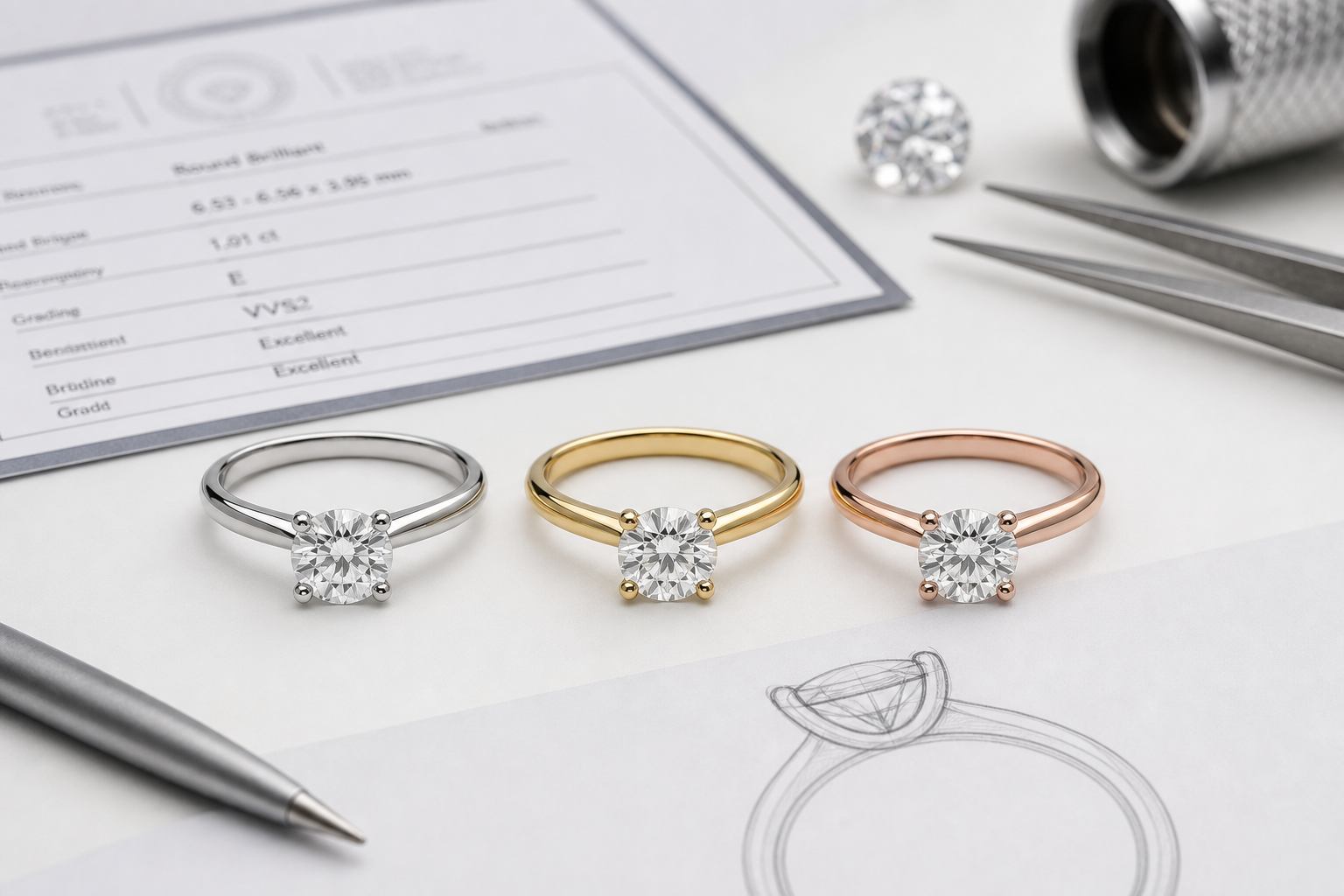
Diamond color and setting metal should be considered together because the ring changes the way the diamond is perceived. A loose diamond viewed against a white background may not look the same once it is surrounded by yellow gold, rose gold, platinum, prongs, side stones, or a halo. For engagement ring diamond color, the finished design often matters as much as the grade itself.
This is where buyers often overpay or under-check. Paying for a higher color grade may be unnecessary in a warm solitaire setting, but choosing a lower color grade can backfire in a bright white halo where contrast is easy to see.
For custom design, the stone cannot be evaluated separately from the setting. Prong color, halo color, side-stone selection, and even how high the diamond sits can change how much body color is visible. At NUVU, this is treated as a practical design comparison rather than a single-grade decision: the report narrows the field, but the center stone still needs to look compatible with the metal and supporting stones.
For custom design, trust comes from matching the stone to the setting, budget, and wearer’s daily use, not from choosing grades in isolation. Before finalizing a center diamond, it is worth confirming the setting dimensions, prong style, accent-stone color range, and whether the chosen shape will sit high or low enough for side-view warmth to matter.
For custom jewelry, stone measurements and setting compatibility should be confirmed before finalizing a purchase. This includes the center stone’s length-to-width ratio, depth, girdle condition, prong coverage, and the color range of any accent diamonds that will sit close enough to create visible contrast.
Platinum and White Gold Make Color Differences More Noticeable
Diamond color in platinum and white gold tends to be less forgiving because cool white metals create a bright frame around the stone. If a diamond has slight warmth, the contrast may be easier to notice from the side, near the prongs, or when the ring is viewed against a white band.
Buyers who are sensitive to warmth should usually lean toward D-F in platinum or white gold, especially for larger stones or step cuts. A carefully selected G can still be a strong choice, but H needs more caution. The issue is not that H cannot look good in white metal; it is that white metal gives the eye fewer reasons to ignore warmth.
Yellow Gold and Rose Gold Can Make Near-Colorless Grades Look More Natural
Diamond color in yellow gold is more forgiving because the setting already introduces warmth. Against a yellow or rose gold band, a G or H diamond often looks naturally white rather than noticeably warm. This is one of the clearest cases where buying the highest color grade may deliver less visible benefit than buyers expect.
That does not mean D-F is wasted in yellow or rose gold. Some buyers like the stronger contrast of a very white diamond against warm metal, and that preference is valid. But for many designs, G or H gives a better balance because the setting supports the diamond instead of exposing every trace of warmth.
Halo and Side-Stone Settings Require Color Matching
Halo, three-stone, and side-stone settings add another layer because the center diamond is not viewed alone. If the center stone is H and the surrounding melee or side stones are D-F, the contrast can make the center look warmer than it would in a solitaire. This is one of the most common ways buyers notice color after the ring is finished, even if the center diamond looked fine by itself.
A good match does not always require every diamond to have the exact same grade, especially with small accent stones. The goal is visual compatibility. If the center is G or H, the accent stones should be chosen so the finished ring looks intentional, not mismatched. This matters more in halos than in simple side-stone designs because halos place many small diamonds directly against the center.
Solitaire Settings Give More Flexibility
Solitaire settings are usually more forgiving because there are no neighboring diamonds creating a direct color comparison. A G or H center stone can look very white in a solitaire, particularly in a brilliant cut and a warm metal. Even in white gold or platinum, a well-selected G often performs well because the eye focuses on the diamond’s brightness and shape rather than side-by-side color contrast.
H can also be a smart solitaire choice, but the same limits still apply: large size, step-cut shape, and personal color sensitivity can change the recommendation. If the buyer wants a minimalist platinum solitaire with a large emerald cut, the setting is simple, but the color standard may still need to be higher because the stone itself is fully exposed.
Setting Compatibility Questions to Ask
- What metal will the ring be made in: platinum, white gold, yellow gold, or rose gold?
- Will the prongs match the band, or will white prongs be used on a yellow or rose gold ring?
- If the ring has side stones or a halo, what color range will those diamonds be?
- Will the center stone look visually compatible with the accent stones?
- Is the diamond shape forgiving enough for G or H in this setting, or would F or higher be safer?
- Can the jeweler compare the center diamond and setting components before the ring is finalized?
How Carat Size, Cut Quality, and Viewing Conditions Affect Visible Color
A color grade does not show itself the same way in every diamond. Size, cut quality, viewing angle, and lighting can all make a visible diamond color difference feel either obvious or almost irrelevant. This is why two buyers can compare the same grades and reach different conclusions: one may be looking at a small round brilliant in yellow gold, while another is judging a large oval in platinum under cool daylight.
Larger Diamonds Can Reveal More Body Color
Diamond color by carat size matters because larger stones give the eye more material to look through. A slight body color that feels negligible in a smaller brilliant-cut diamond may become easier to notice as the diamond gets larger, especially near the edges, corners, or side profile.
As a practical guideline, many buyers find G or H very acceptable in brilliant cuts under about 1.00 ct, assuming the diamond is well cut and the setting is compatible. Around 1.50 to 2.00 ct, G and H deserve closer visual review rather than automatic rejection. Above 2.00 ct, color sensitivity, shape, and setting metal become more important, and buyers who want a crisp white look may feel safer comparing F, G, and H directly before deciding.
These are not hard rules. A well-cut 2.20 ct G round can look beautifully white, while a poorly chosen 1.50 ct elongated shape may show more warmth than expected. The mistake is treating carat weight as separate from color; as the stone gets larger, a small color compromise can become more visible if the shape and setting also emphasize it.
Strong Cut Quality Can Make a Diamond Look Brighter and Whiter Face-Up
Cut quality and diamond color are closely connected in real-world appearance, even though cut does not change the actual color grade. A well-cut diamond returns light more effectively, which can make the stone appear brighter and visually whiter from the top. A weaker cut can leave more areas looking dull or glassy, making body color easier to notice.
This is one of the clearest places where buyers should avoid over-prioritizing the color grade. A D-color diamond with poor light performance may look less lively than an F or G with stronger cut quality. If budget forces a tradeoff, it is often smarter to protect cut quality first, then choose the highest color grade that still makes sense for the shape and setting.
The practical takeaway is simple: do not upgrade color at the expense of brilliance. Color affects whiteness; cut affects the diamond’s life. In a finished ring, a bright, well-cut near-colorless diamond can often make a stronger impression than a higher-color stone that does not perform well.
Side View Versus Face-Up View Matters
Diamond color is often more noticeable from the side than from the top. Face-up, a brilliant diamond is returning light toward the viewer, which can mask subtle warmth. From the profile, there is less sparkle to distract the eye, so the body color may be easier to see through the pavilion or side of the stone.
This matters because rings are usually admired face-up on the hand. If a G or H diamond looks white from the top and only shows slight warmth from the side, many buyers will consider that an acceptable tradeoff. For buyers who want the stone to look icy from every angle, especially in a higher-profile platinum setting, a higher color grade may be worth the premium.
The wrong move is judging a diamond only by the most revealing angle. Side-view warmth is real, but it may not matter equally in daily wear. The decision should depend on whether that angle will be visible in the chosen setting and whether the wearer is likely to notice it.
Lighting Conditions Can Exaggerate or Hide Color
Lighting can change how a diamond’s color appears more than many buyers expect. Jewelry-store lighting often makes diamonds look bright and lively. Daylight can reveal subtle differences more clearly. Warm indoor lighting may make even high-color diamonds look slightly warmer, while cool lighting can make near-colorless stones appear crisper.
Online product photography adds another variable. White backgrounds, editing, exposure, and inconsistent video environments can all affect color perception. A diamond that looks warm in one vendor’s video may look neutral in a different lighting setup, while another may appear unusually white because the image has been heavily brightened.
One of the most useful lab-grown diamond buying tips is to compare stones under consistent conditions whenever possible. A single image can mislead; a set of comparable videos is more useful. If two diamonds are being compared for color, they should be shown in the same shape family, similar size range, and similar lighting environment, or the comparison may say more about the photo setup than the stones.
Practical Review Parameters
Use color comparisons to narrow your shortlist, not to judge isolated stones in different conditions. Compare only diamonds within the same shape family whenever possible, because an H round and an H emerald cut will not reveal color in the same way. Keep carat weight within roughly 0.10 to 0.20 ct when comparing color directly, so size is not exaggerating the difference.
Review at least one face-up image, one side or profile image if available, and one rotating video. Face-up media shows how the diamond will usually be seen on the hand; side-profile media helps reveal body color; video helps expose whether warmth appears consistently or only at a certain angle. Avoid making a final color decision from heavily edited still photos alone.
If two stones are close in price and appearance, choose the one that performs better in the viewing conditions closest to the final ring. For most engagement rings, face-up appearance in the intended setting matters more than a magnified side view on a white screen.
How Color Grade Affects Price and Where Buyers Often Find Better Value
Lab-grown diamond color price usually rises as the grade moves higher, but the increase is not always proportional to what the eye sees. The smarter question is not whether D costs more than G or H. It is whether the extra cost produces a visible improvement in the actual diamond, setting, and wearing situation.
Prices can change with market conditions, report type, seller channel, and stone-specific details, so exact comparisons should be verified at the time of purchase.
Why Higher Color Grades Usually Cost More
Higher color grades generally command higher prices because they sit higher on the grading scale and may be less available in a given combination of shape, size, clarity, and cut quality. A D-color diamond will often carry a premium over a near-colorless diamond with otherwise similar specifications.
Lab-grown pricing, however, is not controlled by color alone. Inventory levels, seller channel, grading report type, cut precision, measurements, and current demand can all influence the final price. Two F-color diamonds of the same carat weight may not be equally valuable if one has stronger proportions, better visual performance, or a more desirable outline.
This is where diamond color value becomes more specific than grade ranking. A higher color grade is only a better value if it improves the finished look or supports a priority the buyer truly cares about. Paying more for a grade that is not visible in the chosen ring may simply reduce the budget available for features that matter more.
Why This Guide Avoids Fixed Price Percentages
It can be tempting to look for a universal rule such as how much more D should cost than F, or how much H should save compared with G. Without current, dated, and market-specific price data, those fixed percentages can mislead buyers. Lab-grown diamond prices can vary by seller, inventory mix, report type, shape availability, cut quality, and how desirable the stone’s measurements are, so a percentage rule that seems helpful may not apply to the actual diamonds in front of you.
A more defensible way to evaluate price is to build a narrow comparison set. Compare diamonds in the same shape, close carat range, similar clarity, similar cut quality, and similar documentation. If the only meaningful difference is color, then the price gap becomes more useful. If several variables change at once, the price difference cannot be safely attributed to color alone.
When Paying for D-F Makes Sense
Paying for D, E, or F can make sense when the design gives color fewer places to hide. Platinum and white gold settings can make warmth easier to detect. Emerald and Asscher cuts have open facets that reveal body color more readily. Larger center stones can make small color differences more noticeable, especially for buyers who already know they are sensitive to warmth.
The question “is D color diamond worth it” has a reasonable answer in these cases: yes, if the buyer wants the highest color grade, is choosing a design where color will be visible, or simply values the specification enough to pay for it. There is nothing wrong with buying D for peace of mind, provided it does not force a weaker choice in cut quality or overall design.
For many buyers, E or F can provide a more balanced version of the same goal. They remain in the colorless category but may leave more room for size, setting craftsmanship, or a better-performing stone. If the visual difference between D and F is not obvious in side-by-side media, F may be the more rational purchase even though D is the higher grade.
When G-H May Be the Better Allocation of Budget
G and H often become attractive when the buyer wants a white-looking diamond but also cares about size, cut quality, or the ring itself. In many brilliant cuts, especially in yellow gold, rose gold, or solitaire settings, a well-selected G or H can appear very white in normal wear. That can free budget for a better cut, a slightly larger stone, or a more refined setting.
G color diamond value is often strongest for buyers who want a safe middle ground. It usually offers a white appearance without paying for the top colorless grades, while still being less likely to show warmth than H in sensitive designs. H can also be a strong value choice, but it deserves more careful review in larger stones, elongated shapes, step cuts, and white metal settings.
The point is not that lower color is automatically better value. A cheaper diamond that looks warm in the wrong setting is not a smart buy. The better allocation is the one that protects the finished appearance while avoiding money spent on a difference the wearer will not see.
Price Should Be Compared Across Similar Stones Only
A D-color diamond and an H-color diamond are not meaningfully comparable unless the other factors are close. Shape, carat weight, clarity range, cut quality, report type, measurements, and seller context all need to be similar before the price difference says anything useful about color value.
For example, a lower-priced D may not be a better opportunity if it has weaker proportions, less desirable measurements, or a visual issue that affects brightness. A higher-priced G may still be reasonable if it has stronger cut quality, better spread, or more appealing video performance. Color is only one part of the price logic.
Buyers often make a diamond color mistake by comparing grades across stones that are too different. If a 1.80 ct H oval is compared against a 1.50 ct F round, the result will not reveal whether H is a better value. It will only mix several variables at once.
In practical buying, this is where many comparisons become misleading. A price difference may reflect color, but it may also reflect proportions, availability, report details, growth method, seller channel, or how desirable the measurements are for the shape, which is why a lab grown diamond 4Cs guide can help separate grading factors from visible design tradeoffs. Before treating a lower price as a bargain, make sure the diamond is not giving up something visible or important to the design.
Value Comparison Checklist
Before deciding that one color grade is a better deal, compare diamonds with similar carat weight, shape, clarity range, cut quality, measurements, and grading report type. If possible, compare stones from the same seller or at least under similar presentation standards, because photography and listing details can influence how value appears online.
Keep the comparison tight: same shape, close carat weight, similar clarity, similar cut quality, and adjacent color grades where possible. An F versus G or G versus H comparison is usually more useful than jumping directly from D to H without controlling the other variables.
If exact price data is used in a buying decision, it should be current and dated. Lab-grown diamond pricing can shift, so the stronger value judgment comes from comparing available stones in the current market rather than relying on a fixed percentage rule.
How to Choose Between D, E, F, G, and H Based on Your Ring Plan
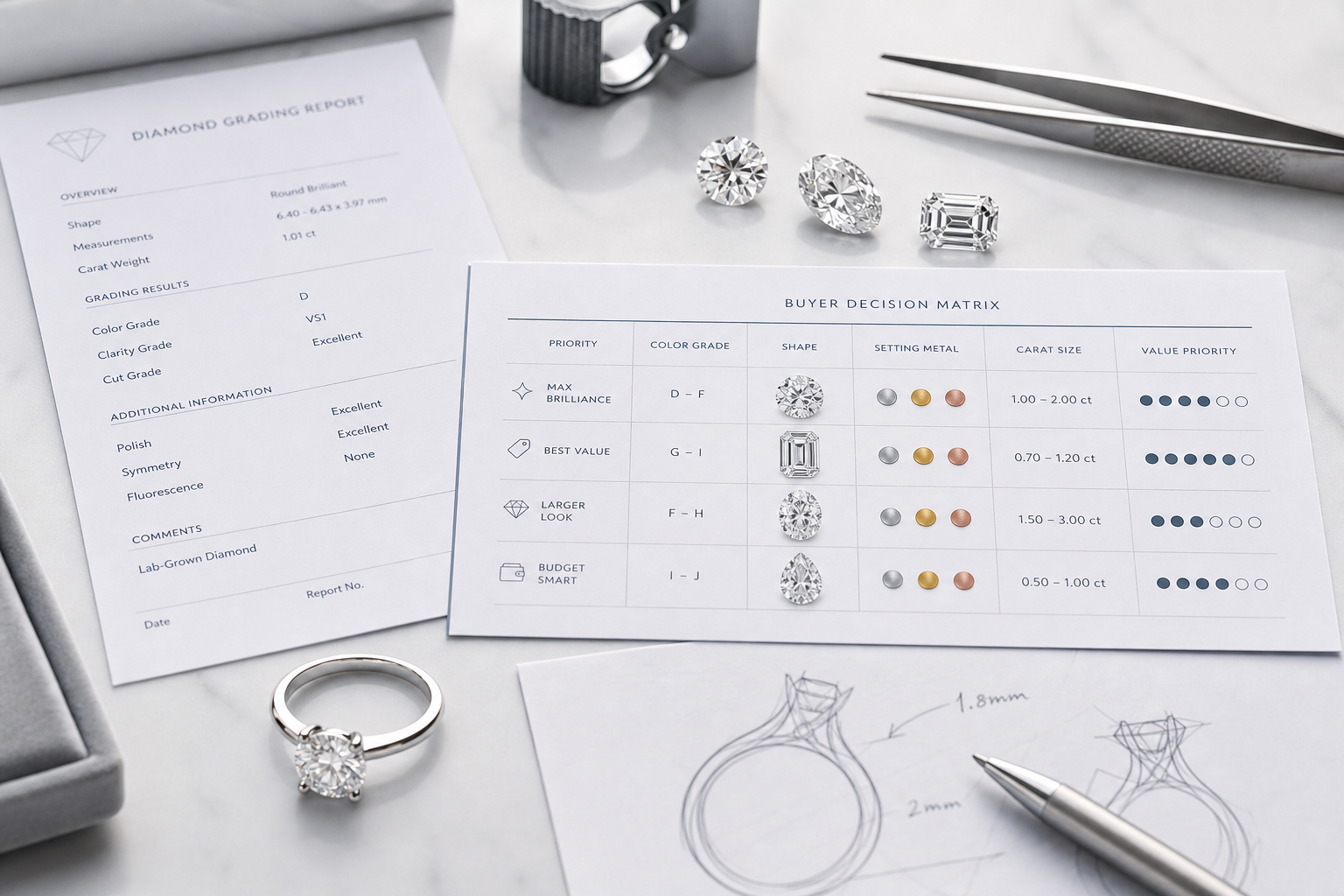
Learning how to choose diamond color becomes easier once the ring plan is clear. The right grade is not just a loose-stone decision. It depends on the shape, size, metal color, side stones, and how much the wearer cares about a crisp white appearance versus budget flexibility.
If You Want the Whitest Possible Look
If the priority is the whitest possible appearance, start with D, E, or F. This is especially sensible for platinum or white gold settings, emerald cuts, Asscher cuts, larger center stones, and buyers who know they notice warmth quickly. In these cases, choosing a colorless grade reduces the chance that the finished ring will look warmer than expected.
Even within D-F, the difference can be subtle. D is the top grade, but E or F may still look extremely white once mounted. For many buyers, F is the practical lower boundary of the colorless range: it keeps the diamond in a high color category while often allowing more flexibility elsewhere in the ring plan.
If You Want the Best Balance of Appearance and Value
For many engagement ring buyers, G is a useful starting point. It often delivers a white face-up look without requiring the price premium of D-F, especially in round brilliant, oval, cushion, radiant, and similar brilliant-style cuts. From there, compare one F and one H if they are close in size and quality.
This creates a useful middle path. If the G looks just as white as the F in the chosen setting, there may be no reason to pay more. If the H also looks white and allows a meaningful improvement in size or setting, it may be the better personal value. If the H shows warmth that bothers you, G becomes the safer compromise.
For buyers asking for the best color for engagement ring diamond selection without overpaying, this F-G-H comparison is often more useful than starting at D by default. It shows the actual tradeoff instead of assuming the highest grade is automatically the smartest choice.
If You Want More Size for the Same Budget
If size is a major priority, G or H can be worth considering, but only if the diamond still looks white in the chosen shape and setting. This is where a buyer may reasonably choose a larger near-colorless diamond over a smaller colorless one, especially in a brilliant cut and a warmer metal.
The warning is cut quality. Do not sacrifice cut performance just to increase carat weight. A larger diamond that leaks light or looks dull will not feel like an upgrade on the hand. If choosing between more size and higher color, keep cut quality stable first, then test whether the lower color grade is visually acceptable.
A smart size-focused shortlist might compare a smaller F, a mid-size G, and a slightly larger H within the same shape family. If the H appears warm, remove it. If the G looks white and offers better spread, it may be the strongest overall choice.
If You Are Designing a Custom Ring
For a custom ring, color should be chosen after the design direction is clear. Metal color, side stones, prong color, diamond shape, and overall style can all change how the center stone reads. A loose diamond that looks like a good deal on paper may be less successful if it does not match the final design.
NUVU’s buyer-first approach is to make comparison clearer, especially around report details, visual evidence, setting fit, and documentation. A G or H center stone may be excellent in a yellow gold solitaire, while the same stone might need more caution in a platinum halo with higher-color accent diamonds.
This is where lab-grown diamond selection becomes more practical than theoretical. The most suitable stone is not always the highest grade; it is the diamond that supports the design, looks right in the intended metal, and fits the buyer’s priorities without creating avoidable contrast or warmth issues.
A transparent custom process should leave a clear record of the main decisions: the selected stone’s report details, the intended metal, the accent-stone color range if applicable, and any design features that may make color more or less visible. This type of documentation does not replace visual judgment, but it reduces confusion when the loose stone, setting plan, and final ring are being discussed together.
Decision Matrix for Fast Selection
- Platinum or white gold with emerald or Asscher cut: Consider D-F, or review a G very carefully if value is the priority.
- Yellow gold with round brilliant: G-H is often a practical range, assuming strong cut quality and a white face-up appearance.
- Halo setting with high-color accent stones: Match the center stone closer to the accent stones so the center does not appear warmer by contrast.
- Large oval over 2.00 ct: Compare F, G, and H videos carefully, paying attention to the ends, edges, and side profile.
- Strict color sensitivity: Stay in D-F rather than trying to convince yourself that warmth will not bother you later.
A useful D F G H diamond comparison should narrow the shortlist, not create a universal ranking. Start with the ring plan, compare adjacent grades under similar conditions, and choose the lowest color grade that still gives the finished look you actually want.
Documentation, Origin, and Claim Boundaries Buyers Should Check
Color is only one part of a responsible lab-grown diamond comparison. The seller’s description and grading report should clearly state that the diamond is laboratory-grown, and the buyer should not have to infer origin from wording such as “created,” “cultivated,” or “alternative.” Clear origin disclosure matters because a laboratory-grown diamond is not a mined diamond, and a diamond simulant is not a laboratory-grown diamond.
When growth method or post-growth treatment is relevant, buyers should look for clear disclosure in the grading report or seller documentation. HPHT and CVD may refer to lab-grown diamond growth methods, while separate treatment disclosures should be read according to what the report or seller documentation actually states. Buyers should not assume treatment status unless it is documented for that specific diamond.
Environmental and sustainability claims should be specific, documented, and limited to what can be substantiated. Lab-grown diamonds offer a different sourcing path from mined diamonds, but broad claims about being sustainable, eco-friendly, conflict-free, carbon-neutral, or ethically superior should be supported by concrete information such as production practices, energy use, supply chain disclosures, or seller documentation.
Before purchase, buyers should confirm documentation, payment terms, return terms, resizing policies, and after-sales support directly with the seller. These policies can vary by seller and by custom order status, so they should be checked in writing rather than assumed from general jewelry-buying advice.
Common Mistakes Buyers Make With Lab-Grown Diamond Color
The most common lab-grown diamond buying mistakes around color come from treating the grade as an isolated score. Color matters, but it only tells part of the story. A diamond can have a high color grade and still look dull if the cut is weak, while a near-colorless stone can look bright and clean when the shape, proportions, and setting work in its favor.
A good color decision is not about avoiding every trace of warmth at any cost. It is about knowing where color will actually show, where it will not, and whether paying for a higher grade changes the finished ring enough to justify the tradeoff.
Mistake 1: Choosing D Color Before Checking Cut Quality
D color is the highest grade on the standard diamond color scale, but it does not create sparkle by itself. Brilliance comes mainly from cut quality, proportions, symmetry, and how well the diamond returns light. A D-color diamond with poor light performance can look less lively than an F or G diamond with stronger cutting.
This is one of the costliest diamond color vs cut mistakes. Buyers sometimes upgrade color because it feels like a safe way to buy “better,” then compromise on the factor that most affects what they see across the room. If the budget forces a choice, cut quality should usually be protected before chasing the top color grade.
The practical rule is simple: do not pay for D color until the diamond already has strong visual performance. Color can refine the look of a beautiful stone, but it cannot rescue a poorly performing one.
Mistake 2: Assuming H Will Always Look Yellow
H color is often misunderstood. It is a near-colorless grade, not a visibly yellow grade by default. In many brilliant-cut lab-grown diamonds, especially rounds, ovals, cushions, and radiants, an H can look white face-up once set. This is especially true in yellow gold, rose gold, or designs where the metal already brings warmth into the overall look.
The mistake is not choosing H. The mistake is choosing H without checking whether that specific stone works in the intended design. H may be less forgiving in larger sizes, step cuts, bright white metals, or halos with very white accent stones. In those cases, the warmth may become easier to notice because the setting gives the eye something cooler to compare against.
For value-focused buyers, H can be a smart choice when the diamond looks white in actual media and the setting supports it. It becomes risky when the buyer assumes every H will behave the same way across every shape and ring style.
Mistake 3: Comparing Color Grades Across Different Shapes
A diamond color mistake many buyers make online is comparing grades across different shapes as if the grade will look identical in every cut. An H round brilliant and an H emerald cut can present color very differently. The round’s sparkle may help mask slight body color, while the emerald cut’s broad, open facets can make warmth easier to detect.
This is why shape-specific comparison matters. If you are choosing an oval, compare oval videos. If you are choosing an emerald cut, compare emerald cuts in the same general size range. A lower color grade that looks excellent in one shape may not be the right call in another.
The safest approach is to compare diamonds within the same shape family, similar carat weight, and similar setting direction. Otherwise, you may think you are comparing color when you are really comparing cutting style, facet pattern, and light behavior.
Mistake 4: Ignoring Accent Stone Color
Accent stones can change how the center diamond looks. If a center stone is H color and the halo or side stones are much whiter, the contrast can make the center appear warmer than it would in a solitaire. This is not because the center stone changed; it is because the ring created a direct comparison point.
This matters most in halo rings, three-stone rings, pavé bands near the center, and designs with larger side stones. In a solitaire, the eye usually judges the center diamond on its own. In a multi-stone setting, the eye compares one diamond against another.
The goal is not always to match every stone to the exact same grade. Very small accent diamonds can behave differently visually than a center stone. But the color range should be close enough that the finished ring looks intentional rather than mismatched.
Mistake 5: Treating Marketing Language as Evidence
Another common mistake is accepting broad listing language without checking what it actually proves. Phrases such as “premium white,” “excellent value,” or “looks like a D” may be useful as seller descriptions, but they are not substitutes for the grading report or stone-specific visual evidence. The buyer should separate documented facts from styling language and sales shorthand.
For a color decision, the most reliable comparison is narrow and concrete: the report-stated grade, the stone’s actual media, the intended setting, and any side-stone color information. If a claim about appearance cannot be checked through those details, treat it as a prompt to ask questions rather than as proof that the diamond will perform a certain way.
Pre-Purchase Confirmation List
- Confirm the diamond color grade on a grading report.
- Confirm that the report and listing clearly disclose laboratory-grown origin.
- Review actual stone media, including face-up video whenever possible.
- Check the setting metal before finalizing the color grade.
- Confirm the color range of halo stones, side stones, or pavé accents.
- Ask whether two or three stones can be compared side by side under similar conditions.
- Get the key diamond and design details in writing before purchase.
The diamond grading report color grade is important, but it should not be the only checkpoint. The report tells you how the stone was graded; the media and setting details tell you whether that grade makes sense for the ring you are actually buying.
Final Recommendation: Do You Really Need a D Color Lab-Grown Diamond?
The Direct Answer
If you are asking, “do I need D color diamond?” the honest answer is no, not automatically. D color is the highest grade and can be the right choice for buyers who want the most colorless designation possible, especially in larger stones, step cuts, platinum settings, or highly color-sensitive purchases. But it is not the automatic best choice for every ring.
For many buyers, F or G is the more balanced starting point. F keeps the diamond in the colorless range while often avoiding the full premium of D. G can look very white in many well-cut brilliant shapes, especially when the setting does not exaggerate warmth. H can also be a sensible option when the design is forgiving and the buyer has confirmed the stone looks white enough in actual media.
The safest final rule is to choose the lowest color grade that still looks right in the specific diamond and setting. If D gives you confidence and fits the budget without weakening cut quality or design, it can be a satisfying choice. If the visible difference between D and F or G is minimal in your ring plan, the lower grade may be the smarter purchase.
For lab-grown diamonds, the same practical discipline applies as with any diamond purchase: documentation matters, but it does not replace judgment. Compare the report with real images, video, measurements, and setting details. A report-aware decision is stronger than either a report-only decision or a purely visual decision made without confirming the documented grade.
Before purchase, buyers should confirm the seller’s documentation, return policy, resizing terms, and after-sales support in writing. When a grading report is provided, the report details should be checked through the issuing laboratory’s official tools where available.
NUVU’s role in buyer education is to make comparison clearer, especially around grading reports, visual evidence, design fit, and documentation. A grading report helps confirm the stated color grade, while stone-specific images, video, and setting details help confirm whether that grade supports the finished design.
Next Steps for Comparing Color Grades
The most useful next step depends on what you are still trying to decide. If the main question is whether a lower color grade will still look white, the next move should be visual comparison across similar stones. If the question is how color will work in a finished ring, the next move should be setting-focused rather than grade-focused.
Recommended Comparison Path
Readers who are still narrowing the basics should move from this lab-grown diamond color guide into a broader lab-grown diamond buying guide only if they need help balancing color against cut, clarity, carat weight, and grading reports. Color should not be chosen in isolation, but it also should not be buried under every other 4C at once.
For buyers comparing reports, a diamond grading report guide is the better next page. The grading report confirms the assigned color grade, but it does not show how the stone will look in a specific shape, lighting environment, or ring setting. That distinction matters because two diamonds with the same color grade can still feel different in real viewing conditions.
Shape-focused buyers should continue to a diamond shape guide before finalizing color. This is especially useful for oval, pear, cushion, emerald, Asscher, radiant, and princess cuts, where color may show differently than it does in a round brilliant. A buyer choosing an emerald cut in platinum has a different color-risk profile than a buyer choosing a round brilliant in yellow gold.
Engagement ring buyers should also review setting guidance before purchasing the center stone. The most suitable color grade for a lab-grown diamond engagement ring depends heavily on metal color, accent stones, prongs, and whether the design creates direct comparison points around the center stone.
Compare Adjacent Color Grades
Compare lab-grown diamonds in adjacent grades such as F, G, and H using the color priorities for your shape and setting. Do not default to the highest grade or the lowest price without checking the visible difference.
For a custom design with a halo, side stones, mixed metals, or a non-round center stone, make the diamond color decision alongside the setting plan. A custom lab-grown diamond ring can look more cohesive when the center stone, accent stones, and metal are selected as a group instead of as separate purchases.
Choose two or three report-supported lab-grown diamonds with similar shape, carat weight, clarity, and cut quality, then compare the color difference through actual stone media. This keeps the decision grounded in visible appearance rather than grade anxiety.
For NUVU, the helpful role is to support that comparison process. Buyers can review loose stones, consider how D, E, F, G, and H grades behave in the intended setting, and decide whether the higher color grade adds enough visible value to justify the tradeoff.
Keep Color Recommendations Conditional
No recommendation should promise that one color grade will always look identical to another, that a lower grade always saves money wisely, or that a higher grade is always unnecessary. The safer recommendation is to compare documentation, real visuals, and setting compatibility together. A well-chosen G or H can be excellent value in the right design, but a D, E, or F may still be the better choice when the ring style, diamond shape, or buyer preference makes color more noticeable.
Your Final Color Decision
Ask when the color grade actually changes what you see, and when the difference is mostly a paper distinction once the diamond is mounted. Judge the grade in the context of the actual diamond and finished design.
How Cut, Clarity, and Carat Affect Color Decisions
Cut, clarity, and carat weight matter here only when they affect visible color. Cut matters because stronger light return can make slight warmth less obvious face-up. Carat weight matters because larger diamonds can reveal more body color. Clarity matters only in the sense that buyers should compare similar stones before judging color value.
For color decisions, first check whether the grade difference is visible in the chosen shape and setting. Then consider whether paying for the higher grade takes budget away from a more noticeable improvement, such as cut quality, size, or setting craftsmanship.
Compare Color Value Without Relying on Fixed Prices
Color affects price, but a fixed price chart is not enough for a purchase decision. Lab-grown diamond pricing changes with inventory, seller channel, grading report type, measurements, cut quality, and market demand, so fixed numbers can become misleading quickly if they are not current and clearly dated.
The more durable value lesson is comparative: do not judge diamond color value by grade alone. A D-color stone is not automatically the better purchase, and an H-color stone is not automatically the better deal. The decision only makes sense when the stones being compared are similar enough that color is the main variable.
Use the Color Grade Alongside Visual Review
A grading report is essential because it confirms the assigned color grade, but it should not be treated as a complete appearance prediction. The report can tell the buyer whether the diamond is D, E, F, G, or H. It cannot fully show how that specific diamond will appear in a yellow gold solitaire, a platinum halo, a large oval, or an emerald cut with open facets.
Do not treat a laboratory ranking or grading report as a guarantee of beauty. Use the grading report color grade to narrow the search, then use visual review to decide whether that grade works for the intended ring.
Choose Color for the Finished Ring
D-F is most compelling for buyers who want a crisp colorless look, especially in larger stones, step cuts, platinum, white gold, or designs with very white accent stones. G-H can be a strong value choice when the diamond is brilliant-cut, well cut, mounted in a compatible setting, or chosen by a buyer who cares more about size or overall design than the highest color designation.
Choose color after confirming shape, size, cut quality, setting metal, and accent stone color. Do not buy D just because it ranks highest, or H just because it appears cheaper. Compare D, E, F, G, and H in the context of the actual ring.
Disclosure: This article is for general educational purposes only. Diamond grading, pricing, availability, specifications, and seller policies can change, and readers should verify important details through grading reports, official laboratory tools, seller documentation, or qualified professionals before making a purchase decision. Laboratory-grown diamonds should be clearly distinguished from natural diamonds, and environmental or sourcing claims should be supported by specific documentation.