- Shop
Diamonds & Jewelry
Loose Lab Diamonds Yellow Lab Diamonds Pink Lab Diamonds Blue Lab Diamonds Engagement Rings Fine Jewelry Shop All Loose lab-grown diamonds10 shapes · IGI, GIA or NGTC reports
- Wholesale
- Custom Design
- Education
- About
Lab-Grown Diamond Cut Guide: Why Cut Quality Matters More Than Most Buyers Realize
- What cut controls
- What goes into a cut grade
- Reading the proportions on a report
- Reference ranges for round brilliants
- How depth changes face-up size
- Why color and clarity cannot rescue a weak cut
- Two stones with the same report grades
- Fancy shapes: judging cut without a grade
- Ideal, Triple Excellent and Hearts and Arrows
- How the setting affects cut
- Cut in small stones and melee
- Why cut quality varies between producers
- Cut questions
- See the cut before you choose
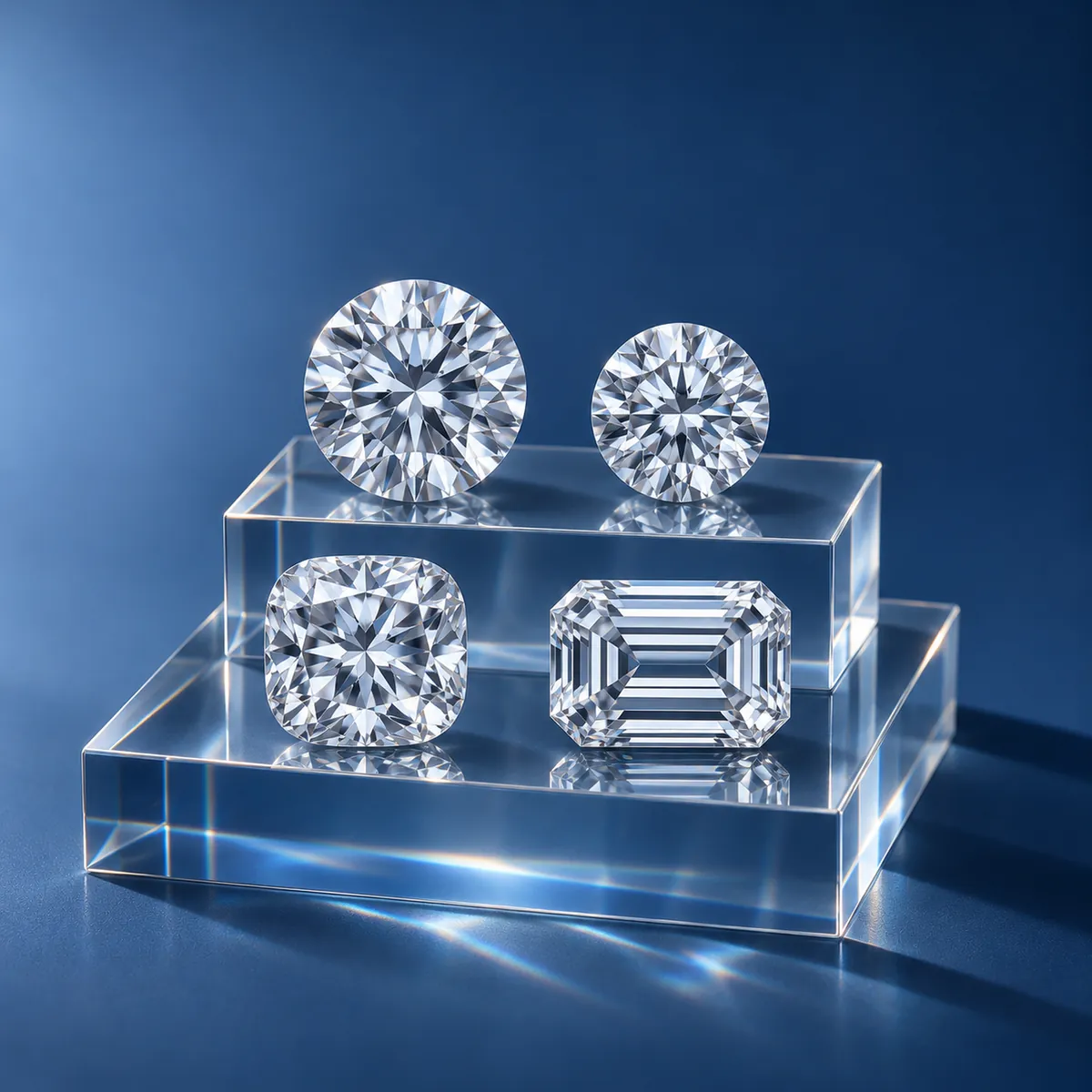
Cut decides how a diamond handles light: how bright it is, how much fire and sparkle it shows, and how large it looks face-up. A higher color or clarity grade cannot fix a weak cut. For a round lab-grown diamond, choose an Excellent (GIA) or Ideal (IGI) cut grade with Excellent polish and symmetry. Fancy shapes carry a cut grade only on some reports (IGI added one in 2022; GIA plans one for ovals, pears and marquises in 2027), so you judge them by their proportions, outline and bow-tie in video.
What cut controls
What goes into a cut grade
GIA grades cut on round brilliants only, from Excellent down to Poor. The grade combines seven things: brightness, fire, scintillation, weight ratio, durability, polish and symmetry. Two of these surprise most buyers:
- Weight ratio. A thick girdle or deep pavilion adds weight you pay for but cannot see.
- Durability. A very thin girdle makes the edge easy to chip, so it lowers the grade even if the stone looks bright.
GIA sets the overall grade from the weakest of the first five factors. A stone with excellent brightness but a weight-heavy girdle cannot reach Excellent. IGI uses a similar scale for lab-grown rounds, with Ideal at the top.
Reading the proportions on a report
A real IGI report for a 2.02 ct round CVD diamond graded F, VS1, Ideal shows these numbers:
Swipe the table to see more →
| Field | Value on the report | What it means |
|---|---|---|
| Measurements | 8.09–8.12 × 4.97 mm | Diameter range and depth; the two diameters show how round the outline is |
| Total depth | 61.3% | Depth divided by average diameter; inside the usual range for a bright round |
| Table | 58% | The top facet as a share of the diameter |
| Crown angle | 35° | Steeper crowns give more fire |
| Pavilion angle | 40.8° | The angle that most decides brightness |
| Girdle | Medium (faceted) | Neither weight-heavy nor fragile |
An 8.1 mm diameter is what a well-cut 2 ct round should measure. If a 2 ct stone measures 7.8 mm, the missing width is sitting in its depth.
Reference ranges for round brilliants
Swipe the table to see more →
| Measure | Common range for well-cut rounds |
|---|---|
| Table | about 54–58% |
| Total depth | about 59–62.5% |
| Crown angle | about 34–35° |
| Pavilion angle | about 40.6–41° |
| Girdle | thin to slightly thick |
| Culet | none or pointed |
Two stones inside these ranges can still look different, so use the numbers to shortlist and video to decide.
How depth changes face-up size
For the same weight, a deeper stone keeps more of its weight below the girdle and faces up smaller. Approximate diameters for a 1.00 ct round:
Swipe the table to see more →
| Total depth | Approx. diameter | How it looks |
|---|---|---|
| 58% | 6.6 mm | Larger, but can leak light and look glassy |
| 61% | 6.4–6.5 mm | Balanced |
| 64% | 6.2–6.3 mm | Smaller face-up, often darker |
A 0.3 mm difference sounds small. Side by side it is easy to see, and you pay for the hidden weight.
Why color and clarity cannot rescue a weak cut
Color affects whiteness and clarity affects inclusions. Cut decides whether the stone looks alive. A poorly cut D VVS1 can look duller than a well-cut G VS2. Because lab-grown diamonds make high color and clarity affordable, buyers are often tempted to trade cut away for better grades. That trade costs more brightness than it gains in whiteness.
Two stones with the same report grades
Two 1.50 ct rounds, both G VS1 Excellent. One has a 57% table and 61.5% depth; the other a 60% table and 63% depth. The first faces up larger and brighter. The second still earns Excellent, but sits near the edge of the range. The grade tells you both are good; the proportions tell you which one is better.
Fancy shapes: judging cut without a grade
On most reports, ovals, pears, marquises, cushions, emeralds and radiants still have no cut grade, and even an IGI fancy cut grade does not show the bow-tie. Look at:
- Length-to-width ratio. It sets how long or round the outline looks. Ovals around 1.35–1.50 and pears around 1.50–1.75 are popular, but it is a matter of taste.
- Depth. Many brilliant-style fancy shapes look best in the low to mid 60s. Deeper stones face up small.
- Bow-tie. The dark band across the middle of ovals, pears and marquises. Some is normal; a wide, dark one shows in every light.
- Step-cut pattern. In emeralds and Asschers, look for even, parallel facets and a centered culet.
Ideal, Triple Excellent and Hearts and Arrows
- Ideal: IGI’s top cut grade for rounds, and a trade term for well-proportioned stones.
- Triple Excellent (3EX): Excellent cut, polish and symmetry together.
- Hearts and Arrows: a round cut with very precise symmetry, which shows eight arrows face-up and eight hearts face-down in a special viewer. It is a selling term, not a laboratory grade. If a stone is sold as H&A, the viewer images should show even, complete patterns.
How the setting affects cut
Light enters through the crown and leaves through the crown, after bouncing off the pavilion. Closed-back settings and very low bezels let less light reach the pavilion. Heavy prongs cover part of the outline. Oil and lotion on the pavilion dull even a perfect cut, so clean rings regularly.
Cut in small stones and melee
Melee is rarely sold with cut grades, but cutting still shows: badly cut small stones look dark next to a bright center stone. For pavé and bracelets, check a sample under 10x for even facets and a consistent outline, and compare brightness across the parcel. See melee and calibrated stones.
Why cut quality varies between producers
Cutters balance weight against brightness. Cutting for maximum weight leaves stones deep or with a thick girdle, and the extra weight raises the price per stone. Cutting for light takes longer and gives up more of the rough. That is one reason two stones with the same grades are priced differently. See cutting and polishing in China.
Cut questions
Is cut the most important C for lab-grown diamonds?
For appearance, yes. It decides brightness and face-up size.
What cut grade should I choose?
Excellent at GIA or Ideal at IGI for rounds, with Excellent polish and symmetry.
Do fancy shapes have a cut grade?
No. Judge them by ratio, depth, bow-tie and video.
Is Hearts and Arrows better than Excellent?
It describes very precise symmetry within a well-cut round. It is not a laboratory grade, so judge the viewer images and the proportions.
See the cut before you choose
NUVU shortlists stones by their proportions as well as their grades, and on request sends video so you can see brightness and face-up size before you decide. Send your requirements or message us on WhatsApp / WeChat at +86 19118403930.
Sources

12+ years in lab-grown diamond grading, identification and quality assurance for both HPHT and CVD stones.
About NUVU. NUVU is the international brand of New Perspective Superhard Materials Co., Ltd. in Zhecheng, Henan, China. We grow HPHT lab-grown diamonds in-house and cut, polish and match stones in our own workshop.
Related Guides
4Cs buying guide
The 4Cs for lab-grown diamonds: why cut comes first, which color and clarity ranges give best value, carat vs…
Read more →4Cs guideCarat guide
Carat is weight, not size.
Read more →Education4Cs guide
The 4Cs for lab-grown diamonds in one page: which cut, color, clarity and carat to choose for your shape and metal…
Read more →