 Get a Quote
 Loose lab-grown diamonds10 shapes · IGI, GIA or NGTC reports
Lab-Grown Diamond Carat Guide: Why Bigger Is Not Always Better
- Carat to millimeters for round brilliants
- Why size grows slower than weight
- Shape changes how big a carat looks
- Spread: size for the weight
- Price steps at round weights
- When bigger is not better
- How carat weight is stated
- Choosing a size for the hand
- Large lab-grown stones: what to check
- Carat questions
- Find the size you want for your budget
Carat measures weight, not visible size: one carat is 0.2 grams. Two stones of the same weight can face up at different sizes, depending on how deep they are cut and what shape they are. Lab-grown prices make large stones affordable, but a big stone with a weak cut, a visible inclusion or a tint can look worse than a smaller, well-cut one. Compare millimeters, not only carats.
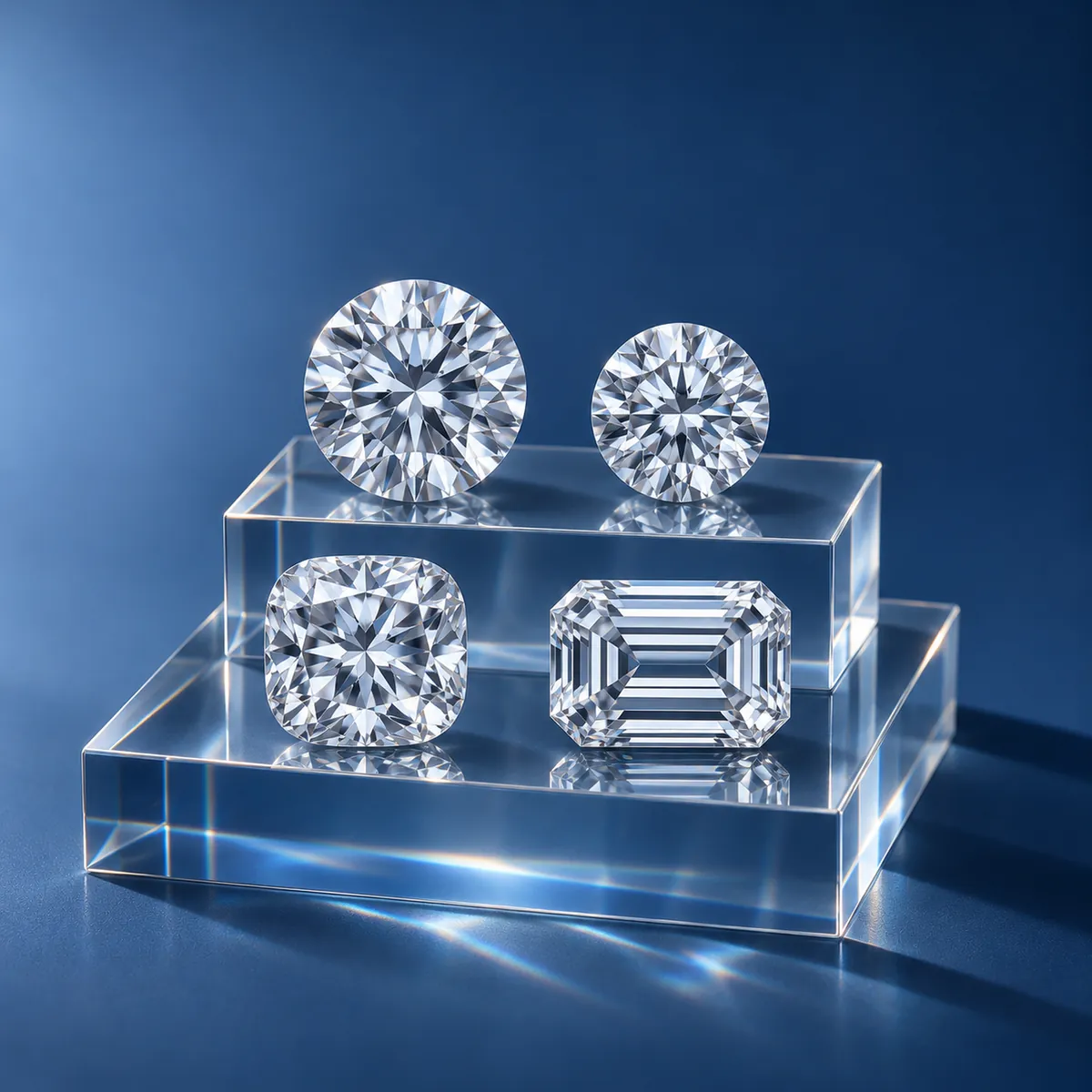
Carat to millimeters for round brilliants
These are typical for well-cut rounds. As a check, an IGI report for a 2.02 ct round graded Ideal lists 8.09–8.12 mm. A deep stone measures less for its weight; a very shallow one measures more but loses brightness.
Why size grows slower than weight
Weight follows volume, but you see the diameter. Double the weight from 1 ct to 2 ct and the diameter grows by only about 25%, from roughly 6.5 mm to 8.1 mm. Each step up in carat adds less visible size than the step before, while the price per carat usually rises. That is the main reason “bigger” is not automatically better value.
Shape changes how big a carat looks
The same weight looks larger in an elongated shape and smaller in a deep, compact one. Typical face-up sizes for a well-cut 1 ct stone:
Swipe the table to see more →
| Shape (1 ct) | Typical size | How it looks next to a 1 ct round |
|---|---|---|
| Round | 6.4–6.5 mm | Reference |
| Oval | about 7.7 × 5.7 mm | Looks larger, and longer on the finger |
| Pear | about 8.5 × 5.5 mm | Looks larger |
| Marquise | about 10 × 5 mm | Looks the largest for its weight |
| Emerald | about 7 × 5 mm | Similar; the open table makes it look flatter |
| Princess | about 5.5 mm square | Looks smaller, because much weight sits in the corners and depth |
| Cushion | about 5.5–6 mm | Looks smaller; cushions are often cut deep |
| Radiant | about 6.5 × 5.5 mm | Similar to slightly smaller, depending on depth |
Sizes vary with each stone’s proportions, so use the measurements on the report for the stone you are actually considering.
Spread: size for the weight
Spread is how much top surface a stone shows for its weight. Balanced proportions give good spread. A stone cut deep to keep weight faces up small; a stone cut too shallow shows a wide top but leaks light and can look glassy. Judge spread by comparing the diameter with the chart above.
Price steps at round weights
Prices step up at popular weights. GIA’s buying advice names 0.50, 0.75 and 1.00 ct as the main “magic sizes”; 1.50, 2.00 and 3.00 ct work the same way. A stone just below the step looks almost the same.
Swipe the table to see more →
| Price step | Value alternative | Visible difference in a round |
|---|---|---|
| 0.50 ct | 0.45–0.49 ct | Up to about 0.2 mm |
| 1.00 ct | 0.90–0.99 ct | Up to about 0.25 mm |
| 1.50 ct | 1.40–1.49 ct | Up to about 0.2 mm |
| 2.00 ct | 1.80–1.99 ct | Up to about 0.3 mm |
| 3.00 ct | 2.80–2.99 ct | Up to about 0.2 mm |
When bigger is not better
- When reaching the size means accepting a weak cut.
- When color or inclusions become visible at the larger size.
- When it pushes you over a price step for little visible gain: a 0.95 ct looks almost the same as a 1.00 ct.
- When the stone is too large for daily wear: big stones sit higher and take more knocks.
How carat weight is stated
Reports give the weight to two decimal places. On jewelry, “total carat weight” (TCW or CTW) means the combined weight of every stone in the piece, not the size of the largest one. A “2 ct TW” pair of studs is two stones of about 1 ct each, and a “3 ct TW” tennis bracelet may be 50 or more small stones.
Swipe the table to see more →
| Piece | How carat is usually stated | What to check |
|---|---|---|
| Stud earrings | TCW for the pair | Each stone’s weight and diameter |
| Pendant | Weight of the center stone | Diameter and how it sits on the chain |
| Tennis bracelet | TCW across all stones | Size and number of stones |
| Halo or three-stone ring | Center weight plus total accent weight | The center stone’s weight on its own |
Choosing a size for the hand
There is no right size; it depends on taste, budget and how the ring will be worn. The same stone looks larger on a slender finger, and elongated shapes make the finger look longer. Thin bands and halos add visual size without adding weight. Before deciding, print a size guide or try ring mock-ups at actual size.
Large lab-grown stones: what to check
At 3 ct and above, color and inclusions are easier to see. Check color in daylight video, choose a clarity that is clean to the eye at that size, and use a protective setting. Large lab-grown stones are also where growth method and treatment status matter most to many buyers, so choose a report that states both.
Carat questions
How big is a 1 carat lab-grown diamond?
About 6.4–6.5 mm across for a well-cut round.
Does a lab-grown carat weigh the same as a natural one?
Yes. A carat is 0.2 grams for any diamond.
Is a 2 carat diamond twice as big as a 1 carat?
No. Its diameter is only about 25% larger.
Which shape looks biggest per carat?
Marquise, then pear and oval. Princess and cushion look smallest.
Find the size you want for your budget
Tell NUVU the face-up size you want, in millimeters or on the hand, and we will suggest the weight, shape and proportions that reach it, with measurements, and video of candidate stones on request. Send your requirements or message us on WhatsApp / WeChat at +86 19118403930.

12+ years in lab-grown diamond grading, identification and quality assurance for both HPHT and CVD stones.
About NUVU. NUVU is the international brand of New Perspective Superhard Materials Co., Ltd. in Zhecheng, Henan, China. We grow HPHT lab-grown diamonds in-house and cut, polish and match stones in our own workshop.
Related Guides
4Cs buying guide
The 4Cs for lab-grown diamonds: why cut comes first, which color and clarity ranges give best value, carat vs…
Read more →Price1 carat price guide
Why two 1 carat lab-grown diamonds can be priced very differently: cut, color, clarity, shape, measurements, report…
Read more →Education4Cs guide
The 4Cs for lab-grown diamonds in one page: which cut, color, clarity and carat to choose for your shape and metal…
Read more →