- Shop
Diamonds & Jewelry
Loose Lab Diamonds Yellow Lab Diamonds Pink Lab Diamonds Blue Lab Diamonds Engagement Rings Fine Jewelry Shop All Loose lab-grown diamonds10 shapes · IGI, GIA or NGTC reports
- Wholesale
- Custom Design
- Education
- About
Lab-Grown Diamond Clarity Guide: How to Find an Eye-Clean Diamond Without Overpaying
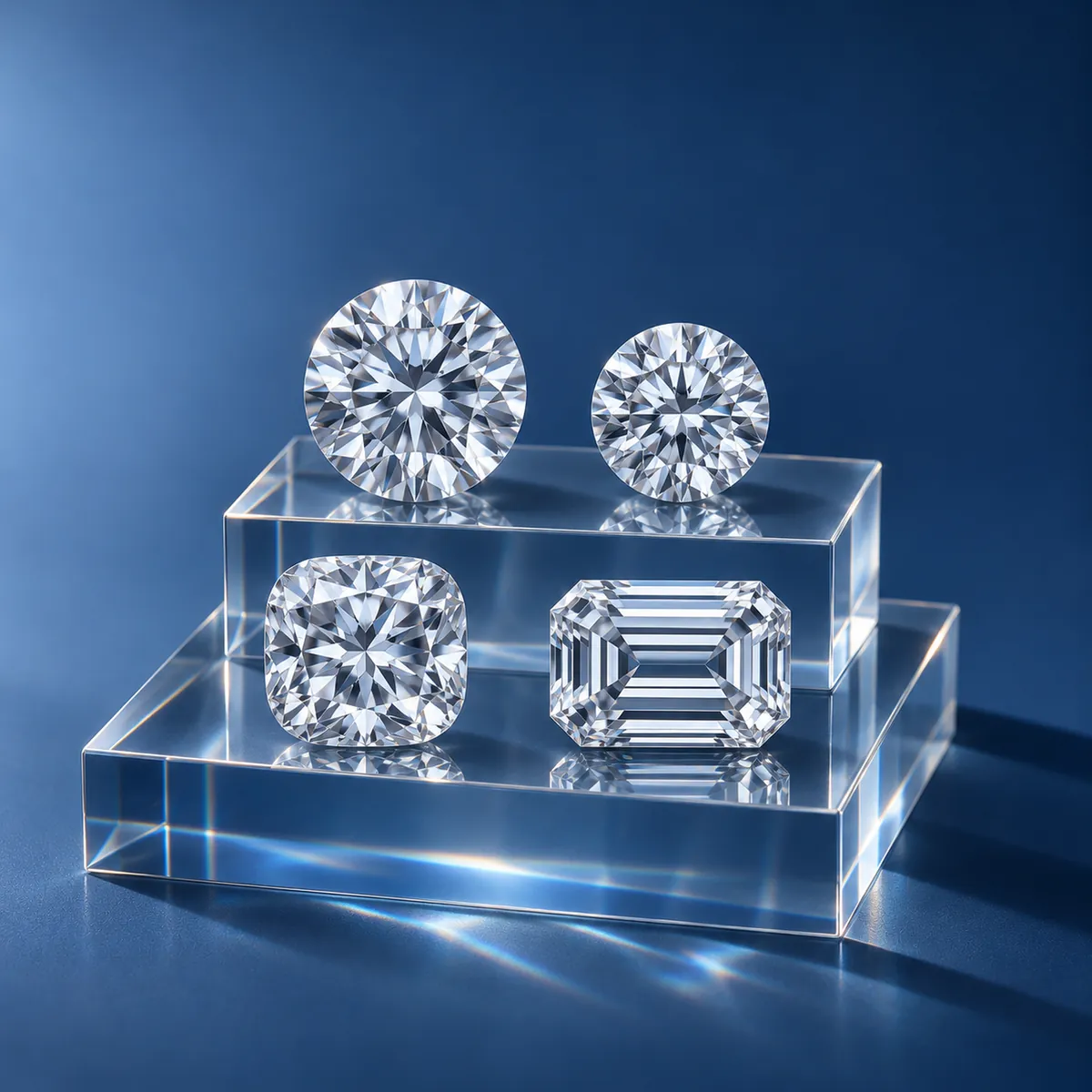
- Clarity grades in real life
- Minimum clarity by shape and size
- Report grade vs what you see
- Inclusion types that matter most
- Inclusions typical of lab-grown diamonds
- How to check that a stone is eye-clean
- Clarity and durability
- Clarity by jewelry type
- Clarity ranges in wholesale orders
- When a higher clarity grade is worth it
- Clarity questions
- See the inclusions before you decide
“Eye-clean” means you cannot see any inclusion with the naked eye when you look at the stone face-up from normal distance. For round lab-grown diamonds up to about 2 carats, VS1 and VS2 are almost always eye-clean, and many SI1 stones are too once you have checked them on video. Emerald and Asscher cuts and larger stones need a higher grade, because their open facets show more. VVS and Flawless look the same as an eye-clean VS stone in everyday wear.
Clarity grades in real life
Choose a grade:
GIA’s own buying advice notes that most SI diamonds show no inclusions to the naked eye. The catch is that “most” is not “all”, so an SI stone has to be seen before you choose it.
Minimum clarity by shape and size
Swipe the table to see more →
| Shape or size | Lowest grade that is usually eye-clean |
|---|---|
| Round, under 2 ct | VS2, or an SI1 you have checked |
| Oval, cushion, radiant, pear | VS2; check video |
| Emerald, Asscher | VS1 or better |
| Over 3 ct, any shape | Check stone by stone; often VS1 or better |
Brilliant facets break up light and hide small inclusions. Step cuts have a large, open table that works like a window into the stone.
Report grade vs what you see
The clarity grade records inclusions at 10x magnification. It does not tell you whether you will see them. Two VS2 stones can look different: one inclusion may sit under the table, the other near the girdle where a prong will cover it. If the report has a clarity plot, use it to see where the inclusions are.
Swipe the table to see more →
| Where the inclusion is | Effect face-up |
|---|---|
| Under the table | Most visible; reflections can repeat it |
| Under the crown facets | Partly hidden by sparkle |
| Near the girdle | Often hidden by prongs or the setting |
| Surface-reaching, at a point or corner | Can be a weak spot as well as a visual one |
Inclusion types that matter most
- Dark crystals and pinpoints under the table are the most visible.
- Clouds of tiny pinpoints are harmless when small, but a large cloud can make the stone look slightly hazy.
- Feathers are small fractures. Near the girdle or at a point they can matter for durability.
Inclusions typical of lab-grown diamonds
Lab-grown diamonds have their own kinds of inclusions, which come from how they were grown. The clarity grade judges them the same way as in a mined diamond: by size, number, position and visibility.
Swipe the table to see more →
| Growth method | Inclusions you may see | What GIA has reported |
|---|---|---|
| HPHT | Dark metallic inclusions (solidified metal from the growth process), pinpoints | Most HPHT stones GIA has graded were VS1 or VS2. Large metallic inclusions can make a stone attracted to a strong magnet, though usually only in SI to I grades |
| CVD | Black graphite-like spots, pinpoints of non-diamond carbon, sometimes clustered into clouds | Most CVD stones GIA has graded were VVS2 to VS1. Growth layers and strain patterns show only under special lighting |
A magnet test is not a reliable way to identify a lab-grown diamond: most lab-grown stones are not magnetic. Identification needs laboratory equipment.
How to check that a stone is eye-clean
Normal viewing distance is about 25 to 30 cm. Strong spotlights show more than daylight does, so judge the stone in ordinary light as well.
Clarity and durability
Most inclusions are only cosmetic. Large feathers that reach the surface, especially near the girdle or at the points of pears, marquises and princess cuts, can be weak spots. Protect those areas with prongs or a V-tip, and avoid stones with large surface-reaching feathers for rings worn every day.
Clarity by jewelry type
Swipe the table to see more →
| Piece | Clarity that usually works |
|---|---|
| Engagement ring, brilliant center stone | VS2, or a checked SI1 |
| Engagement ring, step-cut center stone | VS1 or better |
| Stud earrings | VS2–SI1, eye-clean |
| Pendants | VS2–SI1, eye-clean |
| Melee and pavé | A range such as VS–SI, even across all stones |
Clarity ranges in wholesale orders
Trade buyers usually order clarity as a range, such as VS1–VS2, together with an eye-clean requirement for center stones. A range lets the supplier match repeat orders without drifting. For melee, the range applies to the whole parcel, so inspect a sample under 10x and check that the stones are even rather than mixed. See melee and calibrated stones.
When a higher clarity grade is worth it
- Emerald and Asscher cuts with large tables.
- Large stones, where inclusions are larger too.
- When the grade itself matters to you or your customer, for example for a top-grade report.
Clarity questions
What clarity is eye-clean for a lab-grown diamond?
VS1 and VS2 in almost all rounds; many SI1 stones too, once checked.
Is VVS worth it for a lab-grown diamond?
Only if you want the grade. Face-up, VVS looks the same as an eye-clean VS stone.
What clarity should I choose for an emerald cut?
VS1 or better, because the open table shows inclusions.
Do lab-grown diamonds have inclusions?
Yes. HPHT stones can have dark metallic inclusions; CVD stones can have small dark carbon spots. Both are graded the same way as inclusions in mined diamonds.
See the inclusions before you decide
NUVU checks clarity face-up and can send video and close-up images of each candidate stone on request, so you can see what the grade means for that stone. Send your requirements or message us on WhatsApp / WeChat at +86 19118403930.
Sources

7+ years researching color tuning, inclusions and defect characterization of lab-grown diamonds.
About NUVU. NUVU is the international brand of New Perspective Superhard Materials Co., Ltd. in Zhecheng, Henan, China. We grow HPHT lab-grown diamonds in-house and cut, polish and match stones in our own workshop.
Related Guides
4Cs buying guide
The 4Cs for lab-grown diamonds: why cut comes first, which color and clarity ranges give best value, carat vs…
Read more →4Cs guideColor guide
Which lab-grown diamond color to choose: when D, E, F, G and H look different, how metal and shape change the…
Read more →Education4Cs guide
The 4Cs for lab-grown diamonds in one page: which cut, color, clarity and carat to choose for your shape and metal…
Read more →