- Shop
Diamonds & Jewelry
Loose Lab Diamonds Yellow Lab Diamonds Pink Lab Diamonds Blue Lab Diamonds Engagement Rings Fine Jewelry Shop All Loose lab-grown diamonds10 shapes · IGI, GIA or NGTC reports
- Wholesale
- Custom Design
- Education
- About
Do Lab-Grown Diamonds Look Different From Natural Diamonds? What Buyers Can and Cannot See
- What controls how a diamond looks
- Sparkle comes from the cut
- Color: the same scale, with different causes
- Clarity: different inclusions, the same rules
- What only a laboratory can detect
- Fluorescence
- How to compare a lab-grown and a mined stone fairly
- Does it matter that no one can see the difference?
- Appearance questions
- Compare stones on video, with the report
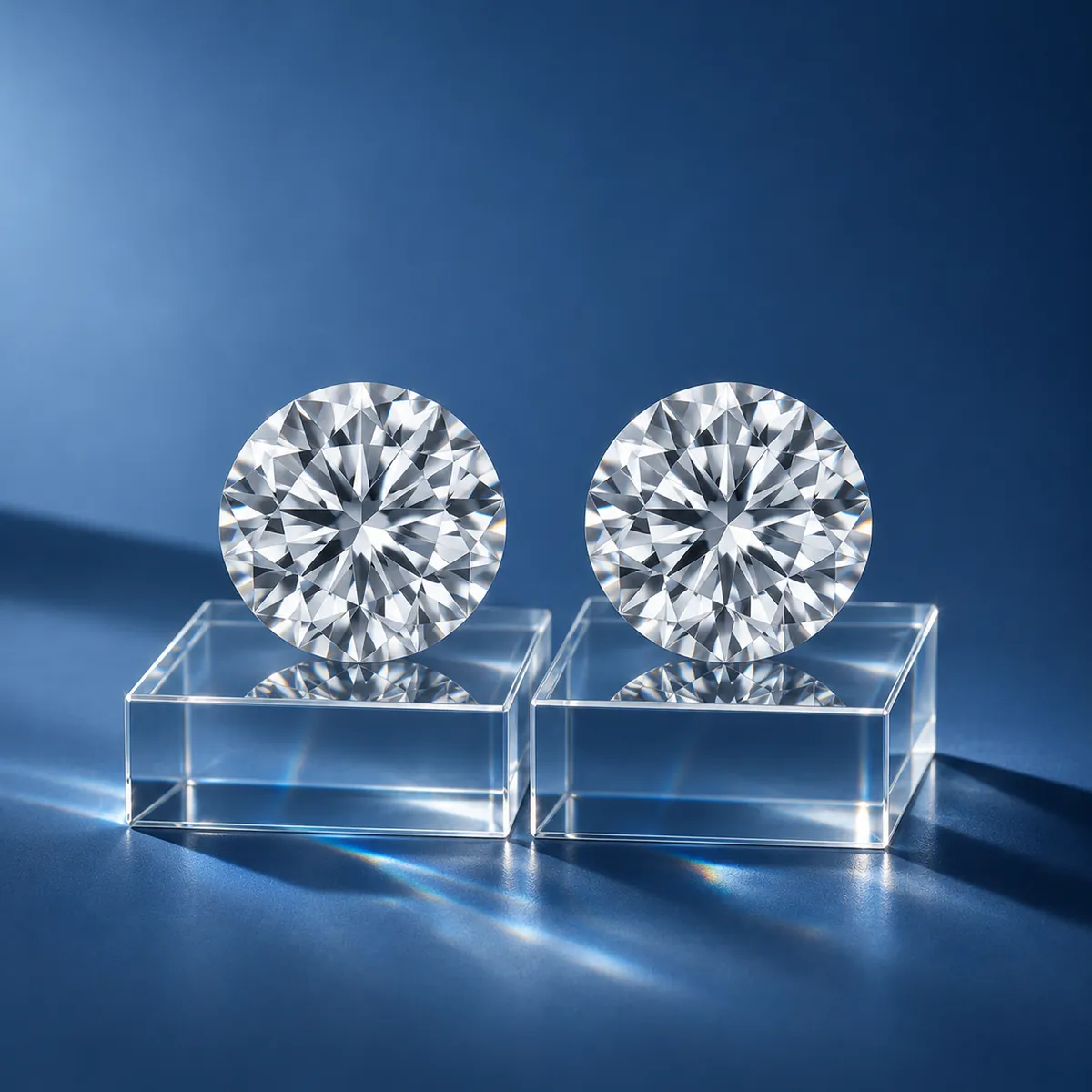
Lay two 1.00 ct round brilliants on a white tray, both G color, VS1 clarity, Excellent cut, about 6.4 mm across. One was mined, the other grown in a CVD reactor. An experienced jeweler with a 10× loupe will not reliably say which is which. Now swap the lab-grown stone for one with a deep pavilion that looks dark in the center. Anyone at the counter will see the difference, and it has nothing to do with origin.
By eye and under a loupe, lab-grown and mined diamonds of the same quality look the same. How a diamond looks depends on its cut, color, clarity, shape, size and setting. Origin is identified with laboratory instruments, which is why it is printed on the report rather than judged at the counter.
What controls how a diamond looks
Sparkle comes from the cut
A well-cut lab-grown diamond sparkles as much as a well-cut mined one, and more than a poorly cut stone of either origin. GIA’s cut grade for round brilliants, Excellent to Poor, weighs brightness, fire, scintillation, weight ratio, durability, polish and symmetry. For rounds, the cut grade is the best single guide. For fancy shapes, most reports give no cut grade, so judge proportions and a video. See the 4Cs guide.
Color: the same scale, with different causes
IGI and NGTC grade lab-grown stones on the same D–Z scale as mined ones, and a G is a G. GIA has given lab-grown stones a Premium or Standard assessment instead of letter grades since October 2025.
What differs is the cause of any tint. GIA’s research shows that brown in CVD stones comes from vacancy clusters and nitrogen-related defects, and that about 80% of the CVD stones it received since 2020 had been HPHT-treated after growth to improve color. Most colorless HPHT stones contain a trace of boron, which in larger amounts gives a blue tint. The color grade records the result, whatever the cause. Treatment must be disclosed; on IGI reports, look for the “As Grown” or “Indications of post-growth treatment” comment. See HPHT vs CVD.
Clarity: different inclusions, the same rules
Swipe the table to see more →
| Origin | Typical inclusions | Usually visible? |
|---|---|---|
| Mined | Mineral crystals, feathers, clouds | Depends on size and position |
| HPHT-grown | Metallic flux; GIA sees these consistently only in SI and I grades | Depends on size and position |
| CVD-grown | Dark graphitic specks, non-diamond carbon pinpoints | Depends on size and position |
Whether you can see an inclusion depends on its size, color and position, not on where the stone came from. Eye-clean is the useful standard either way.
What only a laboratory can detect
- Growth patterns, seen under deep ultraviolet imaging: cubo-octahedral growth sectors in HPHT stones, growth striations in CVD stones. In colorless HPHT stones GIA notes the contrast can be subtle.
- Spectroscopy features, such as nitrogen, silicon and boron signatures, and the diamond type.
- Phosphorescence: colorless HPHT stones often keep glowing blue for a few seconds after ultraviolet light is switched off, which GIA links to traces of boron.
- Signs of treatment after growth.
GIA’s iD100, a desktop instrument, separates natural diamonds from lab-grown diamonds and simulants in under two seconds. A grading laboratory then confirms the origin and puts it on the report.
Fluorescence
Under ultraviolet light, some diamonds of either origin glow, usually blue. Strong fluorescence can, rarely, make a stone look slightly hazy in daylight. The report gives the fluorescence strength; in most stones it is invisible in normal light.
How to compare a lab-grown and a mined stone fairly
- The same shape and similar measurements, not only the same carat weight.
- Similar cut quality and proportions.
- Color and clarity on the same scale.
- Both seen in the same light, in person or on video.
- Both reports checked on the laboratories’ websites.
If one stone looks better, the reason will be in the cut, color, clarity or setting.
Does it matter that no one can see the difference?
For how the stone looks on the hand, no. For price, resale and what the stone means to the wearer, origin matters, and that is why it has to be disclosed. See lab-grown vs natural.
Appearance questions
Can a jeweler tell lab-grown from mined by looking?
Not reliably. It takes laboratory instruments.
Do lab-grown diamonds sparkle more?
No. Sparkle comes from the cut.
Do lab-grown diamonds look too perfect?
Not necessarily. They span the same color and clarity range as mined stones, and many have visible inclusions under magnification.
Do lab-grown diamonds turn cloudy over time?
No. A diamond’s color and clarity do not change in normal wear. Oil and lotion dull any diamond, and cleaning restores it.
Compare stones on video, with the report
NUVU can send a video of the actual stone and its report number on request, so you can compare it with any other stone in the same light. We can arrange IGI, GIA or NGTC reports for the stones you are considering. Send your requirements or message us on WhatsApp / WeChat at +86 19118403930.
Sources
- GIA Gems & Gemology: Update on laboratory-grown diamonds (2024)
- GIA Gems & Gemology: HPHT-grown synthetic diamonds review (2017)
- GIA Gems & Gemology: CVD-grown synthetic diamonds review (2016)
- GIA 4Cs: Cut grade, six things to know
- GIA: Simulants, moissanite and lab-grown diamonds
- GIA: Updated laboratory-grown diamond services (Aug 2025)

7+ years researching color tuning, inclusions and defect characterization of lab-grown diamonds.
About NUVU. NUVU is the international brand of New Perspective Superhard Materials Co., Ltd. in Zhecheng, Henan, China. We grow HPHT lab-grown diamonds in-house and cut, polish and match stones in our own workshop.
Related Guides
Lab-grown vs natural guide
Lab-grown vs natural diamonds compared: what is the same, what differs (origin, price, resale, rarity, reports…
Read more →Education4Cs guide
The 4Cs for lab-grown diamonds in one page: which cut, color, clarity and carat to choose for your shape and metal…
Read more →EducationLab vs natural comparison
Lab-grown vs natural diamonds compared on six points: what they are, how they look, price, resale, how to tell them…
Read more →