- Shop
Diamonds & Jewelry
Loose Lab Diamonds Yellow Lab Diamonds Pink Lab Diamonds Blue Lab Diamonds Engagement Rings Fine Jewelry Shop All Loose lab-grown diamonds10 shapes · IGI, GIA or NGTC reports
- Wholesale
- Custom Design
- Education
- About
Lab-Grown or Natural Diamond: How to Decide by Price, Sustainability and Priorities
- What is the same and what is different
- The same material, by definition
- Appearance
- Price
- Resale and long-term value
- What a report tells you, and what it does not
- Sustainability and ethics claims
- Choose by priority
- Which is usual in which jewelry
- A decision checklist
- For retailers and brands
- Related guides
- Lab-grown vs natural questions
- Compare lab-grown stones for your purchase
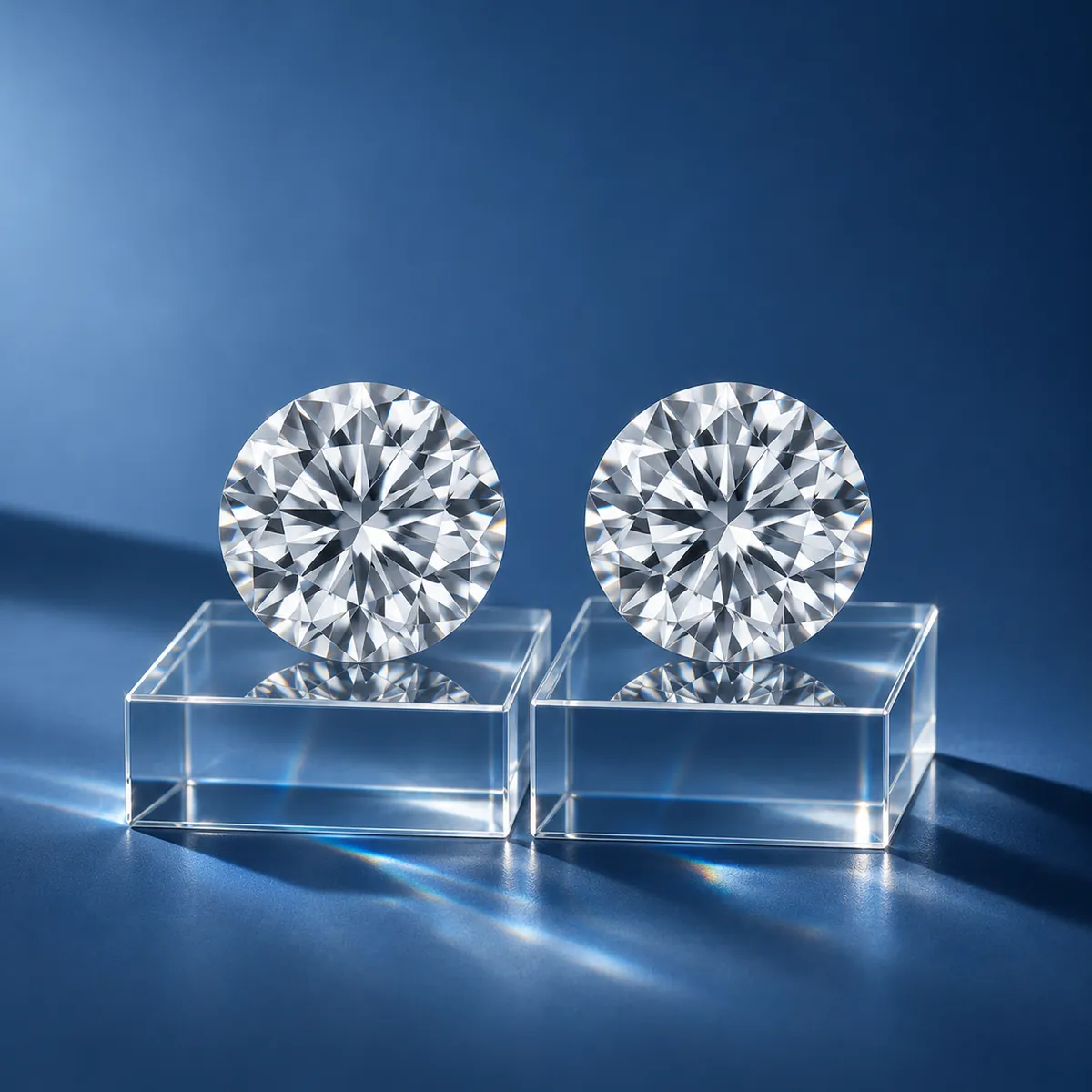
Hand a jeweler two 1.50 ct round diamonds, both F color, VS1, Excellent cut, one grown in a reactor a few months ago and one formed in the earth more than a billion years ago. With a loupe and years of experience, the jeweler still cannot say which is which; that takes laboratory instruments. The price tags, though, are far apart, and so are their resale values. That is the lab-grown versus natural decision in one example: the stones are the same material, and almost everything that differs is outside the stone.
Lab-grown and natural diamonds are both carbon crystallized in the diamond structure, with the same hardness, brilliance and durability. They differ in origin, price, rarity, resale and how they must be described. Lab-grown usually costs much less for the same size and grades, so it suits buyers who want size, quality or design freedom for their budget. Natural suits buyers who value geological origin, rarity and a resale market. Neither is better in daily wear. Decide which of those differences you care about, then compare individual stones by cut, measurements and a report you have looked up. For the full side-by-side comparison, see lab-grown vs natural diamonds.
What is the same and what is different
The same material, by definition
The US FTC Jewelry Guides define a diamond as “a mineral consisting essentially of pure carbon crystallized in the isometric system”. A lab-grown diamond meets that definition. What has to be disclosed is the origin: the word diamond, used for a lab-grown stone, must be qualified straight away with “laboratory-grown”, “laboratory-created”, “[manufacturer name]-created” or a term of the same meaning. The Guides also warn against describing artificially produced stones as “real”, “genuine” or “natural”. The accurate short form is: a lab-grown diamond is a diamond, and it is lab-grown.
Appearance
There is no visible difference by origin. What you can see is quality: cut, color, clarity, shape and size. Two stones of the same origin can look very different, and two of different origins can look identical. Laboratories identify origin with spectroscopy, imaging under deep ultraviolet light and other instruments that reveal growth patterns and trace elements. Lab-grown stones have their own tell-tale features under magnification, such as metallic flux inclusions in some HPHT stones and graphitic pinpoints in some CVD stones, but these are for gemologists, not buyers. See do lab-grown diamonds look different?.
Price
Natural diamond prices reflect geological scarcity, mining, sorting and a long distribution chain. Lab-grown prices reflect production cost, which has fallen as HPHT and CVD capacity has grown, plus cutting, grading and distribution. The fall has been steep: Edahn Golan’s wholesale data, reported by JCK in July 2026, showed lab-grown wholesale prices down 26% across 2025 and 13% year on year in the second quarter of 2026, with some signs of stabilizing. The gap between the two is widest in larger, higher-grade stones. See why lab-grown diamonds cost less.
Resale and long-term value
Most diamonds resell well below their retail price. Natural diamonds have an established secondary market. Lab-grown resale value is limited, and falling production costs push the price of new stones down over time. Buy a lab-grown diamond to wear, not as an investment. See resale value.
What a report tells you, and what it does not
Swipe the table to see more →
| Report field | What it tells you |
|---|---|
| Origin statement | Lab-grown or natural |
| Report number and inscription | The link between the stone and the paper |
| Shape, measurements, carat | Identity and face-up size |
| Color, clarity, cut | Quality; GIA gives lab-grown stones Premium or Standard instead of letter grades since October 2025 |
| Comments (lab-grown) | Often the growth method (HPHT or CVD) and the treatment finding |
Treatment after growth is common in lab-grown stones: GIA has reported that about 80% of the CVD diamonds it received since 2020 had been HPHT-treated to improve color. That is legitimate when disclosed. On IGI reports an untreated stone carries the comment “As Grown – No indication of post-growth treatment”. A report that says nothing about treatment is not proof that a stone is untreated.
A report does not tell you whether the price is fair, how the stone looks in motion, or anything about environmental or ethical claims. See how to read a report.
Sustainability and ethics claims
Both sides make broad claims, and both deserve a closer look. Lab-grown production uses a lot of electricity, and its footprint depends on the energy source and the process. Mining footprints vary by mine and region. In the US, the FTC Green Guides warn that broad, unqualified claims such as “eco-friendly” are hard to substantiate. In the EU, Directive 2024/825 has applied since September 27, 2026: generic environmental claims, climate claims based on offsets, and self-made sustainability labels are no longer allowed. Specific statements are what count: the energy source, a third-party certification, chain-of-custody records. See are lab-grown diamonds more sustainable?.
Choose by priority
Which fits you?
Which is usual in which jewelry
Swipe the table to see more →
| Jewelry | Common choice | Why |
|---|---|---|
| Engagement center stone | Either | Personal priorities |
| Studs | Often lab-grown | Larger matched pairs for the budget |
| Tennis bracelets, eternity bands | Often lab-grown | Many matched stones |
| Heirloom or value-minded purchase | Often natural | Origin and an established market |
| Fashion jewelry | Often lab-grown | Price points |
A piece can combine a lab-grown center with natural side stones, or the reverse. Each type must be named on the invoice and in the description; a mixed piece cannot simply be called “diamond”.
A decision checklist
For retailers and brands
More retailers now carry both. Keep the origin clear on every tag, listing and invoice, train staff on the qualifier rule, keep lab-grown and natural stock physically and administratively separate, and keep each report with its stone. In the EU, review any environmental wording on lab-grown lines against the 2026 rules. For lab-grown supply, see bulk loose stones.
Related guides
- What are lab-grown diamonds?
- Are lab-grown diamonds real diamonds?
- Lab-grown diamonds vs simulants
- Lab-grown vs natural for engagement rings
Lab-grown vs natural questions
Are lab-grown diamonds the same as natural diamonds?
The same material and properties; a different origin, price and resale value.
Can a jeweler tell them apart?
Not by eye or with a loupe. A laboratory with specialized instruments can.
Which holds its value better?
Natural diamonds, though most diamonds resell below retail.
Can I insure a lab-grown diamond?
Yes. Keep the report and invoice, and insure the finished piece at its replacement value.
Compare lab-grown stones for your purchase
Send the shape, size and grades you are comparing, and we will suggest lab-grown stones to set against them. NUVU can arrange IGI, GIA or NGTC reports and, on request, provide proof that stones have had no post-growth treatment. Send your requirements or message us on WhatsApp / WeChat at +86 19118403930.
Sources
- FTC Jewelry Guides (16 CFR Part 23)
- FTC Green Guides (16 CFR Part 260)
- Baker McKenzie: EU green claims rules apply from 27 September 2026
- GIA Gems & Gemology: Laboratory-grown diamonds, an update on identification (2024)
- GIA: Updated laboratory-grown diamond services (Aug 2025)
- JCK: Lab-grown diamond prices show signs of stabilizing (July 2026)
More guides on this topic

7+ years researching color tuning, inclusions and defect characterization of lab-grown diamonds.
About NUVU. NUVU is the international brand of New Perspective Superhard Materials Co., Ltd. in Zhecheng, Henan, China. We grow HPHT lab-grown diamonds in-house and cut, polish and match stones in our own workshop.
Related Guides
Lab vs natural comparison
Lab-grown vs natural diamonds compared on six points: what they are, how they look, price, resale, how to tell them…
Read more →EducationLab-grown diamond education
Every NUVU lab-grown diamond guide in one place: 4Cs, certificates, HPHT vs CVD, prices, shapes, engagement rings…
Read more →EducationCertification knowledge
IGI, GIA and NGTC lab-grown diamond reports explained: what each lab grades, GIA’s 2025 Premium/Standard change, ‘As…
Read more →