- Shop
Diamonds & Jewelry
Loose Lab Diamonds Yellow Lab Diamonds Pink Lab Diamonds Blue Lab Diamonds Engagement Rings Fine Jewelry Shop All Loose lab-grown diamonds10 shapes · IGI, GIA or NGTC reports
- Wholesale
- Custom Design
- Education
- About
Are Lab-Grown Diamonds Real Diamonds? The Clear Difference Between Real, Natural, and Fake
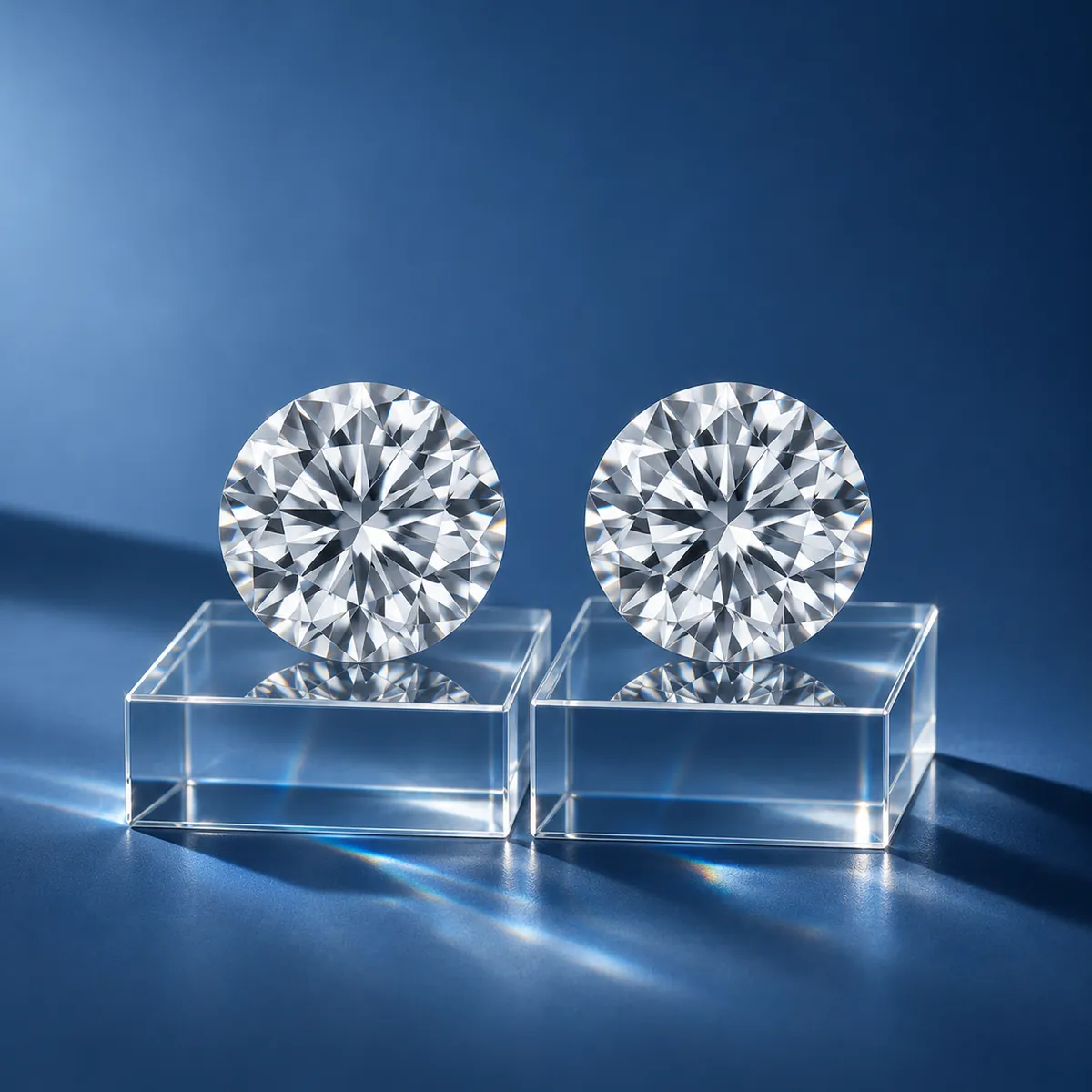
Two listings sit side by side. One says “Real diamond ring, lab-made, 1 ct”. The other says “1.00 ct laboratory-grown diamond ring, IGI LG report”. Both may describe the same stone. Only the second describes it in a way US rules accept, and only the second tells the buyer something they can check.
A lab-grown diamond is diamond. It is carbon crystallized in the same structure as a mined diamond, with the same hardness of 10 and the same refractive index of 2.42. It is not an imitation. What it is not is natural, and that is why the word “real” causes trouble: the FTC Jewelry Guides say artificially produced stones should not be called “real”, “genuine”, “natural” or “precious”. The accurate answer is two words long: diamond, lab-grown.
Four words, four meanings
The “fake diamonds” people worry about are simulants. A lab-grown diamond and a simulant can both be cheap compared with a mined diamond, but only one of them is diamond.
What the FTC Jewelry Guides say
The US Guides (16 CFR Part 23) were revised in 2018. Four sections answer this question:
Swipe the table to see more →
| Section | What it says | What it means for a lab-grown stone |
|---|---|---|
| 23.12(a) | A diamond is “a mineral consisting essentially of pure carbon crystallized in the isometric system”, hardness 10, refractive index 2.42 | It is a diamond |
| 23.12(b) | The unqualified word “diamond” may not be used for anything that does not meet the definition | Moissanite and CZ may not be called diamond |
| 23.12(c)(3) | “Cultured” may be used only with a clear disclosure, such as “laboratory-created”, that the stone was not mined | “Cultured diamond” on its own is not enough |
| 23.27 | “Real”, “genuine”, “natural”, “precious” and similar words may not be used for artificially produced products | “Real lab diamond” is out |
The same Guides require the word diamond, when used for a lab-grown stone, to be qualified straight away with “laboratory-grown”, “laboratory-created”, “[manufacturer name]-created” or a term of the same meaning.
Wording you will see
Swipe the table to see more →
| Wording | What it means | Acceptable in the US? |
|---|---|---|
| “Lab-grown diamond”, “laboratory-grown diamond” | Diamond grown in a lab | Yes |
| “Laboratory-created diamond”, “[Brand]-created diamond” | The same | Yes |
| “Cultured diamond, laboratory-created” | The same | Yes, with the qualifier |
| “Real diamond” or “genuine diamond” for a lab-grown stone | Suggests natural | No |
| “Diamond” alone for a lab-grown stone | Hides the origin | No |
| “Moissanite”, “cubic zirconia”, “simulated diamond” | Not diamond | Yes, for simulants |
| “Lab diamond” for a moissanite | Not diamond | No |
What is the same
Swipe the table to see more →
| Property | Lab-grown | Mined |
|---|---|---|
| Material | Carbon | Carbon |
| Crystal structure | Cubic | Cubic |
| Mohs hardness | 10 | 10 |
| Refractive index | 2.42 | 2.42 |
| Specific gravity | About 3.52 | About 3.52 |
| Thermal tester | Reads diamond | Reads diamond |
| Color and clarity scales | IGI and NGTC: D–Z, FL–I; GIA: Premium or Standard | GIA, IGI and others: D–Z, FL–I |
What is different
- How it formed. Days to weeks in a press or reactor, against geological time underground.
- Growth features. HPHT stones can contain metallic flux inclusions; CVD stones can contain dark graphitic pinpoints. Laboratories also look at growth patterns under deep ultraviolet light and at spectroscopy. None of this is visible to the eye.
- Treatment. GIA found that about 80% of the CVD stones it received since 2020 had been HPHT-treated after growth to improve color. Mined diamonds can be treated too; in both cases it must be disclosed.
- Price, rarity and resale. See the price comparison.
Why some people still say “fake”
“Lab-made” sounds like “imitation”, and for decades the lab-made stones in jewelry shops were imitations: cubic zirconia from the late 1970s, moissanite from the late 1990s. A lab-grown diamond is a different case. The confusion is about where it came from, not what it is made of.
How a laboratory settles it
A grading report from IGI, GIA, NGTC or another laboratory states whether the stone is laboratory-grown or natural, and the girdle is usually laser-inscribed with the report number. GIA adds the words “Laboratory-Grown” to the inscription.
An inscription is only as good as the check behind it. In 2021 GIA found a 3.07 ct CVD stone, HPHT-treated after growth, whose girdle carried the report number of a natural G IF diamond that GIA had graded in 2018. The stone had even been cut to almost the same measurements. Only laboratory testing caught it. So:
- Look the report number up on the laboratory’s own website.
- Compare the measurements and weight on the record with the stone.
- Check that the inscription matches.
- Make sure the invoice describes the stone the same way as the report.
- If a seller says only “diamond” and does not state the origin, ask.
See how to read a report.
Real-diamond questions
Is a lab-grown diamond a real diamond?
It is diamond, the same material as a mined one. It is sold as a lab-grown diamond, not as a “real” or “natural” diamond.
Is a lab-grown diamond fake?
No. The imitations are simulants such as moissanite and cubic zirconia.
Can a diamond tester tell lab-grown from mined?
No. A thermal tester reads both as diamond. Origin needs laboratory instruments.
Is it a natural diamond?
No. “Natural” means formed in the earth.
Buy lab-grown stones described the right way
Ask for the report number before you decide, and check that the report, inscription and invoice all say laboratory-grown. NUVU can arrange IGI, GIA or NGTC reports and can provide proof of no post-growth treatment on request. Send your requirements or message us on WhatsApp / WeChat at +86 19118403930.
Sources

12+ years in lab-grown diamond grading, identification and quality assurance for both HPHT and CVD stones.
About NUVU. NUVU is the international brand of New Perspective Superhard Materials Co., Ltd. in Zhecheng, Henan, China. We grow HPHT lab-grown diamonds in-house and cut, polish and match stones in our own workshop.
Related Guides
What are lab-grown diamonds?
What lab-grown diamonds are, how HPHT and CVD grow them, how they differ from natural diamonds and moissanite, how…
Read more →Lab-grown vs naturalLab-grown vs simulants
Lab-grown diamond vs moissanite vs cubic zirconia: material, hardness, fire, how they age, how testers read them…
Read more →EducationLab vs natural comparison
Lab-grown vs natural diamonds compared on six points: what they are, how they look, price, resale, how to tell them…
Read more →