- Shop
Diamonds & Jewelry
Loose Lab Diamonds Yellow Lab Diamonds Pink Lab Diamonds Blue Lab Diamonds Engagement Rings Fine Jewelry Shop All Loose lab-grown diamonds10 shapes · IGI, GIA or NGTC reports
- Wholesale
- Custom Design
- Education
- About
Lab-Grown vs Natural Diamond Price Comparison: Why Lab Diamonds Usually Cost Less
- Why the prices differ
- Scale and competition
- Cheaper does not mean fake
- Where the gap is widest
- What the gap means for a budget
- Weight thresholds
- The cost layers in a lab-grown diamond
- Why two similar lab-grown stones cost different amounts
- Resale
- For retailers and brands
- Price questions
- Get a quote you can compare
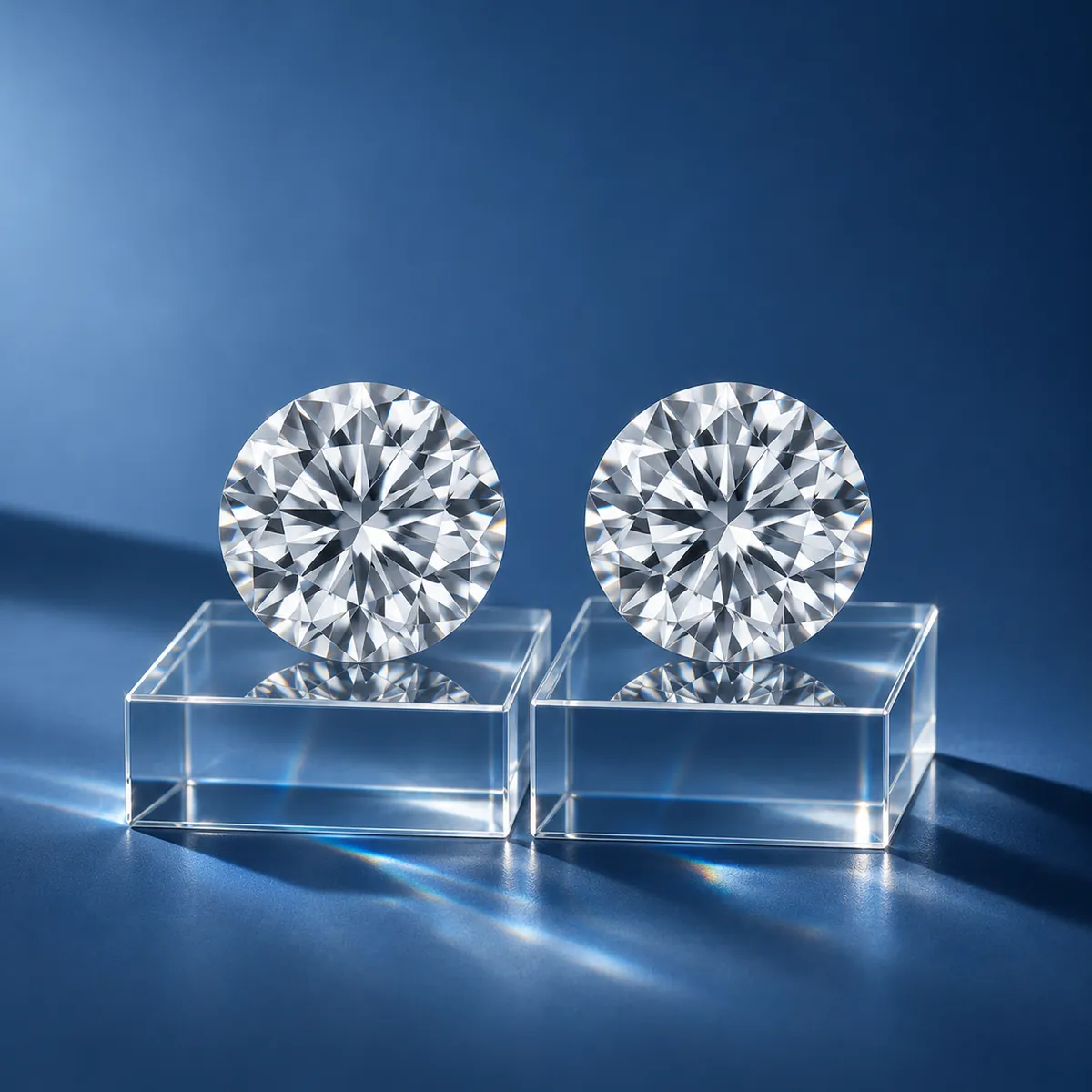
A buyer prices two 1.50 ct oval stones, both F color and VS1 clarity. The mined one costs many times more than the lab-grown one. Ask again a year later and the lab-grown price has very likely moved more than the mined one, and probably down: lab-grown wholesale prices fell 26% across 2025, according to the Edahn Golan data JCK reported in July 2026.
The two prices come from different places. A mined diamond’s price rests on a supply that geology limits. A lab-grown diamond’s price rests on production that can be added when demand grows, and as presses, reactors and sellers multiplied, prices fell. A lower price says nothing about the material, which is diamond either way. It does say something about resale.
Why the prices differ
Scale and competition
HPHT presses and CVD reactors can be added as demand grows. China produces almost half of the world’s lab-grown diamonds, mostly by HPHT, according to an IDEX report from 2025. More capacity and more sellers push prices down, and buyers can compare similar stones online in minutes.
The JCK report also shows where prices stood in mid-2026: in the second quarter, 1.50–1.99 ct stones were down 11% year on year and 2 ct stones down 20%, while 1 ct rounds rose 1% on the quarter. Some Chinese producers had raised rough prices by at least 30%. Prices are still moving, but not only downward.
Cheaper does not mean fake
The price reflects supply, not the material. A lab-grown diamond is diamond, with the same hardness and refractive index as a mined one. Rarity and price are separate questions from what the stone is made of. See are lab-grown diamonds real diamonds?
Where the gap is widest
For a dated reference point, StoneAlgo’s index of online asking prices put the average loose 1 ct lab-grown diamond at $516 and the average natural 1 ct at $3,864 on 29 October 2026, so the lab-grown stone cost about 13% as much. For rounds the share was about 11% ($517 against $4,670). The gap usually grows with size and quality. Small, lower-grade stones differ less in money terms; large stones with high color and clarity differ most. That is why many buyers use lab-grown to move up in size or grade rather than only to spend less.
What the gap means for a budget
Which fits you?
Weight thresholds
Price per carat rises with size and jumps at round weights. GIA names 0.50, 0.75 and 1.00 ct as “magic sizes” where prices step up. A 0.95 ct stone looks almost the same as a 1.00 ct and usually costs noticeably less, whatever its origin. See the lab-grown diamond price guide.
The cost layers in a lab-grown diamond
Swipe the table to see more →
| Layer | What drives it |
|---|---|
| Growth | Equipment, electricity, seeds, labor, yield |
| Treatment after growth, if any | Annealing time and equipment |
| Cutting and polishing | Labor, and how much of the rough is kept |
| Grading | The laboratory fee and shipping to the lab |
| Distribution | Wholesale, retail, marketing, margin |
The stone’s share of the price falls as it moves down the chain. In finished jewelry, metal, labor and retail costs make up a large part.
Why two similar lab-grown stones cost different amounts
Cut quality, the exact measurements, fluorescence, the grading laboratory, the growth method, whether the stone was treated, and the seller’s own costs all move the price. Two retailers can also price the same stone very differently because of brand, service, warranty, returns and margin. Compare stones by their verified reports, measurements and video, and ask what each price includes.
Resale
Because new lab-grown stones are plentiful and their prices have fallen, a used one competes with cheaper new stock. Its resale value is limited. Mined diamonds resell better, but usually well below retail. See resale value.
For retailers and brands
Falling wholesale prices reduce the value of stock on the shelf. Buy closer to demand, keep stock moving, and price finished jewelry on design and service rather than on stone cost alone. Quotes age quickly in a moving market, so note how long each one is valid. See the wholesale program.
Price questions
Why are lab-grown diamonds so much cheaper?
Production can grow with demand, and competition among producers and sellers has pushed prices down.
Will lab-grown prices keep falling?
They fell 26% in 2025. By mid-2026 there were signs of stabilizing and some rough prices rose. Future prices depend on production and demand and cannot be predicted.
Are cheaper lab-grown diamonds lower quality?
Not necessarily. Price follows the specifications and the market. Check the report and a video of the stone.
Is a mined diamond a better investment?
It holds value better than lab-grown, but most diamonds are not good investments.
Get a quote you can compare
Send the shape, carat range, color and clarity you want, the quantity, and any report you need. Ask for the report number with each stone so you can compare offers like for like. NUVU quotes at current market prices and can arrange IGI, GIA or NGTC reports. Send your requirements or message us on WhatsApp / WeChat at +86 19118403930.
Sources
- JCK: Lab-grown diamond prices show signs of stabilizing (Jul 2026)
- IDEX Online: lab-grown market report (Sep 2025)
- GIA 4Cs: Ways to save money on a diamond
- FTC Jewelry Guides (16 CFR Part 23)
- StoneAlgo: 1 carat lab-grown diamond prices (read 29 Oct 2026)
- StoneAlgo: 1 carat natural diamond prices (read 29 Oct 2026)

11+ years supporting global clients with lab-grown diamond product consultation and market analysis.
About NUVU. NUVU is the international brand of New Perspective Superhard Materials Co., Ltd. in Zhecheng, Henan, China. We grow HPHT lab-grown diamonds in-house and cut, polish and match stones in our own workshop.
Related Guides
Lab-grown vs natural guide
Lab-grown vs natural diamonds compared: what is the same, what differs (origin, price, resale, rarity, reports…
Read more →PriceDo lab-grown diamonds hold value?
Do lab-grown diamonds hold value?
Read more →WholesaleBulk loose stones
Bulk loose lab-grown diamonds: center stones, matched pairs, calibrated melee and parcels.
Read more →