
A diamond purchase is not the same as a resale plan. This article explains why the money you pay at retail, the value shown on an appraisal, and the cash you may get later are often very different. In the context of lab-grown vs natural diamond budgets, natural diamonds usually have broader recognition and stronger resale liquidity, while lab-grown diamonds often lose value faster because comparable new stones are easy to source and pricing can move quickly. Neither option should be treated as a guaranteed investment.
For the full framework, read Lab-Grown Diamond Price Guide.
One important limitation is that a grading report or appraisal does not create resale demand by itself. Future buyers still look at current replacement prices, visible condition, measurements, and whether the stone is easy to verify in the channel they use.
The useful question is not which diamond holds value perfectly, but which choice fits your budget, buying priorities, and future flexibility. This guide helps you judge how resale works in real life, what paperwork actually matters, how shape and cut can affect buyer interest, and when trade-in or buyback terms deserve close attention before you commit.
Evidence note: Because resale pricing changes by channel, timing, stone characteristics, and buyer demand, this article avoids quoting fixed resale percentages or exact future values. Any seller who gives a precise resale forecast should be able to explain the basis for that number, whether it is a current written buyback policy, a documented trade-in formula, or a real offer from a buyer. Without that support, resale claims should be treated as estimates, not guarantees.
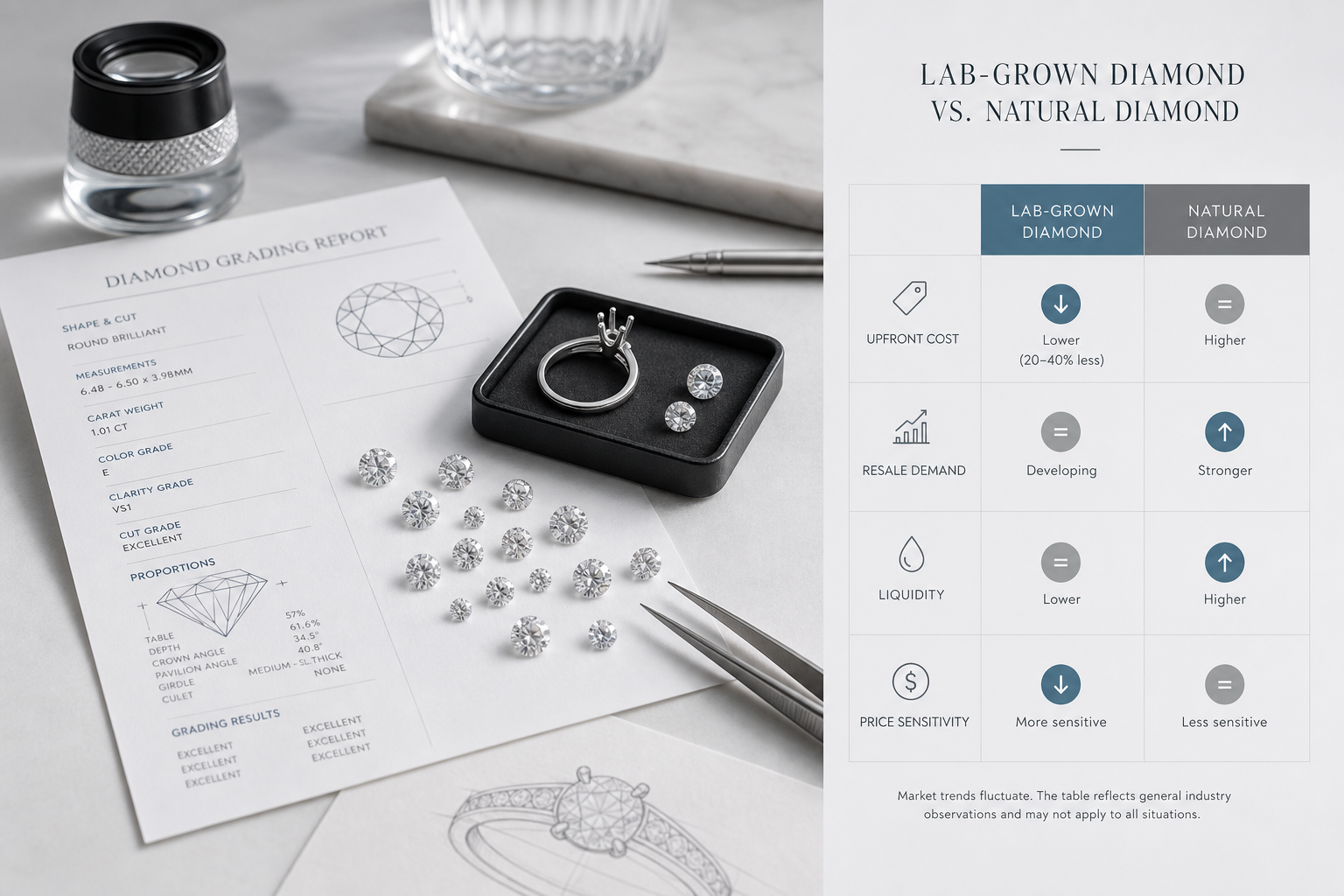
| Decision Factor | Natural Diamond | Lab-Grown Diamond |
|---|---|---|
| Resale liquidity | Usually stronger and easier to place | Usually narrower buyer demand |
| Cash value vs retail | Still often well below retail | Often drops more sharply from retail |
| Best fit | Buyers who want more future flexibility | Buyers who want more size for the budget |
| Important paperwork | Grading report, receipt, condition, policies | Grading report, receipt, condition, policies |
| Terms to verify | Trade-in or buyback terms in writing | Trade-in or buyback terms in writing |
| Common mistake | Assuming appraisal equals cash resale | Assuming lower price means better resale |
Quick Questions Before You Read
Q: Does an appraisal show what I can resell for?
No. Appraisals usually reflect replacement value, not actual cash resale value.
Q: Which diamond type is easier to resell?
Natural diamonds usually have better liquidity because more buyers recognize them.
Q: Are lab-grown diamonds a poor choice if I may sell later?
Not necessarily, but they usually carry a bigger resale discount than natural stones.
Q: What should I check before buying?
Look for a grading report, strong documentation, and any written trade-in or buyback terms.
What Buyers Should Verify Before Treating Resale Claims as Reliable
Resale language can sound persuasive because it is tied to practical concerns, but buyers should separate documented facts from projected outcomes. A grading report can help identify the stone, yet it does not create a resale offer, a future buyer pool, or a guaranteed exit price.
For lab-grown diamonds, the report should clearly state laboratory-grown origin so the stone is not confused with a mined diamond later. For natural diamonds, the report and seller description should match the stone’s measurements and any notable features. In both cases, current condition, visible wear, and matching paperwork matter more than broad claims about future value.
When growth method, post-growth processing, or any treatment is relevant, it should be disclosed in the documentation buyers receive. If a seller is making environmental, ethical, or sourcing statements, ask what specific facts support those statements rather than accepting general language at face value.
- Ask for the full grading report or report number before purchase.
- Check whether the listing identifies the stone as lab-grown or natural.
- Confirm whether any trade-in or buyback term is written, dated, and applicable to the exact item.
- Compare the stone against current new listings with similar specifications.
Start With the Real Answer: Most Diamonds Are Not Strong Resale Investments
Most diamonds resell for less than their original retail purchase price. That is true for both lab-grown and natural diamonds, even though the reasons are different. Natural diamond resale value is generally stronger because the category has a more established secondary market, but most consumer sellers still should not expect to recover what they paid at retail. Lab-grown diamond resale value is usually weaker because new supply is more scalable, current retail prices can shift quickly, and secondhand demand is more limited.
This does not mean diamonds have no value. It means diamond resale value is not the same as retail price, appraisal value, or emotional value. A diamond can be beautiful, meaningful, and worth buying while still being a poor financial asset. The mistake is treating a jewelry purchase like a liquid investment when the resale path is usually slower, narrower, and more discounted than buyers expect.
Condition and presentation can influence resale, but they do not override the basic market gap. A polished report, a clean setting, and a complete receipt help a buyer trust the stone, yet the final offer still depends on what similar diamonds are selling for now.
The Short Version Buyers Need Before Comparing Stones
If your main question is whether natural diamonds are better for resale, the practical answer is usually yes, but with a major caveat. Natural diamonds tend to have better recognition among jewelers, dealers, and private buyers, which can improve liquidity. Better liquidity does not mean strong profit potential, and it does not mean you will resell near the amount you paid in a jewelry store.
Lab-grown diamonds often face steeper resale discounts because the buyer has more alternatives. A secondhand buyer can compare your stone against newly produced lab-grown diamonds with current grading reports, return options, and fresh retail protections. That makes used lab-grown diamonds harder to price attractively unless the discount is meaningful.
The more useful question is not simply “Do lab-grown diamonds have resale value?” They can. The better question is whether resale recovery should drive the purchase. If you are buying an engagement ring for daily wear, visual size, and budget efficiency, a lab-grown diamond may still be a rational choice even with weaker resale expectations. If future resale is a serious priority, a natural diamond may offer broader resale recognition, but it still should not be bought with the assumption of investment-like performance.
Why Retail Price and Resale Price Are Different Numbers
The price you pay at retail includes more than the diamond itself. It can include sourcing, grading, setting work, merchandising, labor, overhead, customer service, payment processing, return risk, and seller margin. Those costs are part of a normal jewelry transaction, but a secondhand buyer does not usually reimburse them when you sell.
A dealer, pawn shop, jeweler, online buyer, private marketplace shopper, or trade-in program looks at the stone from a different position. They are not asking what you paid. They are asking what they can safely resell it for, how much verification is needed, how quickly it may move, and how much margin or risk protection they need. That difference is why resale price can feel surprisingly low compared with the original receipt.
Trade-in value can also be misunderstood. A store credit may be more favorable than a cash offer, but it is usually tied to that seller’s policy and future purchase terms. Cash liquidity is harder. If you need money quickly, you may have to accept a lower offer than if you are willing to wait for a private buyer or consignment opportunity.
The Practical Takeaway for Engagement Ring Buyers
An engagement ring should usually be judged first by whether it fits the wearer, the design, the budget, and the life it will be part of. Wearability, beauty, documentation, setting quality, and personal meaning matter more in everyday use than a hypothetical resale price years later.
Resale should still be considered, especially if the purchase stretches your budget. The warning sign is not choosing lab-grown or natural. The warning sign is needing the diamond to perform financially in order for the purchase to feel safe. If future resale is required to justify the spend, the cleaner decision may be to reduce the budget rather than depend on a market that may not be favorable when you sell.
For custom or made-to-order jewelry, resale expectations should be separated from design satisfaction. A stone that is well matched to the setting, finger size, prong style, daily wear pattern, and wearer’s taste may deliver strong personal value even if the finished design is less liquid later. Trust comes from confirming measurements and setting compatibility before finalizing the diamond, not from choosing a grade in isolation.
What to Check Before You Decide
If resale recovery is a top priority, compare natural diamonds carefully, prioritize respected grading documentation, and ask sellers whether any upgrade, buyback, or trade-in policy exists in writing. Do not rely on verbal assurances. Confirm whether the policy applies to the exact diamond type you are buying, whether it pays cash or store credit, and whether future conditions or minimum spend requirements apply.
If visual size, design flexibility, lower upfront cost, and personal enjoyment matter more, a lab-grown diamond may still be the better fit. The tradeoff is clear: you may receive more diamond appearance for the money today, while accepting that the secondary market may be thinner later. That is not a bad purchase if you understand where the value is coming from.
How Lab-Grown and Natural Diamond Resale Value Typically Compare
Lab-grown vs natural diamond resale value is best understood as a difference in liquidity, not a guarantee of outcome. Natural diamonds generally have more established resale channels and broader buyer familiarity. Lab-grown diamonds usually have lower upfront prices but face more pressure in the secondary market because replacement options are easier to find.
The common mistake is asking which diamond holds value better as if the answer automatically identifies the smarter purchase. Natural diamond resale may be stronger in relative terms, but the buyer still has to consider how much was paid upfront, how long they plan to keep the ring, and whether they have a realistic resale channel. Lab diamond resale is often weaker, but the lower initial spend can change the financial comparison.
Natural Diamonds: Better Recognition, Still Discounted on Resale
Natural diamonds benefit from an older and more familiar resale ecosystem. Jewelers, dealers, estate buyers, auction channels, and private buyers generally understand how to evaluate them, especially when the stone has a reliable grading report and a marketable combination of size, shape, color, clarity, and cut quality. That recognition can make a natural diamond easier to place than a comparable lab-grown diamond.
The limitation is that consumer sellers usually enter the market from a weak position. A professional buyer is likely to think in wholesale terms, not retail replacement terms. They need room for verification, cleaning, resetting, inventory holding time, market shifts, and resale margin. Even when natural diamond value retention is better, the offer can still be materially below the original jewelry store price.
It also helps to separate the center stone from the setting. A natural diamond in a highly personal or heavily customized ring may be harder to resell as a finished piece than as a loose stone, because the next buyer may value the design differently. That does not reduce the diamond’s quality; it simply means design taste may not travel as well as the stone itself.
Lab-Grown Diamonds: Lower Upfront Cost, Weaker Secondary Demand
Lab-grown diamonds are real diamonds chemically and visually, but their resale market behaves differently. The issue is not whether the stone is genuine. The issue is whether a secondhand buyer has a strong reason to choose a used lab-grown diamond when new stones are widely available with current grading documentation, retail return terms, and setting options.
Because lab-grown diamond supply can scale and retail prices have become more competitive over time, used lab-grown stones often need a larger discount to attract interest. This is especially relevant for standard sizes and popular specifications where buyers can easily compare new alternatives. A seller may find that the diamond still has value, but the pool of willing buyers is smaller and more price-sensitive.
Within the lab-grown category, resale is not identical for every stone. Better cut, cleaner documentation, and more marketable shapes can make a used diamond easier to discuss, but they usually improve the conversation more than they change the underlying price pressure from new supply.
For lab-grown diamonds, traceability is most useful when it clarifies what the stone is and how it was represented at purchase. Buyers should look for documentation that clearly identifies laboratory-grown origin, report number, measurements, growth-related comments if listed, and any laser inscription information if present. These details do not create resale demand by themselves, but they make it easier for a future buyer to compare the stone against current alternatives without relying on vague descriptions.
Why “Holds Value Better” Does Not Mean “Good Investment”
Natural diamonds may hold value better than lab-grown diamonds in many resale situations, but that is not the same as being a good investment. A true investment is usually evaluated by liquidity, transaction costs, transparent market pricing, and the ability to sell without a large spread between buying and selling price. Most consumer diamonds do not meet that standard.
The more accurate framing is this: natural diamonds may be more resale-friendly, while lab-grown diamonds may be more upfront-cost-efficient. Those are different advantages. A resale-minded buyer may reasonably lean natural, but a buyer who wants the most visual impact for a fixed budget and has no plan to sell may still prefer lab-grown. The wrong move is buying either one based on imagined future appreciation.
Buyer Verification Checklist
Before buying with resale in mind, verify the grading report, carat weight, color, clarity, cut information, measurements, and any notes that may affect desirability. Confirm whether the diamond is natural or laboratory-grown on the report, and make sure the report number matches the stone being sold.
When a grading report is available, buyers should verify the report details through the issuing laboratory’s official report-check tool where available, then compare those details with the stone’s visual evidence and seller documentation.
Ask the seller whether any upgrade, buyback, or trade-in policy exists, and get the terms in writing before purchase. These policies are not universal, and they can vary by diamond type, minimum purchase amount, condition, documentation, and whether the value is offered as cash or store credit. A policy can improve your future options, but it should not be treated as a guaranteed resale outcome.
Proof Points Worth Keeping With the Diamond
For resale purposes, the most useful evidence is practical and transaction-specific: the grading report, purchase receipt, any laser inscription information if present, written trade-in or buyback terms, photos or videos from the original purchase, service records, and documentation for the setting. These materials do not prove that a future buyer will pay a certain amount, but they reduce avoidable doubt about what is being sold.
A simple traceability file can be more valuable than scattered paperwork. Keep the report copy, invoice, seller description, stone images, setting specifications, resizing or repair notes, and any written policy terms together. If the diamond is removed from a setting, reset, or transferred to another piece, note the date and keep updated photos. This creates a clearer chain of information for a future buyer, even though it does not guarantee a particular resale outcome.
Buyers should be cautious with vague resale statements such as “this will always be valuable,” “this appraises for more than you paid,” or “you can easily sell it later.” Those statements are not the same as a written policy or a real secondary-market offer. If resale is part of the decision, ask what evidence supports the claim and whether the seller will put the terms in writing.
Why Lab-Grown Diamonds Usually Have Lower Resale Liquidity
Lab-grown diamond resale value is usually limited by liquidity. The diamond may be real, attractive, and well documented, but selling it later depends on whether there are enough buyers willing to pay a meaningful secondhand price. In many cases, the problem is not value in the abstract. It is the difficulty of converting that value into cash at a strong price.
Lab diamond liquidity is affected by production scale, price compression, retail price decline, and replacement cost. If a buyer can purchase a comparable new lab-grown diamond at a competitive price, the used stone has to offer a clear reason to choose it. That reason is usually price.
Scalable Supply Changes the Resale Equation
Natural diamonds are limited by geological supply and mining economics. Lab-grown diamonds are different because production can expand with technology, capacity, and market demand. This does not make every lab-grown diamond identical, but it does change how buyers think about scarcity and replacement.
For resale, replacement cost matters more than what the original buyer paid. If a comparable new lab-grown diamond is available with updated documentation and retail protections, a secondhand buyer has little reason to pay close to the original purchase price. This is why lab-grown diamond resale is often less about the stone’s beauty and more about the current price of a similar new diamond.
New Retail Prices Influence Used Diamond Offers
Used diamond offers do not exist in isolation. They compete against current retail listings. If new lab-grown diamond prices become more accessible, a previously purchased stone may have to be priced below today’s comparable new-stone options to attract attention.
This is one of the least obvious risks for buyers. The resale challenge is not only that the stone is “used.” It is that the benchmark may have moved. A buyer who purchased a lab-grown diamond during a higher-price period may later be selling into a market where similar new stones cost less than expected. That can make resale offers feel low even when the diamond itself has not changed.
The Secondhand Buyer Has Less Incentive to Pay Close to Retail
A secondhand buyer will usually ask a practical question: why buy this used lab-grown diamond if a new one is available with current grading, return options, and the ability to choose the setting from the start? Unless the used diamond is priced attractively, the new option often feels safer.
This is especially true for engagement ring shoppers who want control over the full purchase. They may care about the exact shape, measurements, ratio, setting style, metal color, return window, and warranty terms. A secondhand loose stone or finished ring may require compromise. The larger the compromise, the larger the discount buyers tend to expect.
What This Means in a Real Purchase
Consider a buyer who chooses a 2.00 ct lab-grown diamond because it delivers the visual size they want without stretching the budget. For daily wear, that can be a sensible decision. The buyer receives the look, scale, and design flexibility they wanted at a lower upfront cost than many comparable natural diamond options.
Five years later, if they try to sell it, the market may look different. Comparable new lab-grown diamonds may be widely available at competitive prices, and secondhand buyers may be limited. The seller may still find interest, but likely only at a price that reflects the buyer’s alternatives. The original purchase was not necessarily wrong; the value came mainly from years of wear, personal enjoyment, and budget efficiency rather than resale recovery.
How to Read Origin, Sustainability, and Treatment Claims Without Overstating Them
Some listings mix origin, ethics, and environmental language into the same paragraph, but those are separate questions. A laboratory-grown diamond should be clearly identified as laboratory-grown, and it should not be presented as a mined diamond. A natural diamond should not be described as “better” in a universal sense simply because it is mined; the buyer still needs to consider pricing, documentation, and intended use.
Environmental and sustainability claims should be specific, documented, and limited to what can be substantiated. Production method, energy sourcing, manufacturing practices, and supply-chain transparency are the kinds of details that can support a narrower claim. Broad statements like “eco-friendly” or “ethical” are too general to function as resale evidence.
The same caution applies to grading and lab language. A grading report helps document key characteristics, but it should not be treated as a guarantee of beauty, value, or sourcing ethics. Buyers comparing lab grown diamond sustainability claims should read the report alongside photos, measurements, and seller documentation, especially when they are evaluating a finished ring rather than a loose stone.
For custom jewelry, stone measurements and setting compatibility should be confirmed before finalizing a purchase. A diamond that looks right on paper can still be a poor fit if the head size, band width, prong layout, or profile height is not matched to the intended design.
Why Natural Diamonds May Resell Better but Still Below Retail
Natural diamond resale value is usually stronger than lab-grown diamond resale value because natural diamonds have a longer-established secondary market, broader buyer recognition, and a supply story tied to geological rarity. That does not mean a consumer can buy a natural diamond at retail and expect to resell it close to the same price. The more realistic view is that natural diamonds may be easier to resell in some channels, but the resale price is still shaped by wholesale value, buyer margin, verification risk, and current market demand.
This distinction matters because many buyers ask, “Do natural diamonds hold value?” when the more useful question is, “How much can I resell a natural diamond for, through which channel, and how quickly?” A diamond can have real value and still be difficult to turn into cash at the number a seller has in mind.
Established Demand Helps, but It Does Not Remove the Retail Gap
Natural diamonds benefit from an older and more familiar resale ecosystem. Jewelers, dealers, estate buyers, auction specialists, consignment platforms, and private buyers all understand the category. That broader recognition can help a seller find a pathway to resale, especially for a well-documented stone with desirable size, shape, and quality.
The problem is that most consumers do not resell into the same market where they originally bought. They often sell into a professional buying environment where the buyer must leave room for grading verification, cleaning or resetting, market shifts, and resale margin. A jeweler or dealer is not usually comparing the stone to the original retail receipt. They are asking what they can reasonably resell it for after accounting for risk.
This is why “natural diamonds hold value better” can be true in a relative sense while still disappointing sellers who expect retail recovery. Natural diamonds may have better diamond value retention than lab-grown diamonds in many resale situations, but better retention is not the same as strong investment performance.
Appraisal Value Is Not the Same as Cash Resale Value
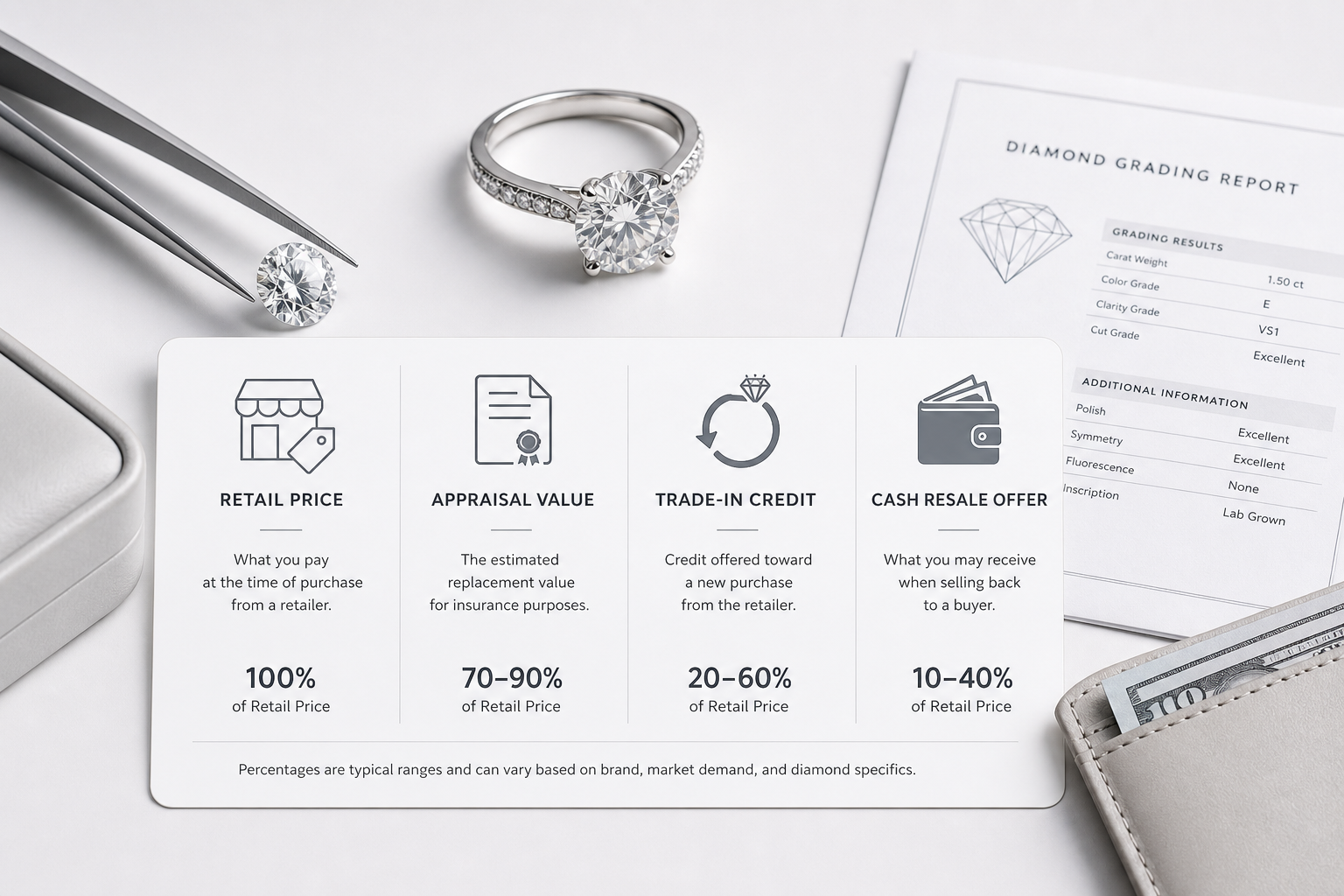
One of the most common resale mistakes is treating an appraisal value as a cash offer. Insurance appraisals often reflect retail replacement value, meaning the estimated cost to replace a similar item through a retail jewelry source. That number may be useful for insurance coverage, but it is not a promise that a dealer, pawn shop, private buyer, or consignment platform will pay that amount.
A buyer who paid $8,000 for a ring and received a $10,000 appraisal may assume the diamond has appreciated. In many cases, the appraisal is simply reflecting replacement pricing, not the amount the owner could receive if they needed to sell. For resale planning, cash value matters more than appraisal value because cash value reflects what someone is willing to pay now, not what it might cost to replace the item at retail.
This misunderstanding can lead buyers to overestimate natural diamond resale value before purchase. If resale recovery is important, the better move is to ask how the seller calculates trade-in value, whether any upgrade policy exists, and what documentation would be needed later. An appraisal alone should not be treated as an exit plan.
Stone Quality and Documentation Matter More at Resale
When a buyer tries to resell natural diamond jewelry, uncertainty lowers offers. A grading report from a reliable laboratory can make the stone easier to evaluate because it gives future buyers a common reference point for carat weight, color, clarity, measurements, and other identifying details. Documentation does not guarantee a high offer, but lack of documentation can make the process slower, more skeptical, and less competitive.
Quality combinations also matter. A natural diamond with a popular shape, strong cut quality, desirable color and clarity range, and a clean report is usually easier to discuss with buyers than a poorly cut stone with unclear details or visible damage. The market does not reward every grade equally. A larger carat weight can help, but not if the stone has obvious visual issues, weak proportions, or documentation that does not match buyer expectations.
Rare, collectible, unusually large, or exceptional natural diamonds can behave differently from typical engagement ring diamonds. Those stones may attract specialized buyers, but they are not the normal benchmark for most consumers. For the average engagement ring purchase, natural diamonds should be viewed as more resale-friendly than lab-grown diamonds in many cases, not as guaranteed investment assets.
Certificate and Visual Review Check
Buyers who may resell a natural diamond later should keep the original grading report, purchase receipt, setting details, warranty or service records, and any independent appraisal. The report number, measurements, inscription details if present, and stone description should remain easy to verify. If the diamond is reset, resized, repaired, or modified, keeping updated documentation can reduce confusion later.
Anyone selling should also expect the actual stone to be reviewed. Professional buyers will not rely only on paperwork if the diamond’s condition, measurements, or visual appearance raise questions. Chips, abrasions, heavy wear on the setting, loose prongs, or a mismatch between the report and the stone can affect confidence and reduce the offer.
The Numbers Buyers Should Understand Before Thinking About Resale
Diamond resale value is easier to understand when buyers separate the different numbers involved. The original retail price, current comparable new-stone price, appraisal value, trade-in value, and cash offer can all be different. Confusing them is one of the fastest ways to build unrealistic resale expectations.
Many consumer diamond resales happen materially below the original retail price. The exact diamond resale price depends on the stone, documentation, selling channel, current market conditions, and how quickly the seller wants money. A fast dealer offer may be convenient but lower. A private sale may produce a stronger number, but it can take weeks or months and requires more effort, trust-building, and negotiation. Consignment can sometimes improve the result, but it may take longer and usually includes fees or commission.
A Useful Resale Expectation Framework
A practical framework starts with the market today, not the receipt from years ago. The first comparison should be the current price of a similar new diamond with comparable grading, size, shape, and condition. If current new-stone prices are lower than what the buyer originally paid, the resale offer will usually reflect that reality. This is especially important when thinking about lab-grown diamond resale value, because new lab-grown diamond pricing has been more price-sensitive over time.
The second question is the selling channel. A dealer or jeweler may offer less because they are buying inventory, not making an emotional personal purchase. A private buyer may pay more if they trust the documentation and like the stone, but that buyer also has alternatives, including new diamonds with return policies and updated grading reports. A trade-in program may look stronger on paper, but it may only apply as store credit and may require a new purchase.
The third question is time. If a seller needs cash quickly, the liquidity discount is usually larger. If the seller can wait, compare offers, and present strong documentation, the outcome may improve. Speed and price usually move in opposite directions: faster selling often means accepting a lower offer, while a better price usually requires more time and uncertainty.
Retail Price, Trade-In Value, and Cash Offer Are Different
Retail price is what a consumer pays to buy the diamond or finished jewelry. It includes the stone, sourcing, grading, setting labor, design work, overhead, merchandising, customer service, and retail margin. It is not the same as the amount another buyer will pay when the item becomes secondhand.
Trade-in value is usually a store-specific credit. It may be useful if the buyer plans to upgrade with the same retailer, but it should not be treated like cash unless the policy explicitly says so. Some trade-in policies apply only to certain diamonds, certain purchase amounts, or certain future transactions. If resale flexibility matters, the terms should be written, dated, and understood before purchase.
A cash offer is the amount someone is willing to pay now. This is often the most conservative number because the buyer is taking on verification risk, resale risk, and market risk. A cash offer may be lower than trade-in credit because the buyer is not using the transaction to support another sale. For anyone asking how much value diamonds lose, the cash offer is usually the clearest reality check.
What Factors Can Move the Resale Offer Up or Down
Carat weight can influence resale interest, but size alone does not protect value. A poorly cut larger diamond may be less desirable than a smaller stone with better visual performance. Shape also matters because common shapes tend to have broader buyer pools, while niche cuts may need the right buyer to appear.
Cut quality, color, clarity, and condition affect confidence. A clean, well-proportioned diamond with a reliable grading report is easier to evaluate and price than a stone with uncertain details or visible damage. Brand recognition can help in some finished jewelry categories, but buyers should be careful not to assume a branded setting automatically recovers its original design cost.
The setting can add some resale value when it contains precious metal or additional stones, but custom settings often do not recover their full labor and design expense. Gold or platinum may have scrap or resale value, while the taste-specific parts of a design may be worth less to a secondhand buyer than they were to the original owner.
Practical Comparison Benchmarks
| Benchmark | What to Compare | Why It Matters |
|---|---|---|
| Original retail price | The amount paid for the diamond or finished jewelry | Useful for personal records, but not the strongest predictor of resale value |
| Current comparable new-stone price | Similar carat weight, shape, color, clarity, cut, grading report, and condition | Often more relevant than the original receipt because buyers compare against today’s alternatives |
| Likely buyer type | Dealer, jeweler, private buyer, consignment platform, or trade-in program | Different buyers price for different reasons; convenience usually costs money |
| Documentation strength | Grading report, receipt, appraisal, photos, service records, and matching report number | Strong documentation reduces uncertainty but does not guarantee a high offer |
| Setting resale contribution | Metal value, side stones, brand recognition, condition, and design flexibility | Precious metal may retain some value, while custom design labor often does not |
| Expected liquidity | How quickly the item can realistically sell | Dealer offers may be faster but lower; private sale or consignment may take weeks or months |
A useful diamond resale estimate should compare several of these benchmarks together. A single number from one source may reflect convenience, store credit, replacement cost, or negotiation strategy rather than the full market. The safest judgment is to treat resale as a range, not a fixed promise.
Which Diamond Features Matter Most if Resale Is a Concern
If resale is part of the buying decision, the most important diamond resale factors are the ones that make the stone easier for a future buyer to verify, compare, and want. Documentation usually matters first because it reduces uncertainty. After that, market preference, visual appeal, and condition play a larger role than many buyers expect.
The resale value of diamonds is not determined by one feature in isolation. A larger carat weight can help, but it can be offset by weak cut, unusual proportions, poor documentation, or a shape with limited demand. Buyers who care about diamond value retention should prioritize broad appeal and verifiability over trying to guess which trend will be popular years later.
Documentation and Grading Reports Reduce Uncertainty
A grading report helps future buyers understand what they are evaluating. It gives a common reference for carat weight, measurements, color, clarity, cut information where available, and identifying details. This does not guarantee resale price, but it can make the diamond easier to compare against current market options.
Lack of documentation creates friction. A buyer may discount the offer because they need to verify the stone independently, account for grading uncertainty, or protect themselves against mismatch risk. For resale-minded buyers, a diamond with a grading report is usually easier to defend than a stone sold only with a verbal description or store receipt.
Certification affects resale value most by improving confidence, not by magically increasing the diamond’s worth. A report supports the conversation, but the market still judges the stone against current demand, condition, and comparable alternatives.
Why Report Details Should Match the Resale Story
A grading report is most useful when its details line up cleanly with the diamond being presented for resale. The shape, measurements, carat weight, inscription information if present, and identifying characteristics should be consistent with the stone in front of the buyer. If the report is missing, damaged, outdated, or difficult to connect to the diamond, a future buyer may request additional verification or lower the offer to account for uncertainty.
It is also important not to overstate what a report proves. A report can document characteristics at the time of examination, but it does not promise future value, guarantee liquidity, or replace a buyer’s visual inspection. For resale-minded buyers, the safest approach is to treat the report as one part of the evidence file, alongside receipts, condition, photos, service history, and written seller policies.
For NUVU, the buyer-first approach is to make diamond comparison easier to understand: what the report shows, what the visuals reveal, and whether the stone fits the intended piece and budget. This perspective is especially useful when resale is part of the conversation, because a documented stone still needs to make sense in real use before it can make sense as a future sale.
Popular Shapes May Be Easier to Resell Than Niche Choices
Shape affects liquidity because it affects the size of the buyer pool. Round diamonds often have broad recognition, and shapes such as oval, emerald, cushion, and princess cuts may also attract familiar demand depending on current style preferences. A buyer looking for the best diamond shape for resale should think in terms of broad market comfort, not a guaranteed winner.
Niche shapes can be beautiful and meaningful, but they may require a more specific buyer later. A marquise, pear, radiant, Asscher, or heart-shaped diamond can resell well when the right buyer wants that exact look, but the selling process may be less predictable than for a more commonly requested shape. The tradeoff is personal expression now versus potentially narrower resale demand later.
If the diamond is mainly for daily wear and personal enjoyment, buyers should not let resale concerns push them into a shape they do not love. If future liquidity is a serious priority, choosing a familiar shape with strong documentation is usually the safer path.
Cut Quality and Visual Appeal Still Matter
Paper grades can narrow the field, but they do not replace visual judgment. A diamond that looks bright, balanced, and well-proportioned will usually be easier to present to a future buyer than one that appears dull, dark, shallow, overly deep, or visually uneven. This matters because resale buyers are not only checking the report; they are deciding whether the stone looks worth owning.
Cut quality is especially important because it affects how the diamond performs in real lighting. A stone with acceptable color and clarity but weak light return may be harder to sell than a slightly lower-spec diamond that looks lively and well cut. Buyers often overemphasize clarity differences they cannot see while underestimating how much cut and proportions affect everyday appearance.
Condition also matters. Chips, scratches, worn prongs, damaged settings, and poorly executed repairs can reduce confidence and lead to lower offers. A diamond intended for long-term wear should be insured, maintained, and periodically checked, not because maintenance guarantees resale value, but because avoidable damage can make resale harder.
Certificate and Visual Review Check
Before purchase, resale-minded buyers should review the grading report number, carat weight, measurements, shape, color, clarity, cut grade where applicable, polish, symmetry, and fluorescence for natural diamonds. Clear photos or 360-degree video can help confirm whether the stone’s appearance matches the paper description. For lab-grown diamonds, the report should clearly identify the diamond as laboratory-grown so there is no confusion later.
The strongest resale position usually comes from a diamond that is easy to verify and easy to like. A report with complete details, a shape with broad demand, strong visual performance, and good condition will not guarantee a high resale offer, but it reduces the reasons a future buyer might hesitate or discount aggressively.
Where and How Diamonds Are Resold: Liquidity Matters More Than Theory
A diamond’s resale value is not determined only by its grading report or original receipt. It is determined by whether there is a real buyer, how much confidence that buyer has, and how quickly the seller wants cash. This is where diamond liquidity matters more than theory. A stone may have a reasonable paper value but still be difficult to sell at that number if the available resale channel is cautious, slow, or heavily discounted.
For someone asking the best way to resell a diamond, the practical answer depends on the tradeoff they are willing to accept. A faster sale usually means a lower offer. A higher potential sale price usually means more time, more negotiation, and more uncertainty. This applies to both natural and lab-grown diamonds, though lab-grown diamonds often face a thinner resale market because many buyers compare them against newly produced stones with current pricing and fresh documentation.
Dealer or Jeweler Offers: Faster but Often Lower
Dealer and jeweler offers are often the most convenient path for someone who wants to sell a diamond without managing the process themselves. A professional buyer can evaluate the stone, verify documentation, assess market demand, and make an offer relatively quickly. The drawback is that the offer usually reflects wholesale-style economics, not the retail price the original buyer paid.
This lower offer is not always a sign that the diamond has no value. It reflects the buyer’s need for margin, verification time, potential grading risk, inventory carrying cost, and resale uncertainty. A jeweler who buys a diamond must be confident they can resell it later, often after additional inspection, cleaning, resetting, marketing, or recertification. If the stone is less popular, poorly documented, damaged, or difficult to price against current inventory, the discount may be larger.
This route can make sense when speed, simplicity, and security matter more than maximizing the final number. It is usually a weaker fit for sellers who are willing to wait for a better price and manage buyer questions directly.
Private Sale: Potentially Higher, Usually Slower and Less Certain
A private sale through an online marketplace, personal network, or direct buyer can sometimes produce a higher price than a dealer offer because there is no professional reseller margin built into the transaction. The buyer may be shopping for a specific size, style, or budget range and may be willing to pay more than a trade buyer would.
The problem is friction. Private buyers often hesitate because they do not evaluate diamonds every day. They may question whether the grading report matches the stone, whether the price is fair, whether the setting affects value, and whether the transaction is safe. Sellers also have to manage photos, documentation, negotiation, payment security, shipping, and potential disputes. A private sale may take weeks or months, and there is no guarantee that interest will turn into a completed transaction.
Private resale tends to work best when the diamond is well documented, priced realistically against comparable current listings, and easy for a buyer to understand. It tends to work poorly when the seller anchors to the original retail price or assumes an appraisal value is the same as a cash market value.
Trade-In or Upgrade Programs: Useful but Policy-Dependent
Trade-in or upgrade programs can be helpful for buyers who may want a different diamond later, but the details matter more than the headline promise. Some programs apply only to natural diamonds. Some include lab-grown diamonds. Some offer store credit rather than cash. Some require the new purchase to be a certain amount higher than the original purchase. Some exclude settings, custom work, taxes, shipping, or worn-condition adjustments.
This is why trade-in value should not be treated as the same thing as open-market resale value. A store credit can be useful if the buyer already plans to upgrade within that retailer’s system, but it may not help if they need cash or want to shop elsewhere. A generous-sounding policy can also be less useful if it is narrow, undocumented, or subject to change.
How to Verify This Before Buying
Before purchase, resale-minded buyers should ask direct questions and get the answers in writing. The most important questions are simple: Is there a trade-in policy? Does it apply to lab-grown diamonds, natural diamonds, or both? Is the value paid in cash or store credit? Are there minimum spend requirements for an upgrade? Are settings included, excluded, or valued separately? Does the policy depend on the original grading report, condition, or purchase channel? Is the policy written, dated, and attached to the transaction?
Clear photos, recent measurements, and any service records can reduce avoidable friction, but they do not turn a weak market into a strong one. Good presentation supports confidence; it does not replace demand.
The strongest decision is not always the diamond with the highest theoretical resale value, and a clear view of lab-grown vs natural diamond priorities can help frame that judgment. It is the purchase where the buyer understands the likely exit path before relying on it. If future liquidity is important, vague verbal assurances are not enough.
When Lab-Grown Diamonds Still Make Financial Sense Despite Weak Resale
Weak resale does not automatically make a lab-grown diamond a poor financial decision. The judgment depends on the starting price, the buyer’s priorities, and whether the diamond is being purchased for daily wear or future liquidation. Lab-grown diamond resale value is usually lower and less predictable than natural diamond resale value, but lab-grown diamonds can still offer strong personal-use value because the upfront cost is often much lower.
The mistake is evaluating lab-grown diamonds only by what they might sell for later. A better question is whether the buyer is getting the look, size, and design they want while keeping the purchase within a comfortable budget. If the diamond is meant to be worn and enjoyed for years, the financial logic can be very different from an asset intended to be resold.
Lower Purchase Price Can Reduce Financial Risk
A lower purchase price can reduce the amount of money tied up in the diamond from the beginning. This matters because resale loss should be measured against actual dollars at risk, not only against percentage retention. A diamond that loses a larger percentage of a smaller purchase price may still expose the buyer to less financial pressure than a more expensive stone that holds value somewhat better.
For buyers comparing lab-grown vs natural diamond cost, this is the key distinction. Natural diamonds may have stronger resale recognition, but they usually require a higher upfront spend for the same visual size and quality range. If a buyer stretches the budget mainly because natural diamonds are perceived as “better for resale,” they may be taking on more financial risk than they realize. The resale advantage is only useful if the future sale is realistic, timely, and strong enough to justify the higher initial cost.
Personal-Use Value Can Be the Main Return
An engagement ring or anniversary piece is usually not a financial instrument. It is jewelry meant to be worn, seen, and associated with a specific moment or relationship. For many buyers, the main return is daily use, not cash recovery. That does not make resale irrelevant, but it should keep resale in the right place.
This is where lab-grown diamond engagement ring value can be easier to understand. If the ring delivers the desired look, fits the wearer’s style, and avoids unnecessary budget strain, it may be a rational purchase even if the future resale market is weak. The tradeoff becomes unacceptable only when the buyer is counting on the diamond to preserve capital or provide an easy exit later.
Budget Can Shift Toward Setting, Design, or Life Priorities
Choosing a lab-grown diamond can free budget for other priorities. That may mean a more thoughtful setting, a custom design, a wedding budget, travel, savings, or simply less financial stress. The value is not only in getting a larger center stone. It is in deciding where the money creates the most satisfaction.
This is especially relevant for buyers who care about visual size but do not have a realistic plan to resell. Spending more for a smaller natural diamond may make sense for someone who strongly values traditional market recognition. For someone focused on appearance, wearability, and budget allocation, the lab-grown option may be the more practical choice.
What This Means in a Real Purchase
Consider a couple with a fixed budget choosing between a smaller natural diamond and a larger lab-grown diamond. If they expect to upgrade, trade, or sell within a few years, resale liquidity should carry more weight, and the natural option may deserve closer consideration. If they plan to keep the ring and care more about how it looks on the hand every day, the lab-grown diamond may deliver more satisfaction for the same budget.
The important point is not that one choice is universally smarter. It is that the recommendation changes when the goal changes. Lab-grown diamonds make the most financial sense when the buyer treats upfront savings and personal enjoyment as the value, not when they expect strong resale recovery later.
When Natural Diamonds May Be the Better Choice for Resale-Minded Buyers
Natural diamonds may be the better fit for buyers who place a higher priority on future resale recognition, trade-in potential, or traditional market acceptance. Natural diamond resale value is generally supported by a more established resale market and broader buyer familiarity. That advantage is real, but it should not be stretched into the idea that a typical natural diamond is a safe investment.
The practical judgment is narrower: if two buyers care equally about appearance but one is much more concerned about liquidity, the resale-minded buyer may reasonably lean natural. Even then, the purchase should be made with realistic expectations about retail markups, selling channels, and future discounts.
The Buyer Plans to Upgrade, Trade, or Sell Later
If a buyer already knows they may upgrade or sell later, a natural diamond can offer more established pathways. Jewelers, dealers, private buyers, and consignment platforms are generally more familiar with evaluating natural diamonds, especially when the stone has a respected grading report and a marketable quality profile.
This does not mean the buyer should expect to recover the retail purchase price. A future dealer offer may still be materially below what was paid, and a private sale may still require time and negotiation. The difference is that natural diamonds often have broader recognition in the diamond resale market, which can make the process less uncertain than selling a lab-grown stone of similar visual characteristics.
The Buyer Values Traditional Market Recognition
Some buyers place real value on natural origin, rarity, and long-standing market acceptance. For them, natural vs lab diamond long-term value is not only about projected dollars; it is also about how the category is understood by future buyers. Natural diamonds have a longer history in estate jewelry, auctions, trade-ins, and secondhand sales, which can support confidence in certain resale settings.
This preference is most relevant when the buyer is comfortable paying more upfront for that recognition. It is less convincing when the buyer is stretching financially or assuming traditional recognition will protect them from resale loss. Market familiarity can improve liquidity, but it does not erase the gap between retail purchase price and cash resale value.
The Buyer Is Considering Higher-Quality or More Scarce Stones
Higher-quality, larger, rare-color, or unusually desirable natural diamonds can behave differently from standard commercial stones. Scarcity, strong documentation, and exceptional quality can improve buyer interest, especially when the stone falls into a category that collectors, dealers, or high-end buyers actively seek.
Most engagement ring diamonds do not fall into that category. A typical round, oval, cushion, or emerald-cut natural diamond may be beautiful and meaningful without being collectible. Buyers should be especially cautious when a salesperson frames an ordinary diamond as a natural diamond investment. The word “investment” should trigger more questions, not more confidence.
Buyer Verification Checklist
Before choosing a natural diamond mainly for value retention, buyers should confirm the grading report details, compare current market listings for similar stones, and understand the seller’s written trade-in or upgrade policy. The comparison should be based on actual comparable diamonds, not broad claims about rarity or appreciation.
Buyers should also separate the diamond from the setting when thinking about resale. The center stone may have a clearer market value than a custom setting, especially if the design is personal or difficult to reuse. Paying more for a natural diamond can make sense for a resale-minded buyer, but paying a large premium solely because someone calls it an investment is a warning sign.
A Practical Decision Framework: Buy for Use, Not for Imagined Exit Value
The clearest diamond buying decision starts with one question: will this purchase still feel right if you never resell it? If the answer is yes, the choice becomes much easier. If the answer depends on recovering a strong resale price later, the purchase deserves more caution.
Lab-grown vs natural diamond resale value matters, but it should not control the entire decision for most engagement ring and fine jewelry buyers. Natural diamonds generally have stronger resale recognition, while lab-grown diamonds often deliver more size or quality appearance for the upfront budget. Neither category should be treated as a simple path to financial return. The more practical goal is budget confidence, long-term satisfaction, and a clear understanding of the financial tradeoff before purchase.
Choose Lab-Grown If Your Priority Is Visual Value and Budget Efficiency
Lab-grown diamonds make the most sense when the buyer wants strong visual presence, a larger carat size, or higher color and clarity within a defined budget. The tradeoff is weaker resale liquidity. If you are choosing a lab-grown diamond, the more realistic value calculation is not “What will I sell this for later?” but “Does this give me the diamond appearance I want without stretching my finances?”
This is especially relevant for engagement rings that will be worn daily. A buyer may prefer a larger lab-grown oval or round diamond over a smaller natural diamond because the piece better fits their design goal and budget. That can be a rational decision as long as the buyer is not relying on future resale recovery to justify the purchase.
Choose Natural If Resale Recognition Matters More
Natural diamonds may be the better fit for buyers who place more weight on traditional value retention, resale familiarity, and broader secondary-market recognition. This does not mean a natural diamond is protected from depreciation. It means there may be more established channels for evaluation, trade-in, consignment, or dealer purchase compared with many lab-grown stones.
The risk is overpaying because the diamond is described as an “investment.” For a typical engagement ring diamond, stronger resale recognition is not the same as a guaranteed strong resale price. If resale value is a serious concern, the natural diamond should be well documented, fairly priced at purchase, and selected with mainstream buyer demand in mind.
Choose a Smaller or Simpler Purchase If Liquidity Anxiety Is High
If you are highly worried about needing to sell the diamond later, the best answer may not be lab-grown or natural. It may be spending less overall. A smaller diamond, simpler setting, or more conservative budget can reduce financial pressure more effectively than trying to choose the category with better theoretical resale value.
This is the most overlooked part of the diamond resale value conversation. Liquidity anxiety is often a budget signal. If losing access to the money would create stress, the safer decision is to lower the purchase amount rather than depend on a future buyer, trade-in program, or appraisal number.
Final Pre-Purchase Decision Check
- Can I afford this diamond without needing to resell it later?
- Am I buying for daily wear, personal meaning, and design preference, or am I expecting financial return?
- Do I understand the difference between retail price, appraisal value, trade-in value, and cash resale value?
- Do I have a grading report, purchase documentation, and clear details about the setting?
- Have I confirmed any trade-in, upgrade, or buyback policy in writing before purchase?
At NUVU, the goal is to help buyers compare diamonds with transparent information rather than resale myths. A strong purchase is not one that promises an imagined exit value. It is one that fits the wearer, the budget, the design, and the buyer’s real expectations.
How to Challenge a Resale Claim Before Purchase
If a salesperson, listing, or advertisement suggests that a diamond has unusually strong resale potential, ask for the exact evidence behind the statement. A defensible answer should identify whether the claim is based on a written buyback policy, a trade-in program, a current comparable market analysis, or a general opinion. General phrases like “diamonds hold value” are too broad to guide a specific purchase.
For lab-grown diamonds, be especially careful with claims that turn lower upfront pricing into a resale advantage. A lower initial cost can be financially sensible, but it does not automatically create strong future demand. For natural diamonds, be equally careful with claims that use rarity language to imply guaranteed appreciation. Rarity, recognition, and resale liquidity are related ideas, but they are not the same as a fixed future cash value.
Frequently Asked Resale Questions
Do lab-grown diamonds have any resale value?
Yes, lab-grown diamonds can have resale value, but resale demand is usually weaker than demand for natural diamonds. Offers may be significantly lower than the original retail price because comparable new lab-grown diamonds are often available with current grading reports, return options, and competitive pricing.
Do natural diamonds hold their value better than lab-grown diamonds?
Generally, natural diamonds have stronger resale recognition and may hold value better in some selling situations. That does not mean most natural diamonds resell near retail price. Consumer sellers often receive offers based on wholesale-style pricing, buyer margin, documentation, and current market demand.
Are diamonds a good investment?
For most consumers, diamonds are not a good investment in the same way stocks, bonds, or other liquid financial assets are. They are better understood as personal jewelry purchases. Some rare or exceptional diamonds may behave differently, but typical engagement ring diamonds should be bought for use, beauty, and meaning rather than expected profit.
Does a grading report improve resale value?
A grading report can improve buyer confidence and make a diamond easier to evaluate, especially when the report clearly identifies the stone’s carat weight, color, clarity, cut information, measurements, and whether it is natural or laboratory-grown. It does not guarantee a resale price, but missing documentation can make resale harder and offers weaker.
Keep Resale in Perspective
The short answer is that resale value should inform the purchase, not dominate it. Lab-grown diamond resale value is usually weaker, natural diamond resale value is usually more recognized, and both categories can resell below retail depending on the stone, documentation, timing, and selling channel.
Next Steps Before You Buy
Further Reading Beyond Resale
If resale value is only one part of your decision, the next useful step is to compare the areas that affect purchase confidence more directly: diamond pricing, certification, loose diamond selection, and the broader differences between natural vs lab-grown diamonds. These topics help separate the purchase price from the resale assumption, which is where many buyers get confused.
Readers comparing engagement rings may also want to review setting choices, because the setting can strongly affect daily wear and design satisfaction even when it contributes less to resale recovery. For buyers considering a more personal piece, a custom ring design guide can help connect the diamond, metal, proportions, and lifestyle fit before money is committed.
Compare the Diamond You Will Wear
For buyers leaning toward lab-grown diamonds, the better comparison is not based on resale claims. It is based on certified details, measurements, cut and visual performance, shape, setting compatibility, and total budget. A lab-grown diamond can be a strong choice when the buyer understands that its value is mainly in daily wear and upfront visual quality, not future liquidity.
NUVU supports that kind of comparison by helping buyers look at lab-grown diamonds through practical details rather than investment language. The right stone should make sense on paper, in the setting, and on the hand.
NUVU’s role in buyer education is to make comparison clearer, especially around grading reports, visual evidence, design fit, and documentation. Buyers should still confirm any seller-specific policies in writing before purchase.
Confirm Trade-In Terms in Writing
No seller can responsibly promise future diamond resale value, guaranteed appreciation, or a fixed buyback outcome unless a specific written policy states exactly what applies. Verbal claims are not enough. If trade-in or upgrade value matters to you, ask whether the policy applies to lab-grown diamonds, natural diamonds, settings, custom work, and future purchases, then keep a dated copy.
Reader Value Check
The practical takeaway is simple: lab-grown diamonds usually offer stronger upfront visual value but weaker resale liquidity, while natural diamonds may have better resale recognition but still commonly resell below retail. The best diamond buying decision is the one you can enjoy without depending on a future sale to make the purchase feel financially safe.
Keep Purchase Priorities and Resale Expectations Separate
Keep the retail purchase price, appraisal figure, trade-in credit, and cash resale offer separate when reviewing your options. Ask which figure a seller is discussing and read the written terms of any trade-in or upgrade policy.
Use the grading report to identify and compare the diamond, not as a promise of a future selling price. Consider the stone, documentation, selling channel, and any conditions attached to an offer.
Origin preferences and sustainability questions deserve their own supporting evidence. They do not settle the resale question. Choose within a budget you are comfortable with and avoid relying on an assumed future sale to justify the purchase.
Disclosure: This article is for general educational purposes only. Diamond grading, pricing, availability, specifications, and seller policies can change, and readers should verify important details through grading reports, official laboratory tools, seller documentation, or qualified professionals before making a purchase decision. Laboratory-grown diamonds should be clearly distinguished from natural diamonds, and environmental or sourcing claims should be supported by specific documentation.