
Choosing between lab-grown and natural diamonds becomes clearer when the budget is tied to the finished ring, not just the stone category. A lower price per carat does not automatically mean a better result, and a higher natural diamond price does not automatically create a more beautiful piece. In the context of lab-grown versus natural diamonds, the real question is what the budget should accomplish: more visible size, stronger cut quality, a better setting, meaningful origin, or a balanced custom design.
For the full framework, read Lab-Grown Diamond Price Guide.
This guide breaks the decision down by price range so you can compare trade-offs more realistically. It looks at when lab-grown diamonds often deliver stronger visible value, when natural diamonds may still make sense for emotional or heirloom reasons, and why measurements, proportions, documentation, and setting fit often matter more than carat weight alone.
| Budget Range | Often Stronger Choice | What to Check Before Deciding |
|---|---|---|
| Under $2,500 | Lab-grown for visible size and setting flexibility | Total ring cost, cut quality, and basic grading documentation |
| $2,500–$5,000 | Depends on shape, setting, and buyer priority | Face-up measurements, proportions, and stone-to-setting balance |
| $5,000–$10,000 | True comparison point between size and rarity | Cut, spread, documentation, and whether carat weight is hidden |
| $10,000–$20,000 | Lab-grown for scale; natural for heirloom meaning | Visual performance, inclusion placement, and matching options |
| Above $20,000 | Project goals matter more than category | Provenance, custom design plans, proportions, and long-term significance |
Quick Questions Before You Read
Q: Is lab-grown always the better value on a budget?
Not always, but it often gives more visible size and design flexibility for the same spend.
Q: Should I compare diamonds by carat weight first?
No. Compare face-up size, cut quality, proportions, and how the stone fits the setting.
Q: When does a natural diamond make more sense?
It can make sense when rarity, tradition, provenance, or heirloom meaning is the main priority.
Q: Does a grading report guarantee the best-looking diamond?
No. A report is a starting point; photos, video, measurements, and setting compatibility still matter.
How to Read a Lab-Grown vs Natural Diamond Budget Comparison
A useful lab-grown vs natural diamonds budget comparison should not start with the question, “Which one is better?” It should start with a more practical question: what does the buyer actually get to see, wear, and feel for the money?
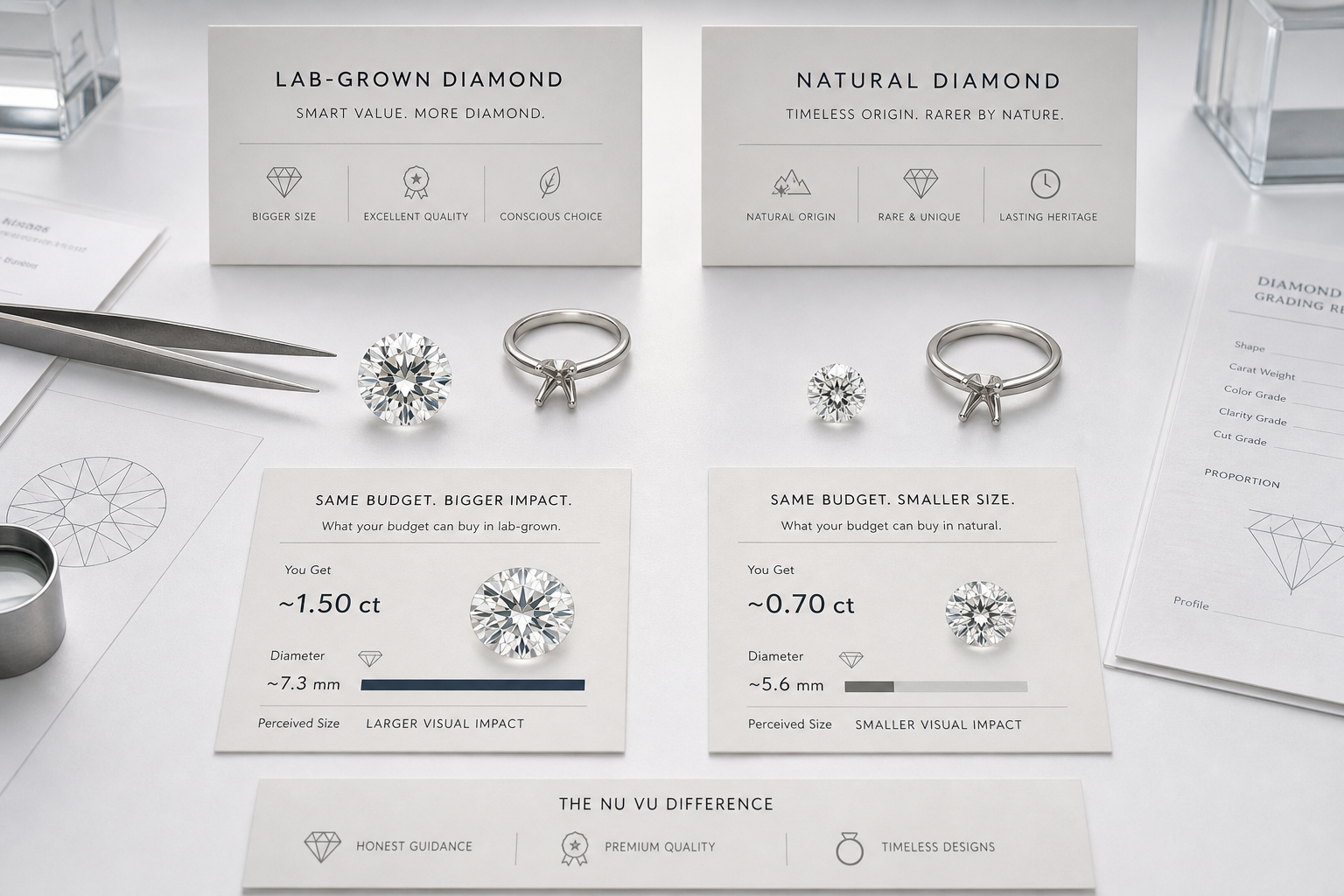
That matters because the same diamond budget can produce very different outcomes. A $3,000 budget may buy a visibly larger lab-grown center stone with room left for a clean setting, or it may buy a smaller natural diamond where the value is tied more to origin, rarity, and tradition. Neither choice is automatically wrong. The better choice depends on what the purchase is meant to accomplish.
This guide uses “visible value” as the main lens. That means size on the hand, cut performance, face-up appearance, setting quality, and how well the finished piece fits the buyer’s goal. Price per carat matters, but it is not enough by itself. A diamond that looks large on paper but appears dull, poorly proportioned, or mismatched to the setting is not a strong buy.
For buyers, the practical point is not just what the report says, but how the stone performs visually and fits the intended design. A grading report can help confirm category, measurements, color, clarity, and other documented characteristics, but it does not prove that a diamond is the most attractive option for a specific ring. The safest comparison is to treat the report as one piece of evidence, then check media, proportions, and the total design plan before deciding.
Start with the buyer’s goal, not the diamond category
The first decision is not lab-grown or natural. The first decision is the purpose of the purchase.
If the goal is the largest attractive center stone within a fixed ring budget, lab-grown will usually be the stronger starting point, especially at lower and mid-range prices. If the goal is a natural diamond because the buyer values geological rarity, family tradition, or a more conventional heirloom choice, then a smaller natural stone may make more sense even when it gives up visible size.
Custom projects add another layer. A buyer designing a three-stone ring, a larger pendant, or a piece with matching side stones may get more design freedom from lab-grown diamonds because more of the budget can go into scale, matching, and setting work. A buyer focused on a single natural center stone may prefer to simplify the design so more of the budget goes toward the diamond itself.
Clarify the Category Before Comparing the Budget
Laboratory-grown diamonds and natural diamonds are both diamonds, but they have different origins. A laboratory-grown diamond is created through a controlled growth process, while a natural diamond formed geologically. Laboratory-grown diamonds should be clearly identified as laboratory-grown, and they should not be presented as mined diamonds.
This distinction also matters when reading listings or reports. A diamond simulant, such as a non-diamond lookalike, is not the same as a laboratory-grown diamond. If a listing uses unclear language such as “created,” “synthetic,” “simulated,” or “diamond alternative,” buyers should confirm whether the item is a laboratory-grown diamond, a natural diamond, or a simulant before comparing price or value.
Define what “better value” means in this article
Better value does not mean the lowest price. It means the strongest outcome for the intended purchase.
For an engagement ring, that may mean a center stone that looks balanced on the hand, has strong cut performance, and leaves enough budget for a durable setting. For a loose diamond purchase, it may mean choosing the stone with the best relationship between measurements, cut quality, color, clarity, and documentation. For custom jewelry, it may mean choosing the diamond type that allows the whole piece to work rather than spending too much on one spec.
The most common mistake is treating carat weight as the whole value story. Carat weight tells you how much the diamond weighs, not how large it looks, how bright it appears, or whether it suits the setting. A well-cut 1.50 carat diamond can be a better visual decision than a poorly proportioned 1.80 carat stone, even before comparing lab-grown and natural options.
Show how to read the price bands that follow
The budget ranges in this article are decision zones, not fixed rules. Real prices move with shape, grading report, cut quality, color, clarity, and market availability. The point is to show how buyer priorities usually change as the budget moves from entry-level to mid-range, premium, and custom or high-budget purchases.
At lower budgets, the decision is often size-sensitive because every dollar has to cover both the diamond and the setting. In the middle ranges, shape and ring design start to matter more because the buyer has more room to choose between visible impact and refinement. At higher budgets, the question becomes less about getting “more diamond” and more about whether the buyer values statement size, rarity, custom design flexibility, or a natural-origin preference.
The cleanest way to use the sections that follow is to compare the total purchase, not just the loose stone. A diamond budget should include the center stone, setting, metal choice, side stones if any, resizing or customization needs if applicable, and the level of documentation and visual review needed to buy confidently.
Prices can change with market conditions, report type, seller channel, and stone-specific details, so exact comparisons should be verified at the time of purchase. When comparing a lab-grown diamond and a natural diamond, compare like-for-like specifications as closely as possible before treating one option as a better value.
Budget Framework Check
Before comparing stones, define the budget clearly. Decide whether it includes only the loose diamond or the finished ring, whether the setting is simple or design-heavy, and whether the top priority is maximum visible size, a specific shape, a natural diamond identity, or a balanced final piece. This prevents a common problem: choosing a diamond that looks good as an isolated purchase but forces compromises in the ring itself.
Documentation Reality Check
Any budget comparison is stronger when the seller’s description, grading report, measurements, and visual media tell the same story. Lab-grown diamonds should be clearly represented as lab-grown rather than implied to be natural, and natural diamonds should not be presented as more beautiful simply because they are natural. If a stone’s report, listing title, and sales explanation do not align, pause the purchase and ask for clarification before comparing value.
When a grading report is available, buyers should verify the report details through the issuing laboratory’s official report-check tool where available and compare those details with the seller’s listing, measurements, and visual media.
Traceability in a practical buying sense does not mean assuming every claim has been fully proven by one document. It means building a consistent trail from the diamond listing to the grading report, from the report to the stone’s measurements or inscription when applicable, and from the selected stone to the final ring or jewelry specification. If any part of that trail is unclear, the next step should be a clarification request rather than a rushed decision.
For NUVU, the buyer-first approach is to make comparison easier to understand: what the report shows, what the visuals reveal, and whether the stone fits the intended piece. This is especially useful when a buyer is deciding between a larger lab-grown diamond and a smaller natural diamond, because the two options may be valuable for different reasons.
Under $2,500: Where Lab-Grown Usually Delivers the Clearest Visible Value
With an under $2,500 diamond budget, lab-grown usually delivers the clearest visible value. This is the most size-sensitive range because the buyer is often trying to cover both a center stone and a wearable setting without making the ring feel too small or unfinished.
For a couple buying an entry-level engagement ring on a fixed budget, the practical difference can be obvious. Choosing lab-grown may allow them to consider a more noticeable center stone while still leaving money for a secure solitaire, a clean cathedral setting, or a simple pavé band. Choosing natural in the same range often means accepting a smaller stone, more conservative grades, or a simpler setting to keep the total cost under control.
The key judgment at this level is straightforward: if visible size and overall ring presence are the priority, lab-grown should usually be considered first. Natural can still be meaningful, but it asks the buyer to care more about origin and tradition than about the strongest visual result for the money.
What lab-grown typically lets the buyer do at this level
Lab-grown diamond value is especially strong at this budget because it can make room for choices that are difficult to balance with a natural diamond. The buyer may be able to prioritize a better-looking face-up size, stronger cut quality, or a setting that does not feel like an afterthought.
This matters because a small budget can be weakened quickly by the wrong compromise. A buyer who spends too much of the budget chasing a natural center stone may end up with a ring that has a modest diamond and a thin, overly basic setting. With lab-grown, the same buyer may be able to build a ring that looks more complete: a bright center stone, a stable mounting, and proportions that feel intentional on the hand.
The warning is that bigger is not automatically better. A larger lab-grown diamond with weak cut, awkward depth, or poor light return can still disappoint. At this price level, a slightly smaller stone with better proportions is usually a smarter choice than stretching for the largest carat number available.
What a natural diamond usually looks like in the same budget
A natural diamond under $2,500 can still be a good purchase, but the tradeoffs are harder to avoid. The center stone will usually be smaller, and the buyer may need to be more flexible on color, clarity, shape, or setting style. That does not make the ring inferior; it simply means the value is coming from the natural origin rather than maximum visible presence.
This is where expectations need to be realistic. A buyer who wants a substantial center stone, a refined setting, and a natural diamond all within this range may find the budget stretched too thin. One part of the ring will usually absorb the compromise. It may be the carat weight, the setting detail, the color range, or the clarity grade.
Natural makes more sense here when the buyer is comfortable with that tradeoff. A smaller round solitaire, a delicate vintage-inspired ring, or a simple setting with sentimental importance can be a strong choice if the natural diamond identity matters more than size.
Who should still consider natural at this price
Natural is still worth considering for buyers who place real emotional value on the stone’s origin. Some shoppers simply want a natural diamond for an engagement ring because it matches their idea of tradition, family meaning, or a classic purchase. If that preference is strong, forcing a lab-grown choice only for size may not feel right long term.
The best natural-diamond buyer in this budget range is someone who is honest about the compromise. They are not expecting the largest-looking ring in the showcase. They are choosing a smaller or simpler piece because the natural diamond itself carries the value they care about most.
The weaker natural choice is the one made without accepting those limits. If the buyer wants a visibly large center stone but also insists on natural under $2,500, the result may involve too many compromises at once. In that case, lab-grown is usually the cleaner decision.
What to Verify Before You Assume Lab-Grown Is the Better Deal
Before assuming lab-grown is automatically the better deal, check the full purchase. Confirm how much of the budget remains for the setting, whether the stone has strong cut and proportions, and whether the ring design is being rushed just to afford a larger carat weight. The best choice under $2,500 is not the biggest diamond; it is the ring that looks intentional, wears securely, and uses the budget without hiding a weak point.
Also check that the diamond’s documentation matches the selling description. In entry-level budgets, buyers sometimes focus so heavily on getting a larger-looking stone that they overlook whether the grading report, stone measurements, and online media all describe the same practical reality. A modest diamond with clear documentation and a compatible setting plan is usually a safer purchase than a bigger stone with unanswered questions.
If the listing uses terms such as “certified,” “eco,” “ethical,” or “conflict-free,” ask what those words specifically refer to. A grading report may document diamond characteristics, but it should not be treated as proof of broad sourcing, labor, environmental, or resale claims unless the seller provides separate documentation that supports those points.
$2,500 to $5,000: When Shape, Size, and Setting Start Changing the Answer
In the $2,500 to $5,000 diamond budget range, the answer becomes more nuanced. Lab-grown still often wins on visible impact, but this is the first range where the buyer is not only choosing between bigger and smaller. Shape, setting quality, and overall ring balance start to change the value picture.
A $5,000 ring budget can go in several directions. It can support a larger lab-grown engagement ring with a strong center stone and a considered setting. It can also support a smaller natural diamond with a cleaner, more classic overall presentation. The right choice depends on whether the buyer wants the diamond to dominate the design or wants the whole ring to feel refined and proportionate.
How shape starts to affect the comparison more than many buyers expect
Shape can stretch or shrink the apparent value of the same budget. Oval, pear, marquise, and some emerald-cut diamonds often appear larger for their carat weight because of their length and spread. Round diamonds tend to be more expensive for the same carat weight and can make the budget feel tighter, especially in natural stones. Cushion cuts can vary widely; some face up smaller because they carry more weight in depth.
This means a buyer comparing lab-grown and natural diamonds should not rely on carat weight alone, especially when diamond resale value is part of the long-term comparison. A 1.50 carat oval may look more visually prominent than a 1.50 carat cushion, while an emerald cut may need better clarity because its step-cut facets make inclusions easier to notice. At this budget, shape is not just a style preference. It changes how much diamond the buyer appears to get for the money.
The practical takeaway is to compare measurements, not just labels. Length, width, depth, and face-up appearance often explain why two diamonds with similar carat weights look noticeably different in a ring.
When the setting starts to compete for budget
At this range, the setting becomes a real budget decision. A simple solitaire keeps more money focused on the center stone. A halo can add visual spread, but it may also compete with the stone if the proportions are wrong. Side stones, hidden halos, thicker bands, custom prongs, and more detailed metalwork can improve the finished ring, but they reduce the amount available for the diamond.
This is where lab-grown engagement ring value can be especially strong. Because the center stone may cost less than a comparable natural diamond, the buyer may have more room to choose a setting that feels complete rather than settling for the cheapest mounting. That can matter more than adding a small amount of carat weight.
The mistake to avoid is building an unbalanced ring. A large center stone on a setting that is too thin, too plain for the design goal, or poorly proportioned can look less refined than a slightly smaller stone in a better-considered ring. The setting should support the diamond visually and physically, not simply hold it in place.
When natural still makes sense in this range
Natural diamond value by budget becomes more personal in the $2,500 to $5,000 range. A buyer may be able to choose a natural diamond that feels substantial enough for their taste, especially if they are open to a modest carat weight, a simple setting, or a shape that uses budget efficiently.
Natural still makes sense for the buyer who would rather have a smaller stone with natural-origin meaning than a larger lab-grown diamond. This is not only about tradition. Some buyers like the idea of a stone formed naturally, or they want the engagement ring to fit a family expectation or personal definition of a classic diamond purchase.
The recommendation changes if the buyer is comparing two finished rings and strongly prefers the appearance of the lab-grown option. In that case, choosing natural only because it sounds more traditional can lead to regret. At this budget, the better decision is the one that matches both the visual expectation and the emotional reason for buying.
Stone-to-Setting Fit Check
Before choosing, look at the center stone and setting together. Confirm that the stone’s measurements suit the setting style, that the band width looks balanced, and that any halo or side stones support rather than overwhelm the center diamond. A slightly smaller stone in the right setting can look more deliberate than a larger stone forced into a design that was chosen only after the budget was already spent.
Color and clarity should also be judged in context rather than treated as automatic upgrades. A higher clarity grade may not improve the finished ring if the inclusions in the lower-graded stone are not visible in normal wear, while a warmer color may be acceptable or even harmonious in yellow or rose gold. In practical buying, this is where many comparisons become misleading: the “better” grade is not always the better use of budget if it does not change what the wearer will actually see.
For custom design, trust comes from matching the stone to the setting, budget, and wearer’s daily use, not from choosing grades in isolation. Before finalizing a loose diamond, confirm the stone’s length, width, depth, girdle condition, prong plan, and ring profile with the intended setting. This prevents a common budget mistake: buying a stone that looks attractive on a report but requires design changes that add cost or weaken the final proportions.
For custom jewelry, stone measurements and setting compatibility should be confirmed before finalizing a purchase. This is especially important for elongated shapes, unusually deep stones, low-profile settings, and designs with halos or side stones, where a small mismatch can affect both appearance and wearability.
$5,000 to $10,000: The Most Balanced Comparison Zone
A diamond budget of $5,000 to $10,000 is where lab-grown vs natural diamonds become a real head-to-head decision. Below this range, lab-grown often has a clear visual advantage because the natural option usually requires more visible compromise. Here, both categories can produce a serious-looking ring or jewelry piece, so the better choice depends less on the label and more on what the buyer actually wants the budget to accomplish.
For many shoppers, this is the first range where the question changes from “What can I afford?” to “What kind of value do I want to buy?” One buyer may prefer a larger lab-grown center stone with strong visible presence. Another may choose a smaller natural diamond because the natural origin matters more than face-up size. A third may decide that the smartest move is not the largest stone at all, but a better-balanced ring with a thoughtful setting, secure proportions, and a center stone that does not overpower the design.
Why this is the first true head-to-head budget zone
In the $5,000 to $10,000 range, lab-grown still tends to deliver more visible diamond for the money, but the comparison is no longer as simple as “larger versus smaller.” A lab-grown diamond may allow the buyer to move into a noticeably larger center stone, higher color, cleaner clarity, or a more generous setting budget. That can be the right choice if the goal is a ring that looks substantial in everyday wear.
A natural diamond can also make sense here, especially for a buyer who is comfortable choosing a smaller stone in exchange for natural rarity and tradition. The mistake is pretending both purchases are trying to solve the same problem. A larger lab-grown diamond is usually buying visual impact and budget efficiency. A smaller natural diamond is often buying origin preference, scarcity, and a more traditional emotional frame. Neither is automatically more “worth it” unless it matches the buyer’s reason for buying.
A practical way to compare current inventory is to look at stones with grading reports in the same shape, cut range, and color-clarity bracket, then compare face-up measurements rather than carat weight alone. In this budget band, buyers often discover that the visible difference between the two categories is not just weight on paper; it is millimeter spread, setting presence, and how much of the total budget remains after the stone is selected.
How the answer changes by ring style or jewelry type
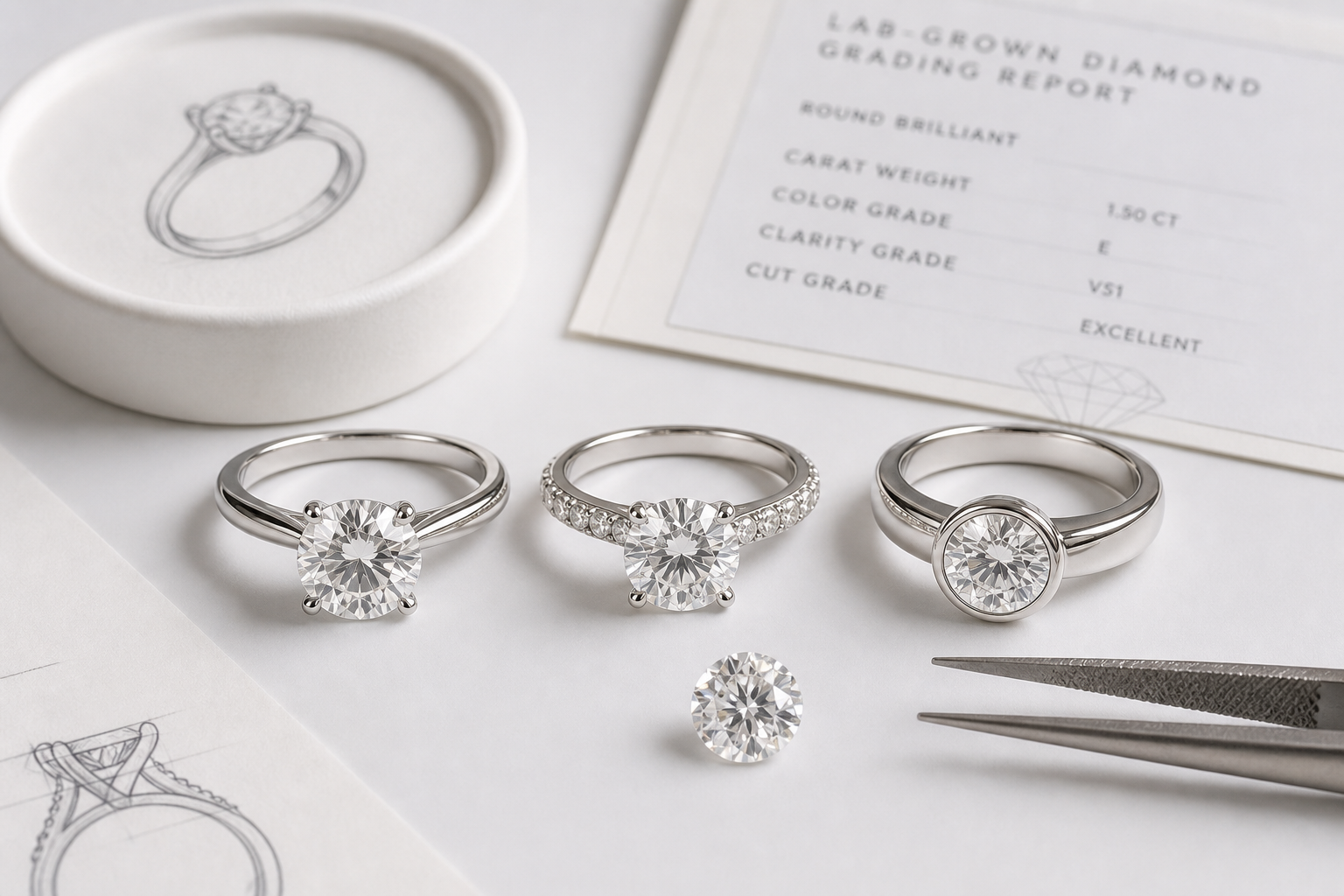
Ring style can change the answer quickly. A solitaire puts most of the visual pressure on the center stone, so lab-grown often has a strong advantage if the buyer wants a larger, cleaner diamond to carry the whole look. In a simple round, oval, emerald, or cushion solitaire, the difference in center-stone size may be obvious enough that many buyers choose lab-grown without much hesitation.
A halo or three-stone ring changes the math. These settings add visual coverage, but they also absorb more of the budget through side stones, metalwork, and craftsmanship. In this case, forcing the largest possible center stone can backfire if the ring starts to look poorly proportioned or the setting quality is weakened to make room for the stone. A slightly smaller natural diamond in a refined three-stone design may feel more intentional than an oversized lab-grown center stone placed in a thin or underbuilt setting.
Pendants and earrings behave differently again. For a pendant, a lab-grown diamond can be especially practical because the viewer usually notices size, brightness, and outline before origin. For diamond earrings, matching becomes more important; a pair should align closely in size, color, shape, and visual spread. Lab-grown can make matching easier within this budget, while natural pairs may require tighter compromises or a smaller total look.
What the buyer should focus on in the stone itself
At this level, the biggest mistake is chasing headline carat weight while ignoring how the diamond actually performs. A poorly proportioned 2.00-carat stone can look dull, deep, or smaller than expected, while a well-cut 1.70-carat stone may face up better and look more lively. This matters in both lab-grown and natural diamonds. The category does not rescue a weak cut.
Cut quality should be the first filter, especially for round diamonds. For fancy shapes such as oval, emerald, cushion, pear, and radiant, proportions and visual review become even more important because two stones with the same grades can look very different in person. Bow-tie effect in ovals and pears, watery centers in some cushions, and dark windowing in emerald cuts are not fully solved by a grading report.
Color and clarity should be judged through the lens of the setting and shape. A yellow gold setting may make a slightly warmer diamond look balanced, while a bright white metal setting can make body color more noticeable. Clarity also depends on placement of inclusions, not just the grade. A visible mark under the table is more concerning than a similar-grade inclusion near the edge where a prong may hide it.
Certificate and Visual Review Check
Before deciding, compare the grading report, face-up measurements, depth, table, and any available photos or video. At a $5,000 to $10,000 diamond budget, visual proof matters as much as the stated specs because the buyer is no longer just trying to find an acceptable stone; they are choosing between two different versions of value.
Check whether the stone’s measurements support the carat weight. A diamond that carries excess depth may cost more without looking meaningfully larger from the top. Review video for brightness, symmetry, dark areas, bow-tie strength, and inclusion visibility. If the stone will be used in a ring, confirm that the setting design can support its shape and size without looking too thin, too bulky, or poorly balanced.
At NUVU, we usually treat the grading report as the starting point, not the final answer. The report narrows the shortlist, but photos, video, proportions, and setting compatibility are what show whether the diamond actually works for the purchase.
How to Compare the Report Against the Actual Stone
A grading report can narrow the comparison, but it should be read alongside the stone’s proportions, visual evidence, and intended jewelry use. For example, two oval diamonds with similar color and clarity grades can have very different bow-tie strength, outline shape, and face-up spread. Two emerald cuts with the same clarity grade can also look different if one has an inclusion near the table and the other has inclusions near the edge.
Buyers should use the report to confirm the basic identity of the diamond, then use media and measurements to decide whether the stone is visually convincing. If a seller provides a report number, a video, and setting notes, those pieces should not contradict each other. The safest shortlist is the one where the documented details, the visual appearance, and the design plan all point to the same conclusion.
A grading report helps document key characteristics, but it should not be treated as a guarantee of beauty, value, or sourcing ethics. When growth method or post-growth treatment is relevant, buyers should look for clear disclosure in the grading report or seller documentation.
$10,000 to $20,000: When a Natural Diamond Can Still Be the Right Call
A diamond budget of $10,000 to $20,000 gives buyers more freedom, but it does not automatically make natural diamonds the better choice. What changes is that natural diamonds become more plausible for buyers who care about rarity, origin, tradition, or a specific emotional goal. At this level, the decision becomes more strategic because the buyer has enough budget to make either category feel intentional.
Lab-grown still often wins on visible size and design flexibility. A buyer who wants a statement center stone, a more dramatic custom ring, or a matched diamond layout may find that lab-grown delivers a stronger finished piece for the same total spend. But a buyer who wants a natural diamond because the origin itself is part of the meaning may reasonably accept a smaller stone. The key is to avoid measuring one purchase by the other purchase’s goal.
When natural becomes more compelling again
Natural diamonds become more compelling in this range when the buyer is not mainly trying to maximize carat size. If the purchase is tied to family tradition, heirloom intent, or a preference for natural rarity, a smaller natural diamond can feel more aligned with the reason for buying. That does not make it visually better for the money, but it may make it emotionally better for the buyer.
This is where “natural diamond worth it” becomes a personal question rather than a pricing formula. A natural diamond makes more sense when the buyer would still prefer it after seeing a larger lab-grown option side by side. If the larger lab-grown stone creates instant hesitation, the buyer may be more size-driven than they thought. If the natural stone still feels like the right object despite being smaller, that preference is real and should not be dismissed as irrational.
The risk is overpaying for the idea of natural while ignoring the actual stone. A natural diamond still needs strong cut, appropriate proportions, a reliable grading report, and a setting that suits its scale. Rarity does not compensate for a lifeless stone, and tradition does not make poor proportions a good purchase.
When lab-grown still wins clearly
Lab-grown remains the practical choice when the buyer wants a large, bright, visually dominant diamond without pushing the project into a much higher cost tier. In the $10,000 to $20,000 range, lab-grown can support a statement engagement ring, a larger elongated shape, or a custom design with more presence than many natural-diamond options at the same budget.
It can also be the stronger choice when the design includes matching stones. Three-stone rings, diamond bands, earrings, and coordinated custom pieces often depend on consistency. Matching size, shape, color, and visual spread can become expensive with natural diamonds. Lab-grown can make that kind of design more achievable without forcing the buyer to reduce the overall scale of the piece.
The warning is that bigger is not always better. A very large center stone can overwhelm the hand, expose awkward setting proportions, or feel less wearable for daily use. Lab-grown gives the buyer more room to choose size, but the smartest choice is still the size that fits the wearer, the setting, and the intended use.
How the buyer’s intent changes the best answer
The best answer in this budget band depends on whether the buyer wants visual impact or symbolic preference to lead the decision. A buyer choosing a ring for daily wear and maximum presence may be happier with a larger lab-grown stone in a well-built setting. A buyer choosing a diamond for tradition, family meaning, or natural-origin preference may be happier with a smaller natural stone that feels more personally significant.
The same $15,000 budget can produce two very different but valid outcomes. One path might prioritize a larger lab-grown center stone with excellent visual performance and a custom setting. The other might prioritize a natural diamond with more conservative size but stronger emotional alignment. The wrong choice is the one made to satisfy a generic idea of value instead of the buyer’s actual reason for purchasing.
This is also the range where buyers should separate “impressive” from “right.” An impressive diamond draws attention. The right diamond fits the purpose of the jewelry, the wearer’s style, and the level of meaning the buyer attaches to origin. Those are not always the same thing.
What to Compare Before You Decide
Compare the stone, the setting, the documentation, and the total project cost side by side. For each option, ask what the budget is really buying: larger visible size, natural rarity, better craftsmanship, stronger design balance, or a more personal story. If the answer is unclear, the shortlist is not ready.
For both lab-grown and natural diamonds, check the grading report, measurements, proportions, photos, and video. Then look at the finished piece, not just the loose stone. At this level, a weak setting choice can waste a strong diamond, and an oversized stone can make an otherwise expensive ring feel poorly planned.
Origin and sustainability language should be handled carefully at this budget. A natural diamond’s story should be supported by available documentation rather than assumed from price, and a lab-grown diamond should not be treated as automatically more sustainable without information about production, sourcing, and seller transparency. If ethical or environmental considerations are central to the purchase, ask what can actually be documented and what is simply a broad marketing claim.
A careful sustainability conversation should separate the diamond’s growth origin from the seller’s environmental claims. “Lab-grown” explains how the diamond was produced, but it does not automatically prove low impact, carbon neutrality, or superior sourcing practices. Likewise, “natural” describes geological origin, not the full chain of custody. Buyers who care about these issues should request specific, written support rather than relying on broad category labels.
How to Handle Ethical and Environmental Claims in the Shortlist
Environmental and sustainability claims should be specific, documented, and limited to what can be substantiated. Instead of relying on broad labels, buyers can ask what the seller can document about production practices, energy use, sourcing disclosures, chain-of-custody information, or any third-party claims being referenced.
This does not mean every buyer needs a complex sourcing file for a personal ring. It means that marketing phrases should not carry more weight than the evidence behind them. If two diamonds are otherwise close, clearer documentation and more precise seller communication may be a meaningful deciding factor, especially for buyers who care about origin, production, or sourcing transparency.
$20,000 and Above: How Custom Jewelry and Larger Purchases Change the Equation
Above $20,000, the decision is often no longer only about one center stone. The buyer may be considering a larger custom ring, a multi-stone design, a matched pair, or a statement jewelry piece where design, craftsmanship, and stone coordination matter as much as the diamond category. This is where a high budget diamond choice becomes a project decision, not just a stone decision.
Natural diamonds can feel more intentional at this level for buyers who want rarity, provenance, or a traditional high-end purchase. Lab-grown can still be the smarter move for buyers who want size, design freedom, or a more ambitious layout without moving into an entirely different spending tier. A high budget does not decide the answer. It only makes the tradeoff more visible.
How larger or custom pieces change the question
With custom diamond jewelry, the budget has to serve the whole piece. A large center stone may be only one part of the design. Side stones, pavé work, hidden halos, basket structure, metal choice, ring profile, and daily wear durability can all affect whether the final result feels refined or forced.
This matters because large stones expose weak design decisions. A setting that looks acceptable with a modest diamond may look underbuilt or awkward with a much larger center stone when compared in the context of lab grown vs natural diamonds, especially as buyers weigh price, sustainability, and buying priorities. A multi-stone ring also requires proportion, not just budget. If the side stones are too small, too large, or poorly matched, the piece can lose balance even when the individual diamonds are attractive.
At NUVU, the diamond and setting are considered together because a beautiful stone still has to work physically and visually inside the design. The better question is not “How large can the diamond be?” but “What size, shape, and layout will make the finished piece look deliberate?”
Why natural can feel more intentional at this level
Natural diamonds can be the right choice above $20,000 when the buyer wants the purchase to carry rarity value as part of its meaning. This may apply to an engagement ring intended as an heirloom, a milestone anniversary piece, or a buyer who simply prefers the idea of a natural-origin stone and has the budget to make that preference realistic.
The important distinction is that natural should be chosen for the right reason. If the buyer mainly wants the largest visual result, natural may create unnecessary compromise. If the buyer wants a diamond that feels singular because of its natural formation and traditional market identity, then accepting a smaller size can be a rational tradeoff.
Even at a high budget, natural diamonds require careful selection. Buyers should avoid assuming that price alone signals a better stone. Cut quality, report consistency, face-up appearance, and setting fit still matter. A natural diamond chosen for rarity should also be a diamond the buyer enjoys seeing every day.
Why lab-grown can still be the smarter design move
Lab-grown can be the smarter design move when the buyer wants a bolder piece, a larger center stone, or a more coordinated layout. Above $20,000, lab-grown may allow for a larger statement diamond, more substantial side stones, or a custom design that would become much more restrictive with natural diamonds.
This is especially relevant for elongated shapes, three-stone rings, tennis necklaces, earrings, and pieces that require matching. Consistency becomes part of the value. A buyer may care less about natural rarity and more about whether the finished jewelry has the right scale, symmetry, and presence. In that case, lab-grown can support the design goal more efficiently.
The main caution is restraint. A large lab-grown diamond can look impressive, but if the size exceeds the wearer’s style or the setting’s structure, the result may feel oversized rather than elevated. The best lab-grown purchase at this level is not the maximum possible carat weight; it is the strongest finished design the budget can support.
What This Means in a Real Purchase
Before deciding, confirm whether the purchase is being optimized for visual presence, collectability, or custom design freedom. If visual presence is the main goal, lab-grown often gives the buyer more room to build a dramatic piece. If rarity and traditional significance matter more, natural may be the better fit even at a smaller size. If the project involves multiple stones or complex design work, the best answer may depend on matching, proportions, and how the total budget is divided.
A useful final test is to compare complete proposals, not just loose diamonds. Look at the center stone, side stones, setting structure, documentation, and finished design cost together. At this budget level, the wrong decision usually comes from isolating the diamond from the piece it is supposed to become.
Documentation and Support for Higher-Budget or Custom Decisions
For larger purchases, trust should come from a clear selection process rather than broad promises. A buyer should be able to see which stones were considered, why certain options were removed, and how the final shortlist fits the design brief. This is especially important when comparing a large lab-grown diamond against a smaller natural diamond, because the value story is different in each case.
When NUVU supports a custom or higher-budget project, the practical goal is to make the decision traceable: report details, measurements, visual media, setting notes, and final order specifications should all align. That does not replace the buyer’s personal preference, but it helps prevent a situation where the stone looks appealing online and then proves mismatched to the finished ring or jewelry piece.
Buyers should also ask what happens after the choice is made. A written summary of the selected diamond, the agreed setting design, the metal, the ring size, the expected process, and any return or adjustment terms that the seller actually offers can be just as important as the diamond report itself. Clear communication reduces uncertainty, particularly when the project involves custom work or matched stones.
Traceability Questions for Larger or Custom Projects
For higher-budget custom work, traceability should be practical rather than vague. Ask how the selected diamond will be identified in the final order, whether the grading report number or stone details will be referenced in the project notes, and how side stones or matched stones will be described. This is not about turning the purchase into a technical audit; it is about making sure the stone discussed during selection is the stone reflected in the final design plan.
If the project includes multiple diamonds, the documentation should explain the matching logic. Buyers can ask how closely the stones are expected to align in size, shape outline, color range, clarity range, and visual spread. In sourcing or wholesale-style conversations, documentation, consistency, and communication often matter as much as the headline specification, because a project can fail visually even when each individual stone appears acceptable on paper.
A grading report is useful documentation, but it should not be treated as a complete purchase guarantee. Buyers should confirm the seller’s documentation, design specifications, report details, and relevant policies in writing before committing.
What Matters More Than the Diamond Type at Any Budget
The lab-grown versus natural decision matters, but it should not be the only filter. A poorly cut diamond with a bigger carat weight is still a weak buy, whether it was grown above ground or formed naturally. The better diamond buying checklist starts with what will affect the finished piece in real life: cut quality, face-up size, shape, visual proof, setting fit, and documentation.
This is where many buyers make the wrong tradeoff. They spend too much attention on the category label and not enough on whether the stone actually looks lively, faces up well for its weight, and fits the ring design they want. A smaller, better-cut stone can outperform a larger diamond that carries extra weight in the wrong places. That matters at every budget, but it becomes especially costly once the buyer is comparing higher-value stones.
Cut quality and shape usually move the needle more than buyers expect
Cut quality is often the first place to look because it controls how much life the diamond has in normal lighting. Carat tells you weight. Cut tells you whether that weight turns into brightness, contrast, and sparkle. If two diamonds cost about the same, the one with better proportions and stronger visual performance is usually the safer choice, even if the other stone has a slightly higher carat number.
Shape changes the comparison as well. Oval, pear, marquise, and emerald cuts can appear larger across the finger than some round diamonds of the same carat weight, but they also bring different risks. Ovals and pears can show bow-tie shadows if the proportions are weak. Emerald cuts reveal inclusions and body color more easily because of their open, step-cut pattern. Cushions can look smaller than expected if they are deep and compact. The right shape is not just a style preference; it affects how far the budget goes visually.
A common mistake is assuming that a bigger lab-grown diamond automatically looks better than a smaller natural diamond, or that a natural diamond is automatically more refined because it costs more. Neither assumption is reliable. The visible result depends on whether the stone carries its weight well, whether the shape flatters the setting, and whether the cut makes the diamond look active instead of flat.
Measurements and visual proof matter as much as the report
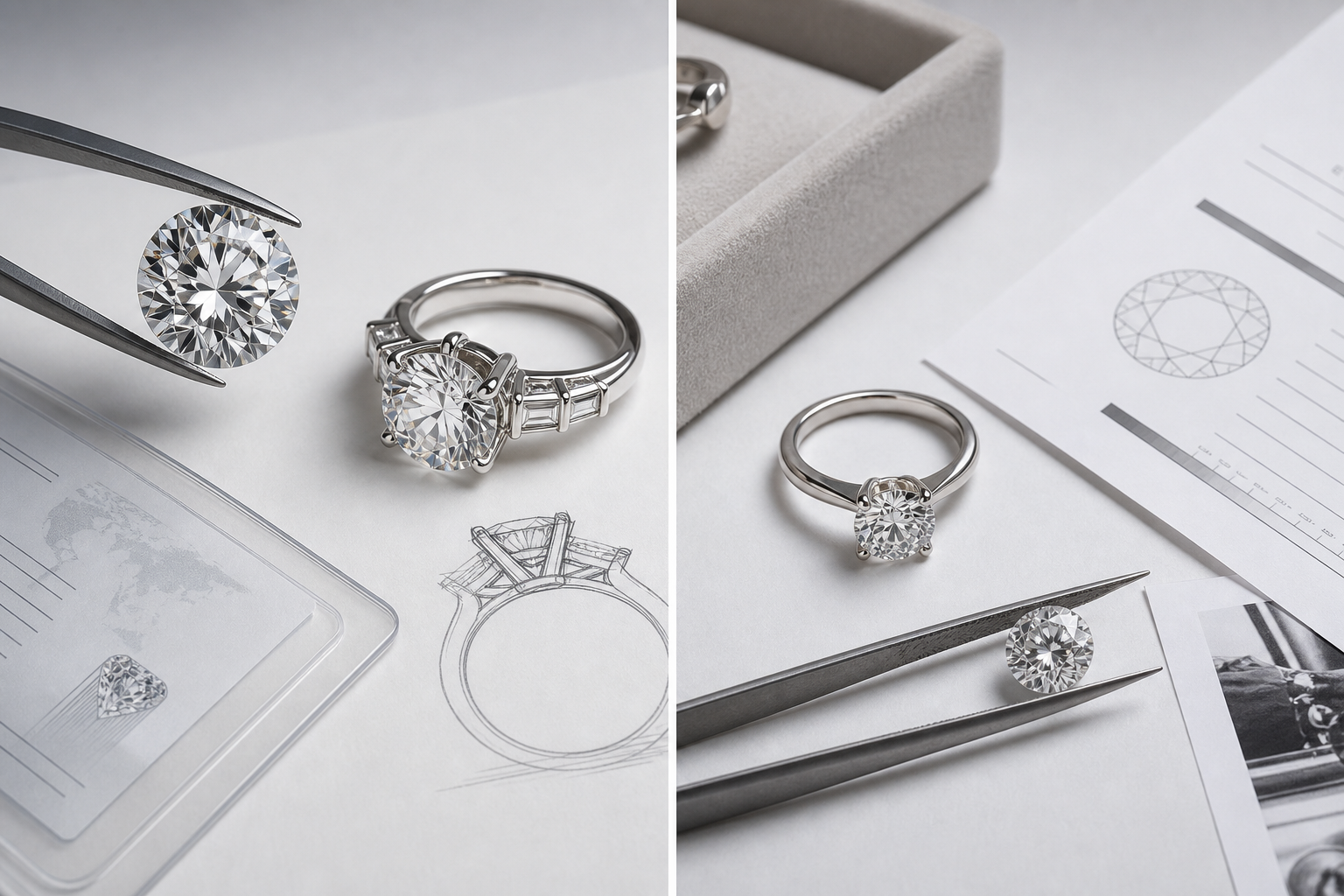
A grading report is useful, but it does not show everything the eye will notice. Measurements tell you how large the diamond will actually appear from the top, and photos or video help confirm whether the stone has strong brightness, clean patterning, and acceptable inclusions. This is especially important when buying online, where a one-carat diamond can face up differently from another one-carat diamond in the same shape.
For a quick numerical check, compare these details before treating two stones as equal:
- Face-up measurements: Check length and width, not only carat weight. A 1.50-carat oval that measures noticeably small for its category may not deliver the visual size you expected.
- Depth percentage: Very deep stones can hide weight below the surface, making them look smaller from the top. Extremely shallow stones may lose light performance.
- Table and proportions: Avoid judging these numbers in isolation, but use them as warning signals when a stone looks unusually glassy, dark, or flat in video.
- Length-to-width ratio: This matters for fancy shapes. A long oval, compact cushion, or narrow emerald cut can completely change the feel of the ring.
- Setting dimensions: Confirm the head, prong style, band width, and stone measurements work together before buying the diamond separately.
The non-obvious issue is that two diamonds with similar reports can behave very differently in the finished ring. A stone can have respectable grades and still be the wrong choice if the video shows weak light return or if the dimensions do not suit the intended setting. At NUVU, we treat the grading report as a starting point, not the final decision, because the report narrows the field but does not replace visual review.
The setting can quietly change the whole budget outcome
The setting is not just the frame around the diamond. It changes how the budget performs. A simple solitaire can put more money into the center stone, while a halo, hidden halo, three-stone layout, pavé band, or custom basket can shift a meaningful part of the budget into metalwork and side stones. That can be worth it, but only if the design improves the final piece instead of compensating for a poorly chosen center stone.
For engagement rings, the setting should be chosen early enough to prevent a mismatch. A large stone on a band that is too thin can look unbalanced or feel less practical for daily wear. A very delicate setting may not be the best match for someone who uses their hands heavily. A stone with an elongated shape may need a different prong layout than a round or cushion. If the setting is treated as an afterthought, the buyer can end up with a diamond that looked like good value loose but feels awkward once mounted.
The practical rule is simple: leave enough budget for the ring you actually want. If choosing lab-grown allows a stronger setting, better proportions, and a more complete design, that can be better value than spending the same budget on a smaller natural stone with a setting compromise. If the buyer strongly prefers natural, it may be smarter to reduce carat weight slightly rather than strip the ring down to a design that feels unfinished.
Transparency has limits, even with a good grading report
Diamond grading reports give useful structure. They document key grading details such as carat weight, color, clarity, measurements, and often growth origin for lab-grown stones. They can also help buyers compare diamonds more consistently and avoid relying only on seller descriptions. But a report is not a beauty guarantee, a resale guarantee, or a complete explanation of how the stone will look in every lighting condition.
This matters because some buyers treat the report like a final verdict. It is not. The report may say a diamond has a strong clarity grade, but the location of an inclusion can still matter. It may show favorable measurements, but the video may reveal a dull center or distracting shadow pattern. It may confirm that a lab-grown diamond is graded, but it does not tell you whether that specific stone is the best visual use of your budget.
Seller communication also matters. Before buying, ask whether the diamond is available for the setting you want, whether the measurements are compatible, and whether additional images or videos can be reviewed. A seller who can explain the tradeoffs clearly is more useful than one who only repeats the report grades.
For wholesale or multi-stone purchases, consistency becomes an additional trust issue. A single attractive diamond may not be enough if the project requires matched earrings, a three-stone ring, or repeatable inventory for multiple pieces. In those cases, buyers should compare documentation, size tolerances, color consistency, shape outline, and communication clarity rather than choosing only by the lowest unit price.
Buyer Verification Checklist
Before committing, confirm the grading report details, actual measurements, shape ratio, face-up appearance, photos or video, and setting compatibility. If two stones are close in price, choose the one with stronger visual proof and a clearer path into the finished ring, not the one with the most impressive headline carat weight.
A Practical Evidence Standard for Any Budget
Before treating any diamond as the better value, separate three types of evidence: the grading report, the visual evidence, and the seller’s written commitments. The report helps document the stone’s characteristics, the photos or video help show how the stone appears, and the written order details help confirm what is actually being purchased. A strong buying decision usually has all three working together.
This evidence standard is especially useful when the two options are emotionally different, such as a larger lab-grown diamond and a smaller natural diamond. Instead of asking which category is universally better, ask which option has clearer documentation, better visual proof, a more suitable setting plan, and a stronger match with the buyer’s stated priority. That approach makes the final decision easier to defend after the excitement of the purchase has passed.
How to Make the Final Choice with Confidence
The final decision should come back to the buyer’s real goal. If the goal is maximum visible size for a fixed budget, lab-grown will usually be the stronger starting point, especially at lower and mid-range price levels. If the goal is a natural-origin diamond with rarity, tradition, or personal meaning, a natural stone can still make sense even when it is smaller. The best choice is not the one that wins every category; it is the one that matches the reason for the purchase.
A useful way to make the decision is to imagine the same fixed budget producing two finished rings. One might have a larger lab-grown center stone, a more detailed setting, or more design flexibility. The other might have a smaller natural diamond that better fits the buyer’s emotional preference or family expectation. If the buyer would keep thinking about the size difference, lab-grown is probably the better fit. If the buyer would keep thinking about the origin, natural may be worth the tradeoff.
If your priority is maximum visible size
Start with lab-grown. This is the clearest recommendation when the buyer wants the largest attractive center stone, a more noticeable engagement ring, or stronger size within a controlled budget. The advantage is not only that lab-grown can cost less than a comparable natural diamond; it is that the savings can be used to improve the total ring, including cut quality, setting design, and overall balance.
The warning is not to chase size blindly. A larger stone with weak proportions, a visible bow-tie, poor light return, or an awkward setting can look less impressive than a smaller, better-chosen diamond. Lab-grown gives more room to work, but the final pick still needs to pass the same visual standards as any serious diamond purchase.
If your priority is rarity, tradition, or long-term emotional meaning
Choose natural if the origin itself is part of the value for you. Some buyers want a diamond that feels tied to tradition, family symbolism, or the idea of a naturally formed stone. In that case, a smaller natural diamond can be the more satisfying purchase because it matches the reason the buyer wanted a diamond in the first place.
The tradeoff is visible size and sometimes setting flexibility. A natural diamond at the same budget may require accepting a lower carat weight, a simpler design, or more careful compromises on color and clarity. That is not automatically a problem. It becomes a problem only when the buyer says they value rarity but still expects the same visual scale they could have achieved with lab-grown.
If you are buying for custom design or a larger jewelry piece
Custom design changes the question because the diamond is only one part of the project. Side stones, matching pairs, metal choice, band width, prong style, and wearability can all affect the best decision. Lab-grown often makes more sense when the design calls for a larger center stone, matched side stones, or a bolder layout that would become expensive quickly with natural diamonds.
Natural can still be the right call for a custom piece when the buyer wants one central stone to carry most of the emotional value. For example, a simpler custom setting around a carefully chosen natural diamond may be more meaningful than a larger lab-grown design if the wearer values natural origin over scale. The mistake is trying to make the diamond type decision before defining the design goal.
If you are deciding between two nearly equal stones
When two diamonds seem close, stop comparing only the headline specs. Look at the report, measurements, videos, shape ratio, inclusion location, and setting plan together. A diamond with slightly less carat weight can be the better buy if it faces up well, has stronger light performance, and fits the ring design without forcing changes.
This is also the point where buyer confidence should come from evidence, not pressure. If one option is cheaper but raises questions about appearance, proportions, or setting fit, it is not automatically better value. If one option is more expensive but does not improve the finished result in a way the buyer will actually notice or care about, it may not be worth the stretch.
How to Sanity-Check the Final Shortlist
Before checkout, compare at least two stones side by side, confirm the setting plan in writing, and make sure the final choice matches the original goal. If the goal was visible impact, do not let the idea of natural rarity pull the budget away from the look you wanted. If the goal was tradition or natural origin, do not let a larger lab-grown stone distract from what would feel more meaningful long term.
If you are still deciding, narrow the choice by budget first, then compare loose diamonds by actual measurements, visual performance, and setting fit. For engagement rings or custom jewelry, the most useful next step is to review the stone and design together rather than treating them as separate purchases. A strong final choice should make sense on paper, in photos or video, and in the finished piece you plan to wear.
Final Documentation Questions Before Purchase
Before making a final decision, ask whether the diamond’s laboratory-grown or natural origin is clearly stated in the listing, report, invoice, or order summary. The same check applies to any growth method, post-growth treatment, inscription, or matching-stone description that is material to the purchase. If those details matter to the buyer, they should be clear before payment rather than reconstructed afterward.
Also confirm practical seller terms directly with the seller instead of assuming them from general jewelry-industry language. Return eligibility, resizing, shipping timing, warranty coverage, repair support, and custom-order changes can vary by seller and by project. A careful buyer does not need every possible policy to be generous; they need the actual terms to be understandable before committing.
Disclosure: This article is for general educational purposes only. Diamond grading, pricing, availability, specifications, and seller policies can change, and readers should verify important details through grading reports, official laboratory tools, seller documentation, or qualified professionals before making a purchase decision. Laboratory-grown diamonds should be clearly distinguished from natural diamonds, and environmental or sourcing claims should be supported by specific documentation.