
Choosing between lab-grown and natural diamonds is not really a question of labels alone. The harder decision is whether diamond resale value factors and the sustainability story behind a stone are specific, verified, and relevant to the way it was made, sourced, and set. A laboratory-grown diamond may avoid mining, but its impact still depends on the energy used and the transparency of the producer. A natural diamond may come with stronger origin or sourcing records, but that does not erase mining or supply-chain concerns.
For the full framework, read Are Lab-Grown Diamonds More Sustainable?.
This article helps you judge those differences with more confidence. Instead of relying on broad claims like “eco-friendly,” “conflict-free,” or “responsibly sourced,” you will see what evidence actually matters: grading reports, origin details, energy disclosures, recycled metal records, and clear explanations of what each claim covers. The goal is to help you compare stones, spot weak documentation, and choose the option you can explain and trust.
| What to Check | Stronger Evidence | Common Pitfall |
|---|---|---|
| Lab-grown sustainability | Energy source, facility practices, traceability | Assuming “lab-grown” means low-impact by default |
| Natural diamond sourcing | Origin records, sourcing policy, third-party audit | Treating “conflict-free” as full sustainability proof |
| Certificate or grading report | Carat, cut, color, clarity, proportions | Using it as proof of ethics or environmental performance |
| Setting materials | Recycled metal record or supplier statement | Checking only the stone and ignoring the setting |
| Broad marketing claims | Plain-language explanation with documentation | Accepting “eco-friendly” or “carbon-neutral” without support |
Quick Questions Before You Read
Q: Is a lab-grown diamond automatically the more sustainable choice?
No. Its impact depends on how it was produced, especially the energy source and the seller’s documentation.
Q: Does a diamond certificate prove responsible sourcing?
No. It confirms gem details, not labor practices, chain of custody, or environmental impact.
Q: Is “conflict-free” enough to judge a diamond?
No. It addresses only a limited risk and does not prove full traceability or broader responsibility.
Q: What should I ask for before buying?
Ask for the grading report, origin or production details, energy or sourcing evidence, and setting metal records.
Lab-Grown vs Natural Diamonds: The Sustainability Question Buyers Should Ask First
The short answer is that lab-grown vs natural diamonds sustainability is not something you can judge from the label alone. Lab-grown diamonds may reduce some mining-related impacts, but that does not make every lab-grown stone automatically sustainable. Their environmental profile still depends on energy use, production practices, and the quality of the documentation behind the claim. Natural diamonds can carry mining-impact concerns, but some sellers provide traceability, responsible sourcing programs, and community-impact information that buyers can actually review.
If you are asking whether lab-grown diamonds are more sustainable, the better question is which claims can be verified. A sustainable diamond is not defined by one word on a product page. It is defined by the evidence behind the claim, and that evidence can look very different depending on whether the diamond was grown in a facility or mined from the earth.
Traceability is also not a single document. It is the connection between the diamond being offered, the report or identification details attached to it, the seller’s explanation, and any supporting production or source records. A buyer should be able to follow that connection without guessing. If the report identifies the stone but the sustainability statement describes only a general company practice, those two pieces of information should not be treated as the same proof.
The short answer: lab-grown may be easier to verify, but not automatically greener
Lab-grown diamonds are often easier to discuss in sustainability terms because the production environment is controlled. That can make disclosures about location, process, and sourcing more straightforward than with some natural diamonds. Even so, production transparency still matters. A broad sustainability claim does not mean much if the seller cannot explain where the stone was grown, what energy was used, or what part of the process is actually being described.
For buyers, that means lab-grown diamonds can be a practical path toward clearer information, but only when the seller is specific. “Lab-grown” answers one question. It does not answer every environmental or ethical diamond buying question on its own.
Why natural diamonds require a different kind of verification
Natural diamonds raise a different set of questions because they come through mining, sorting, cutting, and distribution before reaching the buyer. That creates more places where origin can become less visible unless the seller provides documentation. Some natural diamond programs do offer chain-of-custody details, responsible sourcing standards, or origin-related disclosures, but those claims should still be checked carefully.
The issue is not that natural diamonds are automatically unsustainable. The issue is that mining origin, labor conditions, and supply-chain transparency are not always easy to confirm from a simple sales description. Buyers who want a more responsible natural diamond purchase need to ask what has actually been documented, not just whether the stone is described as “conflict-free” or “responsibly sourced.”
Make the origin distinction explicit
Laboratory-grown diamonds and natural diamonds are both diamonds, but they have different origins. A laboratory-grown diamond is created in a controlled production environment, while a natural diamond forms geologically and is recovered through mining. That distinction should be clearly disclosed in product descriptions, grading reports, and seller communications so that a buyer does not mistake one origin for the other.
Diamond simulants are a separate category and should not be confused with laboratory-grown diamonds. Simulants may look diamond-like, but they are not diamonds unless their material is actually diamond. When a listing discusses a lab-grown diamond, it should identify it as laboratory-grown rather than using vague language that could imply mined origin.
The buyer’s real decision: evidence over category labels
The most useful way to approach sustainability is to compare evidence, not category labels. A lab-grown diamond with vague marketing language is not automatically a stronger choice than a natural diamond with clear sourcing documentation. The better purchase is the one with claims the buyer can understand, verify, and compare against the seller’s explanation.
That is the real decision here: not whether one category wins every time, but which stone comes with the clearest proof behind its sustainability claim.
For buyers, the practical point is that a grading report, a sustainability statement, and a sales description each answer different questions. The report helps identify the diamond and its gem characteristics; the sustainability statement should explain impact or sourcing; the sales description often summarizes both. Keeping those roles separate makes it easier to notice when one document is being used to imply more than it actually proves.
What to Check Before You Decide
Look for written claims rather than broad slogans. Ask for the grading report, any origin or production disclosure the seller can provide, and a plain explanation of what the sustainability language actually covers. If the seller says a diamond is eco-friendly, carbon-neutral, or responsibly sourced, the claim should be specific enough to mean something. If it is not, treat it as marketing until it is backed by documentation.
What “Sustainable Diamond” Actually Means in a Buying Decision
A sustainable diamond is not a single thing. In a real buying decision, diamond sustainability is a bundle of factors that may include energy use, production or mining impact, traceability, responsible sourcing, labor and supply-chain transparency, metal sourcing, and how long the piece is intended to be worn. A stone can look strong in one area and less clear in another.
That is why a sustainable diamond should be judged as a whole purchase, not as an isolated gem. Buyers often focus only on whether the stone is lab-grown or natural, but the setting, the metal, and the seller’s documentation also shape the final footprint of the jewelry.
Environmental impact is only one part of the claim
Environmental impact can include energy use, emissions, land disruption, water use, and waste, but no single one of those tells the whole story. A buyer who only asks about carbon footprint may miss other important issues, while a buyer who only asks about mining impact may overlook how the stone was produced or documented.
The practical point is simple: a sustainability claim should say which environmental factor it is addressing. Without that, the claim is too vague to evaluate responsibly.
Traceability helps a buyer understand where a diamond came from, but it does not automatically prove every ethical concern has been addressed. A diamond can have a lower physical footprint and still raise questions about labor practices, production location, or the completeness of the supply chain record.
Ethical diamond buying works best when traceability and sourcing standards are both addressed. One without the other leaves an important gap.
The setting and metal choice also affect the final jewelry footprint
The diamond itself is only part of the piece. Recycled gold, platinum, and how the jewelry is manufactured can all affect the final footprint. That does not mean every ring needs to become a materials report, but it does mean a sustainability claim tied only to the center stone may be incomplete.
If the buyer cares about the full purchase, the setting matters too. A well-documented diamond in a poorly explained metal package is still only a partial answer.
For custom design, the stone also cannot be evaluated separately from the setting. A larger diamond, a lower-profile setting, a halo design, or a more metal-intensive band can change the material conversation and the practical fit of the finished piece. If sustainability is part of the purchase reason, ask whether the claim applies only to the loose diamond or also to the finished ring that will actually be worn.
Buyer Verification Checklist
Ask the seller which part of sustainability they are actually addressing. It may be energy, traceability, sourcing, recycled metals, packaging, manufacturing, or social responsibility. If the seller cannot separate those categories, the claim is too broad to trust on its own.
Energy Source: The Biggest Variable in Lab-Grown Diamond Sustainability
Lab-grown diamond energy use is one of the most important variables in the sustainability conversation. The stone may be grown without mining, but it is not grown without power. That means the real environmental profile depends heavily on the electricity mix behind the production facility, the efficiency of the process, and whether the seller can point to real documentation instead of broad claims.
This is why sustainable lab-grown diamonds are not all the same. Two stones can both be lab-grown and still have very different sustainability profiles depending on how and where they were produced.
Why lab-grown diamond production still has an energy footprint
Growing a diamond in a controlled environment avoids the land disruption and extraction associated with mining, but it does not mean zero impact. The production process requires significant energy, and that energy has to come from somewhere. If the facility relies on a fossil-fuel-heavy grid, the footprint can be very different from a facility using lower-carbon or renewable sources.
For buyers, this matters because “lab-grown” does not automatically answer the sustainability question. It only shifts the question toward how the diamond was made.
Renewable energy claims need documentation
If a seller says a diamond was produced with renewable energy, that claim should be more than a phrase on a product page. Buyers should ask whether the claim applies to the growth facility, cutting and polishing, office operations, shipping, or the company’s broader energy purchases. Those are different boundaries, and the difference matters when comparing one stone against another.
A useful answer should explain what part of the process is covered and what kind of documentation supports it. It may be a facility statement, supplier disclosure, energy procurement information, or another written explanation that ties the claim to the actual production path. If the seller cannot describe the boundary of the claim, the buyer should treat it as incomplete rather than decisive.
In practical buying, this is where many comparisons become misleading. A lab-grown diamond with a renewable energy statement may still need separate review for its grading report, measurements, visual performance, and setting compatibility. Sustainability evidence can make a stone more appealing, but it does not replace the normal checks that determine whether the diamond is well suited for the design and budget.
HPHT and CVD should be described accurately
When a seller mentions HPHT or CVD, buyers should first confirm whether the term is being used to describe the diamond’s growth method. For laboratory-grown diamonds, HPHT and CVD commonly refer to production methods used to grow diamond material. They should not automatically be described as post-growth treatments unless the seller documentation or grading report specifically says a treatment or enhancement was applied.
When growth method or post-growth treatment is relevant, buyers should look for clear disclosure in the grading report or seller documentation. The practical question is not whether one acronym sounds more technical than another, but whether the description is accurate, complete, and tied to the diamond being considered.
Natural Diamond Sustainability: What Mining Claims Can and Cannot Prove
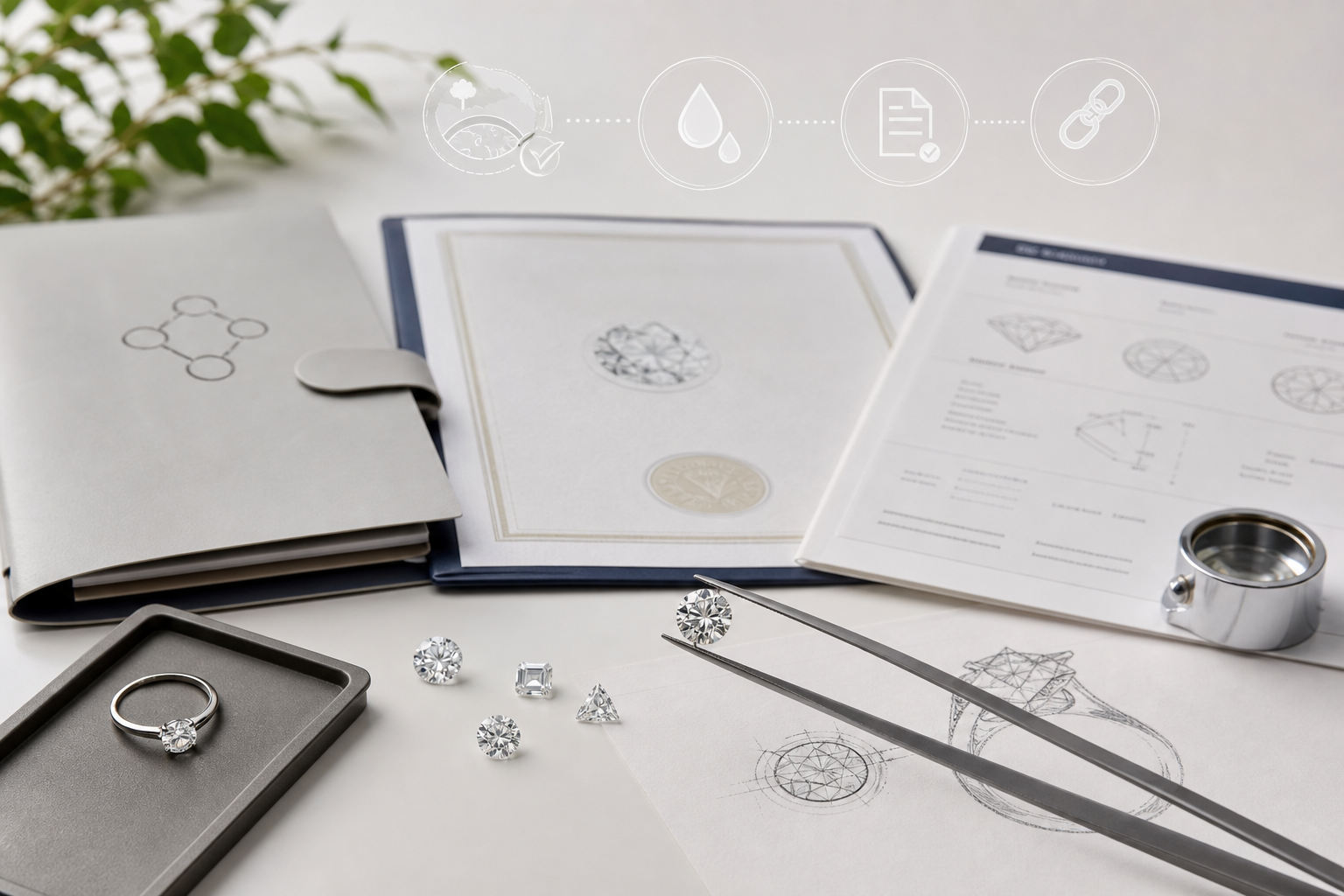
Natural diamond sustainability is not a simple yes-or-no label. A mined diamond can come with responsible sourcing documentation, origin information, and chain-of-custody support, but it still begins with extraction from the earth. That means buyers should think beyond the headline claim and ask what kind of evidence is actually available. A seller saying a diamond is responsibly sourced is useful only if the claim is specific enough to verify.
The main issue is that natural diamonds carry different kinds of impact at different stages. Some concerns are environmental, such as land disruption, water use, energy use, and long-term site management. Others are social or supply-chain related, such as origin transparency, labor oversight, and community impact. A buyer asking are mined diamonds sustainable is really asking how much of that impact has been documented, reduced, or responsibly managed. That is a better question than assuming every natural diamond is either good or bad.
Mining impact is broader than carbon footprint
It is a mistake to reduce natural diamond sustainability to carbon alone. Carbon matters, but it does not tell the whole story. Diamond mining can involve land use, habitat disruption, water management, heavy equipment, transportation infrastructure, and site restoration after extraction ends. Some of those effects are temporary and some can last much longer, which is why a buyer should look at more than a single environmental claim.
For responsible natural diamond buying, the practical question is not whether mining has any impact at all. It does. The real question is whether a seller can explain how that impact is managed, especially when buyers are comparing lab grown vs natural diamonds for engagement rings, and whether the diamond’s origin is documented well enough to support the claim. A broad statement about sustainability is much less useful than a clear explanation of what was measured, what was improved, and what remains uncertain.
“Conflict-free” is not the same as fully traceable
Many buyers see conflict-free as the main proof point for a natural diamond, but that language only addresses a limited set of concerns. It can help screen for certain conflict-related risks, yet it does not automatically answer questions about environmental impact, labor conditions, or the exact mine origin. A diamond can be conflict-free and still have a weak paper trail.
That distinction matters because conflict screening and full traceability are not the same thing. If a seller says a diamond is conflict-free, the next question should be what that actually covers and what it does not. Buyers who want to know how to verify a natural diamond source should ask whether the claim is tied to a documented chain of custody, whether the stone can be traced back to a known origin, and whether any third-party program is involved. Without that detail, the claim is too broad to carry much weight.
Origin documentation can help, but it has limits
Origin documentation is useful when it is real, specific, and connected to the individual stone. Mine-to-market traceability can make a natural diamond easier to evaluate because it gives the buyer a clearer picture of where the diamond came from and how it moved through the supply chain. That is valuable, especially for buyers comparing responsibly sourced diamonds across different sellers.
Still, origin documentation does not prove everything. It may show where a diamond started, but not every environmental or labor detail along the way. It may confirm a sourcing story without fully explaining the methods used at each stage. Buyers should treat origin claims as one layer of evidence, not the full answer. The stronger the documentation, the more useful it may be, but even detailed paperwork should be read carefully to see exactly what it covers.
How to read chain-of-custody language without overextending it
Chain-of-custody language is most helpful when it explains how the stone was tracked from one stage to another. A useful statement may identify the origin point, describe how custody was maintained, and clarify whether the documentation applies to the individual diamond or to a broader group of stones. If the wording only says that a supplier follows a responsible policy, that may be useful background, but it is not the same as stone-specific traceability.
Buyers should also notice whether the documentation follows the diamond through cutting, polishing, grading, setting, and sale. A record that is strong at the origin stage can still leave gaps later in the supply chain. The goal is not to demand impossible certainty; it is to understand where the evidence is strong, where it becomes general, and where assumptions begin.
Certificate and Source Claim Review
Before trusting a sustainability claim, buyers should compare the grading report, any origin statement, the seller’s sourcing explanation, and any responsible sourcing documentation provided with the stone. A grading report can help identify the diamond, but it does not automatically prove how the diamond was mined or whether the sourcing story is complete. The source claim matters just as much as the stone itself.
Ask what is verified, who verifies it, and whether the documentation follows the diamond from origin to sale. If the answer is vague, the claim is weaker than it sounds. For a buyer trying to compare lab-grown vs natural diamonds sustainability factors responsibly, the better choice is not the one with the loudest label. It is the one with the clearest trail of evidence.
Documentation Buyers Should Look For Before Trusting Sustainability Claims
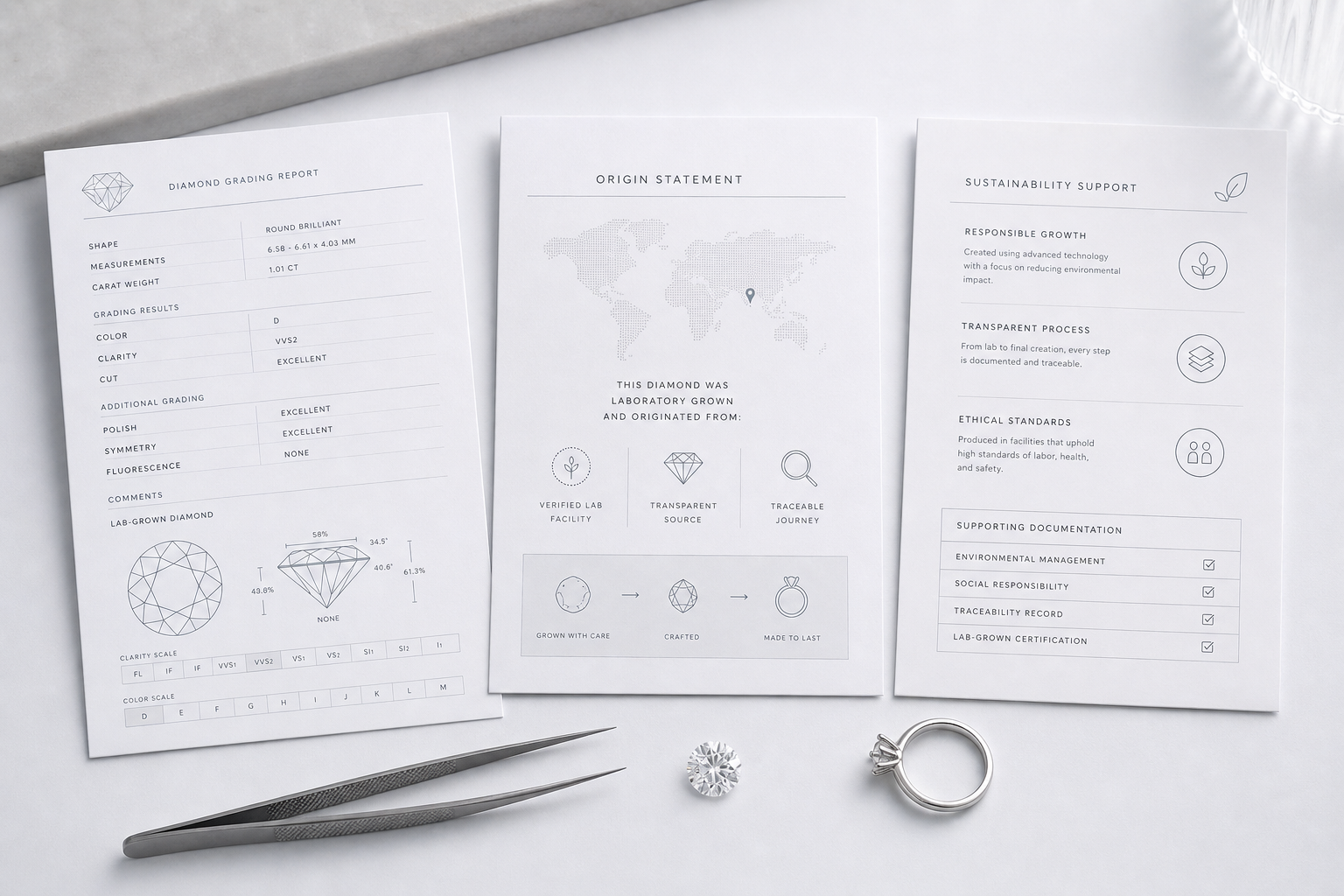
Diamond certification and sustainability documentation are related, but they are not the same thing. A grading report tells you important gemological facts, but it does not automatically prove environmental performance or sourcing responsibility. Buyers often assume a report settles the sustainability question, when in reality it only answers part of it.
That distinction is important whether you are evaluating a lab-grown diamond certificate or a natural diamond grading report. The report may confirm what the diamond is, but sustainability claims need separate support. If a seller uses terms like ethical diamonds or sustainable diamonds, the buyer should expect more than a polished phrase. The documentation should show how the claim is supported, not just how it is marketed.
What a grading report can confirm
A grading report can confirm the diamond’s identity and core gemological details. That usually includes whether the stone is lab-grown or natural, along with carat weight, color, clarity, cut details when applicable, measurements, and a report number that can be checked with the issuing lab. This is useful because it helps a buyer verify that the stone being sold matches the stone described on paper.
For many buyers, that is the starting point for how to verify diamond sustainability claims without getting lost in vague language. A report can tell you what the diamond is, but it does not tell you everything about how it was sourced or produced. That is why the report matters, but it cannot be treated as the whole story.
When a grading report is available, buyers should verify the report details through the issuing laboratory’s official report-check tool where available, then compare those details with the seller’s stone description and visual evidence.
What a grading report usually does not prove
A grading report generally does not prove the energy source used in production, the carbon footprint of the diamond, worker conditions, recycled metal content, or the full chain of custody. It is a gemological document, not a sustainability audit. That limitation is easy to overlook because buyers often see a report as a mark of trust, and it is one kind of trust, just not the complete kind.
This is where diamond sustainability documentation needs to be separated from product quality documentation. A stone can have a legitimate report and still have unclear environmental or sourcing claims. Buyers who understand that difference are much less likely to be misled by a seller’s language.
How to read the claim before you read the brochure
A useful habit is to read the sustainability sentence first and ask what it is actually promising. Does it describe the stone, the process, the seller, or the finished jewelry? Does it name a facility, an origin, a standard, or a date? If not, the sentence may sound convincing without offering enough detail to judge it.
The same habit works for both lab-grown diamond verification and natural diamond sourcing review. If the claim changes from sentence to sentence, or if the wording becomes broader when you ask for specifics, the evidence may be weaker than the presentation suggests. Buyers do not need to become compliance experts, but they do need to notice when a claim has no clear boundary.
What stronger sustainability documentation may include
Stronger documentation may include facility disclosures, third-party audits, carbon accounting reports, renewable energy statements, recycled metal documentation, and written sourcing policies. Some sellers provide more of this than others, and availability can vary widely. The point is not that every purchase must come with a full dossier. The point is that the more specific the claim, the more specific the evidence should be.
If a seller wants the buyer to trust a sustainability claim, the proof should match the claim’s size. A general statement about responsibility is weaker than a document that shows the production facility, energy source, or sourcing policy behind it. Buyers do not need every detail on every purchase, but they do need enough detail to decide whether the claim is meaningful.
For certificate-aware buying, the grading report should also be compared with the actual stone information available to the buyer, such as measurements, proportions, images, videos, and the intended setting. A well-documented sustainability claim does not automatically mean the diamond is the right visual or design choice. A stronger buying decision connects both sides: the stone is properly identified, the claim is supported, and the diamond still makes sense for the jewelry being made.
How to match documents to the exact diamond being considered
One of the simplest traceability checks is to match identifiers across documents. The report number, carat weight, measurements, shape, inscription details when available, and product listing should line up logically. Small formatting differences are normal, but major inconsistencies should be clarified before the buyer treats the documents as belonging to the same stone.
This matters because sustainability and sourcing statements are sometimes written at a collection or supplier level rather than for one individual diamond. A collection-level statement may still be useful, but buyers should know its scope. Ask whether the production disclosure, origin statement, or metal record applies to the specific diamond and setting under review, or whether it is a broader statement about general practices.
How to Verify This Before Buying
Verify the grading report number on the issuing lab’s website. Then ask which sustainability claims are documented separately and whether those documents apply to the diamond, the setting, or the company as a whole. If a seller uses broad terms like carbon-neutral, eco-friendly, or sustainable, ask for written clarification. A careful answer is more valuable than a confident slogan.
Marketing Language to Treat With Caution
Words like eco-friendly diamonds, ethical diamonds, sustainable diamonds, and responsibly sourced can be useful, but only when they are defined. Without context, these terms sound reassuring while saying very little. The problem is not that every claim is false. The problem is that many claims are incomplete, and incomplete claims are easy to overread.
Buyers comparing lab-grown or natural stones should treat these phrases as prompts for more questions, not as conclusions. A good claim should tell you what was measured, what standard was used, and what part of the supply chain the statement actually covers. If it cannot do that, the claim is too soft to carry much weight.
“Eco-friendly” is too broad without specifics
Eco-friendly sounds positive, but it does not explain what environmental factor is being improved. Is the seller referring to lower energy use, less land disruption, more responsible packaging, recycled metals, or something else entirely? Without that detail, the phrase is too vague to help a buyer make a real judgment.
That is why buyers should ask what the claim is actually measuring. A diamond can be less damaging in one area and still raise questions in another. The label does not tell you which one matters most.
“Carbon-neutral” depends on accounting and offsets
Carbon-neutral claims deserve especially careful reading because the phrase depends on accounting methods, boundaries, and offsets. A seller should be able to explain what emissions were counted, how they were measured, and whether reductions came from actual operational changes or from offset purchases. Those are not the same thing.
Carbon-neutral can be a meaningful claim, but only if the methodology is clear. If a buyer cannot tell whether the number reflects direct reductions or purchased offsets, the claim is weaker than it appears. This is one of the most common places where greenwashing concerns show up, because the wording sounds final even when the evidence is not.
“Ethical” and “responsible” need defined standards
Ethical and responsible sound strong, but they are value words, not proof. They only become useful when they are tied to traceable sourcing, labor standards, documentation, or third-party review. Otherwise, the terms describe intent more than evidence.
For responsible natural diamond buying, the buyer should ask what standard the seller is using. If the answer is specific, the claim has more value. If the answer is just another broad reassurance, the language is doing more work than the documentation.
Evidence gaps buyers can catch quickly
Some of the easiest red flags are also the most revealing. A claim that changes depending on who answers the question, a sustainability statement with no date or scope, or a product page that uses strong language but provides no supporting document are all signs that the evidence may not be mature enough to trust.
Another common gap is when the seller talks about the company’s values instead of the exact diamond being purchased. Company values may matter, but they are not the same as stone-specific documentation. Buyers should be careful not to confuse brand story with proof.
- Ask whether the claim applies to one stone, one collection, or the whole company.
- Ask whether the claim is about the diamond, the setting, the packaging, or the entire order.
- Ask whether the documentation is current or just general background material.
- Ask whether the seller can explain the claim in plain language without changing the meaning.
Claim-by-Claim Buyer Check
For every sustainability claim, ask four things: What exactly is being claimed? What evidence supports it? Who verified it? Does the claim apply to the diamond, the setting, the company, or only part of the supply chain? Those questions keep the conversation grounded and prevent a vague phrase from standing in for proof.
Careful buyers do not need to accept every label or reject every label. They need to separate useful information from marketing language and make the decision based on what can actually be verified.
A Practical Buyer Scenario: Choosing Between Two Diamonds With Different Sustainability Evidence
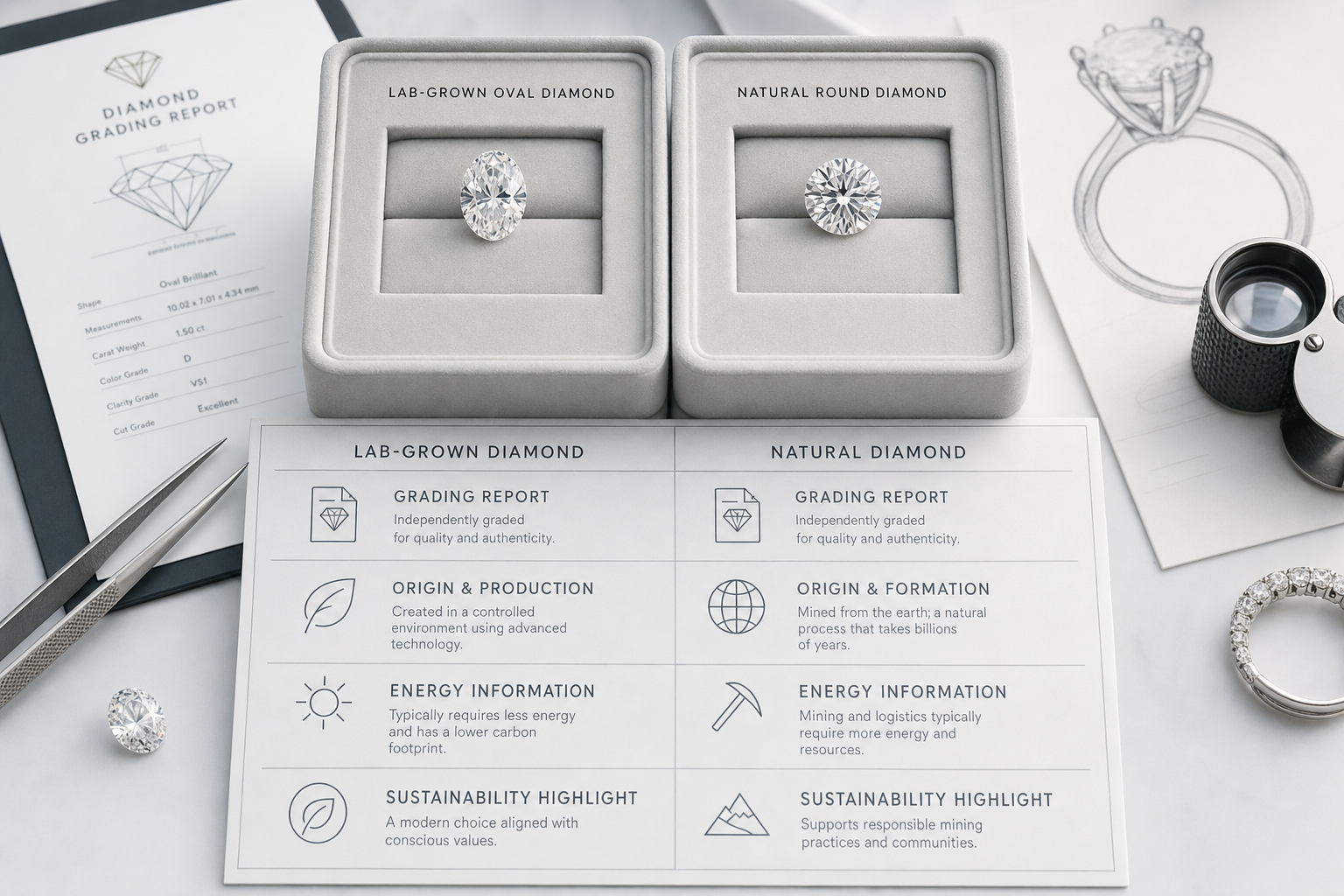
Maya is shopping for a sustainable engagement ring and has narrowed it down to two very different options. One is a 1.50 ct lab-grown oval diamond with an IGI grading report and a seller statement that the stone was produced with renewable energy. The other is a 1.20 ct natural round diamond with origin documentation and responsible sourcing information. On paper, both sound appealing. In practice, the better choice depends on which claim is actually better supported.
This is where the lab-grown vs natural diamond sustainability question becomes more useful. Maya is not really choosing between “good” and “bad.” She is choosing between two sets of evidence, and those evidence sets do not mean the same thing. The lab-grown stone may avoid mining-related impact, but its sustainability claim depends on how the diamond was produced and whether the energy disclosure is specific. The natural stone may carry more mining-related baggage in principle, but stronger origin documentation can make its sourcing easier to evaluate.
The decision point: bigger lab-grown stone or more documented natural origin
If Maya cares most about size, the lab-grown option has an obvious advantage. She gets a larger stone for the same budget and a clearer path to comparison through the grading report. But if she cares most about traceability, the natural diamond may feel more convincing because the seller can point to origin documentation and responsible sourcing language. The point is not that one category wins automatically. The point is that sustainability evidence changes the meaning of the comparison.
A larger lab-grown diamond is not automatically the better sustainable choice if the seller cannot explain the energy source or production context. A smaller natural diamond is not automatically the worse choice if its origin can be documented more clearly than the lab-grown stone’s energy claim. For a real buyer, those details matter more than the category label alone.
The tradeoff: visual size, budget, traceability, and claim quality
This kind of diamond buying decision usually involves more than sustainability. Maya is also weighing size, design, budget, and how much certainty she wants from the paperwork. A lab-grown diamond may offer stronger visual size for the same budget. A natural diamond may offer a different kind of reassurance if the sourcing trail is clearer. Durability is not the deciding issue here, because both can last; the real difference is how much confidence the buyer has in the claim behind the stone.
That is why the loudest claim is rarely the most useful one. “Renewable energy” sounds persuasive, but it is only useful if it is tied to a real production source or facility disclosure. “Responsible sourcing” sounds reassuring, but it still needs to be explained. A sustainable engagement ring should be judged on the quality of the evidence, not the strength of the wording.
Price and value comparisons need like-for-like context
Budget often enters the sustainability discussion because a laboratory-grown diamond and a natural diamond with similar visible size can have very different price points. That does not mean one is automatically the better value. Prices can vary because of cut precision, report type, seller channel, size, shape, availability, and documentation. Buyers should compare like-for-like specifications before treating one stone as a better value.
Resale value, long-term value, and investment language should be treated especially carefully. A diamond purchase is usually a personal jewelry decision, not a guaranteed financial outcome, and in discussions of lab-grown vs natural diamonds, price and sustainability claims should be separated from unsupported investment projections. If a seller makes claims about savings, value retention, or market advantage, the buyer should ask for date-specific, source-backed context and should not rely on unsupported projections.
The outcome: choose the better-supported claim, not the louder claim
Maya’s strongest decision is the one she can defend after reading the documents. If the lab-grown diamond comes with a grading report that can be checked and a clear, specific energy disclosure, that may be the stronger choice. If the natural diamond comes with better origin documentation and a more complete sourcing explanation, that may be the more convincing option. The right answer is not “lab-grown always” or “natural always.” It is the diamond with the claim that is better supported.
For buyers asking should I choose lab-grown or natural diamond, the practical answer is to compare diamond sustainability evidence directly. A smaller natural diamond with stronger traceability can be a more suitable purchase than a larger stone with vague marketing. A larger lab-grown diamond can still be the better choice if the production claim is documented well enough to trust.
What This Means in a Real Purchase
Before buying, create a side-by-side comparison of the diamond type, carat weight, grading report, origin or production disclosure, energy information, seller claim, and anything that still is not verified. That simple comparison makes it easier to see whether you are looking at a well-documented stone or just a better phrase.
Useful Numbers and Benchmarks for Evaluating Sustainability Claims
Buyers do not need exact carbon figures to make a smarter decision. What they do need is a way to judge whether a sustainability claim is specific, documented, and worth trusting. A good diamond sustainability checklist does not measure environmental perfection. It measures how much of the claim can actually be checked.
The most useful benchmark is not a number for emissions. It is a number for evidence. If a seller can only offer one vague statement, the claim is weak. If the seller can support the claim with a grading report, production or origin disclosure, and written explanation, the claim becomes more credible. For finished jewelry, the metal matters too, especially if recycled metal is part of the sustainability story.
A 5-point evidence checklist for any sustainability claim
Start with five checks. First, confirm the diamond type through the grading report. Second, look for production or origin information. Third, ask for energy or sourcing disclosure. Fourth, check whether the metal in the finished piece is documented if the jewelry includes a setting. Fifth, require a written explanation of broad terms like “eco-friendly” or “responsibly sourced.”
If all five are present, the claim is much easier to evaluate. If only one or two are present, the claim is probably too thin to rely on. This is especially important when comparing lab-grown diamond verification against natural diamond sourcing language, because the type of proof is different for each one.
A 3-level claim strength framework
A low-confidence claim is vague and unsupported. It may sound appealing, but it does not tell you much. A medium-confidence claim usually includes a grading report and a seller explanation, which is better but still incomplete. A strong claim combines the grading report with specific energy, origin, sourcing, or third-party documentation.
That framework is more useful than trying to rank every diamond by a single sustainability score. Buyers often overestimate what a polished marketing statement can prove. The real question is not whether the claim sounds responsible. It is whether the claim is documented well enough to matter.
A 10-minute pre-purchase review process
You do not need an hour to review a stone responsibly. Spend two minutes verifying the report number. Spend three minutes reading the sustainability language carefully. Spend three minutes comparing what is actually documented versus what is only implied. Use the final two minutes to write down the questions the seller still has not answered.
That short process is usually enough to expose weak claims. If a seller cannot explain the difference between the diamond itself, the setting metal, and the company’s broader sourcing policy, the sustainability message is probably too broad. A careful buyer should leave with fewer assumptions, not more.
For wholesale or multi-stone purchases, consistency becomes another practical benchmark. One well-documented stone does not automatically prove that every matching stone in a parcel has the same production, origin, or sustainability evidence. Buyers sourcing multiple lab-grown diamonds should ask whether reports, disclosures, and communication are consistent across the full selection, not just the featured example.
In sourcing or wholesale conversations, documentation, consistency, and communication often matter as much as the headline specification. If a buyer needs several stones for a collection, matched jewelry line, or repeat order planning, it is worth clarifying how reports are shared, how sustainability statements are scoped, and whether the same documentation standard applies across the stones being compared. That keeps the conversation focused on fit and transparency rather than assumptions.
What to keep in your own buyer file
If you want to compare options cleanly, save the report, the seller’s sustainability statement, any origin or production note, and the exact version of the product page you reviewed. That makes it easier to compare claims later if the listing changes or if you need to ask follow-up questions. A buyer file does not need to be complicated; it just needs to be organized enough that the claim can be checked again.
A simple file also helps when you are comparing several similar stones. Two diamonds may look nearly identical in photos, but the documented evidence behind them may be very different. Keeping the paperwork together makes the difference easier to see.
Buyer Verification Checklist
Before buying, confirm at least three things in writing: the diamond’s grading report details, the exact sustainability claim being made, and the documentation that supports that claim. If the jewelry is finished, ask whether the metal sourcing or recycled metal content is documented as well. If any of those answers are missing, the claim should be treated as incomplete.
How to Compare Lab-Grown and Natural Diamonds Without Turning It Into a Moral Shortcut
The cleanest way to compare lab-grown and natural diamonds is to decide what matters most before you start reading claims. Some buyers want lower mining impact. Others care more about traceability. Some want stronger energy disclosures. Others care about budget, size, or heirloom value. A useful ethical diamond buying decision is usually the one that matches the buyer’s priorities and can be verified with real evidence.
This is where a sustainable diamond comparison becomes practical instead of ideological. A lab-grown diamond may be the better choice if you want a clearer path to production disclosure and lower dependence on mining. A natural diamond may be the better choice if the sourcing story is stronger, more traceable, or more meaningful to the buyer. The right answer changes depending on what the documentation actually shows.
Start with the impact category you care about most
Separate energy, mining impact, traceability, budget, and design priorities before making the decision. If your main concern is avoiding mining disruption, lab-grown may deserve more attention. If your main concern is origin documentation, a natural diamond with a stronger chain of custody may be easier to trust. If your main concern is budget, you may end up comparing size and documentation together rather than treating sustainability as the only factor.
That order matters. Buyers often start with a broad question like is lab-grown better than natural for sustainability, but the answer is only useful when narrowed to the specific concern behind it. Energy and mining are not the same issue, and a seller who merges them into one vague claim is not helping the buyer make a better decision.
Compare documentation side by side
Do not compare the diamonds only by carat or shape. Compare the paperwork and the language behind it. One stone may have a stronger grading report but weaker sustainability disclosure. Another may have a more modest size but better origin information. A simple side-by-side review makes the differences visible instead of leaving them buried in marketing copy.
For buyers who want a more sustainable engagement ring, this comparison should include what is known, what is claimed, and what is still unverified. That is often the difference between a confident purchase and a hopeful one.
Choose the claim you can understand and verify
The most responsible choice is not the one with the most flattering slogan. It is the one you can explain back in plain language. If you cannot tell whether a sustainability claim applies to the diamond, the setting, or the whole brand, the claim is too broad to rely on.
Buy the stone whose evidence makes sense to you. If you are still unsure after reviewing the report, the origin or production disclosure, and the seller’s explanation, ask for more detail before deciding. A clear answer is worth more than a confident-sounding one.
What to Confirm Before the Final Purchase
Before checking out, confirm the grading report, the sustainability claim, the seller’s explanation, the setting metal details, and any return or service policies directly with the seller. If you are comparing options, keep the focus on what is documented rather than what is implied. That is usually the fastest way to separate a real sustainability case from a vague one.
If a brand like NUVU is part of your search, the useful question is not whether the branding sounds ethical. It is whether the diamond selection process is transparent enough for you to verify.
At NUVU, this kind of comparison is best treated as a practical selection question rather than a single-label decision. The report can narrow the field, but the final choice still needs to make sense visually, physically, financially, and in relation to the sustainability evidence attached to that particular stone.
How Documentation Support Builds Buyer Confidence at the Selection Stage
A trustworthy diamond buying process should make verification feel normal, not awkward. When a buyer asks for a grading report number, a production or origin explanation, or clarification about a sustainability phrase, the answer should be direct and document-aware. That does not mean every diamond will have the same level of sustainability evidence, but it does mean the seller should clearly separate what is confirmed from what is only a general claim.
For lab-grown diamonds, the most useful support often starts with matching the stone to its report and then discussing the buyer’s priorities: size, shape, cut quality, budget, setting style, and any available production disclosures. For natural diamonds, support usually requires a different conversation around origin records, sourcing statements, and what those records can and cannot prove. In both cases, the buyer should leave with a clearer understanding of the stone, not just a stronger emotional impression of the brand.
Custom jewelry adds another layer of trust because the finished ring or piece may change the sustainability discussion. A buyer choosing recycled metal, a specific setting style, or a lower-profile design should be able to ask how those choices affect the final order. Good communication connects the diamond report, the setting details, and the buyer’s priorities so the final piece is not only beautiful, but also easier to explain and document.
For custom design, trust comes from matching the stone to the setting, budget, and wearer’s daily use, not from choosing grades in isolation. A diamond with strong documentation can still be a poor fit if its measurements do not suit the intended setting, if the shape changes the look of the design, or if the sustainability claim applies only to the loose stone while the finished jewelry uses materials that have not been discussed.
Custom design claims should stay tied to measurements and materials
For custom jewelry, stone measurements and setting compatibility should be confirmed before finalizing a purchase. This includes checking the diamond’s dimensions, depth, girdle, shape outline, and any practical setting requirements that could affect durability, appearance, or metal use. A grading report can support identification, but it does not by itself confirm that a stone will fit a specific design.
If sustainability is part of the custom design brief, the buyer should ask whether the documentation applies to the diamond alone, the metal choice, the manufacturing process, or the complete finished piece. That distinction keeps the final claim accurate and prevents a loose-stone sustainability statement from being stretched across the entire jewelry item without support.
When a grading report is provided, buyers should compare the report details with the issuing laboratory’s verification tools where available and ask which sustainability or sourcing documents are separate from the grading report.
FAQ: Lab-Grown vs Natural Diamonds and Sustainability
Are lab-grown diamonds always more sustainable than natural diamonds?
Not always. Lab-grown diamonds can reduce some mining-related impacts, but that does not make every stone automatically sustainable. The main variables are energy source, production practices, and how much the seller is willing to disclose. A lab-grown diamond made with unclear electricity sourcing and vague “eco-friendly” language is a weaker claim than one backed by specific documentation. The better question is not which category sounds greener, but which stone comes with evidence you can actually verify.
Does a diamond certificate prove sustainability?
Usually no. A grading report or diamond certificate can confirm gemological details such as the stone’s identity, measurements, and whether it is lab-grown or natural. It does not usually prove renewable energy use, mining impact, labor conditions, recycled metal content, or full supply-chain responsibility. Buyers should treat the certificate as one useful document, not the whole sustainability story. If a seller makes environmental claims, ask what separate documentation supports them and whether the claim applies to the diamond, the setting, or both.
Is “conflict-free” the same as ethical?
No. “Conflict-free” addresses one specific concern, but it does not automatically prove broader ethical or environmental responsibility. A diamond can be screened for conflict-related issues and still leave open questions about origin traceability, production practices, labor standards, or environmental impact. That is why the term should be treated as a starting point, not a final verdict. If ethical buying matters to you, ask for the exact standard behind the claim and whether there is written support beyond the marketing language.
What is the strongest sustainability evidence a buyer can ask for?
A stronger case is a combination of verified grading information, clear production or origin disclosure, and written documentation that supports the sustainability claim being made. For a lab-grown diamond, that may include energy or facility disclosures. For a natural diamond, it may include origin and sourcing documentation. If the jewelry includes a setting, recycled metal information can also matter. The key is not just having a claim, but having enough evidence to show what was checked and what still remains unverified.
How to Keep FAQ Answers Evidence-Based
For any sustainability claim, ask for one practical proof point before you trust it. That could be a report number you can verify, a written source disclosure, or a clear explanation of what the seller means by “eco-friendly,” “ethical,” or “carbon-neutral.” If the answer stays broad, the claim is probably weaker than it sounds. A good rule is simple: if the seller cannot explain the evidence behind the statement in plain English, the buyer should not treat the statement as decisive.
Next Steps for Comparing Diamond Evidence
If you want to keep comparing options, review diamond grading and certificate reading, then take a focused look at loose lab-grown diamonds or engagement ring settings. If you are still deciding between stones, a specific buying guide can help keep the decision tied to documentation, appearance, and intended use.
Compare lab-grown diamonds with clear grading information, or ask for help reviewing diamond documentation before choosing a stone. If you are planning a ring, a setting guide or custom design page can help connect the stone choice to the finished piece without losing sight of the sustainability questions that matter most.
NUVU can be a helpful resource for transparent lab-grown diamond education and guided selection, but the real test is still the specific report, source disclosure, and supporting documentation attached to the stone in front of the buyer.
Disclosure: This article is for general educational purposes only. Diamond grading, pricing, availability, specifications, and seller policies can change, and readers should verify important details through grading reports, official laboratory tools, seller documentation, or qualified professionals before making a purchase decision. Laboratory-grown diamonds should be clearly distinguished from natural diamonds, and environmental or sourcing claims should be supported by specific documentation.