 Get a Quote
 Loose lab-grown diamonds10 shapes · IGI, GIA or NGTC reports
Lab-Grown Diamond Jewelry Guide: How Lab Diamonds Fit Beyond Engagement Rings
- What to prioritize in each category
- Why lab-grown changes jewelry design
- How to read a jewelry description
- Approximate stone sizes behind common totals
- Choose by how the piece will be worn
- Reports, parcels and descriptions
- Melee and small stones
- Settings and wear
- Metal
- Fancy color lab-grown diamonds
- Budget and custom
- For retailers and brands
- Care
- Category guides
- Lab-grown jewelry questions
- Find the piece, or the collection
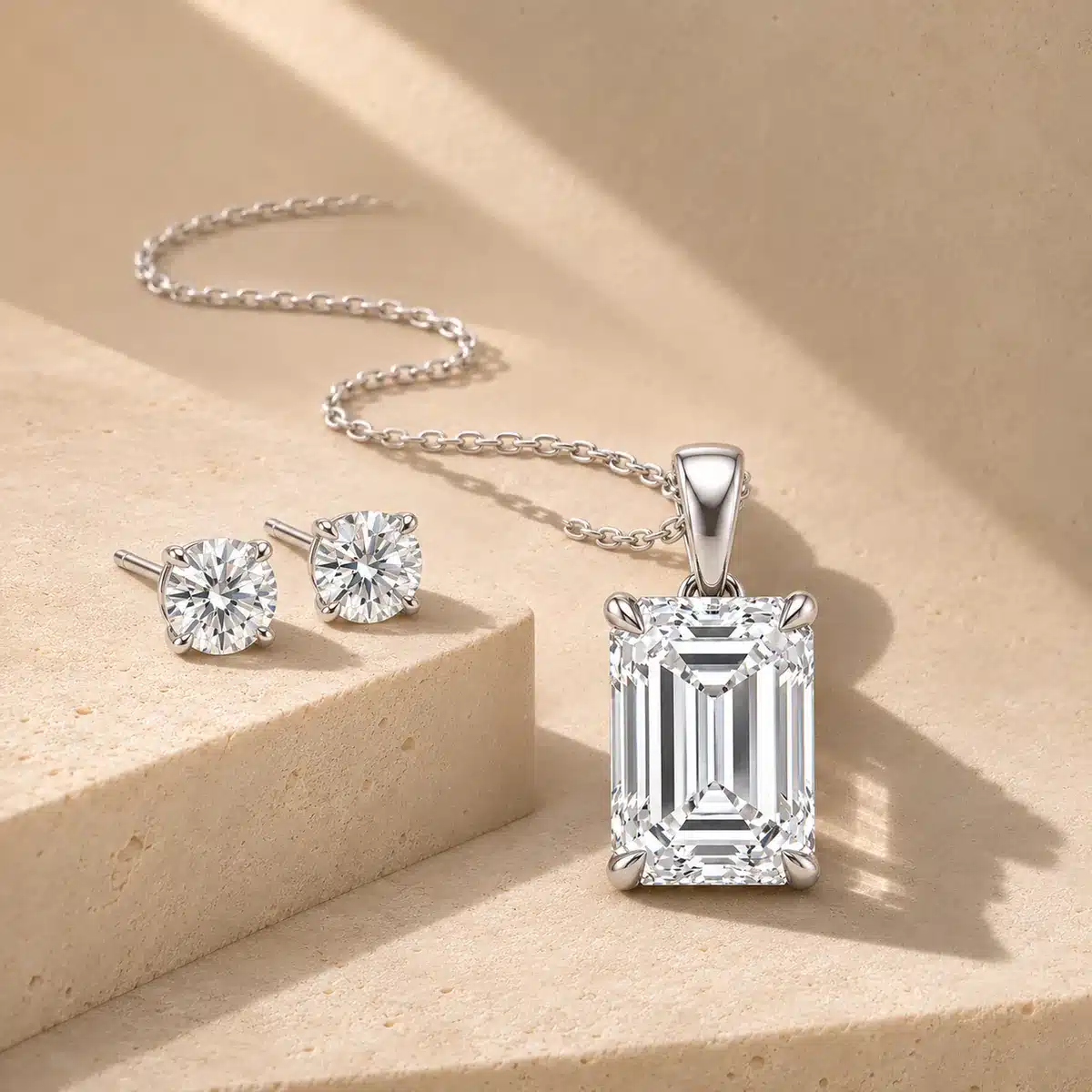
A pair of studs described as “1 ct tw” holds two stones of about 0.50 ct each, roughly 5.1 mm across. A tennis bracelet described as “5 ct tw” may hold about 45 stones of 0.11 ct, each close to 3 mm. Both descriptions are about total weight, and both tell you little about what matters on the ear or the wrist: whether the two studs match, and whether fifty small stones look like one even line. Buying lab-grown jewelry beyond the engagement ring is mostly about reading those descriptions correctly.
Lab-grown diamonds suit every kind of fine jewelry. Because they cost much less than mined diamonds of the same size and grades, larger studs, fuller tennis bracelets, bolder pendants and multi-stone designs come within reach. Each category needs its own buying logic: earrings need a matched pair, bracelets and pavé need consistent small stones and sound construction, and pendants are seen from a distance, so cut counts for more than top clarity. Choose by how the piece will be worn, then check the stones, the setting and the description.
What to prioritize in each category
Choose a category:
Why lab-grown changes jewelry design
With mined diamonds, price climbs steeply with size, so most fine jewelry outside bridal uses small stones. Lab-grown diamonds change that:
- Larger centers outside bridal. A 1 ct pair of studs or a 2 ct pendant becomes realistic for many buyers.
- More and larger stones per piece. Tennis bracelets, eternity bands and riviera necklaces can use bigger, better-matched stones.
- Shape freedom. Pears, marquises, emerald cuts and other fancy shapes appear in everyday designs.
- Easier matching. Stones of similar color and size are easier to gather for multi-stone layouts.
How to read a jewelry description
- TCW (total carat weight) is the combined weight of every diamond in the piece, not the size of any one stone. Divide by the number of stones to get a rough per-stone weight.
- Decimal and fractional weights. In the US, the FTC Jewelry Guides require a decimal weight such as “.47 ct” to be accurate to its last digit. A fraction such as “1/2 ct tw” must come with a clear note that the weight is not exact, and the range it covers.
- A quality range, for example “G–H, VS–SI”, describes small stones as a group.
- “Laboratory-grown” or “laboratory-created” has to qualify the word diamond for every lab-grown stone. “Cultured” may only be used with a clear statement that the stone was not mined. If a piece mixes lab-grown and natural stones, each type is named.
- Metal stamps (14K or 585, 18K or 750, Pt950) give the metal’s fineness.
A description that says only “diamond” for a lab-grown piece is incorrect under the FTC Guides.
Approximate stone sizes behind common totals
Swipe the table to see more →
| Description | Stones | Approx. weight each | Approx. diameter each (round) |
|---|---|---|---|
| Studs, 0.50 ct tw | 2 | 0.25 ct | 4.1 mm |
| Studs, 1.00 ct tw | 2 | 0.50 ct | 5.1 mm |
| Studs, 2.00 ct tw | 2 | 1.00 ct | 6.4 mm |
| Tennis bracelet, 3 ct tw, 7 in | about 50 | 0.06 ct | 2.5 mm |
| Tennis bracelet, 5 ct tw, 7 in | about 45 | 0.11 ct | 3.0 mm |
Diameters are typical for well-cut rounds; deep or shallow stones differ. Bracelet stone counts vary with the design.
Choose by how the piece will be worn
Every day. Low-profile settings, bezels or sturdy prongs, secure closures and a comfortable weight. Studs with screw backs or firm friction backs, pendants that lie flat, and bracelets with a box clasp and a safety latch hold up best.
Occasions. Drops, larger hoops, riviera necklaces and cocktail rings can take more height and movement. Heavy drops need a secure closure and the right post length.
Stacking. Lower settings and narrower bands stack well. Check how the pieces sit together, and choose matching metal colors or a deliberate contrast.
Reports, parcels and descriptions
Swipe the table to see more →
| Stone size | What usually comes with it | What to check |
|---|---|---|
| Center stones of about 0.30 ct and up | An individual report (IGI, GIA, NGTC or another laboratory) | Look the number up; read the growth and treatment comments |
| Matched pairs | Two reports | Matching measurements, color and appearance |
| Melee and small side stones | A description on the invoice | Approximate total weight, color and clarity range, lab-grown origin |
A report confirms one stone’s identity and grades. It does not show how stones look together, so video of the finished piece is the check for matching.
Melee and small stones
Most fine jewelry outside solitaires uses melee: small stones, usually under about 0.20 ct, sorted into sizes and quality ranges rather than reported one by one. For an even look, the stones in one piece, and across a set, should come from a matched parcel. Retailers and brands should agree size tolerances and quality ranges per SKU. Because lab-grown and natural melee look the same to the eye, screening is how a parcel’s origin is checked. See wholesale melee and calibrated stones.
Settings and wear
Swipe the table to see more →
| Setting | Security | Light | Notes |
|---|---|---|---|
| Prongs | Good | The most | Tips should be smooth |
| Bezel | The highest | Slightly less | Protects the edge |
| Channel | Very good | Good | Needs calibrated stones |
| Pavé, micro-pavé | Depends on the work | High sparkle | Stones should sit level |
| Tension | Varies | High | Needs precise engineering |
Pieces with many small stones should be checked about once a year.
Metal
14K gold is durable and cost-efficient; 18K has a richer color and is softer; platinum is dense and white but heavier, which is noticeable in earrings and bracelets. White gold needs replating over time. See best metal for diamond jewelry.
Fancy color lab-grown diamonds
Lab-grown yellow, blue and pink diamonds make colored jewelry more affordable. Some colors come from the growth process, others from treatment after growth, which has to be disclosed. See fancy color lab-grown diamonds.
Budget and custom
The total includes the stones, metal weight, setting labor, findings (clasps, backs, chains) and finishing. In multi-stone jewelry, labor and matching can be a large share. See the jewelry budget guide. Custom makes sense for a specific stone size or shape, a matching set, a personal motif or a design not sold ready-made; see the custom jewelry guide.
For retailers and brands
Buying finished lab-grown jewelry to resell means the same checks at volume: matching across units, a stone specification per style, sample approval before production, and inspection before shipment against agreed tolerances. Listings, tags and invoices must carry the lab-grown qualifier for every piece. See private label and OEM.
Care
- Clean with warm water, mild soap and a soft brush, especially under settings.
- Store pieces separately; diamonds scratch other jewelry and each other.
- Take off bracelets and rings for heavy work and sport.
- Check clasps, backs and prongs about once a year.
Category guides
- Earrings: studs, hoops and drops
- Necklaces and pendants
- Bracelets: tennis, bangles and custom
- Jewelry gifts
Lab-grown jewelry questions
Are lab-grown diamonds good for everyday jewelry?
Yes. They are as hard and durable as mined diamonds. Choose secure settings and closures for daily wear.
What does TCW mean?
Total carat weight: the combined weight of all the diamonds in the piece.
Do small accent stones need reports?
Usually not one by one. They are described with the piece: type, approximate weight and quality range.
Can a piece mix lab-grown and natural diamonds?
Yes, as long as each type is named in the description and on the invoice.
Find the piece, or the collection
Browse NUVU’s lab-grown earrings, necklaces, bracelets and rings, or send the category, stone sizes and metal you need, for one piece or a retail line. NUVU can arrange IGI, GIA or NGTC reports for center stones. Browse fine jewelry or send your requirements, or message us on WhatsApp / WeChat at +86 19118403930.

11+ years supporting global clients with lab-grown diamond product consultation and market analysis.
About NUVU. NUVU is the international brand of New Perspective Superhard Materials Co., Ltd. in Zhecheng, Henan, China. We grow HPHT lab-grown diamonds in-house and cut, polish and match stones in our own workshop.
Related Guides
How to choose an engagement ring
How to choose a lab-grown diamond engagement ring: are they a good choice, choosing the center stone, shape, setting…
Read more →EducationLab-grown diamond education
Every NUVU lab-grown diamond guide in one place: 4Cs, certificates, HPHT vs CVD, prices, shapes, engagement rings…
Read more →ShopShop by metal
Lab-grown diamond jewelry in platinum and 14K or 18K white, yellow and rose gold.
Read more →