
Choosing a diamond gift for a birthday, anniversary, or milestone often raises more questions than buying an engagement ring. Without the traditional guidelines of that purchase, it’s easy to overpay for grades you don’t need or pick a setting that doesn’t suit the recipient’s lifestyle. Lab-grown diamonds offer the same brilliance and durability as mined stones at a lower cost, but the real challenge, as outlined in an everyday lab grown diamond jewelry guide, lies in matching the stone, shape, and setting to the specific piece of jewelry and the person wearing it.
For the full framework, read Lab-Grown Diamond Jewelry Guide.
This guide breaks down the practical decisions behind meaningful diamond gifts—from how cut quality and clarity tolerance change between studs and bracelets, to why a bezel setting can be smarter than prongs for an active recipient. You will finish knowing exactly which specifications matter for the occasion and how to verify value before you buy.
For buyers, the practical point is not just what the report says, but how the stone performs visually and fits the intended design. A grading report helps narrow the shortlist, but it does not replace visual review or setting compatibility checks.
| Decision Point | Best For Gifts Under $2,000 | Best For Gifts Over $2,000 |
|---|---|---|
| Diamond Origin | Lab-grown (offers larger size for budget) | Lab-grown or natural (based on recipient’s values) |
| Shape Strategy | Elongated shapes (oval, pear, marquise) maximize perceived size per carat | Round brilliant for maximum sparkle; oval or cushion for unique look |
| Color & Clarity | Studs/pendants: G-I color, SI1-SI2 clarity; Rings/bracelets: D-F, VS+ | D-F color, VS+ clarity for all pieces |
| Setting Type | Bezel or halo for security and visible size | Prongs for brilliance; channel set for bracelets |
| Metal Choice | 14k yellow or white gold (durable, cost-effective) | Platinum for durability; 18k gold for color depth |
| Certification Need | IGI or GCAL report recommended | GIA or GCAL report essential |
| Sizing Flexibility | Choose designs that can be resized (avoid eternity bands) | Confirm exact size; custom sizing adds 2-4 weeks lead time |
Quick Questions Before You Read
Q: Can anyone tell the difference between lab-grown and natural diamonds in a gift?
No. Lab-grown and natural diamonds are chemically and optically identical. The only difference is a microscopic laser inscription visible under a jeweler’s loupe—not noticeable to the recipient.
Q: Is it safe to buy lab-grown diamond jewelry without seeing it in person?
Yes, if the seller provides a grading report from a recognized laboratory (IGI, GIA, or GCAL) and a 360-degree video of the actual stone. Before ordering, confirm the return policy directly with the seller.
Q: Do lab-grown diamond gifts lose all their value over time?
Resale value is typically lower than natural diamonds due to abundant supply. However, the purchase price is often significantly less upfront, making the value-for-money equation favorable for gifts focused on wear and enjoyment rather than investment. Prices can change with market conditions, report type, seller channel, and stone-specific details.
Q: Can I resize any lab-grown diamond ring after purchase?
No. Eternity bands and some full-bezel rings with continuous stone settings cannot be resized. Always verify with the retailer before buying, or choose a standard solitaire or three-stone setting that can be adjusted.
Why Lab-Grown Diamonds Are a Practical Choice for Meaningful Gifts
Diamond jewelry has always carried emotional weight, but for most buyers, the connection to engagement rings has made diamond gifts for other occasions feel either out of reach or overwrought. Lab-grown diamonds close that gap. They deliver the same material, the same brilliance, and the same lasting quality as natural diamonds, but at a price that makes birthday, anniversary, holiday, and milestone gifting financially sensible rather than extravagant.
The Gift Gap: Why Non-Engagement Diamond Jewelry Deserves Its Own Category
Most diamond buying advice centers on engagement rings, leaving gift buyers to guess at what works for birthdays, anniversaries, graduations, or holidays. That gap matters because the decision criteria are different. An engagement ring buyer is often locked into specific expectations about carat size, ring style, and budget floor. A gift buyer operates with more flexibility — and more anxiety about getting it right without overpaying.
Lab-grown diamonds shift the equation. Both CVD and HPHT production processes yield diamonds that are chemically, physically, and optically identical to mined stones. The only real difference is origin, and the result is a noticeable reduction in retail cost. That price advantage turns the typical gift budget of $300 to $3,000 into a range where a buyer can choose a larger stone, higher quality, or a more elaborate setting than a natural diamond budget would allow. The recipient experiences the same diamond, not a compromise version.
How the 4Cs Apply Differently for Gifts vs. Engagement Rings
The 4Cs are not a fixed formula. They shift in priority depending on the jewelry type, and gift buyers who apply engagement-ring standards to non-ring pieces usually overpay for grades that add no visible benefit.
Cut quality remains the single most important visual factor regardless of jewelry type. A well-cut diamond captures light and returns sparkle, and no other grade compensates for a poor cut. But color and clarity tolerances vary significantly by piece. Earrings and pendants sit farther from the eye than a ring, and they are rarely examined under direct comparison lighting. For these pieces, G to I color and SI1 to SI2 clarity deliver strong visual performance at a lower cost than the D–F, VVS ranges that ring buyers often pursue. The diamond looks white and clean in normal wear, and the savings can go toward a larger stone or higher karat gold.
Bracelets and rings are different. They sit closer to the eye, catch more direct light, and invite more scrutiny. For a tennis bracelet or a right-hand ring, higher color grades (D–G) and clarity grades (VS2 or above) may be worth consideration because inconsistencies can become noticeable at arm’s length. The practical rule is simple: the closer the piece sits to the eye, the more attention color and clarity may require.
The Disclosure Advantage: Documentation as a Gift Credibility Tool
A diamond gift without documentation is a question mark. The recipient has no way to know what they actually received, whether the quality matches what was paid, or how to insure, resize, or reset the piece later. A grading report from IGI, GIA, or GCAL solves that. It transforms the gift from an opaque purchase into a documented, verifiable item with known characteristics.
A grading report is valuable but not exhaustive. It documents key characteristics such as cut, color, clarity, and carat weight, but visual performance, proportions, and setting compatibility are not fully captured on a certificate. For buyers, the report narrows the field, but the final decision still depends on how the stone looks in motion and how it fits the intended design. For milestone gifts — anniversaries, graduations, major birthdays — the report number can be cross-checked on the lab’s website, giving the recipient independent proof of the stone’s documented qualities.
Buyer Verification Checklist
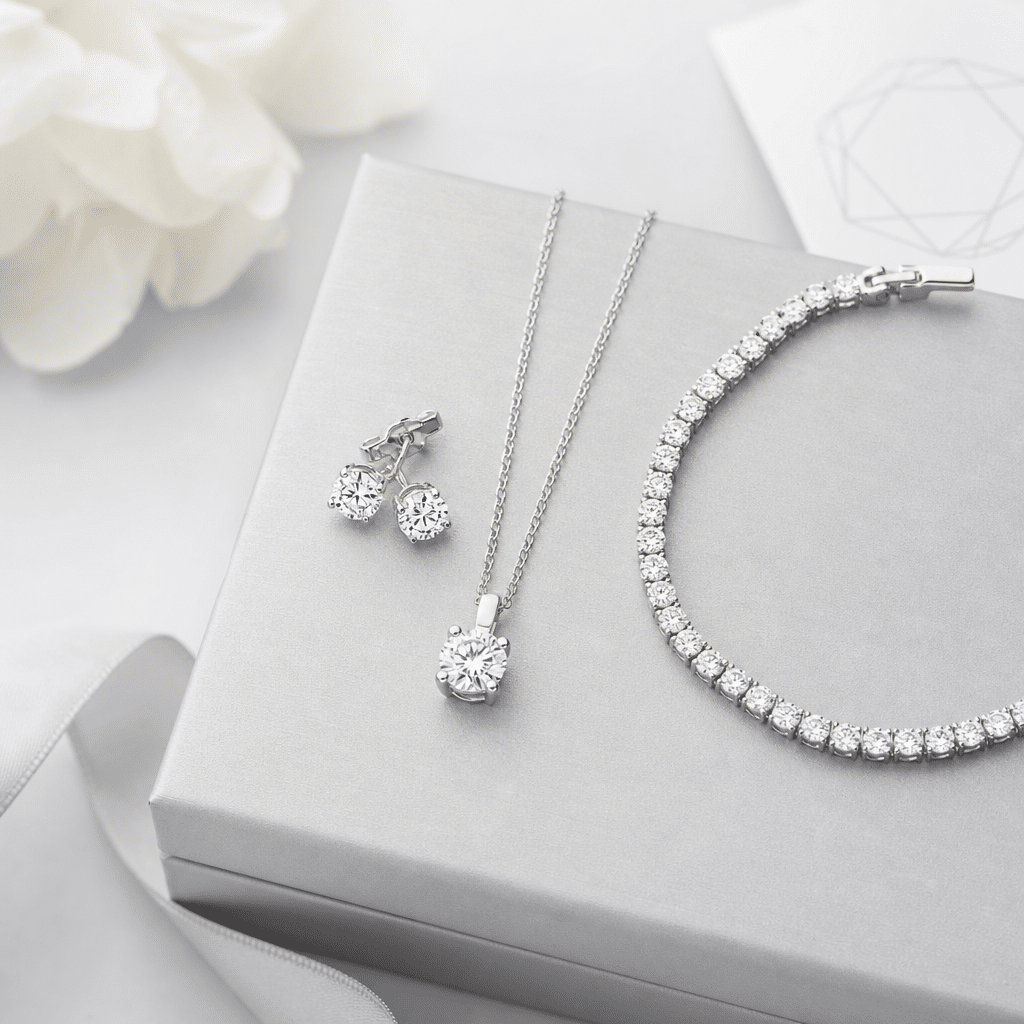
Before purchasing, confirm the stone comes with a grading report from IGI, GIA, or GCAL. Verify the report number directly on the grading lab’s website to ensure it matches the stone. Request 360-degree video or high-resolution photos of the actual piece, not stock images. Ask about the return policy and warranty terms before committing to the purchase, and get written confirmation of both.
Matching Jewelry Type to Gift Occasion: A Practical Decision Framework
Not all diamond jewelry fits every occasion equally. The right match depends on the recipient’s lifestyle, the weight of the milestone, and how the piece will be worn. The most common mistake gift buyers make is choosing a jewelry category first and then trying to fit the occasion to it. Reversing that order leads to a better outcome.
Diamond Stud Earrings: A Popular Choice with Broad Appeal
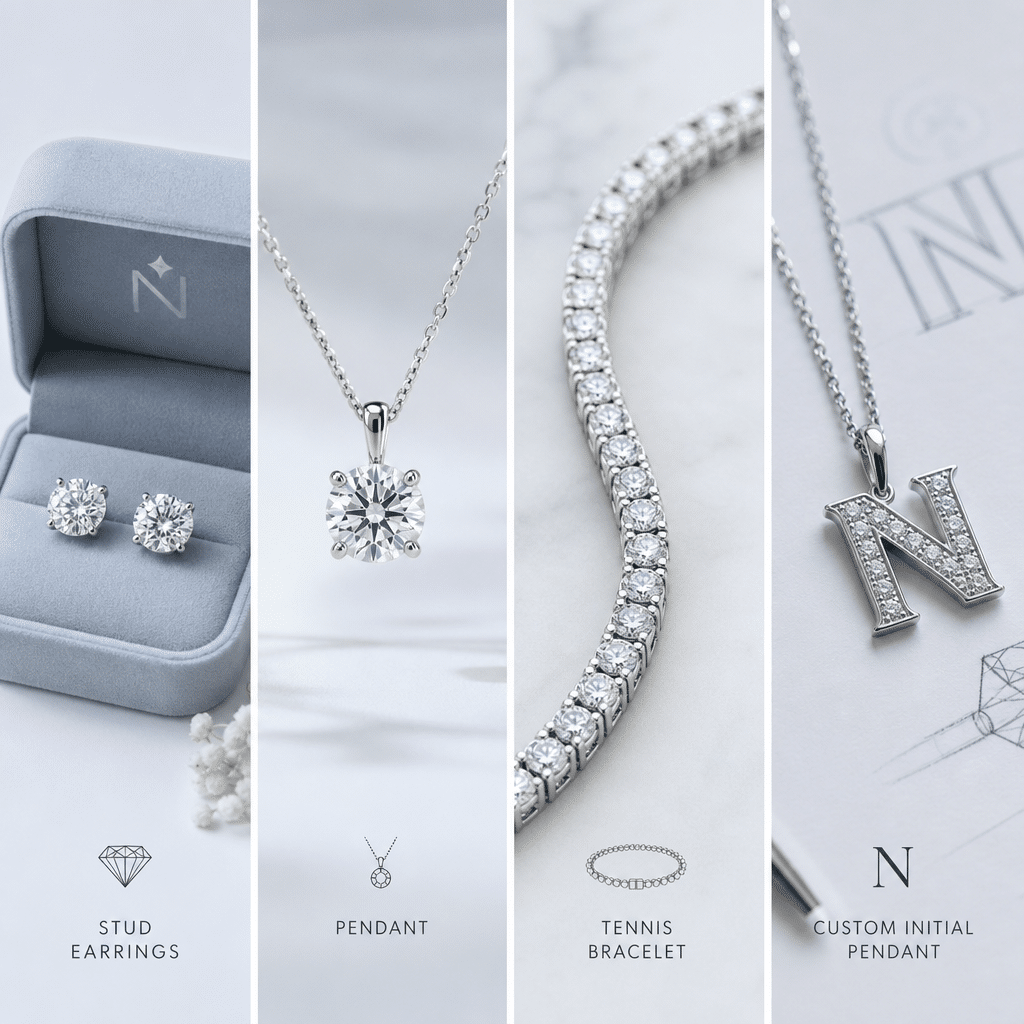
Stud earrings are a low-risk diamond gift for one simple reason: they suit many recipients. Age, personal style, and metal preference matter far less with studs than with rings or bracelets. Round brilliant and princess cut studs in 0.50 to 1.00 carat total weight per pair hit a practical sweet spot for many gift budgets, and 14k white or yellow gold works with many wardrobes.
The color and clarity range that works for studs is wider than for rings. G to I color and SI1 to SI2 clarity can look bright and clean at normal viewing distance, and the savings can be redirected toward larger carat size. Setting type also matters. Push-back backs are the standard and provide sufficient security for most wearers, but screw-back backs are a better choice for recipients who are physically active, travel frequently, or have a history of losing earrings.
Pendants and Necklaces: Personal Meaning and Daily Wear
A pendant sits close to the chest, which makes it a natural choice for graduations, promotions, or personal milestones where the giver wants the piece to carry emotional weight without being ostentatious. Single-stone solitaire pendants in the 0.25 to 0.75 carat range are common gift sizes. They are small enough for daily wear without snagging on clothing or catching on objects, and large enough to be noticed.
Shape choice matters more for pendants than for studs. Round brilliants are safe and versatile, but oval and emerald cut pendants offer a more distinctive look that signals thoughtfulness rather than default selection. Bezel settings add a layer of security for active recipients and give the piece a cleaner, more modern silhouette. Chain material is not an afterthought. A 14k gold chain adds longevity and perceived value, while sterling silver is a more affordable starting point for younger recipients or lower-budget gifts. The chain should be appropriate to the pendant weight — too thin a chain on a heavier stone risks breakage.
Diamond Bracelets: A Statement Choice for Major Milestones
A diamond bracelet signals that the occasion is significant. Tennis bracelets and line bracelets often require 2.00 to 5.00 carats total weight, which places them at a higher budget tier than most other non-ring diamond gifts. This is a piece for major anniversaries, milestone birthdays, or significant career achievements where the gift needs to carry visible weight.
Round brilliant and princess cut stones in 14k white gold or platinum deliver strong brilliance in a bracelet format. The clasp type is a durability factor that most gift guides overlook. Box clasps with a safety catch are more secure and longer-lasting than lobster claw clasps, especially for bracelets that will be worn daily. A bracelet that comes unclasped and falls off is not just an inconvenience — it is a loss risk.
Custom and Personalized Pieces: For Adding Emotional Meaning
When the occasion demands more than a standard design, custom jewelry allows the buyer to embed meaning that a stock piece cannot capture. Initial pendants, birthstone-and-diamond combinations, engraved bands, or designs inspired by a shared memory turn a beautiful object into a specific emotional statement. This is a useful gifting route when the recipient has a strong personal style or when the occasion carries deeper weight.
Custom design comes with lead time and process. Expect 2 to 4 weeks from initial consultation to delivery, including a design brief, CAD rendering, approval revisions, and final production. The buyer must come prepared with clear decisions on metal choice, stone shape, size range, and engraving text. For custom jewelry, stone measurements and setting compatibility should be confirmed before finalizing a purchase.
Stone-to-Setting Fit Check
For stud earrings, confirm the post length (10 to 12 millimeters is standard) and backing type before purchase. For pendants, check that the bail width matches the chain thickness so the pendant hangs properly. For bracelets, verify the clasp type and confirm a safety catch is present. For custom pieces, always request a CAD rendering and confirm stone measurements match the setting dimensions before production begins.
How to Choose the Right Carat Size for Each Gift Type
Carat size recommendations for engagement rings do not transfer to other jewelry categories. Stud earrings, pendants, bracelets, and non-engagement rings each have their own natural size ranges, and buying outside those ranges usually produces a piece that looks either too small or disproportionately heavy for its form.
Carat Size Ranges for Earrings, Pendants, Bracelets, and Rings
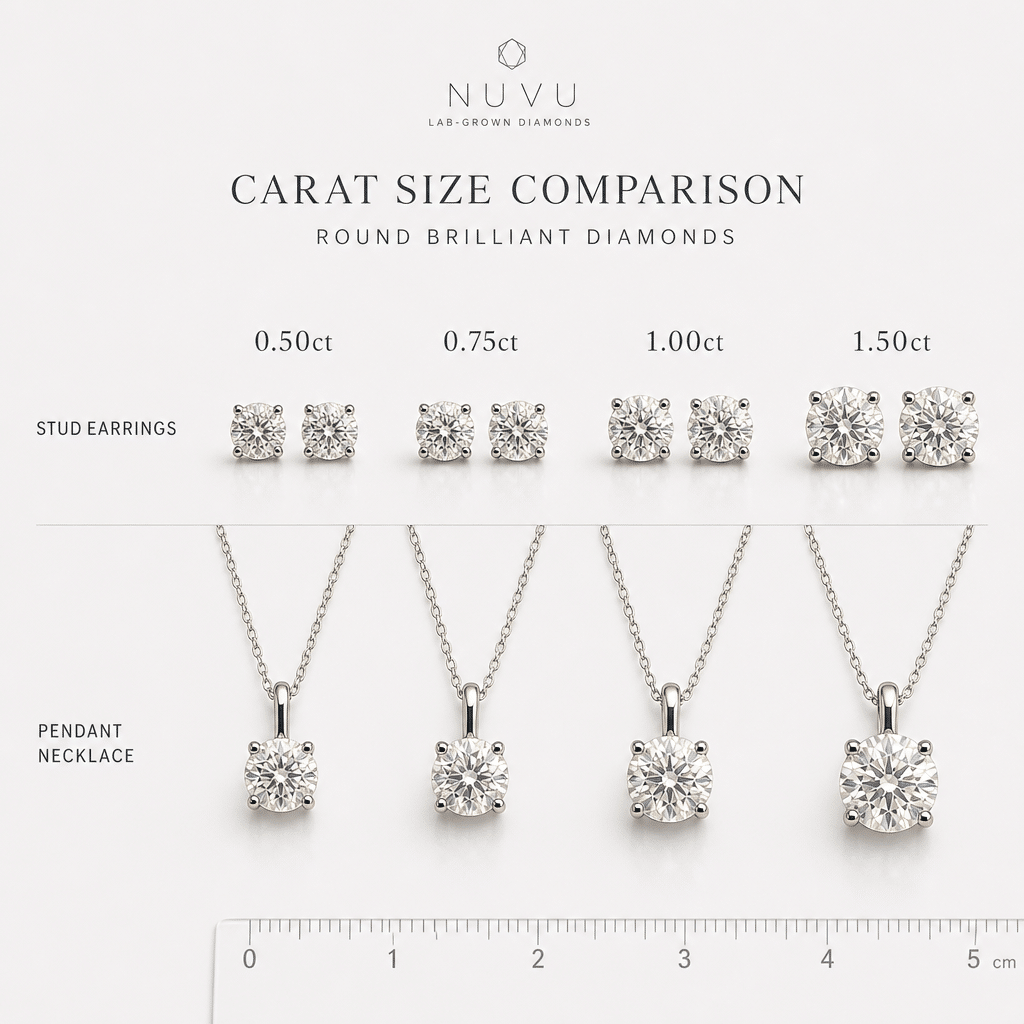
For stud earrings, 0.50 to 1.00 carat total weight per pair is a common gift range. Below 0.50 total weight, the stones become difficult to appreciate at normal viewing distance. Above 1.00 total weight, the studs can start to look heavy on smaller earlobes and may require larger backing posts for balance.
For pendants, a single stone between 0.25 and 0.75 carat is most common. This range provides visible presence without making the pendant look bulky or causing the chain to flip. Tennis bracelets sit at a higher threshold — 2.00 to 4.00 carats total weight can deliver a visible but wearable row of stones. Below 2.00 carats, the bracelet can look sparse.
Non-engagement rings — right-hand rings, anniversary bands, and fashion rings — operate differently. A single stone of 0.50 to 1.50 carats works for a solitaire style, as detailed in lab grown diamond bracelet guide, while multi-stone designs typically require 1.00 to 2.00 carats total weight distributed across the band. Going larger usually makes the ring feel top-heavy for daily wear.
Visual Size vs. Carat Weight: What the Recipient Actually Sees
Carat weight is a measure of mass, not surface area. Two diamonds with the same carat weight can look very different in size depending on their shape. A 1.00 carat round brilliant measures 6.5 millimeters in diameter. A 1.00 carat oval measures approximately 7.5 millimeters by 5.5 millimeters, giving it a longer silhouette that reads as larger in one dimension. Pear and marquise cuts behave similarly, carrying weight along a longer axis.
For gift buyers who want maximum visual impact per carat, elongated shapes may be worth considering. They deliver a larger face-up appearance without the same price increase that comes with moving up in carat weight in a round cut. The tradeoff is that elongated shapes require more careful setting to protect pointed tips, but for pendants and earrings, that is rarely a problem.
Budget Allocation: Where to Spend More and Where to Save
Not every factor deserves equal investment. For stud earrings, cut and color are both visible from the front at close range. Clarity matters less because small inclusions are often nearly invisible at normal viewing distance. For pendants, color grade can often be relaxed — G to H is common — while cut remains important because a pendant’s sparkle depends on how the stone handles light from varying angles.
Bracelets often demand more attention to clarity and consistency across multiple stones. A single inclusion in a solitaire pendant may go unnoticed, but an inclusion in one stone of a tennis bracelet can draw the eye because it breaks the visual uniformity of the row. For custom pieces, a common approach is to allocate approximately 60 to 70 percent of the budget to the stone and 30 to 40 percent to the setting and labor.
What to Check Before You Decide
Ask the seller for actual measurements in millimeters, not just carat weight. A 1.00 carat round and a 1.00 carat oval are different sizes visually, and only millimeter measurements let you compare. For multi-stone pieces, request photos of all stones together to check color and clarity consistency across the set. For rings and bracelets, confirm that total carat weight is distributed evenly across the piece rather than concentrated in one dominant stone. Prices can change with market conditions, report type, seller channel, and stone-specific details, so exact comparisons should be verified at the time of purchase.
Shape Selection Guide for Gift Jewelry
The shape of the diamond is the single most visible decision in any jewelry purchase. For gift buyers, the right shape depends less on industry trends and more on how the piece will be worn and by whom. A shape that works perfectly in a pendant can look mismatched in a bracelet. Understanding these differences helps avoid a common mistake: buying the shape that looks best in a display case rather than the one that works best for the recipient’s actual lifestyle.
Round Brilliant: A Versatile Shape for Many Gift Types
Round brilliant remains a safe and reliable shape for gift jewelry for a simple reason: it produces more sparkle per carat than many other cuts. Its 57 to 58 facets are engineered to return a large amount of light to the eye, which means it performs well in low light, bright light, and everything in between. For stud earrings, round brilliants deliver strong brilliance from a small surface area. For pendants, they are a forgiving shape across different lighting conditions and angles of movement. Round brilliants also suit many metal types, settings, and tastes, making them a popular choice when the recipient’s style preferences are uncertain. The tradeoff is price per carat — round cuts can carry a premium because of higher rough yield loss during cutting — but for a gift where confidence in the result matters, that premium is often worth considering.
Princess and Emerald Cuts: Modern Choices for the Design-Conscious Recipient
Princess cut offers a contemporary square silhouette with brilliant faceting that produces strong sparkle, though slightly less than a well-cut round. It works particularly well in bracelets and right-hand rings where a clean, geometric look complements modern fashion. The square shape also sets cleanly in channel or shared-prong settings, making it a practical choice for multi-stone pieces. Emerald cut sits at the opposite end of the visual spectrum. Its step-cut facets create wide, open planes that emphasize clarity rather than sparkle. Because the large table and deep pavilion facets act like windows into the stone, inclusions and color tints become more visible. For emerald cut gifts, VS2 clarity or higher is often recommended, and the shape benefits from a careful setting to protect its long, straight edges. Both shapes can work well with bezel settings, which add security while reinforcing their clean, modern lines.
Oval, Pear, and Marquise: Elongated Shapes for Visual Impact
Elongated shapes create the illusion of greater size without increasing carat weight. An oval cut with a length-to-width ratio of approximately 1.40 to 1.50 can appear visibly larger than a round brilliant of the same carat weight when viewed from above, because the surface area is distributed across a longer axis. This makes oval a popular non-round shape for pendants and rings, especially when the gift buyer wants a substantial look within a moderate budget. Pear and marquise cuts carry the same surface-area advantage but introduce a practical constraint: the pointed tip is vulnerable to chipping. For everyday wear pieces — pendants worn close to the body or rings exposed to impact — a protective prong or V-tip setting is worth considering. Without it, the tip becomes the weakest point on the entire piece. Buyers should also confirm the length-to-width ratio with the seller, as poorly proportioned elongated shapes can look stubby or excessively narrow depending on the cut.
Fancy Shapes: When the Recipient Wants Something Distinctive
Cushion, radiant, heart, and Asscher cuts serve narrower preferences but reward careful matching to the recipient’s taste. Cushion cut combines a soft, rounded rectangle with a faceting pattern that can range from brilliant to modified brilliant, making it a strong fit for vintage-style or antique-inspired settings. Radiant cut blends the emerald cut’s octagonal silhouette with brilliant faceting, offering more sparkle than a pure step-cut while keeping a structured outline. Heart cut is most commonly chosen for romantic anniversary or Valentine’s Day gifts, but buyers should budget for higher setting costs — the complex curved outline may require custom prong placement and careful metalwork to avoid distortion. Heart cut also demands a well-cut stone; a poor cut will collapse the cleft or make the lobes uneven. For any fancy shape, symmetry and polish grades of Excellent or Very Good are helpful guardrails against a disappointing visual result.
Certificate and Visual Review Check
Before purchasing any shape, request the grading report’s symmetry and polish grades. Excellent or Very Good is a recommended minimum. For princess, emerald, and Asscher cuts, ask for a video that shows the step-cut or modified brilliant facets in motion — still photos can hide uneven facet alignment or windowing. For elongated shapes, confirm the length-to-width ratio directly with the seller. A 1.00 carat oval at 1.45 ratio can look elegant; the same stone at 1.20 ratio can appear squat. Shape preference is subjective, but the underlying quality and proportions are not.
Metal Selection for Gift Diamond Jewelry
The metal that holds the diamond is not a neutral choice. It affects how the diamond’s color reads, how often the piece needs maintenance, and how the jewelry feels on the wrist or finger over years of wear. Many gift buyers focus entirely on the diamond and treat the metal as a secondary afterthought. That order should be reversed: the metal determines the piece’s practical lifespan and daily comfort, and a mismatch here can turn a thoughtful gift into something the recipient rarely wears.
14k Gold: A Common Choice for Durability and Value
14k gold, composed of 58.3% pure gold alloyed with stronger metals, is a practical choice for gift jewelry. It balances durability with affordability, resisting scratches and dents better than higher-purity gold options. The choice within 14k matters. White gold offers a bright, modern look but may require rhodium plating every one to three years to maintain its color — a maintenance step many first-time buyers do not anticipate. Yellow gold requires no such upkeep and develops a warm, classic patina over time. Rose gold, with its copper alloy content, provides a warm, flattering tone that works across many skin tones and hides daily wear marks better than yellow or white gold. For a gift that will be worn regularly, 14k gold is a common choice.
18k Gold: Higher Purity for Higher Emotional Value Gifts
18k gold contains 75% pure gold, giving it a deeper, richer color than 14k and a noticeably heavier feel on the hand. The tradeoff is softness. 18k gold scratches more easily and is more prone to bending under pressure, making it a less suitable choice for daily-wear rings or bracelets. Where it can work well is in pendants, earrings, and pieces worn on special occasions rather than every day. For milestone gifts — a tenth anniversary, a major graduation, a retirement — 18k gold can signal a higher level of perceived value that matches the significance of the occasion.
Platinum: A Premium Choice for Active Lifestyle Recipients
Platinum is 95 to 98 percent pure, naturally white, and does not require rhodium plating. It is denser than gold — a platinum ring feels notably heavier than the same design in 14k — and more durable under daily wear. For recipients who work with their hands, lead active lifestyles, or simply dislike the idea of periodic maintenance, platinum can be a strong choice. It resists metal fatigue better than gold, holds stones securely, and develops a soft patina over time rather than wearing away. The drawbacks are real. Platinum typically costs more than 14k gold, and its density means the piece will feel heavier than expected. Some recipients find the weight uncomfortable for all-day wear, particularly in larger ring or bracelet designs. For the right recipient — someone who values longevity and low maintenance over lightness — platinum is a strong option.
Sterling Silver: Entry-Level Gifting for Younger Recipients
Sterling silver, at 92.5% silver content, is an affordable metal option and makes sense for student graduation gifts, milestone birthday presents for younger recipients, or first diamond pieces where budget is a primary constraint. The limitations are clear. Silver tarnishes over time and requires regular polishing to maintain its brightness, and it is significantly softer than gold or platinum. For a piece that will be worn daily, silver will show wear quickly. Rhodium-plated silver pieces hold their brightness longer and are worth considering for the small premium. One practical consideration: silver settings may not provide the same structural support for larger stones as gold or platinum settings.
What This Means in a Real Purchase
For a daily-wear bracelet or ring, 14k gold or platinum are common choices. For a pendant or earrings worn occasionally, 18k gold is acceptable and can add perceived value. For a first-time gift to a younger recipient, 14k gold balances quality and practicality without requiring the wearer to manage complex maintenance routines. Always ask the seller about rhodium plating frequency for white gold pieces. And before committing, request a photo of the metal option next to the selected diamond shape; subtle interactions between metal color and stone color can shift the overall look.
Setting Styles That Protect and Showcase Gift Diamonds
The setting is the interface between the diamond and the person wearing it. A well-chosen setting protects the stone, matches the recipient’s activity level, and determines how much light reaches the diamond. The wrong setting can make a beautiful diamond look dull — or worse, put it at risk of damage. For gift jewelry, where the buyer may not be able to consult the recipient about daily wear habits, setting choice becomes one of the most consequential decisions in the purchase.
Prong Settings: Maximum Light Exposure
Prong settings hold the diamond with metal claws that allow maximum light exposure to the stone. This is a common setting type for good reason: it produces strong sparkle and is easy to clean and inspect. The number of prongs matters. A six-prong setting provides more security for round brilliant studs and pendants because the additional prongs distribute holding force more evenly. A four-prong setting exposes more of the diamond but may require thicker prongs for shapes with straight edges or corners, such as princess and emerald cuts. Prong height is another factor. High prongs can catch on clothing and hair. For an active recipient or someone who works with their hands, lower-profile prongs can reduce snagging risk without significantly reducing light entry.
Bezel Settings: Enhanced Security for Active Lifestyles
A full bezel setting encases the diamond’s perimeter in a continuous metal rim. This is a secure setting, protecting the stone from impact, loosening, and edge chipping. For tennis bracelets, where a single loose stone can compromise the entire piece, bezel settings are a standard choice. For daily-wear pendants, a bezel eliminates the risk of the diamond catching on clothing or snagging on objects. The tradeoff is light return — the metal rim blocks some light from entering the sides of the stone, potentially reducing overall brilliance compared to an open prong setting. Half-bezel settings offer a middle ground, covering only part of the girdle while exposing more of the crown and pavilion. For a gift recipient who leads an active lifestyle or values low maintenance, a bezel setting removes the worry of damage and reduces the likelihood of needing repairs.
Halo Settings: Extra Sparkle and Visual Size
A halo setting surrounds the center diamond with a ring of smaller diamonds, creating the visual impression of a larger center stone without increasing its carat weight. This can be a particularly effective choice for gift buyers working within a fixed budget who want maximum visual impact. The halo adds a ring of continuous sparkle around the center stone, and a well-matched halo can make a smaller carat center diamond appear larger. Double halos and hidden halos — a second ring beneath the main halo — add further brilliance but increase the overall width of the piece. For ring gifts, this can make the design feel too wide for smaller fingers. A common consideration with halo settings is color matching between the center stone and the halo stones. If the halo diamonds are noticeably whiter or warmer than the center stone, the difference can become visible under normal lighting. Buyers may wish to request confirmation that the halo stones match the center stone color grade within one grade.
Tension and Channel Settings: Modern Styles for Bracelets and Bands
Tension settings use metal pressure — no prongs or bezel — to hold the diamond in place, creating a floating appearance. The effect is striking, but tension settings require precise engineering and may be less forgiving of wear and impact than other setting types. They are best suited for recipients who will wear the piece carefully and occasionally. Channel settings, by contrast, are among the more secure options for multi-stone pieces. Diamonds are set between two metal rails, with no metal between the stones, creating a continuous line of sparkle. Channel settings are a standard for tennis bracelets and anniversary bands because the stones are fully protected on the sides. For daily-wear bracelets, channel settings are often more secure than tension settings. The channel width must be precisely matched to the stone depth — a gap allows the diamond to shift, and a too-tight fit risks stress fractures in the setting.
Stone-to-Setting Fit Check
Confirm that the setting prong count — four or six — matches the diamond shape. Princess and emerald cuts need prongs placed at the corners, not the edges, to avoid pressure points. For bezel settings, ask whether the metal rim fully covers the girdle or leaves a partial opening. For halo settings, request the total carat weight of the halo stones and confirm they fall within one color grade of the center stone. For channel settings, verify that the channel width matches the stone depth measurements. These checks take five minutes and can help prevent common repair scenarios.
Practical Buying Checklist for Diamond Jewelry Gifts
A thoughtful diamond gift can still go wrong if the practical details are overlooked. The transaction itself — verifying what you are buying, confirming fit, and planning for long-term care — deserves as much attention as selecting the stone.
Pre-Purchase Verification: Grading Reports, Return Policies, and Photos
Before you click buy, confirm that the diamond comes with a grading report from IGI, GIA, or GCAL. Do not take a seller’s word for it — look up the report number on the issuing lab’s website to verify it matches the stone being offered. A grading report number that does not return a result is a red flag.
Request a 360-degree video and high-resolution photos of the actual piece. Stock images tell you nothing about the specific stone’s color, clarity, or cut quality. Ask whether the video shows the exact diamond you will receive, or simply a representative sample. For multi-stone pieces like tennis bracelets or halo settings, request photos of all stones together so you can check color and clarity consistency across the set.
Ask about the return window explicitly. A minimum of 30 days is common among many sellers. Confirm the warranty period, what it covers, and whether resizing or repairs are included. Get written confirmation of every policy. A grading report helps document key characteristics, but it should not be treated as a guarantee of beauty, value, or sourcing ethics.
Size and Fit Confirmation for Rings, Bracelets, and Necklaces
For rings, confirm the ring size before purchase and ask whether resizing is possible. Some designs — particularly eternity bands with stones set all the way around — cannot be resized, meaning you must get the size exactly right the first time.
For bracelets, measure the recipient’s wrist circumference and add 0.5 to 1 inch for a comfortable fit. A bracelet that is too tight will not be worn. For necklaces, standard chain lengths are 16 to 18 inches for pendants and 18 to 20 inches for longer styles. If you are unsure of the recipient’s preference, 18 inches is a safe default for many adults.
For any piece valued above a few hundred dollars, choose signature-required delivery. Lost or stolen packages are not worth the risk.
Insurance and Appraisal Considerations
A grading report is not the same as an appraisal. The report documents the diamond’s quality characteristics. An appraisal determines the replacement value of the finished jewelry for insurance purposes. For pieces valued over $1,000, the recipient should consider obtaining an appraisal within 30 days of receiving the gift.
Once appraised, the piece should be added to a homeowner’s or renter’s insurance policy, or covered by a standalone jewelry insurance policy. Standard policies often have limits on single-item value, so check the coverage cap explicitly. The cost of insurance is typically 1–2% of the appraised value per year.
Aftercare and Maintenance for Long-Term Wear
Most diamond jewelry can be cleaned with an ultrasonic cleaner, but pieces with certain treatments or loose settings should not go in the machine. When in doubt, warm water and a soft brush are safe for any piece. For proper care of lab grown diamond jewelry, the lab grown diamond jewelry guide recommends scheduling a professional inspection every 6 to 12 months to check prongs, clasps, and general wear. Prong tightening is routine maintenance — ignoring it is how stones get lost.
White gold may require rhodium plating every 1 to 3 years to maintain its bright white appearance. This is not a defect; it is standard maintenance for white gold. Store diamond jewelry pieces separately in soft pouches or compartments. Diamonds can scratch other diamonds and can scratch gold. Loose storage in a shared box invites unnecessary damage.
Buyer Verification Checklist
Confirm the grading report number matches the stone on the lab’s website. Review photos or video for visible inclusions or color inconsistencies that the report may not clearly communicate. Confirm the setting metal type and karat. Get written return and warranty policies before payment. Ask about shipping insurance and whether a signature is required at delivery. Inform the seller this is a gift and request appropriate packaging — many sellers will provide a gift box without additional charge.
When to Choose Custom Design for Your Diamond Gift
Custom design gives you control over the final piece, but it also adds time, cost, and complexity. Whether that tradeoff is worth it depends on the occasion, the recipient, and your timeline. The decision is not about which option is better in general — it is about which option fits your specific situation.
When Custom Design Adds Emotional Weight That Stock Pieces Cannot
Custom design matters most when the gift commemorates something specific. A piece that incorporates the recipient’s birthstone, features an engraved date or message, or matches a personal style that stock jewelry does not serve can carry meaning that no off-the-shelf piece can replicate. Custom is also a choice worth considering when the recipient has a strong aesthetic preference — a particular metal finish, an unusual stone shape, or a specific silhouette — because stock inventory may not cover that combination.
The tradeoff is cost and time. Custom pieces often cost more than comparable stock pieces due to design fees, CAD rendering, and prototyping. If the occasion justifies that premium, the result is a gift that cannot be duplicated.
The Custom Design Process: Timeline, Budget, and Communication
A typical custom design timeline runs 2 to 4 weeks total. The process breaks down as follows: one design consultation session, 3 to 5 days for CAD rendering and approval, 3 to 5 days for a wax model or sample, and 7 to 14 days for final manufacturing and shipping.
Communication with the designer should be direct. At least two revision rounds should be included in the quoted price. If the designer charges for every revision beyond the first, ask for a clear breakdown upfront. Request a CAD rendering before approving production — this is your last chance to catch proportion issues or design mismatches. For custom jewelry, stone measurements and setting compatibility should be confirmed before finalizing a purchase.
When Stock Pieces Are the Better Choice
Stock pieces ship within 1 to 5 business days, carry no design fees, and are often easier to return or exchange. If the recipient’s taste is uncertain, or if you need the gift within two weeks, a stock piece is the safer choice. Many stock pieces can be sized or adjusted after purchase, making them nearly as personalized as custom work without the upfront design cost.
The risk of custom design for a surprise gift is simple: if the recipient does not love the design, the time and money spent on the custom process cannot be recovered. Stock pieces with generous return policies preserve that flexibility.
What This Means in a Real Purchase
If the occasion is a major milestone — a 10th anniversary, a milestone birthday, a graduation after a difficult journey — and you know the recipient’s style well, custom design may be worth the investment. If the gift is a surprise or the timeline is under two weeks, choose a stock piece with a good return policy. In either case, request CAD rendering before committing to custom production, and confirm the return window for any stock piece before purchase.
Lab-Grown Diamond Gift Value: What You Get vs. What You Pay
The value advantage of lab-grown diamonds for gift buyers is worth examining. For the same budget, you can often buy a larger or higher-quality stone. The question is whether that tradeoff matters to the recipient and how the difference compares across real purchase scenarios.
Price Comparison: Lab-Grown vs. Natural Diamonds for Gift-Size Stones
Directional pricing tells part of the story. A 1.00 carat round brilliant lab-grown diamond with G–H color and VS1–VS2 clarity may fall in the $600 to $900 range, while a comparable natural diamond — same size, same grades — may run $4,000 to $6,000. That is roughly a 6x to 7x price difference for stones that can look identical to the naked eye. Prices can change with market conditions, report type, seller channel, and stone-specific details, so exact comparisons should be verified at the time of purchase.
The practical effect on gift buying is straightforward. A $1,000 budget may buy a 1.00 to 1.50 carat lab-grown diamond in a quality setting. The same budget may buy a 0.30 to 0.50 carat natural diamond. For a $2,000 budget, the lab-grown option can reach 2.00 carats or higher, while the natural option may stay around 0.50 to 0.70 carats. The visual difference between those sizes is dramatic.
Quality Consistency Across Multiple Stones
For multi-stone pieces — tennis bracelets, halo settings, cluster rings — lab-grown diamonds can offer a practical advantage. Because lab-grown stones are produced under controlled conditions, their color and clarity can be more predictable across batches. Manufacturers may more easily source matched pairs or sets without extensive sorting time. Natural diamonds of matching quality often require more labor to group together, and that labor adds cost.
For a gift buyer selecting a tennis bracelet or a halo pendant, this consistency can mean the finished piece looks more uniform. Mismatched color or clarity in multi-stone jewelry is easy to spot and can diminish the gift’s overall appearance.
Resale and Heirloom Considerations
Lab-grown diamonds typically carry lower resale value than natural diamonds, and there is no point pretending otherwise. The secondary market for lab-grown stones is less developed, and prices on resale are often significantly lower. But this may matter less for gift jewelry than some buyers assume.
The value of a gift is often in the wearing experience, not speculative appreciation. A lab-grown diamond piece that is well maintained can be reset, passed down, or repurposed. The stone does not degrade or lose its optical properties. If the recipient plans to wear the piece for years — which is the point of a meaningful gift — the resale discount becomes less relevant. For buyers who prioritize heirloom status and eventual resale value, natural diamonds remain an option, but at a higher price for comparable visual quality.
In practical buying, this is where many comparisons become misleading. The useful question is not whether one type holds value better than another, but whether the gift is being chosen for daily enjoyment or for long-term financial expectations. Most gift buyers are better served by the stone that fits their budget and the recipient’s lifestyle today.
What This Means in a Real Purchase
A $1,000 gift budget with lab-grown diamonds can deliver a 1.00 to 1.50 carat stone in a high-quality setting. The same budget with natural diamonds may deliver a 0.30 to 0.50 carat stone. The decision comes down to the recipient’s values. If they care about size, sparkle, and daily wear, lab-grown is a clear choice. If they value natural origin and potential heirloom status, adjust expectations accordingly. Do not assume one answer fits every recipient — match the stone to what the receiver will actually appreciate.
Understanding Growth Methods, Terminology, and Disclosure
When choosing a lab-grown diamond gift, the terms used to describe the stone can sometimes be confusing. Terms like “HPHT,” “CVD,” “man-made,” and “synthetic” appear in product descriptions, and buyers may wonder whether these distinctions affect quality or value. Understanding the basics helps the buyer make an informed choice without overcomplicating the decision.
HPHT vs. CVD: Two Proven Growth Paths
Lab-grown diamonds are created using one of two primary methods: High Pressure-High Temperature (HPHT) or Chemical Vapor Deposition (CVD). Both processes produce diamonds that are identical to natural diamonds in chemical composition and optical properties. GIA explains that HPHT mimics the natural diamond formation process by subjecting carbon to extreme pressure and temperature, while CVD creates diamonds in a vacuum chamber where carbon atoms deposit layer by layer onto a substrate. Both methods are widely used in the jewelry industry, and one is not inherently superior to the other for gift purposes. The key takeaway is that the diamond’s specific growth method does not affect its brilliance, hardness, or appearance to the naked eye. When growth method or post-growth treatment is relevant, buyers should look for clear disclosure in the grading report or seller documentation.
Clarity in Language: What Terminology Means for Buyers
The FTC offers guidance that sellers should use clear, non-misleading language when describing laboratory-grown diamonds. Terms like “synthetic” are scientifically precise but can carry a negative connotation for some buyers, while terms like “lab-created” or “laboratory-grown” are more consumer-friendly. For the gift buyer, the important distinction is that the stone is a real diamond, produced by human technology rather than geological processes. A seller’s advertising should not imply that lab-grown diamonds are imitation stones or inferior substitutes. When comparing lab-grown diamond jewelry, the FTC cautions that environmental or sustainability claims must be supported with specific evidence, and broad claims about “eco-friendly” or “sustainable” production should be verified with the seller. Laboratory-grown diamonds should be clearly identified as laboratory-grown, and they should not be presented as mined diamonds.
Disclosure as a Gift Credibility Tool
Honest and transparent disclosure about a diamond’s origin is valuable in gift-giving. When a stone is clearly labeled as lab-grown on a grading report and in marketing materials, it removes any ambiguity and builds trust between the buyer, the seller, and the recipient. GIA’s research on lab-grown diamond identification notes that laboratory-grown diamonds can be identified through advanced spectroscopic and luminescence techniques, but for the buyer, the easiest verification is a grading report that explicitly states the stone is laboratory-grown. This documentation is a form of evidence that the buyer can share with the recipient, reinforcing the gift’s legitimacy and quality. For milestone gifts where the piece may be passed down or re-set, the grading report serves as a permanent record of the diamond’s origin and characteristics. Environmental and sustainability claims should be specific, documented, and limited to what can be substantiated.
Frequently Asked Questions About Lab-Grown Diamond Gift Jewelry
Is a Lab-Grown Diamond a “Real” Diamond for Gift-Giving?
Yes. Lab-grown diamonds share the same chemical composition — pure carbon arranged in a crystal lattice — as natural diamonds. They score 10 on the Mohs hardness scale, have a refractive index of 2.42, and display the same fire and brilliance. The only difference is where the crystal formed. That distinction has no effect on how the stone looks, wears, or performs. For gifting, the recipient receives a real diamond by every measurable standard.
Can the Recipient Tell It’s Lab-Grown?
Not by looking at it. Lab-grown and natural diamonds are optically indistinguishable without specialized equipment that detects subtle differences in growth patterns or trace elements. Some lab-grown diamonds carry a tiny laser inscription on the girdle identifying them as lab-created, but this marking is invisible to the naked eye and only visible under magnification. From the recipient’s perspective, the stone sparkles, reflects light, and wears exactly like any other diamond.
Is a Lab-Grown Diamond Gift Less Meaningful?
Meaning in a gift comes from the occasion, the relationship, and the thought behind the choice — not the geological history of the stone. A lab-grown diamond represents the same intention, commitment, or celebration as a natural diamond. Many buyers find the modern origin story adds a layer of significance: the stone was created through human ingenuity, produced under controlled conditions with clear documentation, and sourced without the supply-chain questions that can accompany mined stones. For recipients who value transparency and responsible production, that context can make the gift more meaningful, not less.
How Do I Know If the Recipient Would Prefer Lab-Grown?
Consider what matters to the person receiving the gift. If they tend to value scientific innovation, sustainability, or getting the most quality for a given budget, they are likely to appreciate a lab-grown diamond. If they hold strong traditional views about natural origin or have specific family heirloom expectations, they may prefer a mined stone. The safest approach is a direct conversation if the gift is not a surprise. For surprise gifts, choose a lab-grown piece from a retailer with a generous return policy, so the recipient can exchange it if their preferences differ from your assumption.
[1] GIA, “Laboratory-Grown Diamond,” GIA.edu, accessed 2025.
[2] GIA, “HPHT and CVD Diamond Growth Processes,” GIA.edu, accessed 2025.
[3] Federal Trade Commission, “Guides for the Jewelry, Precious Metals, and Pewter Industries,” 16 CFR Part 23, FTC.gov, 2018 revision.
[4] GIA, “Identifying Laboratory-Grown Diamonds,” GIA.edu, accessed 2025.
Disclosure: This article is for general educational purposes only. Diamond grading, pricing, availability, specifications, and seller policies can change, and readers should verify important details through grading reports, official laboratory tools, seller documentation, or qualified professionals before making a purchase decision. Laboratory-grown diamonds should be clearly distinguished from natural diamonds, and environmental or sourcing claims should be supported by specific documentation.