- Shop
Diamonds & Jewelry
Loose Lab Diamonds Yellow Lab Diamonds Pink Lab Diamonds Blue Lab Diamonds Engagement Rings Fine Jewelry Shop All Loose lab-grown diamonds10 shapes · IGI, GIA or NGTC reports
- Wholesale
- Custom Design
- Education
- About
Loose Lab-Grown Diamond vs Finished Jewelry: When Should You Buy the Stone First?
- Which route fits
- When buying the stone first gives you more control
- When finished jewelry is simpler
- Matching stone and setting
- Custom ring sequence
- Cost comparison: loose plus setting vs finished
- Bringing your own stone to a jeweler
- Finished jewelry: what to check
- For retailers and brands
- Stone-first questions
- Plan the stone and setting together
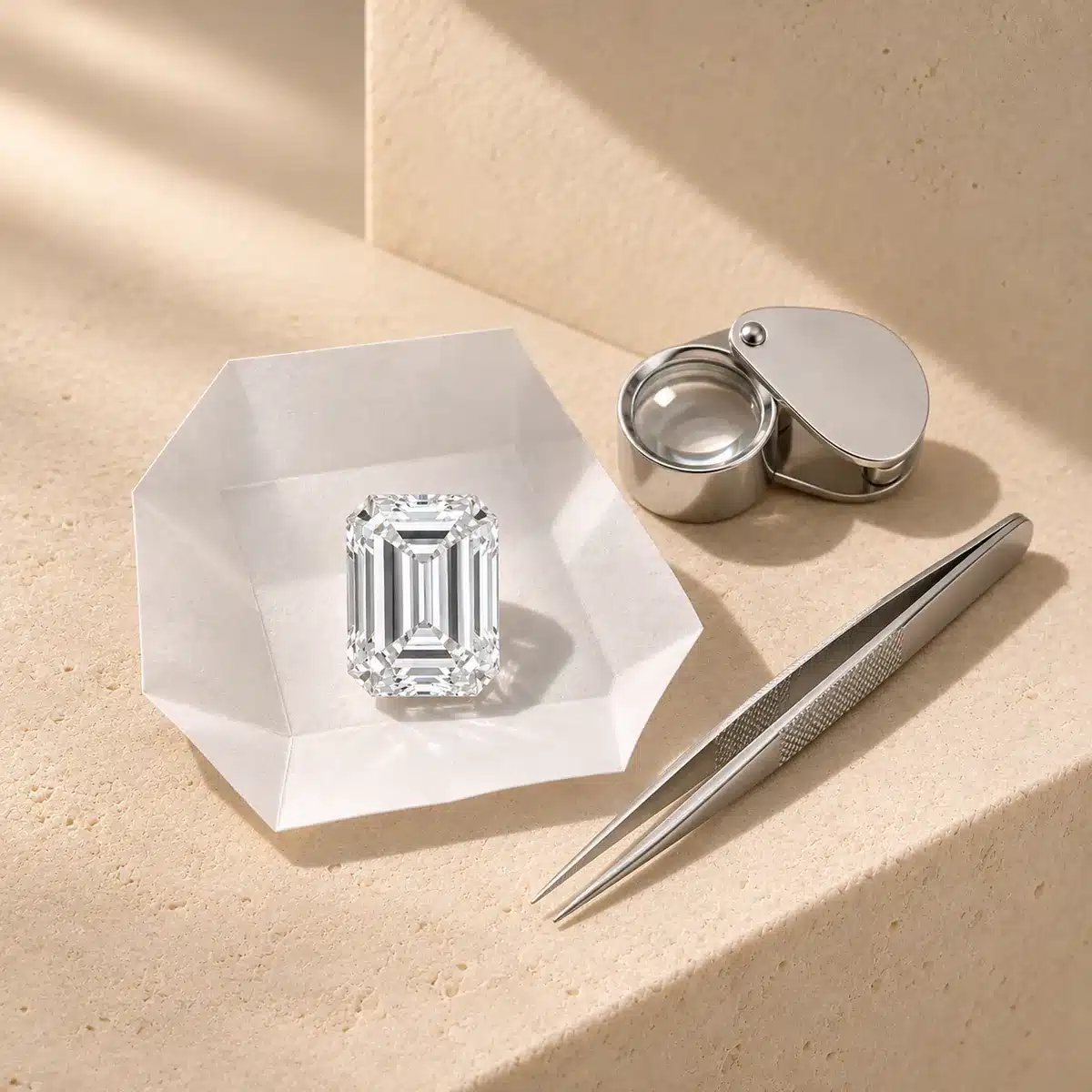
A buyer finds a 2.00 ct emerald cut they love, about 8.8 × 6.3 mm, and then picks a semi-mount listed for “2 ct center stones”. The head was made for a round of about 8.1 mm. The emerald’s corners hang past the prongs, and the setting has to be rebuilt. A stone and a setting are only a match when their measurements are.
Buy the loose stone first, or choose stone and setting together, when the diamond is the main point of the piece: an engagement ring, a custom design, or a specific shape and size. Buy finished jewelry when the design matters more than the exact stone, you need it quickly, or the stones are small. For custom rings, the best sequence is shape, setting style, stone, then final CAD built around the stone’s measurements.
Which route fits
- Engagement ring, center stone matters most → Stone first, or stone and setting together
- Specific shape, ratio or size → Stone first
- Custom design → Stone and setting together
- Matching pairs (earrings) → Matched stones first, then setting
- Brand or retailer production → Stone specification and setting designed together
- Fashion jewelry, small stones
- Need it fast
When buying the stone first gives you more control
- Shape and size are deliberate choices, not limited by stock settings.
- Cut and appearance can be judged on video before the design is fixed.
- The report can be verified before you commit.
- Budget goes to the stone first, then a setting that fits.
When finished jewelry is simpler
Ready-made pieces are quicker, the price is fixed, and the stone is already fitted. For pieces with many small stones, choosing each stone yourself is rarely practical. Check that the main stone’s report and disclosure come with the piece.
Matching stone and setting
Choose them as a pair:
Swipe the table to see more →
| Shape | Setting notes |
|---|---|
| Round, oval, cushion | Work with most settings |
| Emerald, radiant, Asscher | Corners need protection; consider claw or V-prongs |
| Pear, marquise | Points need V-prongs |
| Large stones | Check setting height and comfort |
Measurements decide fit: length, width and depth determine where the prongs go and how tall the head is. A setting sold for a carat weight assumes a shape; check its millimeter size against the report. Metal color also changes how the stone’s color reads: GIA notes that J–K color can look fine in yellow or rose gold.
Custom ring sequence
- Choose shape and setting style.
- Set stone limitssize range, cut, color, clarity, report.
- Select the stone from video and reports.
- Final CAD built to the stone’s measurements.
- Approve a numbered CAD version, with its key measurements.
- Production, setting, quality check.
- A photo or video of the finished piece, and a check that the inscription still matches the report.
See our custom process.
Cost comparison: loose plus setting vs finished
Swipe the table to see more →
| Cost item | Loose stone + setting | Finished jewelry |
|---|---|---|
| Stone | Chosen individually; price visible | Included; often not itemized |
| Setting and metal | Separate quote | Included |
| Labor and setting | Separate | Included |
| Design (if custom) | CAD and revisions | None for stock designs |
| Report | For the center stone | Usually for the center stone |
| Time | Longer | Shorter |
Buying loose often gives better value on the stone and more control. Finished jewelry is simpler and the total is fixed.
Bringing your own stone to a jeweler
Many jewelers set customer stones, but policies vary. Ask:
- Whether they accept lab-grown stones and how they handle risk during setting.
- What the setting fee includes.
- Whether they will photograph the stone and check the inscription before and after setting.
Finished jewelry: what to check
- Center stone report and inscription, where present.
- Side stone description: lab-grown or natural, approximate total weight and quality range.
- Metal stamp and weight.
- Return and resizing terms.
For retailers and brands
Retailers often combine both models: semi-mounts on display with a loose center stone program. Brands producing a collection usually fix stone specifications and settings together, then approve a sample. See engagement rings wholesale for retailers.
Stone-first questions
Is it cheaper to buy a loose diamond and set it separately?
Often you get better value on the stone, but add setting and labor costs.
Can I bring my own lab-grown diamond to a jeweler?
Many jewelers accept it. Confirm measurements and their policy first.
Should I choose the setting before the diamond?
Choose the setting style first, then the stone, then finalize the setting to the stone’s measurements.
What should I ask before a jeweler sets my own stone?
Whether they accept lab-grown stones, how they handle risk during setting, the fee, and whether they will photograph the stone before and after setting.
Plan the stone and setting together
Send the shape and size range you want, the setting style and ring size, or the report number of a stone you already have. Ask for the setting’s head size in millimeters before you approve it. NUVU can supply the loose stone and arrange IGI, GIA or NGTC reports. Start your custom design or WhatsApp / WeChat +86 191 1840 3930.

11+ years supporting global clients with lab-grown diamond product consultation and market analysis.
About NUVU. NUVU is the international brand of New Perspective Superhard Materials Co., Ltd. in Zhecheng, Henan, China. We grow HPHT lab-grown diamonds in-house and cut, polish and match stones in our own workshop.
Related Guides
How to Buy Loose Lab-Grown Diamonds: Buying Guide
How to buy loose lab-grown diamonds online or wholesale: who it suits, specs to fix first, price drivers,…
Read more →NUVUEngagement Ring Setting Styles Compared
Solitaire, halo, hidden halo, three-stone and vintage settings compared: look, stone protection, height,…
Read more →NUVULab-Grown Diamond Engagement Rings
Lab-grown diamond engagement rings in solitaire, halo, hidden halo, three-stone and vintage styles.
Read more →