- Shop
Diamonds & Jewelry
Loose Lab Diamonds Yellow Lab Diamonds Pink Lab Diamonds Blue Lab Diamonds Engagement Rings Fine Jewelry Shop All Loose lab-grown diamonds10 shapes · IGI, GIA or NGTC reports
- Wholesale
- Custom Design
- Education
- About
Lab-Grown Diamond Certification Guide: How to Read a Diamond Report with More Confidence
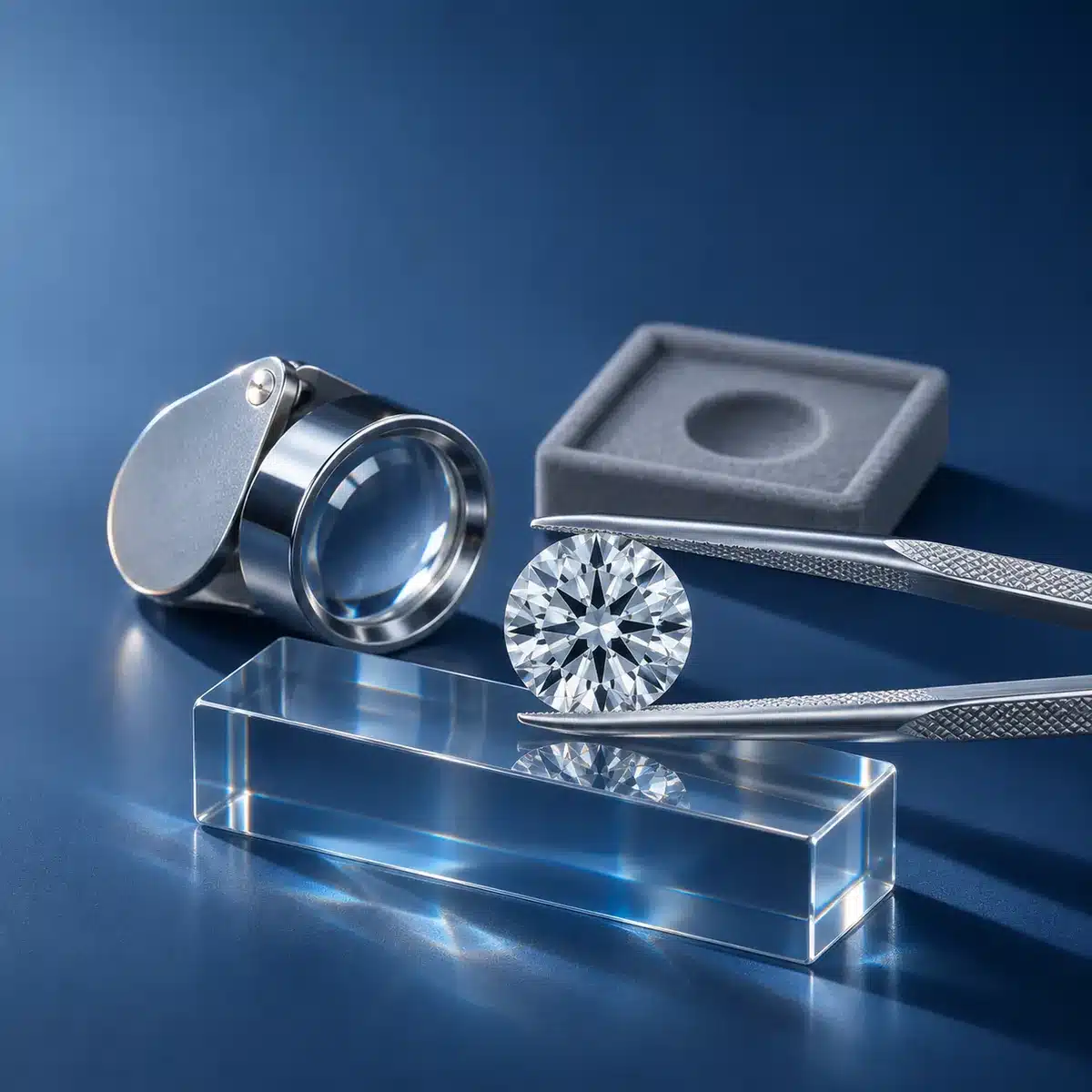
- The report at a glance
- A real report, line by line
- 1. Start with the identity block
- 2. The lab-grown statement and the report's scope
- 3. Report number and inscription
- 4. Measurements before carat weight
- 5. Color and clarity
- 6. Cut, polish and symmetry
- 7. Fluorescence
- 8. Growth method and treatment
- 9. Match the document to the stone
- What a report cannot tell you
- Five checks before you pay
- Grading report, quality assessment, identification report
- Reports on set jewelry
- Using reports in wholesale orders
- Report questions
- Choose the report for your stones
Read a lab-grown diamond report in this order: who issued it and when, the statement that the stone is laboratory-grown, the report number and inscription, the shape and measurements, the quality grades, and finally the comments, where growth method and treatment usually appear. Then look the number up on the laboratory’s own website and check that the report matches the stone in front of you. A report describes one stone as it was when tested. It says nothing about beauty, price or the seller.
The report at a glance
A real report, line by line
An IGI report for a round lab-grown diamond issued in February 2026 reads like this:
Swipe the table to see more →
| Line on the report | Value | How to read it |
|---|---|---|
| Report number | LG77066xxxx (last digits hidden here) | IGI lab-grown numbers start with “LG”; look it up on igi.org |
| Description | Laboratory grown diamond | Origin stated clearly |
| Shape and cutting style | Round brilliant | Rounds receive a cut grade |
| Measurements | 8.09–8.12 × 4.97 mm | Diameter range and depth; a tight range means a round outline |
| Carat weight | 2.02 ct | 8.1 mm is right for a well-cut 2 ct |
| Color / clarity | F / VS1 | Colorless; eye-clean in almost all rounds |
| Cut / polish / symmetry | Ideal / Excellent / Excellent | IGI’s top cut grade |
| Fluorescence | None | No effect |
| Proportions | Depth 61.3%, table 58%, crown 35°, pavilion 40.8° | Inside the usual range for a bright round |
| Comments | Created by Chemical Vapor Deposition (CVD) growth process; Type IIa | Growth method stated |
| Inscription | The report number | Check it under 10x |
Note what this report does not say: there is no separate line about post-growth treatment. That is common, and it is the reason the treatment question needs its own check (see section 8 below).
1. Start with the identity block
Check the laboratory, the report type and the date first, because they tell you what the rest of the page can contain.
- IGI grades lab-grown diamonds on the full 4Cs. See the IGI report guide.
- GIA has not given D-to-Z color or clarity grades to lab-grown diamonds since October 1, 2025. It issues a quality assessment: Premium or Standard. See the GIA report guide.
- HRD Antwerp stopped issuing quality reports for loose lab-grown diamonds in 2026, so older HRD reports exist but new ones do not.
For which laboratory suits which purchase, see IGI vs GIA.
2. The lab-grown statement and the report’s scope
The report should say plainly that the stone is laboratory-grown. US FTC rules require lab-grown diamonds to be described with a clear qualifier such as “laboratory-grown” or “laboratory-created” whenever the word diamond is used. Also note what kind of document it is: a full grading report, a quality assessment, or an identification-only document. They answer different questions (see the table further down).
3. Report number and inscription
The report number is the most important number on the page. Type it into the laboratory’s own report check, not a link the seller sends you, and compare every line. Most graded lab-grown stones also carry a microscopic girdle inscription, usually the report number, which you can read with a 10x loupe. See how to verify a certificate online and laser inscription explained.
4. Measurements before carat weight
Measurements give length, width and depth in millimeters. Two stones of the same weight can face up at different sizes if one is cut deeper. For fancy shapes, divide length by width to get the ratio: an oval of 8.95 × 6.40 mm has a ratio of 1.40.
5. Color and clarity
Color measures how colorless the stone is; clarity describes inclusions and blemishes. Lab-grown diamonds are often sold in high grades because they are affordable, but neighboring grades usually look the same face-up. Where an inclusion sits matters as much as the grade. See certificate fields explained.
6. Cut, polish and symmetry
Cut grades apply to round brilliants and are the best single guide to brightness. Polish and symmetry describe the finish. Fancy shapes carry a cut grade only on some reports, such as IGI’s since 2022, so use proportions, outline and video as well.
7. Fluorescence
Fluorescence is listed as None, Faint, Medium, Strong or Very Strong. It rarely changes how a stone looks in daylight. If a report lists Strong or Very Strong, check video in daylight for any haze.
8. Growth method and treatment
Many reports state whether the stone was grown by CVD or HPHT, and some state whether it was treated after growth. IGI usually notes this in the comments. Treatment is common: GIA reported that about 80% of the CVD diamonds submitted to it since 2020 had been HPHT-treated after growth to improve color. It is legitimate when disclosed. If you need as-grown stones, choose a report type that states treatment status, because a report that does not mention treatment is not proof that the stone is untreated. See HPHT vs CVD.
9. Match the document to the stone
Compare the report with the stone itself: weight, measurements, shape and inscription. When you buy online, a video of the stone next to its report, with the number readable, links the two.
What a report cannot tell you
- How bright or lively the stone looks.
- Whether the price is fair.
- Whether the seller is reliable.
- How it compares side by side with another stone of the same grades.
See certificate vs actual appearance.
Five checks before you pay
If any of these fail, the documentation red flags guide explains what usually lies behind them.
Grading report, quality assessment, identification report
Swipe the table to see more →
| Document | Issued by | What it covers | Where you see it |
|---|---|---|---|
| Full grading report | Independent laboratory (e.g. IGI, NGTC, GCAL) | Origin, measurements, color, clarity, cut (rounds), finish, comments | Center stones and loose stones for sale |
| Quality assessment | GIA, for lab-grown since Oct 2025 | Origin, measurements, Premium or Standard | GIA-submitted stones of 0.15 ct and above |
| Identification or screening document | Laboratory or screening service | Lab-grown or natural identity; usually no quality grades | Small stones, parcels, set jewelry |
| Jewelry report | Laboratory | A finished piece and its stones, often as ranges | Tennis bracelets, pavé pieces |
| Seller or brand certificate | The seller | The seller’s own description and grades | All kinds of jewelry; not independent |
Only the first four are independent. A seller’s own certificate can be useful, but it is not a laboratory report. Whether a stone needs a laboratory report at all depends on its size and use; see certified vs non-certified.
Reports on set jewelry
A setting hides part of the stone, so a set diamond can only be partly graded. For engagement rings, buy the center stone with its report before setting, and photograph the inscription before it is covered by the setting. For pieces with many small stones, a jewelry report or the supplier’s parcel description gives total weight and quality ranges.
Using reports in wholesale orders
- Choose one laboratory and report type per product line, and keep it the same across reorders.
- Get report numbers with the quote, before payment.
- On delivery, look up a sample of numbers online and check the inscriptions.
- Keep each report number linked to its SKU and invoice.
See the wholesale certification guide.
Report questions
What is a lab-grown diamond certificate?
A grading report from an independent laboratory describing one stone’s identity, measurements and quality at the time of testing.
Which laboratories grade lab-grown diamonds?
IGI, GIA, GCAL and NGTC are among the most used. Their report formats differ.
Does every report say whether a stone is CVD or HPHT?
No. It depends on the laboratory and the report type. IGI usually states it.
Is a certificate a guarantee of quality?
No. It records grades. The stone’s look and its price still need judging.
Choose the report for your stones
NUVU can arrange IGI, GIA or NGTC reports to your requirement. Ask for the report numbers of the stones you are considering and check each one on the laboratory’s own site. Send your requirements or message us on WhatsApp / WeChat at +86 19118403930.
Sources
- GIA: Updated laboratory-grown diamond services (Oct 2025)
- GIA Gems & Gemology: Laboratory-grown diamonds, an update on identification (2024)
- IGI: Verify a report
- FTC Jewelry Guides (16 CFR Part 23)
- IGI: Cut grading for fancy-shaped diamonds (Sep 2022)
- Rapaport: GIA to launch cut grade for select fancy shapes in 2027 (Jun 2026)

12+ years in lab-grown diamond grading, identification and quality assurance for both HPHT and CVD stones.
About NUVU. NUVU is the international brand of New Perspective Superhard Materials Co., Ltd. in Zhecheng, Henan, China. We grow HPHT lab-grown diamonds in-house and cut, polish and match stones in our own workshop.
Related Guides
Certification knowledge
IGI, GIA and NGTC lab-grown diamond reports explained: what each lab grades, GIA’s 2025 Premium/Standard change, ‘As…
Read more →About NUVUCertifications and quality control
How NUVU checks lab-grown diamonds and jewelry: IGI, GIA or NGTC reports, as-grown proof, stone inspection, matching…
Read more →Education4Cs guide
The 4Cs for lab-grown diamonds in one page: which cut, color, clarity and carat to choose for your shape and metal…
Read more →