
Choosing between IGI and GIA certification for a lab-grown diamond is one of the most common—and most misunderstood—decisions a buyer faces. While both labs issue reliable reports, the best choice depends entirely on what matters more to you: access to a wider selection of stones, transparency about how the diamond was grown, or a slightly stricter color and clarity grade. The practical difference between an IGI and GIA diamond of the same stated grade is usually invisible to the naked eye, yet the reports themselves differ in content and cut quality, making it vital for buyers to engage in lab-grown diamond certificate verification, a process that includes checking the online report number, matching laser inscriptions, and ensuring all certificate details match the diamond.
For the full framework, read Lab-Grown Diamond Certification Guide.
This article cuts through the brand reputation and the marketing noise to help you decide which certificate actually serves your buying priorities. You will learn how each lab grades lab-grown diamonds, which report provides the data you need, and why many experienced buyers now choose the diamond first—and the certificate second.
| Factor to Compare | IGI Lab Report | GIA Diamond Report |
|---|---|---|
| Market Share for Lab-Grown | Dominant; grades 60–80% of lab diamonds over 1 carat | Smaller share; limited inventory in the lab-grown market |
| Growth Method Identification | Explicitly states HPHT or CVD on the report | Standard report omits growth method type |
| Cut Grade for Round Diamonds | Complete cut grade based on light performance data | Standard cut grade without light performance assessment |
| Color & Clarity Strictness | Generally standard within a 1-grade tolerance of GIA | Slightly more conservative at higher color/clarity grades |
| Impact on Resale Value | Minimal—lab diamond resale value is low regardless | Minimal—GIA brand does not improve lab resale value |
| Best Use Case for Buyer | More inventory choice and full growth method data | Preference for traditional natural-diamond report brand |
Quick Questions Before You Read
Q: Does an IGI report mean lower quality than a GIA report?
Not in practice. For lab-grown diamonds, the difference rarely exceeds one grade (e.g., IGI F vs. GIA E), and the visual difference is typically unnoticeable without direct side-by-side comparison.
Q: Which certificate is better if I care about cut precision?
IGI provides a more complete cut grade for round brilliants because it assesses light performance. GIA’s standard lab report does not include this data, so you would need to request additional information.
Q: Does one certificate hold its value better for resale?
No. Resale value for lab-grown diamonds is limited across the board, and neither IGI nor GIA certification meaningfully changes that.
Q: Should I avoid a diamond just because it has an IGI report?
No. IGI is the dominant grader in the lab-grown market, and avoiding it drastically reduces your inventory options. It is better to choose a well-cut, visually beautiful stone with an IGI report than a mediocre stone with a GIA report.
IGI vs GIA Lab-Grown Diamond Certification: Which Report Matters More for Buyers?
When you start looking at lab-grown diamonds, you will see two names on grading reports more than any others: IGI and GIA. Both are respected gemological laboratories. Both grade diamonds using established scales. But they are not interchangeable, and the difference between them is not a simple “one is better” question. The real question is which report serves your specific purchase better. That depends on what you are buying, what you care about, and how you plan to use the stone.
The Role of Traceability in Buyer Confidence
In recent years, traceability has become a growing consideration for diamond buyers. For a lab-grown diamond, traceability means understanding the stone’s origin in terms of the production facility, growth method, and the grading lab that issued the report. While a grading report from IGI or GIA provides a reliable snapshot of a diamond’s measurable qualities, it does not by itself constitute a complete traceability document. A buyer seeking full traceability should look beyond the certificate to the seller’s sourcing documentation, any available chain-of-custody records, and whether the growth facility or method is disclosed by the vendor. For NUVU, providing this context alongside the grading report helps buyers make informed decisions based on both the stone’s characteristics and its production history.
A grading report functions as a document of record, not a quality guarantee. It describes measurable characteristics within a defined tolerance range. The same stone sent to both labs could receive slightly different grades, yet neither result would be incorrect. What matters is whether the information on the report helps you compare that stone against others in a meaningful way. When combined with traceability data—such as the specific growth method and facility origin—the certificate becomes a more complete tool for buyer confidence.
Why One-Size-Fits-All Answers Don’t Work Here
A buyer choosing a loose stone for a simple solitaire engagement ring may care most about cut precision. A buyer comparing two stones at different price points may need to evaluate whether a color or clarity difference is real or just a tolerance variation between labs. A buyer concerned about future resale or insurance valuation may prioritize laboratory reputation. These are different decisions, and they benefit from different kinds of report information. This comparison is organized around the weight each factor carries in a real purchase, not around declaring a winner.
For custom design, trust comes from matching the stone to the setting, budget, and wearer’s daily use—not from choosing grades in isolation. A grading report can narrow the comparison, but it should be read alongside the stone’s proportions, visual evidence, and intended jewelry use.
How to Verify This Before Buying
Check which laboratory graded the stone you are considering. Read the grading report format for that specific lab. Do not assume that a report from one lab is automatically better for your purchase until you identify what you actually need to confirm.
Grading Language and Consistency: What the Words Mean
Both IGI and GIA use the same D-to-Z color scale and the same FL-to-I3 clarity scale. The words on the report look the same. The difference is in how each lab applies those grades to lab-grown diamonds, and whether the gap between two otherwise similar stones is real or just a reflection of lab tolerance. For added clarity, GIA’s official educational resources explain that the 4Cs grading system was established to provide a common language for diamond evaluation, meaning the underlying structure is shared even if individual lab application varies.[1] The Federal Trade Commission’s Jewelry Guides also specifically address how diamonds—whether natural or lab-grown—should be described in advertising and disclosure, emphasizing that the terminology used must not mislead consumers about a stone’s origin or characteristics.[2] These guidelines help ensure that the labels on any grading report, regardless of lab origin, carry consistent meaning under industry regulation.
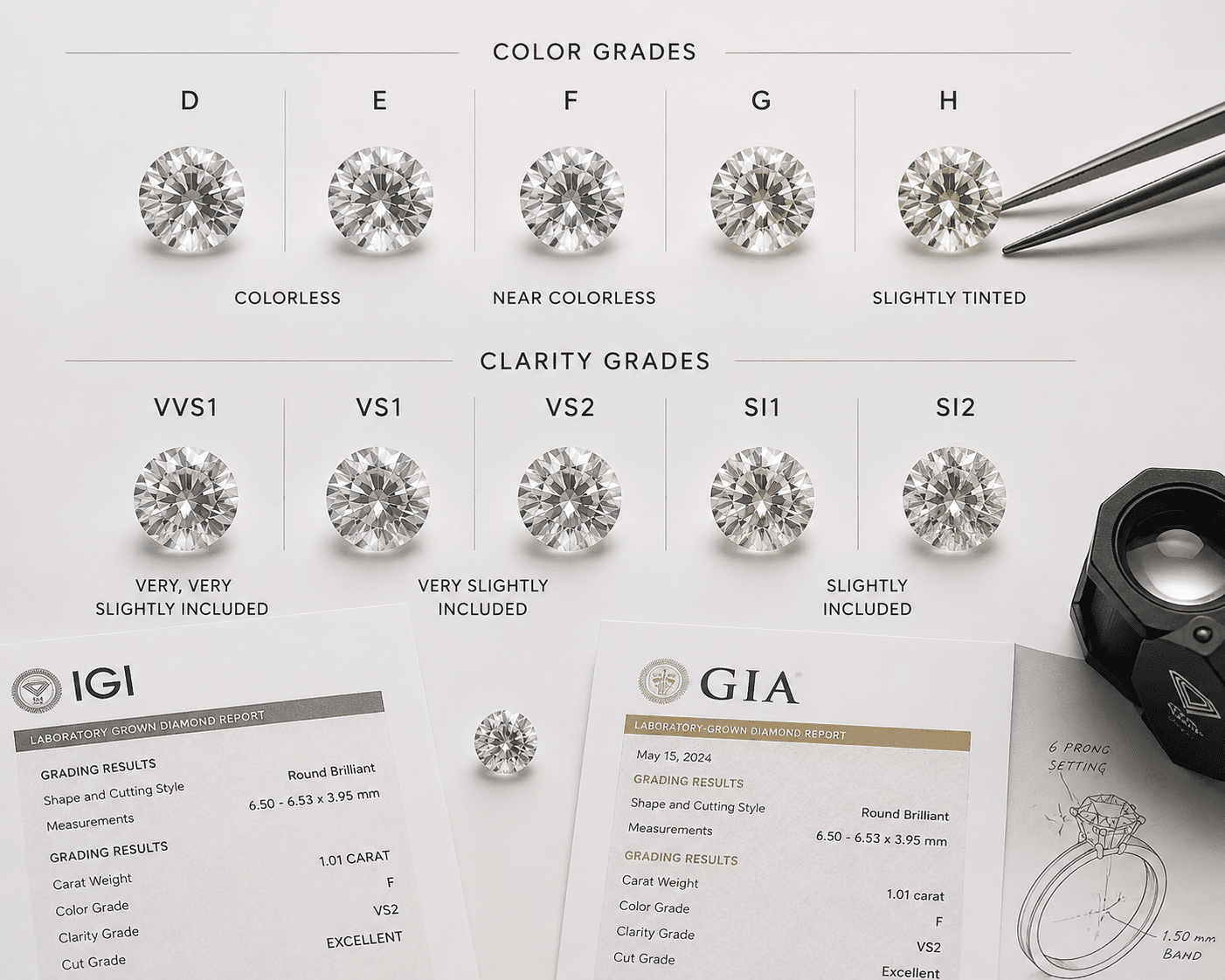
Color and Clarity Terminology: Slightly Different Words, Same Scale
IGI has graded a significantly higher volume of lab-grown diamonds and may use slightly broader tolerance within a given grade. GIA is generally considered more conservative in borderline cases, particularly at the high end of color — D, E, and F — and the high end of clarity, such as IF and VVS. GIA lab-grown diamond certification guide The practical difference for most stones is within one grade, not two or three. A diamond graded G color by IGI might grade H by GIA in some cases, but the visual difference between those two grades is negligible under normal viewing conditions. The risk is not that one lab is wrong. The risk is that a buyer overweights a single grade difference and either overpays for a stone or eliminates a good option based on a distinction that won’t affect how the diamond looks.
Cut Grade: The Most Useful Difference
This is where the two reports diverge in a way that matters. GIA provides a cut grade for round brilliant diamonds based primarily on proportion parameters. IGI also provides a cut grade for round brilliants, but its evaluation includes brightness, fire, and scintillation — the actual visual performance of the stone. For a round brilliant lab-grown diamond, the IGI cut grade is built on a more complete model of how the stone interacts with light. For fancy shapes — oval, pear, marquise, emerald, cushion — neither lab provides a cut grade. The buyer must evaluate light performance through proportion measurements, imaging, and video. As GIA explains in its guide to diamond cut, a cut grade assesses how effectively a diamond returns light to the viewer, though the assessment model for natural diamonds may differ from what IGI applies to its lab-grown grading reports.[1] This does not make one method inherently better; it simply means the information on the report should be understood in context.
Note on Grading Consistency Across Laboratories: Laboratory-grown diamonds and natural diamonds are graded on the same 4Cs scales. However, because different laboratories may apply tolerances differently, a stone graded by one lab is not automatically comparable to a stone graded by another. Buyers should compare based on visual evidence and proportion data, not on the lab name alone. A grading report documents characteristics under a specific laboratory’s criteria — it does not guarantee that the stone will perform identically to another stone of the same grade from a different lab.
Certificate and Visual Review Check
Compare the color and clarity grades on the report with high-resolution images or 360-degree video of the actual stone. For a round brilliant diamond, look at the reported proportions — depth, table, crown angle, pavilion angle — and compare them to known performance ranges, regardless of which lab issued the certificate.
Report Format and Information Density: What You Can Actually See
The content of the report matters as much as the lab name. Two diamonds with identical grades on paper can have very different levels of useful information on their respective reports.
Understanding the Report as a Traceability Document
For a buyer focused on traceability, the grading report is one piece of a larger puzzle. The report number, growth method notation, and proportion data provide a starting point, but true traceability extends to the documentation of the stone’s journey from the growth facility to the retailer. IGI’s explicit notation of HPHT or CVD on its report offers a clear advantage for buyers who want this information without an extra request. GIA’s standard lab-grown report omits this data, meaning the buyer must ask the seller for additional documentation if growth method matters to their decision. In both cases, the certificate should be cross-referenced with the seller’s sourcing records and any available supply chain documentation. NUVU’s approach is to make this connection clearer: what the report shows, what additional documentation is available, and how both fit the buyer’s specific priorities.
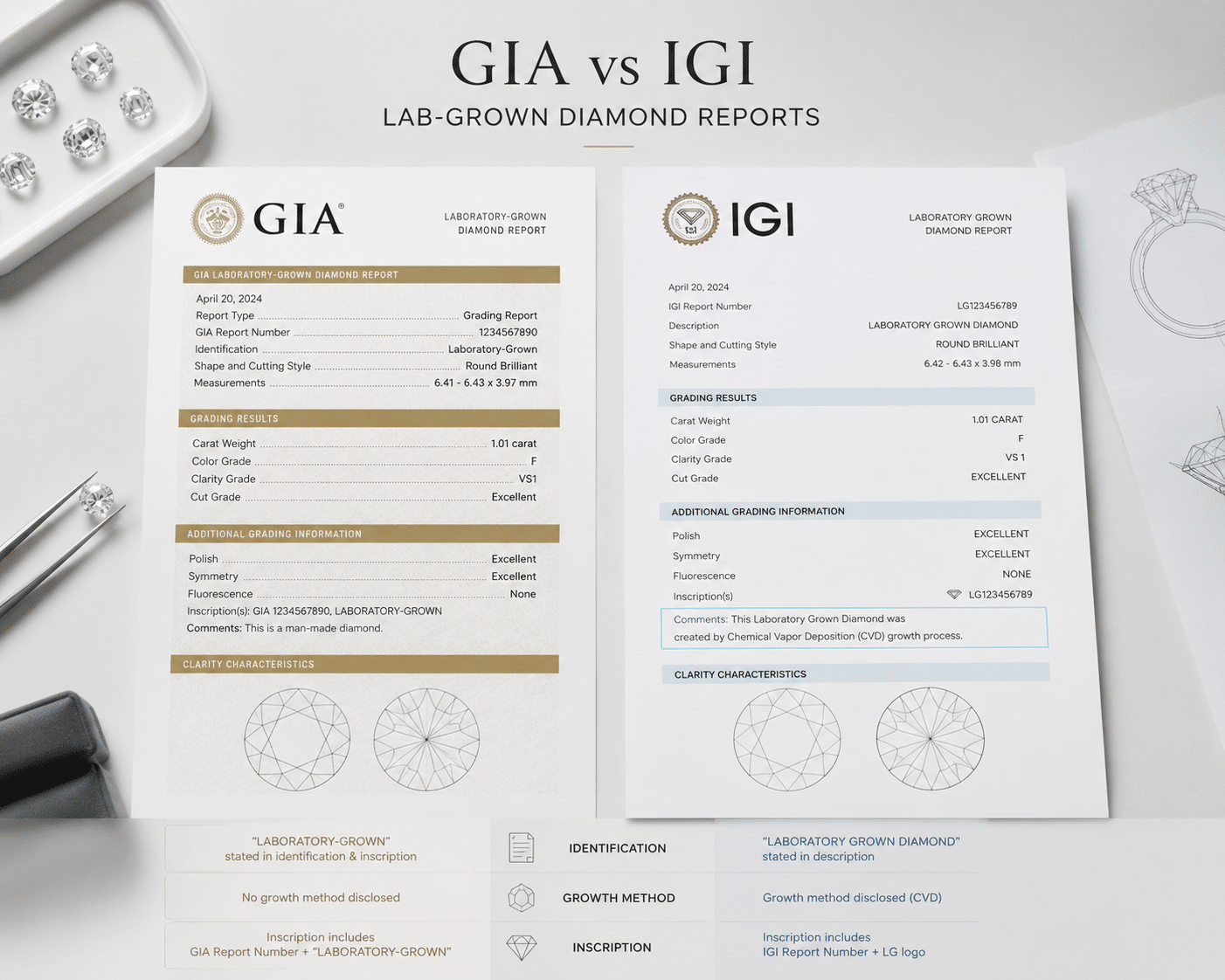
GIA Lab-Grown Report: Detail-Oriented but Structurally Different
GIA issues a separate Laboratory-Grown Diamond Report for lab-grown stones. It includes a full color and clarity grade, a cut grade for round brilliants, a plotted clarity diagram showing inclusion locations, and a proportion diagram. What GIA does not include on its standard lab-grown report is a growth method notation. The report will not tell you whether the diamond was grown through HPHT or CVD unless you specifically request that testing and the result is added. For a buyer who does not care about growth method, this is irrelevant. For a buyer who does, it means an extra step. GIA’s own documentation on laboratory-grown diamonds notes that these stones have the same chemical and physical properties as mined diamonds, and that identification requires advanced testing to distinguish the growth process.[3] This reinforces that the omission of growth method from the standard report is not a flaw—it reflects a deliberate reporting choice.
IGI Lab-Grown Report: Industry Standard with Growth Method Clarity
IGI’s lab-grown diamond report includes the same core information — color, clarity, cut grade, proportion diagram, and clarity plot — but it also explicitly identifies the growth method on the report. If you want to know whether a diamond was grown through HPHT or CVD, an IGI report tells you directly. IGI also inscribes a micro-laser serial number on the diamond’s girdle that matches the report number, which makes verification straightforward. For buyers who value full transparency about how the diamond was made, this is a concrete advantage. GIA’s educational content on diamond identification also confirms that HPHT and CVD produce different types of growth features and trace-element patterns, which means that a buyer who specifically wants one method over the other benefits from having this information clearly stated on the grading document.[3]
What to Check Before You Decide
Look at the report for growth method identification. If this matters to you, an IGI report provides it directly. If you are buying a GIA-graded stone and need this information, it is possible to request it from the seller, but it may not appear on the standard report.
Perception, Resale, and Retail Use: What Actually Matters Outside the Purchase
Industry Perception: GIA Carries More Weight in Natural Diamonds
GIA has built its reputation over nearly a century in the natural diamond market. In that world, a GIA report signals rigorous evaluation and commands faster buyer confidence, especially in resale channels. For lab-grown diamonds, the perception landscape looks different. IGI entered the lab-grown space early and graded the vast majority of stones as the market scaled. Today, IGI reports are the standard reference for retailers, manufacturers, and insurance appraisers who work with lab-grown diamonds daily. A GIA report on a lab-grown diamond is not wrong or inferior, but the brand recognition advantage that GIA holds in natural diamonds does not transfer at full strength to this market.
Note on Perception and Buyer Expectations: While laboratory reputation may influence initial confidence, the practical value of a report depends on the information it contains and how that information is used in the buying process. No laboratory name substitutes for a careful review of the stone’s specifications, visual evidence, and intended use. Buyers should evaluate the report content, not just the lab name.
Resale Reality: Neither Report Creates a Premium Market
The secondary market for lab-grown diamonds is limited compared to natural diamonds, and no certificate brand changes that reality. Whether a stone carries an IGI or GIA report, the impact on resale value is minimal. What matters more in a secondary transaction is the stone’s visual performance, size, condition, and whether the certificate is intact and verifiable. A buyer choosing a certificate based on resale potential should recognize that the market for any lab-grown diamond resale is small, and the certificate brand is not a meaningful factor in that equation.
In sourcing or wholesale conversations, documentation, consistency, and communication often matter as much as the headline specification. For a buyer looking at a stone’s long-term value, verifying the certificate through the issuing laboratory’s online tools and keeping a complete record of the purchase documentation are practical steps that support future appraisal or transfer.
When a grading report is available, buyers should verify the report details through the issuing laboratory’s official report-check tools where available. For IGI-graded stones, report details can be cross-checked through IGI’s online verification portal using the report number inscribed on the diamond’s girdle. For GIA-graded stones, verification is available through GIA’s Report Check service, which confirms the grading details and report status for laboratory-grown diamonds. This step ensures that the information you are relying on in your purchasing decision reflects the actual stone, not a mismatched or misrepresented document.
What This Means in a Real Purchase
Do not select a certificate based on resale speculation. Focus on the stone you are buying now, how it looks, and whether the certificate confirms its measurable qualities. For insurance purposes, either report provides sufficient documentation for a standard appraisal.
Price and Availability: How Certificate Choice Affects What You Can Buy
IGI-Graded Inventory Is Larger and Often More Available
Because IGI grades an estimated 60 to 80 percent of lab-grown diamonds over one carat, the inventory of IGI-graded stones is significantly larger. A buyer who limits their search to GIA-graded lab-grown diamonds may find 40 to 70 percent fewer options within the same price and quality range. That translates to longer search times, less shape variety, and fewer upgrade paths. In practical terms, restricting by certificate brand narrows the field considerably before you even evaluate the stone’s visual performance.
Price Differences: Small and Usually Not Certificate-Driven
For two lab-grown diamonds with equivalent color, clarity, and carat weight, the price difference between an IGI and GIA report is typically within 5 to 10 percent. That gap is more often explained by inventory availability, seller markup, or specific stone characteristics than by the certificate brand itself. If a GIA-graded stone carries a noticeably higher price, look for other factors: exceptional proportions, absence of fluorescence, or a particular growth method. The certificate alone rarely justifies a large premium.
For buyers comparing stones across certificate types, the price comparison is most useful when it accounts for the full picture of report information. A stone with IGI certification that shows an excellent cut grade, clear growth method data, and favorable proportions may represent better value than a GIA-graded stone with an equivalent color and clarity rating but less documented visual performance.
Note on Price Verification: Prices for lab-grown diamonds can vary based on market conditions, seller channel, report type, lab grown diamond certification guide, and stone-specific details such as size, shape, and cut precision. Exact prices and percentages should be verified at the time of purchase, as availability and market dynamics can change. The comparison above is based on general market observations and should not be treated as a fixed pricing rule.
Stone-to-Setting Fit Check
When comparing two stones with different certificates and different prices, check the actual measurements. Diameter and depth matter for round brilliants. Length-to-width ratio matters for fancy shapes. These dimensions determine how the stone fits your ring setting. The certificate brand will not affect fit, but the measurements will.
Visual Performance and the Limits of Any Certificate
Certificates Describe, They Do Not Judge Beauty
Both IGI and GIA reports provide objective measurements and grades. Neither report can tell you whether the stone looks bright, lively, or well-proportioned to your eye. A diamond with excellent grades on paper can still show windowing, extinction, or weak light return if the proportions interact poorly with the specific cutting execution. This risk is especially high for fancy shapes, where no cut grade exists to guide the buyer.
What You Must Verify Outside the Report
For any lab-grown diamond, the buyer must verify visual performance independently. High-resolution images, 360-degree videos, proportion measurements, and in-person viewing all matter more than the certificate brand. The report is a starting point, not the final answer. For fancy shapes, the report provides length and width measurements, clarity, and color, but actual light performance depends on faceting precision and symmetry, which the numeric grade does not fully capture.
If a GIA report is provided, the report details can usually be checked through GIA’s official report verification system. This applies to GIA-graded lab-grown diamonds as well as natural stones. For IGI-graded diamonds, the lab provides a similar online verification tool where the report number and stone characteristics can be confirmed. We encourage every buyer to use these independent verification services before finalizing a purchase, regardless of which lab issued the report. This simple step adds a layer of assurance that the stone you receive matches the documented qualities on the certificate.
Buyer Verification Checklist
Review high-resolution images and 360-degree video of the actual stone. For round brilliants, compare proportions to known performance ranges: depth percentage between 59 and 62.5 percent, table percentage between 54 and 57 percent, crown angle between 34 and 35.5 degrees, pavilion angle between 40.6 and 41 degrees. For fancy shapes, look for even light return, no dark areas, and clean faceting. Ask the seller for proportion data if it is not listed on the report. If possible, view the stone in person or under natural lighting conditions.
Routine Questions Buyers Ask About IGI vs GIA Lab-Grown Reports
Does one lab consistently grade harder than the other?
Within a one-grade tolerance, the two labs produce comparable results. GIA may apply slightly more conservative judgments at the high end of color (D-E-F) and clarity (IF-VVS). IGI may show a one-grade difference on borderline stones, but this is not systematic across their entire output. For most buyers shopping within a reasonable color and clarity range, the difference is negligible and does not affect how the stone looks. The practical risk of a significant grading gap between the two labs is small enough that it should not drive the decision.
Will a jeweler refuse to work with a stone graded by one of these labs?
Almost never. Most jewelers and custom designers who work with lab-grown diamonds accept both IGI and GIA reports. The jeweler cares about the stone’s actual measurements, shape, and how it behaves in the setting. The certificate brand rarely matters at the bench. A refusal based solely on which lab issued the report is extremely unusual in the lab-grown diamond market.
Is the report verification system the same for both?
Functionally, yes. Both labs offer online report verification through their websites. You enter the report number and the system displays the grade details. The report number should match the inscription laser-engraved on the diamond’s girdle. The verification step works the same way for both labs and serves the same purpose: confirming that the stone you are looking at matches the document. GIA provides direct online report check functionality on its website, and the system is designed to verify laboratory-grown diamond reports just as it does for natural stones, which adds an independent layer of confirmation for the buyer.[4]
Your Next Decision: Choosing the Report That Serves the Stone
An Honest Summary: What to Prioritize
For a round brilliant lab-grown diamond, IGI’s cut grade provides a more complete performance evaluation because it includes direct assessment of brightness, fire, and scintillation. For any shape, prioritize the actual stone’s visual performance—through images, video, and proportion data—over the certificate brand. If inventory size matters, IGI-graded stones offer significantly more options across a wider range of sizes and qualities. If brand reputation matters to you personally, GIA has a longer pedigree in natural diamonds, but this advantage is much smaller in the lab-grown market. For growth method transparency, IGI provides it directly on the report.
Building Confidence Through Documentation
Beyond the certificate itself, a buyer’s confidence can be strengthened by assembling a complete documentation package. This includes the grading report, any available sourcing or production records, the seller’s purchase agreement, and the verification confirmation from the issuing laboratory. For a custom design project, documentation of the stone’s measurements and setting specifications further supports a successful final piece. NUVU’s approach is to help buyers navigate these details so the decision rests on clear, verifiable information rather than marketing claims or unsubstantiated promises.
One Practical Takeaway
Choose the stone first, then check the certificate. A beautiful diamond with an IGI report is a better purchase than an average diamond with a GIA report. The report confirms measurable qualities. It does not make the stone beautiful.
What to Check Before You Decide
Compare three stones in your target size and price range—two with one certificate type, one with the other. Look at the images, measurements, and proportions. Your decision will become clear based on what you see in the stone, not what is printed on the report.
[1] GIA (Gemological Institute of America), “4Cs of Diamond Quality,” GIA.edu, educational resource covering color, clarity, cut, and carat weight for diamond evaluation. Source
[2] Federal Trade Commission (FTC), “Guides for the Jewelry, Precious Metals, and Pewter Industries,” 16 CFR Part 23, addressing advertising, terminology, and disclosure requirements for natural and lab-grown diamonds. Source
[3] GIA (Gemological Institute of America), “Laboratory-Grown Diamonds,” GIA.edu, educational page explaining identification, HPHT and CVD growth methods, and properties of lab-grown diamonds. Source
[4] GIA (Gemological Institute of America), “Report Check,” GIA.edu, online portal for verifying grading reports including laboratory-grown diamond reports. Source
Disclosure: This article is for general educational purposes only. Diamond grading, pricing, availability, specifications, and seller policies can change, and readers should verify important details through grading reports, official laboratory tools, seller documentation, or qualified professionals before making a purchase decision. Laboratory-grown diamonds should be clearly distinguished from natural diamonds, and environmental or sourcing claims should be supported by specific documentation.