
A diamond grading certificate is only useful if it matches the stone in your hand. Without verification, a certificate can describe a different diamond entirely—carrying the wrong measurements, a mismatched clarity plot, or even a genuine report number assigned to a completely different stone. These mismatches are not rare, and they can happen with any lab or seller. This article walks through the exact steps to confirm that a diamond’s laser inscription, dimensions, inclusion pattern, and carat weight all align with its official **certificate number verification guide** and what to do when they don’t.
For the full framework, read Lab-Grown Diamond Traceability, Certification, and Transparency Guide.
| Verification Step | What to Check | Red Flag to Watch For |
|---|---|---|
| Laser Inscription | Confirm the report number or ID on the diamond’s girdle matches the certificate. | No inscription, missing characters, or a different number than the report. |
| Exact Measurements | Compare the diamond’s dimensions (mm) to the certificate. Differences over 0.03 mm are suspicious. | Seller cannot provide precise measurement tools or images showing the stone. |
| Clarity Plot | Match the location, shape, and number of inclusions on the plot to the actual diamond. | Inclusions on the stone do not appear on the plot, or vice versa. |
| Online Lab Verification | Enter the report number on the lab’s official website (IGI, GIA, GCAL, etc.) using your own browser. | Seller provides a link to a site that looks like the lab but isn’t the lab’s official URL. |
| Full Certificate Copy | Request the complete, unedited photo of the front and back of the certificate. | Seller only shows a cropped or watermarked version, or refuses to share the full document. |
Quick Questions Before You Read
Q: If the report number exists on the lab website, does that mean the diamond is genuine?
No. It only confirms that certificate exists. It does not prove the diamond in your hand is the one described on that certificate. You must also check the laser inscription, measurements, and clarity plot.
Q: What if my diamond has no laser inscription at all?
Many diamonds are not inscribed. In that case, rely on careful measurement and the clarity plot to match the stone to the report. If the seller cannot help you verify these details, consider it a red flag.
Q: Can I trust a seller who sends me a link to verify the certificate?
Always open your own browser and go to the official lab website manually. Do not click a link provided by the seller—it could point to a fake verification page that shows a genuine-looking report for a different stone.
Q: What is the strongest single piece of evidence that a diamond matches its certificate?
The clarity plot. No two diamonds have identical inclusion patterns. If the inclusions on the plot match what you see under magnification, it is the most conclusive confirmation available.
Why Certificate Verification Matters More Than the Certificate Itself
A grading report from a reputable lab carries weight, but it is not a guarantee that the diamond in your hands is the stone described on the paper. The certificate documents what a specific diamond looked like at the time of grading. It does not track where that diamond goes afterward or confirm which stone a seller actually ships. Buyers who treat the certificate as a final answer rather than a starting point are trusting the seller’s inventory system as much as the lab’s judgment. Verification bridges that gap.
The Difference Between Reading a Certificate and Verifying a Diamond
Reading a certificate tells you what the lab recorded. Verifying a diamond tells you whether that record matches the stone. Those are two different actions, and only one of them protects you. A certificate can be reused across multiple sales, accidentally applied to the wrong stone in a seller’s inventory, or shown for a diamond that was never graded at all. The grading report itself is not the problem. The mismatch between the report and the actual diamond is the problem, and that mismatch can happen with no intent to deceive. Loose inventory control, incorrect labeling, or simple human error are more common than outright fraud. The only way to catch it is to check.
What Can Go Wrong When Verification Is Skipped
The most common failures are not dramatic. A laser inscription that reads one number while the certificate shows another. A diamond that measures 6.50 mm when the certificate says 6.47 mm. A seller showing a certificate for a VS1 clarity stone while the diamond itself has visible inclusions that a VS1 grade would not allow. These mismatches happen because someone in the supply chain swapped the wrong stone into the wrong box or because the certificate image on the seller’s site belongs to a different diamond than the one being offered. Report numbers can be mistyped, certificates can be photocopied without the original, and ungraded stones can be listed with a certificate from a different diamond. Each of these scenarios is detectable if you verify. None of them show up if you only read the PDF.
The Core Verification Chain
Verification works because a grading report contains multiple fixed data points that describe one unique stone. The report number, the laser inscription, the exact measurements, the carat weight, and the clarity plot all refer to the same physical object. If any one of these does not align between the certificate and the diamond, the match is broken. A matching report number alone means nothing if the measurements are off. A matching carat weight is not enough if the clarity plot shows inclusions in different locations. The chain only holds when every link agrees.
Buyer Verification Checklist
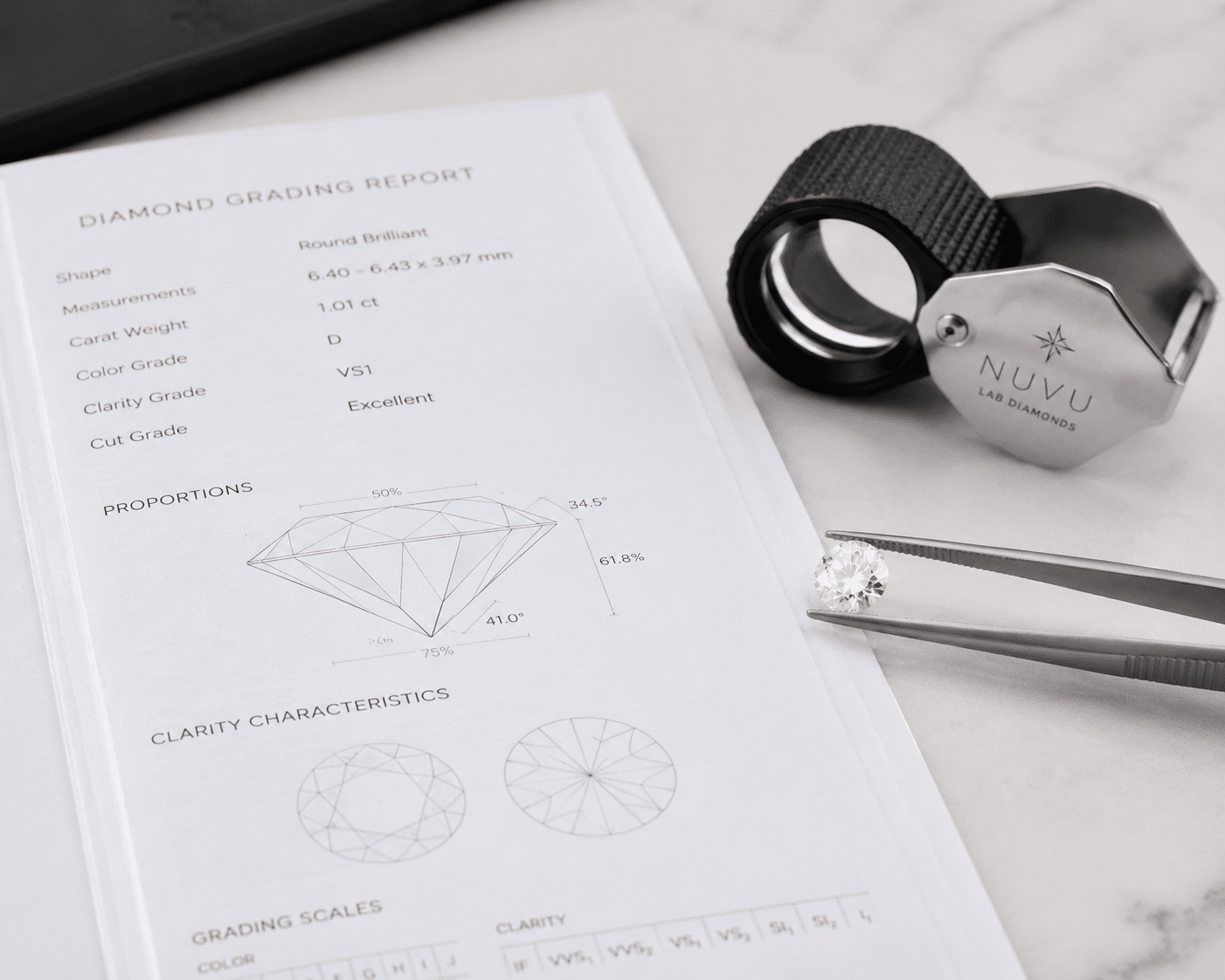
Check the report number printed on the certificate against the number inscribed on the diamond’s girdle. They should match exactly. If the stone is not yet set, use a jeweler’s loupe at 10x magnification or ask the seller for a clear loupe photo showing the inscription. Compare the dimensions listed on the certificate to the seller’s reported measurements. A variation of 0.01–0.02 mm is normal. Anything larger should be questioned. Look at the clarity plot on the certificate and ask for a magnification image of the actual stone. The inclusions you see should correspond to the plotted locations. If you cannot verify the inscription because the diamond is set or lacks one, the measurements and clarity plot become your strongest cross-checks. Do not move forward until these points align.
How Report Numbers Work Across Major Grading Labs
Every major lab assigns a unique report number to each graded diamond. That number is the key to the online verification database, but how it works and what it returns varies by lab. Knowing the format and the lookup process for each lab helps you confirm the certificate is real before you match it to the stone.
IGI Report Numbers and Online Lookup
IGI report numbers use a consistent alphanumeric format, typically a letter prefix followed by a sequence of digits. Enter that number on the IGI website, and the database returns the full grading report, including the 4Cs, the clarity plot, and the proportion data. The online result should match the printed certificate exactly. If the online report shows different measurements, a different clarity grade, or a different carat weight than the certificate you were given, the printed document has been altered or belongs to a different diamond. Always run the lookup on the official IGI website, not through a link or portal on the seller’s site. A seller-provided link can lead to a copy, not the live database.
GIA Report Numbers and Online Lookup
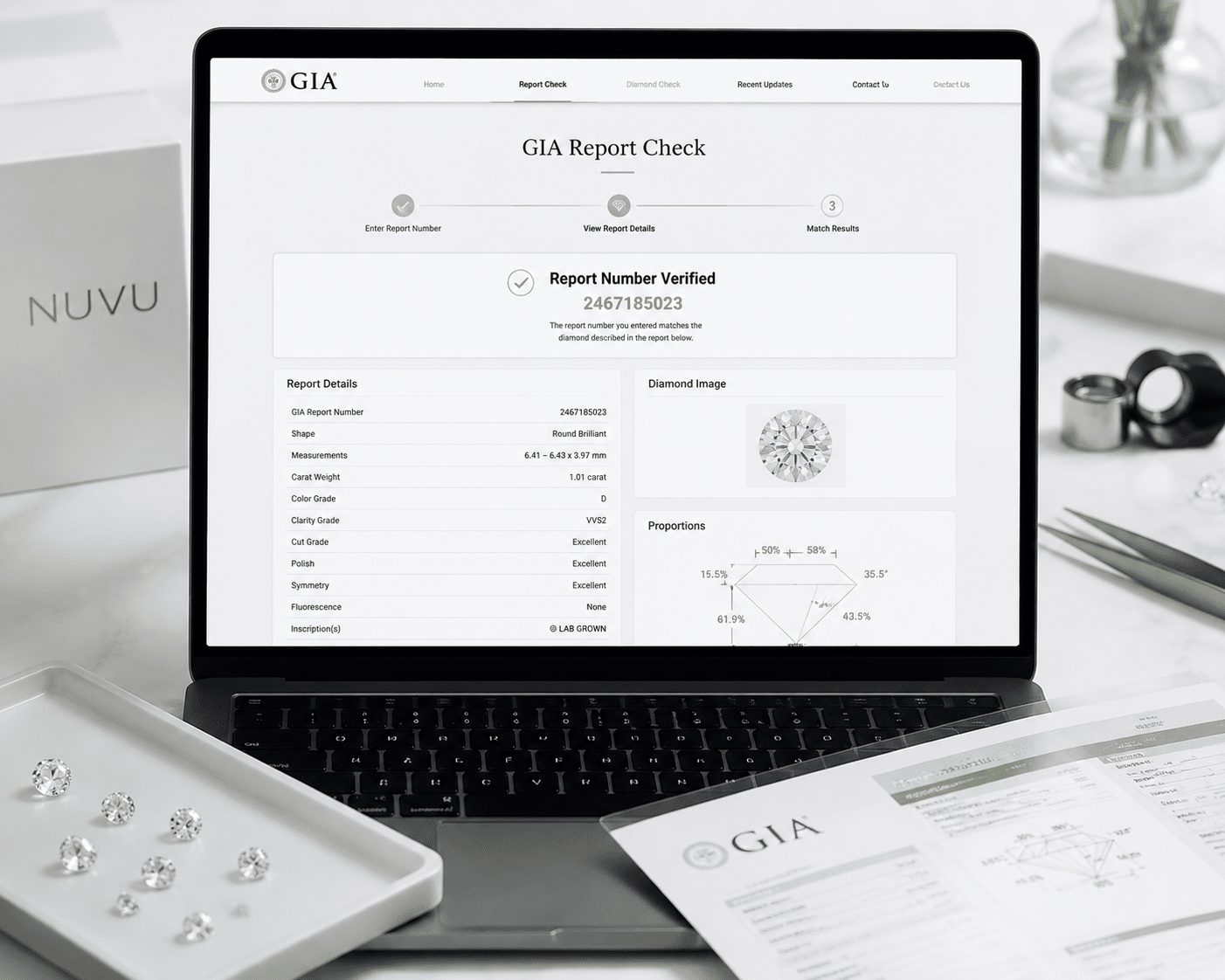
GIA report numbers are numeric only. The GIA Report Check page accepts the number and returns the full grading data, including a downloadable PDF of the original report. GIA also offers a laser inscription verification service that confirms the inscription data on file. The online result from GIA includes the same clarity plot, measurements, and proportions as the original document. If the PDF on the GIA site does not match the certificate you received, the printed certificate is not valid. GIA’s database is the single source of truth for any diamond carrying a GIA report. No other verification method replaces it.
GCAL and Other Lab Verification Systems
GCAL assigns report numbers that can be verified on the GCAL website. The online result includes full grading details and inscription information. GCAL’s database is well maintained, and the lookup process is straightforward. Smaller labs such as EGL and AGS operate their own verification tools, but the consistency and depth of data vary. Some older EGL reports may not appear in an online database at all. AGS reports are more reliable but less commonly encountered in lab-grown diamonds. When dealing with a smaller or less standardized lab, cross-checking with the seller becomes more important because the online tool may not provide enough detail to confirm the match.
What to Check Before You Decide
Enter the report number on the official lab website. Do not use a third-party aggregator or a link embedded in the seller’s product page. Compare the online result to the printed or digital certificate the seller provided. Every data point should match. If the lab database returns no result for that report number, that is a disqualifying signal. Do not assume the certificate is legitimate just because it looks professional. The online database is the only reliable verification source.
Laser Inscription: What It Means and How to Check It
The laser inscription on a lab-grown diamond is the most direct connection between the stone and its certificate. It is a physical link that cannot be altered without removing material from the diamond. Understanding what it contains and how to read it gives you a verification method that does not rely on the seller’s documentation.
What the Laser Inscription Contains
Most lab-grown diamonds graded by major labs include a laser inscription on the girdle, the thin outer edge of the stone. The inscription typically shows the lab abbreviation and the full report number. For example, an IGI-graded diamond will have “IGI” followed by the report number. Some sellers add their own brand identifier or an internal stock number alongside the lab inscription. This does not interfere with verification as long as the lab report number is present and readable. The inscription is permanent and cannot be removed without repolishing the girdle, which changes the diamond’s dimensions and weight.
How to Read the Inscription on a Real Diamond
The inscription is not visible to the naked eye. It requires at least 10x magnification, which a standard jeweler’s loupe provides. Under magnification, the text appears as fine engraved characters along the girdle. If you have access to the loose stone, you can check it yourself with a loupe. If you are buying online, ask the seller for a loupe photo or a macro video that clearly shows the inscription. The inscription number must match the report number on the certificate exactly. Any discrepancy, even a single digit, means the certificate does not belong to that diamond.
What to Do If There Is No Inscription
Not all lab-grown diamonds are laser inscribed. Some buyers prefer an uninscribed girdle for aesthetic reasons, and some labs offer inscription as an optional service rather than a requirement. A missing inscription does not automatically mean the certificate is wrong, but it removes the easiest verification method. Without an inscription, you must rely on the physical measurements, carat weight, and clarity plot to confirm the match. These cross-checks are still effective, but they require more careful comparison. If a seller cannot provide an inscription, be prepared to verify through other parameters and request measurement confirmation before purchasing.
Certificate and Visual Review Check
Request a loupe photo or macro video that clearly shows the laser inscription on the diamond’s girdle. Compare the inscription number to the report number on the certificate. They must match exactly. If the seller cannot provide a clear image of the inscription, ask why. If the diamond has no inscription, ask for the exact measurements and a magnification image showing the clarity characteristics. Use these as your primary matching tools instead.
Understanding the Legal Framework for Diamond Certificate Verification
Certificate verification is not only a practical step for buyers but also a matter that is addressed by official guidelines on diamond terminology and advertising. Understanding the regulatory context helps clarify why verification is both necessary and protected by consumer standards.
FTC Guidance on Diamond Disclosure and Advertising
The Federal Trade Commission (FTC) provides guidance on how diamonds should be described in advertising and sales. The FTC’s Guides for the Jewelry, Precious Metals, and Pewter Industries address the use of terms like “laboratory-grown” and “synthetic,” requiring that such descriptions be clear and not misleading [1]. While the FTC does not directly regulate certificate verification, its emphasis on accurate representation supports the buyer’s right to confirm that a diamond’s documentation matches the product being sold. Misrepresenting a diamond’s grade or report falls under the FTC’s prohibition against deceptive advertising, making accurate documentation a legal expectation, not just a courtesy.
How Terminology Standards Support Verification
Official diamond terminology, as outlined by institutions like GIA, provides a consistent language for describing diamonds and their characteristics. GIA explains that lab-grown diamonds are real diamonds that share the same physical and chemical properties as natural diamonds, but they must be disclosed as laboratory-grown to avoid confusion [2]. This standardization means that a buyer comparing a certificate to a stone can trust that the terms used—such as “VS1” or “HPHT”—carry the same meaning across different labs, as long as the labs follow recognized grading practices. Verification becomes more reliable when both the certificate and the buyer are working from a shared vocabulary.
The Role of Grading Reports in Consumer Protection
A grading report from a lab like IGI or GIA documents the specific characteristics of a diamond at the time of grading. IGI describes its grading reports as detailed documents that include proportions, clarity characteristics, and a color grade, all of which serve to protect the buyer by providing an independent assessment [3]. However, as noted throughout this article, the report, as detailed in IGI vs GIA lab-grown diamond certification, is only as good as the match between its data and the actual stone. The legal and regulatory context reinforces that buyers have the right to demand that match be verifiable, and that sellers who fail to provide accurate documentation may be in violation of consumer protection standards.
What This Means for Your Verification Process
Understanding that certificate verification is supported by official guidelines and consumer protection laws gives buyers more leverage when requesting documentation. If a seller hesitates to provide inscription images or measurement verification, the buyer can point to the expectation of accurate representation under FTC guidance. The legal framework does not replace the need for hands-on checking, but it reinforces the importance of treating certificate verification as a standard part of any transparent diamond transaction.
Matching Measurements: Carat Weight, Dimensions, and Clarity Plot
Laser inscriptions are the fastest verification tool, but not every diamond has one. Some diamonds are never inscribed by the lab. Others may have a very small or faint inscription that is difficult to read without ideal lighting and a steady hand. When inscription verification is not possible, physical measurements become the most reliable fallback.
Why Carat Weight Alone Is Not Enough
Carat weight is the number most buyers check first, and it does need to match. The certificate records weight to the nearest 0.01 carat, and the diamond should land on that exact number. But two diamonds can share the same carat weight and be completely different stones. One may be cut deeper and smaller in diameter. Another may be spread wider but thinner through the crown. Both weigh the same. Both look different in a setting. Matching carat weight is necessary, but it confirms almost nothing by itself. It only rules out a stone with a clearly different weight.
How Dimensions Confirm or Disconfirm a Match
The certificate lists the diamond’s length, width, and height in millimeters, measured to two decimal places. These numbers are precise because the lab measures every certified stone the same way. A buyer can ask the seller to measure the actual diamond and compare. A difference of 0.01 to 0.02 mm is normal—measurement tools and technique introduce minor variation. Anything larger than 0.03 mm should raise a question. A 0.10 mm gap means the stone is not the same one described on the certificate.
For round brilliants, the diameter measurement is especially useful because it is the most stable dimension. A round diamond’s diameter changes very little between measurements when done correctly. If the certificate says 6.50 mm and the seller measures 6.45 mm, something is off. For fancy shapes such as ovals, pears, or emerald cuts, the length-to-width ratio serves as the anchor. A mismatch in that ratio often reveals a different stone even when carat weight is close.
Using the Clarity Plot as a Visual Check
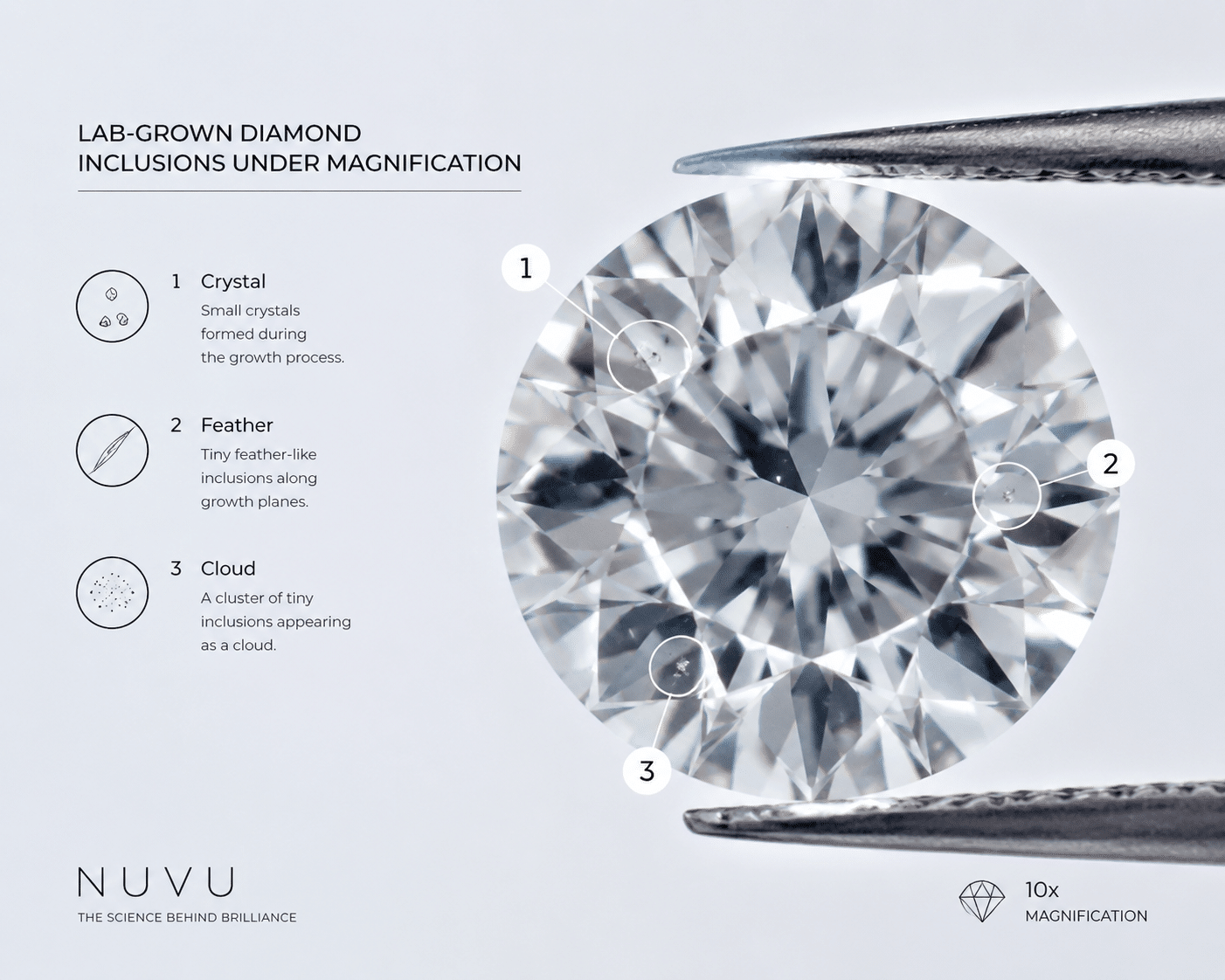
The clarity plot on a certificate is a diagram that marks the location, type, and relative size of each inclusion. It is drawn by the grader based on what they saw under magnification. This is the strongest non-destructive verification tool because no two diamonds have the exact same inclusion pattern. Even two stones graded at the same clarity level will have different internal features in different positions.
A buyer can request a high-magnification image or video of the actual diamond and compare the inclusions to the plotted locations. The inclusion at 10 o’clock on the plot should appear at roughly 10 o’clock on the diamond. A crystal near the center of the plot should be visible in approximately the same position under magnification. If the pattern does not match, the certificate belongs to a different stone. This check is conclusive regardless of whether a laser inscription exists.
Stone-to-Setting Fit Check
Ask the seller for actual measurements of the diamond, not just the certificate values. A seller who can provide measured numbers has likely handled the stone and confirmed it matches. Compare the measurement results against the certificate dimensions. Request a high-magnification image of the clarity plot area and compare inclusion positions. If the diamond is already set in a ring, ask the seller for a setting-out video or a loose stone image taken before mounting. A set stone is harder to measure accurately, so loose confirmation before setting is the safer approach.
For buyers, the practical point of measurement comparison is not just catching a mismatch. It also reveals how the stone will behave in a setting. A diamond with a slightly larger diameter than the certificate states may require a different prong size or head style, especially in a custom design. That is why a measurement check serves two purposes: it confirms the stone matches the report, and it confirms the stone fits the intended design.
What Sellers Should Provide for Verification
Verification depends on what the seller is willing to share. A transparent seller makes it easy. A seller with something to hide makes it difficult. Knowing what to ask for separates a confident purchase from a risky one.
Standard Verification Documentation
A reputable seller should provide three things without hesitation. First, a copy of the full certificate, not a cropped summary or a screenshot of just the grade. Second, a laser inscription photo or video taken under magnification so the buyer can see the number on the girdle. Third, the actual measured dimensions of the stone, ideally confirmed by the seller’s own tool, not just repeated from the certificate. Some sellers also provide a graded report image showing the full clarity plot and proportion data, which makes the visual verification step much easier. These are not extras. They are baseline documentation.
Red Flags in Seller Behavior
Certain responses signal a problem before any verification begins. Refusing to provide a loupe image of the laser inscription is a clear warning. Saying the certificate is “on file” but not showing a full copy is another. Claiming the report number cannot be shared before purchase defeats the entire purpose of independent verification. A lack of 360-degree video or high-resolution images also limits what a buyer can confirm. None of these omissions proves fraud by itself, but together they make it impossible to verify the match before committing money. A buyer should not need to fight for basic documentation.
When to Ask for a Third-Party Verification
For higher-value purchases or when buying from an unfamiliar seller, independent verification adds a layer of protection. A buyer can request that the diamond be sent to a third-party lab or an independent appraiser for measurement and documentation review before purchase. Some sellers accommodate this as a standard part of their process. Others may charge a restocking fee or refuse outright. A seller who resists independent confirmation when the diamond is claimed to match the certificate is asking for trust without evidence. That is not a reasonable request.
One often overlooked point in this process is that the grading report itself may have been issued months or even years before the sale. During that time, the stone could have been repolished, damaged, or simply mismanaged in inventory. Verification is the only way to confirm that the lab’s record still describes the stone being offered today. Even a certificate that was accurate at grading may no longer match if the stone has been re-cut or chipped, though those cases are less common with lab-grown diamonds that are handled carefully.
How to Verify This Before Buying
Ask for a full copy of the grading report, not just a summary page. Request a loupe video showing the laser inscription clearly. Confirm the seller allows independent verification through an appraiser or lab before finalizing the purchase. Get all return and verification policies in writing before payment. If a seller cannot or will not provide these, the safest response is to buy elsewhere.
Traceability in the Supply Chain: How Documentation Follows the Stone
Certificate verification is most effective when the diamond’s path through the supply chain is traceable. A grading report alone does not establish traceability, but the combination of the report, laser inscription, and seller documentation can create a verifiable chain from the lab to the buyer. Understanding how traceability works helps buyers ask the right questions before committing to a purchase.
What Traceability Means for a Lab-Grown Diamond
Traceability in the diamond context means that the identity and history of a specific stone can be confirmed from the point of grading through each transaction. For a lab-grown diamond, the strongest traceability tool is the laser inscription combined with the grading report. If a stone is sold with its original certificate and the inscription matches the report number, the chain from the lab to the current owner can be documented. However, if a stone changes hands multiple times without a direct inscription match or if the certificate is separated from the stone, traceability breaks down. Buyers should ask whether the stone being offered is the exact stone described on the certificate, or whether the certificate is being used as a general representation for a batch of similar stones.
How Sellers Can Demonstrate Traceability
A seller who can demonstrate traceability provides more than just a certificate. They provide a clear link between the stone and the document. This includes showing that the stone in their inventory matches the inscription on the certificate, and that the measurement data and clarity plot have been cross-checked. Some sellers maintain internal tracking systems that log the stone’s path from the lab to the showroom. While these systems are not standardized, a seller who can explain how they track individual stones and confirm matches is more likely to ship the correct diamond. Buyers should ask how the seller verifies that the stone being shipped is the same one listed on the website.
What to Expect When Traceability Is Missing
When a seller cannot demonstrate traceability between the certificate and the stone, the buyer must rely entirely on post-purchase verification. This is riskier because the mismatch is only discovered after payment. A seller who cannot explain how they match stones to certificates may have loose inventory control. In such cases, the buyer should ask for additional documentation, such as a video showing the inscription being checked against the report number, or a confirmation that the stone will be measured before shipping. The absence of traceability does not always mean fraud, but it increases the need for careful verification on the buyer’s side.
Traceability Check Before Purchase
Ask the seller directly: “How do you confirm that the stone you ship is the exact diamond listed on the certificate?” Listen for specific answers such as “we match the laser inscription to the report number before shipping” or “we photograph the inscription and compare it to the report.” A vague or evasive answer is a reason to proceed cautiously. A transparent response shows that traceability is part of the seller’s standard process, not an afterthought.
How Online Verification Tools Work (and Their Limits)
Online verification tools are useful, but they do less than most buyers assume. They confirm the certificate exists. They do not confirm the diamond matches.
Using GIA Report Check and IGI Online Verification
Both GIA and IGI allow anyone to enter a report number on their website and retrieve the full grading data for that stone. GIA Report Check returns a PDF of the original report, including measurements, clarity plot, proportions, and the full 4Cs. IGI’s online lookup returns a report image with the same information. These tools are fast and free. They confirm that a certificate with that number exists in the lab’s database. But they only confirm the certificate. They do not confirm that the diamond in your hand or on your screen is the same diamond described in that report.
What Online Verification Confirms and What It Does Not
Online verification confirms the report number is valid and provides the original data recorded by the lab. It also confirms the certificate has not been altered—if the online version shows different measurements, dimensions, or grades than the printed certificate, the printed version is suspect. But even a valid online report does not mean the diamond matches. The lab database does not include a photograph of the stone. It does not include a fingerprint or unique visual identifier. The only way to connect the online report to the physical diamond is through the verification methods already discussed: laser inscription matching, measurement comparison, and clarity plot review. These steps happen outside the online tool.
Why Some Fake or Altered Certificates Exist
Fraud in the diamond market usually targets the certificate, not the stone. A seller may show a genuine certificate from a higher-grade diamond while offering a lower-grade stone. Or a seller may alter a PDF to change the grade, hoping the buyer never verifies it online. Online verification catches the most common forms of this fraud because it surfaces the original lab data. If the online result shows different measurements, a different clarity grade, or a different carat weight than the seller’s certificate, the mismatch is conclusive. That is a hard stop. Do not proceed with the purchase.
It is also worth noting that some sellers use a single certificate to represent a batch of similar-looking stones, especially in lower price ranges. The certificate may be genuine, and the report number may return valid data online, but the stone you receive may not be the exact one that was graded. This is most common with stones sold without a direct inscription match or clear stone-specific photography. The online tool cannot detect this kind of mismatch. Only the combination of inscription verification and clarity plot comparison can.
Certificate and Visual Review Check
Always verify the report number on the lab website, not on a third-party aggregator site. Compare the online result to the physical or digital certificate provided by the seller line by line. If the online report shows different measurements, clarity characteristics, or proportions from the seller’s certificate, the document has been altered or the wrong certificate is being used. A discrepancy in any single field is enough to stop the transaction.
What to Do When the Certificate and Diamond Do Not Match
A mismatch between the certificate and the actual diamond is not a minor issue. It means the documentation does not describe the stone in front of you, and that changes everything about the transaction. The right response is immediate and firm.
Immediate Steps After Discovering a Mismatch
Stop all purchase steps as soon as you identify a discrepancy. Do not accept a partial explanation or a casual promise to fix it later. Contact the seller in writing with specific details from the lab grown diamond certification guide about what does not match — report number, laser inscription, measurements, clarity plot, or any combination. Request a full refund or an alternative stone that matches its certificate. Document everything. Take screenshots of the online verification result showing the lab’s official data. Photograph the diamond or certificate showing the mismatch. Written records matter if the situation escalates.
Return Policies and Buyer Protections
Most reputable sellers offer a return window of 14 to 30 days. A certificate mismatch is exactly the kind of defect that return policies are designed to cover. If the seller refuses a return, credit card chargeback protections apply because the item was not as described. The Federal Trade Commission considers a mismatched certificate a material misrepresentation. That legal classification matters. It means the seller is not just disappointing you — they are violating consumer protection standards.
Reporting Fraud to the Lab and Consumer Agencies
If the seller refuses to remedy the situation, you have additional options. Report the fraudulent certificate to the issuing lab. Labs maintain databases of valid report numbers, and they will flag and may invalidate a number associated with fraud. This prevents the same certificate from being reused on another sale. You can also file a complaint with the FTC or your state consumer protection office. These agencies investigate patterns of deceptive practices, and individual reports contribute to enforcement actions.
What This Means in a Real Purchase
A certificate mismatch is a dealbreaker, not a negotiation point. Do not accept a partial refund, a store credit, or a promise to send a corrected document later. Return the stone, request a refund, and consider the seller’s behavior a disqualifying signal. A seller who ships a diamond that does not match its certificate either lacks inventory control or is not being straightforward. Neither scenario is worth your time or money. The best protection is verifying before purchase, not after.
When a mismatch occurs after purchase, the experience often teaches a broader lesson about the seller’s reliability. A single mismatched stone may be an honest mistake, but it is worth asking how many other stones in that seller’s inventory are mismatched and undetected. For buyers making repeat purchases or sourcing for a collection, a seller’s willingness to accept a return without argument is a more revealing signal than the mismatch itself.
How NUVU Approaches Certificate Verification
Certificate verification is built into how NUVU presents every loose diamond. It is not an extra service or a special request. It is part of the standard product information, available before anyone makes a purchase decision.
What NUVU Provides for Every Loose Diamond
Every loose diamond listing includes the full grading report, not just a summary card. Buyers can see the actual document with all 4Cs data, proportions, and clarity plot. Alongside the report, NUVU provides laser inscription photo or video, actual measurements taken from the specific stone, and 360-degree imagery. Every buyer can independently verify the report number on the issuing lab’s website using the information provided on the product page.
Verification Before and After Purchase
NUVU encourages buyers to verify the certificate online before completing a purchase. The report number is listed clearly, and the product page includes enough visual documentation — inscription images, measurements, and high-resolution video — to support a cross-check. After purchase, the stone ships with its original certificate, and the laser inscription is visible under standard magnification. The return policy covers any documentation discrepancy, so buyers have protection after delivery as well.
How Verification Supports Buyer Confidence
Verification should not feel like a hurdle. It should be straightforward enough that a buyer can confirm what they are buying without special tools or insider knowledge. At NUVU, the verification process is treated as a buyer right, not a favor. It is integrated into product pages and customer communication so that anyone — first-time buyer or experienced collector — can check the details and feel confident about what they are receiving.
The practical value of providing inscription images, measurements, and full certificates upfront is that it removes the asymmetry between seller and buyer. When both sides can see the same stone data and confirm it against the lab record, the transaction is built on shared documentation rather than trust alone. That is the standard that makes independent verification possible for every buyer, regardless of their experience level.
Frequently Asked Questions About Certificate Verification
Can a Certificate Be Fake?
Yes, counterfeit certificates exist, and some are convincing enough to look legitimate at first glance. Online verification through the lab database detects most of them because a fake certificate will not return matching data on the official lookup tool. Always verify the report number on the issuing lab’s website, not through a link provided by the seller. If the lab’s database shows different information — or returns no result at all — the certificate is not valid.
What If the Diamond Is Already Set in a Ring?
Verification is harder with a mounted stone because the setting blocks access to the girdle and makes precise measurement difficult. Buyers can request a setting-out video from the seller or ask them to confirm the laser inscription through the setting. Some local jewelers can verify a set stone under a microscope without removing it. The clarity plot is still useful here — a jeweler may be able to confirm that visible inclusions match the plotted locations.
Does a Certificate Guarantee the Diamond’s Quality?
A certificate reports what the lab observed at the time of grading under controlled conditions. It does not guarantee how the diamond will look in every lighting environment or to every viewer. Visual performance also depends on cut quality, proportions, and personal perception. A certificate is a reliable starting point for comparison, but it does not replace seeing the stone in person or in high-resolution video.
Should I Pay for a Second Certificate?
For most buyers, the original certificate plus visual review provides sufficient confidence. A second opinion from a different lab adds verification redundancy, but it is usually not necessary unless the purchase is unusually high in value or the buyer has specific concerns about the original grading. If you do consider a second certificate, factor the cost and time into your decision. The original report from a major lab like GIA, IGI, or GCAL is already a strong document for most purchases.
One additional consideration for certificate tools: they work best when the buyer understands what each field in the report actually represents. For example, the “Comments” or “Key to Symbols” section on a GIA report often lists features like “Feather” or “Crystal” that may not appear on the clarity plot. Reading those notes alongside the plotted inclusions gives a more complete picture. A careful buyer should not just match the plot — they should also confirm that any additional features noted in the report are consistent with what they see on the stone.
How Growth Methods HPHT and CVD Relate to Certificate Verification
Understanding the two primary methods used to grow lab-grown diamonds—High Pressure High Temperature (HPHT) and Chemical Vapor Deposition (CVD)—can inform a buyer’s approach to certificate verification. While the growth method does not affect the verification steps themselves, it can influence the presence or nature of certain characteristics that appear on the grading report.
HPHT and CVD: What the Certificate May Reveal
GIA explains that HPHT diamonds are grown using high pressure and high temperature, while CVD diamonds are grown by chemical deposition from a gas mixture [4]. The grading report from a major lab will often indicate the growth method, and some characteristics, such as specific types of inclusions or color distribution, can differ between the two methods. For example, HPHT diamonds may exhibit flux inclusions, while CVD diamonds may have graining or pinpoint inclusions. When verifying a certificate, a buyer who checks the clarity plot should note whether the type of inclusion described aligns with what is typically associated with the method listed on the report.
Why This Matters for Matching
If a seller provides a certificate for a diamond labeled as “CVD” but the clarity plot shows inclusions that are characteristic of HPHT growth, or vice versa, this could be a subtle indicator of a mismatch. While this alone is not conclusive—both methods can produce a wide variety of internal features—it is another data point for careful buyers. The growth method is a fixed characteristic of the diamond, so any inconsistency between the report and the expected features should prompt additional checking, especially with the clarity plot and measurements.
How to Use Growth Method Information in Verification
When reviewing a certificate, note the listed growth method and look for any related comments or features on the report. Then, when examining the stone or a high-magnification image, see if the visible characteristics are consistent with that method. This step is optional for most buyers but can provide an extra layer of confidence, particularly when verifying stones where the clarity plot alone might be ambiguous. It also reinforces the broader principle of this guide: every detail on the certificate is a potential verification tool.
Practical Buyer Guidance for Comparing Diamonds and Their Reports
While certificate verification is a step-by-step process, the most effective buyers approach it with a clear framework for comparison. The goal is to confirm that every documented characteristic matches the physical stone, and to understand when a discrepancy is meaningful. A grading report is a useful reference document, but it should be read alongside visual evidence, measurements, seller documentation, and the intended jewelry use. Buyers should not treat a certificate as a guarantee of beauty, value, or sourcing ethics, but rather as a starting point for independent confirmation.
Using the Report as a Reference, Not a Guarantee
A grading report documents key characteristics such as carat weight, color grade, clarity grade, cut grade, and measurements. These are the data points a buyer can verify. However, the report does not describe how the diamond appears in all lighting conditions, how it interacts with a particular setting, or how it compares to other stones in person. It is not a holistic quality score. For example, two diamonds with the same GIA Ex/Ex/Ex cut grade can have different proportions and visual performance. The certificate is a reference document, not a final judgment. Buyers should verify the documented data and then evaluate the stone visually using high-resolution images and video.
When to Prioritize Visual Evidence Over the Report
In some cases, a certificate may describe a stone accurately, but the visual evidence reveals a characteristic that the report’s grade does not capture. For example, a diamond graded VS2 may appear to have a very well-placed inclusion that is hard to see, or it may appear to have an inclusion that is more noticeable than the grade suggests. Similarly, a diamond with a “Good” cut grade on paper may still look attractive in a particular setting. Visual evidence—such as 360-degree video, macro photography, and a clarity plot comparison—can help a buyer make a more informed choice than relying on the certificate alone. The certificate and the visual evidence together offer a more complete picture than either one alone.
How to Compare Like-for-Like Before Buying
When comparing multiple diamonds, buyers should ensure they are comparing like-for-like specifications. This means comparing stones with the same shape, the same approximate carat weight, the same clarity grade range, and the same color grade range. Within those parameters, measurements, cut quality, inclusions, and proportions should be compared. Buyers should also check whether the grading lab is the same for all stones, as different labs may apply slightly different standards. A grading report from a major lab like GIA, IGI, or GCAL can help standardize comparisons, but the buyer should still verify visual characteristics against the report. Buyers should treat the report as a starting point and use visual and dimensional data to make the final choice.
[1] Federal Trade Commission, “Guides for the Jewelry, Precious Metals, and Pewter Industries,” 16 CFR Part 23, available at ecfr.gov.
[2] GIA, “Lab-Grown Diamonds,” GIA.edu, GIA Laboratory-Grown Diamond.
[3] IGI, “Grading Reports,” International Gemological Institute, IGI Grading Reports.
[4] GIA, “HPHT and CVD Diamond Growth Processes,” GIA.edu, HPHT and CVD Diamond Growth.
Disclosure: This article is for general educational purposes only. Diamond grading, pricing, availability, specifications, and seller policies can change, and readers should verify important details through grading reports, official laboratory tools, seller documentation, or qualified professionals before making a purchase decision. Laboratory-grown diamonds should be clearly distinguished from natural diamonds, and environmental or sourcing claims should be supported by specific documentation. A grading report documents key characteristics but should not be treated as a guarantee of beauty, value, or sourcing ethics. Prices and market conditions can vary, and exact comparisons should be verified at the time of purchase.