
An IGI report is the most common document you will see when shopping for a lab-grown diamond, but it can be misleading if you do not look beyond the headline grades. The report provides a starting point—certifying weight, dimensions, color, and clarity—but it does not tell you how the diamond actually performs in light, or whether it will look beautiful in your setting. Many buyers overpay by focusing only on the highest color and clarity grades, assuming a D color or IF clarity guarantees a better stone, when in reality a G-color Excellent-cut diamond often looks identical and costs significantly less. The GIA lab grown diamond report guide helps you read an IGI report critically, spot hidden issues like brownish tints in CVD stones or oversized inclusions under the table, and compare actual dimensions rather than just carat weight. Use it to turn the report into a practical checklist before you make a purchase.
For the full framework, read Lab-Grown Diamond Certification Guide.
| What the Report Says | What You Actually Need to Check | Why It Matters |
|---|---|---|
| Carat weight, e.g., 1.00 ct | Actual dimensions, e.g., diameter < 6.3 mm | A 1 ct round below 6.3mm diameter faces up noticeably smaller than its weight suggests. |
| Color grade, e.g., D | Visual hue—look for brownish or gray tints in photos or video | IGI color grades can mask brownish tints common in CVD stones; a D grade does not guarantee a colorless face-up appearance. |
| Clarity grade, e.g., VS1 | Inclusion location on the plot diagram—avoid central crystals near the table | A VS1 clarity grade is meaningless if a dark inclusion sits under the table; location matters more than the letter grade. |
| Cut grade, e.g., Excellent | Table % (57–60%), crown angle (34–35°), depth (61–62.5%) | IGI “Excellent” is broader than GIA’s standard; poor proportions can still earn the grade and reduce sparkle. |
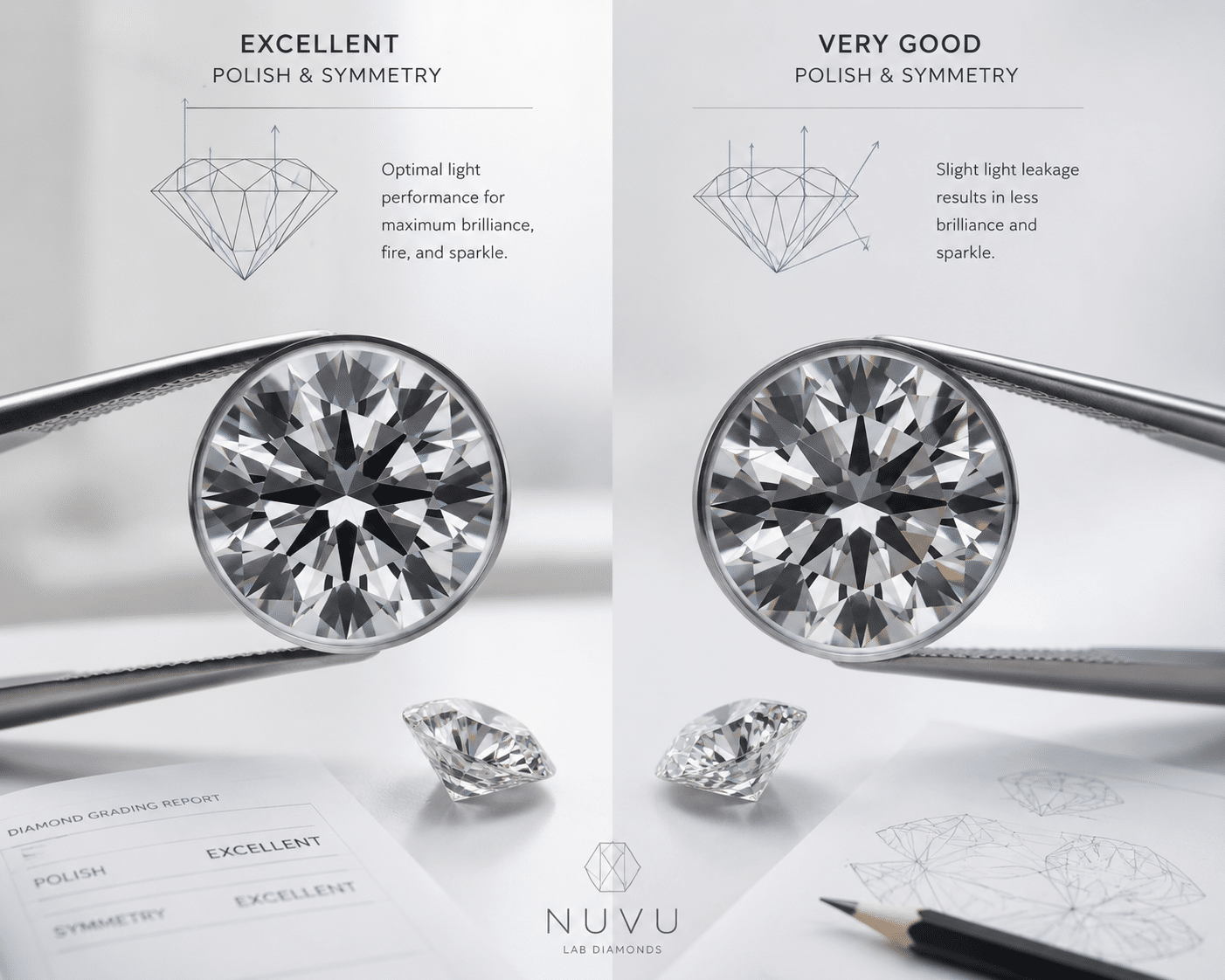
| Polish and symmetry grades | Both must be Excellent for maximum light performance | One Very Good grade can noticeably dull the overall brightness of the diamond. |
| Growth method, e.g., CVD | Treatment status—post-growth treatment indicated on the report | Untreated CVD stones may have more brownish tint; treated stones are cheaper but raise questions about long-term stability. |
Quick Questions Before You Read
Q: Does an IGI “Excellent” cut guarantee a beautiful diamond?
No. IGI’s cut grade is less strict than GIA’s. You still need to check table %, crown angle, and depth yourself; otherwise a stone can have the grade but poor light performance.
Q: Should I always buy a D color grade diamond?
Not usually. D color costs 15–25% more than G or H, but in most settings the difference is invisible to the naked eye. A well-cut G color often looks identical and leaves budget for better proportions.
Q: Are untreated CVD diamonds always better than treated ones?
Not necessarily. Untreated CVD stones often show more brownish tints, while treatment can improve color appearance. Check real photos rather than relying solely on the “untreated” label for purity judgment.
Q: How do I know if a diamond will face up as large as its carat weight suggests?
Look at the diameter on the IGI report. For a 1-carat round, a diameter of 6.3 mm or wider indicates good visual size. Anything smaller means the stone will look smaller than its carat weight implies.
Why the IGI Report Matters More Than You Think
If you are shopping for a lab-grown diamond online in the United States, the document you will see most often is an IGI grading report. The International Gemological Institute has graded more lab-grown diamonds than any other major laboratory, including GIA, GCAL, and AGS. That makes its report the default format for listings across virtually every online retailer and wholesaler. But a report is only as useful as your ability to read it critically. The difference between a confident purchase and a disappointing one often comes down to knowing which numbers to trust, which to question, and what the document does not tell you at all.
Laboratory-grown diamonds should always be clearly identified as laboratory-grown, and they should not be presented as mined diamonds. An IGI report for a lab-grown diamond will specify the growth origin, helping buyers distinguish the stone from a natural diamond. Throughout this guide, we treat IGI reports as one common type of documentation for lab-grown diamonds, not as a universal endorsement of any single stone’s quality or value.
The Role of IGI in the Lab-Grown Diamond Market
IGI took an early lead in the lab-grown diamond category while other labs were still deciding how to approach it. The result is simple market reality: most lab-grown diamonds you will find online carry an IGI report. This does not mean IGI is better or worse than GIA or GCAL, but it does mean you need to understand how IGI’s grading approach differs. IGI applies slightly different parameters for cut grade and may describe clarity with a marginally different threshold than GIA would use for the same stone. A “VS1” on an IGI report may look closer to a “VS2” under GIA’s standard. Knowing this difference matters when you compare stones across listings or try to evaluate whether a high grade is actually a better stone.
What a Report Can and Cannot Tell You
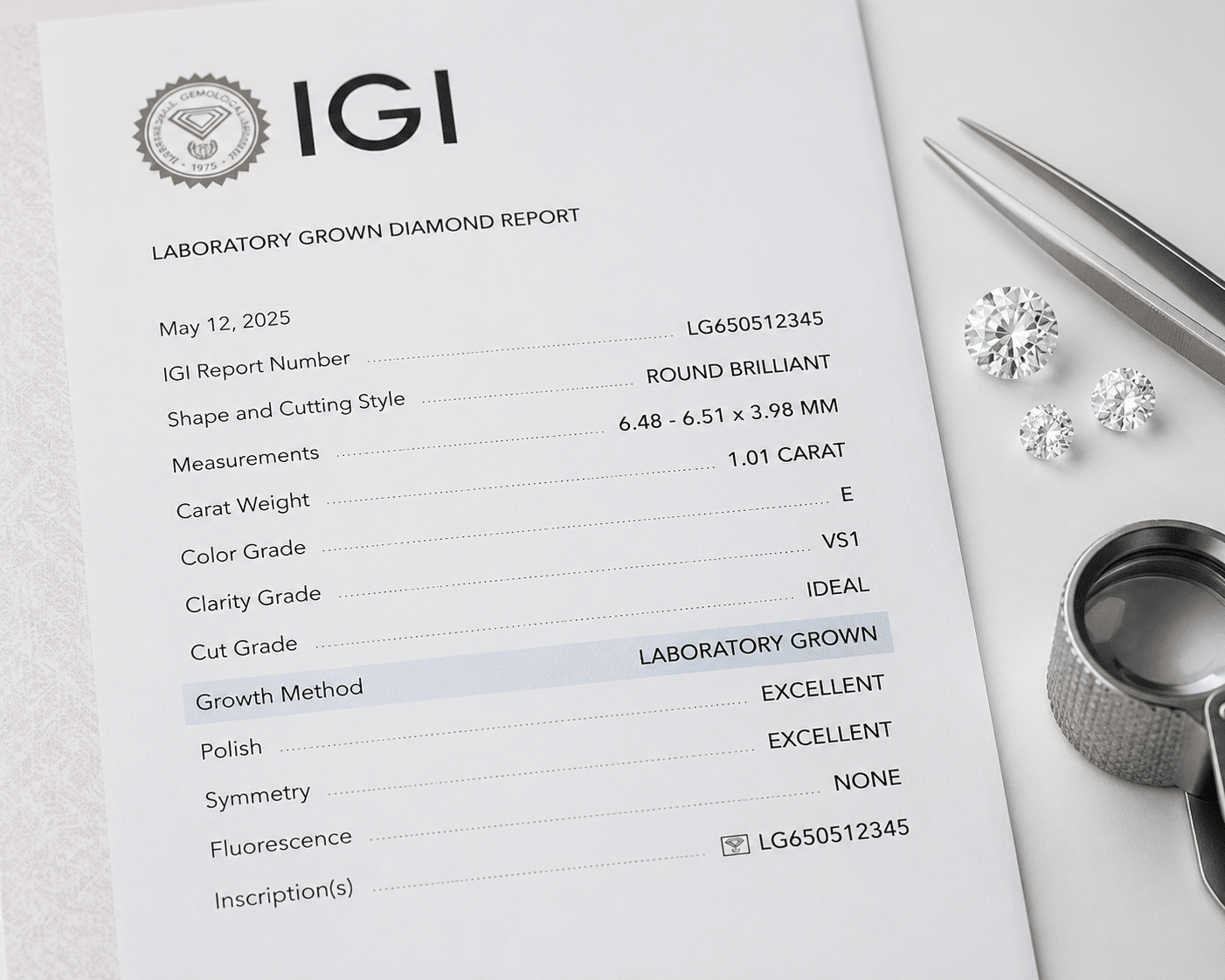
An IGI report confirms the measurable facts: carat weight, exact dimensions in millimeters, color grade on the D-to-Z scale, clarity grade with a plotted diagram, cut grade for round brilliants, polish, symmetry, fluorescence, growth method (CVD or HPHT), and the unique inscription number laser-etched into the girdle. These are reliable data points. What the report cannot confirm is whether the stone actually looks good in person. It does not measure light performance, brightness, or sparkle. It does not tell you whether the stone will fit your setting, whether the proportions will look right in a specific ring design, or whether the price matches the stone’s real visual quality. The report is a starting point, not a final verdict. The buyer still needs to see the stone.
Your First Quick Check on Any IGI Report
Before you spend time analyzing grades or comparing plots, run three quick confirmations. First, verify that the inscription number on the report matches any inscription listed in the product description. Second, confirm the carat weight and shape exactly match what the seller is advertising. Mismatches happen more often than buyers expect, especially when sellers list similar stones. Third, if the growth method is listed as CVD, check for any notation on post-growth treatment, such as annealing or HPHT color improvement. These three checks take about fifteen seconds and eliminate the most common errors in online listings.
Traceability Through Report Number and Inscription
A grading report is only as trustworthy as its link to the physical stone. The IGI report number serves as the primary record, but the connection between the document and the diamond relies entirely on that number being legibly inscribed on the girdle. This is the basis of traceability: a unique identifier that persists through the supply chain, from the grower to the cutter to the retailer to the end buyer. When the inscription is present and readable, any buyer or jeweler with a 10x loupe can confirm that the stone they are evaluating is the same stone described in the report. This one-to-one correspondence is what separates a verifiable grading report from a generic statement of quality. Without this link, the report describes a theoretical stone, not the specific stone in your hand.
For buyers, this traceability chain matters most at the point of delivery. When the stone arrives, the report number should match the inscription. If the stone has been set into a ring, the prongs may obscure the inscription, making direct verification impossible. In that case, the traceability chain is broken from the buyer’s perspective. The seller should provide pre-setting documentation: a magnified video of the inscription, a verification statement, or both. If neither is available, the buyer should consider independent verification before final payment. A report without a readable inscription loses its traceability function and reduces to a description that cannot be reliably linked to the stone.
When a grading report is available, buyers should verify the report details through the issuing laboratory’s official report-check tool where available. For IGI reports, the report number can be entered into IGI’s online verification portal. This confirms that the report is genuine and that the details match the laboratory’s records.
The Shape and Measurements Section: What Specs Reveal
The shape and measurements section of an IGI report is often the most overlooked field, yet it tells you more about how the stone will actually look than almost any other line. Two stones with the same carat weight can appear dramatically different depending on their exact dimensions. Learning to read this section lets you evaluate visual size, proportions, and setting feasibility before you even look at the price.
Shape vs. Cutting Style Decoded
IGI lists both the shape and the cutting style in a single field, typically formatted as “Shape and Cutting Style.” For a standard round diamond, this will read “Round Brilliant,” meaning the standard 57 or 58 facet arrangement. For other shapes, the terminology changes in ways that matter. A stone listed as “Princess Modified Brilliant” means it is a square shape with a faceting pattern that may vary from one cutter to another. “Oval Modified Brilliant” or “Pear Modified Brilliant” similarly indicate that the faceting layout may not follow a strict standard. This is important because non-standard modifications can affect how the stone catches light and how it looks compared to another stone of the same shape. If you see “Modified Brilliant” on a fancy shape, ask for real images or video to confirm the faceting pattern looks good to your eye.
Deciphering the Measurements
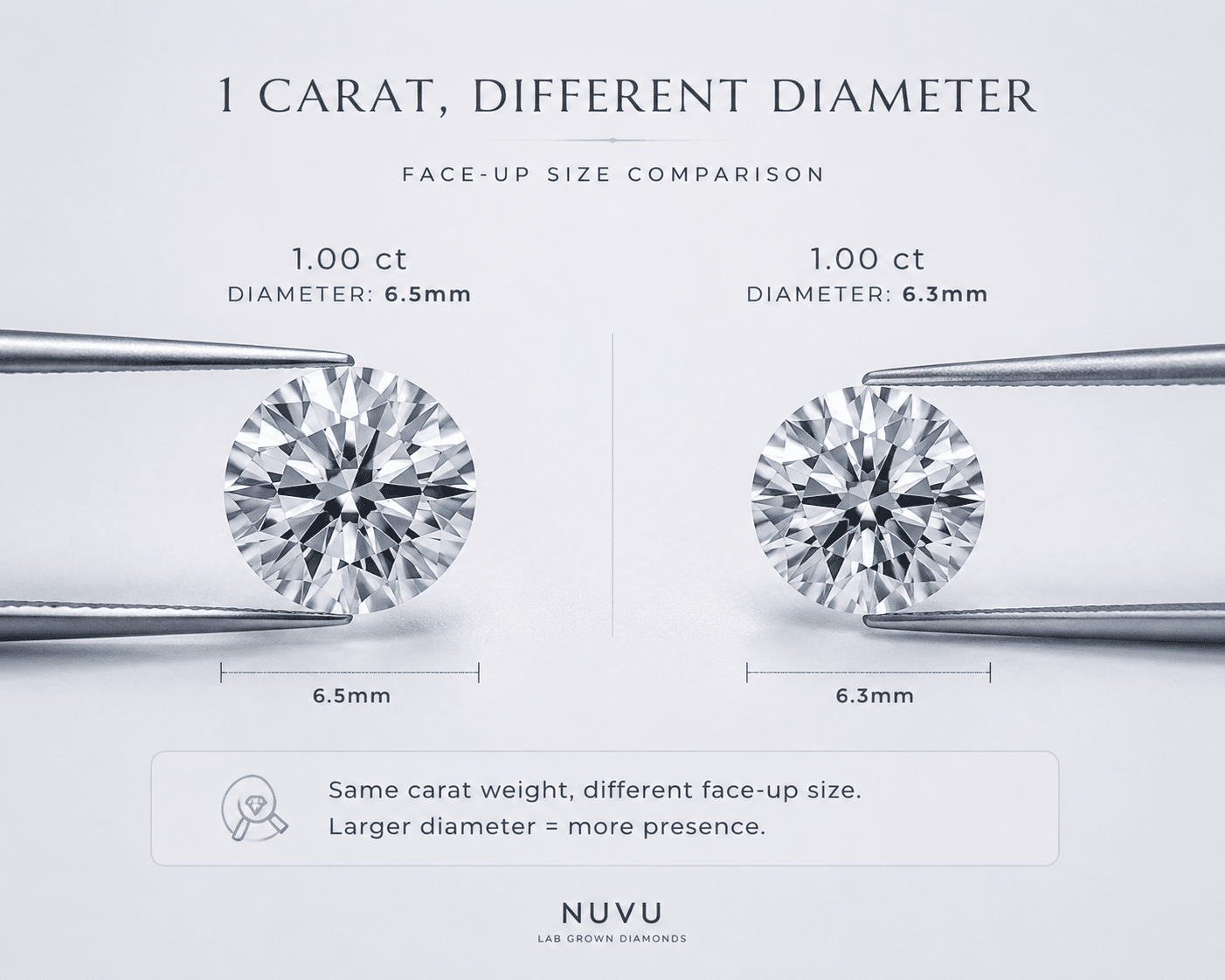
The measurement line on an IGI report provides length, width, and height in millimeters, often formatted as something like “6.50 — 6.53 x 4.00 mm.” For round stones, the first two numbers represent the minimum and maximum diameter, and the third is the total depth. The average diameter and depth percentage directly control how large the stone appears when viewed from above. A round stone with a 6.5mm average diameter is standard for one carat; a stone with a 6.3mm diameter will look noticeably smaller face-up even though the weight is the same. For fancy shapes like oval, pear, emerald, or radiant, the ratio between length and width determines the silhouette. A 1.35 ratio oval will look classic and balanced, while a 1.50 ratio oval will look noticeably elongated and slender. Neither is wrong, but you need to know which one you are buying, because they look completely different once set.
Real-Life Size Check: What the Numbers Mean
For a one-carat round brilliant, a 6.5mm diameter is the standard benchmark. If the diameter falls below 6.3mm, the stone is considered deep or heavy in the pavilion, which means it will look smaller than its weight suggests. This is an overpriced stone in disguise. For ovals, check the length-to-width ratio against your preference. A 1.35 to 1.40 ratio is the classic oval silhouette that most buyers imagine. A 1.45 ratio or higher produces a more elongated shape that may look elegant but can also appear skinny in certain settings. For emerald cuts, a 1.40 to 1.50 ratio is typical, while a ratio above 1.60 becomes noticeably long. These simple checks prevent the most common mistake buyers make: ordering a stone that looks different in person than it did in the listing photo.
Establishing common terminology helps here. The GIA has published educational material clarifying that terms like “Round Brilliant” and “Cushion Modified Brilliant” describe specific facet arrangements, and that changing the cutting style directly changes light behavior.[1] Buyers encountering an unfamiliar modifier on an IGI report should verify whether it matches their visual expectations before assuming it is a standard cut.
Color Grade and Clarity on an IGI Report: What the Letters Mean
Color and clarity grades are the two fields buyers obsess over most, often to their own detriment. The letters and numbers on an IGI report do not tell the full story, and in some cases they can mislead if taken at face value. Understanding what these grades actually mean for lab-grown diamonds, and what they fail to capture, is essential for making a smart buying decision.
Color Grade: D-E-F vs. G-H-I vs. J+
IGI uses the same D-to-Z color scale that GIA established, with D representing colorless and Z representing noticeable color. For lab-grown diamonds, especially those grown using CVD, there is a complication that the letter grade alone does not capture. CVD stones can exhibit color graining, which is a subtle brownish or grayish tint that may not be fully represented by the final color grade. A stone rated “D” on an IGI report can still show a faint brown or gray cast when viewed from the side or under certain lighting conditions. This is not a grading error; it is a limitation of how color grades are assigned in a controlled environment. For this reason, the smartest move is to never buy a stone based solely on its color letter grade. Always request photos or video that show the stone in different lighting conditions, especially against a white background and in natural daylight. A D-color stone that looks warm or gray in real photos is not worth the premium you would pay for the letter.
Clarity Grade: The Real View on Inclusions
IGI grades clarity from FL (flawless) down to I3 (heavily included). For lab-grown diamonds, the most practical clarity grades for most buyers are SI1 and VS2. These grades are typically clean to the naked eye, meaning you will not see the inclusions without magnification, but they cost significantly less than VVS1 or IF grades. The key is not the letter grade alone; it is the type and location of the inclusions. The plot diagram on the left side of the report shows each inclusion as a colored symbol. A feather near the edge of the stone may be safe in most settings but could become a risk if the prong presses directly against it. A crystal inclusion near the table, the flat top facet, is more visible and more likely to catch the eye. A cluster of pinpoints in the center may not affect durability but could become visible in bright light.
What to Check Before Deciding on Clarity
For any SI1 or VS2 stone, take an extra step before committing. Request a 360-degree video or a real photo taken under 10x magnification. Confirm that the inclusion marked on the plot is not positioned near the center table where it can be seen face-up. Identify the inclusion type: a crystal near the edge is safer than a crystal at the center, and a feather near the edge is safer for a prong setting than one near the girdle. If the inclusion is located centrally and listed as a crystal or knot, which are lab grown diamond certification red flags, consider moving to a VS2 or VS1 stone with a cleaner plot. These checks take minutes and prevent the disappointment of receiving a stone that looks clean on paper but shows a visible flaw in person.
Practical note on grade boundaries: A VS1 on an IGI report is a strong grade, but it is worth remembering that grading is not a purely mechanical process. Different graders, lighting conditions, and even the specific day of evaluation can produce small differences in how an inclusion is classified. For the buyer, this means a VS1 should be verified through visual documentation rather than accepted on faith. The plot diagram and a magnified image together give a much clearer picture of clarity than the letter grade alone.
GIA’s educational resources on diamond clarity explicitly state that inclusions are plotted in terms of “type, number, size, location, and relief,” and that the same grade can encompass a very wide range of inclusion appearances.[2] This same principle applies to IGI reports, reinforcing why the plot diagram is often more important than the grade letter.
Cut Grade and Light Performance for Round Lab-Grown Diamonds
For round brilliant lab-grown diamonds, the IGI cut grade is the single most important field on the report for predicting visual performance. But it is not interchangeable with a GIA cut grade, and understanding the difference prevents disappointment.
IGI’s Cut Grade vs. GIA’s Cut Grade
Both labs grade cut on a scale from Excellent to Poor, but they apply slightly different parameters. IGI allows a wider acceptable range for table percentage (57–62%) compared to GIA’s tighter 56–60% range. Crown angles that fall outside GIA’s ideal window can still earn an IGI Excellent grade. The practical result is that an IGI Excellent cut is not inherently a bad cut — it is a broader category. Some stones earn the grade with proportions that produce acceptable but not optimal light return.
For the best combination of brightness and fire, do not stop at the cut grade. Cross-check the actual numbers. On an IGI report for a round brilliant, look for a table percentage between 57% and 60% and a crown angle between 34° and 35°. Depth should fall between 61% and 62.5%. When those proportions align with an IGI Excellent grade, you get a stone that performs near its optical potential. When the grade is Excellent but the table or depth sits near the edge of IGI’s range, light performance will be serviceable but not spectacular.
Polish, Symmetry, and Fluorescence
These three fields are often treated as secondary, but they directly affect how a diamond interacts with light. Polish describes the smoothness of each facet surface. Symmetry describes how precisely the facets align with each other. IGI rates both as Excellent, Very Good, Good, Fair, or Poor. A stone with Excellent polish and Excellent symmetry will reflect light more cleanly than one with Very Good in either category, even if both carry the same cut grade. For maximum sparkle, hold out for Excellent on both.
Fluorescence is rarely an issue with lab-grown diamonds. Most test as inert. If the report lists fluorescence as Faint or Medium, the stone may emit a soft glow under UV light. In natural diamonds, strong fluorescence can create a hazy or milky appearance. In lab-grown stones this is less common, but it is still worth checking. Request a video under natural and direct light to confirm the stone looks clear from all angles.
Cut Quality Verification Checklist
For round brilliants, confirm three items on the report before making a final decision: Polish is listed as Excellent, Symmetry is listed as Excellent, and the table and depth percentages fall within the ideal ranges above. For fancy-shaped diamonds — oval, pear, emerald, cushion, princess — IGI does not assign a cut grade at all. There is no single number to check. Instead, rely on the polish and symmetry grades as proxies for cutting quality, and verify the stone’s appearance through photos and video. A beautifully cut fancy shape will show even facet reflections and consistent brightness across the stone. If the seller cannot provide clear visuals, do not rely on the report alone to confirm cut quality.
Growth Method: CVD vs. HPHT and What It Means
Every IGI report for a lab-grown diamond explicitly states the growth method. This field is easy to overlook, but it carries real implications for what the stone looks like, how it was finished, and what you should verify before buying.
Reading the Growth Method Field
IGI lists the growth method clearly: either Chemical Vapor Deposition (CVD) or High Pressure High Temperature (HPHT). Some CVD reports also include a note about post-growth treatment, such as “Annealing” or “HPHT to improve color.” This is a normal part of the manufacturing process for certain CVD stones and does not mean the diamond is defective. But it should be noted, because it affects how you evaluate the stone.
Each method has characteristic internal features. HPHT stones sometimes contain tiny metallic flux inclusions — small dark spots that result from the metal catalyst used during growth. CVD stones do not have metallic inclusions, but they may show striations or graining: fine internal lines that can appear as faint bands under magnification. Neither flaw necessarily ruins the stone, but knowing which to look for helps you evaluate what you are actually buying.
GIA provides a detailed technical explanation of both growth processes, confirming that HPHT relies on a metal solvent-catalyst and that CVD deposits diamond from a hydrocarbon gas mixture onto a substrate.[3] Understanding these physical mechanisms clarifies why each method generates different characteristic inclusions.
Buyer Considerations for Growth Method
The main point of comparison for many buyers is whether one method may offer more consistent characteristics. Neither is universally superior, but the tradeoffs can be worth understanding. CVD stones that required post-growth treatment to improve color are often priced lower than HPHT stones of comparable grade. The concern — theoretical more than proven — is that treated CVD stones may be more prone to color shift over very long periods. Current evidence does not suggest this is a practical risk for normal wear, but it is worth knowing if you plan to hold the stone for decades.
HPHT stones tend to have more consistent color throughout the crystal and fewer internal striations. Their downside is the potential for metallic inclusions, which in rare cases can be large enough to affect durability if the inclusion sits near a corner or edge. For most buyers, the practical choice comes down to price versus visual consistency. If you are optimizing for budget, a treated CVD stone at a lower price per carat may be the better choice. If you want the most predictable color and clarity profile, HPHT usually justifies its slightly higher cost.
Note on environmental and sustainability claims: Environmental and sustainability claims should be specific, documented, and limited to what can be substantiated. Neither growth method automatically qualifies as more sustainable than the other. Buyers who care about environmental impact should ask the seller for specific documentation about production practices, energy use, and supply chain transparency rather than assume a method is inherently better.
What to Ask the Seller About Growth Method
Ask whether the stone is CVD or HPHT, and whether the report lists any post-growth treatment. If treatment is noted, ask whether the seller offers a return policy if you notice a change in color or clarity within a reasonable inspection window. For HPHT stones, request a magnified image or video that lets you check for metallic inclusions near the surface or edge. These checks take a few minutes and prevent surprises after purchase.
Context for wholesale buyers: When purchasing multiple stones for resale or production, growth method consistency matters differently. Mixed inventories of CVD and HPHT stones in the same price tier can create unpredictable variation in color consistency, internal appearance, and even how the stones respond to jeweler repair work. For wholesale buyers, it is worth asking the supplier whether the lot is exclusively one growth method or a blend, and whether the documentation tracks this across each individual stone.
Inscription and Verification: How to Confirm Your Stone Matches the Report
The IGI report number inscribed on the diamond’s girdle is the most direct link between the stone you receive and the document you evaluated. Without a legible inscription, the report becomes nearly useless as a verification tool.
What the Inscription on the Girdle Offers
IGI laser-inscribes the report number on the girdle of every graded lab-grown diamond. The inscription is microscopic — typically 0.1 to 0.2 millimeters deep — and appears as text such as “IGI LG123456789.” With a 10x loupe or a jeweler’s microscope, anyone can confirm that the number on the stone matches the report number. This is the primary protection against receiving a stone that differs from what was listed. When the inscription matches, you have verification that the grading data applies to that specific diamond.
When Inscription Is Missing or Illegible
Most lab-grown diamonds on the market carry an IGI inscription, but exceptions exist. Loose stones graded before IGI standardized the inscription practice may not have one. Stones that were recut after grading may have had the inscription removed. In both cases, the report still describes the stone’s original characteristics, but you lose the ability to confirm a match at a glance. If you cannot read the inscription clearly with a 10x loupe or microscope — or if the inscription is absent — do not accept the stone without independent verification. Request a verification service from another grading lab or from IGI directly. Never finalize a purchase for a stone whose identity cannot be confirmed against its report.
GIA’s verification and report-lookup pages highlight the importance of matching a diamond’s inscription to its grading record as a means of confirming identity and accessing the original report details online.[4] This same principle applies to IGI reports, where the inscription serves as the primary link between the physical stone and its documentation.
Verification Steps Before You Buy or Accept Delivery
When the stone arrives, inspect the girdle with a 10x loupe. Confirm the full inscription matches the report number. If the diamond is already set in a ring, the inscription may be hidden behind prongs and impossible to read. In that case, ask the seller to provide a close-up video of the inscription taken before the stone was set, or request a written verification statement. If neither is available, consider having the stone independently verified before paying the balance. A few minutes of verification upfront saves the headache of discovering a mismatch later.
Common Pitfalls: What Buyers Miss on IGI Reports
Reading an IGI report seems straightforward until you compare two stones and realize the grades alone do not tell the full story. Buyers regularly make three mistakes, all of which lead to overpaying or choosing a stone that underperforms visually.
Over-Estimating the Value of a D-F Color Grade
It feels natural to assume that a “D” color is always the right choice. But for lab-grown diamonds, the visible difference between D and H is almost nonexistent in most ring settings. Yellow gold and rose gold masks any color difference entirely. Even in white gold or platinum, a G or H stone looks bright and colorless, according to the lab grown diamond certification guide, unless placed directly next to a D-grade stone under controlled lighting. The cost gap, however, can be noticeable. Depending on market conditions, moving from H to D can add a premium to the price with little visible payoff in the finished ring. If your budget is fixed, a higher color grade often forces a tradeoff in cut quality or carat size, which matters far more to the final appearance.
Treating Clarity Grades as Absolute Truth
IGI and GIA do not apply clarity standards identically. IGI tends to be slightly more lenient at the same grade level. A VS1 on an IGI report may look closer to a VS2 under GIA’s microscope. This does not mean IGI reports are unreliable, but it does mean the letter grade alone is not precise enough for a buying decision. You need to look at the plot diagram to see where inclusions are located and what type they are. A feather near the edge is far less concerning than a crystal near the center table. For SI1 stones, always request a face-up photo or 360-degree video. Many SI1 stones on IGI reports are clean to the naked eye, but the only way to confirm is to look at the stone, not the grade.
Assuming a CVD Diamond Without Treatment Is “Purer”
A common assumption is that a CVD stone with no post-growth treatment notation is automatically better than one that was treated. That is not reliably true. An untreated CVD stone may have stronger internal graining or a lower color grade than a treated stone that was annealed to improve its appearance. The absence of a treatment notation tells you the growth process did not include a correction step, but it does not guarantee better visual quality. Evaluate the stone by how it actually looks under light, not by what the report omits.
The U.S. Federal Trade Commission (FTC) has issued guidance on how advertisers should describe lab-grown diamonds, underscoring that adjectives like “pure” or “natural” must not be misleading and that any claim about a product’s characteristics must be capable of substantiation.[5] This makes it clear that a buyer should not assume a “purer” status from the absence of a treatment notation without independent visual verification.
Buyer Mistake Prevention Summary
Three checks prevent most overpayment errors. First, compare the color grade against real photos under multiple lighting conditions, not just the letter. Second, compare the clarity plot diagram against magnified images of the actual stone. Third, ask the seller to confirm the growth method and any post-growth treatment in writing. Grades are useful shorthand, but they are not substitutes for seeing the stone.
How to Compare Two IGI Reports Side by Side
Once you have two candidate stones, the reports allow a structured comparison. The goal is not to find the stone with the highest individual grade in every field, but to identify which stone offers better visual and value outcomes for your specific priorities.
Note on pricing comparisons: Prices can change with market conditions, report type, seller channel, and stone-specific details, so exact comparisons should be verified at the time of purchase. When evaluating value, consider that the same carat weight and grade combination can vary in price depending on cut precision, dimensions, and seller documentation. Buyers should compare like-for-like specifications rather than relying on grade letters alone to determine which stone is better value.
Prioritize Cut Over Everything Else
For round brilliants, cut grade influences light return more than color or clarity. An Excellent-cut G-color stone may appear visibly brighter and more brilliant than a Very Good-cut D-color stone. Start by comparing cut grade, polish, and symmetry. If both are Excellent on all three, move to the next factor. For fancy shapes, IGI does not assign a cut grade, so use symmetry and polish as the closest approximation. For ovals and pears, also compare the length-to-width ratio. A 1.38 ratio and a 1.48 ratio produce noticeably different silhouettes, and the right choice depends on your design preference, not on which is technically better.
Evaluate Carat vs. Dimensions Tradeoff
Two stones with the same carat weight can have different face-up sizes. A 1-carat round with a 6.4 mm diameter will look smaller than a 1-carat round measuring 6.6 mm, even though both weigh the same. The wider stone offers better visible-size value for the same price per carat. Always compare the measurements section directly rather than relying on carat weight alone. For fancy shapes, compare the L/W ratio and the overall surface area. A well-proportioned oval at 1.35 ratio often looks larger than a poorly cut oval at 1.50 ratio with the same carat weight.
Factor in Growth Method and Treatment
The growth method introduces a practical tradeoff. HPHT stones tend to have more consistent color and fewer internal striations, but they may contain tiny metallic flux inclusions. CVD stones without treatment can show stronger graining, while CVD stones with post-growth annealing may be cheaper but require more careful verification of color stability. Neither option is universally better. The deciding factor should be how the stone actually performs under your preferred lighting and setting, not the method label alone. At the same price, an HPHT stone with Excellent polish and symmetry is usually a stronger choice than a treated CVD stone with lower symmetry, but you need to verify visually.
Quick Comparison Template for Buyers
Use this sequence to eliminate decision paralysis. Step one: compare spread — diameter for rounds, L/W ratio for fancy shapes. Step two: compare cut quality — cut grade for rounds, polish and symmetry for all shapes. Step three: compare the clarity plot — check inclusion type and location, not just the grade letter. Step four: compare price per carat. Step five: choose the stone that wins on the two factors you care about most, such as spread and cut, or clarity and price. This narrows the field without requiring you to weigh every factor equally.
One nuance often missed in side-by-side comparison: The relationship between table percentage and depth percentage is important to check together, not separately. A stone with a table near 60% and a depth near 62.5% may look acceptable on paper, but if the crown angle is too steep, light can leak through the pavilion rather than reflect back to the eye. For buyers comparing two IGI Excellent rounds, cross-referencing these three measurements — table, crown angle, and depth — is a more reliable indicator of light performance than the cut grade alone.
Traceability in Side-by-Side Comparisons
When comparing two stones from different sellers or listings, traceability takes on an additional dimension. Each stone carries its own unique report number, and that number should be verifiable independently through IGI’s online portal. Cross-checking report numbers between competing listings is a simple way to ensure you are comparing distinct stones rather than encountering the same diamond listed under slightly different descriptions by multiple sellers. If two listings carry the same report number but different specifications or prices, the discrepancy should raise caution. In sourcing and wholesale contexts, consistent documentation across multiple stones in a lot is equally important. Buyers should confirm that each stone in a multi-diamond purchase has its own distinct report number and that the number is inscribed on the stone, not just listed on a summary sheet. Document-level traceability protects against inventory mix-ups and ensures that what you paid for is what you receive.
Conclusion and Next Steps
The IGI report is a useful document, but it is not a buying decision on its own. It confirms weight, dimensions, grades, growth method, and inscription details. It does not confirm how the stone looks in natural light, how it performs inside a specific setting, or whether the price reflects real value. Your job as a buyer is to use the report as a filter, then verify the stone visually before committing.
Your IGI Report Reading Checklist
Before you finalize any purchase, confirm these seven items. One: the inscription on the stone matches the report number. Two: the shape and measurements match the listing description. Three: the cut grade is Excellent for round brilliants. Four: polish and symmetry are both Excellent. Five: the clarity grade is realistic for your budget and the plot diagram shows acceptable inclusion placement. Six: the growth method and any post-growth treatment are clearly stated. Seven: photos or 360-degree video confirm the grades you see on paper. If any item is missing or unclear, ask the seller before moving forward.
When a grading report is provided, buyers should compare the report details with the issuing laboratory’s verification tools where available. Independent confirmation of the report number and its matching inscription provides a stronger foundation for the purchase decision than relying solely on the seller’s description.
Where to Go from Here
For every stone you are seriously considering, request a 360-degree video and at least one photo taken under natural or daylight-equivalent lighting. If the stone is loose, verify the inscription with a 10x loupe before paying a deposit or accepting delivery. If the stone is already set, ask the seller to provide a video of the inscription before the setting was completed, or request a written verification statement. Your next step is always to look at the stone itself. The report tells you what the stone should be. Visual inspection tells you what it actually is.
Your Next Purchase Decision
Once you have narrowed your list to two or three stones that pass your IGI report verification, confirm that the seller’s policies cover stones that do not match visual expectations. Before purchase, buyers should confirm documentation, return terms, resizing policies, and after-sales support directly with the seller. NUVO provides IGI reports and open 360-degree video for every loose lab-grown diamond, so you can compare each stone directly against its certificate without guessing. The report gives you the data. Your own eyes should give you the confidence.
[1] GIA, “Diamond Cutting Style,” Gemological Institute of America, https://www.gia.edu/gia-news-research/diamond-cutting-style.
[2] GIA, “Diamond Clarity,” Gemological Institute of America, https://www.gia.edu/diamond-clarity.
[3] GIA, “How Lab-Grown Diamonds Are Made,” Gemological Institute of America, https://4cs.gia.edu/en-us/laboratory-grown-diamond.
[4] GIA, “Diamond Report Check,” Gemological Institute of America, https://www.gia.edu/report-check-landing.
[5] Federal Trade Commission, “FTC Reminds Marketers of Testimonial, Endorsement, and Environmental Marketing Rules,” FTC Business Blog, 2023, https://www.ftc.gov/business-guidance/blog/2023/09/ftc-reminds-marketers-testimonial-endorsement-and-environmental-marketing-rules.
Disclosure: This article is for general educational purposes only. Diamond grading, pricing, availability, specifications, and seller policies can change, and readers should verify important details through grading reports, official laboratory tools, seller documentation, or qualified professionals before making a purchase decision. Laboratory-grown diamonds should be clearly distinguished from natural diamonds, and environmental or sourcing claims should be supported by specific documentation.