
Choosing between a custom lab-grown diamond engagement ring and a ready-made one isn’t just about preference—it’s about understanding where your control ends and where risk begins. Ready-made rings offer speed and simplicity but limit your stone selection to standard sizes and pre-set diamonds, without lab grown diamond selection criteria, often making it hard to verify visual performance. Custom design gives you full control over every detail, from shank profile to prong style, yet introduces longer lead times, revision costs, and a final-sale policy that means no returns on the setting itself.
For the full framework, read Custom Lab-Grown Diamond Jewelry Guide.
This article breaks down the real tradeoffs: how to compare total costs, evaluate jeweler policies, and decide whether design flexibility or a quick delivery matters more for your situation. It also covers a practical middle path—semi-custom—that balances selection with a shorter timeline and partial returnability. By the end, you will have a clear framework for matching your timeline, budget, and risk tolerance to the right buying path.
| Factor | Custom Design | Ready-Made |
|---|---|---|
| Lead time | 4–8 weeks | 1–5 days |
| Return policy on setting | No returns (final sale) | Returnable within policy window |
| Stone selection control | Choose specific loose diamond by visual performance | Limited to stones already set in the ring |
| Cost structure | ~70% on stone, ~30% on setting | Fixed price for complete ring |
| Design flexibility | Full freedom (mixed metals, hidden details, specific shank) | Fixed design, standard sizes (US 5–7) |
| Revision risk | $50–$200 per extra CAD revision | No design revisions needed |
| Best for buyers who | Have clear preferences and can wait | Want speed and a safety net |
Quick Questions Before You Read
Q: Does custom always cost more than ready-made?
Not necessarily. If you control the stone and setting split carefully, custom can cost the same or less for a higher-quality diamond, but the setting itself is final sale—so mistakes are costly.
Q: Can I return a custom engagement ring if I do not like it?
Generally no. The setting portion is made to your specifications, so most jewelers treat it as a final sale. The loose diamond may be returnable separately, but always confirm policies before ordering.
Q: What is a semi-custom option?
A pre-designed setting paired with a loose diamond of your choice. It ships in 1–2 weeks, offers partial returnability, and gives more stone selection than a ready-made ring without the full wait of a custom build.
Q: How do I know if I am ready for a custom order?
Try on similar ring styles first. If you are confident about metal width, stone height, and prong type, custom makes sense. If you are still deciding between shapes or settings, start with ready-made or semi-custom.
When a Ready-Made Ring Falls Short: Why Buyers Start Considering Custom
The assumption that a ready-made ring will work for your situation breaks down more often than most buyers expect. Pre-set inventory is built for efficiency, not for your specific finger, your chosen stone, or your personal taste. When any of those three factors fails to align, custom design stops being a luxury and starts being the practical answer.
The Fit Problem: Sizing, Finger Shape, and Wearability
Ready-made rings are stocked in standard US sizes—typically 5 through 7—with the most common shank profile being a 4mm comfort fit band. If your ring size falls outside that range, or if your finger shape makes a standard band slip or pinch, pre-set options become a gamble.
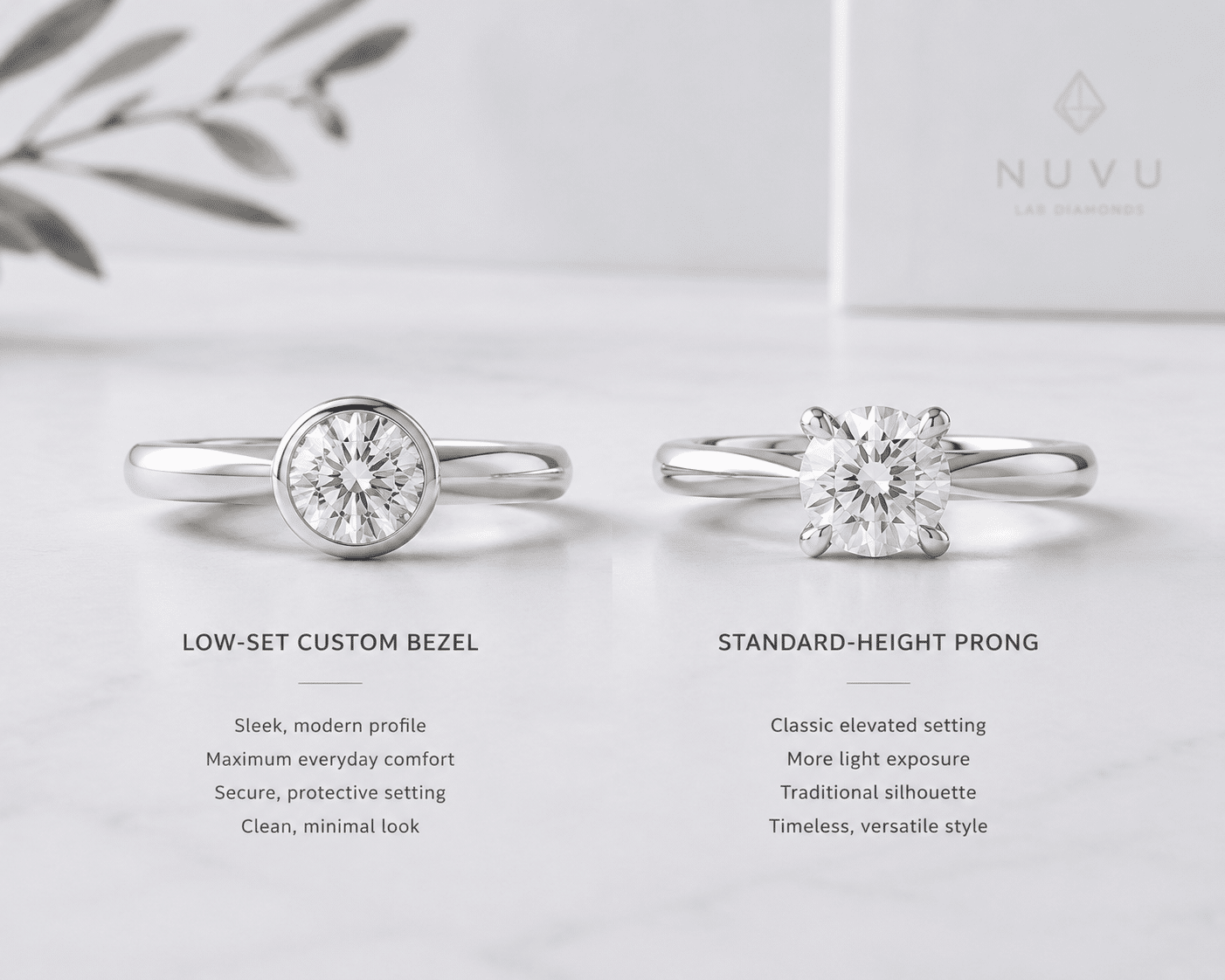
Custom design solves this by giving you control over every dimension that affects how the ring actually feels. A short finger may benefit from a tapered shank that adds visual length. An active lifestyle makes a low-profile basket the sensible choice over a tall cathedral setting. Stone protection matters differently for someone who works with their hands than for someone in a desk job. A bezel setting, which wraps metal around the diamond, offers more security than exposed prongs. These are not stylistic preferences. They are functional decisions that determine whether the ring feels secure for years or becomes something the wearer removes constantly.
The Stone Problem: When the “Perfect” Diamond Isn’t in a Pre-Set
Pre-set rings lock you into a specific diamond. You are choosing from whatever stone the jeweler or manufacturer already set into the mounting. That means you accept a fixed shape, a fixed carat weight, a fixed color grade, and a fixed clarity grade. If the available inventory only offers a 1.00 carat G/VS2 but your ideal was a 1.10 carat E/VS1, you either compromise or walk away.
Custom design reverses that sequence. You choose the loose diamond first, based on its actual proportions, face-up appearance, and how it looks under magnification and video. Then you design the setting around that specific stone. This matters more than most first-time buyers realize. Two diamonds with the same 4Cs grades can look noticeably different in person because of optical symmetry, inclusion positioning, and how the cut interacts with light. In a pre-set ring, you never get to compare options side by side.
What to Check Before You Decide
Before committing to a custom path, confirm that your chosen loose diamond is physically compatible with the setting you have in mind. The stone’s diameter, depth, and overall measurements determine the required claw height, gallery width, and metal weight for the mounting. A common mistake is picking a diamond that needs a very specific head design—one that costs significantly more to fabricate than a standard mount. Ask the jeweler for a side-profile rendering before any metal is cut. This is the point where an incompatibility is cheap to fix. After casting, it is not.
The Design Problem: When Catalog Rings Don’t Match Your Style
Retail catalogs and showroom cases are filled with the designs that sell in volume: halo settings, three-stone arrangements, and classic solitaires. If your aesthetic leans toward something less common, the catalog will not serve you.
Custom design opens options that mass production cannot economically replicate. You can mix metals—a 14k white gold head paired with an 18k yellow gold shank—without paying a premium for a non-standard assembly. You can add hidden accent stones along the gallery, set a small inscription inside the band, or design an asymmetrical arrangement that would never be profitable to make in quantity. Secret stones, engraving, and unusual prong configurations become practical additions rather than custom exceptions. The goal is not to invent something eccentric. It is to get a ring that does not look like a more expensive version of the same five designs everyone else is wearing.
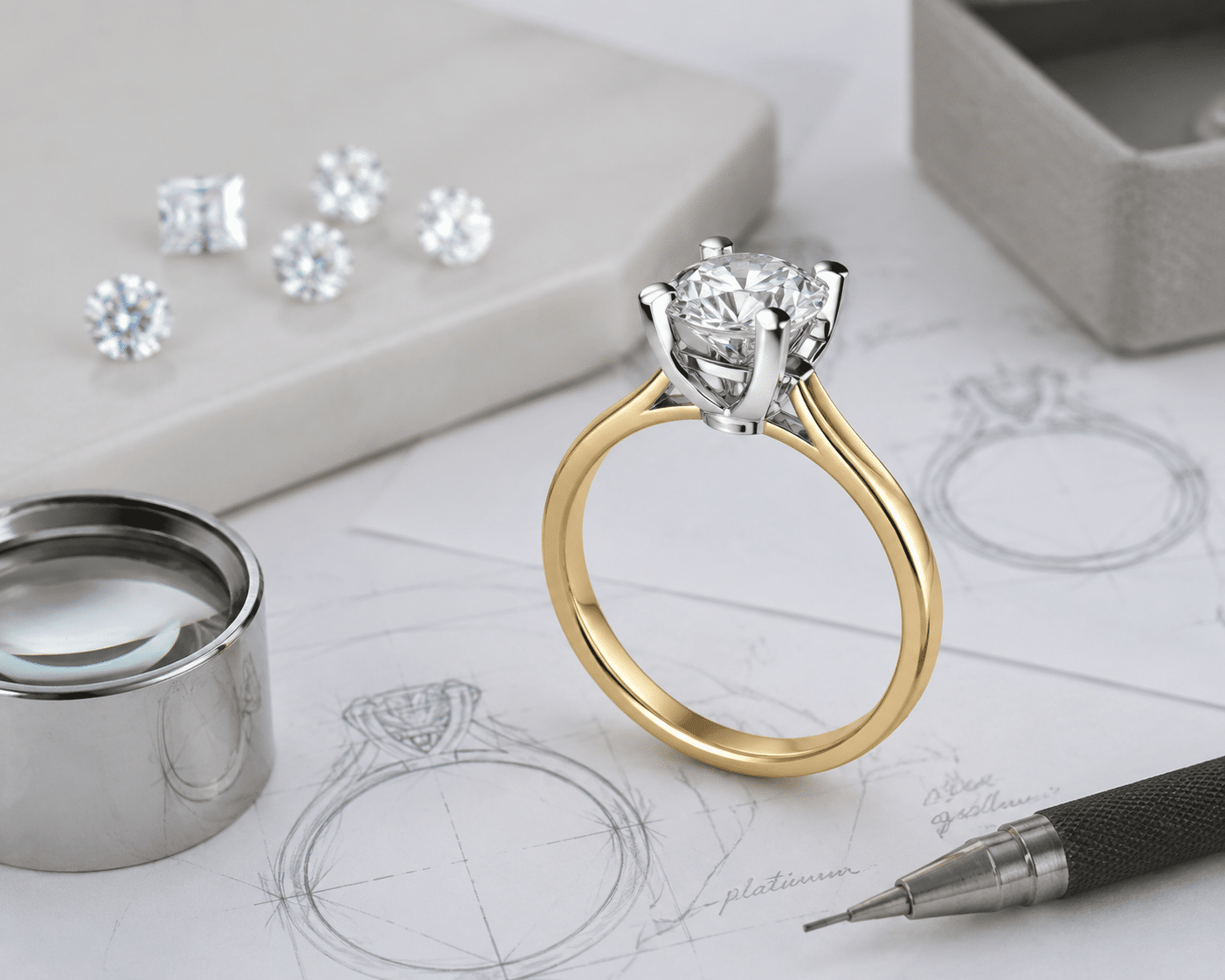
When selecting a center stone for a custom design, it is important to remember that laboratory-grown diamonds are real diamonds, created through a different process than mined diamonds, and they should be clearly identified as laboratory-grown in all seller documentation and discussions. This distinction is not a quality difference—both types share the same chemical composition and physical properties—but it affects how the stone is sourced, described, and sometimes priced. A grading report for a lab-grown diamond should indicate its growth method, which helps the buyer understand exactly what they are purchasing.
Who Actually Benefits Most from Custom Design (And Who Doesn’t)
Custom design is not the right choice for every buyer. The value it provides depends heavily on how prepared you are, how you want to allocate your budget, and how much uncertainty you can tolerate before committing. Pushing every shopper toward custom ignores the real tradeoffs.
The Informed Buyer: Best Fit for Custom
The buyer who benefits most from custom design has already done the research. They know which diamond shape they prefer. They understand the 4Cs well enough to set their own tolerances—perhaps SI1 clarity is acceptable as long as the inclusion is not face-up visible, or H color works fine in a yellow gold setting. They arrive with a visual reference: a sketch, a Pinterest board, or a photo of a ring that captures the structural elements they want.
This buyer controls the outcome because they walk in with decisions already made. They are not easily upsold on unnecessary upgrades because they have already decided what matters to them. The custom process becomes execution of a plan, not exploration of unknown territory.
The Budget-Sensitive Buyer: When Custom Saves Money
Custom design can cost less than buying ready-made, but only if you structure the purchase intentionally. The savings come from allocation. A typical custom buyer can spend roughly 70% of the total budget on the center stone and 30% on the setting. In a retail ready-made ring, a larger portion of the price covers metal markup, branded mounting costs, and the overhead of maintaining full-time sales staff and return-ready inventory.
The key is to compare line-item totals, not headline prices. A custom setting from a skilled jeweler may cost $800–$1,200 for a solid solitaire. A comparable branded mounting from a retail store can cost $1,500–$2,500, even before the center stone is added. When you control both components separately, the savings become visible. However, buyers should note that prices can change with market conditions, report type, seller channel, and stone-specific details, so exact comparisons should be verified at the time of purchase.
Buyer Verification Checklist
Before committing to a custom order, run through this verification:
– Request a total line-item estimate that breaks out the loose diamond cost, custom setting cost, finishing labor, and metal weight pricing.
– Compare that total against 3–4 ready-made rings with equivalent specifications in carat weight, color, clarity, and gold type.
– Ask whether the jeweler includes at least two design revisions at the quoted price. Anything less means you pay extra if the first attempt is not right.
– Confirm the lead time. A typical custom ring takes 10–20 business days. If the jeweler quotes significantly less or more, ask why.
The Hesitant or Undecided Buyer: When Custom Is a Risk
Custom design is a poor fit for buyers who have not yet settled on the basics. If you are unsure about diamond shape, setting style, or what your partner actually prefers, spending money on a one-off ring is premature. Multiple CAD revisions, frustration with the design process, and a final ring that feels nothing like the original sketch are common outcomes when the buyer starts custom without a firm direction.
The better path for undecided buyers is to try on ready-made rings first. Visit a jeweler, test different shapes and setting heights, and narrow down what works on the actual finger. Once the parameters are clear, custom becomes a much safer investment. Until then, it is an expensive guessing game.
How the Custom Design Process Changes the Final Outcome
The difference between custom and ready-made is not about romance or sentiment; it is about control over specific technical decisions, including three-stone lab grown diamond side stones, that determine how the ring actually performs, with each decision point changing the final piece in a measurable way.
Center Stone Selection: Moving Beyond the 4Cs to Real Visual Performance
When you buy a custom ring, you do not select a grade range. You select a specific loose diamond. That means you can reject stones that look clean on paper but perform poorly in person. A diamond with strong grades on the 4Cs can still have poor optical symmetry that causes light leakage. An SI1 stone can have an inclusion positioned directly under the table that is visible to the naked eye. These are not issues you catch on a report.
In custom buying, you review real images, 360-degree videos, and ideally ASET or ideal-scope images that map how the diamond handles light. You compare two diamonds side by side before deciding. This is not a process that exists in ready-made shopping, where the diamond is already mounted and impossible to evaluate independently.
Stone-to-Setting Fit Check
The physical dimensions of your loose diamond determine whether the setting will work as intended. A round diamond measuring 6.5mm in diameter needs a head with a specific claw span and depth to sit securely. A stone that is shallow relative to its diameter may not sit well in a low basket design. A stone that is unusually deep will require a higher setting than you planned, changing the ring’s overall profile.
These variables are invisible during the design phase unless you actively check them. A stone that fits the budget and looks beautiful under video can still be the wrong physical match for the setting you want. Always confirm the diameter, depth, and culet position against the mounting dimensions before fabrication begins.
For buyers working with a jeweler, the practical question is not just whether the stone grades well, but whether the stone’s measurements fall within the setting’s intended parameters. A grading report documents the stone’s characteristics, but a physical assessment—even through video—reveals how the stone interacts with light from multiple angles. In practice, this is where two diamonds with identical grades can diverge significantly in visual appeal, and why the custom process allows for a more informed selection.
Setting Structure: Shank, Gallery, and Head Configuration
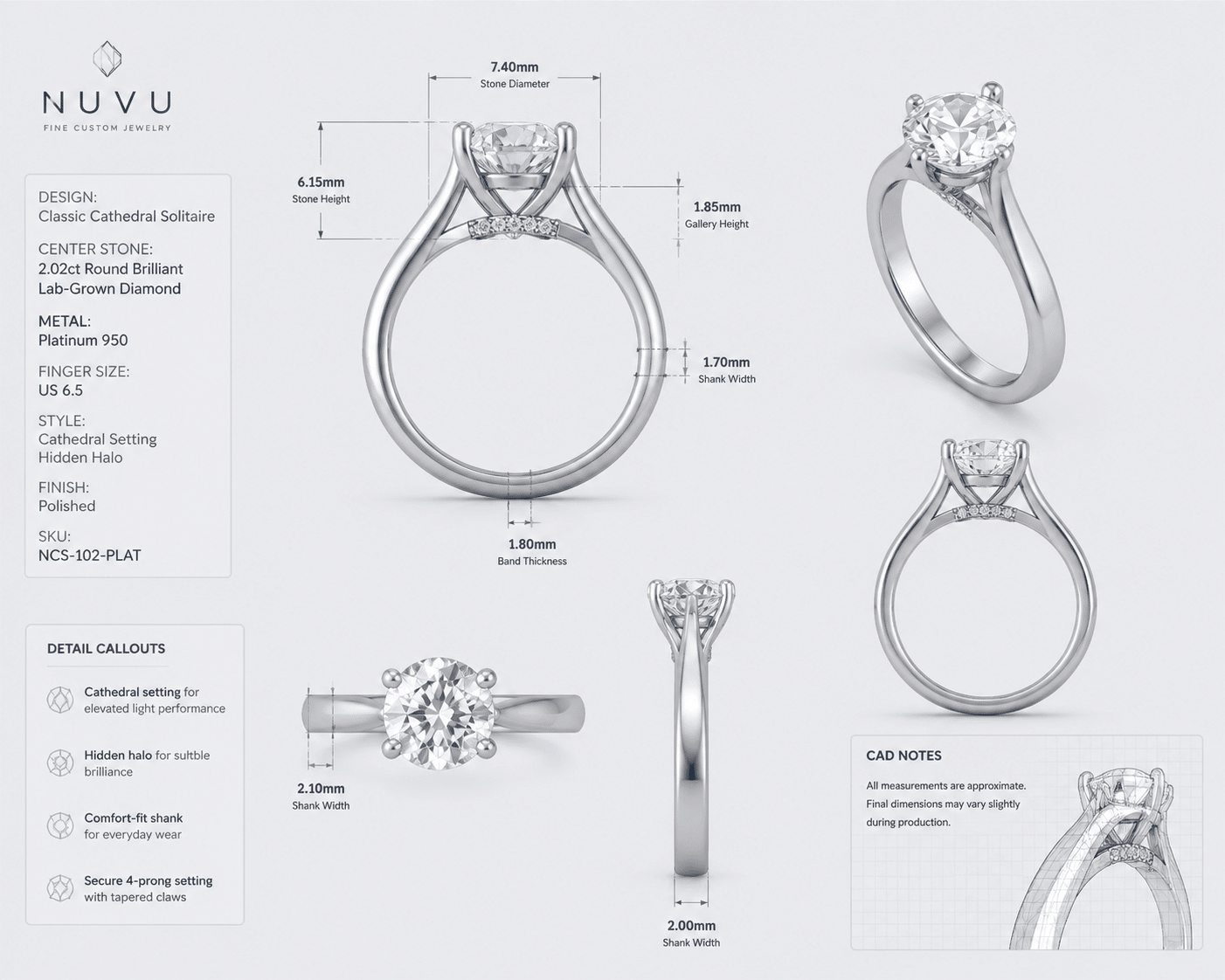
Custom allows you to specify the metal thickness at the bottom of the band—1.8mm minimum for durability, 2.0mm for a more solid feel. You choose the shank profile: flat, D-shaped, or knife-edge. Each changes how the ring sits on the finger and how it interacts with a wedding band.
The gallery—the area visible from the side of the ring—can be open, filled with a lattice pattern, or designed with a hidden halo that adds sparkle without increasing the visible ring width. These are not decorative trimmings. The gallery changes how light passes through the diamond, how easy the ring is to clean, and how it looks at common viewing angles.
Proportions and Finishing: The Difference Between “Looks Good” and “Feels Right”
Finishing decisions determine whether the ring wears well or becomes a frustration. Stone height above the finger can be set at 4.5mm for a low, secure fit or 7mm for a more dramatic elevation. The correct choice depends on whether the wearer wants a ring that barely clears a wedding band or prefers a bolder silhouette.
Prong style matters more than most buyers assume. Claw prongs hold securely but catch on clothing if too tall. Round prongs are smoother but offer slightly less grip. V-tip prongs suit marquise and pear shapes but require precise alignment. The polish finish—high, matte, or brushed—affects how the metal shows scratches and how it feels against an adjacent ring.
None of these details exist in a ready-made purchase. You take what comes with the setting. In custom, every one of them is a decision, and each decision changes the final experience of wearing the ring.
The Hidden Costs and Tradeoffs of Custom (That Most Guides Don’t Mention)
Custom design sounds appealing in theory, but the real tradeoffs are rarely laid out clearly. Beyond the price of the diamond and setting, three factors determine whether a custom project goes smoothly or turns into a drawn-out frustration: timeline, revision risk, and the fact that the finished ring cannot be returned.
Lead Time: Why Custom Takes Longer and What That Means
A custom engagement ring follows a fixed sequence. The jeweler needs time for CAD design, usually two to four weeks, depending on complexity and how quickly you respond to revision requests. After the design is approved, casting and setting add another one to two weeks, followed by final polish and inspection. Total timeline: four to eight weeks from start to finish.
A ready-made ring ships in one to five days. If you are planning a proposal in two weeks, custom is simply not the right path. No amount of urgency changes the fabrication process. Some jewelers offer rush service at a 15 to 20 percent premium, but even then, three weeks is usually the minimum. The takeaway is straightforward: if the timeline is tight, buy something that already exists.
Revision Costs: What Happens When the Design Doesn’t Work
Most reputable jewelers include two CAD revisions in the quoted price. That is usually enough if you have a clear design reference and know what you want. But if the initial brief is vague, or if you change your mind about setting height, metal weight, or stone choice after seeing the render, each additional revision costs between 50 and 200 dollars.
The biggest hidden cost is not the revision fee itself. It is the time lost going back and forth when the design brief was weak from the start. A buyer who sends a jeweler a few vague Pinterest images without specifying finger size, stone dimensions, or desired profile height often ends up with three or four rounds of revisions and a ring that does not match the original vision. A clear brief saves weeks and dollars.
Return Risk: Custom Rings Are Not Returnable
This is the single most important risk to acknowledge. Because the setting is fabricated specifically for your finger and for that exact loose diamond, it cannot be returned or exchanged. The diamond itself may have a 30-day return window if purchased separately, but the setting is a final-sale item.
If the ring does not feel right after completion, your options are limited. Some jewelers offer a one-time recast at reduced labor cost, usually 30 to 50 percent of the original setting price, if you want a completely different design. Resizing is typically covered for one to two sizes at no charge. A few will offer an upgrade or trade-in path for the center stone, but that policy varies. None of these options are guaranteed.
What This Means in a Real Purchase
Before ordering, ask the jeweler directly: “If the ring doesn’t feel right after completion, what are my options?” Clarify whether they offer a one-time recast at reduced labor cost, a resizing policy, or an upgrade path for the center stone. Get this written in the order confirmation. A jeweler who is willing to document their post-completion policy is a jeweler worth working with.
How to Evaluate a Custom Jeweler: The Questions That Actually Matter
Choosing a custom jeweler comes down to a small set of verifiable details. The questions below separate jewelers who can execute a clean custom design from those who rely on vague promises and stock photography.
Ask About CAD Software and Revision Policy
Professional jewelry CAD software includes MatrixGold, Rhino, and ZBrush. These programs allow the designer to model the ring in three dimensions, adjust proportions, and show how the stone sits in the setting. Ask which software they use. Then ask how many revision rounds are included in the quoted price. If the answer is zero, move on.
Request a sample CAD rendering from a previous custom engagement ring project. A finished ring photo tells you nothing about the design process. A CAD rendering shows whether the jeweler can visualize the ring before metal is cut. If they cannot provide one, they likely do not handle custom work regularly.
Ask About Metal Source and Finishing Methods
Most custom settings use cast gold, which is standard across the industry. But milled, or machined, settings offer tighter tolerances and fewer porosity risks. The difference matters most in thin shanks and detailed gallery work. Ask whether they use cast or milled metal, and whether they finish by hand or only by machine. Hand-polishing catches finer tooling marks that machine polish leaves behind. For a ring that is worn every day, that finishing step affects how the metal feels against the skin and how the ring ages.
Ask About Stone Verification and Return Policy
Before the stone is set, ask whether the jeweler physically inspects the specific loose diamond, not just the certificate. Some jewelers rely entirely on the grade report and skip visual inspection. A physical check catches issues that a certificate cannot show, such as poor optical symmetry or inclusions that sit near the girdle.
Once you choose a diamond, verify the certificate number at the issuing laboratory’s website. IGI, GIA, and GCAL all offer free online verification.[1] Then ask for a written policy on what happens if the stone arrives damaged or is lost during setting. A reputable jeweler carries insurance that covers these events, but you want the policy in writing before you hand over the stone.
What to Check Before You Decide
Request a side-by-side comparison from two to three jewelers using the same input specs: same stone shape, carat, gold weight, and setting type. Compare total price, lead time, revision limit, return policy, and whether the initial CAD render is free or paid. The best custom partner is the one who offers transparency in all five categories.
When a grading report is provided with a loose diamond, buyers should verify the report details through the issuing laboratory’s official online report-check tool where available. Comparing those verified details with the stone’s visual evidence—including video, magnification, and proportion data—gives a more complete picture than relying on the certificate alone. This is especially important in custom design, where the diamond is chosen before the setting is made.
Putting the Decision Together: The Custom vs. Ready-Made Comparison
By this point, the tradeoffs are clear. Custom gives you control over the stone and the setting, but costs more in time, carries revision risk, and locks you into a final-sale item. Ready-made gives you speed and returnability, but limits your selection to what is in inventory. The right choice depends on your specific constraints.
When to Design Custom
You have a specific loose diamond you love, one that is not available in a pre-set ring. You have a clear design reference, whether that is a sketch, a photo, or a detailed description. You can wait four to eight weeks. You want to control proportions, metal mix, and finishing details. You accept that the setting is final-sale and cannot be returned.
When to Buy Ready-Made
You need a ring in under two weeks. You are unsure about shape or setting preference and want to try options in person. You want the option to return or exchange the ring if it does not work, lab grown diamond engagement rings guide, and you are satisfied with the selection of pre-set inventory that fits your budget and style.
The Middle Path: Semi-Custom
Semi-custom bridges the gap. You choose a pre-designed setting, usually a mounting that the jeweler already offers, and select your own loose diamond to be set in it. Lead time drops to one to two weeks because the setting design is already finalized. You still control the center stone. And the mounting itself may have limited return options, unlike a fully custom setting, which has none. For informed buyers who want stone control and speed, semi-custom is often the best compromise.
What the Grading Report Does and Does Not Tell You in a Custom Purchase
In the custom process, the grading report serves a useful but limited role. It documents the diamond’s weight, shape, color, clarity, and cut grade based on the issuing lab’s standards. It does not show how the stone looks from different angles, whether light leaks from the side, or whether an inclusion is hidden beneath a prong.
For buyers, the practical point is not just what the report says, but how the stone performs visually and fits the intended design. Two diamonds with the same report grades can appear different side by side because of subtle differences in facet alignment or inclusion location. A certificate narrows the selection, but visual evaluation confirms the final choice. This distinction matters most in custom buying, where the diamond is chosen before the setting is made, and the buyer has the chance to verify both the report and the stone’s actual appearance.
Understanding Lab-Grown Diamond Terminology and Disclosure
Lab-grown diamonds are real diamonds, created through processes that replicate natural diamond formation. The two primary growth methods are High Pressure-High Temperature (HPHT) and Chemical Vapor Deposition (CVD).[2] Both methods produce diamonds with the same chemical composition and crystal structure as mined diamonds. The Federal Trade Commission (FTC) has issued guidance on how lab-grown diamonds should be described in advertising and marketing, emphasizing that terms like “cultured” or “laboratory-created” must be clear to avoid misleading consumers about the nature of the product.[3] For the custom buyer, understanding this distinction is essential when evaluating a jeweler’s disclosures about a diamond’s origin and growth method. A reputable seller should always clearly communicate whether a diamond is lab-grown or natural, and by which method it was created. The FTC guidance is especially relevant here, as it establishes baseline expectations for truthful and non-deceptive advertising in the jewelry industry.[3]
Beyond terminology, the durability and brilliance of a lab-grown diamond are identical to a natural diamond of the same grade. The Gemological Institute of America (GIA) notes that its grading system applies equally to both, and its reports for lab-grown diamonds include a specific notation indicating the diamond’s origin.[4] This means the same 4Cs criteria, the same cut standards, and the same optical properties apply. For the custom buyer, this is a practical advantage: you are selecting a diamond based on visual performance and design fit, not origin, and the grading report provides a standardized benchmark regardless of whether the stone is lab-grown or natural. The key is to ensure the grading report explicitly states the diamond’s origin and that the jeweler provides clear, written disclosure of the growth method before you commit to the purchase.
Documentation and Sourcing Transparency in Custom Design
In any custom design project, the documentation that accompanies the diamond plays a role in how confidently a buyer can proceed. A grading report from an established laboratory provides a standardized reference for the stone’s characteristics, but the value of that documentation depends on whether the buyer can independently verify it before the diamond is set. For lab-grown diamonds, the report should also indicate the growth method—HPHT or CVD—so that the buyer knows exactly what they are purchasing.
In sourcing conversations with a jeweler, documentation consistency and communication matter as much as the headline specifications. A jeweler who can provide clear written disclosure of the diamond’s origin, growth method, and the issuing laboratory for its report, and who can explain how those details match the stone you are selecting, is one who prioritizes transparency. For custom design, this documentation helps establish a baseline for the stone’s quality and origin, but the final decision should also account for the stone’s visual performance and its physical fit within the intended setting.
For buyers, the practical step is to confirm that the grading report matches the stone in hand before the setting begins. Request the certificate number and verify it through the issuing laboratory’s portal. Ask the jeweler to confirm that the stone’s measurements—diameter, depth, and table percentage—are compatible with the mounting design. This combination of documentation verification and dimensional compatibility checks forms the foundation of a transparent custom purchase.
Why Sourcing Transparency Matters for Custom Buyers
In custom design, where the buyer selects the diamond and the setting as separate components, sourcing transparency becomes a practical concern. A loose diamond may come from a different supply channel than the setting, and the buyer needs to understand what documentation accompanies each part of the purchase. For the diamond, the grading report provides a baseline for weight, shape, color, clarity, and cut, but it does not automatically guarantee the stone’s origin. For lab-grown diamonds, the report should also indicate the growth method, and the seller should clearly disclose whether the diamond is laboratory-grown or natural. This is not a theoretical distinction—it directly affects how the stone is valued, described, and potentially resold.
Buyers should also consider that documentation alone does not fully describe the stone. A grading report documents key characteristics, but it should be read alongside visual evidence, measurements, seller documentation, and the intended jewelry use. In a custom project, where the buyer has the opportunity to compare multiple loose diamonds before choosing, the report serves as a screening tool, not a final verdict. The stone that looks best on camera and under magnification may have report grades that are slightly lower than another candidate, but the visual performance matters more for the ring’s final appearance.
For buyers working with a jeweler on a custom design, the practical approach is to request both the grading report and a visual assessment—video, magnification, and if possible, an ASET or ideal-scope image—before committing to the stone. Confirm that the report’s measurements match the stone’s actual dimensions. Ask the jeweler to provide written disclosure of the diamond’s origin and growth method. This combination of documentation verification and visual confirmation provides a more complete picture than either source alone.
One Final Check Before You Decide
Scenario Grounding: David’s Custom vs. Ready-Made Choice
David wanted a 1.2 carat oval lab-grown diamond for the engagement ring. The problem was straightforward: every ready-made ring he found stocked either a 1.0 or a 1.5 carat center stone. Neither matched what he wanted.
He chose the custom route. He selected a specific 1.21 carat E/VS1 oval lab-grown diamond, designed a low-basket 14k yellow gold solitaire, and paid a total of $3,400 — $2,400 for the diamond and $1,000 for the setting. The timeline ran five weeks from deposit to finished ring. The setting was paid upfront and could not be returned.
Sarah, his partner, found a different path. She tried on a ready-made 1.2 carat oval from another retailer priced at $3,800. It shipped in three days and was returnable within 30 days.
Both choices were reasonable. Neither was wrong. The deciding factors were David’s willingness to wait, his desire to control the diamond selection, and his acceptance of the final-sale risk. Sarah valued speed and the option to change her mind. The difference was not quality or price — it was which tradeoffs each buyer could live with.
For any buyer, the useful exercise is to run the same comparison with your own numbers before committing. Write down your budget, your must-haves for the stone, your desired lead time, and your comfort with a no-return setting. Then match those constraints against the custom, semi-custom, and ready-made options available. The decision becomes clearer when it is grounded in your specific situation rather than general advice.
What This Means for Your Purchase
If you want maximum control over the diamond and setting, and you can wait five to eight weeks, custom design is worth the timeline. You pick the exact stone, set the proportions, and own every detail. The tradeoff is that the setting is final sale.
If speed matters more, or if you want the safety net of a return window, buy ready-made. You lose some control over the center stone, but you can have the ring in hand within days.
If you want stone control without a full custom timeline, look for semi-custom options. You choose a pre-designed setting and pair it with a loose diamond you select. Lead time drops to one to two weeks, and the mounting may have limited return options.
Practical Guidance for a Transparent Purchase
Before you finalize any order, take time to verify the documentation and the stone together. Confirm that the grading report number matches the stone you have selected, and check that report against the issuing laboratory’s database. Ask your jeweler to provide a clear breakdown of what each component costs: the loose diamond, the setting, and any labor or finishing fees. For the setting itself, request a side-profile rendering that shows how the stone will sit in the mounting, including the height above the finger and the claw coverage. These steps ensure that you are not relying on assumptions about what you are purchasing.
For the diamond itself, request video or high-resolution images that allow you to assess its face-up appearance from multiple angles. If the jeweler offers ASET or ideal-scope images, use those to evaluate how the stone handles light. A grading report provides a useful baseline, but visual confirmation matters before a stone is set into a non-returnable setting. In custom design, where the buyer chooses the diamond first and the setting second, this verification process is where real buyer confidence comes from.
Before you decide, request a total cost comparison — stone, setting, and any labor — from at least two providers. The numbers will tell you which path fits your budget. The rest is about your timeline and your tolerance for risk.
For wholesale or custom sourcing conversations, consistency in documentation and clear communication about the diamond’s specifications and origin help establish a reliable baseline. Buyers should ask for written confirmation of the stone’s grading report details, growth method, and setting compatibility before committing to a custom order. A transparent process makes comparison easier, regardless of whether the purchase is a single engagement ring or part of a larger batch.
[1] GIA, “How to Use GIA Report Check,” Gemological Institute of America, accessed 2025.
[2] GIA, “How Lab-Grown Diamonds are Made: HPHT and CVD Methods,” Gemological Institute of America, accessed 2025.
[3] Federal Trade Commission, “Guides for the Jewelry, Precious Metals, and Pewter Industries,” 16 CFR Part 23, FTC, 2018.
[4] GIA, “GIA Lab-Grown Diamond Grading Reports,” Gemological Institute of America, accessed 2025.
Disclosure: This article is for general educational purposes only. Diamond grading, pricing, availability, specifications, and seller policies can change, and readers should verify important details through grading reports, official laboratory tools, seller documentation, or qualified professionals before making a purchase decision. Laboratory-grown diamonds should be clearly distinguished from natural diamonds, and environmental or sourcing claims should be supported by specific documentation. A grading report documents key characteristics, but it should not be treated as a guarantee of beauty, value, or sourcing ethics.