
Choosing a three-stone engagement ring is more complicated than picking a center diamond and flanking it with two smaller ones. The most common mistake buyers make for custom lab grown diamond engagement rings is treating the side stones as an afterthought, which can throw off the entire ring’s visual balance. A mismatched pair of side stones can make the center look smaller, create awkward gaps, or simply feel off.
For the full framework, read Lab-Grown Diamond Engagement Rings Guide.
This article explains how to select side stones that genuinely support—rather than compete with—your center stone. You will learn how shape, size, color, clarity, and setting style work together to create a cohesive ring. The goal is to help you make intentional choices so your ring looks like it was designed as one complete piece, not three stones set next to each other.
| Consideration | What to Look For | Why It Matters |
|---|---|---|
| Side stone shape | Tapered baguettes for ovals; rounds for cushion centers; kite stones for pointed shapes | Shape determines how the visual line flows and whether the ring feels balanced |
| Proportional carat weight | Each side stone 25–33% of center carat; total side stones 40–60% of center carat | Wrong proportions make the center appear smaller or the side stones overpower the ring |
| Color match | Side stones within one color grade of the center stone | Visible color differences are distracting, especially in side stones over 0.30 carats |
| Clarity relaxation | SI1–SI2 clarity for side stones is acceptable; VS2 is safe for most | Side stones hide inclusions better, so you can save budget without sacrificing appearance |
| Cut quality | Do not let side stone cut quality exceed the center’s light performance | Higher-scintillation side stones can visually outshine the center, breaking the hierarchy |
| Millimeter measurement vs. carat weight | Use exact length/width dimensions, not just carat weight | Carat weight varies by shape; millimeters ensure side stones match each other and align with the center |
Quick Questions Before You Read
Q: Can I use different side stone shapes on the same ring?
Yes, but only if they create intentional symmetry—for example, two tapered baguettes flanking an oval center. Avoid mixing shapes that feel random or unbalanced.
Q: How much more will a matched pair of lab-grown side stones cost?
A matched pair usually carries a small premium, but for side stones under 0.30 carats each, you can often skip matching and save money without noticeable difference. Prices vary based on specific grades and availability, so the final amount depends on market conditions and the seller’s pricing.
Q: Is it better to buy a preset three-stone ring or custom?
Custom allows you to control proportion, shape, and setting height precisely. Preset rings save time but may sacrifice balance. If you value visual harmony, custom is worth the extra steps.
Q: Can I resize a three-stone ring later?
Resizing is more complex than for a solitaire, especially if the shank has shared prongs or heavy side stones. Confirm with the jeweler before purchase, as many custom pieces limit resizing options. The specific resizing capability depends on the design, metal type, and the jeweler’s policies.
Why Three-Stone Rings Are a Design Choice, Not Just a Category
A three-stone engagement ring is not simply a style you pick from a dropdown menu. It is a compositional problem. The design asks you to arrange three independent diamonds into a single visual statement, and the difference between a ring that looks intentional and one that looks haphazard comes down to how well those three stones relate to each other. The center stone is the anchor, but the side stones determine whether the ring reads as balanced, elegant, or disjointed.
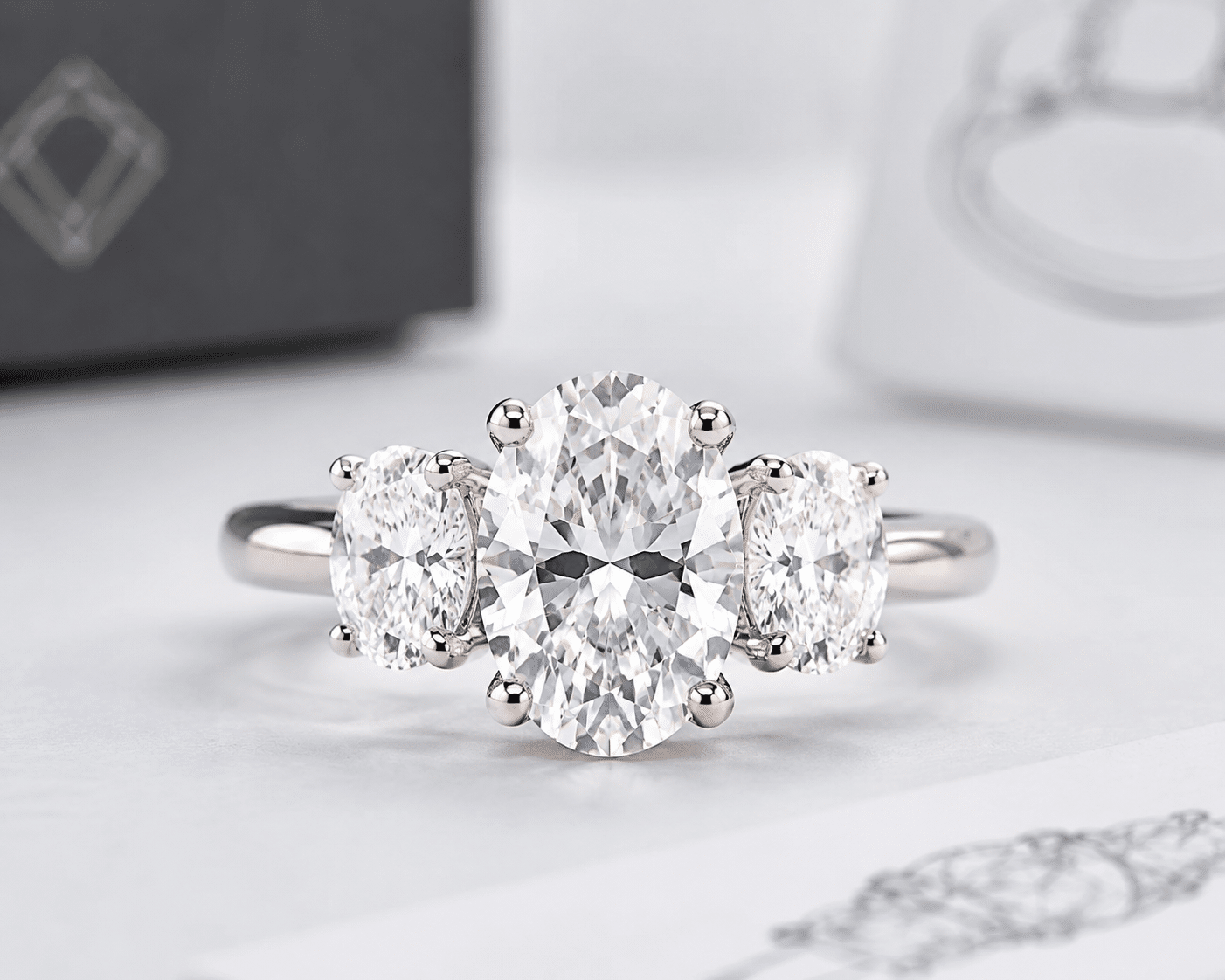
What Makes a Three-Stone Ring Work: Center Stone vs. Side Stones
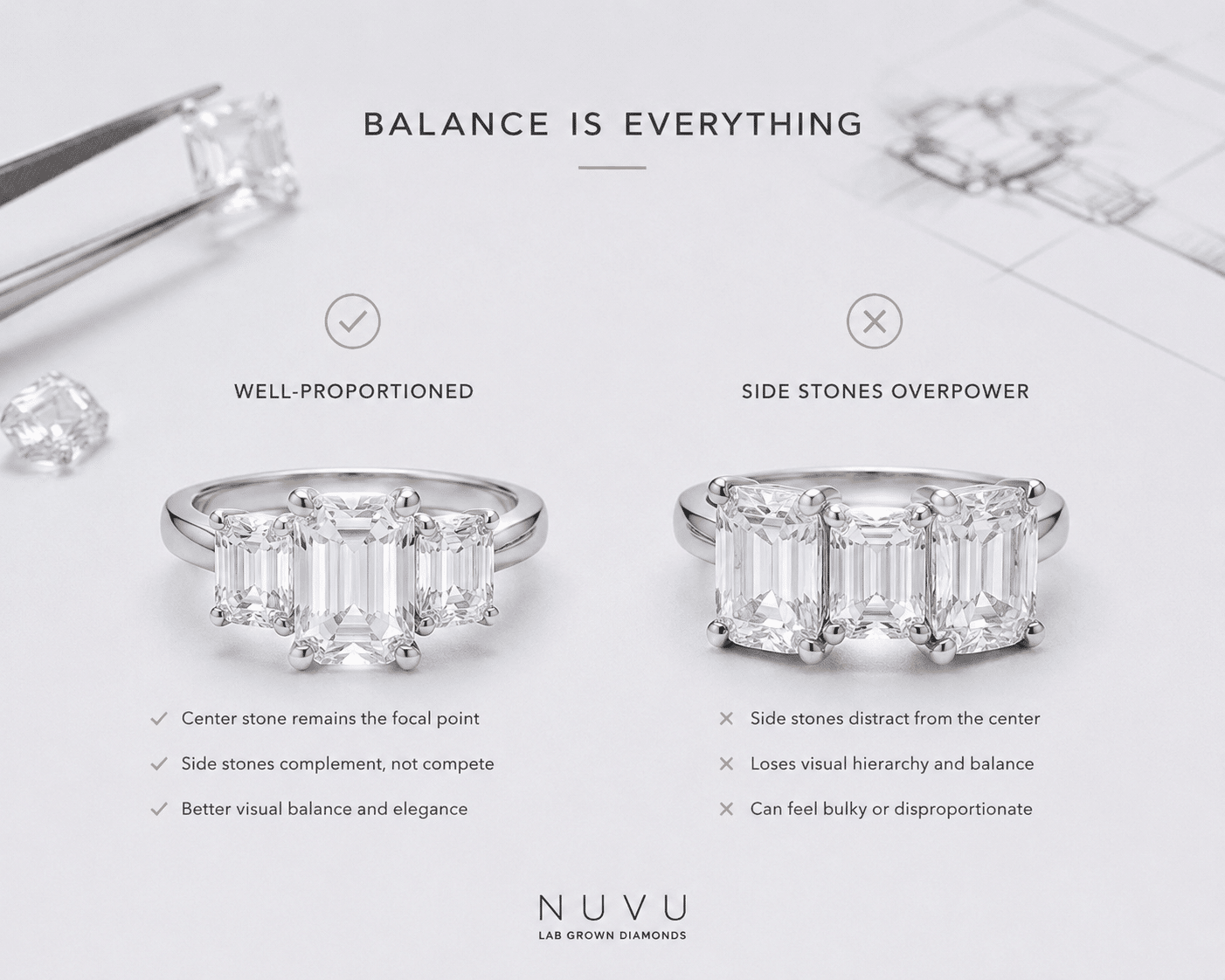
The core principle is straightforward: the side stones must support the center stone visually, not compete with it. When the relationship works, the eye moves naturally from one side stone across the center to the opposite side stone in a single smooth line. When it does not, the ring feels chaotic. Side stones that are too large pull attention away from the center. Side stones that are too small make the center look isolated. The wrong shape can make a well-cut center diamond appear shorter, narrower, or less defined than it actually is. The goal is not symmetry for its own sake. The goal is a composition where all three stones feel like they belong together.
For buyers, the most useful question is not whether the side stones are beautiful on their own, but whether they make the center stone look better. A side stone that looks impressive in a tray can still be the wrong choice if it breaks the ring’s visual flow. This is one place where evaluating stones individually—as most online shopping interfaces encourage—can lead to a worse overall result than evaluating them as a set.
Distinguishing Laboratory-Grown Stones from Natural Diamonds in a Three-Stone Ring
When building a three-stone ring that may include stones from different sources, the importance of clear, accurate terminology cannot be overstated. A three-stone ring can be composed entirely of laboratory-grown diamonds, entirely of natural diamonds, or even a combination of both, though the latter is uncommon. Laboratory-grown diamonds should always be clearly identified as laboratory-grown in any seller description, grading report, or invoice. They should not be presented as mined diamonds. For buyers, this means carefully reading the language used by the seller: terms like “laboratory-grown,” “lab-created,” or “laboratory-created” indicate a diamond with a different origin from natural diamonds. Distinct labeling across all three stones is essential for maintaining transparency, especially if the stones are sourced separately. Understanding this distinction is foundational—it shapes your expectations for price, characteristics, and long-term documentation. A grading report that specifically identifies a stone as laboratory-grown provides an additional layer of independent verification, though for very small side stones, such reports may not be available.
Why Lab-Grown Diamonds Make This Design Logic More Accessible
Lab-grown diamonds give buyers more freedom to adjust side stone size, shape, and color without breaking the budget. At the same price point, a lab-grown center stone and matching side stones may be larger and cleaner than their natural counterparts. This means the design logic of proportion and composition is more achievable. You do not have to settle for side stones that are too small or visibly mismatched in color because the budget forces you to. You can afford to be deliberate. For a three-stone ring, that flexibility matters more than it would for a simple solitaire, because the design depends on the relationship between stones, not just the quality of one.
Proportion Check Before You Buy
Before committing to a three-stone design, compare the total carat weight of the side stones to the center stone. A common rule of thumb: each side stone should be between one-quarter and one-third the carat weight of the center stone. Verify with actual millimeter measurements, not just carat weight, because different shapes face up differently.
How Side Stone Shape Affects the Center Stone’s Visual Role
The shape of the side stones directly changes how the center stone is perceived. A well-chosen side stone shape can make a center diamond look longer, wider, or more defined. A poor match can shrink it visually or blur its outline. The decision is not about which shape you prefer in isolation, but about how that shape interacts with the center stone.
Tapered Baguettes: Strengthening Elongated Centers (Oval, Emerald, Pear)
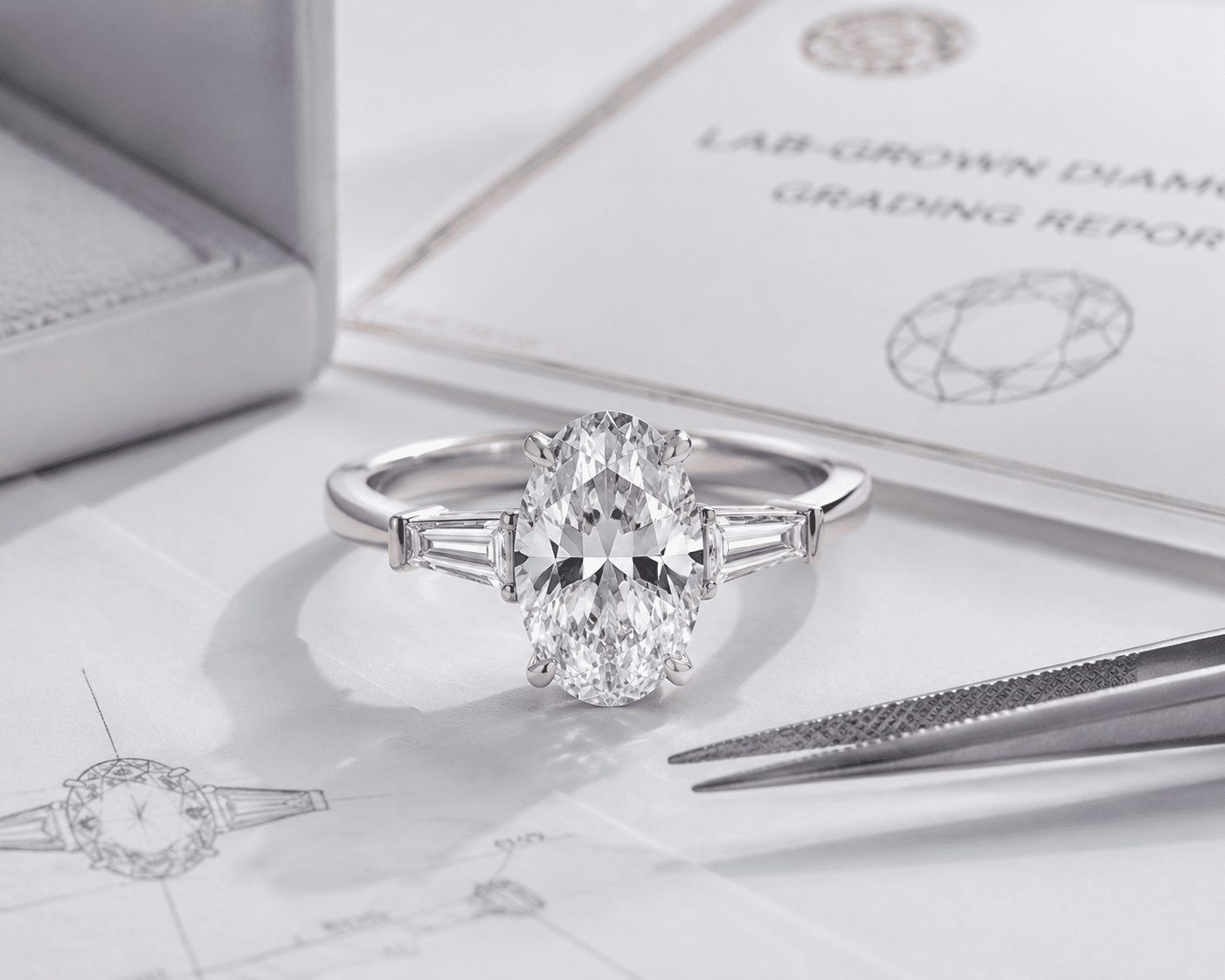
Placing tapered baguettes beside an elongated center stone creates a smooth visual flow that extends the vertical line of the ring. The taper narrows toward the center stone and widens outward, which makes a narrow oval, emerald, or pear appear even longer and more graceful. The straight edges of the baguettes also provide a deliberate contrast to the rounded ends of an oval or pear, reinforcing the center stone’s silhouette rather than blending into it. This combination works best when the baguettes are cut to the same height as the center stone so the three stones form a continuous horizontal line.
Round Side Stones: Softening Angular Centers (Asscher, Cushion, Radiant)
Round side stones introduce soft curves next to a step-cut or angular center stone. This contrast prevents a square or rectangular shape from feeling too rigid or geometric. For an Asscher, cushion, or radiant center, round side stones break up the hard lines and add a softer rhythm to the overall composition. The risk is that large, bright round stones can outshine the center. Because round diamonds have high light return, they can visually compete with the center if they are cut too well relative to the center stone’s cut quality. The goal is to let the center remain the brightest point in the arrangement.
Kite or Trapezoid Side Stones: Supporting Pointed Centers (Pear, Marquise, Heart)
For pointed center stones such as pear, marquise, or heart shapes, kite or trapezoid side stones create a nearly seamless outline. These fancy-shaped stones nestle against the pointed ends of the center, eliminating the gap that round or baguette side stones would leave. The result is a continuous silhouette that reinforces the center stone’s shape rather than interrupting it. This configuration is less common and highly intentional. It works best when the side stones are cut to match the angle of the center stone’s points, which requires a custom setting. If the angles do not align, the side stones will look misaligned rather than integrated.
Stone-to-Setting Fit Check
When choosing side stones, ask the jeweler for the exact width and height of the side stones in millimeters, not just carat weight. A tall side stone may lift the center stone uncomfortably in the setting. Request a CAD rendering or a photo of a similar finished ring to verify the side stones sit flush against the center stone without gapping.
Proportion Principles: How to Scale Side Stones to a Center Stone
Getting the side stones to the right size relative to the center is the single most important variable in a three-stone ring. Size here means both weight and surface area, and the two do not always agree.
Total Side Stone Weight vs. Center Stone Weight
A commonly cited guideline is that the combined carat weight of the two side stones should be 40 to 60 percent of the center stone’s carat weight. For a 1.5-carat center stone, that means two side stones totaling 0.60 to 0.90 carats, or roughly 0.30 to 0.45 carats each. This ratio keeps the center stone visually dominant while allowing the side stones to contribute noticeable presence. Going below 40 percent makes the side stones look weak and incidental. Going above 60 percent risks pulling attention away from the center.
Face-Up Dimension Matching: Why Carat Weight Is Not Enough
Two diamonds of the same carat weight can have very different surface areas depending on cut proportions and shape. A shallow-cut oval faces up larger than a deep-cut oval of the same weight. A well-cut round with an ideal table percentage will look wider than one with a steep crown. This means two side stones listed at 0.40 carats each may not look the same size as each other, and they may not look proportional to a 1.5-carat center stone that faces up small. Always compare the actual length and width of the side stones to the center stone in millimeters, not just carats. A side stone that matches within 1 to 1.5 millimeters of the center stone’s width is usually a solid starting point.
Visual Weight vs. Physical Weight: How Cut Quality Affects Perceived Size
A well-cut side stone reflects more light and appears brighter, which makes it seem larger than a less brilliant stone of the same carat weight. This is usually a benefit, but it creates a problem when the side stones are noticeably brighter than the center. The center stone should always be the most visually compelling part of the ring, so matching light performance across all three stones matters. Side stones with Excellent or Very Good cut quality are fine, but if the center stone has a more subdued sparkle due to a different cut style or color, then side stones with extreme brightness will draw the eye away. At NUVU, we treat cut balance across the three stones as a factor worth verifying before the setting is made, because once the ring is assembled, swapping stones is not simple.
Grading Reports and Documentation: What They Can and Cannot Confirm
A grading report can document key characteristics of a diamond—such as its color, clarity, and cut proportions—which is useful when selecting side stones to match a center stone. However, a report should not be treated as a guarantee of beauty, value, or sourcing ethics. For a three-stone ring, the reports for the center stone and side stones can help you narrow your selection, but they cannot confirm how the three stones will look together. Two side stones with identical GIA grades can still face up differently due to minor variations in proportion or internal characteristics that the report does not fully capture. A grading report provides a standardized starting point, but the final judgment happens when the stones are placed together, and that visual check remains the buyer’s best tool. Buyers should verify report details through the issuing laboratory’s official report-check tool where available, but should also request visual evidence like top-down photos or videos of the stones side-by-side before the setting is made.
What to Check Before You Decide
If you are selecting side stones online, request the following for each stone: total depth percentage, table percentage, and crown angle. For side stones that will sit in a shared prong or bezel setting, also confirm that the girdle thickness is similar across all three stones to ensure the prongs sit evenly.
Why Official Grading Documentation Matters for Side Stone Selection
When building a three-stone ring, relying on seller descriptions alone for side stones can introduce risk that becomes visible only after the ring is assembled. The GIA explains that its grading reports document key characteristics such as color, clarity, and cut proportions, which can help buyers compare stones systematically.[1] For side stones that are individually graded, the report provides a standardized baseline for matching. A matched pair of side stones with documented grades, as seen in hidden halo engagement rings with lab grown diamonds, allows the buyer to verify that color and clarity align within acceptable tolerances before the setting is made. If side stones are sold without individual reports, the buyer assumes more responsibility for visual matching. The GIA also offers a lab-grown diamond report that specifically identifies the stone as laboratory-grown and includes a laser inscription matching the report number.[1] This documentation can be especially useful for side stones where the buyer wants independent verification of origin and grading, though for very small stones under 0.15 carats, individual reports are less common and the visual match becomes the primary tool.
When a grading report is available, buyers should verify the report details through the issuing laboratory’s official report-check tool where available. The report number on the stone’s girdle is the link to the documented characteristics, but it is worth noting that the report covers individual attributes—not how the stone looks next to other stones in a setting.
Symmetry and Alignment: Making the Three Stones Feel Like One Design
A three-stone ring succeeds or fails on alignment. If the three diamonds do not read as a single visual unit, the ring will look disjointed regardless of stone quality. Symmetry here is not just about matching left and right. It is about creating a composition where the center stone and side stones belong together.
The most important structural decision is how the stones are held. Shared prongs use a single metal prong between two adjacent stones, eliminating the visual break. This creates an unbroken line of diamonds and is the most common choice for three-stone rings because it emphasizes continuity. Shared prongs work best when all three stones have a similar table height. If one stone sits noticeably higher or lower, the shared prong will look uneven rather than seamless.
Separate prongs create individual frames around each stone. This introduces visible gaps between the diamonds, which can be helpful when side stones have different proportions or when you want the center stone to feel more isolated. The tradeoff is visual separation. A ring with separate prongs reads as three distinct stones rather than one connected design. Choose shared prongs when continuity is the goal. Choose separate prongs when the side stones are significantly different from each other or when the center stone benefits from a more distinct frame.
In practical terms, shared prongs also reduce the total metal visible between stones, which can make the diamond area appear larger overall. This is worth considering if the center stone is on the smaller side and you want to maximize the diamond surface across the ring.
How Stone Orientation Affects the Visual Line
Elongated center stones demand attention to orientation. A pear, oval, or marquise center stone has a defined long axis, and the side stones should follow that same axis to reinforce the visual line. A pear-shaped center with side stones set horizontally creates a broken silhouette that fights the natural direction of the center stone.
The most reliable approach is to align the side stones along the same axis as the center. For a vertically oriented oval, tapered baguettes placed on each side with their long edges parallel to the oval create an extended, graceful line. For a round or cushion center, orientation matters less because these shapes have no dominant axis, but the side stones should still be positioned to frame the center rather than compete with it.
There is room for deliberate contrast. A round center with horizontally set baguettes can work if the change in direction is intentional and the visual weight is balanced. But this is a design choice, not a default. If you are not certain the contrast will look intentional, align everything on the same axis.
Why Matching Side Stones Is Not Always the Best Choice
Two identical side stones provide the most traditional symmetry, and this remains the safest option for most buyers. But identical side stones are not the only valid choice. A pair of different side stones, such as one round and one baguette, is uncommon but can produce a modern, sculptural look. This works best when the asymmetry is clearly intentional, such as a center stone that leans organic in shape paired with side stones that diverge in form.
The practical risk is that asymmetry complicates future repairs. If one side stone is damaged, finding a replacement that matches the other two may be difficult. Resizing a ring with asymmetrical side stones also requires more careful planning because the setting cannot simply mirror both sides. This is a fine choice for buyers who prioritize originality over long-term flexibility, but it is not a shortcut for saving money on side stones.
Certificate and Visual Review Check
When buying online, ask whether the side stones are graded individually or as a pair. A matched pair should have identical or near-identical color, clarity, and cut grades. If the seller cannot provide individual certificate numbers for each side stone, request a top-down photo of all three stones placed together before setting. This is the only reliable way to verify that the visual alignment works. Grading reports do not show how three stones look next to each other, and that is where the real judgment happens.
How the FTC Guides Terminology for Lab-Grown Diamonds
The U.S. Federal Trade Commission (FTC) has provided guidance on how laboratory-grown diamonds should be described in advertising and sales. As part of its Jewelry Guides, the FTC advises that terms such as “laboratory-grown,” “laboratory-created,” or “[manufacturer name]-created” should be used to clearly distinguish these from natural diamonds.[2] The guidance helps ensure that buyers understand exactly what they are purchasing, which is especially relevant when selecting side stones that may come from different sources. When sellers advertise lab-grown side stones, the terminology used should be transparent and consistent. The FTC also cautions against unqualified environmental or sustainability claims unless the seller possesses competent and reliable evidence to support them.[3] This means that while lab-grown diamonds offer design flexibility, claims about their ecological impact should be evaluated carefully rather than accepted at face value. For the three-stone ring buyer, this guidance underscores the importance of verifying that all three stones are clearly and accurately described, and that any marketing language around the side stones is substantiated. Environmental and sustainability claims should be specific, documented, and limited to what can be substantiated. Broad green language is less useful than clear information about production, energy, sourcing, and seller transparency.
Setting Compatibility: How Side Stones Affect Ring Fit and Wear
Side stones change more than the ring’s appearance. They affect how high the ring sits, how wide it feels on the finger, and how comfortably it pairs with a wedding band. These factors are easy to overlook when focusing on proportion and symmetry, but they determine whether the ring works as daily jewelry.
Cathedral Setting vs. Basket Setting for Three-Stone Rings
Cathedral settings use metal arches that rise from the band to support the center stone. This structure distributes visual weight more evenly, which is useful when side stones are large. The arches frame the entire composition and prevent the ring from looking top-heavy. Cathedral settings also allow the center stone to sit higher, which helps balance the height introduced by substantial side stones.
Basket settings are lower and more compact. The center stone sits closer to the finger, and the side stones are held in a simpler framework. This works well for smaller side stones and for buyers who want a lower profile. The limitation is visual crowding. Wide or tall side stones in a basket setting can feel stuffed into the frame, especially if the basket has limited metal structure. For large side stones, a cathedral setting is usually the better choice because it creates breathing room around each stone.
Band Width and Side Stone Protrusion
Side stones that extend beyond the band edges create a wider ring silhouette. This is common with round side stones or stones set in prongs that project outward. The practical consequence is that a standard straight wedding band will not sit flush against the engagement ring. A gap between the two rings is not necessarily a problem, but many buyers prefer a flush fit.
If you want the rings to sit together without gaps, a curved or notched wedding band may be required. This is a custom order and adds cost. The alternative is to keep the side stones within the width of the band or to choose side stone shapes that sit closer to the center. Tapered baguettes and kite shapes typically protrude less than round side stones of the same carat weight.
Profile Height and Daily Wear Considerations
A three-stone ring with substantial side stones will have a taller profile than a solitaire. The center stone is often raised to align with the side stones, which adds vertical height. For daily wear, a profile height under 7 millimeters is more practical. Rings above this height catch on clothing, bump into surfaces, and feel less stable on the finger.
The tradeoff is straightforward. Lower profiles are more durable and comfortable but limit how large the side stones can be. Higher profiles allow larger side stones and a more dramatic silhouette but require the wearer to be more careful. If the ring is for someone with an active lifestyle or who works with their hands, prioritize a lower profile and smaller side stones over visual impact.
Stone-to-Setting Fit Check
Request two measurements from the jeweler before you buy: the total height of the ring from the finger to the top of the center stone, and the total width from the outer edge of one side stone to the other. Compare these to your finger size and the shape of your adjacent fingers. A ring that is too wide may touch the neighboring fingers or rotate on the finger due to uneven weight distribution. These measurements are not negotiable. If the jeweler cannot provide them, the design is not finalized enough to purchase.
Color and Clarity Matching: When Side Stones Should and Should Not Match the Center
Color and clarity differences between the center and side stones are visible or invisible depending on stone size, setting type, and lighting. Understanding when a mismatch matters and when it does not can save money without sacrificing appearance.
When Side Stones Should Be the Same Color Grade as the Center
For side stones larger than 0.30 carats each, any color difference will be noticeable in normal lighting. The human eye compares adjacent diamonds automatically, and a visible difference in body color is the fastest way to make a ring look mismatched. Matching the color grade within one grade is the safe standard. A center stone graded G with side stones graded H will typically look fine because the difference is subtle. A G center next to a K side stone will look wrong to anyone who sees the ring.
This rule applies regardless of metal color. White gold or platinum will make any color difference more visible. Yellow gold can mask a slight contrast, but it will not hide a gap of more than two grades.
Practical Considerations for Color and Clarity Expectations
For side stones, the buyer’s priority should be consistency within the pair itself. Two side stones of the same carat weight but with a two-grade color difference will be noticeable to anyone who looks at the ring closely. If the side stones are sold as a pair without individual grades, ask the seller to confirm that they are visually matched in color and clarity under normal lighting. A visual match is more important than identical paperwork grades. For clarity, SI1 to SI2 is often acceptable for side stones, as long as there are no prominent black inclusions. White or transparent inclusions in side stones are rarely a problem. The goal is not flawless side stones. The goal is side stones that do not distract from the center.
When Side Stones Can Be Lower in Color for Visual Contrast
For very small side stones under 0.15 carats each, a slightly lower color grade may not be noticeable. Small diamonds hold less body color, and the metal setting often influences how the stone looks more than the grade itself. Some buyers intentionally choose warmer side stones to create a vintage or two-tone appearance. This can work well when paired with a warm metal like yellow or rose gold.
But this is a design decision, not a budget strategy. Deliberately mismatched color requires coordination between stone selection, metal choice, and setting style. If you are choosing lower-color side stones simply to reduce cost without planning the overall look, the result will likely feel accidental rather than intentional.
Clarity Expectations for Side Stones: How Much Can You Relax?
Side stones receive less scrutiny than the center stone. In normal viewing, no one inspects the side stones at close range. This means clarity grades can be relaxed noticeably without harming the ring’s appearance. SI2 to SI1 is usually acceptable for side stones according to the lab grown diamond engagement rings guide, especially when the stones are under 0.30 carats or set in prongs that cover part of the stone.
The exception is visible inclusions. Black carbon spots or feathers near the girdle can be seen in bright light or under magnification. These are worth avoiding even in side stones because they draw attention once noticed. White or transparent inclusions in side stones are rarely a problem. The goal is not flawless side stones. The goal is side stones that do not distract.
Buyer Verification Checklist
When side stones are sold as a pair, request the certificate numbers for both stones. Verify that the color and clarity grades match within one grade. If the side stones are not individually graded, ask the seller to provide video or magnified photos. You are judging clarity and color yourself in that case, and a video under natural light is more useful than a still photo under studio lighting. If the seller cannot provide either certificate numbers or clear video, do not assume the side stones match the center visually.
Budget Allocation: How to Spend on All Three Stones Without Overspending
Distributing your budget across three diamonds is a different problem than buying one. Without a framework, it is easy to overspend on side stones that add little visual value or underspend in a way that leaves the center stone looking unsupported. The goal is not to split the budget equally. It is to allocate money where it has the most visual impact.
The 60-20-20 Rule for Three-Stone Budgeting
A straightforward starting point is to assign 60 percent of your total diamond budget to the center stone, with 20 percent going to each side stone. This ratio keeps the center stone clearly dominant while giving the side stones enough presence to frame it properly. If you are working with a $3,000 diamond budget, that means roughly $1,800 for the center stone and $600 for each side stone. The exact numbers can shift if the design calls for unusually large or small side stones, but the logic holds: the center stone should cost more than the two side stones combined. When the side stones together cost as much as or more than the center, the visual hierarchy of the ring often suffers.
Where to Save on Side Stones Without Sacrificing Visual Quality
The most effective way to control cost on side stones is to relax color and clarity rather than reduce size. A side stone that is too small cannot be visually compensated for, but a slightly lower color grade is often invisible in normal wear. For side stones under 0.30 carats each, dropping from a D–F color range to H–I will rarely be noticeable once the stones are set, because small diamonds hold less body color. The savings can be meaningful. Similarly, clarity can be relaxed to VS2 or even SI1 for side stones, as long as there are no visible black inclusions near the center of the stone. Prongs often hide small inclusions anyway. What you should avoid is reducing the carat weight of the side stones as the primary cost-saving method. Smaller side stones change the proportion of the entire ring, and that tradeoff is much harder to disguise than a half-grade color difference.
When Buying a Matched Pair vs. Two Loose Stones
A matched pair of side stones carries a premium because the seller has selected two diamonds with nearly identical color, clarity, and cut proportions. This matters most when the side stones are large enough to be individually visible, typically above 0.30 carats each. Below that size, the difference between a matched pair and two loose stones of similar grade is often undetectable once the ring is set. If your budget does not comfortably allow a matched pair, buying two loose stones with the same weight range and a similar grade is a practical alternative. The risk is that under close inspection, one stone may appear slightly warmer or slightly less bright than the other. For most buyers, this tradeoff is acceptable, especially if the side stones are set in separate prongs where the visual comparison is less direct.
Understanding Price Variability in Side Stones
Prices for lab-grown diamond side stones can vary depending on cut precision, report type, seller channel, size, shape, and market availability. Two side stones with the same carat weight and color grade can differ in price due to factors like cut quality, the presence of a grading report, or the seller’s inventory. For this reason, it is useful to compare like-for-like specifications before treating one stone as a better value. A matched pair may cost more than two individually selected loose stones of similar grade, but the premium often ensures visual consistency. Buyers should determine whether that consistency is worth the additional cost based on their specific design goals and budget. A side stone that appears to be a bargain may have hidden tradeoffs in cut proportions or clarity that only become apparent once the ring is set.
How to Verify This Before Buying
Before committing to a purchase, request a full cost breakdown that separates the center stone price, each side stone price, and the setting cost. Compare the per-carat price of the side stones to the per-carat price of the center stone. Side stones should generally be priced lower per carat because they are smaller, have less exacting color and clarity requirements, and are often less visible in the final design. If the side stones are priced at or above the center stone on a per-carat basis, ask why. There may be a legitimate reason, such as an unusually well-matched pair in a rare size, but it is worth verifying rather than assuming.
How to Shop for a Three-Stone Lab-Grown Diamond Ring Online
Shopping for a three-stone ring online means making a purchasing decision without seeing the stones together in person. This is entirely workable, but it requires a stricter approach to verification than buying a single stone. The design principles covered above are only useful if you can confirm them before the ring is made.
What Photos and Videos You Need Before Buying
A standard product photo is not enough for a three-stone ring because it cannot show you proportion, height, or alignment. You need at least three things: a top-down photo with a ruler or measurement card next to the stones, a side profile photo that shows how high the center stone sits relative to the side stones, and a 360-degree video of the ring rotating. Without the measurement card, you cannot reliably judge stone size from a photo alone. Without the profile view, you cannot tell whether the side stones lift the center stone into an uncomfortable height. Without the video, you cannot see how light moves across the three stones or whether the alignment shifts from different angles. If a seller cannot provide these, consider that a warning sign.
How to Read a Diamond Certificate for Side Stones
Certificates for side stones matter less than for the center stone, but a few specific measurements are worth checking. Total depth percentage tells you whether the stone faces up normally for its weight. A side stone with a thick girdle will appear smaller than its carat weight suggests, which can throw off the proportion of the entire ring. Crown angle matters for brightness. A too-shallow crown can make a small side stone look dark or dead in the center, which becomes noticeable against a bright center stone. Girdle thickness should be similar across all three stones, especially if they share prongs, because uneven girdles make the prongs sit at different heights. You do not need to become a grading expert for side stones, but a quick look at these three numbers can prevent a mismatch that will be obvious once the ring is set.
Return Policies and Exchange Options for Custom Three-Stone Rings
Because three-stone rings are often made to order, the return policy may be more restrictive than for standard stock designs. Before purchasing, confirm in writing whether the seller offers a return or exchange period for custom work, and whether the side stones can be swapped if they do not visually match the center stone once placed together. Some sellers allow a review window after the CAD rendering is approved but before the ring is cast. This is the safest point to catch proportion or alignment issues. After the ring is finished, some sellers will not accept returns at all. Know this before you pay. Buyers should also confirm the seller’s return policy, resizing terms, and after-sales support in writing before purchase. These policies vary by seller and may change, so written confirmation is essential.
What This Means in a Real Purchase
A buyer selecting a 1.2-carat oval center stone online faced a common choice: round side stones at 0.30 carats each or tapered baguettes at 0.25 carats each. The round stones cost 15 percent more but created a softer look that widened the ring profile. The baguettes were more budget-friendly and made the oval appear longer. The buyer chose the baguettes after confirming that the total width of the ring would sit comfortably under her wedding band. The ring arrived measured exactly as the CAD rendering had shown, and the baguettes sat flush against the center stone with no visible gap. The decision came down to verifying proportion with actual numbers, not just guessing from photos. Prices and availability for both options were confirmed with the seller at the time of purchase.
Practical Steps for Confirming Documentation and Traceability
For buyers who want to verify the documentation behind their three-stone ring, a few straightforward steps can reduce uncertainty before the purchase is finalized. Traceability in this context does not require a supply-chain narrative—it simply means knowing what documentation exists for each stone and how to use it.
Start by asking whether each stone has been graded by an independent laboratory such as GIA, IGI, or GCAL. For side stones, individual reports are common above 0.30 carats, but below that size, stones may be sold as a pair or group with a single report or no report at all. If no report is available, the buyer relies entirely on the seller’s description and visual evidence. In that case, request an unedited video under natural daylight-equivalent lighting and a high-resolution photo with a scale reference. A grading report can narrow the comparison, but it should be read alongside the stone’s proportions, visual evidence, and intended jewelry use.
If side stones are individually graded, confirm that the report numbers are accessible. For GIA reports, the report number is typically laser-inscribed on the girdle. Buyers can check the report details through GIA’s official online report check service where the service is available. This verification step confirms the documented color, clarity, and cut grade, but it does not substitute for viewing the stones together. Even two side stones with identical grades can face up differently due to minor proportion variations. In sourcing or wholesale conversations, documentation, consistency, and communication often matter as much as the headline specification.
For a three-stone ring, traceability is most useful when it gives the buyer confidence that each stone matches the description and that the pair is consistent. A grading report provides a standardized starting point, but the final judgment happens when the stones are placed together, and that visual check remains the buyer’s best tool.
Frequently Asked Questions About Three-Stone Lab-Grown Diamond Rings
Can I use different shapes for the two side stones?
Yes, but it is uncommon in engagement rings for a reason. Using two different side stone shapes creates asymmetry that can look either intentional or accidental, and the line between the two is thin. It works best with a modern, non-traditional setting where the design deliberately breaks symmetry. If that is not the goal, matching side stones are the safer choice.
Do side stones need to have the same cut quality as the center stone?
Not necessarily. Side stones benefit from good cut quality, but an Excellent or Ideal cut is less critical for them than for the center stone. A Very Good cut is usually sufficient for side stones, especially those under 0.30 carats. The center stone is the focal point, and that is where cut quality matters most.
Can I upgrade the side stones later?
Upgrading side stones is possible but often requires a new setting. The prongs and basket of the original ring are designed around the specific dimensions of the original stones. Larger side stones will not fit into the same mounts. If you plan to upgrade later, keep the original stone measurements and ask the jeweler whether the setting can accommodate larger stones without full replacement.
How do I clean a three-stone ring with different side stone shapes?
The cleaning method is the same regardless of shape: warm water, mild soap, and a soft brush. However, side stones with pointed ends, such as baguettes, pears, and marquises, trap dirt more easily beneath the tips. Pay extra attention near the corners when brushing. A buildup of oil or lotion near the points is common and can make a well-cut stone look dull.
Are three-stone rings harder to resize than solitaires?
Yes. Resizing a three-stone ring is more complex because the side stones are set directly into the band. A resizing of more than two full sizes may require removing and re-setting the side stones, which adds labor and risk. Always confirm the resizing policy with the seller before purchase, especially if you are between ring sizes or expect to resize later. Some jewelers will resize only within a limited range for three-stone designs.
[1] GIA, “GIA Lab-Grown Diamond Report,” Gemological Institute of America, accessed 2025. GIA Lab-Grown Diamond Report
[2] Federal Trade Commission, “Guides for the Jewelry, Precious Metals, and Pewter Industries,” FTC, 2018 (amended). FTC Jewelry Guides
[3] Federal Trade Commission, “Environmental Claims: Summary of the Green Guides,” FTC, 2012 (updated). FTC Green Guides
Disclosure: This article is for general educational purposes only. Diamond grading, pricing, availability, specifications, and seller policies can change, and readers should verify important details through grading reports, official laboratory tools, seller documentation, or qualified professionals before making a purchase decision. Laboratory-grown diamonds should be clearly distinguished from natural diamonds, and environmental or sourcing claims should be supported by specific documentation.