
Choosing a hidden halo for your lab-grown diamond engagement ring is more nuanced than simply adding extra sparkle. While the design creates a soft glow around your center stone and can make it appear slightly larger, it only enhances an already excellent diamond and can actively weaken the look of a mediocre cut. This design works best with round stones around one carat, but for three stone engagement ring side stones, it can backfire with elongated cuts, smaller carat weights, or mismatched color grades between accent and center diamonds.
For the full framework, read Lab-Grown Diamond Engagement Rings Guide.
This article breaks down exactly when a hidden halo adds value versus when it creates visual or structural problems. You will learn how to assess cut compatibility, avoid common color mismatches and setting weaknesses, and decide whether the added cost of the setting is worth the visual result for your specific stone.
For practical evaluation, it helps to remember that a grading report documents a stone’s potential, not its final performance in a specific setting. A lab-grown diamond with an Excellent cut grade on paper may still interact with a hidden halo differently depending on its crown angle, pavilion depth, and light return pattern. The report narrows the field, but the final decision still depends on visual performance, measurements, and design fit.
| Decision Factor | Hidden Halo Works | Hidden Halo Risks |
|---|---|---|
| Center stone cut | Excellent or Ideal round brilliant | Mediocre cut (the halo cannot fix poor light performance) |
| Center stone shape | Round, oval (with caution) | Elongated shapes (marquise, pear), step cuts (emerald, Asscher) |
| Center stone carat weight | 0.75 carat and above | Below 0.75 carats (halo can visually overwhelm the stone) |
| Accent stone color | Matches center stone within one grade | Bright accent stones paired with lower-color (J-K) center diamonds |
| Setting construction | Basket with prong-set accent stones | Peg head or bead-set stones (weaker long-term security) |
| Ring stacking plan | Low-profile with clean shank | Straight bands will leave a gap; retrofitting is costly |
Quick Questions Before You Read
Q: Does a hidden halo make a small diamond look bigger?
It adds 0.5–1.5mm of perceived size for a round diamond, but below 0.75 carats the accent stones can visually crowd the center stone rather than enhance it.
Q: Can I add a hidden halo to an existing solitaire ring?
Retrofitting is possible but expensive, often costing as much as a new setting. It is typically not a straightforward upgrade.
Q: Will a hidden halo affect the center diamond’s sparkle?
It adds side sparkle, but if the center stone has a mediocre cut, the halo will not improve its performance and can actually distract from its flaws.
Q: Should I match the color of the halo stones to the center diamond?
Yes. Loose color matching within one grade prevents a visible mismatch where bright accent stones make a lower-color center appear dull or yellow by comparison.
What a Hidden Halo Actually Does to a Lab-Grown Diamond’s Appearance
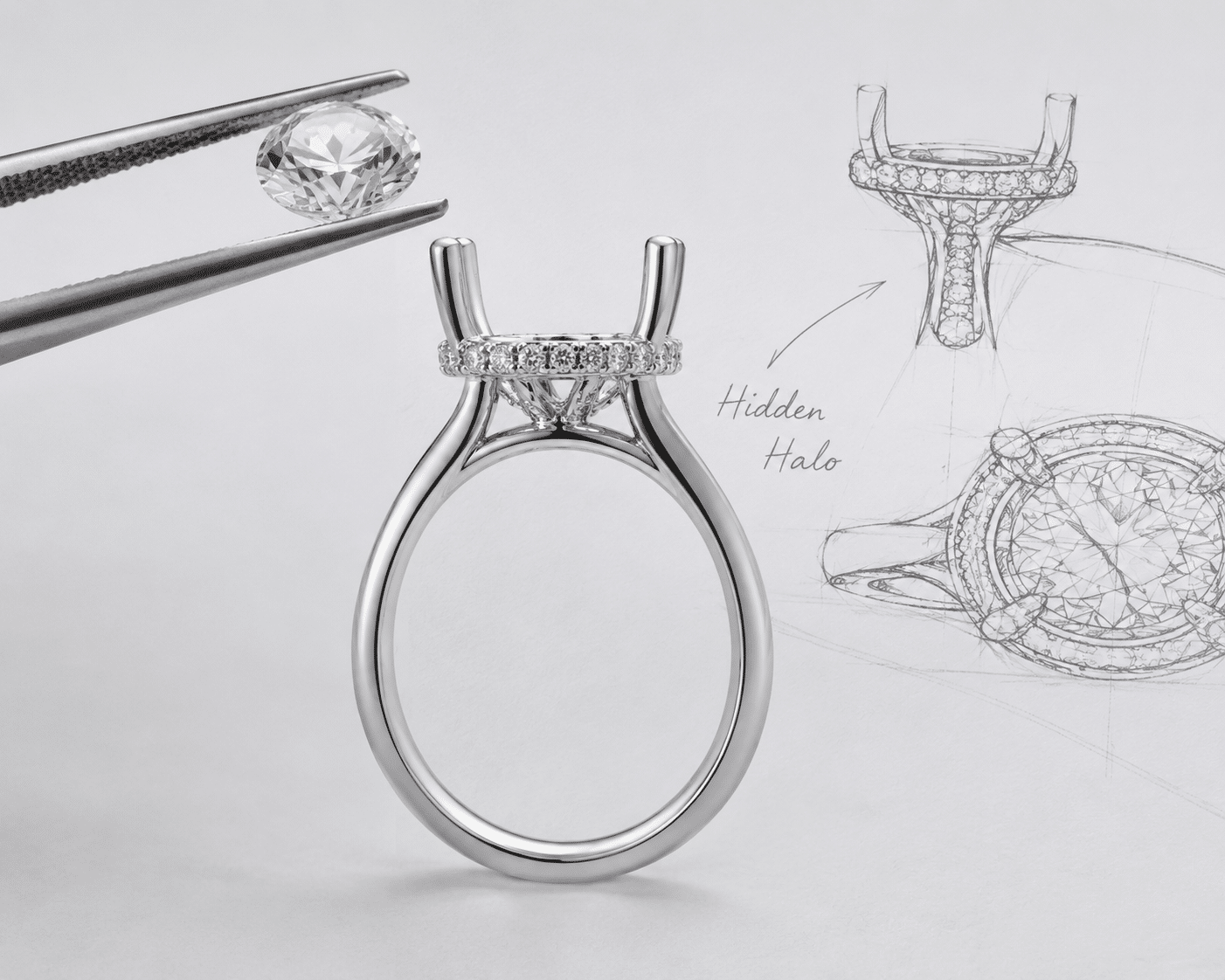
A hidden halo is not a standard halo placed out of sight. It is a ring of small accent diamonds set beneath the center stone’s girdle, usually at basket depth. From the top view, the center stone covers most of the halo, so the effect reads as a soft glow around the diamond rather than a visible frame of metal and melee. This design was originally developed for natural diamonds, but it has become especially relevant for lab-grown stones because the cost structure and cut quality distribution are different.
The Optical Role: How a Hidden Halo Affects Sparkle and Face-Up Size
The accent diamonds in a hidden halo are typically 1.2mm to 1.8mm rounds or tapered baguettes, clustered in a circle below the stone’s widest point. They catch and redirect light that would otherwise pass through the basket, sending it back toward the center stone’s pavilion. For a lab-grown diamond with a strong cut grade, this extra light return can make the stone appear both brighter and slightly larger without adding visible metal to the top view.
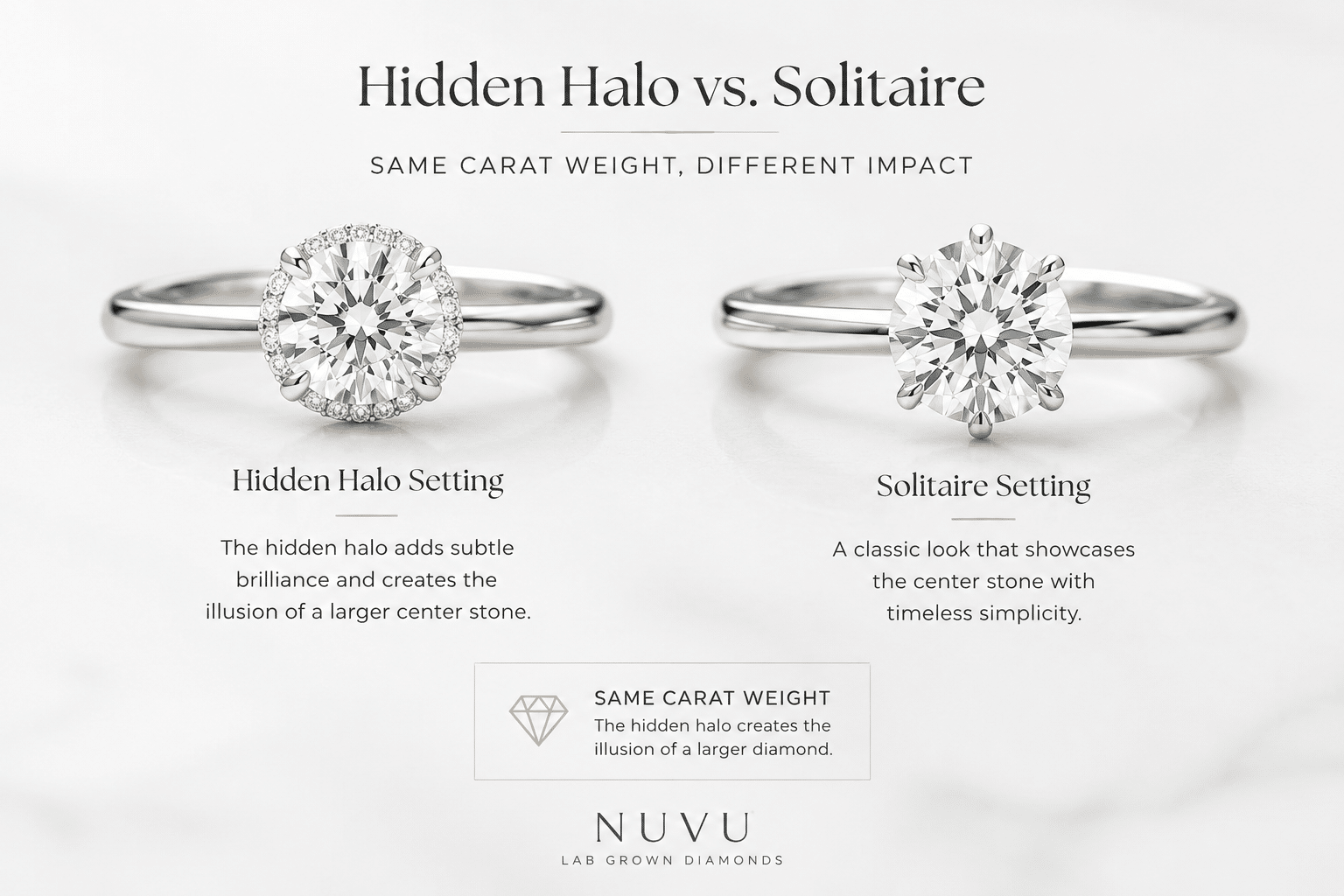
The size effect is real but moderate. A well-constructed hidden halo adds roughly 0.5mm to 1.5mm of perceived face-up diameter, depending on the accent stone size and how deep the halo sits. For a round brilliant near the ideal cut range, the halo amplifies an already efficient light return. The result is a stone that looks bigger without looking framed.
One common misunderstanding is that a hidden halo can compensate for a center stone with poor optical symmetry. In practice, the halo’s accent stones reflect light back toward the pavilion, but if the center stone’s facets do not return light efficiently, the extra input has nowhere to go. The halo works with the stone’s existing light performance; it does not create it. This is why a strong cut grade matters more for a hidden halo setting than for a standard solitaire.
When the Stone Already Performs Well: The “Better Than Needed” Test
A lab-grown diamond graded Excellent or Ideal in cut by GIA or IGI already reflects most incoming light efficiently. Adding a hidden halo in these cases does not fix a dim stone. It amplifies an already strong sparkle. The effect is additive, not corrective.
This is the key difference between hidden halos and standard visible halos. Standard halos are sometimes used to compensate for smaller table sizes or lower clarity grades. Hidden halos rarely serve that purpose well. If the center stone lacks light performance on its own, a hidden halo will not save it. The halo can only work with what the center stone gives it.
For high-cut-grade stones, the hidden halo becomes a refinement—an enhancement of an already strong performer. For stones with mediocre cut, the halo may mask some loss of brightness from the profile view, but it will not transform the top-down appearance.
How Setting Depth and Accent Diamond Quality Change the Result
Hidden halos sit at basket depth, which means the accent diamonds are positioned below the center stone’s girdle, not beside it. This placement is what keeps the halo hidden from the top view, but it also creates a structural constraint. If the accents are set too low, they can be shadowed by the basket walls and produce a dull band instead of a bright glow.
The quality of the accent diamonds matters as much as their placement. Round brilliant accents, the most common choice, should be at least VS clarity and well-cut. Melee stones below SI clarity can look grey or cloudy under direct light, which defeats the purpose of adding sparkle. From side or profile views, poor accent stones become noticeable quickly because they sit at eye level when the ring is worn.
What to Check Before You Decide
Review the center stone’s cut grade first. If it is Very Good or below, a hidden halo can mask some performance loss from profile angles. If it is Excellent, the halo should be positioned to add sparkle, not to fix a dim center. Request a 360-degree video of the finished setting in motion to confirm the hidden halo contributes light, not dullness.
When a Hidden Halo Makes the Center Stone Look Larger
The most common reason buyers consider a hidden halo is the size illusion. It works, but not equally for every stone or every shape. Understanding the limits of the effect is what separates a smart purchase from a disappointed one.
Visual Diameter vs. True Carat Weight
A hidden halo adds roughly 0.5mm to 1.5mm of perceived diameter depending on the accent stone size and setting depth. For a 1.5-carat round brilliant with a face-up diameter of about 7.4mm, a well-constructed hidden halo can make the stone read closer to 2 carats in visual presence.
The effect is strongest when the center stone’s face-up diameter is already at the larger end of its carat-weight range. A round brilliant that cuts heavy in the pavilion and has a smaller table will show less benefit because the halo cannot compensate for a stone that already faces up smaller than its carat weight suggests.
For buyers comparing stones across different vendors, it is worth noting that two lab-grown diamonds with the same carat weight can have noticeably different face-up diameters due to their cut proportions. A hidden halo will amplify whichever stone already faces up larger, which means the halo effect depends on the individual stone’s measurements, not just its carat weight. Checking the reported diameter on the grading report before selecting a setting is a useful step.
Shape-Specific Performance: Round vs. Oval vs. Emerald
Rounds benefit most from hidden halos. Their symmetrical cutting pattern aligns naturally with a circular accent grouping, so the halo reads as an extension of the stone’s own geometry.
Ovals and pears benefit less. Their elongated shape does not match a round hidden halo’s circular arrangement. The result can look mismatched from profile—round accents underneath an elongated stone often create visual tension rather than a seamless glow.
Emerald cuts and Asscher cuts are the weakest candidates. Their step-cut facets, which are often critical in lab grown diamond shape comparison, rely on clean, uninterrupted planes to produce the characteristic hall-of-mirrors effect. A hidden halo breaks that visual clarity by introducing a ring of bright spots beneath the stone. What gets lost is the open, layered depth that makes step cuts distinctive.
The Tradeoff at Very Small Carat Weights
Below 0.75 carat, roughly 5.8mm for a round, a hidden halo can overwhelm the center stone. The accent ring becomes visually dominant, making the center diamond look like an accent rather than the main event. This is the opposite of what most buyers want.
At these sizes, anyone seeking a larger appearance is usually better served by a thinner solitaire setting or a standard visible halo. A visible halo adds 2mm to 3mm of perceived diameter because the accent stones sit flush with or above the center stone’s girdle, creating a more deliberate frame.
Stone-to-Setting Fit Check
Measure the center stone’s face-up diameter. Add 1.0mm to estimate the hidden halo’s outer edge. Compare this total to a companion stone without a halo to judge whether the difference is meaningful to you. For elongated shapes—oval, pear, marquise—confirm the halo follows the stone’s shape curve. A round hidden halo on an elongated stone will look mismatched from profile.
When a Hidden Halo Becomes Too Decorative or Trend-Heavy
Not every stone needs a ring of extra diamonds around it. The hidden halo has become a default recommendation in many jewelry conversations, but it should not be applied reflexively. Knowing when the design starts working against itself matters more than knowing when it helps.
How Stone Quality Affects the “Decorated” Feeling
A hidden halo on a high-color, high-clarity lab-grown diamond—D to F color and VVS to IF clarity—adds refinement. The accent stones complement the center because they share the same clean optical profile.
On a lower-color stone—J to K color or SI2 to I1 clarity—the halo can work against the center. Surrounding a warmer or included stone with bright white accents draws attention to what the center lacks. The contrast effect is more noticeable with lab-grown diamonds because accent stones are often also lab-grown and may have higher color grades than the center stone. The mismatch becomes visible side by side.
Buyers sometimes assume that because all the diamonds are lab-grown, they will automatically match. In reality, the color grades can vary significantly between different batches of lab-grown diamond melee. The center stone and the accent stones may come from different producers or growth runs. Asking the seller to confirm the color grade range of the accent stones and comparing it to the center stone’s grade helps avoid an unintended contrast.
It is also worth noting that the growth method—HPHT or CVD—can influence color behavior in lab-grown diamonds. While both methods are used to produce diamond melee used in hidden halos, the specific color characteristics can differ depending on the process and post-growth treatment. A buyer interested in consistent color across the center stone and the halo melee should ask whether the growth method and any post-growth treatment have been documented, as this information can sometimes help explain subtle color differences. The key requirement is clear disclosure at the point of sale, not necessarily a specific growth method.
Setting Styles That Age Better
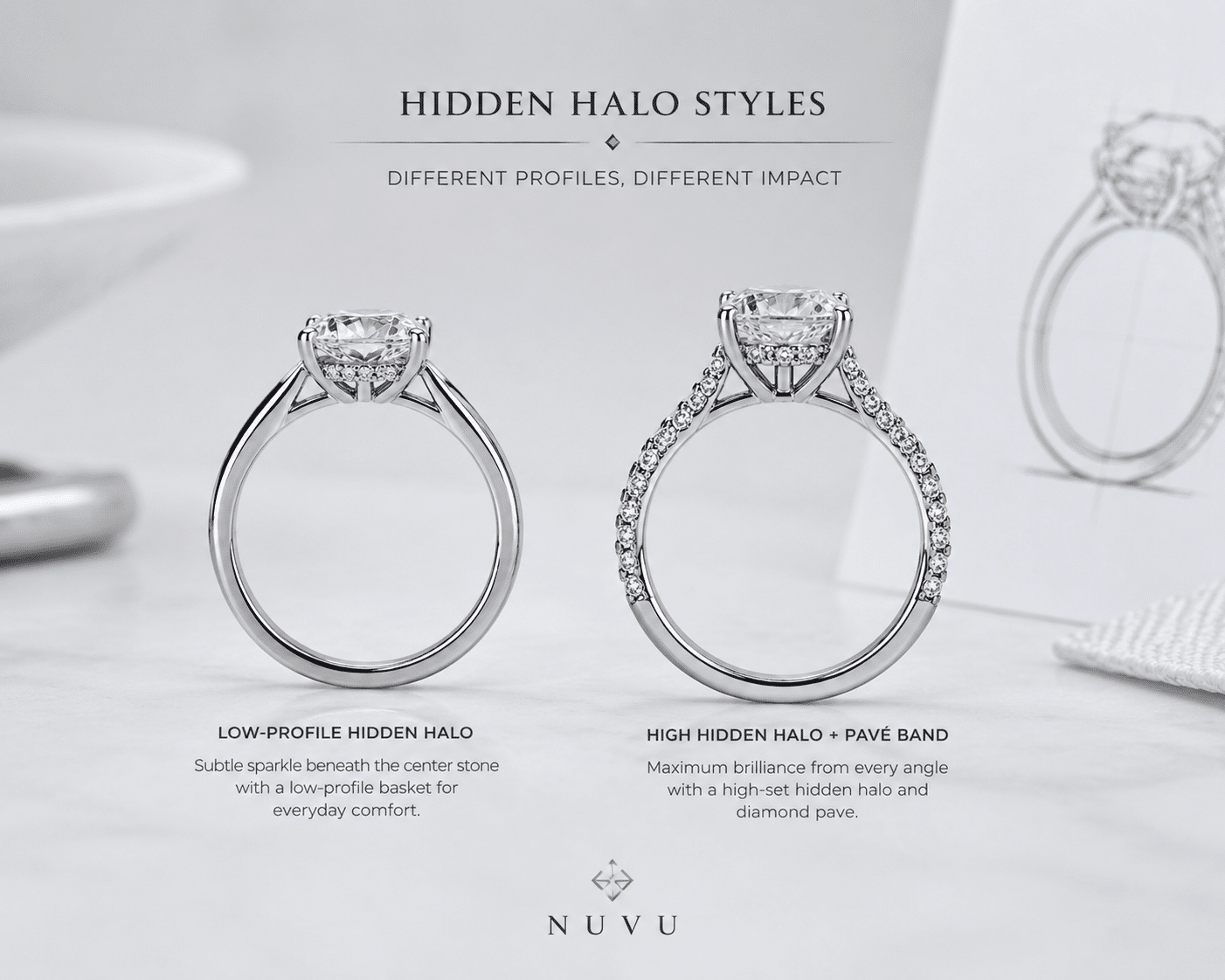
Low-profile baskets with hidden halos set in platinum or 18k white gold tend to look more classic. The halo stays close to the stone, and the rest of the setting remains clean.
High-profile peg heads with hidden halos plus additional pave on the band can look trend-heavy within three to five years. The combination of a raised center, hidden halo, and shank pave creates a layered ornamentation that reads as more decorative than refined. Over time, this look tends to feel busier, not better.
The safest execution is a hidden halo with a clean, unadorned shank and a modest basket design. The halo does its work from below, and nothing competes with it.
The “Stacking and Band Fit” Limitation
Hidden halos add bulk at the base of the center stone. This creates a gap between the engagement ring and a wedding band, especially if the band is a straight style. The gap is usually visible from the side and can look unfinished.
Buyers planning to stack rings should confirm the hidden halo’s basket width and whether a curved or notched band is required for a flush fit. Some buyers do not mind the gap and fill it with a spacer ring. Others find the visual break distracting. Neither choice is wrong, but both should be intentional.
For those who value a seamless stacking look, the hidden halo’s basket width should be measured precisely before the ring is made. A difference of even 1mm in basket thickness can determine whether a straight band sits flush or leaves a noticeable gap. This is one area where requesting a custom fitting with the intended wedding band can prevent a post-purchase disappointment.
How to Verify This Before Buying
Request a profile image of the ring next to a straight wedding band. Measure the gap. If the hidden halo forces a curved band, confirm you are comfortable with that design constraint before purchase. For lower-color center stones, ask to see the hidden halo accent stones side by side with the center to evaluate color contrast. If the accents look noticeably whiter, the ring may not feel cohesive in person.
Hidden Halo Construction and Durability Differences
A hidden halo changes more than how the diamond looks from above. It also changes how the ring is built, how it wears over time, and what maintenance it will need. Buyers focused only on the visual effect often overlook the structural side, which matters more for a ring worn every day.
Basket vs. Peg Head: Which Holds Better
The way the center stone is mounted determines how secure the ring will feel over years of daily wear. A hidden halo built into a solid basket design distributes the weight and pressure from the center stone across the band. This is the stronger construction because the basket connects to the shank at multiple contact points. A peg head uses a single weld point to attach the head to the shank, which creates a stress concentration. If the ring catches on something, the weld joint takes the full force. For engagement rings worn daily, basket construction adds measurable long-term security, especially when the accent stones in the halo are small—below 1.5mm—where even slight movement of the head can shift alignment.
Accent Stone Retention Risks
The small diamonds in a hidden halo are secured in one of two ways. Prong-set stones use four small metal prongs that grip the stone from the sides. Bead-set stones are held by small metal beads pushed over the edge of the stone. Bead setting looks cleaner from the surface, but it depends on thin metal that can wear down over five to ten years. Once the metal beads thin out, stones can loosen and fall out. Prong-set accents offer better long-term retention because the prongs are thicker and can be tightened during routine maintenance. Before buying, ask directly whether the hidden halo uses solid prongs or bead-set channels. The answer should affect your decision for a daily-wear ring.
Another factor worth checking is the metal hardness. Platinum holds prongs slightly better than 18k white gold because it does not wear away as quickly at contact points. For a ring with many small accent stones, the choice of metal can affect how often the setting needs maintenance. Buyers who expect to wear the ring daily for decades may find that the extra upfront cost of platinum pays for itself in reduced retightening visits.
Cleaning and Maintenance Specifics
Hidden halos create a cavity beneath the center stone that collects dust, soap residue, and lotion more readily than an open gallery setting. Routine cleaning with a soft brush and warm water is sufficient for most buildup. Ultrasonic cleaners are effective but carry a moderate risk: if any accent stone is already slightly loose, the vibration can dislodge it. For daily-wear rings, this is worth factoring into your care routine. A simple annual check by a jeweler who can tighten prongs will prevent most issues before they become visible.
Buyer Verification Checklist
Before committing to a hidden halo setting, ask the seller three things. First, is the hidden halo prong-set or bead-set? Second, is the center stone mounted in a basket or a peg head? Third, does the warranty cover accent stone replacement for at least the first year? For daily-wear rings, basket construction and prong-set accent stones are the safer choices. If the setting uses bead-set stones in a peg head, expect higher long-term maintenance. Note that warranty coverage varies by seller and should be confirmed in writing before purchase, as terms such as “lifetime warranty” or “full coverage” often have specific exclusions that may not cover worn prongs or lost accent stones.
When evaluating a hidden halo construction, buyers should request close-up photos of the accent stone setting from both the top and underside of the ring. A transparent seller will provide clear images showing how each accent diamond is secured, which helps in assessing long-term retention and the likelihood of future repairs.
Understanding the Role of Grading Reports and Laboratory Disclosure
Because hidden halos introduce multiple small diamonds into the ring, the interaction between grading reports and disclosure becomes especially relevant. A buyer choosing a lab-grown center stone with a hidden halo of lab-grown melee should understand what the grading report documents and what it does not.
GIA, IGI, and other major laboratories issue individual grading reports for center stones over a certain size, but melee diamonds used in hidden halos are typically not graded individually.[1] The GIA has established specific terminology for describing lab-grown diamonds on grading reports, including the use of “Laboratory-Grown Diamond” on the report face.[2] This distinction matters when comparing the center stone’s documented grade to the ungraded accent stones. The center stone may carry a clear color and clarity grade, while the halo melee may come from a batch with a broad quality range. Asking the seller for the color and clarity range of the melee batch helps bridge this information gap.
The Federal Trade Commission (FTC) has also issued guidance relevant to how lab-grown diamonds and their components are described in jewelry advertising and sales. The FTC’s Jewelry Guides require that if a diamond is lab-grown, the description must be clear and not misleading.[3] For a hidden halo ring where both the center and the accents are lab-grown, this means the seller should disclose that all diamonds are lab-grown and avoid implying a natural origin. A buyer can verify this by checking the product description or asking for written confirmation. Sellers may describe their diamonds using terms like “laboratory-grown,” “lab-grown,” or “laboratory-created,” and these terms should be applied consistently to both the center stone and the accent melee used in the halo.
A grading report for the center stone provides a useful starting point, but it should not be treated as a complete picture of how the stone will perform in a hidden halo setting. The report documents cut, color, clarity, and carat weight, but it does not measure light return in the context of a specific basket design or accent stone arrangement. For this reason, it is worth treating the report as one data point alongside visual evidence, measurements, and the seller’s description of the melee quality. A buyer who understands the limits of a certificate is less likely to be surprised by the final appearance of the ring. Conversely, relying solely on report grades without viewing the stone or requesting videos of the finished setting increases the risk of a mismatch between expectations and reality.
How Hidden Halo Pricing Differs Between Lab-Grown and Natural Diamonds
The cost of a hidden halo matters differently when the center stone is lab-grown. The same setting that represents a small fraction of a natural diamond ring, lab grown diamond engagement rings guide, can become a major budget line item when paired with a lab-grown center. Understanding this shift helps avoid surprise allocations.
The Setting Cost vs. Stone Cost Relationship
A custom hidden halo setting typically adds $400 to $1,200 to the total ring cost, depending on accent stone count and metal type. For natural diamond rings where the center stone runs $4,000 to $12,000, the setting is a smaller fraction of the total cost. For lab-grown diamond rings where the center stone may cost $600 to $2,500, the setting becomes a much larger share of the budget. This changes the value calculation. The setting is no longer a supporting expense. It may be the most expensive single component in the ring.
At NUVU, this shift in cost structure is treated as a practical allocation question: the buyer should decide whether the hidden halo’s visual benefit justifies the higher relative cost. If the setting is the larger budget item, the ring’s long-term value lies more in its craftsmanship and design than in the center stone, which is a reasonable choice as long as the buyer is aware of it. Prices cited above are rough estimates based on typical market ranges and may vary significantly by seller, geographic location, and specific design complexity.
When the Setting Outshines the Stone in Cost
A one-carat lab-grown round diamond in D–F color and VS clarity can cost between $800 and $1,500. A high-end custom hidden halo setting with platinum, precise craftsmanship, and quality accent stones can reach $1,200 or more. In that scenario, the setting costs nearly as much as or more than the center stone. This is not inherently a bad outcome. Some buyers want a detailed, durable setting and a clean, well-cut center stone that does not need to be large. But it changes the ring’s cost structure. If the value is in the setting, resale logic and insurance value will reflect that. Buyers should know where their money is going.
Accent Stone Quality and Total Price
The accent diamonds in a hidden halo are typically lab-grown diamond melee. Higher color grades (D–E) and higher clarity (VS and above) for these accents can increase setting cost by $150 to $400. Lower color (G–H) and SI clarity accents lower the upfront cost, but they can create a visible contrast against a white, high-color center stone. The effect is a center diamond that looks warm or slightly dull by comparison. The savings may not be worth the mismatch.
For buyers who plan to verify the accent stone quality, note that melee diamonds are not always accompanied by individual grading reports. The seller should be able to confirm the color and clarity range of the melee used in the halo. Without this information, the buyer is relying on visual trust alone, which is worth evaluating carefully when the setting cost is high.
Documentation transparency extends beyond the center stone’s grading report. For a hidden halo ring, the buyer should ask whether the melee diamonds in the halo come from documented growth cycles and whether the seller can provide batch-level information about their color and clarity range. In wholesale or custom sourcing conversations, consistency and clear communication about what is documented versus what is visually approximated often matter as much as the headline specifications. A seller who can explain the origin and quality range of the accent stones offers a more complete picture than one who simply describes the halo as “lab-grown diamonds.”
What This Means in a Real Purchase
Allocate your budget with the center stone first, then the setting. If a hidden halo setting costs more than 60 percent of the total ring price, confirm that you are making a deliberate design choice rather than an accidental cost inversion. For accent stones, match color grade to within one grade of the center stone to avoid visible contrast. A D-color center with G-color accents will show the difference under direct light.
Who Should Choose a Hidden Halo—and Who Should Skip It
Not every buyer benefits from a hidden halo. The design works well for some stone sizes, shapes, and personal style preferences, and it works against others. A clear framework helps avoid the wrong fit.
Best Candidates for a Hidden Halo
Buyers who want a larger visual presence from a smaller carat weight—typically under 1.5 carats—are strong candidates. So are buyers who want a solitaire-like top view with extra sparkle from side and profile angles. The ideal scenario is a high-cut-grade round diamond set in a classic white metal. These conditions let the hidden halo add optical value without introducing design conflict. The extra light return from the accent stones complements the center stone rather than fighting it.
Buyers Who Should Consider Other Settings
Buyers setting step-cut stones such as emerald or Asscher cuts should skip the hidden halo. Their clean, parallel facet planes depend on uninterrupted visual lines, and a halo breaks that clarity. Buyers who plan to stack multiple rings without curved bands should also avoid it—the basket width will leave a gap. Buyers on a tight budget where the setting will consume more than half the total cost will usually get better value from a clean solitaire or a thin pave band. And buyers who prefer extremely low-profile rings should know that a hidden halo adds noticeable height.
How to Test the Decision Before Committing
The best test is to compare the exact center stone in a solitaire mounting and a hidden halo mounting side by side. If that is not possible, ask for two photos: one with the stone in a plain basket and one in a hidden halo. A simulation tool can also help. The visual difference should justify the cost for you personally, not simply because hidden halos are popular. If the added sparkle feels subtle or the center stone looks crowded, the halo is not helping.
What to Check Before You Decide
Finger size changes how the halo reads visually. On sizes 4 to 5.5, hidden halos can look proportionally larger against the hand. On sizes 7 and above, the halo may appear smaller relative to the finger. Consider long-term style preference. If you tend to choose jewelry with clean, simple lines, skip the hidden halo. If you prefer layered detail and hidden elements that reveal themselves on closer inspection, it is a strong match.
Hidden Halo vs. Visible Halo vs. Solitaire: Which Design Choice Fits Your Stone
Visible Halo: When You Want Maximum Size and Glamour
A visible halo adds 2–3mm of perceived diameter because the accent stones sit flush with or slightly above the center stone’s girdle. This makes it the strongest option for very small center stones—anything under 0.5 carat—where the halo becomes the dominant visual element and the center diamond reads as part of a larger composition. It is also the right call for buyers who want a ring that reads as a full statement piece rather than a single-stone focal point. The tradeoff is a busier top view and a less solitaire-like appearance. If you want the center stone to feel like the clear lead, a visible halo pushes in the opposite direction.
Solitaire: When You Want Maximum Stone Focus
A solitaire shows the center stone without interference. For a lab-grown diamond with strong cut and clarity, a solitaire is the cleanest possible presentation. Nothing competes for attention. Nothing breaks the line of the stone’s faceting. It is also the most repair-friendly setting and the easiest to pair with any wedding band style—straight, curved, or chevron all fit without modification. Hidden halos sit between solitaires and visible halos in ornamentation, which is exactly why the decision comes down to whether you want the center stone to be the only visual event.
Hidden Halo as a Middle Option
For a 1 to 1.5 carat round lab-grown diamond with an Excellent cut grade, a hidden halo offers a size increase without a visible halo ring from the top view. This makes it a strong choice for buyers who want a solitaire-like top appearance but prefer extra sparkle from side and profile angles. The effect is subtle from above and noticeable from the side, which is the whole point: it adds depth without changing the silhouette. If the center stone already performs optically at a high level, the hidden halo amplifies that performance rather than masking a weakness.
Certificate and Visual Review Check
Compare all three options with the same center stone before deciding. Request a top-view still image, a profile image, and a 30-second video showing the ring under direct light. If the hidden halo adds measurable sparkle without dominating the center, it is the right choice. If the halo looks muted or the center stone feels crowded, you are better off with a solitaire or a visible halo. The video is the most reliable test—still images can hide how accent stones behave in motion.
When comparing design options, the most useful evidence is a video of the exact setting style with a stone of similar proportions to yours. Still images can make a hidden halo appear either more dramatic or more subtle than it actually is in motion. A video under direct light reveals how the accent stones contribute sparkle and whether the center stone remains the focal point.
Frequently Asked Questions About Hidden Halo Lab-Grown Diamond Rings
Yes, by roughly 0.5 to 1.5mm in perceived face-up diameter, depending on accent stone size and setting depth. The effect is noticeable but not dramatic. It works best for round diamonds near 1 carat and above. At smaller carat weights, the halo can dominate rather than enhance.
A well-constructed hidden halo adds side reflection, which can make the center stone appear brighter from both profile and top-down angles. A poorly constructed halo with low-quality accent stones can absorb light and reduce overall sparkle. The accent stones matter—round brilliants at VS clarity or above with good cut grades contribute light. Melee stones below SI clarity can look grey under direct light and drag the center down.
Hidden halos have been a consistent design choice since the early 2010s. They have shifted from trend to staple. The risk of feeling dated is low for classic executions with clean shanks and modest accent stones. The risk is higher when the hidden halo is paired with heavy pave bands, high-profile peg heads, or mixed metal combinations that reflect a specific design moment rather than a lasting look.
Usually not. Hidden halos require a custom basket and head designed around the specific proportions of the center stone. Retrofitting a solitaire means replacing the entire head assembly, which costs nearly as much as a new setting and may require recutting the center stone. It is almost always more cost-effective to commission a new setting.
Curved, chevron, and notched bands fit flush against a hidden halo setting. Straight bands leave a visible gap because the hidden halo adds bulk at the base of the center stone. The gap can be filled with a spacer ring, but some buyers dislike the visual break. Confirm band compatibility before finalizing the engagement ring—mismatched bands are one of the most common post-purchase frustrations with hidden halo rings.
[1] GIA, “Lab-Grown Diamonds,” Gemological Institute of America, accessed 2025. https://www.gia.edu/gia-lab-grown-diamond
[2] GIA, “HPHT and CVD Diamond Growth Processes,” GIA.edu, accessed 2025. https://www.gia.edu/gia-news-research-hpht-cvd-diamond-growth
[3] Federal Trade Commission, “Guides for the Jewelry, Precious Metals, and Pewter Industries,” FTC, 2018. https://www.ftc.gov/legal-library/browse/rules/guides-jewelry-precious-metals-pewter-industries
Disclosure: This article is for general educational purposes only. Diamond grading, pricing, availability, specifications, and seller policies can change, and readers should verify important details through grading reports, official laboratory tools, seller documentation, or qualified professionals before making a purchase decision. Laboratory-grown diamonds should be clearly distinguished from natural diamonds, and environmental or sourcing claims should be supported by specific documentation. Prices mentioned in this article are approximate market ranges and may not reflect current pricing at any specific retailer or at the time of your purchase.