
Choosing between round, oval, emerald, and cushion lab-grown diamonds for an engagement ring quickly moves past personal taste into practical trade-offs. The shape you pick affects not just the ring’s look and settings like hidden halo engagement rings, but also how large the stone appears, how much sparkle it shows, how visible inclusions become, and even how much finger coverage you get for your budget. A round brilliant delivers the most consistent fire but costs more per carat and shows more metal. An oval covers more finger but risks a dark bow-tie effect in poor cuts. An emerald cut relies on clarity over brilliance, demanding a higher grade to avoid visible flaws. A cushion offers the most setting versatility but varies widely in appearance.
For the full framework, read Lab-Grown Diamond Engagement Rings Guide.
This article breaks down the core differences by shape, explains how to use certificate data—surface area, length-to-width ratio, and pavilion depth—to compare stones objectively, and helps you match a shape to your priority: maximum sparkle, finger coverage, understated elegance, or setting flexibility. By the end, you will know exactly which measurements to compare and what to look for in live video before committing.
For buyers comparing shapes, a useful distinction to keep in mind: the grading report documents what the stone is, but it does not fully capture how the stone behaves. Shape, proportion, and cut execution determine much of the visual outcome, and these properties cannot be reduced to a single grade.
| Shape | Best For | Key Trade-Off to Know |
|---|---|---|
| Round Brilliant | Maximum and consistent sparkle | Costs 20–40% more per carat than other shapes; shows more visible metal |
| Oval | Largest finger coverage per carat (up to 30% more) | Risk of bow-tie effect; cannot assess quality from certificates alone |
| Emerald | Understated elegance with step-cut clarity | Requires VS1 or higher clarity; inclusions are highly visible across broad table surface |
| Cushion | Maximum setting versatility (prong, bezel, halo) | Most variable appearance; ranges from high-sparkle brilliant to softer vintage look |
Quick Questions Before You Read
Q: Can I rely on carat weight alone to compare diamond sizes across different shapes?
No. Carat weight is misleading across shapes. An oval of the same carat weight offers roughly 30% more visual coverage than a round. You must compare face-up surface area (length × width in mm²) instead.
Q: Why does an oval diamond sometimes have a dark area in the middle?
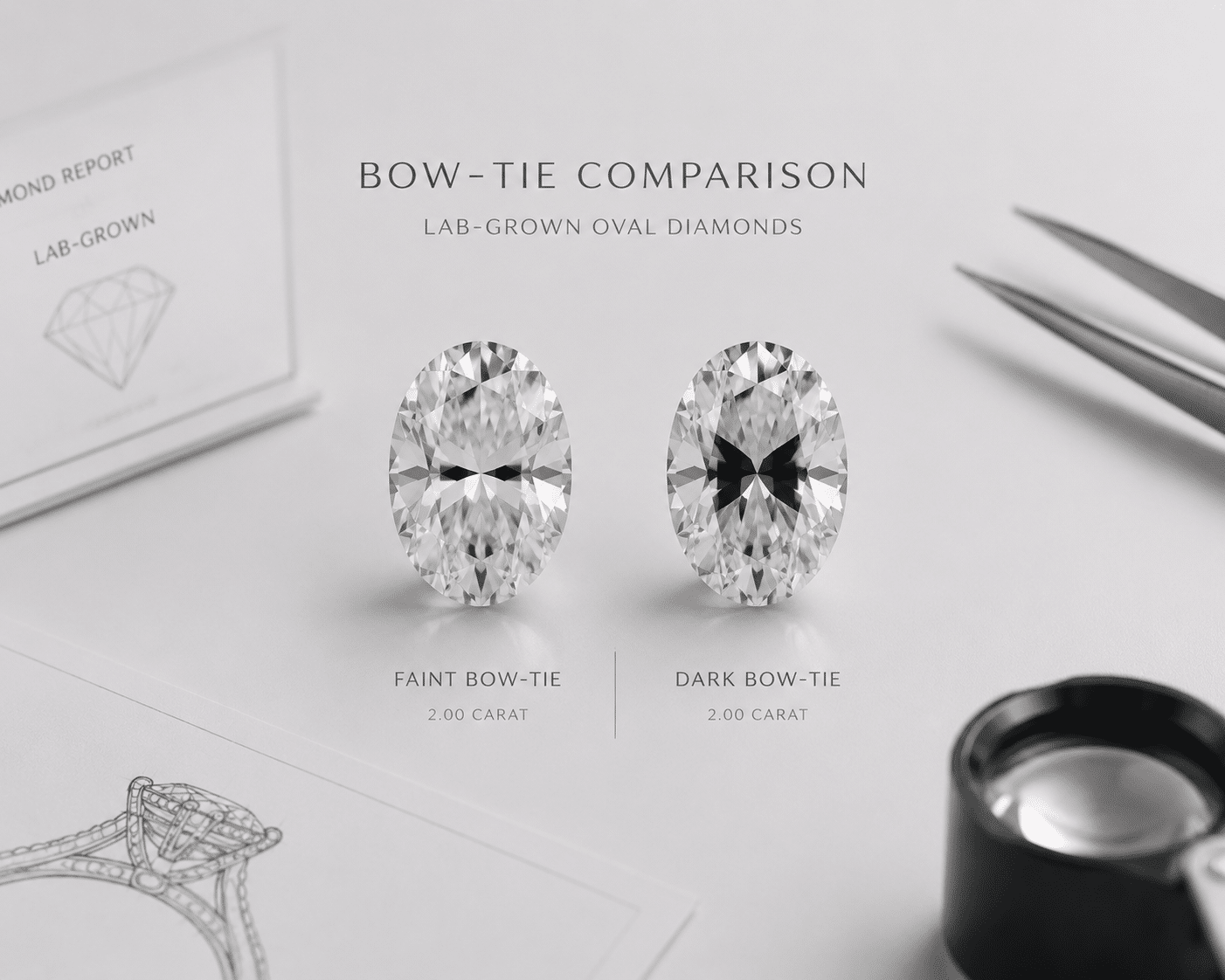
That is the bow-tie effect, caused by poor light return in the center of an elongated cut. It is visible in low-quality ovals. You cannot detect it from a certificate alone—you must view a 360° video under multiple lights before buying.
Q: Do I need a higher clarity grade for an emerald cut compared to a round?
Yes. Emerald cuts use step-cut faceting, which creates a wide, open table that makes inclusions much more visible. Choose VS1 or higher clarity for an emerald, while a round brilliant can hide lower clarity grades more easily.
Why Shape Matters More Than Carat in an Engagement Ring
Most first-time buyers start with carat weight. It is the most advertised number and the easiest to compare. But in a finished ring, shape determines more of the visual outcome than carat weight ever does. Two diamonds at the same carat weight can look completely different on the hand depending on whether the shape is round, oval, emerald, or cushion. The shape controls how the stone spreads across the finger, how it interacts with light, and how it sits in the setting. Carat weight tells you how much the stone weighs. Shape tells you how it will actually look.
A practical point worth noting: carat weight is a measure of mass, not size. Two stones with identical carat weight can have different surface areas if one is cut shallower or wider. This is why shape and proportions often matter more than the carat number when planning a finished ring.
Brilliance Style: What Different Shapes Do with Light
Every shape produces a different light performance, and that difference matters more in daily wear than the exact color or clarity grade on a certificate. Round brilliant cuts use 57 or 58 precisely angled facets to create maximum fire and scintillation. The light return is consistent from nearly every viewing angle, which is why round remains the benchmark for sparkle. Emerald cuts take the opposite approach. Their step-cut faceting uses broad, open planes that create a hall-of-mirrors effect — alternating flashes of light and dark rather than constant sparkle. This look is quieter and more architectural. Cushion cuts sit between the two, combining larger facets with rounded corners to produce a softer, more romantic brilliance pattern. Oval cuts use modified brilliant faceting that spreads light return across an elongated silhouette, giving a sparkle intensity close to round but with a very different finger presence.
Visual Coverage: How Shape Affects Wrist Presence
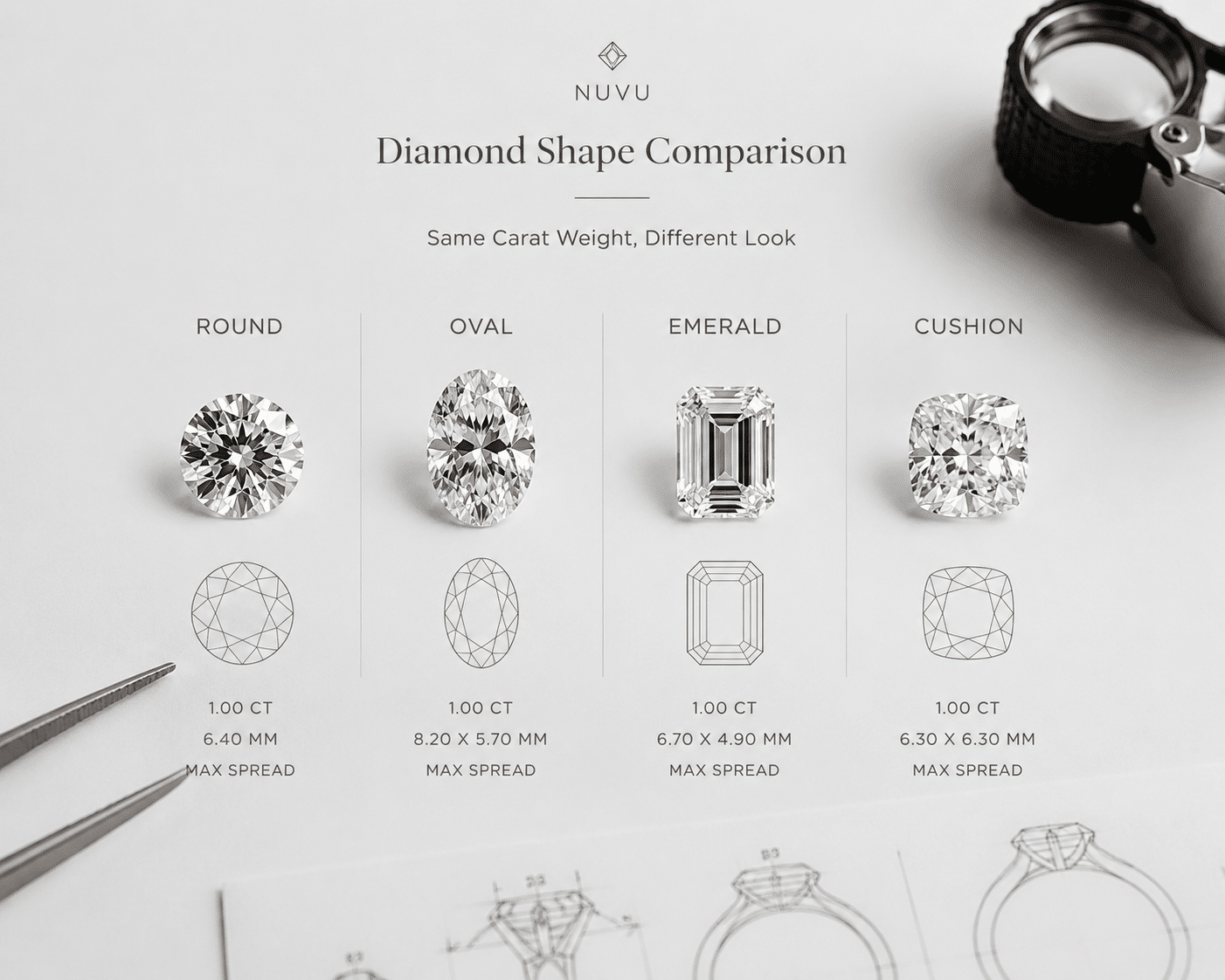
The most practical difference between shapes is how much finger they cover at the same carat weight. Oval and elongated cushion cuts typically provide 30 to 40 percent more visual finger coverage than a round of equal carat weight, purely because of their length-to-width ratio. An emerald cut also appears larger than a round at the same weight, though it achieves that through a wide table and rectangular silhouette rather than elongation. Round and square cushion cuts are more compact. They leave more visible metal around the stone, which changes the balance of the finished ring. A buyer who wants maximum finger presence per dollar should look at elongated shapes first, not larger carat weights.
Understanding How Lab-Grown Diamonds Are Identified and Described
When comparing shapes, it is also helpful to understand how lab-grown diamonds are distinguished from natural diamonds. The Gemological Institute of America (GIA) has outlined terminology for identifying lab-grown diamonds, noting that the key difference lies in their origin, not their physical or chemical composition.[1] GIA explains that laboratory-grown diamonds have essentially the same physical and chemical properties as natural diamonds and require specialized testing to differentiate them.[1] This distinction is important for buyers because it means the optical behavior of any shape—sparkle in a round, the hall-of-mirrors effect in an emerald, or the bow-tie in an oval—is the same regardless of whether the diamond is natural or lab-grown.
What this means in practical buying: the finger coverage advantage of an elongated shape is not a marketing trick, it is a direct result of geometry. A longer stone physically spans more of the finger surface. The buyer’s task is to verify that the elongation looks balanced with their ring size and setting style, not simply to assume longer is always better.
What to Check Before You Decide
Ignore carat weight as a standalone number. Ask for the stone’s length and width measurements in millimeters. A 1.5-carat oval can show the same finger coverage as a 2.0-carat round, which changes how you allocate your budget and how the final ring will proportion against your finger. Verify the length-to-width ratio against your ring size using the seller’s measurement table. A ratio that looks balanced on a size 6 finger may look too elongated or too squat on a size 4 or size 8.
Round Lab-Grown Diamonds: The Brilliance Benchmark
Round brilliant is the most popular engagement ring shape for a reason. No other shape delivers the same consistent sparkle across lighting conditions, and no other shape is as standardized in its cutting. But popularity comes with tradeoffs that matter to your budget and ring design. Understanding both sides is what makes the round shape a clear choice rather than a default one.
Why Round Is the Most Forgiving Shape
The round brilliant cut uses 57 or 58 facets arranged in precise angular relationships that maximize light return regardless of the stone’s orientation. That geometric precision makes round the most forgiving shape for color and clarity. Inclusions and slight color tints that would be visible in an emerald or oval cut are masked by the faceting pattern in a round. The round shape is also the least susceptible to poor cut execution because manufacturers have refined its proportions over decades of CNC cutting. A round stone at a good cut grade will almost always perform well visually. The same cannot be said for fancies, where cut quality varies widely between stones and sellers.
The Practical Downside of Round: Metal and Cost
Round stones require more rough crystal weight to produce than any other shape. That inefficiency raises the cost per carat by 20 to 40 percent compared to ovals, cushions, or emerald cuts at equivalent color and clarity. You pay a premium for the shape itself, not for better material. The round shape also leaves more visible metal around the stone in a setting. Because a round is compact and symmetrical, the surrounding metal becomes a larger proportion of the ring’s top view. Buyers who prefer a floating-stone look or a higher diamond-to-metal ratio often find that elongated shapes achieve that effect more naturally.
For buyers weighing cost and visual impact, the practical question is not whether round is the best shape, but whether the premium for consistent sparkle justifies the reduced finger coverage. This tradeoff is personal, and neither choice is objectively correct.
Stone-to-Setting Fit Check
Confirm that the stone’s diameter measurement matches the intended setting’s prong or bezel design. Round stones have the most standard measurement ranges, but a 6.5 mm round will not fit a setting designed for a 6.0 mm stone. The difference is small in millimeters but large in setting security and final appearance. Request a setting compatibility assessment from your jeweler before selecting the stone, not after.
Oval Lab-Grown Diamonds: The Spread and Slenderness Play
Oval is the most effective shape for buyers who want maximum perceived size per carat. The elongated silhouette covers more finger, creates a flattering visual line, and typically costs less per carat than a round. But the oval shape comes with a specific visual risk — the bow-tie effect — that makes careful selection more important than with any other shape.
Length-to-Width Ratio and Finger Coverage
Standard oval length-to-width ratios range from 1.30 to 1.50, with 1.40 being the most common for engagement rings. A 1.40 ratio provides noticeable elongation without looking thin or narrow. At the same carat weight, an oval will measure 2 to 3 millimeters longer than a round. That extra length translates directly to more finger coverage without increasing cost. A buyer comparing a 1.5-carat oval to a 2.0-carat round will often find that the oval covers the same visual area at a significantly lower price. The tradeoff is that the oval’s brilliance pattern is not as consistent as a round’s, and the elongated shape is more sensitive to cut quality.
The Bow-Tie Effect: Reality vs. Marketing
Well-cut ovals minimize this to a subtle gray band visible only in certain lighting angles, and lab grown diamond engagement ring metals are crucial for the overall setting. Poorly cut ovals show a dark, distracting bow-tie that reduces brilliance and gives the stone a dead center zone. The difference between a good oval and a bad oval is not subtle. A strong bow-tie will be visible in normal room lighting and will make the stone look uneven and dull.
An important clarification for buyers: many sellers describe the bow-tie as a natural characteristic of all ovals, which is technically true, but the degree varies enormously. The buyer’s goal is not to find an oval with zero bow-tie, but to find one where the effect is faint enough not to distract from the stone’s overall beauty. Video under multiple lighting conditions is the only reliable way to verify this.
Certificate and Visual Review Check
Never buy an oval from certificate data alone. A grading report will not show you how the bow-tie performs in real light. Request 360-degree video or inspection photographs under two different lighting conditions: direct overhead light and ambient diffused light. The bow-tie should appear as a faint gray band under direct light, not a black patch. Ask the seller for the exact length and width measurements in millimeters and confirm the ratio. If the seller cannot provide clear video under multiple lighting conditions, move on to another stone.
Emerald Lab-Grown Diamonds: The Clarity and Architecture Statement
The emerald cut is not a shape for someone who wants the brightest sparkle in the room. It is a shape for someone who values structure, clarity, and a different kind of visual interest. This cut asks more from the buyer, but it also rewards a more careful selection process.
Why Clarity Grade Becomes the Dominant Purchase Factor
Step-cut faceting creates broad, open planes of polished diamond surface. Unlike a round brilliant, which uses dozens of small facets to break up light and hide imperfections, an emerald cut shows everything. Inclusions, internal graining, and color tint that would be invisible in a brilliant cut become plainly visible across the large table and step facets. This changes the buying logic entirely. A VS2 emerald cut can look noticeably included, while the same grade in a round brilliant might look clean to the naked eye. Buyers should target VS1 or better clarity for an emerald cut. SI1 is rarely advisable unless the inclusions are extremely well-positioned off the central table and away from the main viewing area. Even then, it requires a careful visual inspection before purchase.
How Step-Cut Faceting Changes the Visual Experience
An emerald cut does not compete with brilliant shapes on fire or scintillation. Instead, it creates alternating flashes of light and dark that shift as the stone moves, often called the hall-of-mirrors effect. The stone feels less like a light show and more like a glass building: architectural, restrained, and rewarding to those who appreciate subtlety. This visual style appeals most to buyers who want understated elegance over maximum sparkle. It also pairs best with low-profile, minimalist settings that do not fight the stone for attention. A thin solitaire or a clean bezel setting lets the emerald cut speak for itself.
What This Means in a Real Purchase
If you choose an emerald cut, do not rely on the clarity grade alone. Request a clarity plot from the seller and inspect the stone under 10x magnification, either in person or through a high-resolution video. Pay attention to inclusions in the center table area, not the edges. Inclusions near the edge can often be hidden under a prong. Those in the middle of the table cannot. Also check the step-facet alignment. Uneven or wavy step facets indicate poor cutting execution and will reduce the hall-of-mirrors effect, making the stone look dull or distorted rather than precise.
One subtle factor that emerald cut buyers often overlook: color grade becomes more noticeable in step-cut shapes. Because the broad table reflects less colored light from the facets, any slight warm or cool tint in the stone is more apparent. Buyers who might accept G-H color in a round brilliant may prefer F or better in an emerald cut to maintain a clean, icy appearance.
Cushion Lab-Grown Diamonds: The Modified Brilliance and Setting Versatility
The cushion cut is the most variable major shape available today. That variability can be confusing, but it also makes the cushion the most adaptable shape for different ring designs and buyer preferences.
Modified Brilliance vs. Traditional Cushion: Key Differences
Modern cushion cuts come in two broad categories. Modified brilliant cushions use 58 to 72 facets with a brilliant-cut pavilion and crown, producing a sparkle intensity that approaches a round brilliant. These stones feel bright, lively, and modern. Traditional cushions use larger, more geometric facets that prioritize a softer, vintage-inspired look with less scintillation. The traditional version feels warmer and more romantic, but it will not have the same light performance. Buyers should decide which behavior they want before comparing stones, because a modified brilliant cushion and a traditional one do not look or perform the same way.
For buyers browsing cushion cuts, a useful sorting step: ask the seller whether the cushion is described as “modified brilliant” or “crushed ice” versus “chunky” or “vintage” facet style. This distinction is not always listed clearly, but it determines the entire visual character of the stone. Comparing two cushions without knowing their facet style is like comparing two different shapes.
Cushion and Setting Interaction: Prongs, Bezels, and Halo Effects
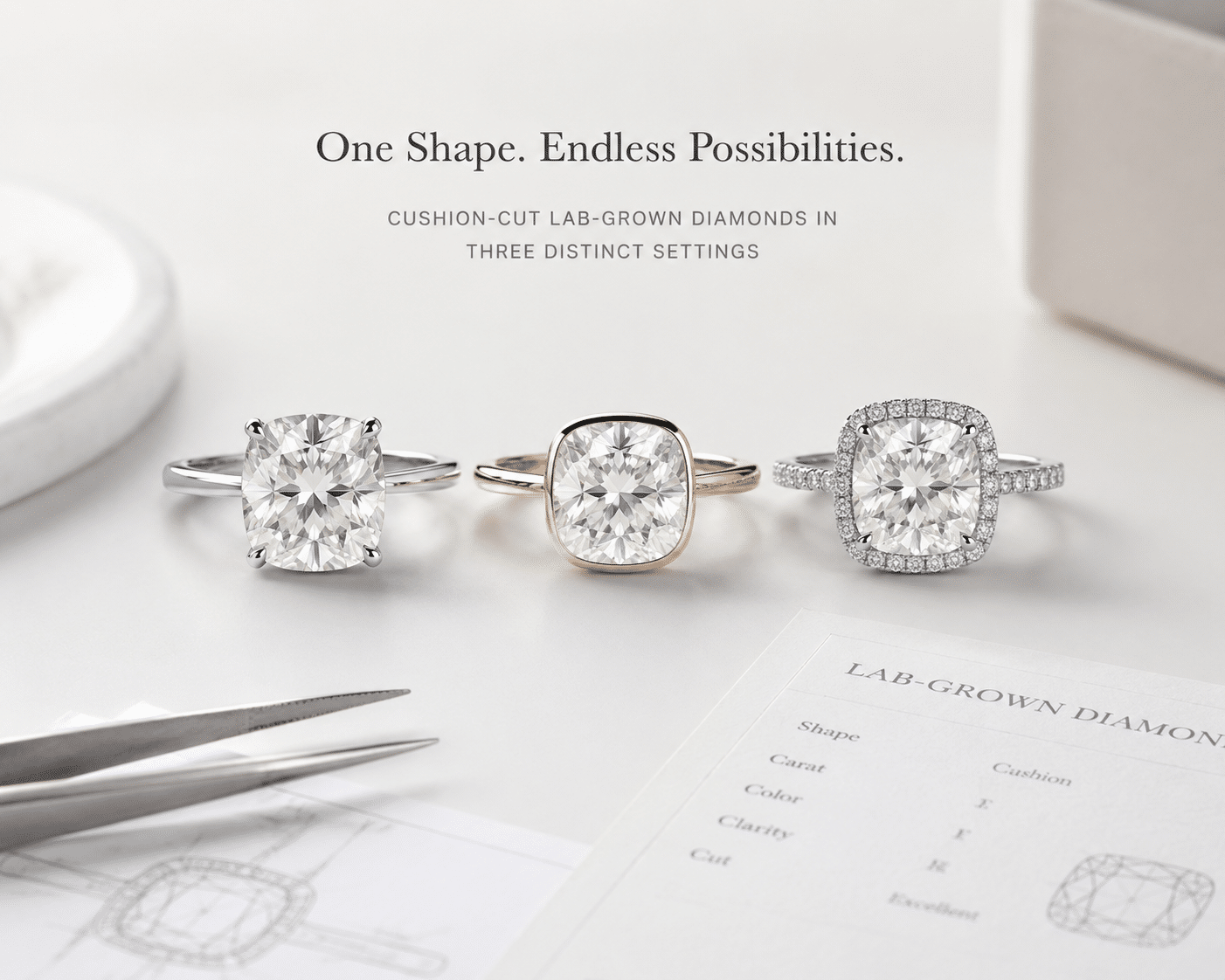
The cushion cut has rounded corners and a squarish to slightly rectangular outline. This geometry makes it unusually compatible with many setting types. It sits cleanly in prong settings without sharp corners that catch on fabric. It works in bezel settings with a smooth, modern line. In halo settings, the rounded outline blends naturally with accent stones, creating a continuous shape without hard transitions. This shape is the most flexible for custom design, and it is often the starting point for buyers who want options rather than a single look.
Buyer Verification Checklist
Verify the cushion’s facet arrangement by requesting a face-up photo or video. A modified brilliant cushion should show even sparkle across the table, not concentrated only in the center or edges. Uneven sparkle indicates poor facet symmetry. If you plan to use a bezel setting, confirm the corner radius. Corners that are too sharp will create stress concentrations in the metal and may cause issues over time. Also check the length-to-width ratio. Most cushions range from 1.00 to 1.10 for a square look or up to 1.25 for an elongated look. The ratio determines whether the stone feels balanced or stretched on the finger.
Shape-Specific Considerations for the Finished Ring
Choosing a shape is only half the decision. The same stone can look different depending on how it is set, and the wrong setting can make a good diamond feel like a poor fit.
Understanding the Two Main Growth Processes for Lab-Grown Diamonds
For buyers who want to know more about how their lab-grown diamond was created, understanding the two primary growth methods can help frame the conversation with a seller. GIA explains that laboratory-grown diamonds are produced using two main processes: High Pressure-High Temperature (HPHT) and Chemical Vapor Deposition (CVD).[2] Both methods produce diamonds that are chemically and optically identical to natural diamonds, but they differ in their growth conditions and typical characteristics.[2] HPHT diamonds are grown under extreme pressure and temperature using a metal catalyst, while CVD diamonds are grown in a vacuum chamber using carbon-rich gases.[2] This information is often available on a grading report and may be useful for buyers who wish to compare the growth history of different stones, though it does not affect the visual performance or beauty of the finished diamond.
Setting Height and Daily Wear
Round and oval stones typically require more vertical clearance because of their deeper pavilion depth. This makes the ring sit higher on the finger, which increases the chance of catching on clothing, bags, or door frames. Cushion and emerald cuts often have shallower pavilions and can be set closer to the finger. The lower profile improves daily wear comfort and reduces snagging risk. For buyers with active lifestyles or jobs that require frequent hand use, a lower-set shape is worth prioritizing.
Band Width and Proportion Harmony
The relationship between band width and stone shape determines whether the finished ring looks balanced. Narrow bands, around 1.5 to 2.0 millimeters, pair naturally with elongated shapes like ovals and emerald cuts. The thin band does not compete with the stone’s length. Wider bands, 2.5 millimeters and above, match round and cushion cuts, creating a more substantial look. Mismatched proportions hurt the overall aesthetic. A wide band with a small oval, for example, makes the ring look visually heavy and the stone smaller than it really is.
Metal Tone and Shape Interaction
Shapes with step-cut faceting, like emerald and some cushion cuts, look more transparent than brilliant shapes. Because more of the stone’s interior is visible, the underlying metal color has a stronger influence on the diamond’s appearance. White metals such as platinum or white gold preserve the stone’s natural cool tone. Yellow and rose gold can warm the look of the diamond slightly. This warm shift is subtle but noticeable, especially in step-cut shapes where the effect is not broken up by brilliant faceting.
Stone-to-Setting Fit Check
Before finalizing any ring, provide your ring size to the jeweler and ask for a mock-up or CAD rendering that shows the stone’s actual measurements inside your chosen setting. This simple step catches proportion mismatches before the ring is made. Also confirm that the prong or bezel design will not cover any inclusion-prone areas of the stone. A well-placed prong can hide a minor inclusion. A poorly placed one can draw attention to the wrong part of the diamond.
How to Compare Lab-Grown Diamond Shapes Before Buying
The biggest mistake buyers make when comparing shapes is relying on carat weight alone. A 1.5-carat oval and a 1.5-carat round can look completely different on the finger—not because one is better, but because shape changes every visual property that matters in a finished ring. The solution is to compare shapes using measurements, not marketing language.
The Three-Data-Point Comparison Method
You only need three numbers to compare any two shapes directly. The first is face-up surface area in square millimeters—length multiplied by width. This tells you which stone actually looks larger on the finger, independent of its carat weight. A round brilliant that measures 6.5 mm wide has a face-up area of about 33 mm². An oval of the same carat weight measuring 7.8 mm by 5.6 mm has a face-up area of about 44 mm²—roughly 30 percent more visual coverage.
The second number is length-to-width ratio. This tells you how elongated or compact the shape will appear on the finger. A round has a ratio of 1.00. An oval at 1.40 is noticeably elongated. An emerald cut at 1.45 looks even longer. A cushion at 1.05 looks nearly square. Knowing this number prevents surprises when the stone is set.
The third number is pavilion depth percentage. This controls how high the stone sits off the finger. A deep pavilion means a taller setting, which makes the ring more likely to catch on clothing. Shallower pavilions allow lower settings and better daily wear comfort.
Using Certificate Data to Compare Shapes Directly
A grading report from IGI or GCAL includes all three data points. When you request a report for any lab-grown diamond you are considering, the measurements, as per the lab grown diamond engagement rings guide, are listed on the first page along with the carat weight and proportions. This data is the only reliable way to compare shapes side by side.
The Role of Disclosure in Buying Lab-Grown Diamonds
Given that lab-grown diamonds are visually indistinguishable from natural diamonds, clear disclosure is an important part of consumer protection. The Federal Trade Commission (FTC) has addressed this in their Jewelry Guides, emphasizing the need for accurate naming and disclosure in advertising.[3] FTC guidance is especially relevant for buyers because it requires sellers to clearly disclose that a diamond is laboratory-grown, using terms such as “laboratory-grown,” “laboratory-created,” or “[manufacturer-name]-created.”[3] This ensures that buyers know exactly what they are purchasing and can compare stones on an informed basis, without confusion over origin.[3] A reputable seller will clearly document the origin of every stone in the grading report and sales listing.
The most useful thing you can do is build a simple comparison table for two or three stones across different shapes. This strips out the shape-specific marketing language that makes every option sound appealing. A round brilliant is described differently than an oval, but their face-up area, ratio, and depth can be compared in a single glance. At NUVU, we treat the certificate data as the starting point for any shape comparison because it eliminates the guesswork.
It is worth noting that certificate data, while essential, does not capture cut precision. Two ovals with the same length-to-width ratio and face-up area can perform very differently depending on facet symmetry, polish, and pavilion angle execution. The certificate tells you what the stone is measured to be, but visual media tells you how it actually performs.
Understanding the Practical Limits of a Grading Report in Shape Comparison
A grading report provides objective measurements, but it has inherent limitations when comparing shapes for a custom engagement ring. The report will list dimensions and proportions, but it cannot indicate how a stone will interact with a specific setting, how the bow-tie appears in an oval under different lighting, or whether the facet alignment in an emerald cut creates a pleasing hall-of-mirrors effect. These qualities require visual inspection. For buyers, the most useful approach is to use the report as a filter—eliminating stones that do not meet minimum measurement or grade criteria—and then evaluate the remaining candidates through video or in-person viewing. This combination of documentary evidence and visual assessment provides a more complete picture than either method alone.
When a grading report is provided, buyers should verify the report details through the issuing laboratory’s official report-check tools where available. This step confirms that the document has not been altered and that the reported measurements, proportions, and grades match the stone in question.
Buyer Verification Checklist
Create your own comparison table with these rows: shape, carat weight, length (mm), width (mm), length-to-width ratio, face-up area (length × width), pavilion depth percentage, color grade, and clarity grade. Fill in the values from the certificate data. Then place the report photos or inspection videos side by side and decide which stone’s visual performance matches your preference, independent of the carat weight shown on the report.
Making the Final Shape Decision for Your Engagement Ring
After comparing the numbers, the final decision comes down to one question: which visual effect matters most to you? Each shape delivers a different priority, and choosing the right one means knowing which tradeoff you are willing to accept.
Decision Rule: Match Shape to Your Visual Priority
Round brilliant is the right choice if sparkle and consistent light return are your top priority. No other shape matches its ability to perform in every lighting condition, and it is the most forgiving of minor inclusions or color tint. The tradeoff is less finger coverage per carat and a higher cost per carat than other shapes.
Oval is the right choice if maximum finger coverage and elongation per carat are your main goals. It delivers noticeably more spread than a round at the same carat weight, and it flatters the finger with its elongated silhouette. The tradeoff is the bow-tie effect in the center, which must be evaluated visually before purchase.
Emerald cut is the right choice if you prefer understated, architectural elegance and are willing to select a higher clarity grade. It does not sparkle like a round, but its hall-of-mirrors effect has a quiet, sophisticated appeal. The tradeoff is that inclusions and color tint are visible, so VS1 or better clarity is usually necessary.
Cushion is the right choice if you value setting flexibility and want a look between modern sparkle and vintage softness. It works with nearly every setting style and offers the widest range of looks depending on facet arrangement and length-to-width ratio. The tradeoff is variability—cushion cuts vary significantly in cut quality and visual performance.
In practice, no single shape is objectively better than others. Each shape prioritizes a different combination of sparkle, coverage, elegance, and flexibility. The right choice is the one where the tradeoffs align most naturally with your visual preference, budget, and daily wear lifestyle.
Internal Linking Path: Next Steps After Shape Selection
Once you have chosen a shape, the next decisions are cut quality within that shape, color grade, and clarity grade. Each shape responds differently to these factors. A round brilliant hides lower color and clarity better than an emerald cut. An oval requires careful bow-tie evaluation that does not apply to other shapes. A cushion’s facet arrangement determines whether it looks modern or vintage.
What This Means in a Real Purchase
After you select a shape, narrow your search to two or three stones at your target carat weight and within your chosen color and clarity range. Request the certificate data and a live video for each stone. Compare face-up area and length-to-width ratio. Then make your final choice based on which stone looks best to your eye in the video and in a setting design of your choice. The numbers narrow the field, but the final decision still depends on what you actually see.
On the Usefulness of Growth Method Information in Shape Selection
Some buyers inquire whether the growth method—HPHT or CVD—influences the visual performance of a particular shape. For practical buying decisions, the answer is that growth method does not determine brilliance, bow-tie severity, hall-of-mirrors clarity, or setting fit. These properties are governed by shape, cut precision, proportions, and polish. Growth method information, when noted on a grading report, is mainly useful for confirming the stone’s laboratory origin and for buyers who wish to understand the production context. It does not change how a round, oval, emerald, or cushion will look on the finger. NUVU’s guidance to buyers is to prioritize shape behavior and cut quality over growth method, as these factors have a much larger effect on the final ring’s appearance.
Understanding the Role of Treatment Disclosure in Lab-Grown Diamond Selection
When reviewing grading reports for laboratory-grown diamonds, buyers may encounter notes related to post-growth treatment, particularly in HPHT-grown stones. It is important to understand the distinction between the HPHT growth process and HPHT as a post-growth treatment. While HPHT is primarily a production method, it can in some cases be used to enhance or modify color after the diamond has been grown. The presence or absence of such treatment should be clearly disclosed on the grading report when applicable. For buyers comparing shapes, treatment status is generally not a primary factor, but for those who wish to know the full history of a stone, it is worth confirming with the seller whether the grading report documents any post-growth treatment. A reputable seller will provide this information as part of the stone’s documentation, allowing buyers to make an informed comparison across different laboratory-grown diamonds without confusion over their production history.
[1] GIA, “Laboratory-Grown Diamond Terminology,” Gemological Institute of America, accessed 2025.
[2] GIA, “HPHT and CVD Diamond Growth Processes,” Gemological Institute of America, accessed 2025.
[3] Federal Trade Commission, “Jewelry Guides: Laboratory-Grown Diamond Disclosure,” 16 CFR Part 23, FTC, revised 2018.
Disclosure: This article is for general educational purposes only. Diamond grading, pricing, availability, specifications, and seller policies can change, and readers should verify important details through grading reports, official laboratory tools, seller documentation, or qualified professionals before making a purchase decision. Laboratory-grown diamonds should be clearly distinguished from natural diamonds, and environmental or sourcing claims should be supported by specific documentation.