
Shape is one of the biggest reasons two lab-grown diamonds with the same carat weight and grade can look, perform, and cost very differently, and cut quality and price can add another layer to that comparison. A round diamond may carry a higher price because it is easier to compare and often more predictable for brilliance, while an oval, pear, emerald, cushion, or radiant may offer more visible size or a distinctive look for the budget. The trade-off is that fancy shapes often need closer review, especially through video, proportions, millimeter measurements, and setting compatibility.
For the full framework, read Lab-Grown Diamond Price Guide.
This guide helps you judge whether a shape is truly good value or simply lower priced. You will learn where visual size, bow-ties, clarity visibility, cut style, face-up spread, and durability concerns affect the buying decision, so you can compare stones with more confidence instead of relying on carat weight or grading report details alone.
Evidence note: This article avoids fixed price rankings, exact market percentages, and date-based price claims because lab-grown diamond prices can change by seller channel, inventory, grading report, cut quality, and availability. The comparisons below are practical buying patterns rather than universal price rules, so they should be used with current stone listings, grading reports, videos, and setting requirements.
Origin and disclosure note: This article discusses laboratory-grown diamonds, not natural diamonds, unless a natural diamond comparison is specifically mentioned. Laboratory-grown diamonds should be clearly identified as laboratory-grown, and they should not be presented as mined diamonds. Diamond simulants are a separate category and should not be confused with laboratory-grown diamonds.
| Shape | Best Buying Advantage | Main Check Before Choosing |
|---|---|---|
| Round | Most predictable sparkle and easy comparison | Higher price per carat than most fancy shapes |
| Oval | Larger face-up look for the carat weight | Bow-tie strength, overall shape, and brightness in video |
| Pear | Elongated size and distinctive silhouette | Symmetry, bow-tie, and point protection in the setting |
| Emerald | Clean geometry and potential price efficiency | Eye-clean clarity, transparency, and windowing |
| Cushion | Soft shape with flexible value options | Facet pattern, face-up size, and light return |
| Radiant | Brilliant look with rectangular or square options | Crushed-ice effect, corner shape, and spread |
Quick Questions Before You Read
Q: Is the cheapest shape always the best value?
No. A lower price only helps if the stone also looks bright, well-proportioned, eye-clean, and suitable for the setting.
Q: Why do round lab-grown diamonds often cost more?
Round diamonds usually have stronger demand, more standardized cut expectations, and easier side-by-side comparison.
Q: Which shapes usually look largest for their carat weight?
Oval and pear shapes often appear larger because their length spreads across the finger, but cut quality still matters.
Q: Can a grading report tell me which fancy shape is best?
Not by itself. Video, millimeter measurements, proportions, clarity visibility, and setting fit are essential checks.
How Diamond Shape Changes Lab-Grown Diamond Price and Value
Why Shape Affects Price Beyond Carat Weight
A useful lab-grown diamond shape price comparison starts with a simple point: carat weight is only one part of value. Two lab-grown diamonds can have the same carat weight, color, and clarity grade, yet differ meaningfully in price because the shape affects cutting yield, demand, visual size, and how difficult the stone is to evaluate.
Round diamonds often sit at the higher end of pricing because they are in constant demand and require precise cutting to deliver the brightness buyers expect. Fancy shapes such as oval, emerald, cushion, pear, and radiant can sometimes cost less per carat, but the lower price does not automatically make them the better buy. Some shapes need more careful screening because visual performance varies more from stone to stone.
The practical mistake is comparing shapes as if they are just outlines. Shape changes how much of the rough diamond is retained during cutting, how large the finished stone appears from the top, how visible inclusions may be, and how easily the stone works in a setting. Those details affect the real lab-grown diamond value more than the headline price alone.
Price Per Carat vs. Real-World Value
Price per carat is a helpful starting point, but it can be misleading if it is treated as the full answer. A lower price per carat may reflect strong value, or it may reflect a shape that needs stricter review for cut quality, symmetry, transparency, or face-up performance.
For example, an elongated fancy shape may appear larger than a round diamond of the same carat weight, which can make it a smart choice for a buyer who wants more finger coverage without increasing carat size. But if that stone has a heavy bow-tie, poor light return, or an awkward outline, the apparent bargain becomes less useful. The better value is not the cheapest stone; it is the stone that gives the right balance of size, appearance, durability, and screening confidence.
This is especially important with lab-grown diamonds because buyers often compare many stones online. The inventory may look similar on paper, but shape-specific visual differences can be large. A grading report can narrow the field, but it does not show every issue that affects how the diamond looks in real life.
For buyers, the practical point is not just what the report says, but how the stone performs visually and fits the intended design. A grading report is useful for confirming documented characteristics such as carat weight, measurements, color, clarity, and lab-grown identification, but it should be compared with actual media and the planned setting. In practical buying, this is where many comparisons become misleading: a stone can look efficient by price per carat while still carrying extra depth, a distracting bow-tie, or proportions that make the finished ring less balanced.
Documentation should narrow the comparison, not finish it. When two lab-grown diamonds have similar headline grades, the more defensible buying decision comes from checking whether the report details, face-up measurements, video appearance, and setting plan all support the same conclusion. If one piece of evidence conflicts with the others, such as a favorable price paired with weak spread or a report grade paired with an obviously distracting visual feature, the buyer should treat the value claim more cautiously.
Prices can change with market conditions, report type, seller channel, and stone-specific details, so exact comparisons should be verified at the time of purchase. If a seller presents one shape as a clear bargain, the comparison should use like-for-like specifications: similar carat weight, comparable measurements, documented lab-grown origin, similar color and clarity grades, comparable cut appearance, and the same level of visual evidence.
When a grading report is available, buyers should verify the report details through the issuing laboratory’s official report-check tool where available, then compare those details with the stone’s photos, video, measurements, and intended setting.
Visual Size, Cut Risk, and Setting Compatibility
Shape strongly affects visual size. Oval, pear, emerald, and some radiant cuts can look larger face-up than round diamonds at the same carat weight because more of their weight is distributed across length. Cushion cuts may look softer and more compact, while round diamonds often deliver strong brightness but may not create the same elongated finger coverage.
Cut risk also changes by shape. Round brilliant diamonds benefit from more standardized cut grading, making them easier to compare. Fancy shapes rely more heavily on visual inspection because two stones with similar grades can perform differently. In oval and pear shapes, the bow-tie effect can become distracting. In emerald cuts, inclusions, color, and windowing are easier to see because the facets are broad and open. In cushion and radiant cuts, facet patterns can range from crisp and lively to busy or uneven.
Setting compatibility is the third piece buyers often underestimate. A shape that looks like strong value as a loose diamond may need a more thoughtful setting to look balanced and secure. Pear shapes need protection at the point. Emerald and radiant cuts have corners that benefit from careful prong placement. Elongated shapes can look elegant in a solitaire but may feel too narrow or too long if the ratio does not suit the hand or design.
For custom design, trust comes from matching the stone to the setting, budget, and wearer’s daily use, not from choosing grades in isolation. A practical review should confirm that the stone’s depth, outline, corners, points, and face-up dimensions can be supported by the chosen setting before the buyer treats the loose diamond as the final answer.
For custom jewelry, stone measurements and setting compatibility should be confirmed before finalizing a purchase. This is especially important for elongated and cornered shapes because prong placement, stone height, halo spacing, and side-stone layout can change both the look and wearability of the finished piece.
What to Compare Before You Choose a Shape
Before choosing a shape, compare the factors that change the buying decision, not just the factors that are easiest to sort online. Start with price per carat, but do not stop there. Look at face-up measurements in millimeters, the length-to-width ratio, cut appearance, clarity visibility, and whether the shape fits the setting you have in mind.
A strong choice usually has a clear purpose. If you want the safest traditional sparkle, round may justify its premium. If you want a larger look for the same carat weight, elongated fancy shapes may be more efficient. If you want a distinctive design, emerald, cushion, pear, or radiant may offer better style value, but they should be judged more visually. The right comparison is not “Which shape is cheapest?” It is “Which shape gives the strongest result for the way I plan to wear it?”
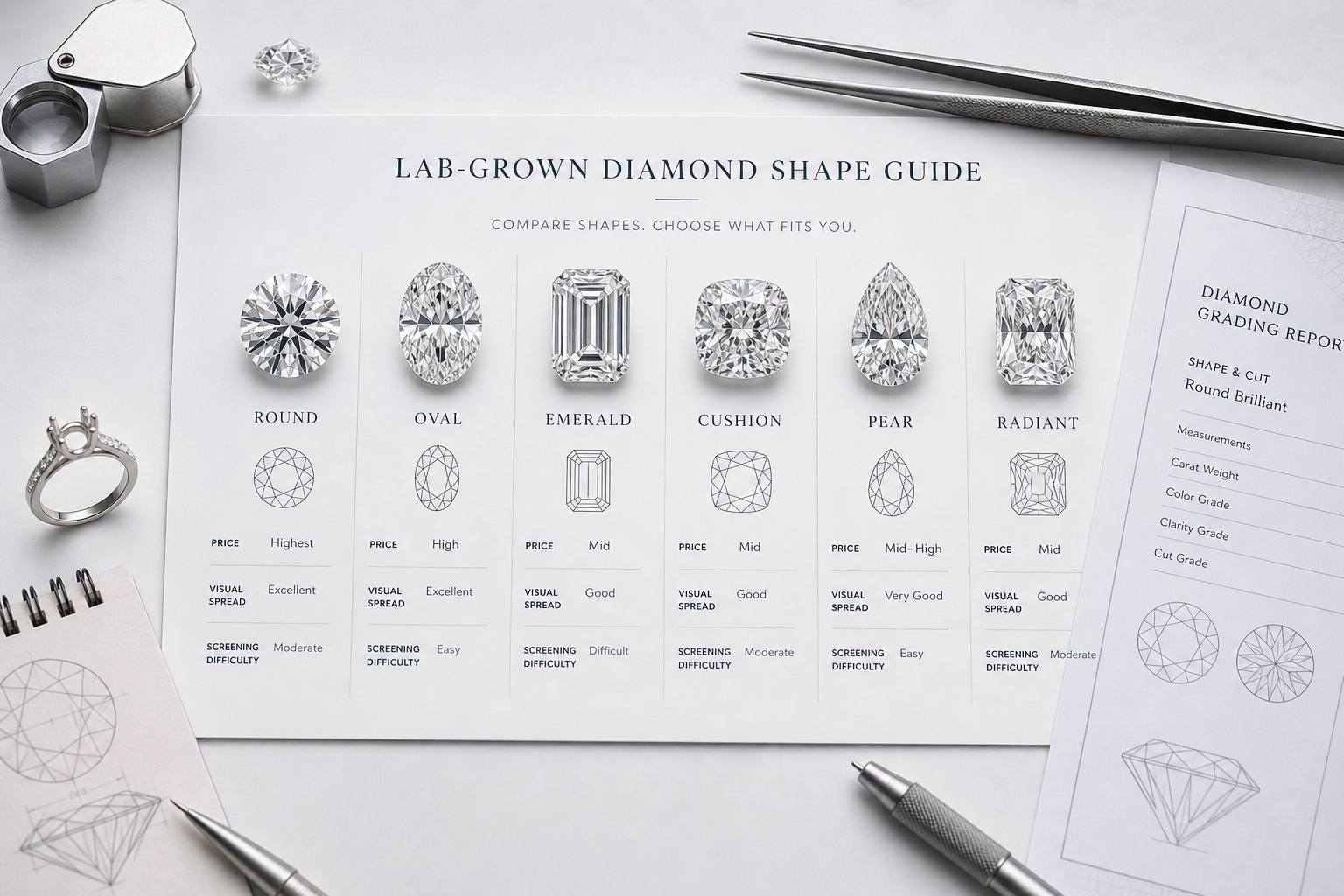
Shape Comparison Matrix: Round, Oval, Emerald, Cushion, Pear, and Radiant
Quick Value Snapshot by Shape
This diamond shape comparison gives a fast way to understand lab-grown diamond price by shape before looking at individual stones. The categories are directional rather than fixed, because actual pricing depends on carat weight, color, clarity, cut quality, grading report, seller channel, and current availability.
- Round: Usually higher price position, medium face-up size impression, lower comparison risk, moderate clarity visibility, useful for buyers who want classic sparkle and easier online comparison.
- Oval: Often moderate to favorable price position versus round, strong face-up size impression, strict cut screening needed, moderate clarity visibility, useful for buyers who want an elongated look and larger visual spread.
- Emerald: Often price-efficient, medium to strong face-up size impression depending on proportions, strict screening needed, higher clarity visibility, useful for buyers who prefer clean geometry and can prioritize visual inspection.
- Cushion: Often moderate to favorable price position, medium face-up size impression, medium screening risk, moderate clarity visibility, useful for buyers who want a softer non-round shape with flexible style options.
- Pear: Often moderate to favorable price position, strong face-up size impression, strict cut and symmetry screening needed, moderate clarity visibility, useful for buyers who want a distinctive elongated shape and are comfortable reviewing videos closely.
- Radiant: Often moderate to favorable price position, medium to strong face-up size impression, medium to strict screening needed, relatively forgiving clarity visibility, useful for buyers who want brilliance with a rectangular or square outline.
The clearest takeaway is that the better value diamond shape depends on what the buyer is trying to maximize. Round is usually the easiest to compare. Oval and pear often win on visual spread. Emerald can be elegant and efficient, but it is less forgiving. Cushion and radiant offer flexible value, though their appearances vary enough that side-by-side review matters.
Use this matrix as a screening tool rather than a ranking system. A shape that is “price-efficient” in one buying situation may become less efficient if it requires a higher clarity grade, a more protective setting, or repeated searching to avoid visual issues. Similarly, a shape that costs more per carat may still be reasonable if it reduces uncertainty and supports the ring design with fewer compromises.
Because this matrix is based on buying behavior and visual tradeoffs rather than a live market database, it should not be read as a promise that one shape will always cost less than another. A well-cut, well-documented fancy shape can be priced above a weaker round, and a round with less desirable grade combinations may not carry the same premium as a more carefully selected one. The reliable comparison is always shape plus measurements plus visual performance plus report details.
Which Shapes Usually Look Largest for the Carat Weight
Shapes with more length usually create the strongest face-up size impression. Oval, pear, emerald, and elongated radiant diamonds can appear larger than a round diamond of the same carat weight because the eye reads length as coverage. This does not mean they contain more diamond; it means the weight is distributed differently.
Oval and pear shapes are often the most effective when the goal is a larger look without increasing carat weight. Radiant cuts can also give good spread, especially in rectangular versions. Emerald cuts may look broad and elegant, but their quieter step-cut appearance can make them feel less sparkly than brilliant-style shapes, even when the face-up dimensions are generous.
Cushion cuts are more variable. A square cushion can look compact compared with an oval or pear of the same carat weight, while an elongated cushion may create more finger coverage. Buyers who want maximum visible size usually should not choose cushion by carat weight alone; millimeter measurements matter more.
Which Shapes Usually Need the Strictest Screening
The shapes that most often need stricter screening are oval, pear, emerald, and some radiant cuts. The risk is not that these shapes are poor choices. The risk is that their quality is harder to judge from basic grades alone.
Oval and pear diamonds should be checked for bow-tie intensity, outline symmetry, and whether the ends look bright or dull. Emerald cuts require careful review for clarity, transparency, windowing, and even light return. Radiant cuts can be lively and forgiving, but some show uneven brightness or a crushed appearance that not every buyer likes.
Round diamonds are usually the safest shape to compare online because cut quality is more standardized and the visual expectations are clearer. That does not make round automatically better, but it reduces one common buying risk: choosing between two stones that look similar on paper but very different in motion.
Shape Ratio Ranges That Affect Appearance
Length-to-width ratio affects style more than quality, but it changes how a diamond looks in a ring. For oval diamonds, many buyers prefer a balanced elongated look around 1.30 to 1.45. Pear shapes commonly fall around 1.45 to 1.75, with lower ratios looking fuller and higher ratios looking more slender. Radiant cuts often look rectangular around 1.25 to 1.45, while square radiants sit closer to 1.00 to 1.05. Emerald cuts frequently appear classic and rectangular around 1.30 to 1.50.
These ranges are not strict rules. A buyer with shorter fingers may prefer a fuller oval or pear, while someone designing a sleek solitaire may prefer a longer outline. The warning sign is not a ratio outside a popular range; it is a ratio that creates awkward proportions, weak light return, or a setting problem.
Round Lab-Grown Diamonds: Highest Demand, Strongest Cut Standards, Often Higher Pricing
Why Round Diamonds Often Cost More Per Carat
Round lab-grown diamond price often sits higher than comparable fancy shapes because round diamonds combine strong demand with demanding cutting requirements. The round brilliant lab diamond is the most familiar engagement ring shape, so more buyers compete for well-cut stones in popular sizes and grades.
Cutting yield also matters. A round shape can require more material loss from the original crystal than some fancy shapes, and the precision expected from a round brilliant is high. If the angles, symmetry, or proportions are weak, the stone can lose brightness quickly. Buyers are not only paying for the outline; they are paying for a shape where cut quality has a direct and visible effect on sparkle.
This is why a round vs fancy shape comparison should not stop at price. Round may carry a price premium, but part of that premium reflects a more standardized performance expectation. For buyers who want a classic look and do not want to navigate as many shape-specific risks, that can be a rational tradeoff.
Where Round Diamonds Can Still Deliver Strong Value
Round is not automatically the wrong choice for value-focused buyers. It can deliver strong value when the priority is reliable brilliance, timeless styling, and easier comparison across multiple stones. A well-cut round diamond tends to look bright in many settings and lighting conditions, which reduces the chance of buying a stone that looks good only in selected images.
The main risk with round diamonds is overpaying for grades that do not meaningfully improve the finished look. A buyer may be better served by prioritizing cut quality and balanced proportions over chasing the highest color or clarity grade. In many real ring settings, a well-cut round with sensible color and eye-clean clarity can outperform a higher-paper-grade stone with weaker light performance.
Round also pairs easily with most settings. Solitaire, halo, three-stone, pavé, bezel, and vintage-inspired designs can all work with a round center stone. That flexibility matters if the buyer has not finalized the ring design yet, because the stone is less likely to create proportion or security issues later.
What Makes Round Easier to Compare Online
Round diamonds are easier to compare online because cut grading is more established than it is for most fancy shapes. A grading report can provide more useful filtering for round stones, especially when paired with measurements, table and depth percentages, symmetry, polish, and high-quality video.
This does not mean the grading report should replace visual judgment. It means the report usually gives buyers a stronger starting point. With many fancy shapes, two diamonds with similar grades can have very different outlines, facet patterns, or light behavior. With round diamonds, the acceptable performance window is easier to narrow before comparing videos.
For buyers who are uncomfortable making subjective visual calls, round is often the lowest-risk online choice. The tradeoff is that the buyer may give up some face-up size or price efficiency compared with certain fancy shapes. That tradeoff becomes acceptable when confidence and consistency matter more than maximizing spread.
A report should still be treated as documentation, not a guarantee of beauty. It can help confirm that the stone being compared matches the listed specifications, but it does not replace checking whether the diamond looks lively in the lighting and setting style the buyer actually prefers. If two round stones look similar by grade, the more useful question is often which one shows stronger, more even face-up performance rather than which one has the more impressive paper combination.
Grading Report and Visual Review Check
For a round lab-grown diamond, the first priority is cut quality. Review the grading report for cut grade, measurements, symmetry, polish, table, and depth, then confirm the stone in face-up video. The goal is not to memorize every proportion number; it is to avoid paying for a round diamond that has strong grades in some areas but weak visual performance.
Watch for balanced brightness across the stone, not just flashes near the center. A round diamond that looks dark around the edges or inconsistent as it moves may not justify its premium in a round vs oval diamond value comparison. If two round diamonds have similar grades and price, choose the one with cleaner light return and better face-up presence rather than the one with a slightly higher grade that cannot be seen in the finished ring.
Oval and Pear Lab-Grown Diamonds: Strong Visual Size With More Shape-Specific Risk
Why Oval and Pear Shapes Can Look Larger Than Their Carat Weight
Oval and pear lab-grown diamonds are often attractive to buyers who want more visible size without simply increasing carat weight. Both are elongated diamond shapes, which means more of the stone’s weight is spread across the finger instead of concentrated in a round outline. A well-proportioned oval can look noticeably larger face-up than a round of the same carat weight, even when the actual carat weight is identical.
This is where oval lab-grown diamond price and pear shaped lab-grown diamond value can become appealing. The buyer is not only comparing price per carat; they are comparing how much presence the stone delivers in the finished ring. If the goal is finger coverage, an oval or pear can be a smarter use of budget than paying more for a heavier stone in a shape that faces up smaller.
The tradeoff is that elongated shapes are less standardized visually. Two ovals with the same carat, color, clarity, and grading report can look very different in person. One may have an elegant outline and even brightness, while another may look narrow, uneven, or dark through the center. Pear shapes add another layer because the point, shoulders, and rounded end all need to work together. A low price is not a win if the outline looks awkward or the stone needs a setting that hides its weaknesses.
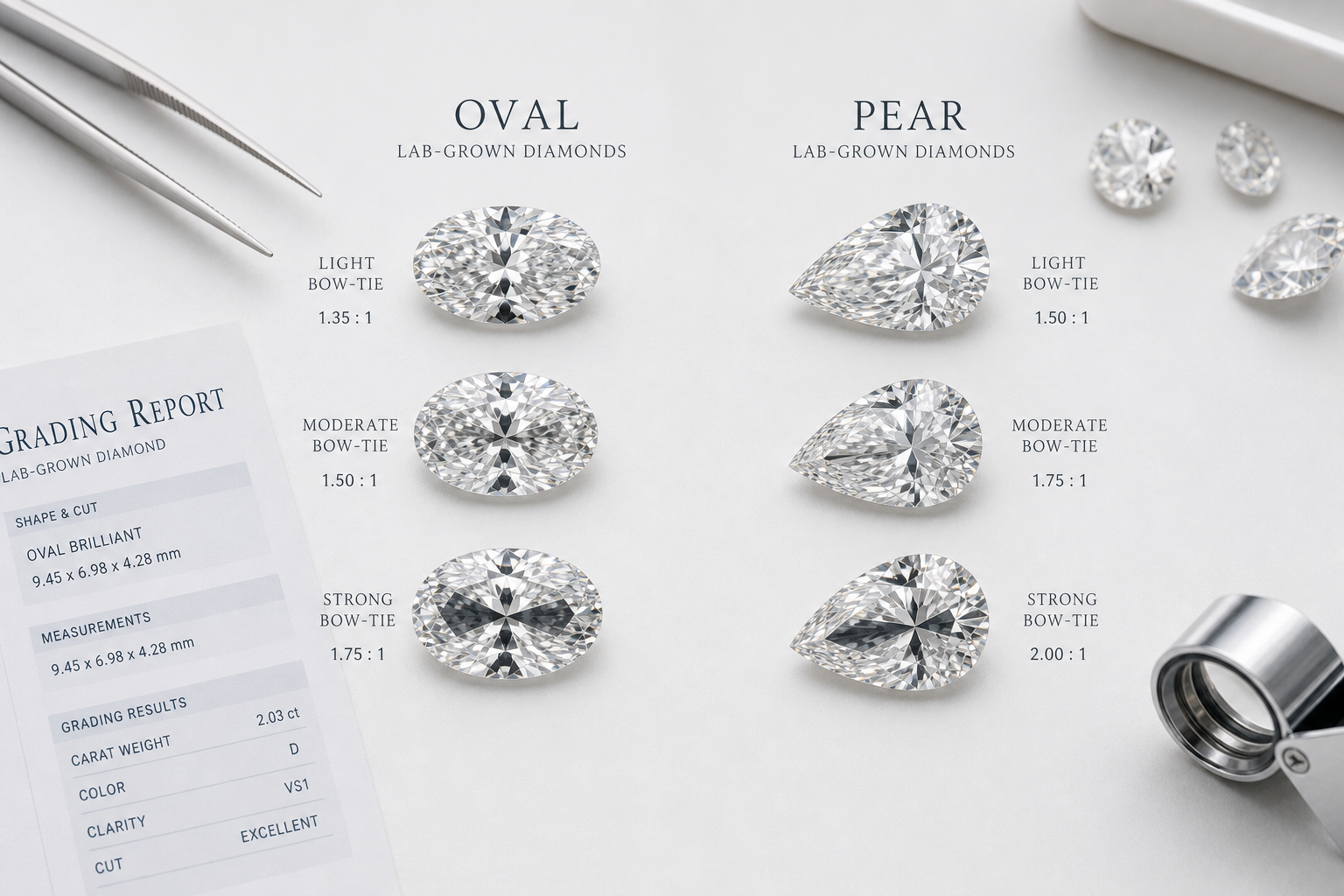
The Bow-Tie Effect and Why Video Review Matters
The main risk with oval and pear diamonds is the bow-tie effect, a dark band or shadowed area that appears across the center of many elongated brilliant-style cuts. A light bow-tie can be normal and may not bother the eye. A heavy bow-tie, however, can make the diamond look dull through its most visible area, which is exactly where the viewer’s attention goes first.
This is why video review matters more for oval and pear shapes than it does for some easier-to-compare cuts. A grading report can confirm measurements, carat weight, color, clarity, and lab-grown status, but it will not tell you whether the center of the diamond goes dark in normal viewing. Still photos can help, but a rotating video is more useful because it shows whether the bow-tie stays heavy or breaks up as the stone moves.
A common buying mistake is choosing the cheapest oval within a desired grade range and assuming the report tells the full story. Imagine a buyer comparing a round with an oval of the same carat weight because they want a larger look without increasing carat weight. On paper, two ovals may appear nearly identical. In video, one may show a strong dark bow-tie and weak edge brightness, while the other has a cleaner center and better light return. The second stone may cost more, but it may be the better value because the added visual size actually looks lively rather than flat.
How Length-to-Width Ratio Changes the Finished Look
Length-to-width ratio has a major effect on style, but it should not be treated as a quality grade by itself. For oval diamonds, many buyers find a balanced look around 1.30 to 1.45. Lower ratios can look fuller and softer, while higher ratios can appear longer and more slender. Neither is automatically better; the better choice depends on the wearer’s hand, the setting style, and the type of presence the buyer wants.
Pear shapes often fall into a wider style range, commonly around 1.45 to 1.75. A fuller pear can feel more classic and substantial, while a more elongated pear can create a stronger finger-lengthening effect. The risk at the extremes is proportion imbalance. A pear that is too short may lose elegance and look bulky; one that is too long may look thin, fragile, or overly pointed in certain settings.
Symmetry is especially important for pear diamonds. The point should align cleanly with the center of the rounded end, and the shoulders should feel even. If the shape looks lopsided loose, a setting rarely fixes it. In fact, prongs and halos can make imbalance more noticeable because they frame the outline.
What This Means in a Real Purchase
If visual size is the priority, oval and pear shapes deserve serious consideration. They can deliver a larger face-up impression and often help a buyer stay within budget. The smarter approach is to narrow by measurements and ratio first, then choose from stones that look good in video rather than choosing by grade alone.
For an oval, look for a pleasing outline, manageable bow-tie, and even brightness across the center and ends. For a pear, add symmetry and point protection to the review. A pear shaped lab-grown diamond should not be judged only as a “larger-looking” stone; it also needs the right setting support, especially at the tip. If the stone will be worn daily, a V-prong or protective design at the point is usually the safer choice.
Emerald Lab-Grown Diamonds: Elegant Value With Less Forgiveness on Clarity and Cut
Why Emerald Cuts Can Be Price-Efficient but Demanding
Emerald cut lab-grown diamonds can offer strong value for buyers who want a refined rectangular diamond without the intense sparkle pattern of a round or oval. The appeal is different: instead of constant scintillation, an emerald cut shows broad flashes of light, clean geometry, and a quieter, more architectural look. For the right buyer, that restraint is the point.
Emerald cut lab-grown diamond price can be attractive compared with some higher-demand shapes, but price efficiency does not mean easy selection. Emerald cuts are step-cut diamonds, which means their long, open facets act almost like windows into the stone. They do not hide visual issues as well as many brilliant cuts. If the cut is weak, the diamond can look glassy or flat. If the clarity is borderline, inclusions may be easier to notice because there is less sparkle to disguise them.
This makes emerald cut value more dependent on visual inspection than many first-time buyers expect. A lower price may reflect a stone that technically meets the grade but lacks life face-up. The better purchase is not simply the emerald with the best price per carat; it is the one with clean transparency, appealing contrast, and proportions that suit the intended ring.
Why Clarity and Transparency Matter More in Step Cuts
Clarity visibility is one of the biggest differences between emerald cuts and brilliant-style shapes. In a round, cushion, oval, or pear, the facet pattern can help break up the appearance of small inclusions. In an emerald cut, larger flat facets give the eye more uninterrupted space to notice what is inside the diamond.
This does not mean every emerald cut needs the highest clarity grade. It means the buyer should be stricter about whether the stone is eye-clean in the actual viewing position. An inclusion near the edge may be less concerning, especially if it can be minimized by the setting. An inclusion under the table, however, can be much more obvious because it sits in the most open part of the stone.
Transparency also matters. Some emerald cuts can appear slightly hazy, watery, or uneven even when the grading report looks acceptable. A grading report is useful, but it cannot fully show whether the diamond has crisp step flashes or whether the center looks washed out. For this shape, a slightly better-looking stone at the same grade often beats a cheaper stone that only looks good on paper.
In practical comparison, clarity grade and eye-clean appearance should be separated. The grade describes the diamond under grading conditions, while the buyer sees the stone from normal viewing distances, in a specific setting, and under changing light. For emerald cuts especially, ask whether the visible center looks clean and transparent, not only whether the report grade sounds acceptable.
How Emerald Cut Proportions Affect Ring Style
Many buyers prefer emerald cut ratios around 1.30 to 1.50 for a classic rectangular outline. A lower ratio creates a broader, squarer look, while a higher ratio feels longer and more elegant. The right choice is not only personal preference; it also affects how the ring sits on the hand and how much visual length the stone creates.
A longer emerald cut can look sleek in a solitaire or three-stone setting, but it may feel too narrow if the width is not strong enough for the carat weight. A broader emerald cut can feel more substantial and modern, but it may lose some of the elongated look that many buyers want from the shape. The setting should guide the decision. A thin solitaire may favor a slightly elongated outline, while a bolder bezel or east-west design may work better with a wider proportion.
Corner protection also matters. Emerald cuts have clipped corners, but those corners still need thoughtful prong placement. If the setting is too delicate or poorly matched to the stone’s outline, the finished ring can look insecure or visually unbalanced.
Buyer Verification Checklist
- Review the video face-up. Look for crisp flashes, not just a bright still image.
- Check the center of the stone. Inclusions, haze, or windowing under the table matter more than small edge details.
- Compare millimeter measurements. Two emerald cuts with the same carat weight can have very different face-up presence.
- Confirm the ratio fits the ring style. Around 1.30 to 1.50 is common for a rectangular look, but the setting may make a fuller or longer outline more appropriate.
- Do not rely on clarity grade alone. Step cuts need visual confirmation because the report cannot show how open facets behave in real viewing.
Cushion and Radiant Lab-Grown Diamonds: Flexible Value With Very Different Looks
Why Cushion Cuts Vary So Much in Price and Appearance
Cushion cut lab-grown diamond price can be appealing because cushions often give buyers a non-round shape with broad design flexibility. They work in solitaires, halos, vintage-inspired rings, and modern settings, and they can feel softer than square or rectangular shapes with sharper geometry. The challenge is that “cushion cut” describes a wide family of looks, not one consistent visual style.
Some cushions have larger, chunkier facets with more defined flashes. Others show a crushed ice appearance, where the sparkle is smaller, busier, and more scattered. Neither style is automatically better, but they create very different results. A buyer who wants bold flashes may be disappointed by a crushed-ice cushion, while someone who likes a glittery surface may find chunky facets too quiet.
This variation is why cushion cuts should not be selected by grading report information alone. Two cushions with the same carat, color, and clarity can look like different shapes once viewed in motion. A lower-priced cushion can be a strong value if the face-up pattern is attractive, but it can also be a poor buy if it looks dark in the corners, watery in the center, or smaller than expected for its weight.
Why Radiant Cuts Can Be a Strong Middle Ground
A radiant cut lab diamond often appeals to buyers who want brilliant faceting with a more geometric outline. It can be square or rectangular, and it usually delivers more lively sparkle than an emerald cut while maintaining a cleaner, more structured shape than an oval or pear. For many buyers, radiant is the middle ground between classic brilliance and modern geometry.
Radiant cuts can offer good value compared with round diamonds, but they still require screening. The biggest issue is uneven light return. Some radiants look bright across the whole face, while others have dark zones, overly busy centers, or corners that do not contribute much visually. The grading report will list measurements and grades, but it will not tell you whether the facet pattern looks balanced.
Radiants are especially worth comparing in video because their personality changes with movement. A strong radiant should not only sparkle in one lighting angle; it should maintain an appealing pattern as it rotates. If the center looks chaotic or the corners appear dead, the stone may not deliver the value its price suggests.
For both cushions and radiants, buyer preference plays a larger role than many grading filters suggest. Some people prefer a soft, glittery pattern, while others want broader flashes and stronger contrast. The useful comparison is not whether one facet style is universally better, but whether the actual stone matches the visual character the wearer wants to see every day.
Square vs. Elongated Versions of Each Shape
Cushion and radiant diamonds both come in square and elongated versions, and the ratio changes the entire feel of the ring. For cushion cuts, ratios around 1.00 to 1.10 usually create a squarer look, while 1.15 to 1.30 moves toward an elongated cushion. Square cushions often feel soft and balanced, while elongated cushions can create more finger coverage without looking as pointed or dramatic as pear shapes.
Radiant cuts around 1.00 to 1.05 look square, while ratios around 1.20 to 1.45 create a more rectangular diamond. A square radiant can feel bold and modern, especially in a solitaire or halo. A rectangular radiant gives more length and can resemble the presence of an emerald cut, but with more brilliant faceting.
The mistake is assuming the ratio is only a style detail. It also affects setting compatibility and perceived size. A deeply cut square cushion may carry weight underneath and look smaller than expected, while an elongated radiant with good spread may look larger for the same carat weight. The buyer should compare both the ratio and the millimeter measurements before deciding which stone is the better value.
How to Compare Two Similar-Looking Stones
When comparing two cushions or two radiants, start with the finished look you actually want. If you prefer soft edges and a warmer, more romantic outline, a cushion may fit better. If you want sharper geometry with lively brilliance, radiant is often the stronger candidate. The better choice depends less on the category name and more on the specific stone’s light pattern, proportions, and setting plan.
For cushions, pay close attention to whether the facet pattern matches your taste. Do not buy a crushed-ice style expecting broad flashes, and do not buy a chunky cushion expecting a fine glitter effect. For radiants, look for even brightness, active corners, and a center that does not look overly dark or chaotic.
If two stones have similar grades and prices, the one with better face-up performance and more useful measurements is usually the smarter buy. Carat weight matters, but it should not override what the diamond actually looks like in the ring. This is where a careful value comparison protects the buyer from paying for weight that does not translate into beauty, presence, or wearability.
Which Lab-Grown Diamond Shapes Are Usually Most Price-Efficient?
The better value lab-grown diamond shape depends on what kind of value the buyer is trying to capture. A lower price per carat is useful, but it does not automatically make a stone the smarter purchase. A shape can be affordable on paper and still disappoint if it faces up small, shows obvious light leakage, needs a higher clarity grade, or looks unbalanced in the intended setting.
A more practical diamond value comparison separates shapes by buying goal. Some shapes help maximize visual size. Some are easier to compare online with less guesswork. Others offer a more distinctive look without moving into the typical round premium. The strongest choice is usually the shape that gives up the least in the areas the buyer actually cares about.
It is also worth separating market price from personal value. Market price reflects supply, demand, grading, availability, and seller channel, while personal value depends on how the diamond will be worn and what tradeoffs the buyer accepts. A buyer choosing a daily engagement ring may prioritize durability and setting fit, while a buyer selecting a fashion ring or pendant may weigh spread and style more heavily.
Best Shapes for Larger Face-Up Appearance
Oval and pear shapes are often strong candidates for buyers who want a larger look for the carat weight. Their elongated outlines can cover more finger length than a round diamond of similar weight, which makes them attractive when the goal is visual presence rather than simply owning the highest carat number.
This value advantage has a condition: the shape must be well selected. A poorly cut oval or pear with a heavy bow-tie, awkward outline, or uneven shoulders can lose the visual benefit that made it appealing in the first place. For these shapes, the most price-efficient diamond shape is not the cheapest available option. It is the one that combines spread, symmetry, and acceptable light return without requiring an unnecessary jump in carat weight.
Radiant cuts can also offer good visual coverage, especially in rectangular proportions. They tend to feel substantial on the hand while keeping a brilliant-style appearance. A rectangular radiant may be a better fit than an oval for buyers who want finger coverage but prefer straighter lines and more geometric structure.
Best Shapes for Easier Online Comparison
Round diamonds are often the safest shape to compare online because their cut standards are more established and easier to interpret. A round lab-grown diamond may not be the lowest-priced option, but the premium can be justified for buyers who want classic sparkle, predictable performance, and a more straightforward comparison process.
This matters most when the buyer is choosing from loose diamonds without seeing the stone in person. With round diamonds, the grading report and proportions can narrow the field more effectively than they can with many fancy shapes. Visual review still matters, but the risk of two similarly graded stones looking dramatically different is usually lower than it is with oval, pear, emerald, cushion, or radiant diamonds.
For a buyer who values simplicity and wants fewer judgment calls, round can be a better value than a cheaper fancy shape that requires more screening. The tradeoff is clear: round may cost more per carat, but it usually reduces uncertainty.
Best Shapes for Distinctive Style Without a Round Premium
Cushion, radiant, and emerald cuts often sit in the strongest middle ground for buyers who want a distinctive engagement ring diamond shape without automatically paying for the round look. These shapes can offer appealing pricing, strong design personality, and enough flexibility to work in solitaire, halo, three-stone, or custom settings.
Cushion cuts are usually useful for buyers who want a softer outline and a less formal feel. Radiants are useful for buyers who want brilliance with cleaner geometry. Emerald cuts are strongest for buyers who prefer quiet, architectural flashes over high sparkle, but they are less forgiving on clarity and transparency. Among these, radiant is often a balanced value choice for someone who wants sparkle, non-round styling, and a shape that can work in either square or rectangular proportions.
Emerald cuts can be price-efficient, but they are not low-effort purchases. If clarity, color, or windowing becomes noticeable, the savings may not be worth it. For that reason, emerald is a strong value shape only for buyers willing to be selective.
Value Is Not Just the Lowest Price
The most affordable lab-grown diamond shape is not fixed across the market. Actual pricing depends on carat weight, color, clarity, cut quality, grading report, seller channel, inventory availability, and how desirable the specific proportions are. Two diamonds with the same shape and carat weight can land in very different value territory once measurements and visual performance are considered.
A useful shortcut is to match the shape to the buyer’s main priority. Choose oval or pear if visual size is the priority and video review is available. Choose round if predictable sparkle and easier comparison matter more than the lowest price per carat. Choose cushion or radiant if flexible style and strong price potential are important. Choose emerald if the goal is refined geometry and the buyer is comfortable screening carefully for clarity and light return.
The wrong move is treating every lower-priced fancy shape as better value than round. The right move is asking what the lower price requires in return.
Which Shapes Need the Most Careful Screening Before Buying?
Diamond screening matters for every shape, but it matters more for some than others. A diamond grading report can confirm key facts such as carat weight, color grade, clarity grade, measurements, and lab-grown status. It cannot fully show how strong a bow-tie looks, whether an emerald cut appears glassy, how lively a cushion’s facet pattern feels, or whether a pear shape looks graceful rather than awkward.
The shapes that need the most careful lab-grown diamond visual review are usually oval, pear, emerald, cushion, and radiant, because these fancy-shape differences often influence lab-grown diamond price factors alongside clarity, carat weight, and cut precision. Round diamonds still need review, especially for cut quality and appearance, but they tend to be more report-friendly than fancy shapes. Fancy shapes are more visually dependent because small differences in outline, facet arrangement, and proportions can create a large difference in the finished look.
A careful screening process should connect three pieces of evidence: the grading report, the stone media, and the intended setting. If those three do not support the same conclusion, pause before choosing the stone. For example, a report may support the grade and measurements, while the video reveals a bow-tie or windowing issue, or the setting plan reveals that the stone’s depth, point, or corners need more protection than expected.
For buyer protection, treat every value claim as something to verify. “Looks larger,” “better spread,” “eye-clean,” and “good value” are useful selling phrases only when they match the stone’s measurements and visual evidence. A defensible comparison should be able to answer four questions: what does the report document, what does the video show, what do the millimeter dimensions prove, and what does the intended setting require?
A grading report helps document key characteristics, but it should not be treated as a guarantee of beauty, value, or sourcing ethics. If growth method or post-growth treatment information is relevant to the buying decision, buyers should look for clear disclosure in the grading report or seller documentation rather than assuming those details from the shape, price, or listing title.
Shapes Where the Grading Report Tells Only Part of the Story
Oval and pear diamonds are the clearest examples of grading report limits. A report may list the measurements and grades, but it will not tell the buyer whether the bow-tie effect is mild, distracting, or severe. A light bow-tie can be normal in elongated brilliant shapes. A dark, dominant bow-tie across the center can make the stone look dull even if the grades appear attractive.
Emerald cuts create a different kind of risk. Because they are step cuts with long, open facets, clarity visibility and transparency matter more than they do in many brilliant-style shapes. A clarity grade that looks acceptable in a round or cushion may be less forgiving in an emerald cut if an inclusion sits under the table or if the stone shows windowing.
Cushion and radiant cuts sit between these extremes. Their brilliant faceting can help hide inclusions, but their appearance varies widely. Some cushions have broad, chunky flashes; others show a crushed ice appearance. Some radiants look bright across the face; others show dead zones near the center or corners. The grading report may be accurate, but it will not tell the buyer which visual personality the stone has.
Visual Issues to Check by Shape
For ovals, the main checks are bow-tie intensity, outline symmetry, and whether the ends look too flat or too pointed. A balanced oval should look graceful from top to bottom, not stretched in a way that makes the center appear dark or narrow.
For pear shapes, the buyer should check the point, shoulders, and belly of the stone. A pear can look elegant when the outline flows naturally, but it can look uneven if one shoulder is higher, the point is off-center, or the rounded end feels too bulky. The bow-tie effect can also appear in pears, so face-up video is more useful than a still photo alone.
For emerald cuts, the priorities are clarity visibility, windowing, and even light movement. The stone should not look watery or empty through the center. A lower price can be tempting here, but emerald cuts punish weak transparency more than most buyers expect.
For cushions and radiants, the buyer should decide what type of sparkle they actually want before comparing stones. A crushed ice cushion and a chunkier cushion can both be attractive, but they should not be judged as if they are the same product. Radiants should be checked for balanced brightness, especially across the center and corners.
Why Measurements Matter as Much as Carat Weight
Carat weight measures weight, not visible size. This is one of the easiest places to overpay. A diamond can weigh more because it carries extra depth, but that weight may not translate into a larger face-up appearance. For shape comparison, millimeter measurements often reveal more about visual size than carat weight alone.
Length-to-width ratio also changes how the diamond feels in a ring. A slightly elongated cushion can look more modern than a square cushion. A longer oval can make the finger appear more slender, but if it is too narrow for the buyer’s taste, it may feel less substantial. A rectangular radiant can offer strong coverage, while a square radiant may look more compact and structured.
Table and depth percentages should be reviewed in context rather than treated as isolated numbers. A deep stone may face up smaller. A shallow stone may show weaker light return or windowing. The warning sign is not one number by itself, but a mismatch between the measurements, face-up appearance, and expected visual size for the carat weight.
How to Verify This Before Buying
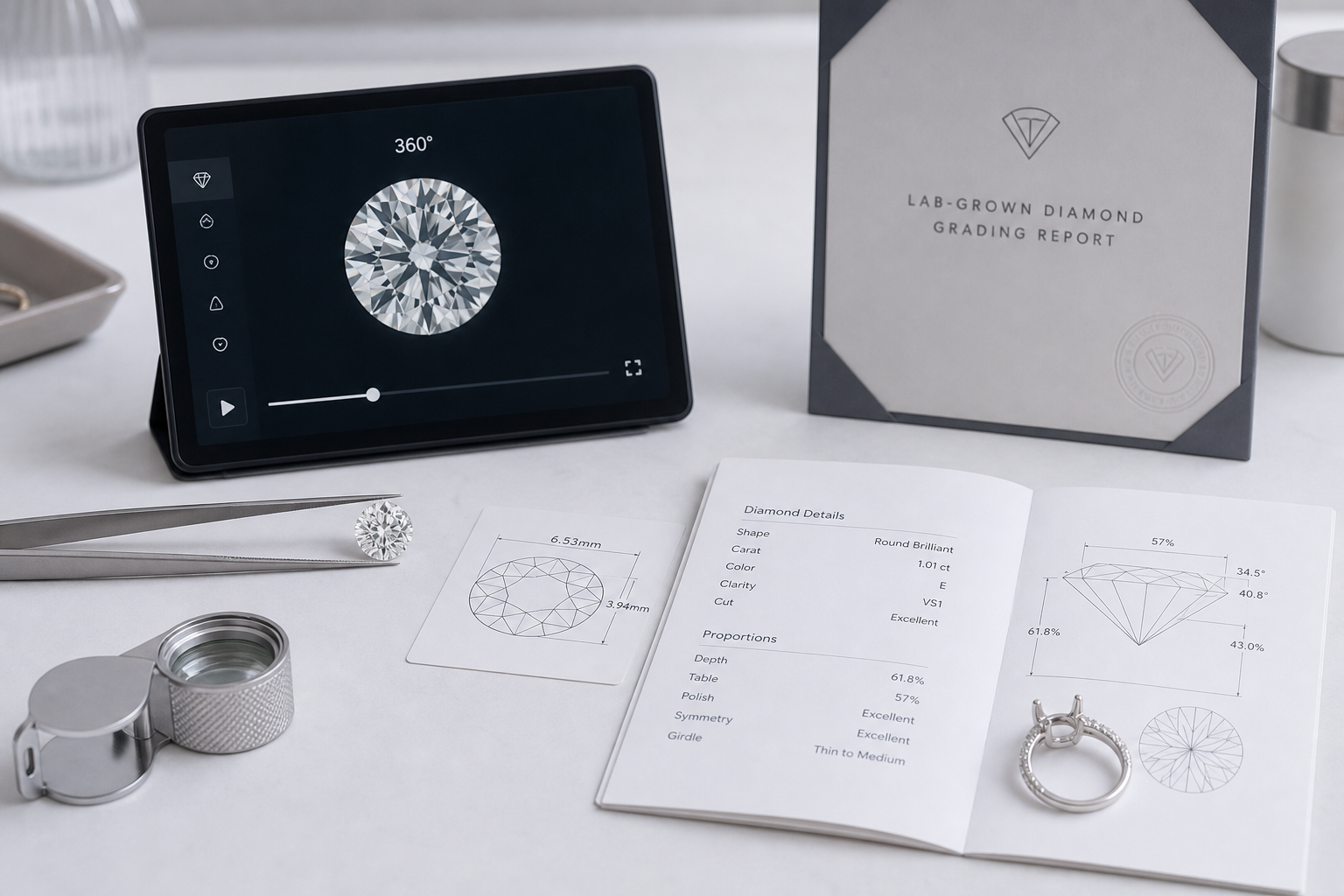
Before committing to a loose lab-grown diamond, compare the measurements in millimeters, not just the carat weight. Check the length-to-width ratio and decide whether it matches the style you want. Review the diamond grading report for carat, color, clarity, measurements, and lab-grown identification, then use photos and 360 video to judge the issues the report cannot show clearly.
For elongated shapes, pause the 360 video at face-up angles and look for bow-tie strength, uneven darkness, and outline balance. For emerald cuts, look through the center of the stone for windowing or obvious inclusions. For cushion and radiant cuts, compare stones side by side to see whether the brightness is even or concentrated only in certain areas.
Setting compatibility should be checked before the final decision, especially for pears, emeralds, and radiants. A stone that looks attractive loose may need specific prong placement, corner protection, or a different setting style to look secure and proportionate in the finished ring.
How Shape Choice Changes the Finished Engagement Ring
A loose diamond can look like a strong value and still be the wrong choice for the finished ring. Shape affects finger coverage, ring proportion, setting compatibility, and daily wear. A strong lab-grown diamond engagement ring is not built from shape alone, but shape is one of the first decisions that controls how the entire design feels.
This is where a purely price-based comparison becomes too narrow. A diamond that saves money per carat may require a more protective setting, a different band width, or a more careful layout to avoid looking unbalanced. For custom engagement ring design, the stone and setting should be evaluated together rather than as separate decisions.
How Each Shape Changes Finger Coverage and Ring Proportion
Round diamonds create the most familiar proportion and usually look balanced across many hand shapes. They do not elongate the finger as strongly as oval, pear, or rectangular radiant shapes, but they are easy to center visually and rarely fight the setting design.
Oval and pear diamonds tend to create more finger coverage from top to bottom. This can make the ring look larger and more elongated without increasing carat weight. The tradeoff is that outline quality becomes more noticeable. If the oval is too narrow or the pear is poorly balanced, the ring can look stretched rather than elegant.
Emerald cuts change the tone of the ring more than many buyers expect. Their rectangular shape and step-cut reflections create a cleaner, more architectural appearance. They often look best when the setting gives the stone room to feel intentional, rather than trying to force it into a setting designed around round-style sparkle.
Cushions feel softer and more relaxed, especially in square or slightly elongated proportions. Radiants feel sharper and more geometric while still offering lively brilliance. These two shapes can overlap in budget and size, but they create very different finished rings.
Setting Styles That Pair Naturally With Each Shape
Round diamonds are the most adaptable. They work naturally in solitaire rings, halo rings, three-stone rings, pavé bands, and vintage-inspired designs. If a buyer wants the easiest path from loose diamond to finished ring, round is usually the least complicated shape.
Oval diamonds often work well in solitaires and hidden halo designs because the shape already provides length. Pear shapes can look striking in solitaire settings, east-west layouts, halos, or three-stone designs, but the orientation and point placement need to be intentional. A pear that is mounted without enough attention to balance can look visually tilted even when the stone itself is symmetrical.
Emerald cuts pair well with clean solitaires, bezel settings, tapered side stones, and three-stone rings. Too much decorative detail can compete with the quiet structure of the cut. Cushion diamonds are flexible and can lean classic, vintage, or modern depending on the band and prong style. Radiants work especially well when the buyer wants a bright center stone with a more angular outline than cushion or oval.
Wearability Considerations for Points, Corners, and Elongated Shapes
Wearability is not only about durability. It is also about how the ring sits on the hand and how exposed the stone shape is during daily use. Pear diamonds need point protection, usually through a V-prong or a setting design that shields the tip. Without that protection, the most vulnerable part of the stone is also the most exposed.
Emerald and radiant cuts have corners that deserve attention. Prong placement should protect the corners without making the stone look boxed in or heavy. This matters more in rings intended for daily wear, where small impacts are more likely over time.
Elongated shapes also need the right band and setting proportions. A very long oval or pear on a thin band can look dramatic, but it may also feel top-heavy if the setting is not built to support it. A wider band or slightly lower profile can make the ring feel more secure and visually balanced.
Stone-to-Setting Fit Check
Before choosing a final engagement ring diamond shape, confirm that the stone’s measurements work with the intended setting. Check the length, width, and depth, not just the carat weight. A deep stone may sit higher than expected. A long stone may need a setting that prevents spinning. A shape with points or corners may need protective prongs that affect the final look.
For a custom design, this fit check should happen before the ring is built. NUVU’s buyer-first approach is to look at the diamond and setting together because a stone that appears to be strong value loose can become less practical if it requires design compromises the buyer did not expect.
For custom work, documentation and communication matter as much as the initial stone choice. The buyer should be able to connect the selected loose diamond to its report details, confirm measurements before the design is finalized, and understand how prongs, bezels, halos, or side stones will change the visual footprint. This does not make one shape automatically better than another, but it reduces the chance that a good loose-stone decision becomes a weak finished-ring decision.
Before finalizing a custom ring, buyers should confirm the stone’s measurements, setting compatibility, documentation, and any seller policies such as returns, resizing, or after-sales support in writing rather than assuming they are included.
How to Choose the Right Shape Based on Budget, Size, and Screening Tolerance
The better diamond shape decision starts with a practical question: what are you trying to protect most: budget, size appearance, ease of comparison, or design style? A lower price per carat is only useful if the stone still looks good in real life and works in the ring you plan to make. A shape that saves money but requires heavy compromise on cut, symmetry, or setting fit may not be the right diamond shape for budget after all.
If you are using this as a loose lab-grown diamond buying guide, narrow the field before looking at individual stones. Choose two or three shapes that match your priorities, then compare actual measurements, videos, grading reports, and setting plans within that smaller group. Most buying mistakes happen when shoppers compare too many shapes at once and focus on carat weight before they understand the visual tradeoff.
If You Want the Safest Classic Choice
Choose round if you want the most familiar appearance, strong sparkle, and the easiest online comparison process. Round brilliant diamonds are not always the lowest-priced option, but they are usually the safest shape for buyers who do not want to interpret bow-ties, step-cut transparency, unusual outlines, or corner protection issues.
The round premium can be worth paying when visual performance matters more than maximum face-up size. It is also a practical choice if the ring will be a simple solitaire, a classic pavé setting, or a design where the center stone needs to look balanced from every angle. The mistake to avoid is assuming round is poor value just because another shape costs less per carat. If the round has better light return, stronger cut consistency, and fewer screening concerns, the higher price may buy lower risk.
If You Want the Largest Look for the Carat Weight
Oval and pear should be on the shortlist if finger coverage and elongated appearance are the main goals. These shapes can make a diamond look larger than its carat weight suggests, especially in solitaire and hidden-halo designs where the outline is easy to see. For a buyer comparing similar carat weights, an oval or pear may create a more noticeable size impression than a round without requiring a jump to the next carat bracket.
The tradeoff is screening tolerance. If you are comfortable reviewing video, comparing outlines, and rejecting stones with distracting bow-ties or awkward proportions, oval and pear can offer strong value. If you want a simpler purchase with fewer visual variables, they can become frustrating. A pear also needs more setting attention because the point should be protected and the stone should sit straight. The value is strongest when the shape looks graceful, the dark center is controlled, and the setting supports the outline rather than fighting it.
If You Want a Distinctive Shape With Strong Value Potential
Emerald, cushion, and radiant are the better shortlist if you want a shape that feels less standard than round but still gives room for value. Emerald works best for buyers who prefer clean geometry and quiet flashes over constant sparkle. It can be an elegant choice, but it is not forgiving. If inclusions, haziness, or weak transparency are visible, the stone can look flat even with respectable grades on paper.
Cushion and radiant are more flexible for buyers who want brilliance without a round outline. Cushion is softer and more romantic in shape, but its appearance varies widely; one cushion may look broad and pillowy, while another may look deep, small, or overly crushed. Radiant is usually the stronger choice if you want a sharper geometric outline with lively sparkle, especially in rectangular designs. The risk with both is assuming the shape name tells you enough. It does not. The actual facet pattern and face-up video matter more than the label.
If You Are Buying a Loose Diamond for a Future Setting
If the setting has not been finalized, avoid choosing the diamond on price alone. A loose stone that looks like a bargain may create design limitations later. Pears need point protection, emeralds and radiants need corner-aware settings, elongated stones need the right orientation and prong balance, and cushions can change the whole mood of a ring depending on whether they are square or stretched.
For custom design, the smartest order is not always “buy the biggest stone first.” It is better to decide the general ring direction, then choose a diamond shape that supports the design, daily wear, and budget together. NUVU’s buyer-first approach treats the stone and setting as one connected decision rather than two separate purchases, because a visually strong diamond can still be the wrong fit for the ring it is meant to become.
For wholesale or multi-stone buying, the same logic applies with an added concern: consistency. Matching several lab-grown diamonds by shape, ratio, measurements, and visual character can be harder than finding one attractive stone. Documentation helps keep the comparison organized, but side-by-side visual review is still important because two stones with similar reports may not match well in brightness, outline, or face-up presence.
In sourcing or wholesale conversations, documentation, consistency, and communication often matter as much as the headline specification. Wholesale buyers should ask how matching standards will be defined, how report details will be shared, and how visual consistency will be evaluated before committing to a group of stones. China-linked supply chains can offer manufacturing depth and scale in some categories, but buyers still need to evaluate consistency, documentation, communication, and quality control rather than assuming country of supply alone determines value.
When a grading report is provided, buyers should compare the report details with the issuing laboratory’s verification tools where available.
NUVU’s role in buyer education is to make comparison clearer, especially around grading reports, visual evidence, design fit, and documentation.
Final Shape Shortlist Framework
If you want classic sparkle and the most straightforward comparison, start with round. If you want a larger-looking diamond and are willing to screen carefully, compare oval and pear. If you want refined geometry and can prioritize clarity and transparency, consider emerald. If you want non-round brilliance with flexible style and pricing, compare cushion and radiant side by side.
The best way to choose a lab-grown diamond shape is to match the shape to your weakest tolerance, not just your strongest preference. If you hate uncertainty, choose the shape with fewer screening risks. If you care most about size, accept that video review matters more. If the ring design is highly specific, let the setting guide the stone. A good shortlist should make the buying process narrower, clearer, and less dependent on guessing from carat weight alone.
Final verification step: before treating any shape as the “best value,” confirm that the selected stone’s report information, millimeter spread, video appearance, and setting design all support the same choice. This keeps the comparison grounded in visible evidence rather than a single metric such as carat weight, shape name, or price per carat.
Disclosure: This article is for general educational purposes only. Diamond grading, pricing, availability, specifications, and seller policies can change, and readers should verify important details through grading reports, official laboratory tools, seller documentation, or qualified professionals before making a purchase decision. Laboratory-grown diamonds should be clearly distinguished from natural diamonds, and environmental or sourcing claims should be supported by specific documentation.