- Shop
Diamonds & Jewelry
Loose Lab Diamonds Yellow Lab Diamonds Pink Lab Diamonds Blue Lab Diamonds Engagement Rings Fine Jewelry Shop All Loose lab-grown diamonds10 shapes · IGI, GIA or NGTC reports
- Wholesale
- Custom Design
- Education
- About
CAD Design for Custom Lab-Grown Diamond Jewelry: What Buyers Should Check Before Approval
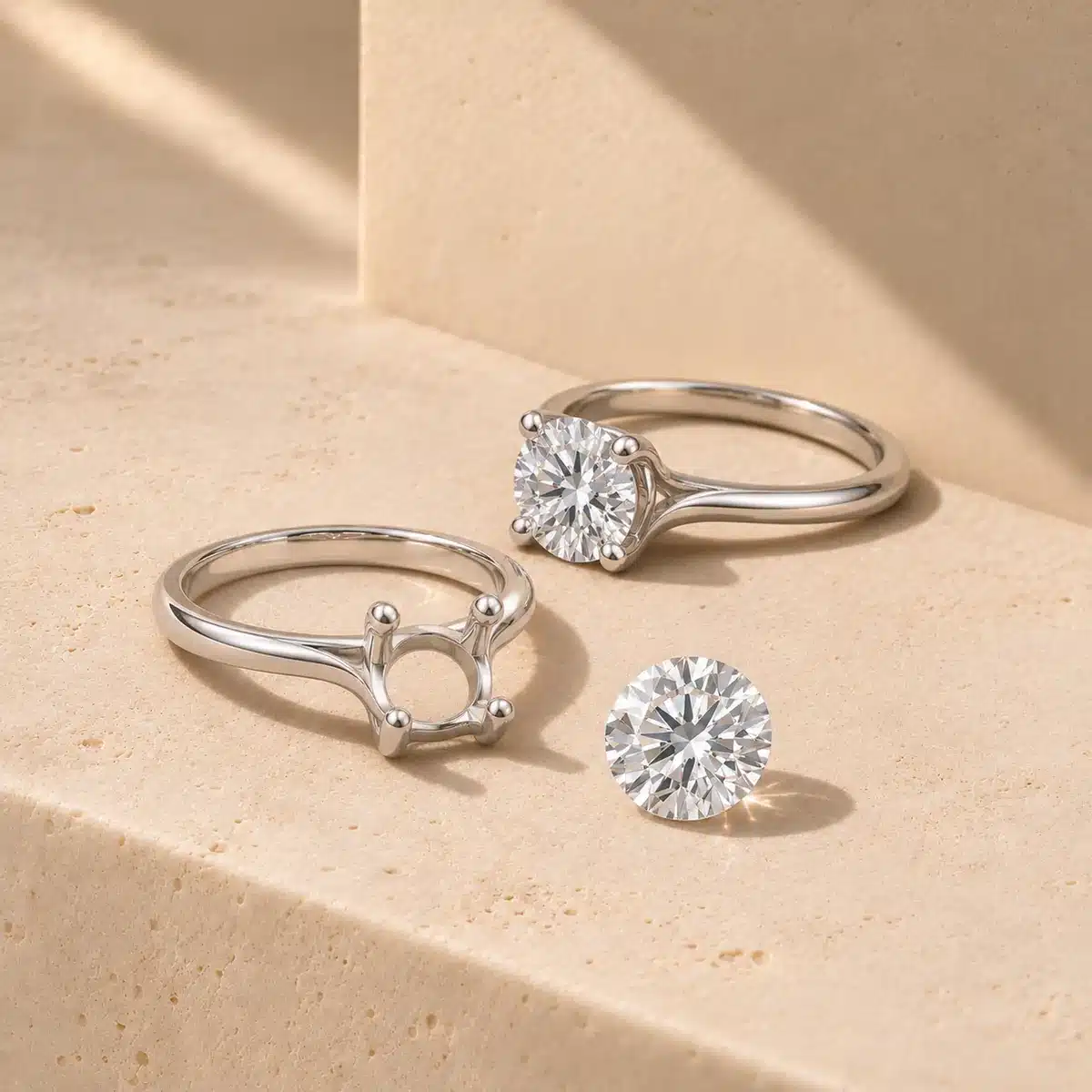
On a laptop screen, a ring render is often shown many times life size. At that scale a 1.6 mm band looks substantial and a 7 mm-high setting looks neat. On the finger, the same band can look thin next to a 2 ct stone, and the same head can catch on every sweater. The render was accurate. It just was not the thing to approve.
Approve the CAD by its measurements, not by how the render looks. The finished piece is printed and cast from the file, so whatever is wrong in it ends up in metal. Before you approve, check the stone outline against your stone’s report, the height from the finger to the top of the stone, band width and thickness, prong size and position, the gallery and side profile, and the ring size and metal.
The measurements every CAD should show
If a measurement is not on the drawing, it has not been decided yet. Get it added before you approve.
Render vs technical views
A render shows how the piece may look in ideal light, often with a generic stone. Technical views, top, side and front with dimensions, show how it will be built. Approve the technical views. Where the ring will be worn with a wedding band, a view with the band beside it shows at once whether the two sit flush.
The checks people skip
Setting height
A higher setting shows more of the stone from the side, but it catches on clothes and gloves and can leave a gap above a straight wedding band. A lower setting is more practical for everyday wear. Compare the height on the CAD with a ring the wearer already has.
Band thickness, not only width
Width is what you see from above; thickness is what keeps the ring round. Many solitaire bands are around 1.8 to 2.5 mm wide, and a narrow band needs enough depth to hold its shape, especially in softer 18K gold. A comfort-fit shank has a rounded inside edge.
Prongs on points and corners
Pears, marquises, princesses and other pointed or cornered stones need V-prongs or claw prongs covering the weak points. Very fine prongs look elegant in a render but wear thinner with time, so check their finished size. See the ring design guide.
Your stone in the model
The stone in the model should match the report’s length, width and depth. A CAD drawn to “about 1.5 ct” will not fit a 1.5 ct stone whose outline differs by half a millimeter.
From CAD to metal
The approved file is printed in resin or wax, cast in metal, cleaned, set and polished. Changes are cheap on screen, possible but slower after a resin print, and limited and costly after casting.
When a resin model is worth it
A resin or wax print lets you hold the real scale before metal is cast. It is worth it for complex designs, large or unusual stones, unusual sizes and anything a brand will reproduce.
CAD points for other pieces
- Earrings: post or hook position, back type, drop length, and whether the earring faces forward when worn.
- Pendants: bail opening for the chain you will use, and whether the pendant hangs straight or tilts.
- Bracelets: clasp type, how the links move, and the length with the clasp closed.
Approving a CAD
Approve a numbered version. With the approval, note the version number, ring size, metal and key measurements. Each revision gets a new number and a short note of what changed, so the workshop never casts from an older file. Any change after approval, to the stone, metal, size, band or height, means a new version and a new approval.
Common mistakes at the CAD stage
- Approving from the top view only.
- Not comparing the model’s stone with the report’s measurements.
- Asking for a “small change” by message without a new version.
- Forgetting the wedding band.
- Judging size from the screen instead of the numbers.
CAD questions
What is a CAD in jewelry?
A 3D computer model of the piece, used to print a model and then cast the metal.
Can I change the design after approving the CAD?
Before casting, usually yes, with a new CAD version. After casting, changes are limited and cost more.
Why does the ring look bigger in the CAD than in real life?
Renders are shown enlarged on screen. Compare the measurements, or get a resin model to see the real scale.
Do I need a resin model?
For complex designs, large stones or a design that will be repeated, it helps. For a simple solitaire with clear measurements, it is optional.
Get a CAD built to your stone
Send the stone’s report number, or the shape and size range you want, with the ring size, metal, setting style and a ring you like the feel of as a size reference. Start your custom design or message us on WhatsApp / WeChat at +86 19118403930.

11+ years supporting global clients with lab-grown diamond product consultation and market analysis.
About NUVU. NUVU is the international brand of New Perspective Superhard Materials Co., Ltd. in Zhecheng, Henan, China. We grow HPHT lab-grown diamonds in-house and cut, polish and match stones in our own workshop.
Related Guides
Custom jewelry guide
How custom lab-grown diamond jewelry is made: when custom makes sense, the brief, stone selection, CAD approval…
Read more →CustomCustom process
How a custom lab-grown diamond piece is made: brief, stone selection, CAD approval, casting and setting, final QC…
Read more →CustomSetting styles
Solitaire, halo, hidden halo, three-stone and vintage settings compared: look, stone protection, height, wedding…
Read more →