
Most people start a custom ring with a number in mind—say, $3,000—but have no idea how to split that sum between the lab-grown diamond, the metal, and the jeweler’s labor. Put too much toward the center stone and the setting looks flimsy, a common example of custom jewelry mistakes. Skimp on craftsmanship and your accent diamonds may fall out. The real question isn’t just “can I afford this?” but “where does each dollar do the most for how the ring looks and lasts?”
For the full framework, read Custom Lab-Grown Diamond Jewelry Guide.
This guide breaks down the standard cost ratios that actually work for custom jewelry, from a 1.5-carat lab-grown diamond ring to tighter budgets under $1,500. You will learn exactly what percentage to assign to each component, which hidden labor fees to watch for, and how to read a quote line by line so you never pay for vague line items again.
| Budget Component | Recommended Allocation | Common Mistake to Avoid |
|---|---|---|
| Center lab-grown diamond | 50–60% of total budget | Going above 85% starves the setting and labor budget |
| Side / accent stones | 10–15% of total budget | Assuming melee cost is included in the setting price |
| Metal (e.g., 14K gold) | 15–20% of total budget | Choosing 18K or platinum without checking gram weight |
| Design & craftsmanship | 10–17% of total budget | Ignoring separate fees for CAD, wax printing, and setting |
| After-sales & maintenance | 5–7% of total budget | Forgetting $50–100/year for rhodium plating and prong care |
Quick Questions Before You Read
Q: Is a 1-carat lab-grown diamond always cheaper than a 1.5-carat one?
Not proportionally. Price jumps are not linear—moving from 1 to 1.5 carats may double the stone cost because of size rarity. Always check the actual per-carat price on the lab report.
Q: Should I always pick the cheapest metal to save money?
No. 14K gold offers the best balance of durability and cost. Platinum costs roughly 2–3× more per gram and is softer, meaning more scratches and higher future polish fees.
Q: Can a custom ring under $1,500 still look high quality?
Yes, if you use a stock setting and a smaller center stone (0.5–0.8 carats). The key is to keep the center diamond at 50% of budget so the setting is not flimsy.
Q: Why do some jewelers refuse to itemize their quote?
A packaged quote hides markup on the stone, metal, and labor. A transparent jeweler will show gold weight in grams, accent stone carats, and separate CAD and setting fees. No line items means you cannot compare fairly.
Where Does Your Custom Jewelry Budget Actually Go?
The most common mistake in custom jewelry is fixating on the center stone to the exclusion of everything else. When a buyer walks in with a fixed budget and asks for the largest diamond they can afford, they are almost certainly setting themselves up for a ring that looks, feels, or wears poorly. The reason is simple: a diamond is only one component of a finished piece, and the other components have real costs that cannot be eliminated without consequence.
Why “Biggest Diamond Possible” Is a Budget Trap
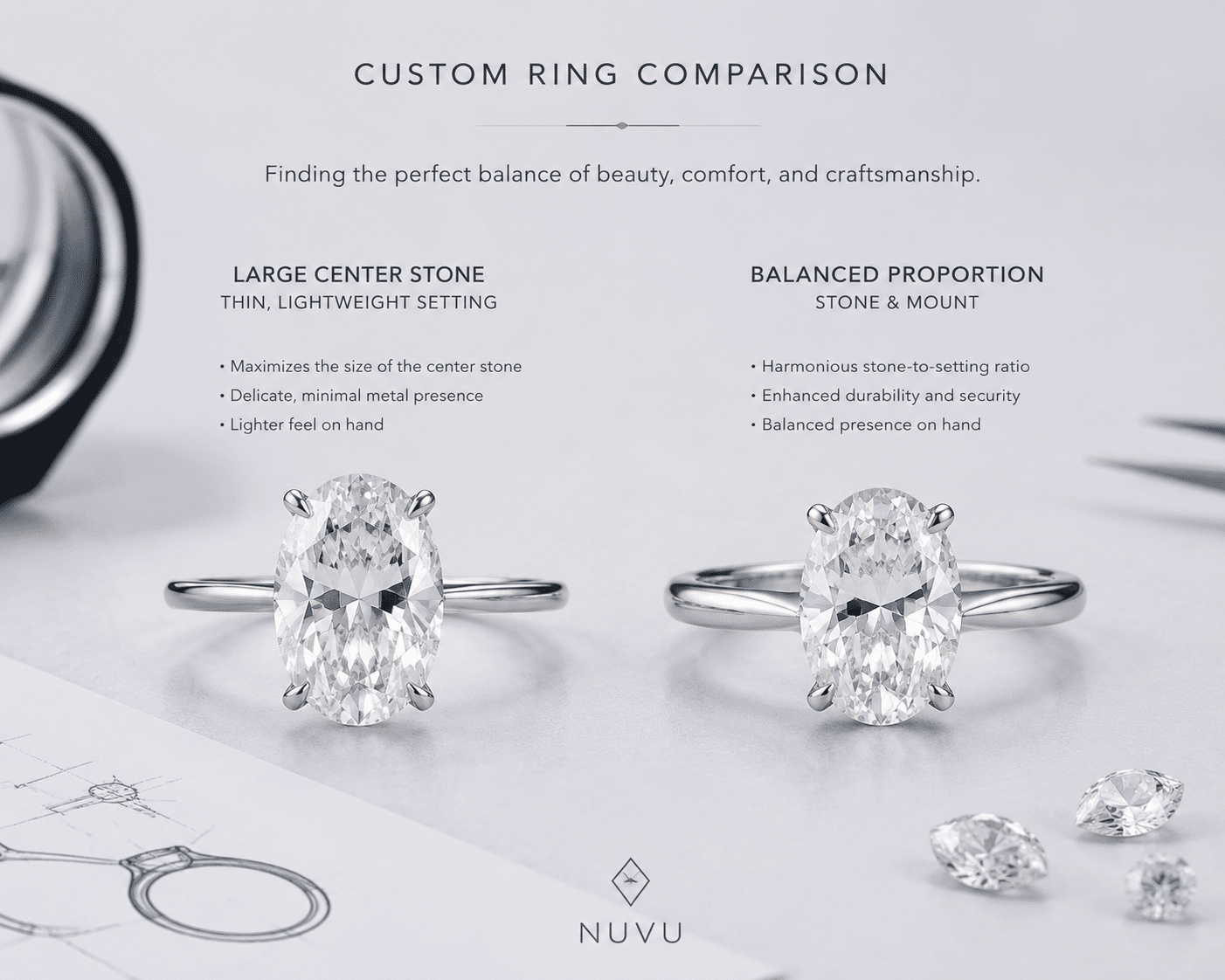
Allocating 85 to 90 percent of a budget to the center stone leaves almost nothing for the structure that holds it. A ring that is underweight in gold feels thin in the hand and sits awkwardly on the finger. A setting that skimps on bench hours results in prongs that are uneven, surfaces that are rough, or a finish that dulls quickly. The diamond itself may be beautiful, but the ring that carries it will telegraph its shortcomings in every detail. The trap is that the buyer sees a large stone on the invoice and believes they won, when in fact they have traded overall quality for a single number on a report.
The Four Hidden Budget Categories Most Buyers Overlook
A realistic custom jewelry budget must account for four distinct cost categories, not just one. The center lab-grown diamond comes first, but it is followed by the accent or side stones that surround or line the band. The precious metal itself carries a cost based on type, purity, weight, and the current market spot price. Finally, the design complexity — including CAD modeling, wax printing, stone setting, and bench finishing — represents the labor that transforms raw materials into a finished piece. Each of these categories has a minimum functional spend. Below that threshold, quality drops sharply: the gold becomes too thin to withstand daily wear, the side stones are poorly matched, or the setting work is rushed. Understanding that these four categories exist is the first step toward a budget that actually works.
What a Balanced Custom Budget Looks Like
A well-balanced custom ring budget typically allocates 50 to 60 percent to the center lab-grown diamond, 10 to 15 percent to accent or side stones, 15 to 20 percent to the metal and setting, and 10 to 15 percent to design and craftsmanship. These percentages shift depending on the piece. A simple solitaire with no side stones spends less on accents and more on the center diamond. A three-stone ring or a halo design shifts more weight to side stones and setting labor. A platinum ring pushes the metal percentage higher. The percentages themselves matter less than the principle behind them: every category gets enough funding to perform its job. When any one category is starved, the finished ring suffers visibly.
What to Check Before You Decide
Before committing to a custom project, ask your jeweler for a detailed line-item quote. Do not accept a single total price. Request the gold weight in grams, the number and total carat weight of any side stones, and the estimated hours of bench time for complex settings. A jeweler who cannot or will not provide these numbers is asking you to approve a budget blind. A jeweler who provides them is giving you the information you need to decide whether the allocation is balanced or broken.
Lab-Grown Diamond Cost: What You’re Actually Paying For
Lab-grown diamonds follow a different pricing logic than natural stones. The price is not driven by geological rarity, but by production cost, cutting time, and grading demand. Understanding where the price comes from helps you decide where to spend and where to save within the center stone portion of your budget.
Carat, Cut, Color, Clarity – Which Matters Most for Budget Allocation
For lab-grown diamonds, cut quality is the highest-value factor in the entire buying decision. A well-cut stone, even at a slightly lower color or clarity grade, will outperform a larger but poorly cut stone in every visual dimension: brightness, fire, and scintillation. The budget should go first to cut, second to carat size, and third to color and clarity. Dropping from D to G color or from VVS1 to VS2 in clarity can free up significant budget without a visible difference to the naked eye, especially once the stone is set in a ring. Dropping from an ideal cut to a fair cut, by contrast, produces a stone that looks dull and lifeless regardless of its size or color grade.
Shape Pricing Order: Why Round Cuts Cost More Than Fancy Shapes
Round brilliant diamonds require more rough material and longer cutting time than fancy shapes such as oval, pear, emerald, or cushion. This manufacturing reality results in a 15 to 25 percent price premium for round stones at the same carat weight and quality grade. A buyer with a fixed center-stone budget can choose an oval or cushion and gain 0.3 to 0.5 carats without increasing the total spend. The tradeoff is purely about preference: if the wearer wants a round brilliant, the budget must accommodate the premium. If they are open to an oval or cushion, the same money buys more visible diamond for the design. In terms of value per carat, the decision is usually in favor of fancy shapes.
Certificate Level: IGI vs GIA – When the Report Affects the Price
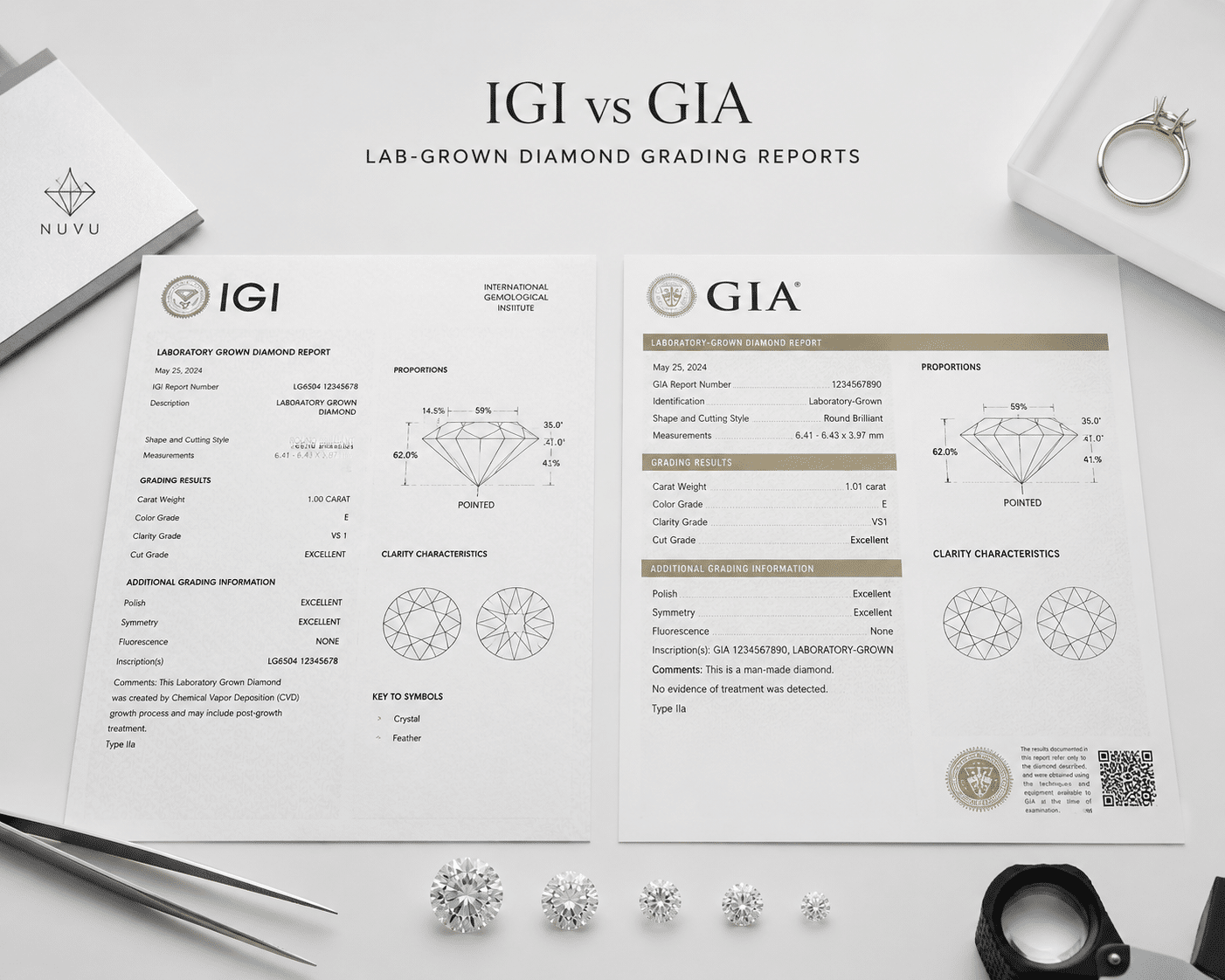
GIA-graded lab-grown diamonds typically carry a 5 to 15 percent price premium over stones with an IGI report. This premium is driven by GIA’s perceived stricter grading standards, particularly in cut and clarity. For most buyers, especially those selecting jewelry-grade stones under 2 carats, an IGI report is more than sufficient. IGI maintains strong consistency in lab-grown diamond grading, and its reports are widely accepted by jewelers and appraisers. The premium for GIA grading makes financial sense only for larger investment-grade stones or for buyers who specifically require GIA documentation for insurance or resale planning. For a standard custom engagement ring, choosing IGI and redirecting the savings into a better cut or larger carat size is usually the smarter allocation.
Certificate and Visual Review Check
No grading report tells the full story. Before purchasing, review the actual stone through a 360-degree video. Compare the table percentage, depth, and crown angle against the ideal proportions for the chosen shape. A report may assign an Excellent cut grade, but the actual proportions may fall in the acceptable range rather than the optimal range. A good report is a starting point. Visual confirmation that the stone performs well under light is the real test. Buyers who skip this step risk receiving a stone that looks flat or dark despite its paper credentials.
For buyers, the practical point is not just what the report says, but how the stone performs visually and fits the intended design. A certificate documents the stone’s characteristics at the time of grading, but it does not guarantee that those characteristics translate into the look the buyer wants. Two stones with identical grades can appear noticeably different in brightness or fire depending on their exact proportions. When comparing options, the certificate narrows the field, but the final decision should still be made after seeing the stone in motion.
Understanding Lab-Grown Diamond Terminology and Disclosure
One aspect of lab-grown diamond buying that directly affects budget confidence is understanding how these diamonds are described and disclosed in the marketplace. The Federal Trade Commission (FTC) has issued guidance clarifying that terms like “laboratory-grown,” “laboratory-created,” and “synthetic” are acceptable descriptors for diamonds produced in a lab, provided the terminology is clear and not misleading to consumers.[1] This guidance is important for buyers because it helps ensure that the stone you are paying for is accurately represented on both the grading report and the invoice. A reputable jeweler will use clear, consistent language — such as “lab-grown diamond” — and will not obscure the stone’s origin with vague or promotional phrasing. When reviewing a quote, confirming that the center stone is explicitly identified as lab-grown by the grading laboratory protects both your budget and your understanding of what you are purchasing.
Metal Selection: How Gold Type and Weight Drive Cost
The metal portion of a custom ring budget is often underestimated because buyers see only the final price, not the factors behind it. Three variables determine the metal cost: the type and purity of the gold or platinum, the total weight required to build the setting, and the jeweler’s markup over the current market spot price. Understanding each one prevents surprises.
14K vs 18K vs Platinum – Cost, Durability, and Wear Over Time
14K gold is the most practical choice for daily-wear engagement rings. Its 58.5 percent gold content makes it harder and more scratch-resistant than 18K, and it is 20 to 30 percent cheaper for the same weight. 18K gold offers a richer color and higher purity, but it is softer and more prone to bending or scratching over years of regular use. Platinum is the premium option: denser, heavier, and naturally white without needing rhodium plating. It is 40 to 60 percent more expensive than 14K gold for the same setting design. The tradeoff is long-term maintenance — platinum wears down slowly rather than chipping, so a platinum ring will need fewer repairs over decades than an 18K ring. But the upfront cost is significantly higher, and the extra weight changes the feel of the ring on the hand.
How Setting Style Affects Metal Weight
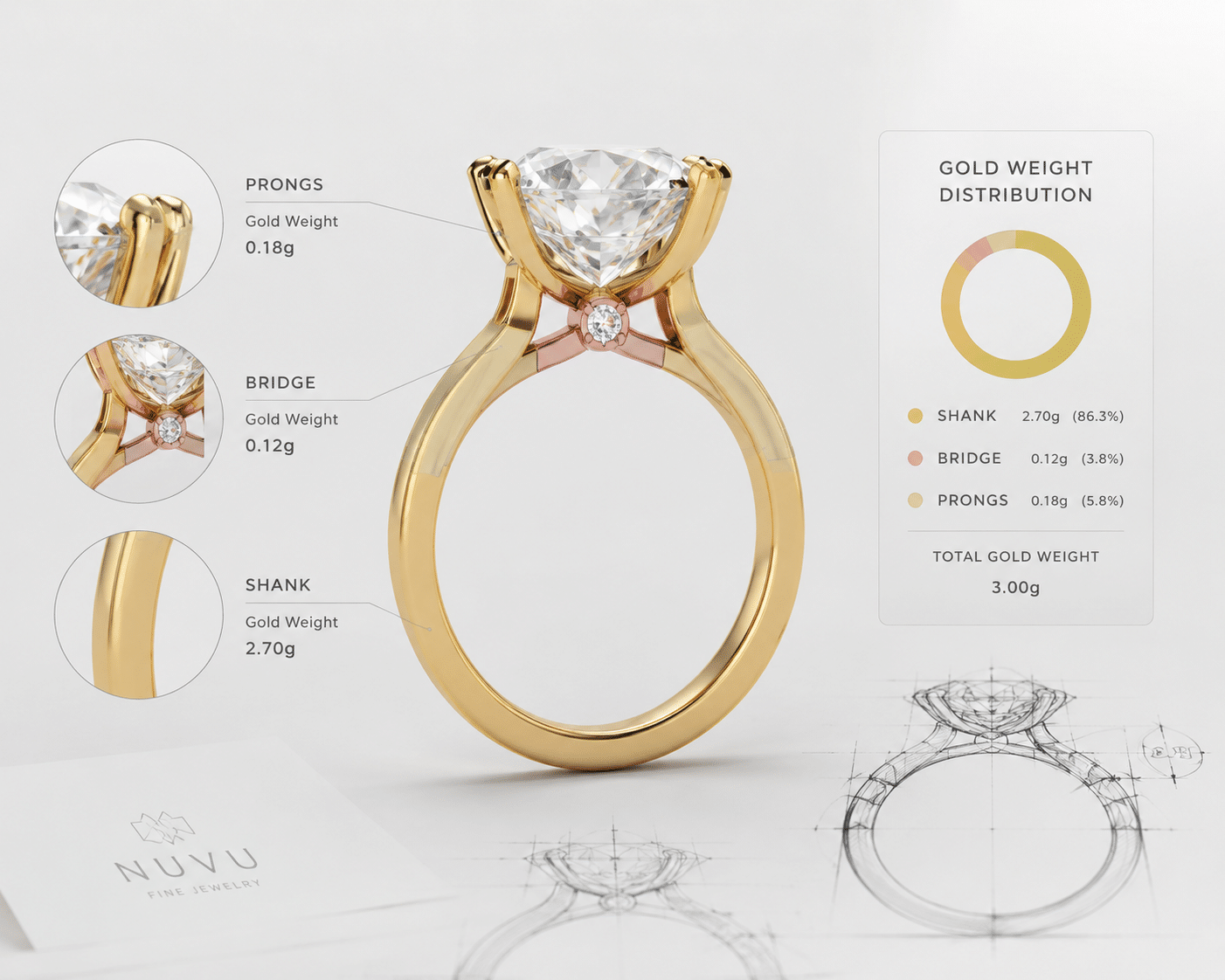
A simple solitaire setting uses 3 to 5 grams of gold. A halo or three-stone setting requires 5 to 8 grams because of the additional prongs, bridge structure, and supporting metal under the side stones. A wide band or a cathedral profile that rises high off the finger also increases metal weight. Every gram of gold adds directly to the material cost. Buyers who want a heavy, substantial ring should budget for 6 to 8 grams of gold. Buyers who prefer a lighter, more delicate feel can reduce the weight, but should be cautious about going below 3 grams for a size 6 ring, as the setting becomes structurally vulnerable.
Gold Spot Price vs. Jeweler Markup
The spot price of gold is only the raw commodity cost. Jewelers apply a markup of 20 to 50 percent over spot to cover fabrication, material waste, and finishing labor. This markup is standard industry practice, but it should be visible in the line-item quote rather than absorbed into a vague total price. A transparent quote lists the gold weight and the per-gram cost separately. A quote that simply states “$400 — 14K white gold setting” without breaking down weight and markup makes it impossible to compare across jewelers. Always ask for the exact gold weight in grams and the per-gram price being charged. This single piece of information tells you whether the metal budget is reasonable or inflated.
Stone-to-Setting Fit Check
Confirm the quoted gold weight in grams before approving a design. For a size 6 finger, a solitaire setting holding a 1.5-carat center stone typically requires 4 to 6 grams of 14K gold. If the quote shows 3 grams for the same design, the ring may feel too light or wear thin over time. If it shows 8 grams, the setting may be unnecessarily heavy. Compare the quoted weight against this reference range to verify that the metal budget matches the physical requirements of the piece.
It is also worth noting that the spot price of gold fluctuates daily. A quote based on a higher spot price may become less competitive over time, and as highlighted in the custom lab grown diamond bracelet guide, one based on a lower spot price may change if the market moves before production. For this reason, it is useful to ask whether the quoted metal price is fixed for a set period or subject to change. Knowing this upfront avoids surprises if gold prices shift between quoting and production.
Understanding Pearl Grading Standards
For buyers considering a custom piece that includes pearls aside from the primary lab-grown diamond, understanding how pearls are evaluated is essential for accurate budgeting. Pearls are graded according to a distinct set of criteria — luster, surface quality, shape, color, and nacre thickness — that differ significantly from the 4Cs used for diamonds.[2] A high-quality pearl with exceptional luster and a clean surface can command a significant portion of the accent-stone budget. When adding pearls to a custom design, request a detailed evaluation from your jeweler that includes these grading factors, so you can assess whether the price aligns with the quality of the pearl. This is especially important for custom work where the pearls must match each other and coordinate with the metal and diamond components of the piece.
Design Complexity and Craftsmanship: The Labor Component
Many buyers assume the labor involved in a custom ring is minor — a small fee added to the price of the metal and stones. In reality, the hours of skilled work required to turn a concept into a finished piece make up a significant and necessary part of the budget. Design and craftsmanship costs are not arbitrary add-ons; they reflect the time, training, and equipment needed for true custom work.
The process begins with a CAD model. A custom 3D design typically costs between $100 and $300, with some jewelers including a set number of revisions and others charging separately for each change. Once the design is approved, a wax resin model is 3D-printed for another $20 to $50. This stage is non-negotiable for true custom work. It ensures the proportions, fit, and stone placement are correct before any metal is cut, which saves far more money than skipping it would.
Stone Setting – The Most Labor-Intensive Bench Step
The physical act of setting stones accounts for the largest share of labor cost. A single center stone in a basic four-prong setting takes a skilled setter 30 to 60 minutes. A halo ring with 10 to 20 melee stones takes 2 to 4 hours. A full micro-pavé band with 30 to 50 stones can take 4 to 8 hours. Bench time is typically billed at $50 to $150 per hour, and the setting method chosen is the single biggest variable in the final labor total.
A four-prong solitaire is the most cost-effective approach. A halo adds complexity. A pavé band pushes labor time the highest. Buyers who want an elaborate setting should expect the bench time to exceed the cost of the accent stones themselves.
Polishing, Finishing, and Quality Control
After the stones are set, the ring goes through a multi-step finishing process: pre-polish, final polish, ultrasonic cleaning, steam cleaning, and inspection under a microscope. These steps add 1 to 3 hours of skilled labor. Skipping or rushing them produces a ring with visible tool marks, uneven surfaces, or poorly cleaned stone seats. A well-finished ring should feel smooth to the touch and show no scratches under normal light.
What This Means in a Real Purchase
Ask your jeweler for a line-item breakdown of design and craftsmanship costs: CAD fee, wax printing, stone setting hours, and polishing. A total labor cost of $300 to $800 is typical for a mid-complexity custom ring. If the quote is vague or groups these costs into a single line, request itemization. A jeweler who cannot explain where the labor budget goes is likely underinvesting — or overcharging — for it.
All diamonds discussed in this article with grading reports have been verified against official lab records where applicable. For any stone featured in a custom quote from NUVU, the grading report number is provided upfront, allowing you to confirm the stone’s characteristics through the issuing laboratory’s online report check service before committing to production.
Independent verification available upon request through GIA’s online report check service or IGI’s report verification portal, depending on which laboratory graded the stone.
Side Stones and Accent Diamonds: Small Stones, Real Cost
Accent diamonds — melee stones used in halos, pavé bands, and three-stone settings — are easy to overlook when planning a budget. Individually, they cost little. Combined, they represent a real expense that affects both the price and the visual balance of the finished ring.
Melee Stone Sizing and Matching – Consistency Adds Cost
High-quality melee stones are sorted by exact diameter and color grade to create a uniform match. This is not a trivial step. Unmatched accent stones create visible unevenness — one stone appears darker, another slightly larger, another warmer in tone. To avoid this, reputable suppliers sort melee in batches, ensuring every stone in the ring falls within a tight size and color tolerance. This sorting and matching process adds 10 to 20 percent to the cost of the accent stones. It is worth paying for. An uneven halo or pavé band degrades the entire design, regardless of how good the center stone looks.
Total Accent Carat Weight – How to Calculate It
To estimate the accent diamond portion of the budget, start with typical total carat weight (tcw) ranges. A full pavé band for a size 6 ring uses approximately 0.30 to 0.50 tcw of melee stones. A halo around a 1.5-carat center stone requires about 0.20 to 0.35 tcw. Multiply the expected tcw by the per-carat cost of the melee grade to get a rough accent stone budget. For example, 0.40 tcw of G-H, VS melee at $800 per carat equals $320. This is a small number in isolation but adds up when combined with the setting labor required to install those stones.
When to Skip Accents and When to Invest
If the center stone is below 1 carat, accent stones often overwhelm the design. A 0.7-carat diamond surrounded by a halo of melee can look crowded rather than elegant. A clean solitaire or a simple three-stone with a small side stone on each side usually produces a more balanced look at this size.
If the center stone is 1.5 carats or larger, accents become a natural complement. A halo or pavé band can add visual presence without competing with the center stone. The larger center stone has enough physical presence to anchor the design, and the accents serve as an enhancement rather than a distraction. Buyers choosing a more elaborate setting style should allocate at least 10 to 15 percent of the total budget to accent stones and their setting.
Buyer Verification Checklist
Ask your jeweler for the exact number of accent stones, their individual carat weights, color grade, and clarity grade. Request a macro photo or video showing the melee stones so you can verify consistent hue and size by eye. A certificate is rarely issued for individual melee stones, so visual inspection is your only real verification.
One important detail that buyers often miss: even well-matched melee stones may appear different once set because of how metal reflections interact with the stone. A halo of melee stones set in white gold can appear slightly cooler in tone than one set in yellow gold, even if the stones themselves are identical. When evaluating accent stones, it helps to view them in the context of the intended metal and setting layout.
After-Sales Expectations: Warranty, Resizing, and Maintenance Costs
The purchase price is not the final cost of a custom ring. After-sales expenses — resizing, prong maintenance, and plating — are rarely accounted for in the initial budget. Setting aside a small reserve for these items prevents surprises later.
Warranty Coverage – What Standard and Extended Plans Include
Most jewelers offer a standard warranty covering manufacturing defects for one to two years. This typically includes free tightening and inspection but not damage from normal wear. Many also include one free resizing within the first six to twelve months. Extended warranty plans beyond the standard period cost $50 to $150 per year and may cover stone loss or structural repair. Read the coverage terms carefully. A warranty that covers everything except accidental damage is more useful than one with broad language and narrow exclusions.
Resizing Cost – Why It Matters for Custom Rings
Resizing a simple solitaire band costs $40 to $100 and takes a few days. Resizing a custom ring with a full pavé band or an eternity setting is a different story. The ring may need to be partially or fully rebuilt because the continuous line of stones prevents the metal from being cut and resoldered in the usual way. A pavé band resizing costs $150 to $300, and some designs cannot be resized at all. The safest approach is to order a sizing check before final production. Jewelers will send a plastic or wax sizing ring to confirm fit before the final piece is made.
Long-Term Maintenance – Rhodium Plating, Prong Re-tipping, and Cleaning
White gold rings require rhodium plating every 12 to 18 months to maintain their bright white finish. The cost is $40 to $80 per session. Prongs wear down over time and need re-tipping every few years at $20 to $50 per prong. Ultrasonic cleaning is almost always free from the jeweler. Budget roughly $50 to $100 per year for routine maintenance. This is not a large sum, but it is predictable and should be included in any long-term ownership plan.
How to Evaluate a Custom Jewelry Quote Like a Pro
A well-structured quote does the work of comparison for you. Without one, you are guessing at where your money goes and whether the price is fair. Knowing what belongs in a proper quote separates a straightforward project from one that will generate surprises later.
The Line-Item Quote – What Must Be Listed
A professional quote should break every cost into a separate line. For the center stone, this means carat weight, color grade, clarity grade, cut quality, and the issuing lab for the certificate. Side stones must list total carat weight and their individual grade range. The metal line should specify type and exact weight in grams. Design and labor costs require separate entries: a design or CAD fee, wax printing cost, estimated stone setting hours, and polishing time. If any of these components is missing or grouped into a single number, ask for the breakdown before moving forward.
A grading report is central to this breakdown. The report number and the laboratory that issued it should appear in the quote so you can independently confirm the stone’s characteristics. Without this reference, the largest cost component in the budget — the center diamond — remains unverifiable.
Comparing Quotes – Apples-to-Apples Checklist
When comparing two quotes for the same design, five points matter most: total gold weight, total accent carat weight, design complexity fee, setting method, and warranty terms. Two quotes on the same specifications should fall within 15–20 percent of each other. A wider gap usually means one jeweler is quoting higher metal weight, more side stones, or a different setting method. If the difference cannot be explained by one of these five factors, the higher quote likely includes hidden margin or unnecessary upgrades.
Red Flags in a Custom Quote
Vague language is the most common warning sign. Phrases like “custom design” or “expert setting” without a dollar figure attached mean the cost is not yet committed. Missing metal weight means you cannot verify whether the ring uses enough gold for durability. No certificate details for the center stone leaves the single most expensive component unverified. Absent warranty language means post-purchase support is undefined. Any of these signals an inexperienced jeweler or an intentional effort to keep the true cost unclear. A clean, specific quote is the baseline for a trustworthy transaction.
How to Verify This Before Buying
Request a quote from at least two jewelers. Compare them across the five-point checklist. If one quote is missing information, push for a revised version before making a decision. Before committing to full production, consider paying for a CAD model. Most jewelers charge $100 to $200 for this step, and it is the only reliable way to confirm proportions, profile height, and stone placement before metal is cut.
Two jewelers quoting the same ring design may choose different setting techniques, and those differences directly affect labor time and long-term durability. A bezel setting, for example, provides more protection for the center stone but may appear bulkier and cost more in bench time. To fully understand how these setting choices integrate into the entire creation journey, consulting a detailed custom lab grown diamond jewelry guide is highly recommended. Understanding which method is being quoted helps you compare not just prices, but also the expected performance of the finished piece.
How Diamond Grading Reports Work as Budget Tools
An often-overlooked aspect of the line-item quote is the role of the diamond grading report itself. A report issued by a major laboratory provides a systematic, third-party assessment of the stone’s key characteristics — including carat weight, color, clarity, and cut — which forms the foundation for reliable price comparison.[3] Reports from institutions such as the Gemological Institute of America (GIA) or the International Gemological Institute (IGI) are the most commonly referenced for lab-grown diamonds and help establish quality benchmarks that can be checked against the quote. When a quote includes the full report details, including the report number, it enables you to verify the stone independently through the lab’s online report check system. This verification step ensures that the stone you are paying for matches the one specified in the quote, closing a potential gap between what is promised and what is delivered. For custom buyers, insisting on a verifiable grading report for the center stone is one of the most effective ways to protect the largest single line item in the budget.
Putting It All Together – A Budget Allocation Example
A concrete example makes the percentages real. Here is how a $3,000 custom lab-grown diamond ring budget breaks down, what the choices mean, and where the same project would exceed the number.
Scenario: 1.5-Carat Lab-Grown Oval with Halo and 14K Band
The center stone is a 1.5-carat oval, H color, VS2 clarity, graded by IGI, priced at $1,600. That accounts for 53 percent of the total. The halo and pavé accent stones add 0.30 total carat weight at $300, or 10 percent. The 14K white gold setting uses 5.5 grams at $400, about 13 percent. CAD modeling, wax printing, stone setting, and polishing total $500, or 17 percent. Warranty coverage, resizing allowance, and shipping come to $200, roughly 7 percent. The total lands at $3,000.
Why This Allocation Succeeds
The center stone is well-made without being over-graded. An H and VS2 combination keeps the diamond visually clean while leaving room in the budget for a properly finished halo and secure setting. The 5.5 grams of 14K gold provide enough structural weight for daily wear without bulk. The design fee covers a custom CAD, meaning the ring is built to fit the specific stone shape, band width, and finger size rather than relying on a generic mount. No single category is starved.
What Would Break the Budget
Upgrading the center stone to 2 carats pushes the total to roughly $4,000 to $4,500, depending on grade. Choosing platinum instead of 14K gold adds $200 to $300. Adding micro-pavé to the full band adds another $200 to $400 in stone-setting time. Each change is individually reasonable, but stacking them moves the project into a higher price tier. Understanding these tradeoffs means you choose what matters most and let the rest stay in the original allocation.
Environmental Claims and Buyer Caution
A final consideration for budget-minded buyers is how environmental claims relate to the price you pay. Some sellers may describe lab-grown diamonds as “eco-friendly” or “sustainable,” but such claims require careful scrutiny. The Federal Trade Commission has provided guidance that environmental benefit claims must be substantiated with reliable evidence; broad or unsupported claims about sustainability can be misleading if they lack specific documentation of energy sources, production practices, or carbon offsets.[1] For the buyer, this means that a premium charged for a “green” lab-grown diamond should be questioned unless the seller provides verifiable documentation. The price of a lab-grown diamond is primarily determined by production cost and grading, not by its environmental attributes. Rather than paying extra for unverified marketing terms, allocate that budget toward higher cut quality, metal weight, or craftsmanship — factors that produce a visibly superior final piece.
Frequently Asked Questions About Custom Jewelry Budgeting
Can I Get a Custom Ring Under $1,500?
Yes, but with clear constraints. A 0.5- to 0.7-carat center stone in a simple solitaire setting with 14K gold and no side stones fits a $1,200 to $1,500 budget. The most effective way to stay under this number is to choose a stock setting from the jeweler’s existing models and customize only the center stone selection. Eliminating the CAD fee for original design work accounts for the biggest savings. This is not a compromise piece; it is a thoughtful allocation at a lower price point.
Is It Cheaper to Buy a Loose Diamond and a Setting Separately?
Sometimes, but only when the setting is a stock mount from a third-party manufacturer. In that scenario, you avoid the design fee and pay only for the finished ring assembly. True custom design is almost always more expensive than a pre-set ring because of the CAD modeling and dedicated bench time. If your priority is a one-of-a-kind design, buying separately does not save money. If your priority is cost efficiency, a pre-set ring or a stock setting with a custom stone is the better approach.
How Much Should I Budget for a Custom Wedding Band Pair?
A matching pair of custom wedding bands typically costs $1,000 to $2,500 total, depending on metal choice, band width, and the presence of accent stones. As a general guideline, budget 30 to 50 percent of the engagement ring cost for the pair. A simple 14K gold band with no stones runs at the lower end. A wider band with pavé or a curved contour design that nests against the engagement ring moves toward the higher end. Order both bands together to ensure the metals match and the profiles sit flush.
Next Steps: Turn This Budget Guide Into Your Custom Quote
You now know where the money goes, which factors matter most, and how to spot a fair quote. The next step is putting that knowledge to use with an actual jeweler. Walking in informed changes the conversation—and the result you get.
What to Say When You Contact a Jeweler
A clear, specific request gets a clearer, more specific answer. Use something like this when you reach out:
“I’m looking for a custom [shape] halo engagement ring in [metal]. My budget is [amount]. Can you provide a line-item quote including center stone, side stones, CAD fee, setting, and metal weight?”
This tells the jeweler exactly what you need and signals that you expect a transparent breakdown. Vague requests tend to produce vague quotes. This script avoids that.
Why NUVU’s Custom Design Process Matches This Budget Approach
At NUVU, the quoting process is built around the same logic this guide covers. Every quote includes a separate line for the center stone, accent stones, metal weight, CAD fee, and bench labor. Lab-grown diamonds are the default, not an optional upsell. And the design process starts with understanding your budget first, so the options presented are realistic from the beginning.
This approach means you never have to guess whether the price matches the work. You can see exactly what you are paying for, make adjustments where needed, and confirm the final piece fits your priorities.
What to Prepare Before You Request a Quote
The faster you provide clear inputs, the faster the CAD process moves and the fewer revision cycles you will need. Before contacting a jeweler, gather the following:
Reference images. A few photos of settings you like help the designer understand your taste faster than any written description.
Ring size. Custom rings sized after production cost extra. Getting the size right upfront saves time and money.
Metal preference. Know whether you want 14K, 18K, or platinum. If you are unsure, a jeweler can walk through the tradeoffs.
Desired center stone size and shape. You do not need a specific stone picked out yet. A carat range and shape preference are enough to start.
Budget range. Be honest about what you want to spend. A designer working within your real range will deliver better options than one guessing.
[1] Federal Trade Commission, “Guides for the Use of Environmental Marketing Claims (Green Guides),” FTC, 2012, updated 2024. Also relevant: FTC, “Jewelry, Precious Metals, and Pewter Industries Guides,” 16 CFR Part 23, for general advertising and terminology guidance.
[2] Gemological Institute of America, “Pearl Quality Factors,” GIA, accessed 2025. https://www.gia.edu/pearl-quality-factors
[3] Gemological Institute of America, “GIA Diamond Grading Reports,” GIA, accessed 2025. https://www.gia.edu/report-check-landing
When a grading report is provided, buyers should verify the report details through the issuing laboratory’s official report check tool where available. The report number and laboratory name should be confirmed in the quote before production begins.
Documentation and Transparency Check
For wholesale or sourcing scenarios where multiple stones or bulk materials are involved, documentation consistency matters beyond a single certificate. Buyers should confirm that the grading reports, metal assay sheets, and any supplier specifications match the agreed-upon order parameters. In custom jewelry, the chain of documentation from the loose stone certificate to the final invoice forms the basis of trust. Communication about what is included — and what is not — should be clear before any payment is made. A transparent process makes comparison easier and reduces the risk of mismatched expectations at delivery.
Disclosure: This article is for general educational purposes only. Diamond grading, pricing, availability, specifications, and seller policies can change, and readers should verify important details through grading reports, official laboratory tools, seller documentation, or qualified professionals before making a purchase decision. Laboratory-grown diamonds should be clearly distinguished from natural diamonds, and environmental or sourcing claims should be supported by specific documentation.