
When buying lab-grown diamonds at wholesale volume, a grading certificate is not a guarantee of quality—it is a data point. The same IGI report for two G-color VS1 stones can hide noticeable differences in face-up tint, brightness, or cut precision. This guide helps retailers and brands understand what certification actually provides, where it falls short, and how to verify that your inventory matches its paperwork. Whether you are comparing suppliers, reviewing grading paperwork, planning private label lab grown diamond supply, setting grading quality agreements, or evaluating a first test order, the decision is not about which certificate is best generally, but which data you can rely on for your specific business model.
For the full framework, read Wholesale Lab-Grown Diamonds for Jewelers and Brands.
The central question this article answers: how do you use certification as a practical tool for consistent inventory, rather than a costly mistake?
| Certification Lab | Best Use Case | Key Consideration |
|---|---|---|
| IGI | Volume wholesale, standard inventory | Cost-effective and consistent; verify face-up color and tint visually |
| GCAL | Stones requiring cut precision or light performance data | Provides ASET or Idealscope images; useful for visual performance verification |
| GIA | Consumer-facing orders, brand-conscious retail | Higher cost but strongest trade acceptance; reserve for premium inventory |
| Supplier internal grading | Quick comparison during test orders | Not a substitute; cross-check via third-party appraisal and return policy |
| No certificate | Avoid unless stone has independent appraisal | No reliable data for commercial matching or resale; high risk |
Quick Questions Before You Read
Q: Is an IGI certificate enough for wholesale buying?
Yes, for most volume orders—it is the industry standard for lab-grown. But always verify face-up color and cut quality visually, as two IGI stones with the same grade can look different.
Q: Can I trust certificates completely for matched pairs or sets?
No. Certificates don’t assess visual match. You must compare stones side-by-side under identical lighting, even if paperwork matches exactly.
Q: What should I do if a supplier offers certificates that seem too good for the price?
Treat inflated grades as a red flag. Cross-check the certificate number on the lab’s portal, and run a test order with independent third-party verification before committing to volume.
Q: Is GIA certification necessary for lab-grown wholesale?
Only for consumer-facing or high-brand retail. For general wholesale, IGI or GCAL is more practical and cost-efficient—provided you inspect the stones in person or via high-res video.
Why Certification Matters Differently in Wholesale Lab-Grown Diamond Buying
A consumer buying a single diamond for an engagement ring typically uses a grading report to feel confident about one purchase. A wholesale buyer operates under a completely different logic. In B2B transactions, the certificate is not about emotional reassurance. It is about repeatable comparison across multiple stones, multiple purchase orders, and multiple lots. A certificate must function as a commercial reference tool, not a sales aid. If it fails to support efficient evaluation at scale, it is not doing its job.
Certification as a Reference Standard, Not a Sales Tool
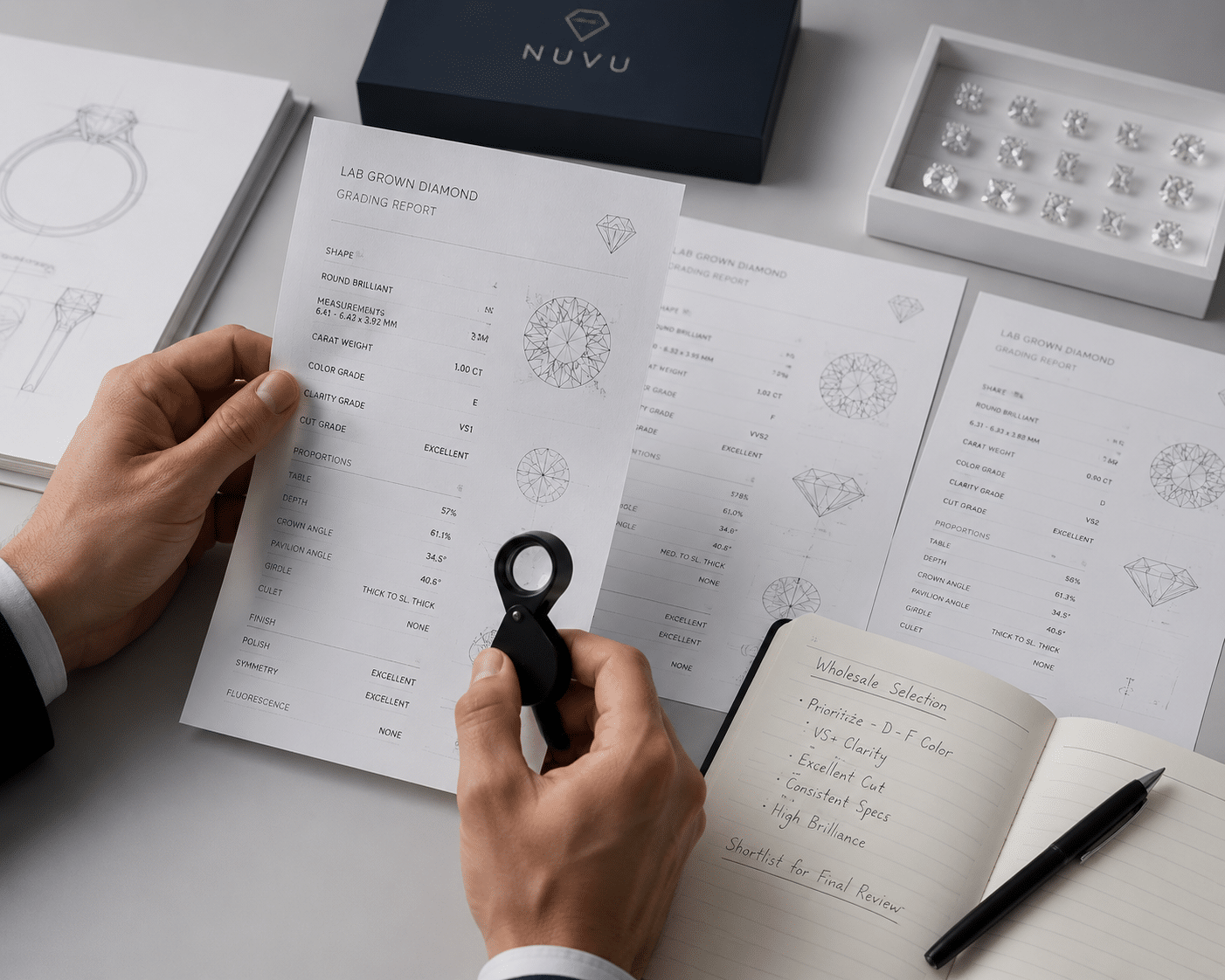
A retail buyer may fall in love with a stone and use the report to justify the decision. A wholesale buyer needs the report to compare stones side by side, match pairs for earrings or three-stone rings, and maintain consistent inventory across months of purchasing. The report must provide stable, comparable data on carat weight, color, clarity, and cut. If the grading varies noticeably between stones that carry the same grade on paper, the certificate loses its value as a reference standard. Wholesale buyers are not looking for a story. They are looking for data that holds up across stones.
The Risk of Treating Certificates as a Guarantee of Supplier Quality
A grading report describes a single stone. It does not describe the supplier’s consistency, grading calibration, batch-to-batch color variation, future supply reliability, or the terms of the commercial relationship. A certificate can be accurate for a specific diamond and still hide larger problems. A supplier may send a well-graded sample and follow it with stones that drift in color or clarity within the same grade. A wholesale buyer who relies exclusively on certificates instead of evaluating the supplier’s overall grading discipline and communication will eventually face merchandising problems. A stone that does not match its neighbors is not useful, regardless of what its individual certificate says.
A grading report can narrow the comparison, but it should be read alongside the stone’s proportions, visual evidence, and intended jewelry use. In sourcing or wholesale conversations, documentation, consistency, and communication often matter as much as the headline specification.
Key Reader Takeaway
The primary question shifts from “Is this stone certified?” to “Does this certificate provide enough reliable data for my commercial use, and what is it not telling me?” A certificate that works for a consumer may be insufficient for a wholesale buyer who needs to match stones, maintain inventory consistency, and sell downstream with confidence.
What This Means in a Real Purchase
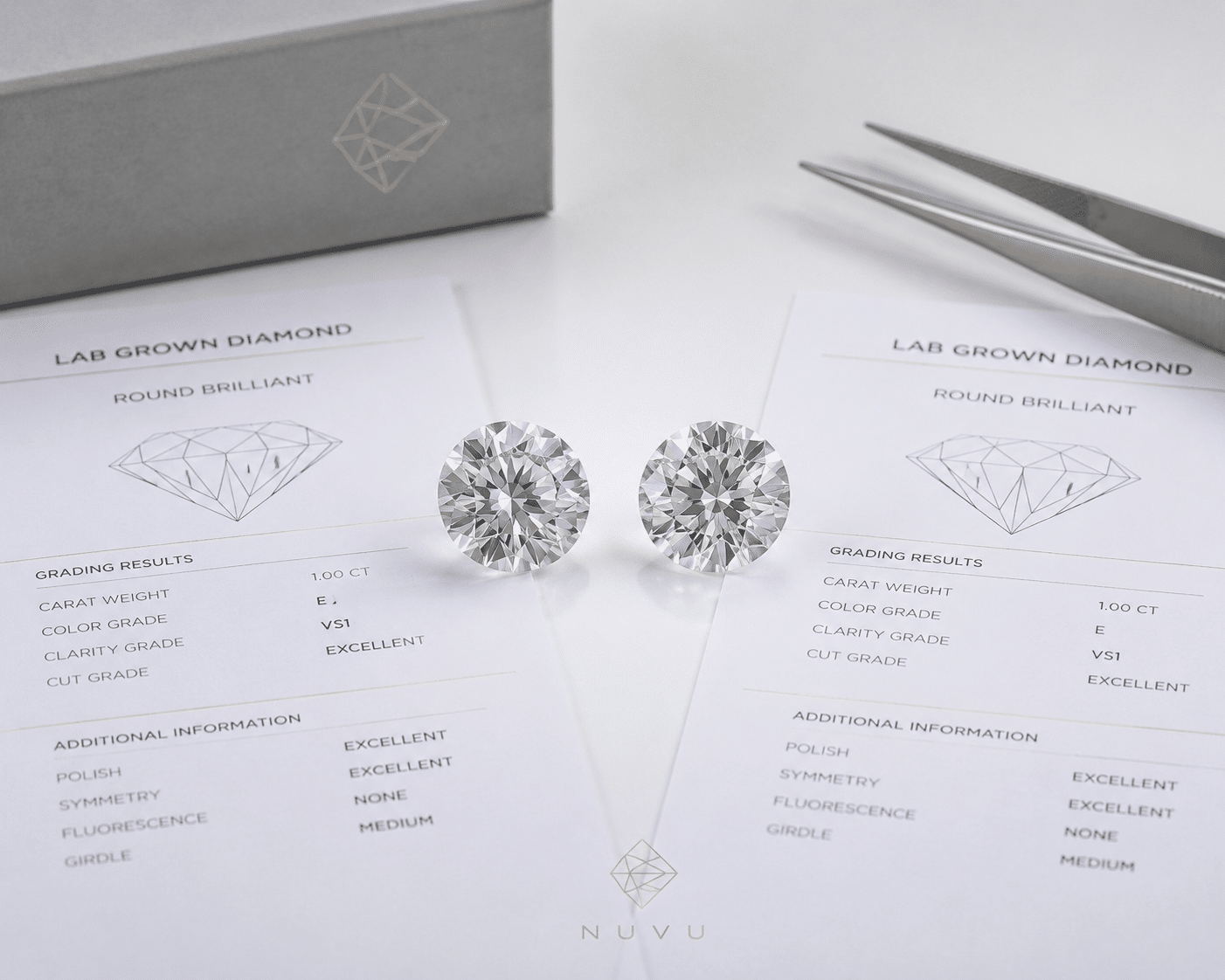
A wholesale buyer reviewing a lot of 20 round brilliants should check each stone’s report for identical color and clarity grades and ask for live photos or video to verify face-up color consistency. Two stones with the same G-color grade can appear slightly different under natural light. For matching pairs, that difference is a problem. The certificate gives you the grade. The visual confirmation tells you whether the grade holds up in practice.
Which Grading Reports Wholesale Buyers Should Prioritize (and Why)
Not all grading reports serve wholesale buying equally. The lab that issues the report affects how easily you can compare stones across suppliers, how smoothly your downstream retail clients accept the product, and how much time you spend verifying data. For wholesale buyers, the choice of grading lab should be driven by consistency, commercial acceptance, and practical cost, not by brand prestige alone.
IGI and GCAL: The Most Common Standards in Wholesale Lab-Grown Diamond Transactions
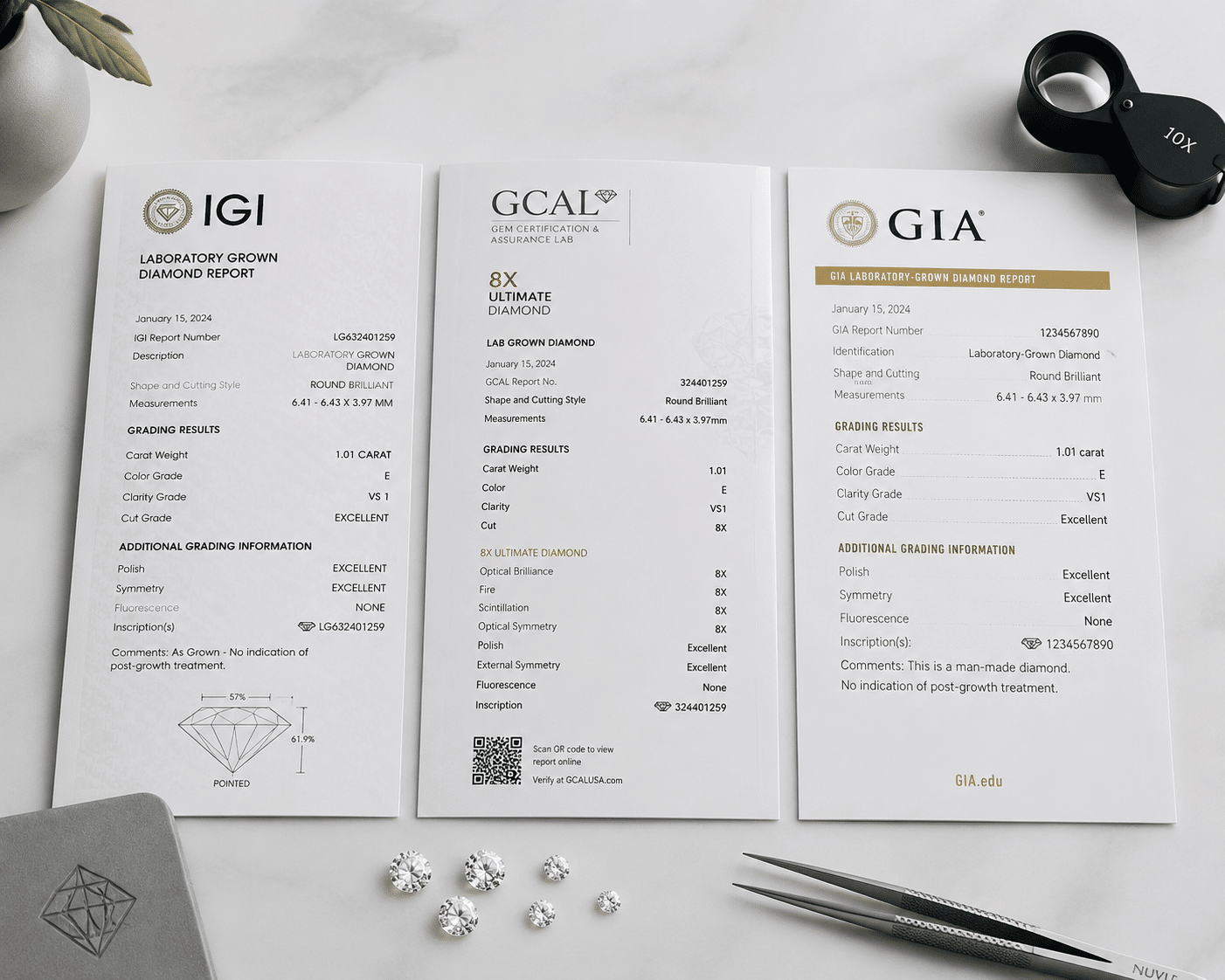
IGI dominates lab-grown diamond grading volume globally. Its reports are standardized across a wide range of suppliers, making it the most practical choice for wholesale buyers who need to compare stones across different sources. GCAL offers more specific cut-grading analysis and stricter proportion evaluation. Both are widely accepted by U.S. retailers and downstream buyers. GIA has entered the lab-grown grading space, but its reports are less common, cost more per stone, and add processing time. For volume wholesale buying, GIA’s limited availability and higher cost make it less efficient. IGI and GCAL are the practical defaults for most B2B transactions.
Why Report Consistency Matters More Than Lab Prestige in Wholesale
Wholesale buyers need repeatable grading. If one supplier’s stones are consistently graded within a lab’s tolerances and another supplier’s stones drift across colors or clarities within the same grade, the second supplier creates downstream risk. Two stones with the same report grade should look similar. If they do not, the grading is unreliable regardless of which lab stamped the report. A lab’s internal consistency matters as much as its name. A prestigious lab with inconsistent output is less useful for wholesale than a practical lab that delivers reliable, repeatable results across lots.
The Practical Tradeoff Between GIA and IGI for B2B Purchasing
GIA carries stronger brand recognition with some end consumers. Some retail buyers may specifically request GIA-graded stones. But GIA reports come with higher per-stone cost and slower turnaround. IGI reports are cheaper, faster, and accepted by the vast majority of trade buyers. The right choice depends on your downstream market. If your retail clients or their customers prefer non-GIA reports, then GIA may be a consideration despite the added cost. If you are selling primarily to trade buyers who prioritize efficient comparison and pricing, IGI is the more practical option. Many wholesale programs default to IGI and reserve GIA for specific high-value or consumer-facing orders.
Buyer Verification Checklist
Before selecting a grading lab for a wholesale program, verify three things. First, whether your downstream retailers or clients accept IGI or GCAL without pushback. Second, whether the supplier’s grading quality has been calibrated consistently across multiple lots. Third, whether the lab’s report includes cut grade parameters suitable for your target price point and accounts for lab grown diamond lead times. A mismatch between lab reputation and actual commercial acceptance creates friction that no certificate can fix.
Traceability and Documentation Standards in Wholesale Lab-Grown Diamond Sourcing
Beyond the grading report itself, wholesale buyers benefit from understanding the full documentation chain that supports a lab-grown diamond’s identity and traceability. A certificate is one piece of a larger documentation picture that may include origin statements, production records, and laser inscription verification. In B2B purchasing, the question is not merely whether a stone has a certificate, but whether the supplier can provide a clear, verifiable link between the stone, its documentation, and its production history.
Laser Inscription and Report Linking
Most lab-grown diamonds graded by IGI, GIA, or GCAL receive a laser-inscribed report number on the girdle. This inscription creates a physical link between the stone and its grading report. For wholesale buyers, this inscription serves a practical purpose: it allows any stone in inventory to be traced back to its original certificate without relying on packaging or memory. When receiving a lot, buyers should verify that each stone’s inscribed number matches its accompanying report. A mismatch may indicate a simple sorting error, but it could also signal a more serious documentation gap. A simple loupe check at 10x magnification is enough to confirm the inscription is present and legible. Buyers who skip this step risk mixing unverified stones into their inventory.
Production and Sourcing Documentation in the Supply Chain
Some wholesale buyers, particularly those supplying retailers with sustainability or transparency requirements, may need more than a grading report. They may need documentation about how the diamond was grown—whether by HPHT or CVD method—and where the production took place. While grading laboratories do not typically verify production method or origin as part of their standard report, some suppliers can provide additional documentation, such as a statement of origin from the manufacturer or a rough-to-polish record. Buyers should ask prospective suppliers what production documentation they can supply beyond the grading report. A supplier that can clearly describe its manufacturing process, provide consistent lot records, and offer traceability data demonstrates a level of operational transparency that supports downstream buyer confidence.
What to Ask Your Supplier About Traceability
When evaluating a new supplier, ask specific questions about the documentation chain. First, does every stone come with a laser inscription that matches the grading report? Second, can the supplier provide batch-level records linking stones to a specific production run or rough crystal lot? Third, for clients who require it, can the supplier furnish a statement of the production method (HPHT or CVD) and the country of manufacture? A supplier that can answer all three questions with clear documentation is better positioned to support traceable inventory. A supplier that cannot provide production documentation may still offer acceptable grading quality, but the buyer should understand the limits of what can be traced downstream.
What the 4Cs Tell a Wholesale Buyer (and What They Don’t)
The 4Cs are essential for any diamond transaction, but wholesale buyers must read them with different eyes. A consumer focuses on the grade. A wholesale buyer must focus on how that grade behaves across multiple stones and whether it reliably predicts visual performance. The 4Cs are useful. They are not sufficient.
Carat Weight: The One Stable Metric
Carat weight is objective, verified by the certificate, and directly influences price per carat. It is the most reliable data point on any report. Wholesale buyers can confidently use carat weight as a baseline for lot comparison and pricing. The tradeoff is that visual size depends on cut proportions and shape, not just weight. A well-cut 1-carat oval can appear larger than a poorly cut 1.10-carat round. Carat weight tells you the mass. It does not tell you how the stone looks on the finger.
Color and Clarity: Understanding the Grade Bandwidth Problem
A D-color stone from one supplier may appear slightly warmer than a D from another supplier. Both carry the same grade, but grading tolerances mean the actual color can vary within the grade range. The same applies to clarity. A VS1 stone may have a more noticeable inclusion than another VS1, yet both are reported as VS1. Wholesale buyers who treat color and clarity grades as absolute risk building inventory with noticeable variation. The safest approach is to know your market’s acceptable floor. If your downstream buyers require a true D-color look, order stones that comfortably sit at the top of the D range, not at the edge. Buying slightly above your minimum grade protects against grade drift.
Cut Quality: The Most Overlooked B2B Differentiation
Cut quality directly affects how a diamond looks. It determines brightness, lightness, and overall visual appeal. In lab-grown diamonds, cut can vary significantly even within the same “Excellent” grade. Two stones graded Excellent may perform very differently under retail lighting. Wholesale buyers who ignore cut parameters risk receiving stones that look dull or dead compared to better-cut competitors. A strong cut grade is a factor, but it should be evaluated alongside the stone’s specific proportion data and visual performance.
What to Check Before You Decide
For each stone in a wholesale lot, check three things. First, the reported proportions: table percentage, depth percentage, crown angle, and pavilion angle. These numbers tell you more about actual cut performance than the single letter grade. Second, whether the certificate includes a full cut grade or only proportion data. A full cut grade is preferable. Third, whether the supplier can provide video or photo to confirm face-up brightness. A stone with strong proportions on paper may still look flat in person. Visual confirmation is the only way to be sure.
Beyond the Certificate: What Wholesale Buyers Must Verify Independently
A grading report tells you what a lab measured under controlled conditions. It does not tell you how the stone performs under a retail spotlight, how it matches the stone next to it in a pair, or whether the supplier’s next batch will look the same. Wholesale buyers who stop at the certificate are making a fragile bet.
Visual Validation: Why Photos, Video, and Live Inspection Still Matter
No certificate captures face-up color, brightness, or how a stone performs in mixed lighting. Two stones with identical G-color VS1 reports can appear noticeably different side by side. One may face up warmer. Another may show a faint gray or brown tint that the lab’s grading environment did not emphasize.
High-resolution video is the minimum standard for wholesale buying. For larger purchases, a third-party inspection or in-person review can reduce the risk of accepting stones that look correct on paper but disappoint in person. If a supplier hesitates to provide clear video, that is a signal worth noting.
Batch Consistency and Color Matching for Pair and Set Sales
Retailers selling earrings, three-stone rings, or multi-stone designs need each diamond to match visually. Certificates with identical color and clarity grades from the same lab do not guarantee a visual match. Grading tolerances allow slight variation within a single grade, and two stones at opposite ends of that tolerance can look mismatched.
For pair or set sales, request the measurements of both stones and ask for a side-by-side photo or video under the same lighting. Compare face-up color, brightness, and any visible inclusions at the same angle. The certificate gets you close. Visual confirmation gets you to a match.
Practical note on certification limits for pairs: For any matched pair, the certificate’s information is only a starting point. In practice, even stones from the same rough crystal lot can show differences in light return or color tone when placed side by side. For this reason, many wholesale buyers consider side-by-side comparison under controlled lighting—daylight-equivalent bulbs, neutral background—more decisive than any single grade. When the goal is a visually consistent pair or set, the human eye under consistent light is a better judge than the certificate alone.
Supplier Grading Calibration and Return Policies
Ask every new supplier three questions. First, do they have an in-house grader who reviews stones before sending them to the lab? Second, do they batch-grade stones to catch variation before certifying? Third, what happens if a stone is returned because the grade does not match visual performance?
A supplier who has clear written policies on stone acceptance, return, and replacement is a supplier who understands wholesale reality. Vague answers or policies that shift all risk to the buyer are a practical warning. The relationship should protect both sides, not just one.
How to Verify This Before Buying
Run a reference purchase of 5–10 stones before committing to volume. Compare each stone’s certificate data against your own visual inspection. If possible, have an independent appraiser or gemologist review the stones as well. This small test reveals grading consistency, supplier responsiveness, and whether the certificate data holds up in practice. A supplier who passes this test is worth scaling with. One who does not is worth avoiding.
How to Build a Certification-Based Supplier Evaluation Process
When certification data becomes part of supplier evaluation rather than a substitute for it, wholesale buyers gain a repeatable framework for comparison. The goal is not to find a supplier with perfect certificates across every lot—that standard does not exist. The goal is to understand how consistently a supplier grades, where their grading tends to shift, and whether their documentation supports your downstream needs. A three-step process can turn scattered certificate data into a usable supplier profile.
Step 1: Request Certificate Samples Before Ordering
Before committing to any volume purchase, ask the supplier for sample certificates from multiple lots, ideally spanning different sizes and color ranges. Do not accept a single sample as representative. Examine the data for patterns: are stones in the G-H color range consistently graded, or do some appear to be borderline I? Do cut proportions cluster around similar numbers, or do they vary widely within the same grade designation? Look for unusual features such as unusually high or low crown angles, asymmetrical clarity plots, or polish and symmetry grades that seem lower than expected for the claimed cut grade. These anomalies are not necessarily disqualifying, but they suggest where inspection may need extra attention.
Step 2: Run a Small Test Order with Independent Verification
Order ten stones from the supplier and submit them to a third-party gemologist or appraiser for a blind comparison against the certificates. This step is the most revealing test of supplier grading consistency for B2B lab grown diamonds evaluation. The third-party evaluator grades color, clarity, and cut proportion independently, without seeing the original reports. Compare their findings to the certificate data. If no more than one stone shows a discrepancy outside acceptable tolerance—meaning no more than one color grade off or one clarity grade off—the supplier’s calibration is reasonable. If the discrepancy rate exceeds ten percent, meaning two or more stones are misaligned, the supplier’s grading process may be unreliable for volume buying. A single test order can save months of downstream returns and rework.
Step 3: Establish a Grading Quality Agreement
Once a supplier passes the test order, formalize the expectation in a purchase agreement. Specify what deviation is acceptable and what triggers a return or price adjustment. For color, a one-grade deviation from the reported grade is generally the outer limit. For clarity, the agreement should state that no inclusions should be visible to the naked eye under normal viewing conditions for stones graded VS2 or above. This protects both parties: the supplier knows what to pre-sort, and the buyer knows what to expect. The agreement should also include a clear process for resolving disputes, such as submitting the stone to a mutually agreed third lab for a tie-breaker grade.
What This Means in a Real Purchase
A buyer testing a new supplier orders ten stones and sends them to an independent gemologist. The gemologist finds one stone’s color appears darker than its G-color report suggests, measuring closer to H when viewed face-up under daylight-equivalent lighting. The buyer flags this to the supplier, who reviews the batch and confirms that those particular stones were graded at the low end of the G range. The buyer adjusts their inspection process to verify face-up color on all G-color stones before accepting delivery. The supplier agrees to pre-sort and re-grade that color range before shipping future lots. The discrepancy is not a deal-breaker, because both sides responded with process changes rather than blame.
Understanding the Legal Framework for Lab-Grown Diamond Disclosure
Beyond grading consistency, wholesale buyers benefit from understanding the legal and regulatory standards that govern how lab-grown diamonds are described and sold. In the United States, the Federal Trade Commission (FTC) provides guidance on the terminology used for laboratory-created diamonds. The FTC has clarified that terms such as “synthetic,” “laboratory-grown,” or “laboratory-created” are appropriate, and that the term “cultured” is not correct for diamonds—unlike pearls, which have a distinct FTC definition. This guidance is relevant for wholesale buyers who need to ensure their own product descriptions and downstream marketing materials comply with federal advertising standards. [1]
For B2B buyers, this means that any certificate or supplier documentation describing a stone should use clear and standardized terminology. A report that uses ambiguous or non-standard phrasing—such as “man-made,” “engineered,” or “created” without the word “laboratory”—may create compliance risk when the stone is resold to a retailer or end consumer. Reviewing supplier certificates for consistent use of FTC-recognized terminology is a simple but important step in supporting downstream sales. [1]
How Grading Laboratories Identify Lab-Grown Diamonds
The major grading laboratories—GIA, IGI, and GCAL—each have established procedures for identifying lab-grown diamonds and distinguishing them from natural stones. GIA, for instance, has published educational resources explaining that advanced spectroscopic and microscopic examination techniques are used to differentiate laboratory-grown diamonds from natural ones. [2] IGI likewise provides detailed identification services, including laser inscription of the report number and a statement of origin on every lab-grown diamond report. [3]
For wholesale buyers, this identification capability matters for two reasons. First, it adds a layer of verification that the stone is exactly what the supplier claims. Second, it supports downstream disclosure. A certificate that clearly identifies a stone as lab-grown using standardized and widely recognized methods helps a retailer fulfill its own disclosure obligations to consumers. Buyers should confirm that their supplier’s certificates include a distinct identification statement, such as “Laboratory-Grown Diamond” or “Laboratory-Created Diamond,” and that the stone is laser-inscribed with the report number as part of the grading process. [3]
Conclusion: Building a Certification Strategy That Serves Your Wholesale Business
Certification in a wholesale context is not one decision—it is an ongoing process. The difference between a buyer who manages certification well and one who treats it as a simple pass-fail check is the difference between a reliable inventory flow and a series of avoidable returns.
The Core Principle: Certificates Are Data, Not Decisions
A certificate is one input among several that a wholesale buyer should weigh before purchasing. It provides objective measurements—carat weight, color and clarity grades, cut proportions—but it does not tell the buyer whether the stone will match another stone in a pair, whether the face-up appearance justifies the grade, or whether the supplier will grade consistently on the next lot. Visual inspection, supplier calibration data, and clear commercial agreements matter just as much. A buyer who treats the certificate as the final word is buying with one hand tied behind their back.
When a grading report is provided, buyers can verify the report details through the issuing laboratory’s official report-check tool where available. This verification helps confirm the certificate data originates from the lab and supports accurate documentation throughout the wholesale supply chain.
How NUVU Supports Wholesale Buyers with Transparent Certification Data
Certification data loses value when it is hard to access, disconnected from the stone, or missing visual context. At NUVU, every stone comes with full digital access to its grading report, high-resolution video, and precise measurements to support pair and set matching. Wholesale buyers can compare stones side by side, verify grading consistency across lots, and build a repeatable buying process without having to pull reports from multiple sources or rely on guesswork. The goal is not to eliminate the buyer’s judgment—it is to remove the friction that makes judgment harder.
Next Step for Wholesale Buyers
Start by requesting certificate samples from your current suppliers and running them through the checklist in this guide. Compare the data, look for patterns, and flag any inconsistencies. If you find gaps in grading consistency or documentation quality, use the three-step supplier evaluation process to tighten your verification workflow. For buyers who want a more structured approach, reach out to NUVU’s wholesale team for guidance on building a certification-based sourcing program that fits your inventory volume and downstream sales requirements.
Frequently Asked Questions About Wholesale Lab-Grown Diamond Certification
Can I Return Stones if the Certificate Doesn’t Match Visual Inspection?
This depends entirely on the supplier’s return policy, and the answer varies significantly across suppliers. A transparent supplier may accept returns for stones where the certificate data is materially inaccurate or where the visual performance clearly contradicts the grade—for example, a stone graded VS1 that shows an obvious inclusion to the unaided eye. However, many suppliers charge restocking fees for returns that fall within normal grading tolerance. Always confirm return terms, restocking percentages, and dispute-resolution procedures in writing before ordering. If a supplier refuses to define their return policy or states that all sales are final regardless of grading accuracy, consider that a warning sign.
How Do I Know If a Supplier Is Faking or Inflating Certificates?
The first step is simple: cross-check every certificate against the issuing lab’s online verification system. IGI, GCAL, and GIA all provide digital verification portals where the report number and stone data can be confirmed. If the certificate number returns no match or the data differs from what you received, the document is invalid. Beyond that, watch for pricing that seems too good to be true for the claimed grades. A 1.5-carat D-color VS1 stone priced well below market averages may have an inflated or inaccurate certificate. If price and certificate data do not align, run an independent verification before buying. Repeated mismatches across multiple suppliers indicate a broader sourcing problem.
What’s the Difference Between a Full Report and a Mini Report for Wholesale?
Full reports include cut grade, proportion data (table percentage, depth percentage, crown and pavilion angles), a clarity plot diagram showing inclusion locations, and often fluorescence grade, polish, and symmetry grades. Mini reports—sometimes called abbreviated or card-style reports—show only basic data: carat weight, color grade, clarity grade, and occasionally a few key dimensions or proportions. For wholesale buying, full reports are generally preferred because they support downstream merchantability. A retail jeweler who receives a mini report may find it harder to present the stone to a consumer with confidence, and the lack of proportion data makes cut performance harder to evaluate. Reserve mini reports for lower-cost commodity stones where margin pressure outweighs the need for detailed documentation.
Should I Only Buy Stones with GIA Reports for My Retail Business?
Not necessarily. GIA reports carry stronger brand recognition with some end consumers, but IGI dominates the lab-grown diamond grading landscape for a reason: consistency across volume, acceptable turnaround time, and broad acceptance by many U.S. retailers and jewelry manufacturers. GCAL offers additional cut-grading detail that can be a differentiator. The right lab depends on your downstream market. If your retail clients specifically ask for GIA or you sell to consumers who are already familiar with the GIA brand, then GIA may be the more suitable choice. If your buyers are trade professionals or price-sensitive consumers, IGI and GCAL may be equally credible and more practical for volume purchasing. Testing the market can help determine which lab best fits your business needs.
A note on how to treat certificate data during ongoing supplier relationships: Even after a supplier has passed initial evaluation and established a grading quality agreement, it is worth periodically re-checking certificate consistency, especially after changes in the supplier’s manufacturing feedstock, staffing, or production volume. Grading drift can occur without a supplier noticing, and a single drift can undermine months of inventory matching. Periodically ordering a small test batch and running an independent comparison—say once per year, or every time the supplier changes their production method—is a low-cost way to confirm that the original calibration still holds. This is not a lack of trust; it is standard quality control in any manufacturing ecosystem where documentation supports downstream sales.
[1] Federal Trade Commission, “Guides for the Jewelry, Precious Metals, and Pewter Industries,” FTC, 2018, available at FTC Press Release.
[2] Gemological Institute of America, “How GIA Identifies Laboratory-Grown Diamonds,” GIA, accessed 2025, available at GIA.edu.
[3] International Gemological Institute, “Lab-Grown Diamond Reports,” IGI, accessed 2025, available at IGI Worldwide.
Disclosure: This article is for general educational purposes only. Diamond grading, pricing, availability, specifications, and seller policies can change, and readers should verify important details through grading reports, official laboratory tools, seller documentation, or qualified professionals before making a purchase decision. Laboratory-grown diamonds should be clearly distinguished from natural diamonds, and environmental or sourcing claims should be supported by specific documentation.