
In wholesale B2B diamond buying, a quoted lead time is one of the first promises a supplier makes—and one of the easiest to get wrong. A fast delivery window may feel like a competitive advantage, but speed without process often hides skipped quality checks, non-compliance with the wholesale lab grown diamond certification guide, incomplete documentation, or inventory that doesn’t actually exist. For buyers managing inventory, customs timelines, and client commitments, the gap between a promised date and a delivered stone carries real cost.
For the full framework, read Wholesale Lab-Grown Diamonds for Jewelers and Brands.
This article breaks down the actual lead time ranges for loose stones, matched pairs, custom cuts, and parcels, explains where delays really happen, and gives you the specific milestones and red flags needed to evaluate supplier reliability before you depend on it.
| Order Type | Realistic Lead Time (Business Days) | Common Hidden Risk |
|---|---|---|
| Single loose stone (in-stock, pre-certified) | 2–5 | Visual flaws not shown on the certificate |
| Matched pair (e.g., for earrings) | 5–10 | Supplier sends near-matches that differ in face-up appearance |
| Parcel (multiple stones, mixed specs) | 7–14 | Inconsistent quality across stones within the parcel |
| Custom cut (specific proportions requested) | 10–18 | Rushed cutting produces poor optical performance |
| First-time order from a new supplier | 7–14 | Faster delivery may indicate skipped validation or QC steps |
| International shipment (incl. customs clearance) | +2–5 extra days | Missing HS codes or incorrect declared value hold the shipment |
Quick Questions Before You Read
Q: If a supplier promises a 3-day lead time, is that a good sign?
Not necessarily. A very short promise on a complex order often means QC, certificate checks, or documentation steps are being skipped. Reliable suppliers give specific, step-by-step timelines, not just one fast number.
Q: What causes most lead time delays for loose stones?
The bottleneck is almost always internal—stone matching, certification queue, or quality inspection—not the courier. Express shipping can’t fix slow processing. Delays during customs for international orders are preventable with complete invoices and correct HS codes.
Q: How can I verify a supplier’s lead time before placing a large order?
Start with a small test order and track it against their written milestones (pick, certify, ship dates). Ask for historical on-time delivery data. A supplier who can’t provide a written timeline breakdown likely lacks process control.
Why Lead Time Is a Supply Chain Signal, Not Just a Shipping Estimate
Most wholesale buyers treat lead time as a simple question: “How long until it arrives?” That framing misses the point. Lead time is one of the most revealing signals a supplier sends about their operational maturity. A quoted timeline reflects not just shipping speed but inventory depth, sorting discipline, quality control throughput, and honesty. Reading it correctly separates reliable partners from risky ones.
What Most Wholesale Buyers Get Wrong About “3-Day Shipping”
A supplier who advertises “3-day shipping” is not promising a 3-day order. They are promising 3 days in transit—after the stone is picked, matched, certified, inspected, and packed. The real bottleneck is almost never the courier. It is whether the stone is already in stock, already graded, and ready to move.
When a supplier does not hold pre-sorted inventory, the timeline expands at every step: days to select a rough or identify a finished stone that meets the spec, additional days for lab submission if the stone is not pre-certified, more time for matching if the order requires consistency across multiple stones, and finally QC verification before anything ships. Express shipping covers only the last leg. A supplier quoting 3-day delivery while taking 10 days to prepare the order is not fast. They are just using a fast courier to mask slow operations.
Lead Time as a Proxy for Supplier Maturity
A supplier who can quote a specific, broken-down lead time—and consistently meet it—reveals several things at once. They have deep enough inventory to fill orders without sourcing after the fact. They maintain pre-sorted stock organized by carat, color, clarity, and cut grade, which means they can pull matching stones quickly rather than hunting through mixed lots. Their QC process is fast because it is routine, not reactive. And they have enough visibility into their own operations to give you a reliable number.
The opposite pattern is just as informative. A supplier who gives a single round number without decomposition, or who consistently delivers 5–10 days late for standard orders, is showing you that their process is opaque and their capacity is stretched. They may be cutting after the order, running a small inventory that cannot cover variations in spec, or simply not tracking where their time goes. None of these problems are fixable with a faster shipping label.
Red-Flag Check: When a Promise Sounds Too Perfect
An immediate “3–5 days” quote for a complex or multi-stone order is not confidence. It is a warning sign. Ask the supplier to decompose that number into specific phases: stone selection, sorting and matching, certification submission or verification, QC inspection, and final packing. A mature supplier can give you estimates for each step because they track them. A supplier who hedges, deflects, or cannot separate the components is likely guessing—and the risk of missed deadlines or quality surprises is real. If they will not share the breakdown on a first order, expect the same lack of transparency when something goes wrong.
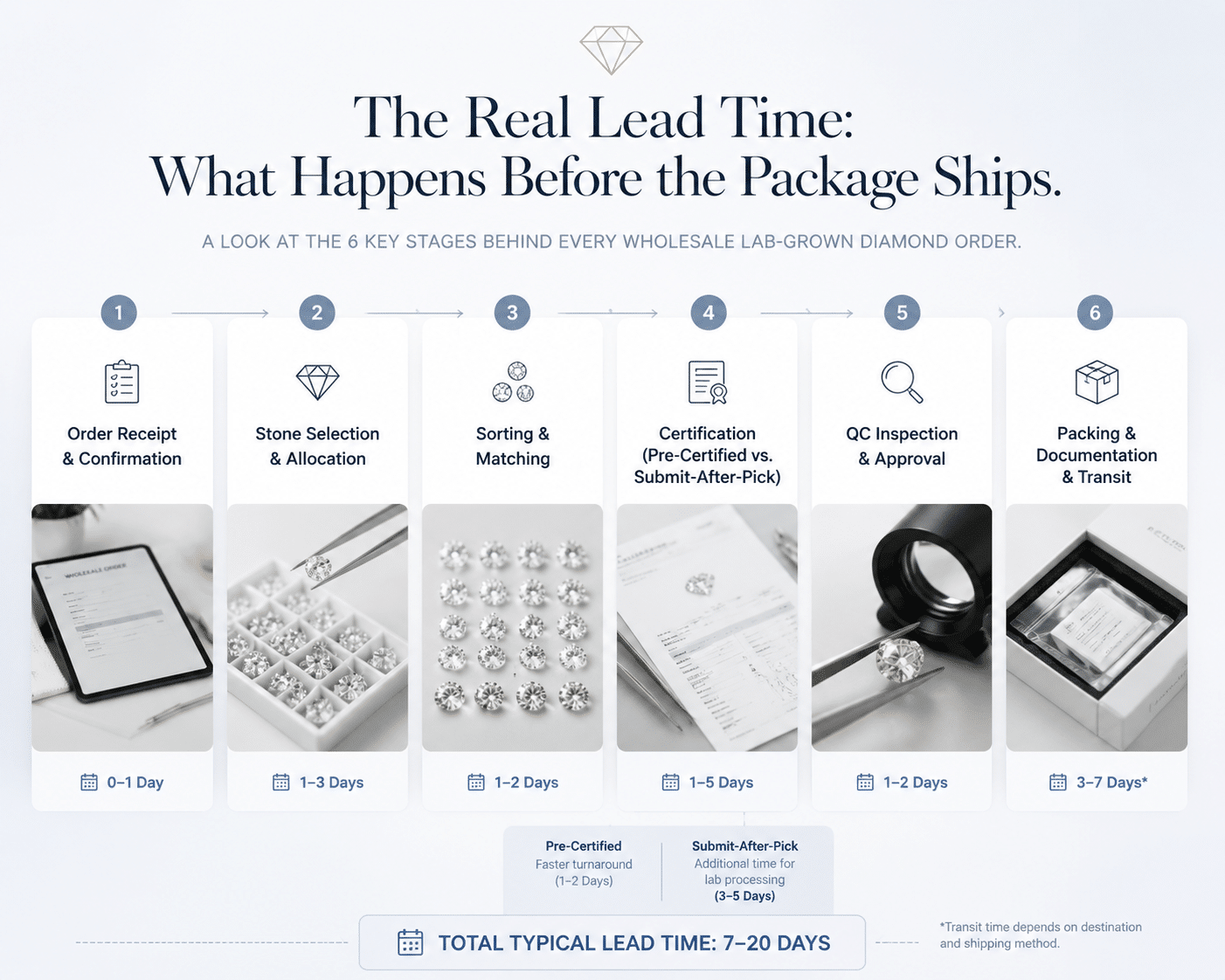
Primary Lead Time Drivers for Lab-Grown Diamond Wholesale Orders
Five operational factors determine how long an order actually takes. Each one can compress or stretch delivery timelines by days, and understanding which driver applies to your order is the first step toward setting realistic expectations.
Stone Availability and Pre-Sorted Inventory
The single biggest variable in lead time is whether the supplier holds the stone you need in finished, graded inventory. A supplier with deep, pre-sorted stock organized by carat range, color, clarity, and cut grade can pull and verify a stone in hours. A supplier who must source rough, cut to spec, or grade after receiving your order adds days or weeks to every step.
This also affects minimum order quantities. A supplier with limited inventory may accept a small order but take just as long to fill it as a larger one, because they still need to source or match the stones. Weight tolerance matters too. If your order requires stones within a tight carat range (e.g., 1.00–1.05 ct), a supplier with pre-sorted stock by weight bucket can fill it quickly. One who must cut to hit that weight window will take significantly longer.
Matching and Sizing: The Hidden Time Sink for Parcel Orders
For single-stone orders, matching is not a factor. For matched pairs, calibrated parcels, or any order requiring visual consistency across multiple stones, it becomes the dominant variable. Sorting through inventory to find two or more stones that match in color, clarity, and optical performance—not just on the grading report but under visual inspection—adds 3 to 10 business days depending on the spec and the supplier’s inventory depth.
The ratio of pre-matched inventory to bespoke matching determines where you land in that range. A supplier who holds pre-matched pairs or calibrated lots can quote shorter timelines. One who matches after the order starts the clock from zero. For tight tolerances, such as D–F color with VVS clarity, even a deep inventory may yield few matching candidates, pushing timelines toward the higher end.
Certification and Lab Submission Queues
A supplier who holds pre-certified inventory ships as soon as QC is complete. A supplier who submits stones to IGI, GIA, or another lab after picking the order adds 5 to 15 days for grading turnaround alone, not including shipping time to and from the lab. Lab submission queues vary by season and location, so the delay is not always predictable.
Pre-certified inventory has its own tradeoff. A stone graded months ago may not match the current visual standard of a freshly graded stone. But for lead time purposes, pre-certified stock is reliably faster. If lead time is your priority, confirm whether the supplier holds certified inventory or submits after order before you compare quotes.
Custom Specifications and Non-Standard Requests
Custom cutting, non-standard measurements, or special clarity requirements (such as VVS1/2 for a specific parcel) introduce iterative communication between your team and the cutting floor. Each round of feedback—approving a cutting plan, reviewing a rough yield estimate, confirming a measurement adjustment—adds days. Typical timelines for custom orders range from 10 to 14 business days, and can stretch further for complex shapes or uncommon specs.
The risk here is not just delay. Rushed custom orders under schedule pressure may produce stones that pass basic grading but have visible asymmetry, tilted crowns, or off-center tables. If you need custom specs, the lead time exists for a reason. Pushing for faster delivery on a custom order increases the odds of optical compromise.
Final QC, Packaging, and Documentation Prep
This step is routinely underestimated by suppliers. Each stone must be re-inspected for grade accuracy, measured for physical dimensions, photographed or video-captured for buyer approval, matched against its certificate, and packed for secure international shipping. Commercial invoices must include HS codes, stone weights, grade summaries, and certificate numbers.
A thorough QC and documentation process takes 1 to 3 days for most orders. A supplier who claims to skip this step or complete it in hours is not more efficient—they are cutting corners. Missing or inaccurate documentation causes downstream delays in customs clearance that far exceed the time saved by rushing the prep.
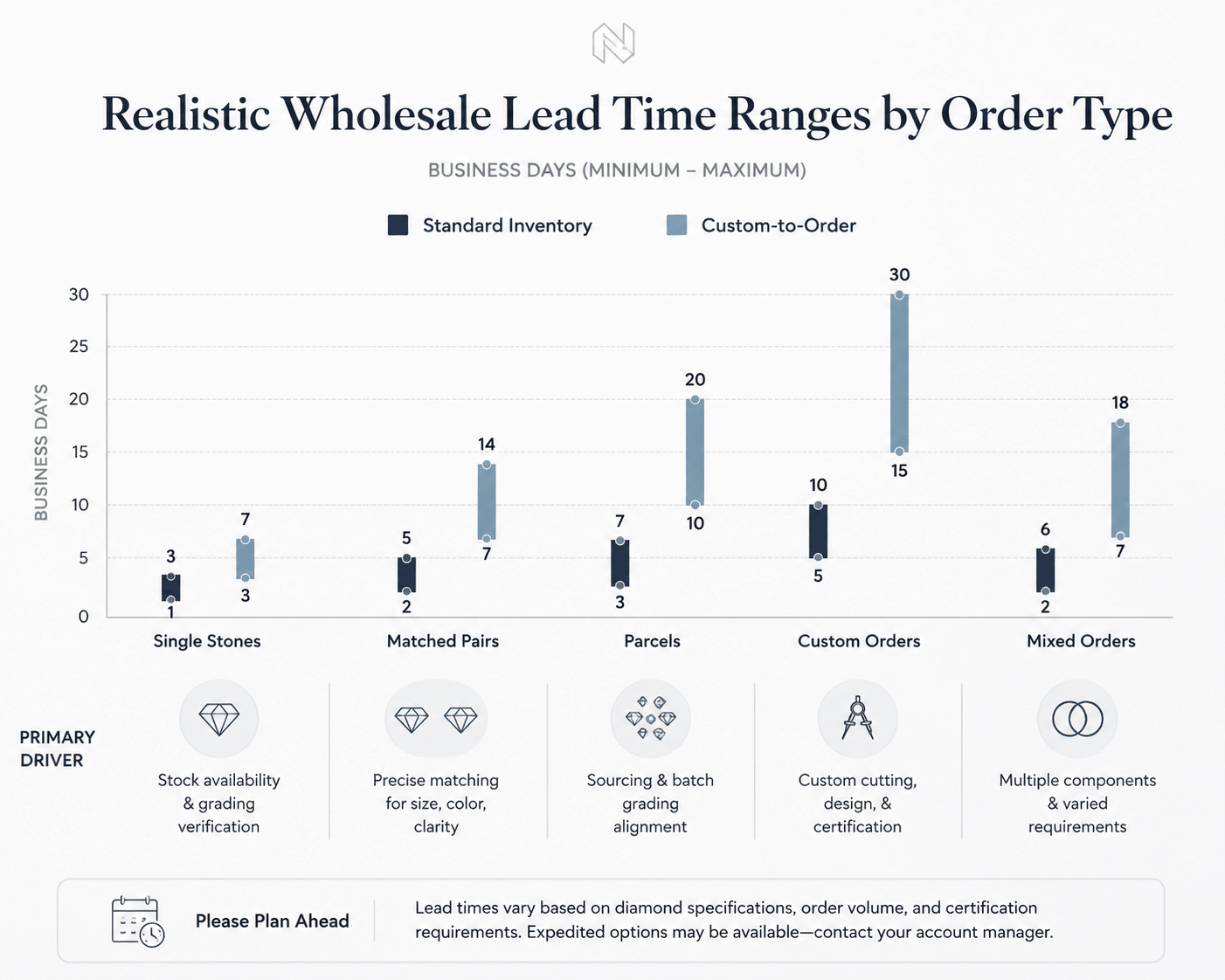
Component Breakdown Table: Realistic Lead Time by Order Type
– Standard loose stone, single stone: 2–5 business days. Primary driver: stone availability.
– Matched pair: 5–10 business days. Primary driver: matching and sorting.
– Custom cut or non-standard spec: 10–14 business days. Primary driver: custom cutting and iterative feedback.
– Parcel with certified stones: 7–14 business days. Primary driver: matching, grading consistency verification across the lot.
– Mixed order with custom and stock items: 10–18 business days. Primary driver: custom component determines the critical path.
These ranges assume a supplier with reasonable inventory depth and pre-certified stock. Add 5–10 days across all categories if the supplier must grade after the order.
How to Evaluate a Supplier’s Lead Time Promise
A quoted lead time is not a fact. It is a claim that deserves verification. The following framework helps B2B buyers separate realistic estimates from aggressive promises that create downstream problems.
Ask for a Written Lead Time Breakdown
A supplier who can separate estimated time for stone selection, matching, certification, QC, and packing has visibility into their own process. A supplier who gives a single number—typically “3–5 days” or “7–10 days”—without decomposition is hiding the structure of their timeline. The breakdown itself is useful, but the willingness to provide it is the real signal. If a supplier cannot describe their process in stages, they cannot manage it reliably either.
Compare Historical vs. Stated Lead Times
If you have placed orders before, compare the supplier’s stated estimate against actual performance over the last five to ten orders. A consistent gap of more than 3 to 5 business days is not an occasional exception. It is the real lead time. For new suppliers, ask if they can share a recent order timeline from a comparable buyer. A supplier who tracks this data will share it. One who does not is working without visibility into their own reliability.
Use a Small Test Order Before a Larger Commitment
A low-stakes first order is the most reliable way to evaluate a supplier’s actual lead time. It tests responsiveness, communication quality, QC thoroughness, and timeline accuracy without exposing you to large financial or inventory risk. A supplier who performs well on a small order is not guaranteed to scale, but a supplier who stumbles on a simple test order will almost certainly fail on a larger one.
Check for Communication Speed as a Lead Time Proxy
Communication speed during the quoting phase is a reliable predictor of order execution speed. A supplier who replies within hours to a pricing or availability question likely has clear processes and visible inventory. A supplier who takes 24 to 48 hours to respond to a simple inquiry is operating without real-time visibility or without dedicated account support, and that slower pace usually carries into order execution.
Buyer Checklist: Five Questions to Ask Before Placing an Order
1. “What is your lead time breakdown by step—stone selection, matching, certification, QC, and packing?”
2. “Do you hold pre-certified inventory, or do you submit stones for grading after the order?”
3. “What additional time should I expect for a matched pair, and do you hold pre-matched pairs?”
4. “Can you share a recent order timeline from a similar-sized order as a reference?”
5. “What is your protocol if the order is delayed beyond the quoted date—do you communicate proactively, and what options do I have?”
These questions test critical B2B diamond supply metrics such as transparency, process visibility, and accountability, referencing the [matched pair wholesale guide], and a supplier who answers them clearly and specifically is demonstrating the same discipline they apply to order execution.
When Faster Lead Time Hides Quality or Documentation Risks
A lead time that sounds too good to be true usually is. In wholesale diamond buying, speed often comes with a hidden cost — one that does not show up until the stones land on your desk. The buyer who focuses only on the delivery date may discover later that what arrived does not match what was ordered, or that the documentation needed to sell those stones is incomplete. Understanding where speed creates risk is the only way to evaluate whether a fast promise is a sign of efficiency or a warning.
The “Rush Out the Door” Problem
A supplier who quotes 1–2 day lead times for complex or matched orders is likely cutting steps, not eliminating inefficiency. The most common casualty is final QC inspection. Stones that should be checked for color consistency, clarity grade alignment, and measurement tolerance may ship without a thorough review. Certificate verification may be skipped. Supporting documentation — photographs, video files, or grading report copies — may be incomplete or absent. The buyer receives the package quickly, but the stones may not match the expected grade or visual appearance. For a wholesale buyer serving retail clients, that mismatch creates downstream problems: returns, exchanges, or a damaged reputation that no delivery speed can fix.
Short Lead Times and Certificate Irregularities
Pre-certified inventory is often assumed to be safe. But a stone with a valid certificate can still have marginal measurements, an off-color body tone, or poor optical performance that the report does not capture. Grading reports describe ranges, not subjective appearance. A supplier shipping fast from pre-certified stock may not have visually verified every stone against its report. The wholesale buyer who receives such a stone and ships it to a retail client risks losing that client’s trust. This is where speed without visual verification creates real liability. The report says the stone is within grade, but the stone does not look like it belongs in that grade — and the buyer is left holding the inventory and the explanation.
Custom Orders Rushed Through Cutting
Custom-cut stones produced under extreme schedule pressure are especially vulnerable. Rushed cutting can produce tilted crowns, off-center tables, or non-ideal proportions that still pass basic grading but fail a trained eye. The stone may meet the grade on paper while performing poorly in real light. For buyers serving retail clients who expect consistent optical performance — or for custom jewelry projects where the stone must sit correctly in a specific setting — this is a serious risk. The client sees the stone and does not like how it looks, and the wholesale buyer cannot point to the certificate as proof of quality because the problem is not the grade; it is the cut execution. A fast custom order is not a bargain; it is a gamble on whether the cutting team cut corners along with the stone.
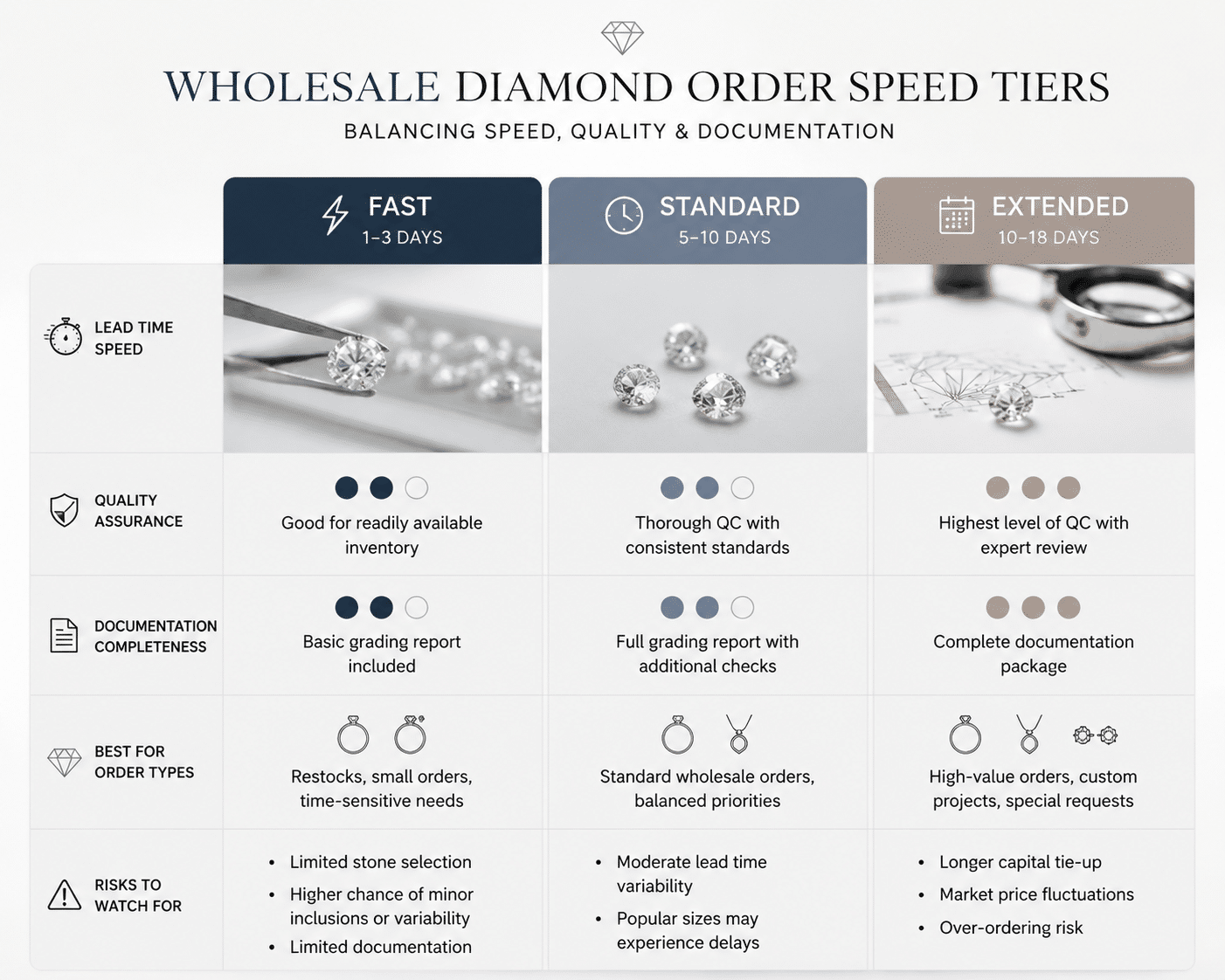
Tradeoff Decision Framework: Speed vs. Quality vs. Documentation
Not every order type demands the same tradeoff, and not every speed is a risk worth taking. The decision depends on what you are ordering, from whom, and how much documentation you need to pass the stone along with confidence.
Fast (1–3 days): Acceptable only for simple, pre-certified, single-stone orders from a known supplier. The stone is standard, the specs are common, and you have worked with this supplier long enough to trust their QC. Even then, confirm that documentation will be complete. Do not use this tier for matched pairs, parcels, or any order from a new supplier.
Standard (5–10 days): Preferred for matched pairs, parcels, or custom orders from a new supplier. This window allows time for proper sorting, matching, QC verification, and documentation preparation. It is the most reliable range for orders where consistency matters more than speed.
Extended (10–18 days): Recommended for complex custom orders, non-standard specs, or any situation where documentation completeness is critical. If the stones need to be placed into retail inventory and resold with confidence, the additional waiting time is an investment in quality assurance, not a delay.
The warning is consistent across all three tiers: the tradeoff bites hardest where the buyer is least aware of it. A fast delivery on a standard order from a trusted supplier is fine. A fast delivery on a custom order from an unknown supplier is a risk that almost always costs more than the time it saved.
Lead Time Realism by Order Type: A Decision Framework
Wholesale buyers need order-type-specific expectations, not a single number. A supplier who quotes the same lead time for a single stone and a matched parcel is either oversimplifying their process or hiding the real timeline behind an averaged estimate. The following framework provides realistic minimum and maximum ranges based on the operational demands of each order type. Use it to benchmark suppliers, plan inventory, and flag quotes that fall outside the normal window.
Single Loose Stones (Standard Inventory)
For a supplier with pre-certified stock and simple QC procedures, a single loose stone typically ships within 2–5 business days. The main variable is whether the stone is pulled from existing inventory and rechecked, or whether it must be graded after selection. A supplier who submits stones to a lab after the order is placed will add 5–10 days to this range. If a supplier quotes 1–2 days for a single stone, confirm that the stone is already graded, photographed, and ready to ship. If a supplier quotes 10+ days for a single stone without a credible reason, ask whether they hold the stone in inventory or source it after receiving the order.
Matched Pairs
Matching two stones by carat weight, color, clarity, and optical performance takes time. For a supplier with pre-matched inventory, 5–10 business days is realistic. If the stones must be cut to match, add 5–10 additional days. The hidden variable here is the supplier’s inventory depth for the specific spec. A supplier with a deep pool of similar stones can find a match quickly. A supplier with thin inventory may need to locate or produce a second stone after the first is selected, which stretches the timeline significantly. For high-value pairs or visible earring applications, do not accept a lead time under 5 business days unless the supplier can demonstrate that they hold pre-matched inventory for that exact spec.
Parcel Orders (Multiple Stones of Same Spec)
Parcel orders require sorting, grading consistency verification, and QC across a lot of stones. A realistic range is 7–14 business days. The tighter the spec tolerances — especially for high-color or high-clarity parcels — the longer the sorting process takes. A supplier quoting 3–5 days for a 20-stone parcel of D–F VVS stones is either overpromising or skipping the consistency check that makes the parcel valuable. For parcel buyers, the risk is not just late delivery; it is receiving a lot where half the stones are visually off-spec, forcing the buyer to re-sort and absorb the mismatch cost.
Custom-Cut or Custom-Measurement Orders
Custom orders are the most time-sensitive and the least compressible. A realistic minimum is 10 business days, and 10–18 business days is the standard range for a new design. The timeline includes cutting floor scheduling, rough selection, intermediate QC during cutting, final grading, and documentation generation. A supplier who quotes under 10 days for a custom order is likely repurposing an existing stone rather than cutting to your exact specifications, or is routing the stone through expedited processing that bypasses intermediate quality checks. For custom orders, the tradeoff is clear: a lead time that sounds too fast suggests the stone is not truly custom, and a lead time that is honest may be longer than you want — but it is the only safe bet.
Mixed Orders (Stock + Custom Components)
A mixed order — where part of the order comes from stock inventory and part requires custom production — should be quoted at the custom component’s lead time, not an average of the two. The stock portion may be ready in 2–5 days, but the total order cannot ship until the custom stones are complete. Realistic range: 10–18 business days. A supplier who quotes a blended number (e.g., “7 days”) without clarifying that the custom portion is the constraint is giving you an incomplete picture. Always ask: “Which component determines the ship date?” If the answer is unclear, assume the slower one.
What This Means for Your Inventory Planning
This framework is not just for evaluating suppliers. It is a planning tool for your own inventory management. If your standard order lead time for a given spec is 14 days, you should maintain at least 21 days of safety stock for that spec — covering the realistic range plus a buffer for variability. For top-selling specifications, 4–6 weeks of buffer inventory is prudent. Do not plan inventory based on the supplier’s best-case quote. Plan based on the realistic range for the order type, and adjust safety stock upward when lead time volatility is high (e.g., for custom orders or parcels from a new supplier). A supplier who delivers in 10 days 90% of the time and 18 days 10% of the time is reliable on average, but that 10% variance will disrupt your inventory if you do not plan for it.
Why Clear Documentation and Terminology Matter for B2B Compliance
For wholesale buyers who resell to retailers or directly to consumers, the documentation that accompanies each shipment carries compliance weight. The U.S. Federal Trade Commission has issued guidance reminding marketers that laboratory-grown diamonds should be clearly distinguished from mined diamonds in advertising and labeling to prevent consumer confusion.[3] This means that a grading report, commercial invoice, and any specification sheet should use unambiguous terms such as “laboratory-grown diamond” or “lab-grown diamond.”
In practice, a buyer who receives a shipment with documents that use vague or incomplete language—such as omitting the growth origin or using terms like “cultured” without clear context—assumes the responsibility for downstream disclosure. A grading report from a recognized laboratory such as GIA or IGI will explicitly state “Laboratory Grown” and may also note the specific growth method (HPHT or CVD) when it can be determined.[1][2] A B2B buyer’s ability to pass a compliant stone to a retailer depends on receiving this documentation unaltered and complete. A supplier who ships quickly but provides documentation that is ambiguous, missing the report’s origin disclosure, or lacking laser inscription matching is not saving time; they are creating a downstream audit trail issue that the buyer must resolve before the stone can be marketed.
For international wholesale orders, these documentation requirements extend to customs declarations. Commercial invoices should include both the stone’s classification as a laboratory-grown diamond and its HS code to facilitate clearance. Including grading report numbers or report copies alongside the invoice further supports accuracy. A supplier who treats documentation as optional or who asks whether the buyer “needs” certificates is operating at a compliance level that may not meet regulatory standards for finished goods resale. B2B buyers should treat complete, clear, and terminology-accurate documentation as a core component of the delivered product, not a value-add.
Practical Judgment: The Certificate as a Starting Point, Not a Guarantee
For the wholesale buyer, a grading report serves a critical role, but it also has limits that become clearer at scale. The certificate documents weight, color, clarity, and often a cut grade—parameters that allow a buyer to filter candidates. But it does not capture proportions in full detail, optical symmetry as perceived by the human eye, or the subtle body tone differences that matter when stones are placed side by side in a retail setting. Two stones with the same GIA or IGI grade may appear noticeably different in real light due to a 0.1-millimeter difference in crown angle or a slight variation in table size that remains within the graded range. This is not a defect in the certificate; it is a natural limit of grading by ranges. The practical consequence for wholesale buyers is that a certificate-based shortlist should be followed by video review, proportion verification, or, for large parcels, a visual audit of representative stones. The report narrows the field, but the final decision on acceptance still depends on visual performance and physical measurements in relation to the order’s requirements.
When a grading report is provided, buyers should verify the report details through the issuing laboratory’s official report-check tools where available. For stones ordered with specific visual or measurement requirements, the final acceptance decision should include a comparison of the stone’s physical appearance against the report data.
Geographic and Customs Considerations in International Lead Times
For U.S. buyers sourcing from China-based suppliers, the most common source of delay is not the cutting floor or the shipping carrier. It is customs clearance. Understanding how geography, supplier location, and documentation quality affect total lead time is essential for setting realistic expectations — and for distinguishing between a supplier who ships efficiently and one whose packages get held up repeatedly.
Transit Time vs. Customs Clearance
Express freight from Shanghai to Los Angeles typically takes 2–3 days. A FedEx or DHL package can reach a U.S. city within 72 hours of leaving the supplier’s facility. But customs clearance can take 1–5 days depending on documentation accuracy, value declaration, and broker quality. Many buyers assume a delay is in transit when it is actually in customs. A package that took 10 days to arrive did not spend 7 days on a plane. It arrived in 3 days and spent 7 days waiting for clearance. The distinction matters because the fix is different — faster shipping does not solve a documentation problem. Always ask your supplier for the date the package left their facility and the date it cleared customs, not just the delivery date.
How Supplier-Location and Consolidation Affect Timelines
A supplier who ships directly from the cutting center may get the package out faster than one who consolidates orders across multiple facilities. Consolidation adds 1–3 days for gathering, repacking, and documenting multiple orders into a single shipment. However, consolidation can also improve documentation consistency if the consolidator is experienced with international shipping requirements. The tradeoff is a moderate time increase in exchange for potentially fewer customs delays. Evaluate the supplier’s shipping model: do they ship from a single location, or do they consolidate? If they consolidate, ask for the consolidation window and factor it into your timeline. A supplier who cannot tell you whether they ship direct or consolidated likely does not have clear visibility into their own logistics.
Documentation Completeness as a Customs Accelerator or Blocker
Customs clearance speed depends almost entirely on paperwork accuracy. Commercial invoices that lack Harmonized System (HS) codes, contain incorrect value declarations, omit certificate numbers, or use vague shipment descriptions can trigger manual review, which adds 5 or more business days to clearance. Incomplete documentation is the single most preventable cause of delay. Reliable suppliers prepare complete, verified paperwork before shipment. They know the correct HS codes for lab-grown diamonds, declare values that match purchase orders, and attach certificate files as a matter of routine. If a supplier asks whether you need documentation, that is a red flag; a wholesale diamond supplier should assume documentation is always required.
Customs Pre-Check: What to Verify Before Shipment
Before a package leaves the supplier’s facility, confirm these four items to avoid customs delays:
– Are commercial invoices complete with HS codes, stone weights, grade summaries, and certificate numbers?
– Are certificate files (PDF or images) attached or provided separately so that customs can verify grade claims?
– Is the declared value consistent with both the grading report and the purchase order? Discrepancies trigger audits.
– Are there any current restrictions on lab-grown diamond imports into your country? U.S. import rules for lab-grown diamonds are generally clear, but regulations can change; verify before shipment.
A supplier who can answer all four questions without hesitation is handling customs as a standard part of their process. A supplier who hesitates or asks you to prepare the documentation is transferring risk to you. Plan accordingly, especially for your first few shipments.
How to Build Lead Time Accountability into Your Supplier Relationship
A supplier relationship without lead time accountability is a one-way risk. The buyer absorbs the delay; the supplier moves on to the next order. To change that dynamic, you need structure, documentation, and a clear feedback loop that makes timeliness a visible and measurable part of the partnership.
Written Lead Time Commitments in the Purchase Order
Verbal promises are not enforceable. Every purchase order should include two dates: an “Estimated Ship Date” and a “Final Ship Date.” The first reflects the supplier’s best projection. The second marks the outside boundary after which the delay becomes a problem for your business.
Include a brief clause describing the consequence of exceeding the final ship date. This does not need to be adversarial. A reasonable provision—cost-sharing on expedited shipping, a discount on the current order, or the right to cancel without penalty for delays beyond a certain threshold—keeps both sides aligned without creating friction. The point is not to punish. It is to ensure the supplier treats your timeline as a real commitment.
Progress Milestones and Status Updates
A lead time number is not the same as process visibility. For any order above a simple single stone, request status updates at key checkpoints: stone selection complete, matching stage finished, QC started, packing confirmed. These milestones let you confirm progress without chasing an estimated ship date and hoping.
A supplier who cannot provide a meaningful update after three to four business days likely lacks real visibility into their own workflow. That lack of transparency is itself a signal. The most reliable suppliers know exactly where each order is in the pipeline and can tell you without checking multiple departments.
Lead Time History as a Supplier Scoring Criterion
Pricing and quality dominate most supplier evaluations. Lead time reliability should be a third axis. Over a series of orders, track what was promised against what was delivered. A supplier who hits the quoted date 90 percent of the time is more valuable than one who hits it 70 percent, even if the second supplier’s pricing is slightly better. The inventory gaps and replanning costs from unreliable timelines often outweigh the savings.
Use a simple scoring system per supplier. Convert lead time performance into a numeric rating alongside quality and responsiveness scores. Over several quarters, the pattern becomes clear: which suppliers are worth a premium for consistency, and which are slowly eroding your operational stability.
Supplier Scoring Template
Track each order in a spreadsheet or internal system. The columns are straightforward:
– Order ID
– Promised lead time (business days)
– Actual lead time (business days)
– Over/under (in days)
– Reason for delay (if applicable)
– Overall rating (1–5)
Share this data with your supply chain team. Over time, it removes guesswork from supplier selection. A supplier with a consistent 1–2 day overage on standard orders is manageable. One who exceeds the quote by a week on every third order is a recurring liability.
When Lead Time Should Be a Dealbreaker
Not every lead time problem is a reason to walk away. But some patterns are so clear that continuing the relationship only compounds the damage. Knowing which patterns to treat as dealbreakers prevents wasted time and inventory disruption.
Systematic Overpromising Across Multiple Orders
A single missed deadline can be explained. Two in a row suggest a pattern. Three or more confirm it: the supplier is systematically quoting shorter timelines than they can deliver. If a supplier promises five business days but delivers in ten or twelve across multiple transactions, that is not an exception. It is policy.
The danger here is cumulative. If you plan inventory and customer commitments around a five-day lead time but consistently receive orders in ten to twelve days, your own fulfillment reliability erodes. The cost of that erosion—expedited shipping to your clients, stockouts on key specs, lost repeat business—often exceeds the margin you saved by choosing a lower-cost supplier in the first place.
Refusal to Provide a Time Decomposition
When asked for a breakdown of their lead time into selection, matching, certification, QC, and packing, some suppliers give a vague answer or refuse outright. That is a meaningful signal in the context of wholesale lab grown diamonds for jewelers and brands, indicating they may lack internal process visibility. They may be hiding capacity constraints. They may simply not want you to see how thin their inventory actually is.
None of these scenarios supports a long-term wholesale relationship. A reliable supplier knows how long each step takes and can share that information without hesitation. If the breakdown is not available, the process is not under control.
Lead Times That Exceed Market Norms Without Explanation
If a supplier quotes 20 or more business days for a standard single-stone order—something the market routinely delivers in two to five days—and offers no credible reason, you are looking at a supplier with shallow inventory, limited cutting capacity, or unresolved operational bottlenecks. The exception is a legitimate external constraint such as a certification backlog or a holiday closure, but only if the supplier proactively explains it.
Without a clear justification, an unusually long lead time usually means the supplier does not hold the stone and will begin sourcing or cutting only after receiving your order. That introduces not just timeline risk but also quality and matching risk, since the stone has not been verified before it was sold.
Dealbreaker Decision Framework
Use these thresholds to flag potential dealbreakers early:
– Single-stone, standard spec: Five or more business days above market norm → flag
– Matched pair: Ten or more business days above market norm → flag
– Custom order: Fifteen or more business days above market norm → flag
– Refuses to explain deviation: Hard pass
– Offers excuse without corrective action: Hard pass on repeat occurrence
These are not rigid rules. But they give you a repeatable way to separate suppliers who occasionally miss a target from those whose business model depends on promising more than they can deliver.
Understanding Supplier Constraints Without Excusing Them
A distinction worth making: a supplier who communicates a constraint proactively is different from one who hides it until after the order is placed. A supplier who says, “For this spec, our grading backlog currently adds 5 days, so the realistic timeline is 12 business days instead of 7,” is demonstrating transparency that protects your planning. A supplier who quotes 7 days and delivers in 12 without notice is creating a disruption. The judgment call for buyers is not whether a supplier faces constraints—most do—but whether those constraints are communicated, tracked, and factored into the promised timeline. A supplier who treats lead time as a negotiation rather than a measurement is likely prioritizing the sale over the delivery.
The Role of Pre-Certified Inventory in Lead Time Reliability
The distinction between pre-certified stock and post-order submission is one of the most important factors a buyer can verify before placing an order. A supplier who holds finished goods with certificates already issued by a recognized laboratory can proceed directly to QC and packing. A supplier who must submit rough or finished stones to a lab after the order is placed adds not only grading queue time but also the risk of grade variance. The stone that was expected to return an F color may come back as G, requiring renegotiation, a different stone selection, or a revised purchase order. This type of delay is not visible to the buyer until after the order has been accepted.
Official laboratory documentation is central to this process. The Gemological Institute of America, for example, notes that its synthetic diamond reports require specific identification language, including disclosure of the growth method when it can be determined.[1] Similarly, IGI provides standardized 4Cs grading for lab-grown diamonds and issues reports that distinguish them from natural stones.[2] A supplier who offers pre-certified inventory with this documentation expedites the timeline, but the buyer should verify that the report matches both the stone and the order spec. The U.S. Federal Trade Commission has issued guidance that lab-grown diamonds should be described clearly to prevent consumer confusion,[3] and complete certificate documentation supports compliance with those standards.
Terminology and Disclosure: Why Documentation Completeness Matters for B2B Compliance
For wholesale buyers who resell to retailers or directly to consumers, the documentation that accompanies each order carries compliance weight. The FTC has provided guidelines for how lab-grown diamonds should be described in marketing and advertising materials, emphasizing that terms like “cultured” or “lab-created” are more transparent than ambiguous alternatives.[3] A grading report that explicitly identifies the stone as laboratory-grown supports accurate labeling, which reduces downstream disclosure risk for the wholesale buyer.
GIA states that its reports for lab-grown diamonds use clear terminology on both the report and the laser inscription on the girdle, providing a permanent method of identification.[1] IGI follows a similar practice, with reports that specify “Laboratory Grown Diamond” prominently.[2] A supplier who ships pre-certified stones without report copies, omits the report number from the commercial invoice, or fails to confirm that the inscription matches the report is creating a compliance gap that the buyer must fill. Lead time that includes proper documentation preparation is not an inefficiency; it is a necessary step for the buyer’s own legal and commercial protection.
Growth Methods, Classification, and What the Certificate Should Show
Lab-grown diamonds are produced through two primary methods—High Pressure-High Temperature (HPHT) and Chemical Vapor Deposition (CVD)—and the grading report should reflect which method was used if it can be determined.[1] This matters for lead time because not all suppliers hold stones from both methods in pre-certified inventory. A buyer who has a preference for CVD or HPHT may find that the supplier needs additional time to locate matching inventory or must submit a new batch for grading. IGI, GIA, and other major labs include this information on their reports, so a supplier who holds pre-certified stock from a specific growth method can confirm availability quickly. A supplier who does not track inventory by growth method will struggle to give a reliable timeline for such a request.
For B2B buyers, the growth method can also affect downstream customer questions. Retail consumers increasingly ask about the origin process, and a report that documents the method provides a supportable answer. A supplier who cannot offer this level of documentation detail is limiting the buyer’s ability to answer those questions. Lead time should encompass not just the physical delivery but the completeness of the accompanying information that makes the stone sellable to an informed end client.
A grading report provides critical parameters, but for wholesale orders, the report alone does not guarantee visual consistency across multiple stones or confirm that a specific stone matches the buyer’s intended use. Buyers should request photographs, video, or physical measurement data alongside the certificate before finalizing acceptance, particularly for matched pairs, high-visible jewelry applications, or parcels where consistency across the lot is required.
Building a Lead Time Strategy That Protects Your Business
Evaluating individual supplier lead times is necessary but not sufficient. The goal is to design a system that absorbs variability so no single delay becomes a crisis. That means buffer inventory, sourcing redundancy, and regular performance review.
Buffer Inventory for High-Volume SKUs
For your top-selling specifications—say, 1-carat round diamonds in F–G color and VS1–VS2 clarity—maintain at least four to six weeks of buffer inventory. This is not safety stock in the traditional sense of covering demand uncertainty. It is a dedicated reserve to absorb supplier lead time variability.
The calculation is straightforward. If your typical order lead time is 14 business days, aim to hold enough stock to cover 21 to 28 business days of sales for that spec. That buffer protects you when a supplier hits 18 business days due to certification delays, QC backlogs, or shipping bottlenecks. Without it, a single extended lead time forces you to back-order your own customers or scramble for a last-minute replacement.
Dual-Sourcing as a Lead Time Hedge
For critical spec families, develop two approved suppliers. One should have deep inventory and moderate pricing. The second should offer faster lead times, even at slightly higher cost. This second supplier becomes your flex option when the primary supplier is delayed or at capacity.
The key is to activate the relationship before you need it. Place a small qualifying order with the backup supplier, confirm their lead time and documentation quality, and maintain an open line of communication. A backup supplier contacted for the first time during a crisis is not a backup at all—it is an unknown variable.
Quarterly Lead Time Review with Top Suppliers
Lead time performance drifts. A supplier who delivered consistently for six months may start slipping due to capacity expansion, staff turnover, or shifting inventory priorities. Without a regular review, you will notice the pattern only after it has disrupted your orders.
Schedule a quarterly call with each top supplier focused specifically on lead time data from the previous quarter. Discuss the root causes of any delays. Ask about planned improvements. Inquire about capacity changes, inventory additions, or certification workflow modifications that will affect future timelines. The conversation should be collaborative, not confrontational, but it must be data-driven. Use your tracking sheet as the agenda.
Lead Time Risk-Mitigation Checklist
Use this as a recurring operational review:
1. Identify your top five SKUs by volume and document their average lead time from each supplier.
2. Maintain four to six weeks of buffer inventory for those SKUs, calculated from the upper end of your suppliers’ lead time range, not the average.
3. Qualify a second supplier for each critical spec family and place a test order to confirm capability.
4. Track lead time performance monthly for every active supplier.
5. Schedule quarterly performance reviews with your top two to three suppliers.
6. Adjust safety stock based on lead time volatility, not just the average. If the variance between best and worst lead time is high, increase buffer proportionally.
Frequently Asked Questions (FAQ)
What is a realistic lead time for a first-time order from a new supplier?
For a standard order with a new supplier, expect 7–14 business days. This range accounts for relationship building, initial verification steps, and the supplier’s natural caution with an unfamiliar buyer. A first order that arrives within this window is on track. One that arrives significantly faster may have skipped steps.
How much faster is a pre-certified inventory order vs. a submit-after-pick order?
A supplier holding pre-certified inventory can save 5–10 business days compared to one who submits stones to a grading lab after receiving the order. That difference often determines whether you receive a shipment in one week or three. If lead time matters for your inventory planning, pre-certified stock is the stronger option.
Can I rely on express shipping (2–3 days) to compensate for slow internal processing?
No. Express shipping covers transit time only. If a supplier takes 10 days to pick, match, certify, and perform quality control, a 2-day shipping upgrade does not solve the underlying 10-day bottleneck. The internal process determines the timeline. Transit is rarely the limiting factor.
What should I do if my supplier consistently misses lead time commitments?
Start by requesting a root-cause breakdown. If the pattern is clear, adjust your safety stock upward to absorb the variability. If missed deadlines continue beyond two quarters, qualify a backup supplier and begin shifting volume. A supplier who cannot correct a repeated problem is unlikely to fix it without commercial pressure.
Is it normal for customs to add 3–5 days to a shipment from China to the US?
Yes, particularly for higher-volume shipments or those with incomplete documentation. Customs clearance of 2–5 days should be treated as a standard assumption, not a risk scenario. The most reliable way to reduce customs delays is to ensure the supplier provides complete commercial invoices with correct HS codes, consistent value declarations, and attached certificate files before the shipment departs.
Next Steps for Buyers
If you are evaluating lab-grown diamond suppliers for your wholesale business, lead time is one of the most revealing indicators of supplier reliability—but only if you know what to look for beneath the surface. The suppliers who quote honestly, decompose their timelines, and deliver consistently are the ones worth building a long-term partnership around.
For B2B buyers interested in evaluating NUVU’s wholesale capabilities, we offer clear, component-level lead time estimates with real-time inventory visibility. Contact our wholesale team to discuss your volume requirements, spec preferences, and desired lead time tolerance. NUVU’s process is built around making the comparison clearer: what the report shows, what the visual evidence reveals, and whether the stone fits the intended piece and order requirements.
[1] Gemological Institute of America, “Lab-Grown Diamonds: How They’re Made and Identified,” GIA.edu, accessed 2025. https://www.gia.edu/lab-created-diamond
[2] International Gemological Institute, “Lab-Grown Diamond Reports,” IGI.org, accessed 2025. https://www.igi.org/reports/lab-grown-diamond-reports
[3] Federal Trade Commission, “FTC Reminds Jewelry Marketers of Their Disclosure Obligations for Lab-Grown and Treated Diamonds,” FTC.gov, June 5, 2018. https://www.ftc.gov/news-events/news/press-releases/2018/06/ftc-reminds-jewelry-marketers-their-disclosure-obligations-lab-grown-treated-diamonds
Disclosure: This article is for general educational and B2B guidance purposes only. Diamond grading, pricing, availability, specifications, lead times, and seller policies can change, and buyers should verify important details through grading reports, official laboratory tools, seller documentation, or qualified professionals before making a purchase decision. Laboratory-grown diamonds should be clearly distinguished from natural diamonds, and environmental or sourcing claims should be supported by specific documentation. Lead time estimates provided are based on common industry practices and should be verified with individual suppliers.