- Shop
Diamonds & Jewelry
Loose Lab Diamonds Yellow Lab Diamonds Pink Lab Diamonds Blue Lab Diamonds Engagement Rings Fine Jewelry Shop All Loose lab-grown diamonds10 shapes · IGI, GIA or NGTC reports
- Wholesale
- Custom Design
- Education
- About
Matched Pair and Layout Stone Wholesale Guide: Getting Lab-Grown Diamonds to Match
- What to match, and how to specify it
- Why matching is harder than buying two similar stones
- Size: millimeters before carats
- Color: compare side by side
- Calibrated stones for standard settings
- Layouts for tennis bracelets, halos and eternity bands
- How to check matched goods on arrival
- What poor matching costs
- Matching tolerances you can write into an order
- Matching melee for pavé and halos
- Matching questions
- Send the tolerance with the order
Two oval stones arrive for a pair of earrings. Both reports say 1.00 ct, G, VS1, Excellent polish. One measures 7.7 × 5.6 mm and the other 8.0 × 5.4 mm. On the ear, one looks longer and slimmer than the other, and the customer notices before the jeweler does.
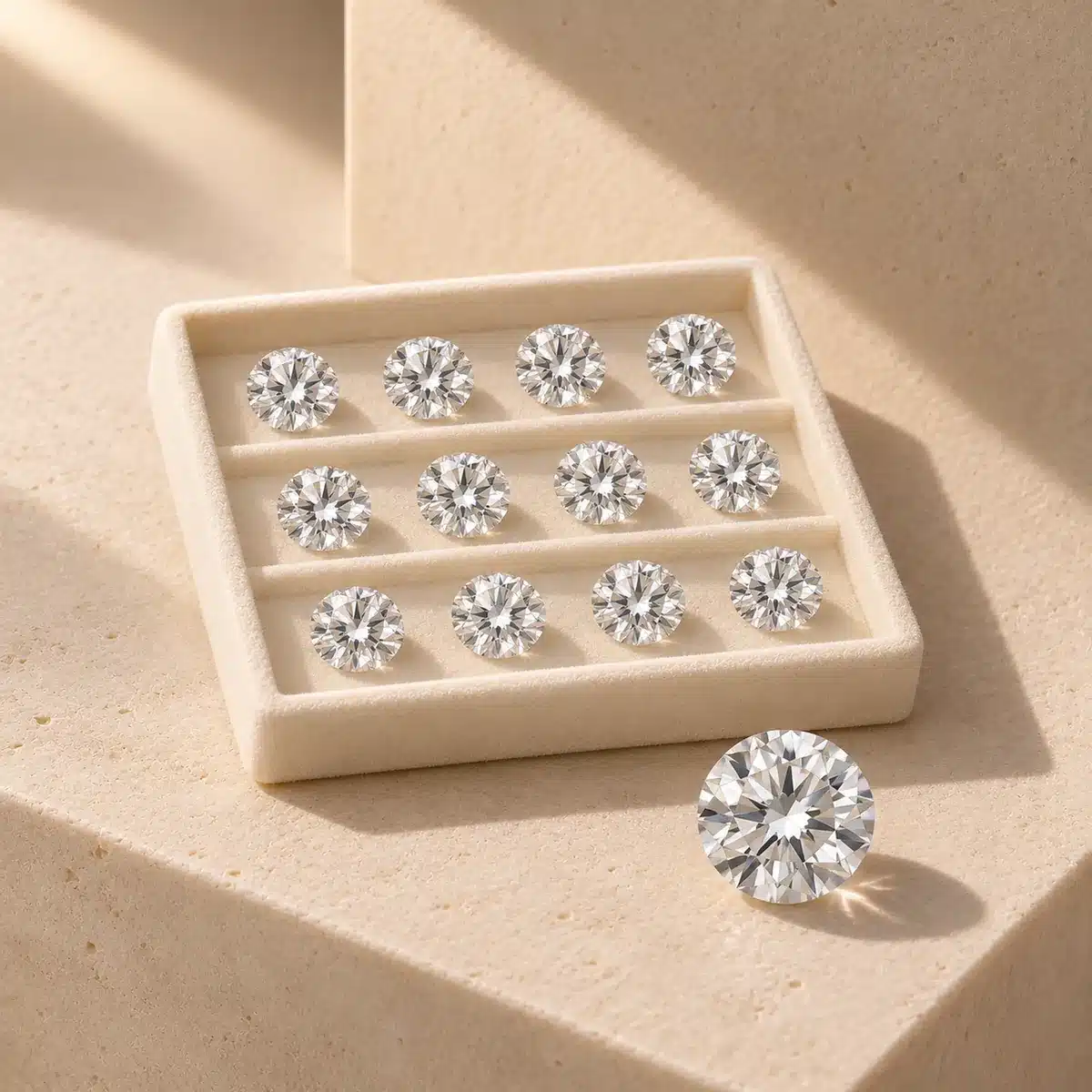
Two stones with identical report grades are not automatically a matched pair. Matching means the stones look the same side by side: millimeter size, outline, depth, face-up color, brightness and inclusion pattern. Calibrated stones are cut to set millimeter sizes so they fit standard settings. For both, write the tolerance you need into the order and check stones side by side on arrival, because reports grade single stones, not pairs.
What to match, and how to specify it
Why matching is harder than buying two similar stones
A supplier with a large stock of single stones still has to sort many of them to find good pairs. Reports were designed for individual stones, so a supplier that matches only by report grade often ships pairs that look uneven. Proper matching is done side by side, under consistent lighting, and with measurements checked.
Size: millimeters before carats
Two 1.00 carat ovals can face up at different sizes if one is deeper. For pairs and layouts, specify millimeter dimensions and a tolerance, not just weight. Step cuts such as emeralds and Asschers are especially sensitive to differences in corners and table outline.
Color: compare side by side
Color grades are bands. Two F stones can look a half grade apart next to each other. Ask the supplier to photograph or video candidates together, on a white background and under neutral lighting. Matching growth method and treatment status can also help color stability across a pair.
Calibrated stones for standard settings
Calibrated stones are cut to fixed millimeter sizes so they drop into standard mountings, halos, tennis pieces and eternity bands without adjustment. Tolerance is the key term. A tighter tolerance means more sorting, a higher price and sometimes longer lead time. Agree it in writing, along with how stones are measured.
Layouts for tennis bracelets, halos and eternity bands
Layouts need consistency across many stones, often in graduated sizes. Ask for:
- A layout plan with sizes per position.
- Color and clarity range for the whole layout.
- Photos of the full layout laid out before setting.
- Spare stones for setting losses, if your production needs them.
How to check matched goods on arrival
- Measure each stone and compare with the agreed tolerance.
- Lay pairs and layouts side by side on a white background.
- View under daylight-type lighting and, if relevant, under UV for fluorescence.
- Check that reports, where provided, match each stone.
- Photograph any mismatch before contacting the supplier.
What poor matching costs
Uneven earrings and patchy tennis bracelets are noticed by customers immediately. They lead to returns, re-setting costs and lost trust. Paying more for properly matched goods is usually cheaper than fixing a mismatch after setting.
Matching tolerances you can write into an order
Swipe the table to see more →
| Item | Example tolerance (agree your own) |
|---|---|
| Diameter (pairs) | Within a small fraction of a millimeter |
| Color | Same grade, or within one grade when compared side by side |
| Clarity | Eye-clean; similar inclusion visibility |
| Ratio (fancy shapes) | Same ratio within a narrow range |
| Depth | Similar, so stones sit at the same height |
Acceptance follows industry practice and the tolerances you agreed in writing, so clear specifications prevent disputes.
Matching melee for pavé and halos
For pavé and halos, consistency across hundreds of small stones counts for more than individual grades. Define size tolerance and quality range per parcel. See wholesale melee and calibrated stones.
Matching questions
Are two diamonds with the same grades a matched pair?
Not necessarily. Matching depends on size, outline, depth, face-up color and brightness, checked side by side.
What tolerance should I specify for calibrated stones?
It depends on your settings. Ask your setter what they need, then write that tolerance into the order.
Do matched pairs need two reports?
For larger stones, often yes. For smaller pairs and layouts, supplier grading with matching is common.
Why do matched pairs cost more?
Because the supplier sorts many stones to find matches and uses only those within tolerance.
Send the tolerance with the order
Send the setting, the millimeter size and tolerance your setter needs, and the color and clarity range for the pair or layout. Photos or video of the stones together before they ship can be agreed in the order. NUVU sorts and inspects matched and calibrated goods to industry practice against the tolerances agreed in writing. Send your requirements or WhatsApp / WeChat +86 191 1840 3930.
Sources

11+ years supporting global clients with lab-grown diamond product consultation and market analysis.
About NUVU. NUVU is the international brand of New Perspective Superhard Materials Co., Ltd. in Zhecheng, Henan, China. We grow HPHT lab-grown diamonds in-house and cut, polish and match stones in our own workshop.
Related Guides
Wholesale Loose Lab-Grown Diamonds in Bulk
Bulk loose lab-grown diamonds: center stones, matched pairs, calibrated melee and parcels.
Read more →WholesaleWholesale Loose Lab-Grown Diamonds for Jewelers
How jewelers buy wholesale loose lab-grown diamonds that sell: shape mix, size bands, quality ranges,…
Read more →WholesaleCustom Sourcing for Wholesale Lab-Grown Diamonds
How to request special lab-grown diamond specs: which requests are easy or hard, how to define a narrow…
Read more →