
For independent jewelers and large brands, ordering custom lab-grown diamonds as a wholesale buyer is fundamentally different from picking from stock. You are asking a supplier to grow and cut rough to your exact specifications, which introduces real variables around yield, cost, and feasibility, directly impacting wholesale lab grown diamond supply needs. Without understanding how these factors interact, a special request can easily turn into a delayed order or a batch that doesn’t match your inventory needs.
For the full framework, read China Lab-Grown Diamond Supply Chain Guide.
This article breaks down how to specify parameters that are actually achievable, how to assess whether a supplier can deliver on narrow tolerances, and what written confirmations protect your purchase. It equips you to distinguish between an operationally straightforward request and one that carries commercial risk, so you can make informed decisions before committing to a production run.
Understanding the true feasibility of a custom request begins with the supplier’s access to the right growing and cutting infrastructure. As the Federal Trade Commission (FTC) has clarified in its guidance on jewelry advertising, terms describing diamonds — including lab-grown diamonds — should be clear and non-deceptive, especially when making claims about their origin or method of production.[1] For the wholesale buyer, this principle is equally critical: the supplier’s claims about their ability to produce a specific spec must match what they can actually deliver, and the purchase order is the document that ensures that match.
| Request Type | Key Challenge | Buyer Protection Move |
|---|---|---|
| Standard shape, wide tolerance | Low technical risk; mainly logistics | Confirm batch consistency (±0.05mm for calibrated melee) |
| Narrow color/clarity (D-F, VS1-VS2) | 15–30% cost premium due to low rough yield | Reject quotes below this premium; request paid sample |
| Unusual shape (e.g., kite, shield) | Requires specific rough crystal habit; longer lead time | Ask which shapes the supplier has actually cut before |
| Calibrated sizes for setting | ±0.05mm width tolerance required; prong vs. bezel matters | Specify exact dimensions and tolerance in purchase order |
| Volume reduction to 25–100 stones | Per-stone cost drops 20–30% between 25 and 100 | Negotiate based on yield, not just per-carat price |
Quick Questions Before You Read
Q: How do I know if a supplier can actually do a custom run?
Send a sample specification before committing. A reliable supplier returns a written, parameter-by-parameter confirmation (e.g., “depth 62%”) rather than a vague “we can do that.”
Q: Why does a narrow color grade cost more for lab-grown diamonds?
Because rough material is not homogenous. Achieving D-F with VS1-VS2 significantly reduces yield from each crystal, typically adding 15–30% to the cost. A quote below that range signals high risk of grade failure.
Q: What is the single most important detail in a custom purchase order?
Measurable tolerances for every parameter: shape, dimensions (with ± range), color/clarity grade with exclusions, and cut angles. Without these, you have no protection if the finished goods do not match your needs.
Q: Should I order the full MOQ right away?
No. Always request a paid sample first. A supplier who refuses or hesitates to provide a sample likely cannot meet your specifications at production scale.
Understanding Custom Sourcing: When Standard Inventory Isn’t Enough
Standard wholesale buying means picking from what a supplier already has in stock. You review a parcel, select stones that fit your general quality range, and move forward. Custom sourcing flips that process. Instead of choosing from existing inventory, you specify the exact dimensions, cut parameters, color and clarity ranges, and ratio tolerances that your collection requires — and the supplier must produce stones to match those specs from rough.
The question is not whether a supplier says yes to your request. Almost all of them will. The question is whether they can actually execute. A supplier who treats custom sourcing the same as stock picking is setting you up for mismatched stones, delayed timelines, and inconsistent parcels.
The Scenario That Changes Everything: From Inventory Picking to Production-Driven Sourcing
Custom sourcing becomes necessary when your design specifications go beyond what is commonly available in polished inventory. The most common scenarios include calibrated melee layouts — for example, requiring 0.4 to 0.6 millimeter stones for micro-pavé, where even a 0.1 millimeter variation creates visible gaps in the setting. Unusual fancy shapes such as lozenges, hexagonal step cuts, or kite-cut side stones also fall outside most standard stock, because their facet geometry and rough requirements differ significantly from rounds or common fancies like princess and cushion cuts.
Narrow quality windows create a similar challenge. A request for D-F color with VS1-VS2 clarity in a specific fancy shape, combined with tight crown and pavilion angle requirements, leaves little room for the supplier to substitute rough. Every stone must land within a narrow grading band, which means the rough itself must start with above-average color and clarity and be cut to precise proportions.
Collection-specific demand adds another layer. If you are sourcing for a bridal line where every stone must have a specific table percentage or depth tolerance to match a shared setting design, the supplier cannot mix stones from different cutting batches or rough sources without introducing dimensional drift.
The operational complexity jumps sharply when you move from selecting polished inventory to specifying parameters that a factory must produce to order. This shift changes everything about lead time, pricing, and risk.
Operationally Easy vs. Commercially Difficult: A Scenarios Comparison Guide
Not all custom sourcing requests carry the same level of difficulty. Understanding where your request falls on the spectrum helps you set realistic expectations and evaluate supplier responses more accurately.
Operationally easy requests share common characteristics: high volume, simple shapes, and wide tolerance ranges. A request for 1.0 carat round brilliants in G-H color with VS clarity, with no strict ratio constraints, is straightforward. The supplier can pull from a broad rough inventory, cut with standard parameters, and expect a high yield. Errors are unlikely, and stones that fall slightly outside the spec can be absorbed into another order.
Commercially difficult requests involve narrow color and clarity windows combined with specific carat weights and calibrations. A request for 0.7 carat elongated radiants, E color with I1 clarity, a length-to-width ratio between 1.45 and 1.50, and a tight depth tolerance is a different proposition entirely. The yield from rough drops sharply because the rough must be elongated rather than boxy, the clarity window eliminates much of the available material, and the specific ratio limits the number of stones that can be cut from each piece of rough. Matching multiple stones in a single parcel adds further time and requires a larger and more varied rough inventory.
The difficulty is not theoretical. A supplier who accepts a difficult request without discussing yield expectations, lead time adjustments, or pricing premiums is likely underestimating the work. A supplier who explains the yield constraint and quotes a realistic timeline and price understands what they are agreeing to.
Buyer Verification Checklist
Before placing any custom order, request a written breakdown of the rough-to-polished yield expectation for your specific request. A supplier who can estimate the yield percentage and set a realistic timeline based on that estimate likely has direct production experience. A vague “yes” without a yield or timeline estimate is a risk signal, regardless of how confident the supplier sounds.
Confirm the following in writing before committing: the expected lead time from order to shipment, the expected carat weight range after cutting (which may differ from your target if yield is lower than anticipated), and the supplier’s return policy if the finished stone does not meet the agreed specifications. Verbal assurances do not protect your order. Written confirmation creates a verifiable standard.
How to Judge a Supplier’s Real Custom Sourcing Capability
When every supplier says yes, the buyer’s real job is separating execution from reassurance. The observable signals are not in the sales pitch. They appear in how the supplier responds to specific questions about feasibility, yield, timeline, and process.
The “Yes” Trap: Recognizing Generalized Overpromise in B2B Communication
Some suppliers accept every request without clarifying feasibility. A broad statement like “we can do any shape, any size, any quality” sounds reassuring but often signals low specialization, lack of direct factory access, or a plan to source from multiple unidentified vendors. The risk is not that the supplier fails to deliver something. The risk is that they deliver inconsistent stones from different sources with no single lot number, making it impossible to repeat the same spec for future orders.
A capable supplier responds differently. They ask clarifying questions before committing. They want to know your exact dimensions, ratio ranges, quality tolerance, and intended setting type. They may ask whether the stones will be set in prongs, bezels, or channels because the setting affects acceptable tolerance for width and depth. They do not say yes until they understand what you actually need.
The difference is not subtle. One supplier accepts your request and figures out the details later. The other checks feasibility first and gives you a realistic answer. The first approach introduces risk. The second approach builds trust.
Six Specific Questions That Separate Real Capability from General Reassurance
When evaluating a supplier for custom sourcing, ask these six questions directly. The answers should be specific, not general.
What is your typical rough-to-polished yield for this exact specification? A supplier who knows the yield can estimate cost and timeline. A supplier who cannot answer has not cut this spec before, or is not working directly with rough.
What is your lead time for a first-batch sample? A sample run before full production lets you verify dimensions, color, and clarity before committing to a larger order. A supplier who cannot provide a sample of their private label lab grown diamond supply or avoids setting a timeline for one is not ready for your spec.
Can you provide a single lot number for matched stones? A single lot number means the stones came from the same rough selection and cutting batch. Multiple lot numbers mean the supplier combined stones from different runs, which increases the risk of dimensional or color variation.
What is your process for handling out-of-tolerance stones? Ask for the specific policy, not a vague assurance. Do they replace stones at their cost? Do they discount them? Do they expect you to accept them? The answer tells you how much risk you are carrying.
Can you provide inspection videos or proportion diagrams before shipment? Visual documentation before shipping allows you to reject non-conforming stones before they reach your workshop. A supplier who only provides images after shipment has already transferred the risk to you.
Do you cut this shape in-house, or do you outsource this specification? In-house cutting means the supplier controls the process from rough selection to finished stone. Outsourcing introduces an additional vendor layer, which can affect consistency, timeline, and accountability.
What to Check Before You Decide
Ask the supplier to share a sample matching report, photo set, or video of a previous order with specifications similar to yours. If they cannot produce visual documentation of past custom runs, their track record is not verifiable. A short, old, or vague portfolio is a warning sign. A supplier who has executed similar custom work before will have documentation ready. A supplier who is saying yes and planning to figure it out later will not.
For buyers evaluating multiple suppliers, it is worth comparing both the answers to these questions and the confidence with which they are given. A supplier who provides specific, documented answers for most of these points is likely operating with direct production control. A supplier who gives general assurances or avoids detailed responses may be relying on a broader network rather than their own capability. In custom sourcing, the distinction matters because accountability is clearer when the supplier controls the rough selection and cutting process directly.
The Critical Role of Rough Diamond Inventory in Custom Sourcing Precision
No amount of cutting skill can compensate for the wrong rough. Custom sourcing precision begins with the raw material. If the supplier does not have access to the right rough in the right crystal habits and quality ranges, the finished stones will be a compromise, not a match.
Why Rough Inventory Determines Feasibility: The Match Between Rough and Final Spec
Every polished diamond starts as a piece of rough with specific crystal habit, clarity zoning, and color distribution. To produce a 0.7 carat elongated radiant with a length-to-width ratio between 1.45 and 1.50, the rough must meet a minimum weight requirement — approximately 1.4 carats, depending on shape and expected yield — and it must have the correct crystal habit. Elongated rough produces elongated stones. Boxy or irregular rough forces the cutter to reduce the ratio or accept a lower polished weight.
The same logic applies to clarity. If your spec requires VS1-VS2 and the rough contains inclusions concentrated near the center, the cutter cannot avoid them while preserving dimensions. The stone may end up with a lower clarity grade, a smaller size, or a different shape than requested.
A supplier who does not hold rough or does not control their rough selection cannot guarantee dimensional precision. They can only cut what they have. The risk is that the final stone is shaped to the rough available, not to your spec. The buyer accepts whatever fits.
How Batch Production and Consistency Tolerance Affect Multi-Stone Orders
For single-stone orders, the main concern is matching the requested spec. For multi-stone orders, consistency becomes the metric that matters most. Stones in the same parcel must be visually and dimensionally interchangeable. The tolerance for width, length, depth, and culet alignment is measured in microns, not millimeters.
For calibrated melee or accent stones, a width variation of ±0.05 millimeters across a batch of 100 stones is a reasonable standard for many settings. A supplier who cannot hold that tolerance is unlikely to be suitable for pavé layouts or channel settings where visible gaps or overlaps become obvious once the stones are mounted.
Batch production consistency depends on three factors: the homogeneity of the rough lot, the precision of the cutting equipment, and the inspection process. A supplier who cuts from a single rough lot and inspects every stone against a calibrated measurement grid will produce more consistent results than one who batches stones from multiple rough sources and spot-checks dimensions.
Ask for the supplier’s standard tolerance range for the specific calibration you need. Do not rely on their general published range, which may be wider than what they can hold for your particular spec.
Stone-to-Setting Fit Check
Before ordering, provide your stone-setter or CAD designer with the supplier’s stated tolerance range. If the tolerance is wider than what your setting design requires, you need to verify that the supplier can hold a tighter range for your specific order. A prong setting typically tolerates ±0.1 millimeters because the prongs can adjust slightly. A bezel setting requires ±0.05 millimeters or tighter because the metal frame does not flex. If the supplier’s general tolerance falls outside what your setting needs, ask for a written commitment to the tighter range before placing the order.
Narrow Quality Windows: What B2B Buyers Should Expect and Negotiate
A narrow quality window is not a small request. It is a fundamentally different commercial proposition than buying within standard SI or near-colorless ranges. Understanding why that difference matters — and how to negotiate around it — separates buyers who get consistent results from those who repeatedly chase replacements.
The Cost of Precision: Pricing for D-F vs1-vs2 Windows vs. Standard SI Ranges
The premium for a narrow window is not arbitrary. It is driven by yield. When a supplier accepts a request for D-F, vs1-vs2 in a calibrated fancy shape, they must start with rough that is both high-color and clean enough to survive cutting without dropping a grade. Much of that rough will be discarded simply because the final stone cannot land inside the agreed window. A routine GH si order uses rough more efficiently because more of the crystal qualifies for the final spec.
The cost difference is real. Rough for a D-F vs1-vs2 calibrated fancy shape can cost roughly double what the same shape would cost in GH si ranges. The premium the buyer pays — typically 15 to 30 percent above standard-range pricing for the same shape and carat weight — reflects that reduced yield, not markup. A supplier quoting below that premium should raise a question. Either they are absorbing the risk by using lower-quality rough and hoping it grades inside the window, or they are inexperienced enough to underestimate the difficulty. Neither scenario serves the buyer.
This yield-driven pricing dynamic is directly linked to how lab-grown diamonds are identified and graded. The Gemological Institute of America (GIA) has noted that laboratory-grown diamonds can be challenging to identify because they share the same chemical composition and crystal structure as natural diamonds.[2] For a B2B buyer sourcing narrow-window stones, the implication is that the grading report becomes even more essential. It is not just a price document — it is the primary evidence that the supplier has delivered the specified color and clarity range. Without a report from a recognized laboratory, a narrow-window order carries an elevated risk of grade failure that no yield estimate can cover.
A Note on Origin Disclosure and Grading Reports for Narrow-Window Orders
When sourcing narrow-window lab-grown diamonds, the term “laboratory-grown” should be clearly identified in any accompanying documentation. A grading report or invoice that states “diamond” without specifying “laboratory-grown” or “synthetic” risks confusion about the stone’s origin. The FTC’s position is that a diamond’s nature and method of production should be clear and conspicuous in any disclosure, particularly when that information is material to a buyer’s decision.[1] In a B2B context, this also protects the downstream retailer or jeweler who relies on accurate documentation to maintain consumer trust. A buyer should confirm that every grading report and commercial invoice for a narrow-window order explicitly identifies the stones as laboratory-grown. A report that does not state this distinction is incomplete for compliance and verification purposes.
How to Define a “Narrow Window” in Your RFQ Without Creating Ambiguity
Ambiguity is the fastest route to mismatched expectations. A narrow window must be defined in exact terms, not umbrella categories.
For color, specify the exact grades included. “D-E only, no F” is clear. “D-F” is not, because some suppliers will interpret it as including everything down to F, while others will aim for the middle and produce a mix. For clarity, “vs1-vs2 only, not si1” removes interpretation. For cut quality, the RFQ should include measurable parameters: depth percentage, table percentage, crown angle range. If the intended setting uses a specific prong or bezel design, the cut tolerances matter more than the grade on paper.
Include exclusion criteria when relevant. “No clouds, no twinning wisps” tells the supplier exactly which clarity features are unacceptable, even if a stone technically grades within vs2. Specify the number of stones and the tolerance for any single stone falling outside the range. If 5 percent of the parcel can fail and still be acceptable, state it. If zero tolerance applies, state that too.
Certificate and Visual Review Check
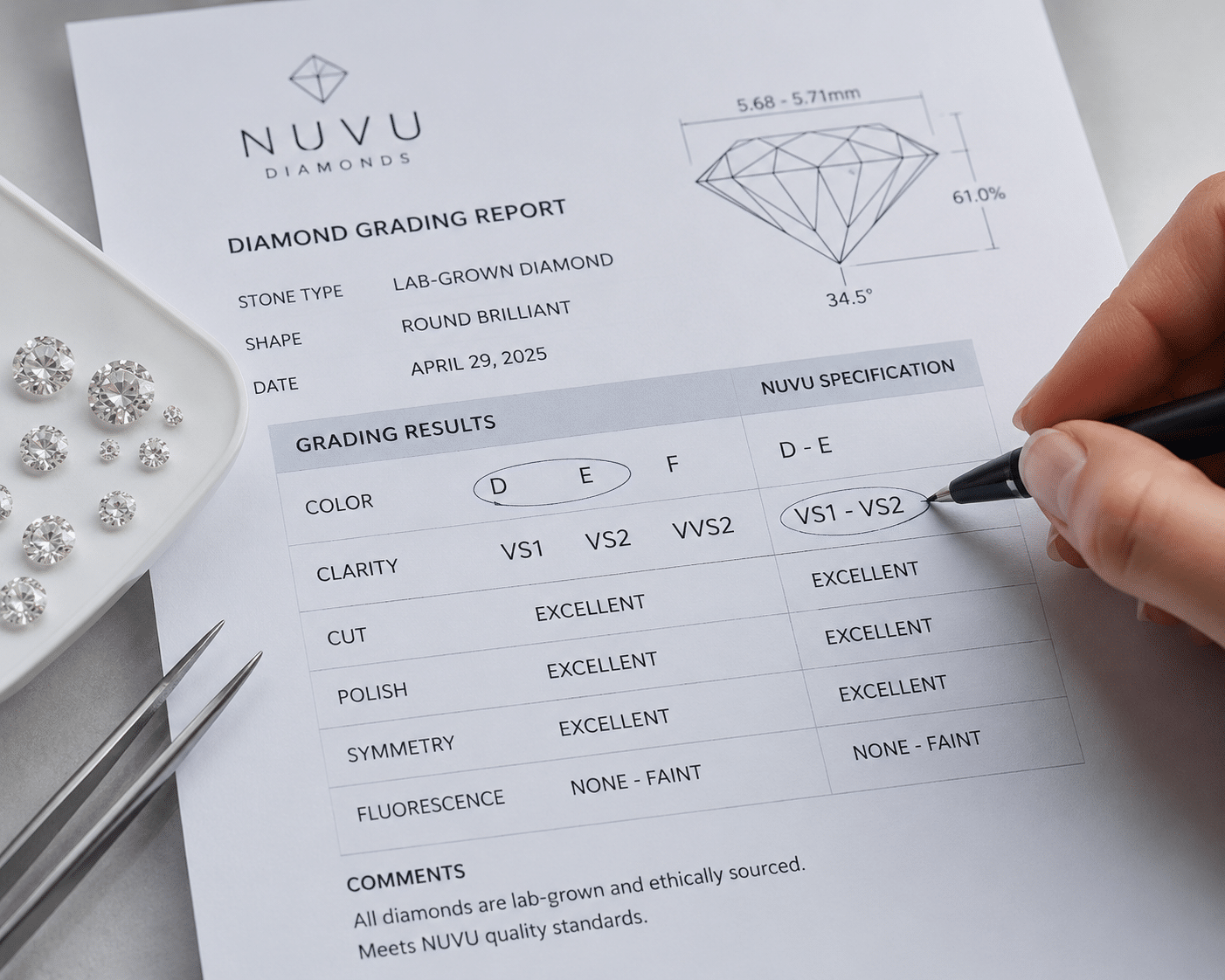
For a narrow-window order, the buyer should request a copy of the grading report or a visual certificate scan for every stone in the parcel before shipment. If the order is large, a 10 percent sample with reports is the minimum acceptable alternative. Verify that the report shows the exact color and clarity grade agreed upon. A report stating “near-colorless” or showing a single “I” grade in a parcel specified as D-E is a failure, not an acceptable variation.
A single uncertified stone in a narrow-window order introduces disproportionate risk. The rest of the parcel may be perfectly within spec, but one uncertified stone that falls outside the window can break a collection’s consistency. If the supplier cannot provide certification for every stone in a narrow-window order, the buyer should question whether the supplier controls their grading or is working with material they cannot verify.
In practice, the grading report should be treated as a documentation layer, not a substitute for visual inspection. A report confirms the grade assigned by a specific lab, but it does not show the stone’s actual appearance under different lighting conditions or its suitability for a specific setting design. For narrow-window orders, the buyer benefits from comparing the report with actual stone images or videos to confirm that what is documented matches what is visible. A mismatch between the report and the stone’s appearance — for example, a D color stone that looks slightly warm in hand — is worth investigating before the order ships.
Traceability and Documentation in Narrow-Window Sourcing
For narrow-window orders, traceability is not an abstract concept — it is a practical requirement. When a buyer specifies D-F color and VS1-VS2 clarity, the ability to trace each finished stone back to its rough source and cutting batch determines whether the order can be reproduced consistently. A supplier who cannot link finished stones to specific rough lots introduces the risk that a repeat order will yield different results, even if the written spec is identical.
Traceability in lab-grown diamond production typically starts with the rough crystal. Each rough piece can be assigned a batch identifier that follows it through cutting, polishing, grading, and final inspection. When a buyer requests a repeat order, the supplier of wholesale lab-grown diamonds for jewelers can refer to the original batch record to match rough characteristics, cutting parameters, and inspection results. Without this record, a second order is effectively a new custom request, not a repeat of the first.
Buyers should ask suppliers how they track rough batches and whether they can provide documentation linking finished stones to original rough identifiers. The answer reveals whether the supplier treats custom sourcing as a repeatable production process or a one-off arrangement. A supplier who maintains batch records can offer consistency across orders. A supplier who does not is asking the buyer to accept whatever the next batch of rough produces, regardless of whether it matches the previous spec.
In sourcing and wholesale conversations, documentation, consistency, and communication often matter as much as the headline specification. A supplier who can document the link between rough input and polished output provides a level of traceability that supports repeat orders and consistent collection quality.
Buyer Verification Checklist
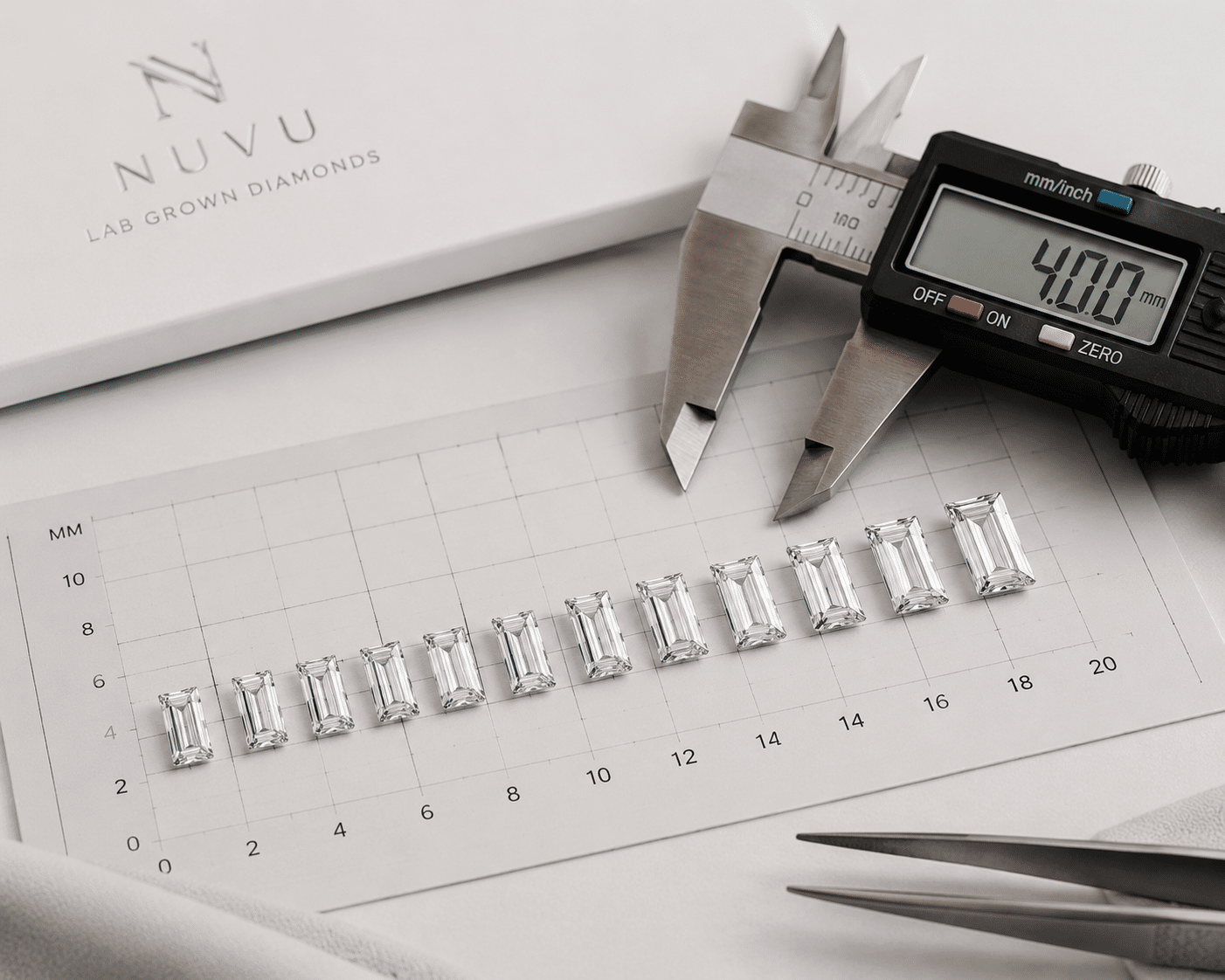
Before placing a calibrated layout order, request a measurement report showing width, length, and depth for each stone in millimeters. A simple grid format is sufficient. The supplier should be able to demonstrate that they have produced consistent dimensions before. Ask to see a sample. If they cannot provide one, or if the sample shows visible variation, the supplier is not yet suitable for that order.
Confirm the return policy for any stone that falls outside the specified width tolerance. The policy should be in writing and should cover the cost of replacement or refund. A supplier who cannot provide a measurement grid or a sample is offering a promise without evidence. In calibrated layout sourcing, evidence matters more than reassurance.
For buyers working with a setter or production team, it is also worth discussing how the stones should be measured. Different tools or measurement methods — calipers vs. optical comparators, for instance — can yield slightly different readings. Agreeing on a consistent measurement method with the supplier before the order ships can prevent disputes later. If the supplier’s measurement method differs from the setter’s, a stone that the supplier considers within tolerance may be rejected by the setter. Confirming the method in advance avoids that gap.
Custom Sourcing Negotiation: Lead Time, MOQ, and Price Commitments
Negotiating custom sourcing requires treating lead time, minimum order quantity, and price as interconnected variables. Changing one affects the others. Understanding how they relate helps the buyer structure an order that is commercially realistic and operationally achievable.
Lead Time Realities: Why Custom Sourcing Takes Longer Than Stock Picking
A custom sourcing order does not begin with a finished diamond. It begins with rough selection. The supplier must identify or acquire rough that matches the buyer’s shape, size, and quality specifications. Then the rough goes to cutting, which must be scheduled around existing production. After cutting, every stone must be inspected against the agreed parameters. Documentation must be prepared. All of this happens before shipping.
A typical custom run for 50 to 200 stones with a narrow spec takes two to four weeks. A run of 500 stones or a highly calibrated layout can take four to eight weeks. The buyer should ask for a production schedule, not a single delivery date. A schedule that includes rough selection, cutting, inspection, and shipping stages shows the supplier has a real process. A vague promise of “two weeks” without breakdown suggests the supplier is either guessing or planning to pull from existing stock rather than cutting to spec.
MOQ and Price Breakpoints: How Volume Affects Cost for Custom Specifications
Minimum order quantity depends on the supplier’s rough inventory and cutting capacity, not an arbitrary number. For unusual shapes, a realistic MOQ is typically 50 to 100 stones, or a minimum carat weight of 10 to 20 carats. A supplier willing to accept a lower MOQ for a complex specification may simply lack the experience to know what is realistic, or may plan to cut from suboptimal rough that will not meet the spec.
Price per stone drops as volume increases. A 100-stone order may cost 20 to 30 percent less per stone than a 25-stone order, because the supplier can select rough more efficiently and schedule a single production run. The buyer should ask for price breakpoints at three volume levels — for example, 50, 100, and 200 stones — to understand how cost scales. A custom spec should always be quoted per stone based on a specific volume. A flat per-carat price without volume context tells the buyer nothing about real cost.
What to Check Before You Decide
Before committing to an MOQ, ask the supplier if they can provide a sample stone at the full spec, at your cost, before the full order. One or two pieces are enough to verify. A supplier who refuses a paid sample is a significant risk. They may not be confident they can meet the spec, or they may not want the buyer to see the result before committing to volume.
If a sample is possible, pay for it and inspect it thoroughly. Compare it to your measurement grid, your color and clarity tolerances, and your setting design. Verify that a single stone can meet all the parameters before ordering fifty that may not. Verifying one stone costs much less than verifying fifty that do not match.
Verifying Pricing and Value Claims in Custom Sourcing
When comparing quotes for a custom order, it is important to treat any price, value, or savings claim with a degree of caution unless the basis for the comparison is clear. A supplier may state that a custom run offers “better value” or “cost savings” relative to stock purchases, but these claims are difficult to assess without a like-for-like comparison. Prices in the lab-grown diamond market can vary due to differences in cut precision, report type, seller channel, rough availability, and the specific details of the requested specification. A buyer’s primary reference for evaluating a price should be the yield estimate and the supplier’s documented track record for similar specs. Comparing documented characteristics — such as exact dimensions, clarity grade, and measurement tolerance — across multiple supplier quotes provides a more reliable basis for judgment than relying on broad claims of value or efficiency.
Buyers should also ask whether the quoted price includes grading reports, visual documentation, and packaging. An all-inclusive quote with full documentation may seem higher than a base quote, but the comparison becomes fair only when the full scope is factored in.
Documenting Your Custom Sourcing Agreement: Protecting Both Buyer and Supplier
Documentation is not just paperwork. It is the final verification layer. A supplier who documents well signals real process control. A supplier who avoids written specifics signals risk. For custom sourcing, the purchase order is the contract that defines whether a stone is acceptable or not.
The Six Elements Every Custom Sourcing Purchase Order Should Specify
A vague PO invites mismatched expectations. Every custom sourcing order should include six specific elements. First, the exact shape description, not just a general category like “fancy.” Second, exact dimensions: length, width, depth, and ratio range in millimeters. Third, color and clarity grade ranges with exclusion criteria. A grade range of “D-F” is not enough if you need only D and E. Fourth, cut quality parameters: table percentage, depth percentage, crown angle, and pavilion angle when relevant. Fifth, tolerance ranges for every dimension. Without tolerances, a stone that is 0.1mm wider than specified is technically not non-conforming. Sixth, documentation requirements: which lab issued the grading report, and whether photos or videos are required.
The PO should also include a return policy for non-conforming stones and a timeline for inspection after arrival. If a stone arrives and does not match the spec, the buyer needs clear recourse defined before payment.
How Documentation Separates a Transparent Supplier from a Generalist
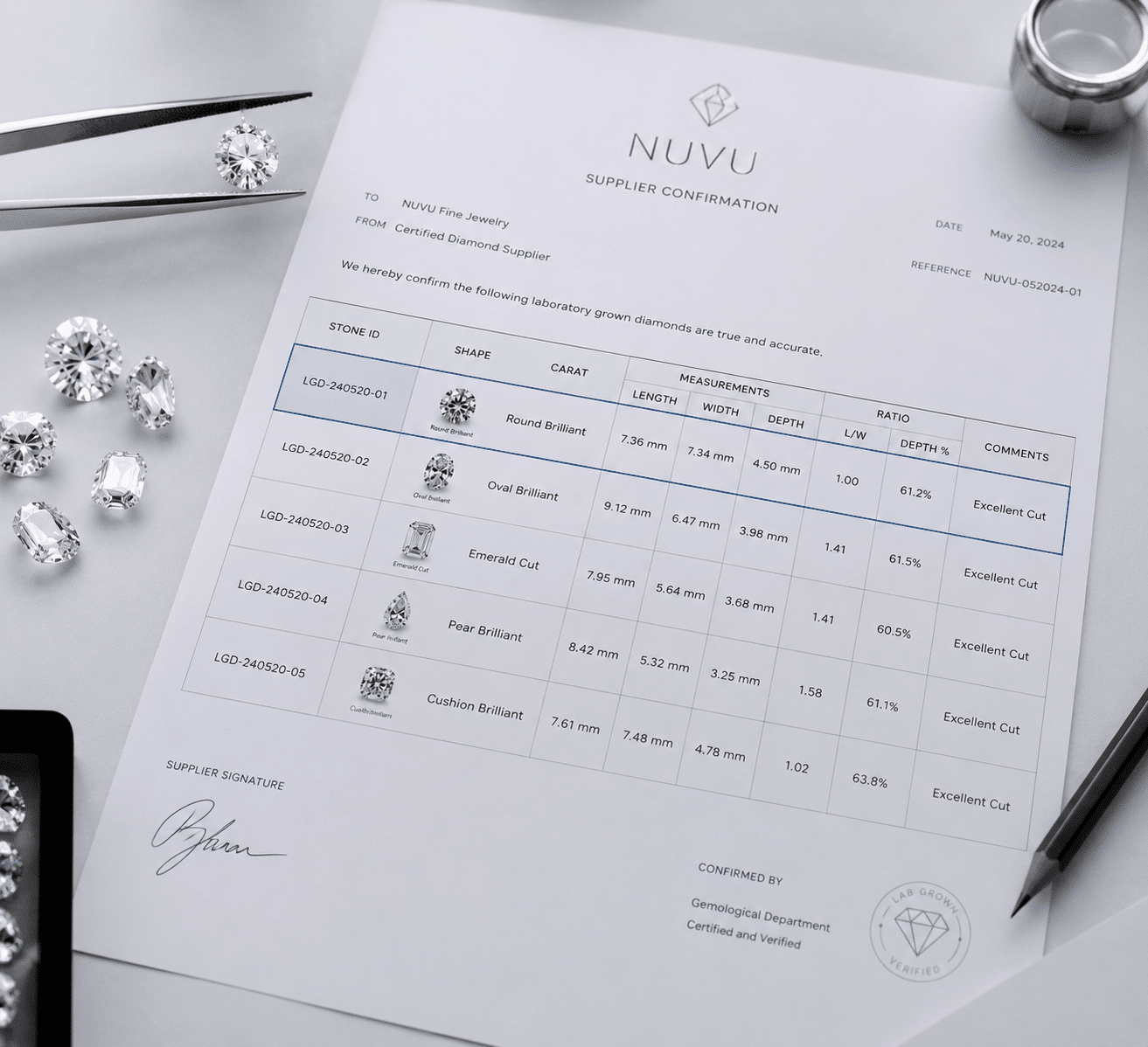
A transparent supplier responds to a detailed PO with a written confirmation for every parameter. They do not skip dimensions. They do not substitute vague terms like “good cut” for specific angles. They confirm tolerances in writing. A generalist supplier responds with a single sentence: “We can do that.” That sentence can hide a lack of direct manufacturing control, a plan to source from multiple unidentified vendors, or simply a hope that the finished stones will fall within range by chance.
The presence of a parameter-by-parameter confirmation is a strong signal of real quality control. The absence of such confirmation is a risk signal, regardless of how confident the verbal communication sounds. Writing forces clarity. If a supplier cannot write down what they will deliver, they have not fully defined what they are committing to.
The value of this detailed documentation is reinforced by the FTC’s guidance on jewelry advertising. The FTC advises that disclosures about a diamond’s origin or specific characteristics must be clear and conspicuous, especially when a non-deceptive statement about the product is material to the consumer’s purchase decision.[1] For the B2B buyer, the purchase order functions as the equivalent disclosure: it is the document that makes the agreed specifications material, and it is the only enforceable record if a discrepancy arises after delivery.
How to Verify This Before Buying
Before sending a full PO, provide the supplier with a sample specification sheet for a single type of stone. Ask them to confirm each parameter in writing. Compare their written confirmation to your spec. If any parameter is missing, or if the wording is vague, flag it. A confirmation should be specific enough that you could test a finished stone against it and see a clear pass or fail result. Terms like “good brightness” or “well-proportioned” are not measurable. A confirmation that reads “depth 62%, table 57%, crown angle 34.5°” is measurable. If the confirmation cannot protect you in a disagreement, it has not done its job.
Differentiation Note: How This Article Stays Distinct from B2B Diamond Buying Guides and Supplier Selection Resources
What This Article Is Not: Avoiding Generic Wholesale Buying Advice
This article is not a general guide to selecting a lab-grown diamond supplier. It does not cover basic supplier vetting such as how to verify business licenses, compare certificate prices, or evaluate communication speed. It does not repeat standard advice on how to buy loose diamonds in bulk. It is not a price guide, and it does not explain how diamonds are grown. It does not compare suppliers by region or manufacturing method.
What This Article Is: A Niche Operational Guide for Custom Sourcing Requests
This article covers one specific question: when a standard inventory pick is not enough, how does a buyer evaluate whether a supplier can actually deliver a custom spec? The focus is on operational feasibility, commercial negotiation, and verification. It addresses the gap between a supplier saying “yes” and actually being able to execute with precision. The content is built around scenarios where shape, size, quality, and tolerance are all constrained, and where the buyer needs to avoid a bad matching or a failed production run.
Reader Value Check
This article is written for a wholesale buyer who needs to evaluate a supplier’s custom capability for a specific collection or production run. The reader walks away with a framework for judging whether a supplier can handle non-standard requests, a set of specific questions to ask before committing, and a documented process for verifying claims with real-world tests and sample orders. The goal is to reduce the chance of a costly mismatch between expectation and delivery.
[1] Federal Trade Commission, “16 CFR Part 23: Guides for the Jewelry, Precious Metals, and Pewter Industries,” FTC, updated 2018. Available at: FTC Jewelry Guides. The FTC guides state that it is unfair or deceptive to misrepresent the nature or origin of a diamond, including misrepresenting a laboratory-created diamond as a natural diamond, and emphasize that disclosures should be clear and conspicuous.
[2] Gemological Institute of America, “Identifying Laboratory-Grown Diamonds,” GIA, accessed 2025. Available at: GIA article on identifying lab-grown diamonds. The GIA article explains that laboratory-grown diamonds share the same chemical composition and crystal structure as natural diamonds, making their identification dependent on advanced spectroscopic and microscopic analysis.
Disclosure: This article is for general educational purposes only. Diamond grading, pricing, availability, specifications, and seller policies can change, and readers should verify important details through grading reports, official laboratory tools, seller documentation, or qualified professionals before making a purchase decision. Laboratory-grown diamonds should be clearly distinguished from natural diamonds, and pricing, value, or environmental claims should be supported by specific documentation. The article does not provide investment or valuation advice, and no guarantee is made regarding the accuracy or completeness of supplier representations.
Last updated: August 2025