
Many shoppers see lab-grown diamonds, moissanite, and cubic zirconia shown side by side and assume they are different versions of the same thing. They are not. A lab-grown diamond is diamond, made of crystallized carbon, with HPHT and CVD processes explaining how that crystal growth is achieved, while moissanite and CZ are separate materials designed to create a diamond-like look. That distinction affects durability, sparkle, pricing, grading, and how suitable each stone is for daily wear.
For the full framework, read Lab-Grown vs Natural Diamonds Guide.
This guide helps you make the first and most important buying judgment: identify what the stone actually is before comparing beauty or price. Once the material is clear, it becomes easier to decide whether you need a gradeable diamond for an engagement ring, a durable alternative with a different sparkle style, or an inexpensive stone for temporary, travel, or fashion jewelry.
| Stone Type | Best Fit | What to Check Before Buying |
|---|---|---|
| Lab-grown diamond | Engagement rings and fine jewelry meant for long-term wear | Grading report, 4Cs, cut quality, photos or video |
| Moissanite | Durable alternative with strong fire and lower cost | Color tone, rainbow sparkle, millimeter size, setting style |
| Cubic zirconia | Fashion, travel, temporary, or very low-cost jewelry | Scratch risk, clouding over time, replacement expectations |
| Any “diamond alternative” listing | Needs careful verification before price comparison | Exact material name, not just appearance-based wording |
| Daily-wear ring stone | Better chosen for hardness and long-term appearance | Diamond or moissanite durability; avoid CZ for constant wear |
Quick Questions Before You Read
Q: Is a lab-grown diamond the same as a simulant?
No. A lab-grown diamond is diamond with laboratory-grown origin; simulants like moissanite and CZ are different materials that resemble diamond.
Q: Can moissanite or CZ be graded like a diamond?
Not in the same way. Diamond grading reports evaluate diamond characteristics, while simulants use different descriptions and quality checks.
Q: Which option is better for an engagement ring?
Lab-grown diamonds are the closest fit if you want a diamond. Moissanite can work if you prefer its look, durability, and price position.
Q: Why not choose CZ if it looks bright and costs less?
CZ is affordable, but it scratches and wears more easily, making it better for occasional or temporary jewelry.
Lab-Grown Diamonds and Diamond Simulants Are Not the Same Category
Lab-grown diamonds, moissanite, and cubic zirconia may all show up in the same search results, but they do not belong to the same category. A lab-grown diamond is a diamond with laboratory-grown origin. It has the same basic crystal structure and the same carbon-based identity as a natural diamond. Moissanite and cubic zirconia are diamond simulants: they are designed to look diamond-like, but they are different materials altogether.
That distinction matters because a lot of shopping confusion starts with appearance. A stone can look bright, clear, and white in a photo and still be something entirely different from a diamond. For a buyer, the first question is not “Which one looks best on a screen?” It is “What is this stone made of?”
In practical buying, the clearest comparison starts with the material name, then moves to beauty, size, and cost. If the listing, invoice, or product description does not clearly say “lab-grown diamond,” “moissanite,” or “cubic zirconia,” the buyer does not yet have enough information to make a fair comparison.
Laboratory-grown diamonds should be clearly identified as laboratory-grown, and they should not be presented as mined diamonds. Natural diamonds and laboratory-grown diamonds share diamond composition, but they have different origins, and that origin should be disclosed in product descriptions, grading reports where applicable, and purchase documents.
What Makes a Lab-Grown Diamond a Diamond
A lab-grown diamond is a diamond because it is crystallized carbon arranged in the same structure as a natural diamond. The main difference is origin. Instead of forming underground over long geological time, it is grown in a controlled environment. That is why the term “lab-grown” describes how it was made, not what it is made of.
This is the key point many new buyers miss. “Lab-grown” does not mean imitation. In the diamond world, it means the stone is still a diamond, just produced by a different process. If you want a diamond with diamond material and diamond behavior, lab-grown diamonds belong in that category.
A grading report can support that identity when one is provided, but it should not be treated as the only decision tool. Buyers should compare the report details with the stone’s measurements, photos, video, and intended jewelry use. A report can narrow the comparison; it does not replace checking whether the stone looks right and fits the setting properly.
What Makes Moissanite and CZ Diamond Simulants
Moissanite and cubic zirconia are called simulants because they are intended to resemble diamonds visually. They are not diamonds by composition. Moissanite is a different gemstone with its own properties, and cubic zirconia is a separate man-made material that has long been used as a diamond lookalike.
That does not make them inferior by default. It simply means the buyer should not treat them as the same thing under a different label. A simulant can be a smart choice for a certain budget or use case, but it should be chosen as a simulant, not mistaken for a diamond.
Why These Stones Are Often Confused in Jewelry Shopping
The confusion usually comes from presentation. In many settings, all three stones can look clear and bright from a distance. Retail photos often flatten the differences, and casual shoppers may only see “sparkly white stone” rather than the material behind it. On top of that, some product listings use broad language like “diamond alternative,” which can blur the line between diamond and imitation.
The clearest way to think about it is simple: lab-grown diamond means diamond with laboratory-grown origin; moissanite and cubic zirconia mean diamond-lookalike materials. Once you keep that category line clear, the rest of the comparison becomes much easier to understand.
The Simple Buyer Test
Read the stone description first. If it says lab-grown diamond or natural diamond, you are looking at a diamond. If it says moissanite or cubic zirconia, you are looking at a simulant. If the wording is vague, that is a sign to slow down and check the material name before comparing anything else.
A More Evidence-Minded Way to Read a Listing
When a product page uses several attractive terms at once, separate the claims into three groups: material identity, appearance description, and selling language. “Lab-grown diamond,” “natural diamond,” “moissanite,” and “cubic zirconia” are identity terms. “Brilliant,” “white,” “sparkling,” and “diamond-like” are appearance terms. “Luxury,” “responsible,” “premium,” and “value” are selling terms that need more context before they should influence a purchase.
This distinction keeps the comparison grounded. A buyer can appreciate that a moissanite ring looks bright without treating it as a diamond. A buyer can also recognize that a lab-grown diamond is a diamond without assuming every lab-grown diamond is equally well cut, equally well documented, or equally suited to a specific setting. The proof should match the claim being made.
Material Differences: Carbon, Silicon Carbide, and Cubic Zirconia
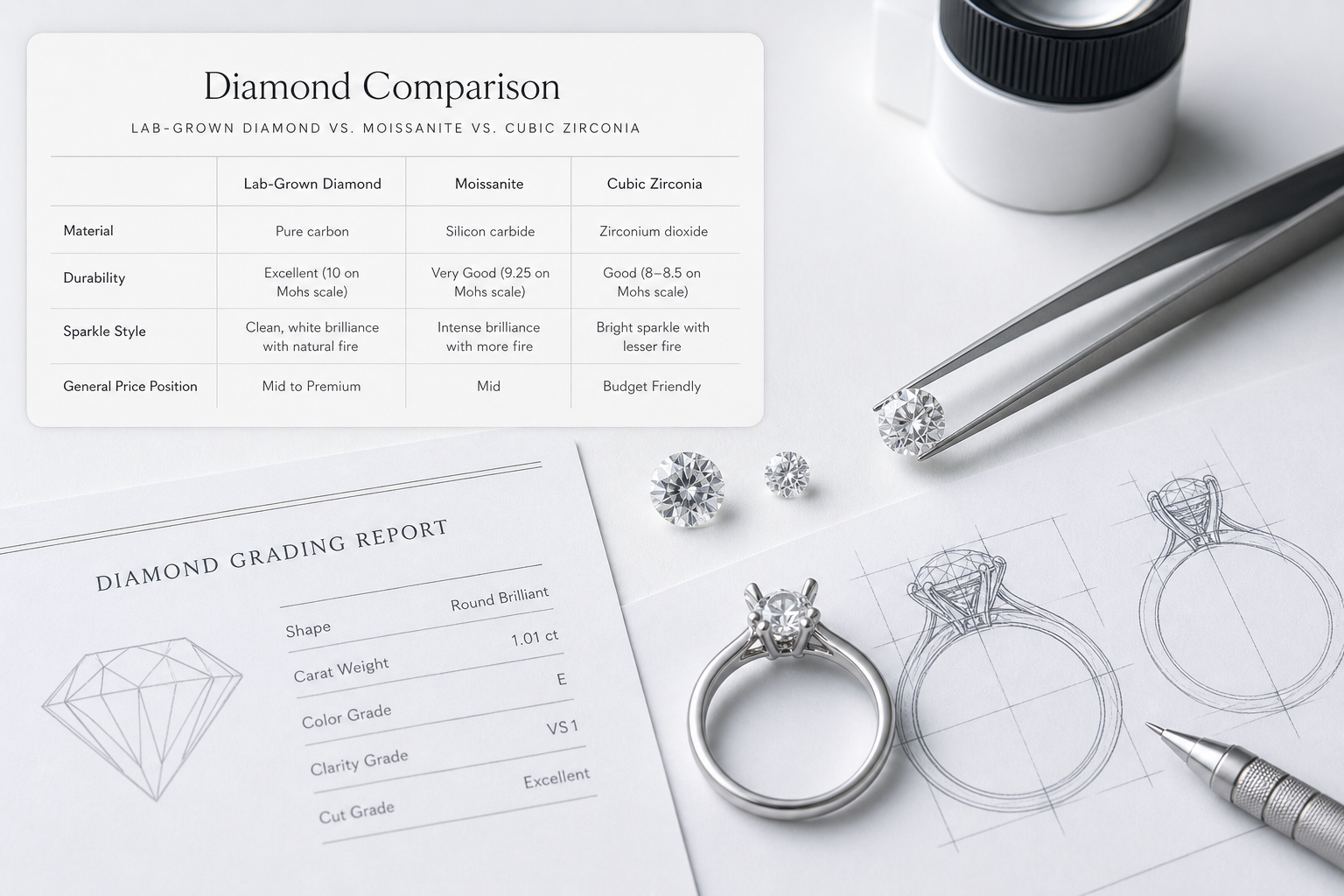
The fastest way to separate these stones is by composition. Lab-grown diamonds and natural diamonds are both crystallized carbon. Moissanite is silicon carbide. Cubic zirconia is zirconium dioxide. Those differences are not just technical labels; they shape how each stone behaves in everyday jewelry.
Different material means different expectations. It affects hardness, how the stone interacts with light, how it feels in hand, and what kind of long-term wear a buyer should expect. That is why two stones can look similar at first glance but still perform differently once they are worn regularly.
Lab-Grown Diamonds: Crystallized Carbon
Lab-grown diamonds are made of carbon arranged in the diamond crystal structure. That is the same basic material identity as a natural diamond. In practice, that means they belong in the diamond category for chemistry, structure, and the way gemologists describe them.
For a buyer, the important point is not how long the stone took to form. It is that the finished gem is still a diamond. That is why lab-grown diamonds are compared with natural diamonds, while moissanite and CZ are compared as alternatives to diamond.
Moissanite: Silicon Carbide With a Diamond-Like Look
Moissanite is silicon carbide, a material that is distinct from diamond but still well suited to jewelry. It has enough hardness and brilliance to make it a strong visual alternative, which is why it is often mistaken for diamond at a glance. The resemblance is real, but the material is not.
That difference matters because moissanite does not behave exactly like a diamond even when it looks close. Its composition gives it a different optical character and a different feel in the market. If a buyer wants a diamond substitute rather than a diamond itself, moissanite is one of the established options.
Cubic Zirconia: A Man-Made Lookalike Material
Cubic zirconia is zirconium dioxide, a synthetic material created to imitate the look of a diamond at a much lower cost. It can be very attractive, especially when new, and it has become one of the most familiar diamond simulants in jewelry. But it is still a separate material with separate performance expectations.
CZ is best understood as a visual stand-in, not a diamond equivalent. That is why it is often used in fashion jewelry, temporary pieces, and low-commitment settings where the goal is appearance first and longevity is less important.
Useful Numbers to Remember
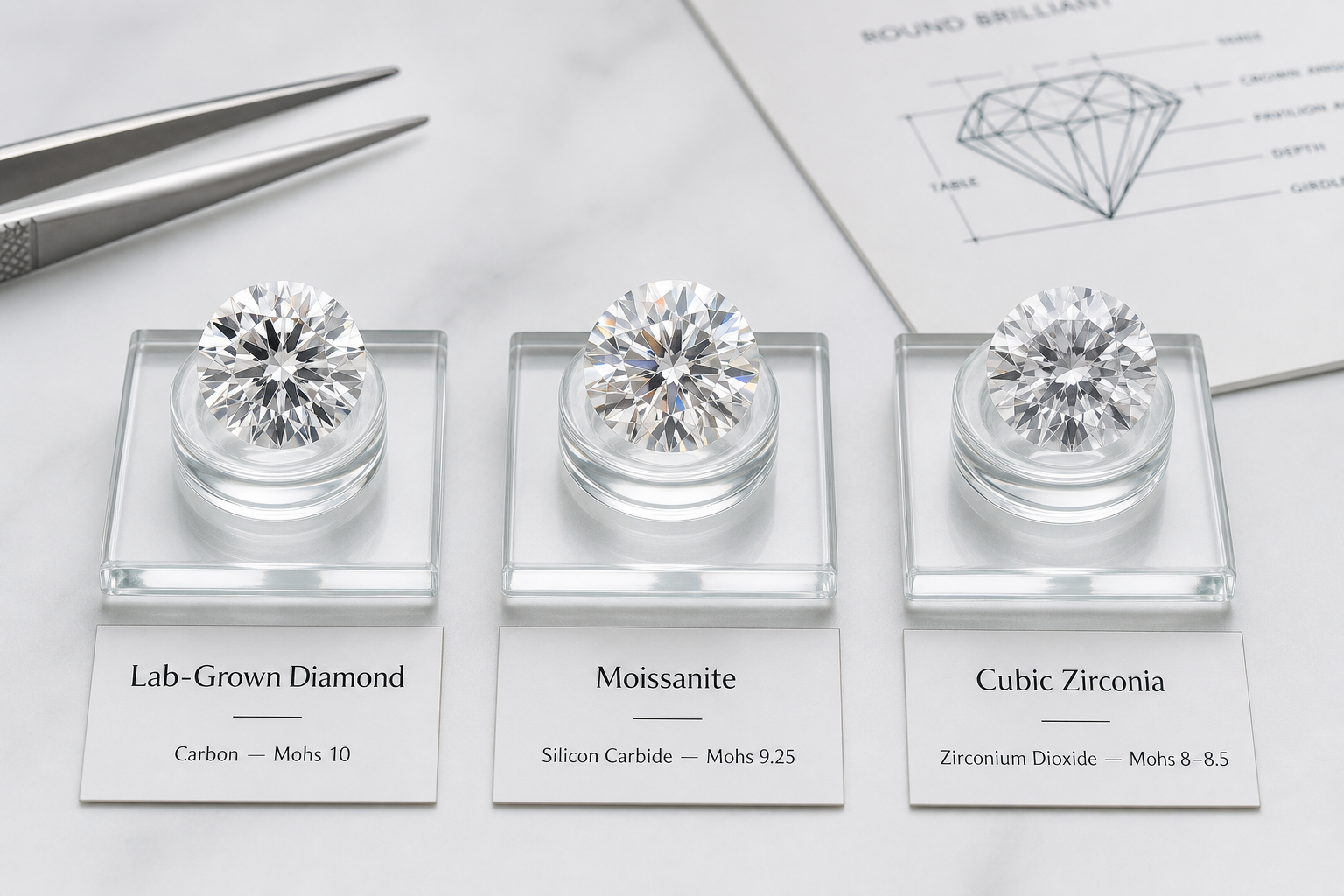
Diamond is commonly described as the hardest jewelry stone on the Mohs scale, with moissanite close behind and cubic zirconia lower than both. Mohs hardness measures scratch resistance, not whether a stone can ever chip or break. It is helpful, but it does not tell the whole wear story.
When growth method or post-growth treatment is relevant for a lab-grown diamond, buyers should look for clear disclosure in the grading report or seller documentation. HPHT and CVD are commonly discussed as diamond growth methods; treatment status should not be assumed unless it is specifically documented for the stone being considered.
Appearance: Why Simulants Can Look Similar but Perform Differently
All three stones can look bright, clean, and attractive in the right light. The reason they still feel different to buyers is that brightness is not the same as visual behavior. Diamond sparkle, moissanite fire, and CZ brilliance are related, but they are not identical.
Most people notice the difference most clearly under direct lighting, in larger stones, or when two stones are seen side by side. That is where the eye starts to pick up on how each material handles light instead of just noticing that it shines.
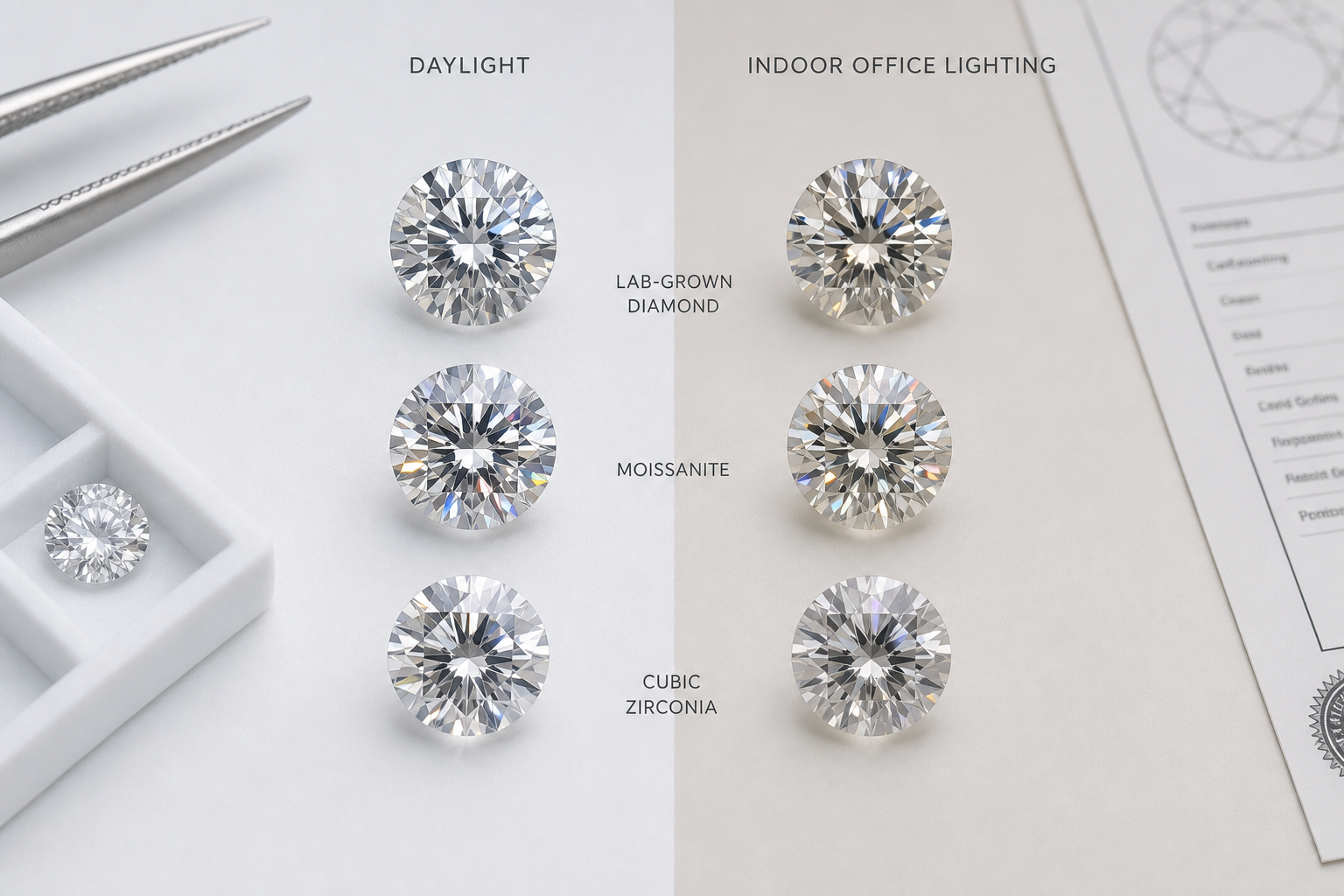
For buyers, this is where still photos can be misleading. A white background, strong studio light, or heavy contrast can make very different stones look equally sharp. Movement matters because it shows whether the flashes are crisp, rainbow-heavy, glassy, or uneven across the stone.
How Lab-Grown Diamonds Reflect Light
Lab-grown diamonds tend to show the balanced light return people expect from a diamond: white sparkle, sharp flashes, and a crisp appearance when the cut is well made. Their appeal is not just that they shine, but that they tend to look diamond-like in a familiar way.
That is one reason lab-grown diamonds often satisfy buyers who want the classic diamond look without moving into a simulant category. The visual goal is still diamond performance, not just general brightness.
Why Moissanite Often Shows More Rainbow Fire
Moissanite often produces more rainbow-colored flashes than a diamond. Some buyers love that effect because it makes the stone look lively and very bright. Others notice that it reads as different from a diamond, especially in sunlight or other strong lighting.
That difference is not a flaw. It is a visual signature, especially in discussions of real diamond differences where optical behavior helps separate diamond, moissanite, and imitation stones. If a buyer wants a stone that closely matches the classic diamond look, moissanite may feel more distinctive than expected. If they enjoy extra fire, that same trait can be a selling point.
Why CZ Can Look Bright but Less Diamond-Like Over Time
Cubic zirconia can look impressively bright when new, which is one reason it remains popular for affordable jewelry. The tradeoff is that its appearance is more sensitive to wear. As the surface scratches, the stone can lose some of the crispness that makes it look diamond-like at first.
That is why CZ is often a better fit for occasional wear than for a center stone meant to be worn every day. It may look good right away, but it does not usually hold that look as well as harder materials over time.
What to Look For in Photos and Video
Look at the stone in more than one kind of light, and pay attention to how it moves rather than only how it looks in a still image. A good video will show whether the stone gives off clean white sparkle, stronger rainbow flashes, or a flatter glassy look. Compare the same angle whenever possible, because different camera settings can flatter all three materials.
If the stone is larger, the visual differences are easier to spot. That is where side-by-side comparison becomes especially useful, because small differences in light performance are easier to miss when a stone is tiny or heavily filtered.
Durability and Daily Wear: Which Stones Hold Up Best
Durability matters most when a stone is going to live on the hand every day. For that use case, lab-grown diamonds have a strong edge for scratch resistance because diamond is harder than the alternatives. Moissanite is also a durable choice and performs well in rings, but cubic zirconia is less suitable for long-term daily wear because it scratches more easily and can lose its clean, crisp look faster. The practical question is not just which stone looks good on day one, but which one still looks good after months and years of actual use.
Durability also depends on the jewelry design. A high-set ring, exposed corners on fancy shapes, thin prongs, or a setting worn during hands-on work can increase the chance of damage regardless of the stone type. Hardness helps with scratch resistance, but it should be considered alongside setting protection and the wearer’s habits.
Scratch Resistance in Everyday Jewelry
Scratch resistance is one reason diamond remains common for high-wear jewelry. A stone can look bright in a showroom and still soften quickly if it marks easily against keys, countertops, or other jewelry. Lab-grown diamonds handle that pressure well. Moissanite is strong enough for regular wear in most settings, which is why it is common in rings. CZ can work well in jewelry that is worn lightly, but it is easier to nick or abrade, especially if the piece is handled often.
Why Engagement Rings Put More Pressure on Stone Choice
An engagement ring is usually one of the hardest-working pieces in a jewelry collection. It gets bumped, washed, cleaned, and worn in situations where the wearer is not thinking about the stone at all. That is why the choice shifts from simple appearance to long-term wear. If the ring is meant to be worn every day, lab-grown diamond is often preferred for scratch resistance, while moissanite can be a practical alternative. CZ can still make sense for a ring that is not meant for constant wear, but it is a weaker choice when the goal is to keep the center stone looking sharp over time.
When Occasional-Wear Jewelry Changes the Decision
Once a piece is intended for travel, events, or occasional use, the decision becomes less strict. A buyer may care more about cost, size, or style than about how the stone will hold up through years of constant contact. In that situation, moissanite often becomes more attractive because it balances durability and price position. CZ can also make sense for fashion jewelry or a temporary piece, where the lower cost is part of the point rather than a compromise.
What This Means in a Real Purchase
If someone is choosing a center stone for a ring they will wear every day, a practical judgment is to prioritize lab-grown diamond or moissanite over CZ. If the piece is a travel ring, a seasonal accessory, or something worn only occasionally, CZ becomes more reasonable because the wear risk is lower. The key tradeoff is simple: the less often the stone is worn, the more acceptable lower durability becomes. If the jewelry is expected to stay on the hand through daily life, durability should carry more weight than short-term savings.
Price Differences: Why Lab Diamonds, Moissanite, and CZ Cost Differently
Price differences between these stones come down to material, production, documentation, cut quality, size, and market expectations. A lab-grown diamond usually costs more than a simulant because it is still a diamond, grown, cut, and often documented in ways buyers expect from a diamond purchase. Moissanite sits in its own middle category because it is a separate lab-created gemstone with its own supply and demand profile. Cubic zirconia is usually the lowest-cost option because it is inexpensive to produce and widely available.
The mistake many buyers make is assuming price alone tells the whole story. It does not. A lower-cost stone may be the better choice for a fashion ring, while a higher-cost stone may be the better choice for a daily-wear center stone. The right comparison is not only what you pay, but what kind of use the stone is expected to handle.
Price can also reflect factors that are not obvious from the headline material name, including cut quality, stone size, color appearance, brand positioning, documentation, and the complexity of the setting. A lower-priced lab-grown diamond is not automatically a better buy than a well-cut moissanite, and an inexpensive CZ is not automatically a poor choice if the jewelry is temporary. The more useful question is whether the price matches the material, the documentation, and the intended wear.
Prices can change with market conditions, report type, seller channel, and stone-specific details, so exact comparisons should be verified at the time of purchase. Buyers should compare like-for-like specifications before treating one stone as a better value.
Why Lab-Grown Diamonds Usually Cost More Than Simulants
Lab-grown diamond pricing reflects the fact that you are buying a diamond, not just a diamond-like look. The stone has to be grown, cut, and often evaluated with the kind of documentation buyers expect in the diamond market. That process creates a different pricing structure from simulants, which are made to imitate appearance rather than match diamond identity. A lab-grown diamond may be more affordable than many comparable natural diamonds in some market conditions, but exact differences vary by seller, report type, size, cut, and availability.
Why Moissanite Sits in a Different Value Category
Moissanite often gives buyers a strong balance of durability, size, and cost, which is why it occupies a category of its own. It is not priced like a diamond because it is not a diamond, but it is also not a throwaway material. For buyers who want a bright, durable stone without diamond-level pricing, moissanite often lands in a practical middle ground. That middle position is part of its appeal, but it is also why buyers should compare it on its own terms instead of treating it as a discounted diamond.
Why CZ Is Usually the Lowest-Cost Option
Cubic zirconia is usually the least expensive because it is easy to produce and broadly used in fashion jewelry. That low cost makes it attractive for pieces where the stone is meant to add style without a major investment. It is not a problem that CZ is inexpensive; the problem is expecting it to behave like a long-term center stone in a ring that will be worn hard. Its price reflects its role, and in the right setting that can be appropriate.
Price Is Not the Same as Long-Term Value
The cheapest stone is not always the strongest value, especially if it has to be replaced sooner or if its appearance changes with wear. Lab-grown diamonds often make sense for buyers who want a diamond and expect regular use. Moissanite can be a practical value when the goal is strong performance at a lower price point. CZ is best understood as a budget-first material for occasional wear, not as a low-cost substitute that should be judged by diamond standards.
Certification and Disclosure: How to Know What You Are Actually Buying
Clear labeling matters because these stones can look similar at a glance while being completely different materials. A lab-grown diamond may come with a grading report from a gemological laboratory, especially when it is a center stone, and that report helps document what the stone is and how it was evaluated. Moissanite and cubic zirconia may come with product information or brand documentation, but they are not graded as diamonds because they are not diamonds. The buyer should not rely on appearance alone when the material name is what really determines the category.
Good disclosure is not just a formality. It is the difference between understanding the purchase and making a wrong comparison. If a listing uses vague language or avoids naming the material directly, that is a warning sign. A transparent seller should say exactly whether the stone is a lab-grown diamond, moissanite, or cubic zirconia.
At NUVU, this kind of comparison is treated as a practical selection question rather than a single-label decision. The report or product document helps narrow the field, but the buyer still needs a clear material name, matching stone details, and visual evidence that the stone suits the intended design.
What a Lab-Grown Diamond Report Can Confirm
A grading report can document that the stone is a diamond and can list details such as measurements, carat weight, color, clarity, cut information, and sometimes the growth method or inscription number. That makes it useful for verification and comparison. It does not, however, tell the full story of how the stone will look in every lighting condition or in every setting. A report is a useful reference point, not a complete substitute for seeing the stone.
A grading report helps document key characteristics, but it should not be treated as a guarantee of beauty, value, or sourcing ethics. Environmental and sourcing claims, if made, should be specific, documented, and limited to what can be substantiated.
When a grading report is available, buyers should verify the report details through the issuing laboratory’s official report-check tool where available, then compare those details with the stone’s photos, video, measurements, and final jewelry description.
Why Simulants Should Be Clearly Labeled
Moissanite and CZ should be identified by name, not hidden behind broad terms like “diamond alternative” without explanation. Those terms can be useful in a general sense, but they should not blur the actual material. Buyers need to know whether they are looking at a diamond, a diamond simulant, or a specific gemstone with its own properties. Clear labeling protects the buyer from paying diamond expectations for a non-diamond stone.
Why Documentation Does Not Replace Visual Review
Even with a report or product document in hand, the stone still needs to be judged visually. Two stones with similar paperwork can perform differently once they are set, photographed, or worn in daylight. That matters especially when comparing sparkle, size appearance, and setting fit. For a buyer making a real purchase, documentation should confirm identity while photos and video help confirm whether the stone actually suits the job.
What Counts as Useful Purchase Evidence
Useful purchase evidence should connect the stone, the product page, and the final receipt. For a lab-grown diamond, that may mean a grading report, matching measurements, a matching inscription if one is provided, and written identification that the stone is laboratory-grown. For moissanite or CZ, it may mean a product description that clearly names the material and does not rely only on “diamond look” language.
The important point is consistency. If the product title says one thing, the specifications say another, and the invoice uses a vague phrase, the buyer should ask for clarification before paying. Clear documentation does not need to be complicated, but it should answer the basic question without interpretation: what material is the center stone?
Questions to Ask Before Relying on a Report or Product Document
- Does the document identify the stone as a lab-grown diamond, natural diamond, moissanite, or cubic zirconia?
- Do the measurements on the document match the measurements shown on the product page?
- If there is an inscription or report number, does it correspond to the stone being sold?
- Does the invoice or order summary use the same material name as the listing?
- Are the photos or videos showing the actual stone or only a representative sample?
These questions are useful because documentation can vary by stone type and seller. A lab-grown diamond report is not the same thing as a general product card for moissanite or CZ, and a generic “certificate” is only helpful if it clearly states what was examined. The buyer should be able to trace the claim from listing to document to final purchase record without guessing.
Certificate and Visual Review Check
Before buying, confirm three things in writing: what the stone is, whether it comes with a report or product document, and whether the material name matches the listing throughout the product page. Then review images or video closely enough to see how the stone behaves, not just how it is described. If the purchase is a lab-grown diamond, the report should support that claim. If it is moissanite or CZ, the listing should say so plainly without forcing the buyer to guess.
Common Misconceptions That Lead to Bad Comparisons
The biggest mistake buyers make is treating every diamond-looking stone as if it belongs in the same category. It does not. A lab-grown diamond is still a diamond. Moissanite and cubic zirconia are diamond simulants, which means they can resemble a diamond without actually being one.
That distinction matters because the wrong language leads to the wrong expectations. If you compare a lab-grown diamond to a simulant as if they are the same product, you can end up judging price, durability, and value on the wrong terms.
“Lab-Grown” Does Not Mean “Fake”
“Lab-grown” describes how the stone was made, not whether it counts as a diamond. In plain terms, a lab-grown diamond has the same basic material identity as a natural diamond. The difference is origin, not category.
Calling it fake usually confuses appearance with composition. That may sound minor, but it changes the entire comparison. If someone wants a diamond with a different origin from mined diamond, lab-grown belongs in that discussion. If someone wants a diamond lookalike, they are talking about a different product entirely.
“Synthetic Diamond” Is Not the Same as “Simulant”
This is another term that creates unnecessary confusion. In gemology, “synthetic diamond” can still mean a diamond that was grown in a laboratory. It is synthetic because it is man-made, not because it is an imitation.
A simulant is different. It is a material made to look like a diamond, but it is not diamond. That is why moissanite and CZ are discussed separately from lab-grown diamonds. They are similar in visual effect, not in identity.
“Diamond Alternative” Can Mean Several Different Things
The phrase “diamond alternative” is broad enough to be useful and broad enough to mislead, which is why a lab-grown diamond guide can help clarify whether the term refers to a lab-grown diamond, which is a diamond, or to a simulant like moissanite or cubic zirconia, which are not diamonds at all.
That is why the label alone is not enough. A product can look like a diamond, be marketed like a diamond, and still belong to a completely different material category. Buyers who miss that difference usually compare the wrong features first.
Responsible wording matters here. Terms such as “responsible,” “conscious,” or “sustainable” should not replace material disclosure or documentation. If a seller uses broad value-based language, buyers should still look for specific information about what the stone is, how it is described, and what evidence supports the claim being made.
Terms That Should Trigger a Closer Look
Some phrases are not automatically wrong, but they should make a buyer pause and read the details. “Diamond-like,” “diamond inspired,” “created stone,” “crystal,” “simulated diamond,” and “alternative center stone” can mean different things depending on the seller. None of those phrases should replace a direct material name.
A careful buyer does not need to reject every listing that uses broad language. The better response is to ask for the exact material and make sure the answer appears in writing. If the seller cannot clearly state whether the stone is lab-grown diamond, moissanite, or cubic zirconia, the comparison is not ready yet.
When Each Option Makes Sense
The right choice depends less on the idea of “best” and more on what the jewelry needs to do. For an engagement ring search, that usually means thinking about daily wear, appearance, budget, and whether the buyer wants a diamond or a diamond alternative for jewelry.
There is no single winner across every use case. Lab-grown diamond vs moissanite is not a simple quality contest. Moissanite vs CZ is not just a price comparison. Each stone makes sense in a different buying situation, and the practical context matters more than the label on its own.
For custom design, the center stone should not be chosen separately from the setting. Shape, measurements, depth, prong layout, and the wearer’s lifestyle can all change which option makes sense. A stone that looks attractive loose may need a different setting style, or a different material choice, to perform well as finished jewelry.
For custom jewelry, stone measurements and setting compatibility should be confirmed before finalizing a purchase. This is especially important when comparing diamond, moissanite, and CZ, because stones with similar face-up sizes can have different depths, weights, and setting requirements.
Choose Lab-Grown Diamond When You Want a Diamond
Choose a lab-grown diamond when the goal is diamond identity, not just diamond appearance. This is usually the better fit for buyers who want a stone that can be graded as a diamond, worn long term, and treated the same way a diamond would be treated in a fine-jewelry setting.
This option makes sense for engagement rings and other pieces where the buyer expects durability, documentation, and a conventional diamond experience. If the goal is to own a diamond without choosing mined origin, lab-grown is the clearer comparison.
Choose Moissanite When You Want a Durable Diamond Alternative
Moissanite is often a strong choice when the buyer wants a diamond-like look with a different visual character and a lower cost than a lab-grown diamond. It is durable enough for daily wear in many settings, which is why it works well in rings that will be worn often.
The tradeoff is mostly about appearance and expectation. Moissanite tends to show more fire than diamond, so it can look noticeably different in certain lighting. For buyers who like that brightness, the difference is a feature. For buyers who want a stone that reads as a diamond first and foremost, it may be the wrong fit.
Choose CZ When Low Cost or Temporary Use Matters Most
Cubic zirconia is the better choice when the main goal is short-term use, very low cost, or a piece that does not need to stand up to constant wear. It can look impressive at first glance, which is why it is popular for travel jewelry, fashion pieces, and temporary styling.
The limitation is durability. CZ is not the stone most buyers should choose for an engagement ring or a piece meant for everyday wear over many years. If the setting is only for occasional use, that is a different decision. If the piece needs to hold up under constant wear, CZ becomes the weakest option of the three.
Buyer Verification Checklist
- Ask what the stone is called in the product listing, not just how it looks.
- Check whether the center stone is identified as lab-grown diamond, natural diamond, moissanite, or cubic zirconia.
- For a lab-grown diamond, look for a grading report number or report details that match the stone when a report is provided.
- Think about where the jewelry will actually be worn most often.
- Be cautious if the listing uses vague language like “diamond alternative” without naming the material.
For lab-grown diamonds, buyers should compare any report information with the issuing laboratory’s available verification tools where possible. For moissanite or CZ, the most important confirmation is clear written material disclosure, because these stones are not graded as diamonds.
How a Careful Seller Should Support the Decision
A reliable buying process should make it easy to connect the recommendation to evidence. If the suggested stone is a lab-grown diamond, the buyer should be able to review the report information, measurements, and visual media before committing. If the suggested stone is moissanite or CZ, the material should be named plainly so the buyer understands that the value comes from appearance, durability level, or budget fit rather than diamond identity.
This is especially important when comparing stones for custom rings or wholesale jewelry programs, where small differences in size, cut, and setting fit can affect the final result. Clear communication about material, measurements, setting structure, and expected wear helps prevent a beautiful-looking stone from being chosen for the wrong job. The goal is not to push every buyer toward the same material, but to make sure the chosen material matches the intended use.
For first-time buyers, the most reassuring sign is consistency across every touchpoint: the product page, consultation notes, grading report or product document, invoice, and finished jewelry description should all use the same material name. When those details match, the buyer can compare options with more confidence and fewer assumptions.
How to Compare Stones Before You Decide
Once the material is clear, the comparison becomes more useful. A strong stone comparison starts with identity, then moves to measurements, light performance, and setting fit. If you skip the first step, you can easily compare a lab-grown diamond and moissanite as if they were the same product, which leads to a misleading price comparison.
The practical rule is simple: confirm what the stone is before you compare what it costs. That is especially important when the listing uses broad terms like diamond simulant or diamond alternative, because those phrases can hide very different expectations.
Confirm the Material Before Comparing Price
A price comparison only makes sense after the material is known. A lab-grown diamond, moissanite, and CZ may all appear similar in a product photo, but they do not belong in the same pricing category. The better deal is not always the cheaper stone; it is the stone that matches the use case without creating a hidden compromise.
If a listing is vague, treat that as a warning sign. A clear seller should name the stone directly, not leave the buyer to guess from marketing language.
Compare Size by Measurements, Not Just Carat
Carat is useful, but it does not tell the whole story for non-diamond comparisons. Two stones with the same carat weight can face up differently because their densities are not the same. That is one reason measurement details matter more than many first-time buyers realize.
For visual comparison, the actual millimeter measurements often tell you more than the carat number alone. This becomes even more important when the stone is being viewed for a ring setting, because the ring needs to balance presence, proportions, and comfort, not just weight on paper.
Review Photos, Video, and Setting Fit
Static product photos can hide important differences. A 360 video, side-angle image, or live-looking product clip gives a better sense of sparkle style, stone shape, and how the piece behaves in different light. That matters most when the stones are large enough for the visual differences to stand out more clearly.
Setting compatibility is just as important. A stone can look good loose and still be the wrong choice for the ring style, head size, or prong layout. The smarter decision is the one that works both visually and structurally once it is mounted.
For custom design, trust comes from matching the stone to the setting, budget, and wearer’s daily use, not from choosing grades or size in isolation. A well-documented lab-grown diamond still needs the right head, prong style, and proportions. A moissanite or CZ still needs clear material disclosure and realistic wear expectations before it is placed into a design.
How to Verify This Before Buying
- Read the listing for the exact material name.
- Match any grading report number to the center stone if it is a lab-grown diamond and a report is provided.
- Check measurements in millimeters, not just carat weight.
- Review photos or video from more than one angle.
- Make sure the setting is designed for the stone type and size.
- Look for written confirmation on the receipt or product page so the stone type is not left ambiguous.
Final Red Flags Before Checkout
Pause before purchase if the seller compares a simulant to a diamond mainly by carat size, avoids naming the material, or presents a “certificate” that does not clearly identify what was evaluated. Also be careful when a listing uses diamond grading language for a non-diamond stone in a way that makes the product sound equivalent to a graded diamond.
A trustworthy comparison should be easy to follow. The stone name, measurements, images, report details if applicable, and final receipt should all point to the same identity. If those pieces do not line up, the buyer should ask questions before treating the listing as a fair comparison.
The Bottom Line: Similar Look, Different Identity
At a glance, lab-grown diamonds, moissanite, and cubic zirconia can all fill the same visual role in jewelry. The important difference is not just how they look, but what they are. Lab-grown diamonds are diamonds with laboratory-grown origin. Moissanite and CZ are diamond simulants: they can create a similar appearance, but they are different materials with different expectations for wear, sparkle, and long-term use.
Lab-Grown Diamonds Are Diamonds
A lab-grown diamond belongs in the diamond category because it has the same basic material and crystal structure as diamond. That matters more than many first-time buyers realize. If you want a stone that should be judged as a diamond, set as a diamond, and understood as a diamond, lab-grown is the right category. It is not a substitute for diamond in the technical sense; it is a diamond grown in a controlled environment.
Moissanite and CZ Are Diamond-Looking Alternatives
Moissanite and cubic zirconia can be attractive for very different reasons, but neither one is a diamond. They are better understood as alternatives that borrow the look of a diamond rather than the identity of one. That distinction is easy to miss when shopping online, especially when photos are polished and the stones are shown in flattering lighting. The clearer way to think about them is simple: they may suit a jewelry goal, but they are not the same product class as a lab-grown diamond.
The Right Choice Depends on Use, Budget, and Expectations
The better choice is the one that fits the job. If you want a diamond for an engagement ring or a piece meant for long-term wear, a lab-grown diamond often makes the most direct sense. If you want a durable diamond alternative with a different visual character, moissanite can be a smart fit. If the goal is low-cost, temporary, or occasional jewelry, CZ can do the job without pretending to be something it is not. The mistake is not choosing the “wrong” stone; it is expecting one material to perform like another.
Before deciding, put the stone into a real-world context: who will wear it, how often it will be worn, what documentation is available, and whether the setting supports the stone properly. That approach gives buyers a clearer decision than relying on appearance, slogans, or price alone.
For NUVU, the practical aim is to make this comparison easier to understand: what the stone is, what the report or product document actually says, what the visuals reveal, and whether the material fits the intended jewelry. That buyer-first sequence is more useful than treating every bright white stone as if it belongs in the same category.
Disclosure: This article is for general educational purposes only. Diamond grading, pricing, availability, specifications, and seller policies can change, and readers should verify important details through grading reports, official laboratory tools, seller documentation, or qualified professionals before making a purchase decision. Laboratory-grown diamonds should be clearly distinguished from natural diamonds, and environmental or sourcing claims should be supported by specific documentation.